


 Скачать презентацию Introduction to Speech Synthesis Simon King Simon King ed
75dbbb3c7b8915519cf1f6a80830121d.ppt
- Количество слайдов: 55
 Introduction to Speech Synthesis Simon King Simon. King@ed. ac. uk Centre for Speech Technology Research, Informatics Forum
 Contents Introduction Unit Selection: text selection, recording data, search techniques, system architecture From speech coding to statistical parametric synthesis (using HMMs) 2
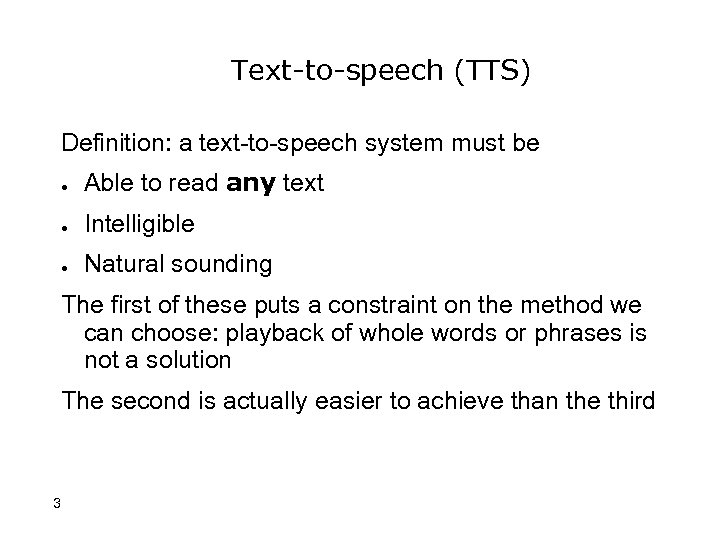 Text-to-speech (TTS) Definition: a text-to-speech system must be ● Able to read any text ● Intelligible ● Natural sounding The first of these puts a constraint on the method we can choose: playback of whole words or phrases is not a solution The second is actually easier to achieve than the third 3
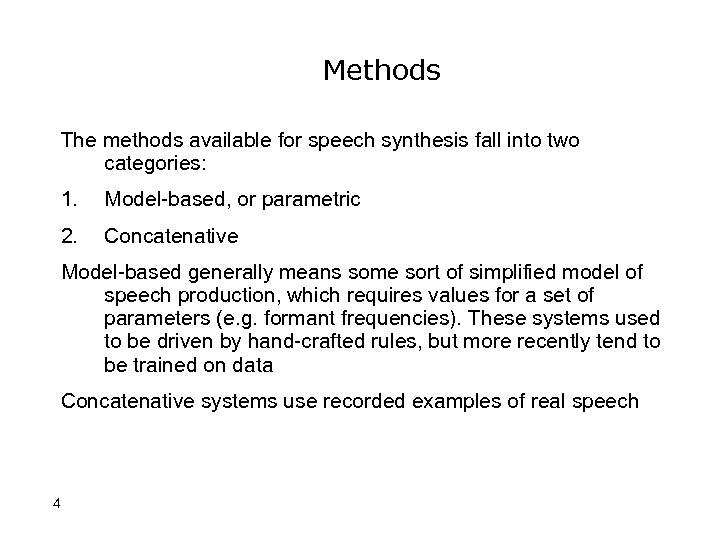 Methods The methods available for speech synthesis fall into two categories: 1. Model-based, or parametric 2. Concatenative Model-based generally means some sort of simplified model of speech production, which requires values for a set of parameters (e. g. formant frequencies). These systems used to be driven by hand-crafted rules, but more recently tend to be trained on data Concatenative systems use recorded examples of real speech 4
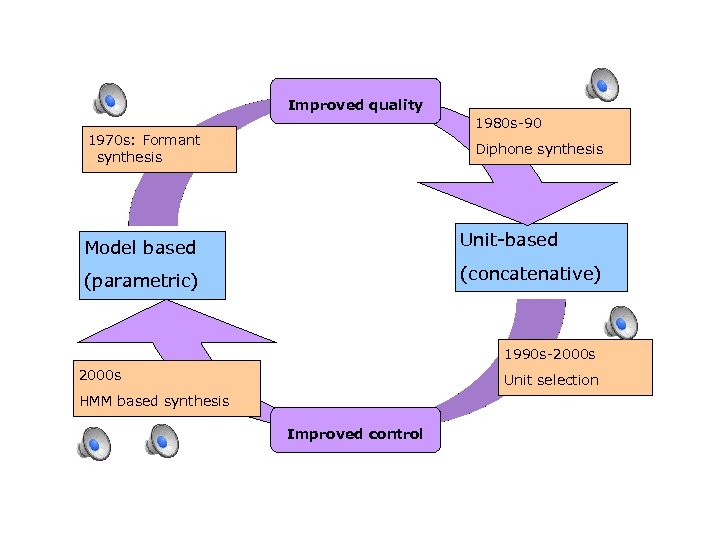 Improved quality 1980 s-90 1970 s: Formant synthesis Diphone synthesis Model based Unit-based (parametric) (concatenative) 1990 s-2000 s Unit selection HMM based synthesis Improved control
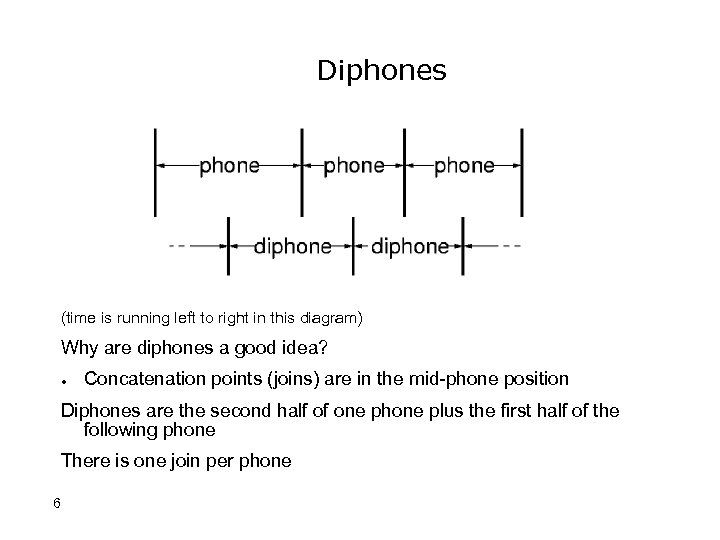 Diphones (time is running left to right in this diagram) Why are diphones a good idea? ● Concatenation points (joins) are in the mid-phone position Diphones are the second half of one phone plus the first half of the following phone There is one join per phone 6
 Text processing Now we are going to look at the text processing aspect of speech synthesis. Text processing breaks the input into units suitable for further processing, such as expanding abbreviations, part-of-speech (POS) tagging and letter-to-sound rules. We end up with something that we can generate speech from, e. g. , a phone sequence and a pitch contour. 7
 Part-of-Speech A morphological analysis can determine the part-of-speech (POS) information for many of the words, but some will have multiple possible POS categories. We need to disambiguate the POS to determine pronunciation and to do syntactic analysis. Why ? 1. The syntactic parser requires the POS tag for each word 2. Without POS information, pronunciation might be ambiguous e. g. “lives” 3. POS will also be used to predict the prosody later on How ? POS tagging is the process of determining a single POS tag for each word in the input. There are two methods: deterministic and probabilistic. 8
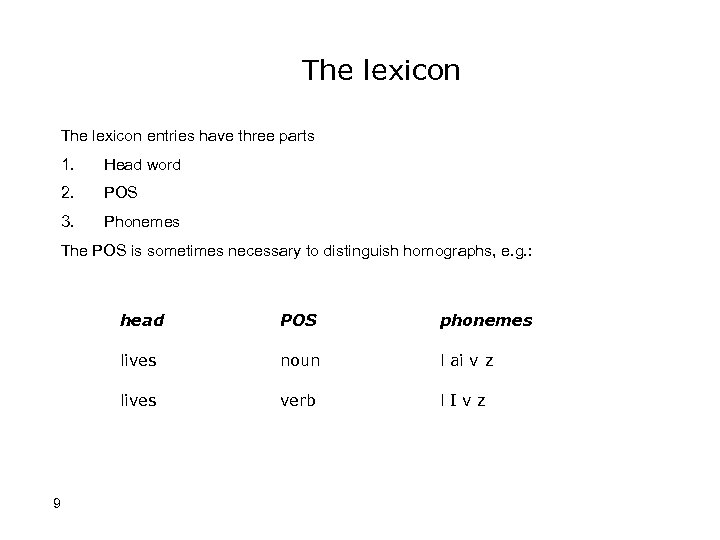 The lexicon entries have three parts 1. Head word 2. POS 3. Phonemes The POS is sometimes necessary to distinguish homographs, e. g. : head phonemes lives noun l ai v z lives 9 POS verb l. Ivz
 Letter-to-sound If lexical lookup fails, we fall back on letter-to-sound rules Example: The letter c can be realised as /k/, /ch/, /sh/, /ts/ or /ε / [deleted] We might write rules like: ● If the c is word-initial and followed by I then map it to phoneme /s/ You can see why we might want to consider an automatic method for constructing these rules ● 10 Classification trees
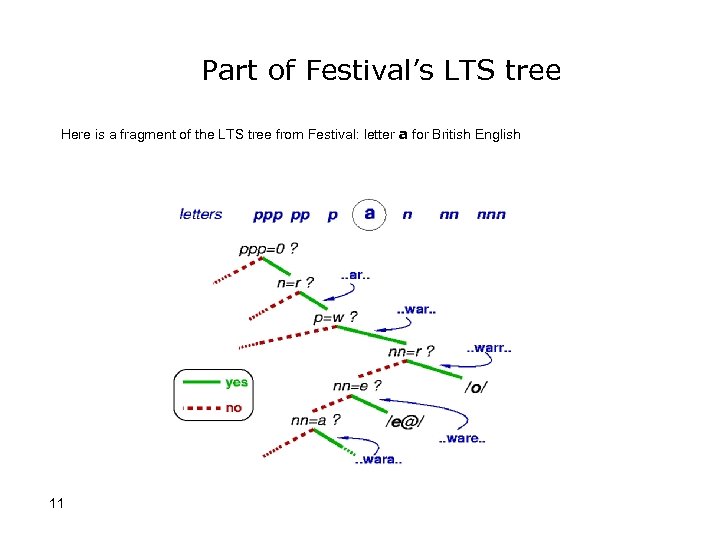 Part of Festival’s LTS tree Here is a fragment of the LTS tree from Festival: letter a for British English 11
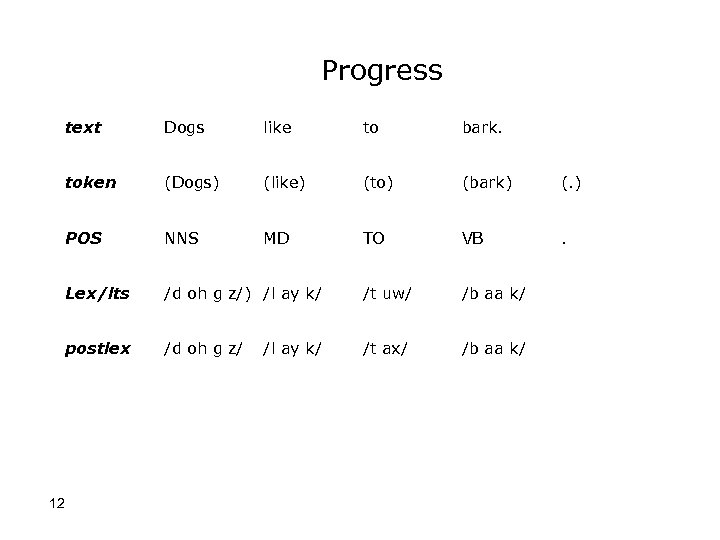 Progress text like to bark. token (Dogs) (like) (to) (bark) (. ) POS NNS MD TO VB . Lex/lts /d oh g z/) /l ay k/ /t uw/ /b aa k/ postlex 12 Dogs /d oh g z/ /t ax/ /b aa k/ /l ay k/
 Phrasing and accents: F 0 and duration Recap: ● ● We have processed the text into tokens and then into words We have determined a sequence of phones We now turn to suprasegmental aspects of synthesis. Some new terms: ● Intonation ● Prosody ● Accents ● Stress For the discussion here, segments = phonemes 13
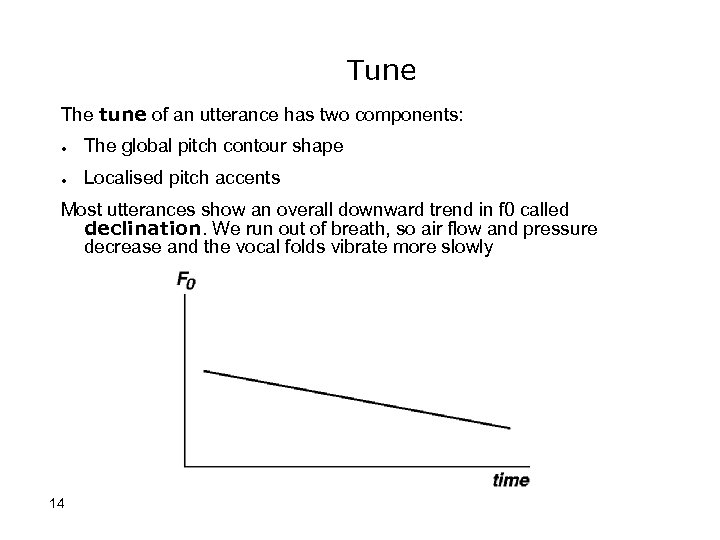 Tune The tune of an utterance has two components: ● The global pitch contour shape ● Localised pitch accents Most utterances show an overall downward trend in f 0 called declination. We run out of breath, so air flow and pressure decrease and the vocal folds vibrate more slowly 14
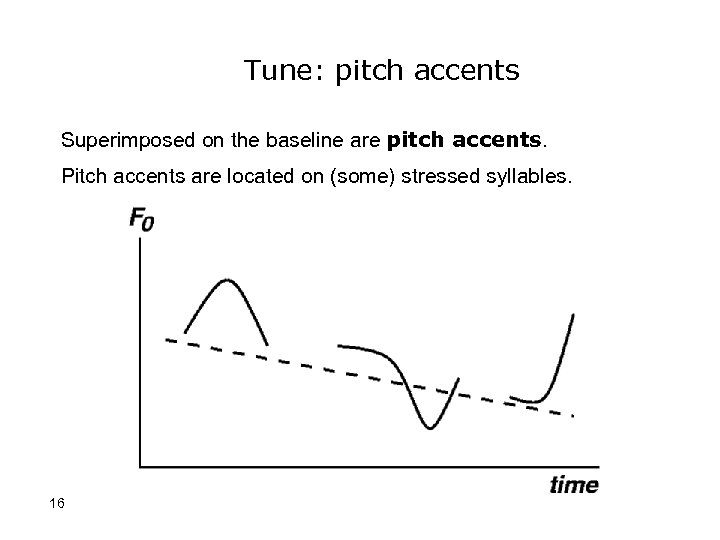 Tune: pitch accents Superimposed on the baseline are pitch accents. Pitch accents are located on (some) stressed syllables. 16
 To. BI Simplified description ● Two basic tones H (high) and L (low) ● Combine to get rise and fall patterns: L+H, H+L ● Use * to mark alignment with the stressed syllable ● Use % to mark a boundary tone Final accent inventory L*, H*, L*+H, L+H*, H+L* Final boundary tones: L%, H% Additionally, words are given a break index of 0 -4, to mark strength of boundary 18
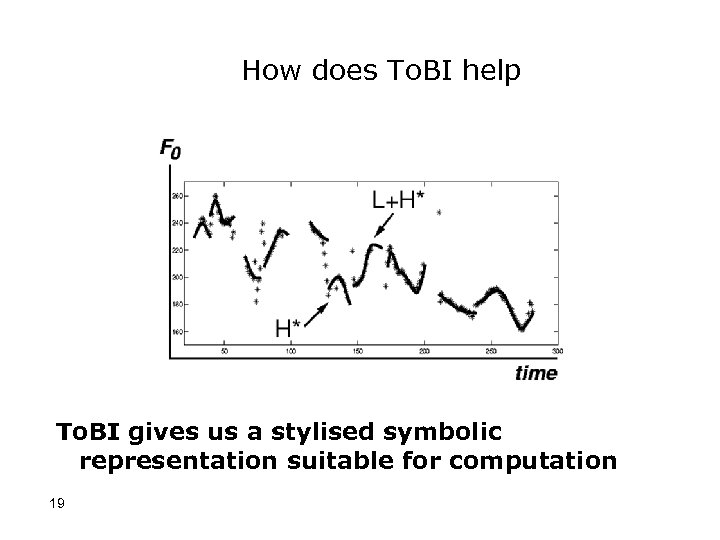 How does To. BI help To. BI gives us a stylised symbolic representation suitable for computation 19
 Waveform generation Now we have got: ● ● Sequence of phonemes (from which we can get diphones) F 0 and duration for all phonemes All that remains is to concatenate the recorded speech units and impose the required f 0 and duration using signal processing This is called waveform generation 20
 TD-PSOLA duration and f 0 modification ● ● Modify duration by duplicating or deleting pitch periods Modify f 0 by changing the spacing between pitch periods In practice, the pitch periods are windowed to give smooth joins (we in fact deal with a window length of two pitch periods) We also have to compensate by adding or deleting pitch periods when modifying f 0 21
 Linear predictive synthesis ● An alternative to time-domain PSOLA ● Still a concatenative method – Uses a recorded database ● Overcomes some problems of TD-PSOLA ● Widely used – ● 22 E. g. , Festival With a few tweaks, can sound very good
 Speech Synthesis Unit selection Simon King Simon. King@ed. ac. uk Centre for Speech Technology Research, Informatics Forum
 Unit Selection Unit selection speech synthesis is all about deciding what to record: ● ● what speech sounds do we need? in other words, what are the basic units of speech, from which we could construct any utterance? and then how to use that recorded speech: ● ● 24 search the recorded database for the best sequence of speech sounds join the units together
 Units of speech ● It is convenient to think about speech as a linear sequence of units – – 25 enables a concatenative approach to speech synthesis in speech recognition, allows us to string together models of small units (e. g. phonemes) to make models of larger units (e. g. words)
 Units of speech ● But the speech signal we observe (the waveform) is the product of interacting processes operating at different time scales – ● at any moment in time, the signal is affected not just by the current phoneme, but many other aspects of the context in which it occurs How can we reconcile this conflict, when we want to simultaneously: 1. model speech as a simple string of units 26 2. take into account all the long-range effects of context, from both before and after the current moment in time
 Context is the key ● ● 27 Context-dependent units offer a solution We can engineer our system in terms of a simple linear string of units We then account for context by having a different version of each unit for every different context But, how do we know what all the different contexts are?
 Context ● If we enumerate all possible contexts, they will be practically infinite – – ● there an infinite number of different sentences in a language context potentially spans the whole sentence (or further) However, what is important is the effect that the context has on the current speech sound – 28 now, we can think about reducing the number of different contexts
 Some contexts are (nearly) equivalent ● This is the key to unit selection – ● We cannot record and store a different version of every speech sound in every possible context – 29 and to HMM-based synthesis too, as we will see later but we can have each speech sound in a variety of different contexts
 Unit selection speech synthesis Record a database of speech with each diphone in many different contexts At synthesis time, search for the most appropriate sequence of diphones to use (other unit types are possible, such as half phones; we may come back to this later) 30
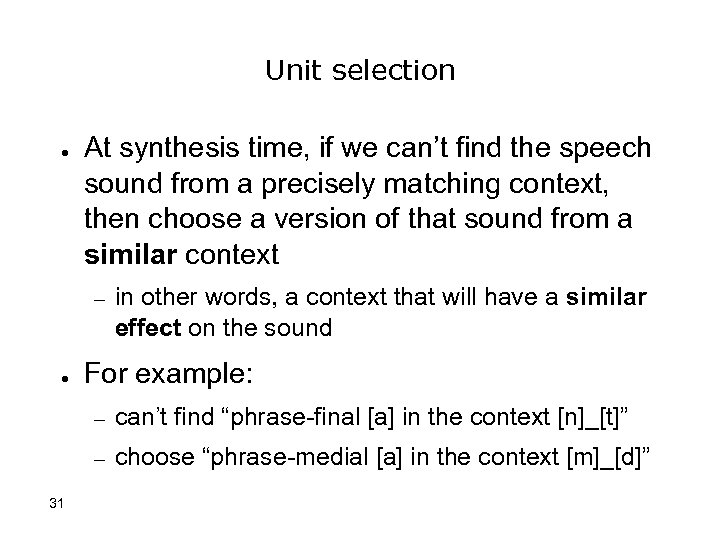 Unit selection ● At synthesis time, if we can’t find the speech sound from a precisely matching context, then choose a version of that sound from a similar context – ● in other words, a context that will have a similar effect on the sound For example: – – 31 can’t find “phrase-final [a] in the context [n]_[t]” choose “phrase-medial [a] in the context [m]_[d]”
 Labelling the database Can get phone labels from forced alignment using ASR techniques - this works very well. Phone labels are not enough, we also need to know • prosodic factors, syllable structure, etc. because these are important context factors • i. e. , they affect the speech sounds Use the TTS front-end to predict this from the text – – 32 won’t exactly match the speech but prosodic labelling from speech signals typically has low accuracy
 Using the database for synthesis At synthesis time we must produce speech corresponding to the input text – find the most suitable sequence of speech units from the database – concatenate them to produce the output speech First we carry out linguistic analysis – 33 results in a structured linguistic annotation on the input text, similar to that on the database utterances
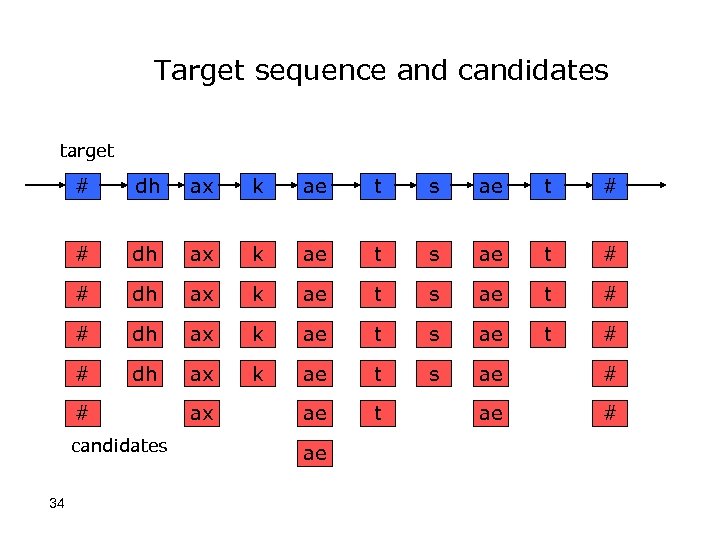 Target sequence and candidates target # dh ax k ae t s ae t # # dh ax k ae t s ae # ae t ae # # candidates 34 ax ae
 What are the criteria for selecting units? ● ● In general, there will be more than one possible unit sequence that could be chosen Need to – – 35 define the criteria for choosing the best sequence find this sequence, from amongst all possible sequences
 Linguistic criteria ● The ideal unit sequence would comprise units taken from identical linguistic contexts to those in the sentence being synthesised – – ● 36 of course, this will not be possible in general, so we must use less-than-ideal units from nonidentical (i. e. , mismatched) contexts need to quantify how close to ideal they are, so we can choose amongst them The mismatch between the linguistic context of a candidate unit and the ideal (i. e. , target)context is measured by the target
 Acoustic criteria ● After units are taken from the database, they will be joined (concatenated) – ● Why? Because of mismatches in acoustic properties around the join point, such as – ● 37 Cannot simply join two fragments of speech and hope that it will sound OK because it won’t ! differences in the spectrum, F 0, or energy The acoustic mismatch between consecutive candidate units is measured by the join cost
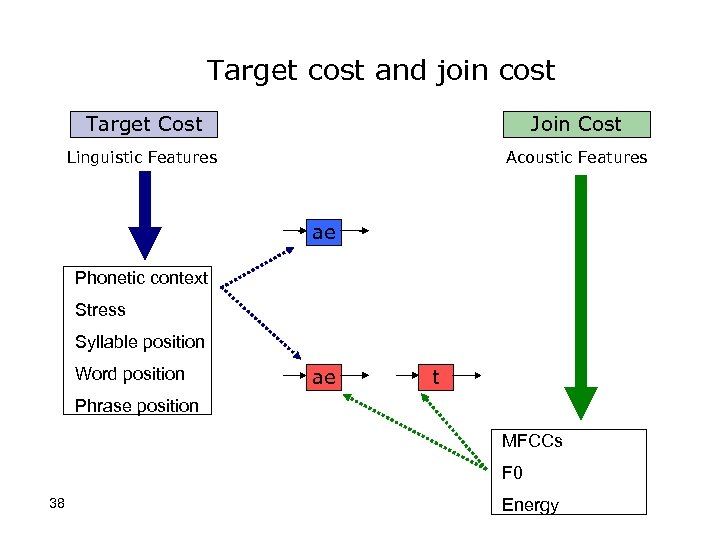 Target cost and join cost Target Cost Join Cost Linguistic Features Acoustic Features ae Phonetic context Stress Syllable position Word position ae t Phrase position MFCCs F 0 38 Energy
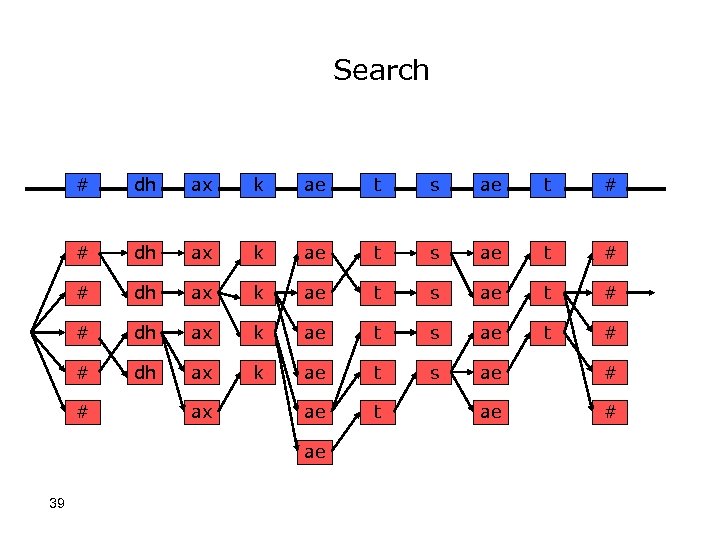 Search # dh ax k ae t s ae t # # dh ax k ae t s ae # ae t ae # # ax ae 39
 Some examples 40 Optional reading: Alan W Black and Paul Taylor. AUTOMATICALLY CLUSTERING SIMILAR UNITS FOR UNIT SELECTION IN SPEECH SYNTHESIS. Proc. Eurospeech 1997
 Speech Synthesis Speech coding and parameter driven speech synthesis Simon King Simon. King@ed. ac. uk Centre for Speech Technology Research, Informatics Forum
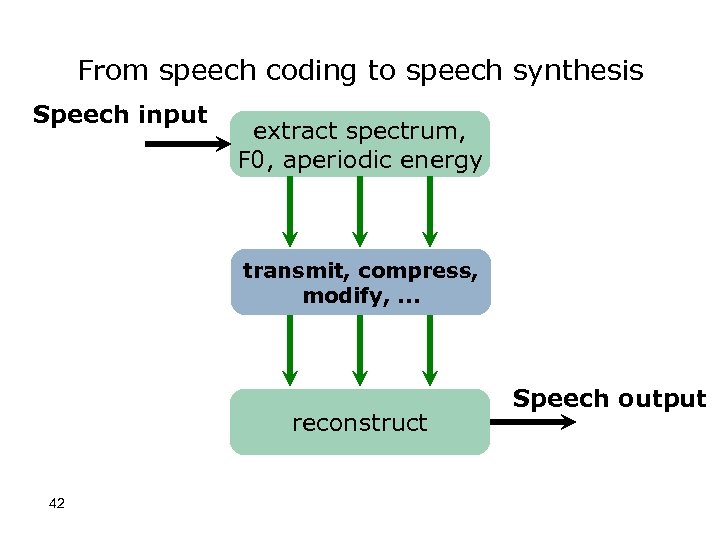 From speech coding to speech synthesis Speech input extract spectrum, F 0, aperiodic energy transmit, compress, modify, . . . reconstruct 42 Speech output
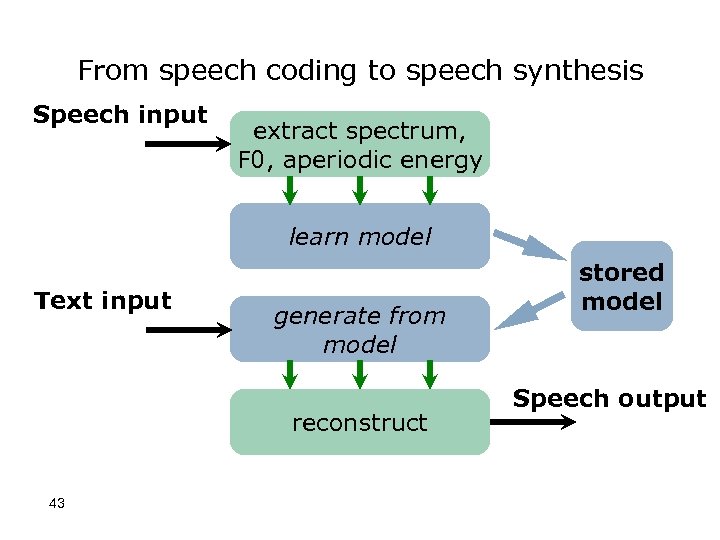 From speech coding to speech synthesis Speech input extract spectrum, F 0, aperiodic energy learn model Text input generate from model reconstruct 43 stored model Speech output
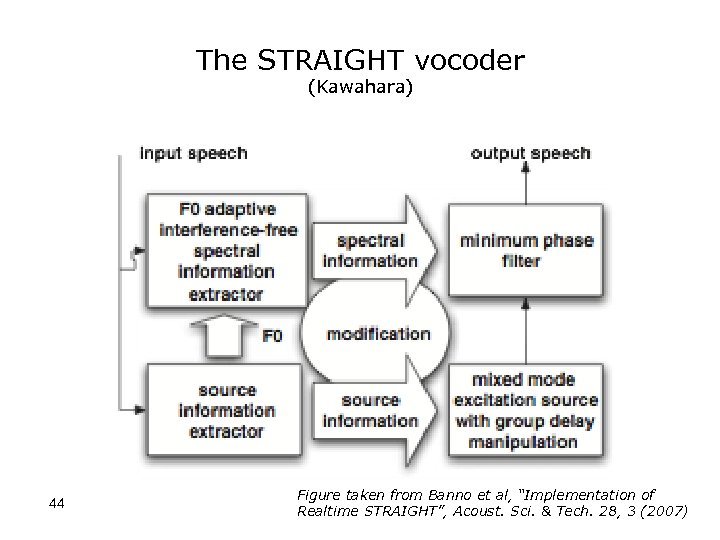 The STRAIGHT vocoder (Kawahara) 44 Figure taken from Banno et al, “Implementation of Realtime STRAIGHT”, Acoust. Sci. & Tech. 28, 3 (2007)
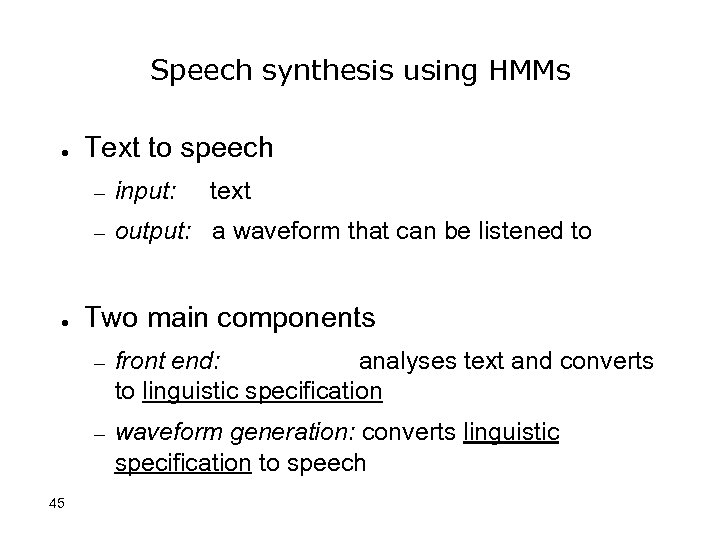 Speech synthesis using HMMs ● Text to speech – – ● input: text output: a waveform that can be listened to Two main components – – 45 front end: analyses text and converts to linguistic specification waveform generation: converts linguistic specification to speech
 HMMs are generative models 46
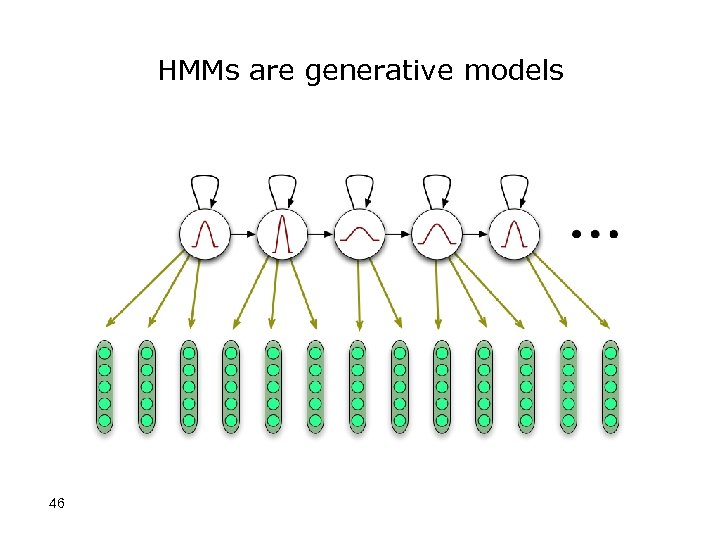
 Generating speech from a HMM ● ● ● HMMs are used to generate sequences of speech (in a parameterised form that we call ‘speech features’) From the parameterised form, we can generate a waveform The parameterised form contains sufficient information to generate speech: – – fundamental frequency (F 0) - sometimes called ‘pitch’ – 47 spectral envelope aperiodic (noise-like) components (e. g. for sounds like ‘sh’ and ‘f’)
 Trajectory generation from HMMs ● Using an HMM to generate speech parameters – – ● because of the Markov assumption, the most likely output is the sequence of the means of the Gaussians in the states visited this is piecewise constant, and ignores important dynamic properties of speech Maximum Likelihood Parameter Generation (MLPG) algorithm – 48 solves this problem, by correctly using statistics of the dynamic properties during the generation process
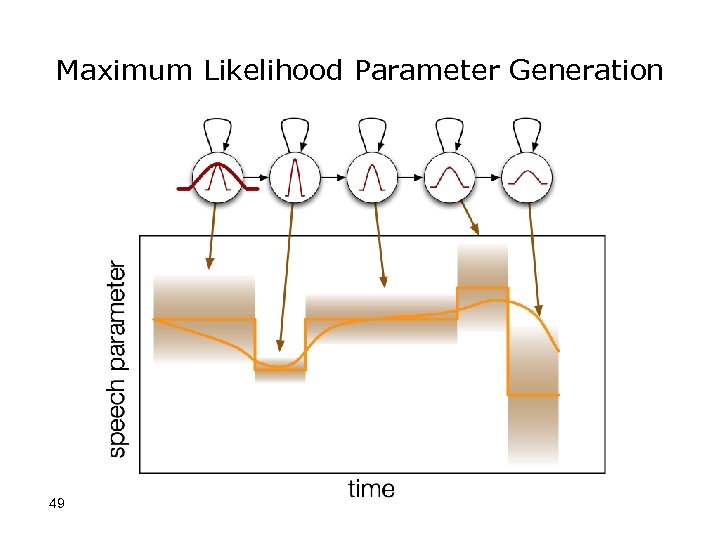 Maximum Likelihood Parameter Generation 49
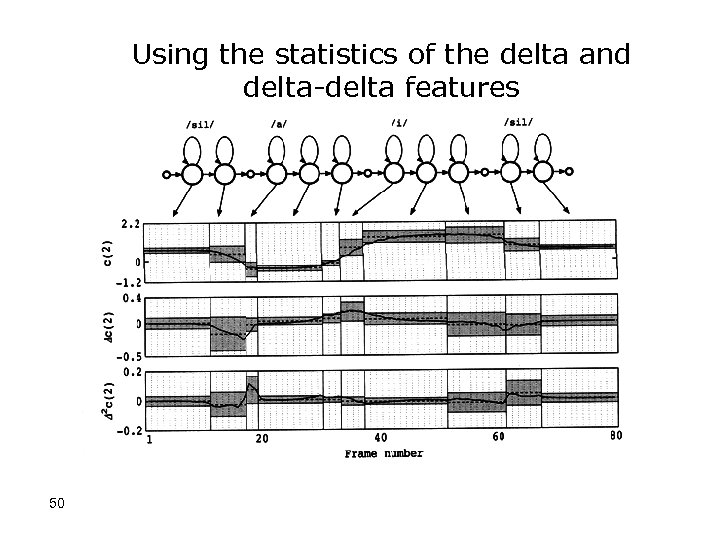 Using the statistics of the delta and delta-delta features 50
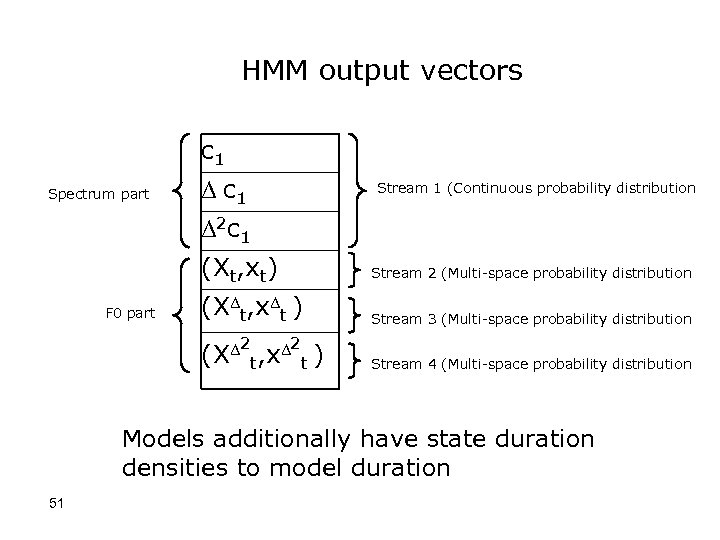 HMM output vectors c 1 Spectrum part Δ c 1 Stream 1 (Continuous probability distribution Δ 2 c 1 (Xt, xt) F 0 part Stream 2 (Multi-space probability distribution (XΔt, xΔt ) Stream 3 (Multi-space probability distribution 2 2 (XΔ t, xΔ t ) Stream 4 (Multi-space probability distribution Models additionally have state duration densities to model duration 51
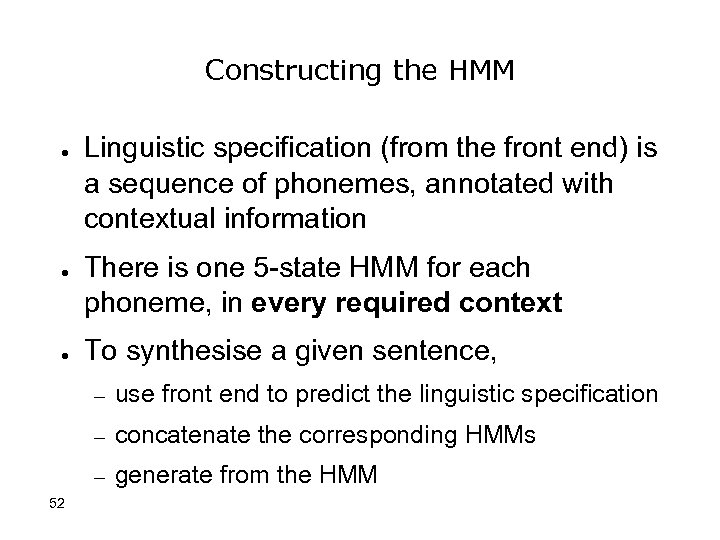 Constructing the HMM ● ● ● Linguistic specification (from the front end) is a sequence of phonemes, annotated with contextual information There is one 5 -state HMM for each phoneme, in every required context To synthesise a given sentence, – – concatenate the corresponding HMMs – 52 use front end to predict the linguistic specification generate from the HMM
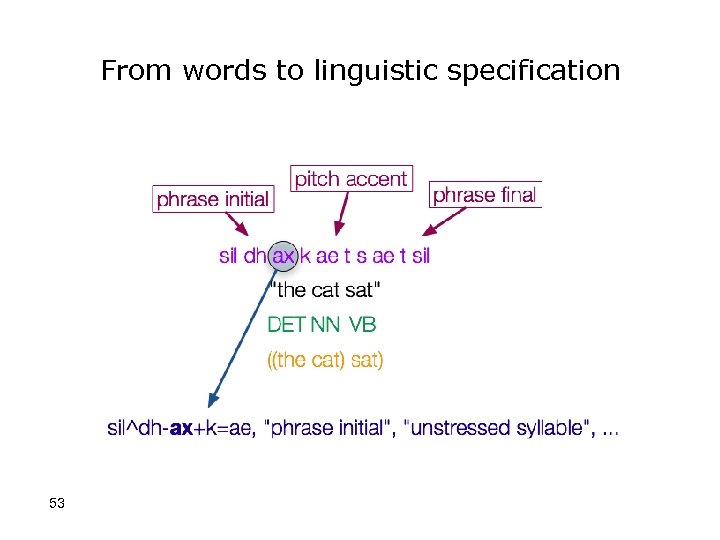 From words to linguistic specification 53
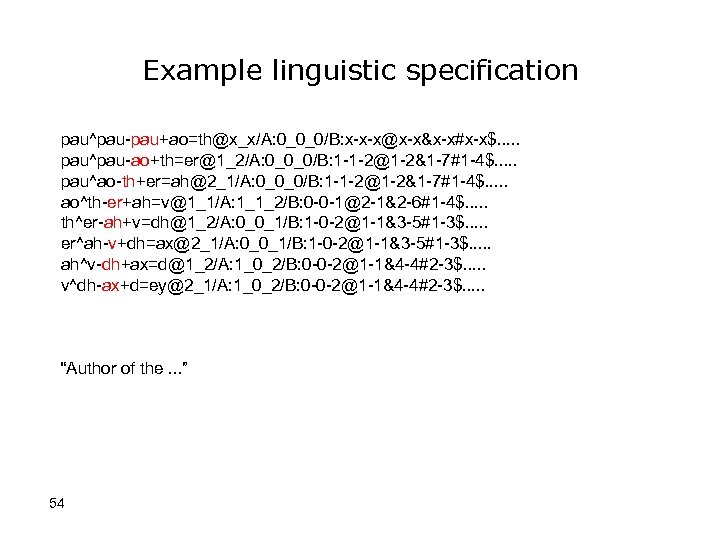 Example linguistic specification pau^pau-pau+ao=th@x_x/A: 0_0_0/B: x-x-x@x-x&x-x#x-x$. . . pau^pau-ao+th=er@1_2/A: 0_0_0/B: 1 -1 -2@1 -2&1 -7#1 -4$. . . pau^ao-th+er=ah@2_1/A: 0_0_0/B: 1 -1 -2@1 -2&1 -7#1 -4$. . . ao^th-er+ah=v@1_1/A: 1_1_2/B: 0 -0 -1@2 -1&2 -6#1 -4$. . . th^er-ah+v=dh@1_2/A: 0_0_1/B: 1 -0 -2@1 -1&3 -5#1 -3$. . . er^ah-v+dh=ax@2_1/A: 0_0_1/B: 1 -0 -2@1 -1&3 -5#1 -3$. . . ah^v-dh+ax=d@1_2/A: 1_0_2/B: 0 -0 -2@1 -1&4 -4#2 -3$. . . v^dh-ax+d=ey@2_1/A: 1_0_2/B: 0 -0 -2@1 -1&4 -4#2 -3$. . . “Author of the. . . ” 54
 Comparison with ASR ● Differences from automatic speech recognition include – Synthesis uses a much richer model set, with a lot more context ● For speech recognition: triphone models ● For speech synthesis: “full context” models – – 55 “Full context” = both phonetic and prosodic factors Observation vector for HMMs contains the necessary parameters to generate speech, such as spectral envelope + F 0 + multi-band noise amplitudes
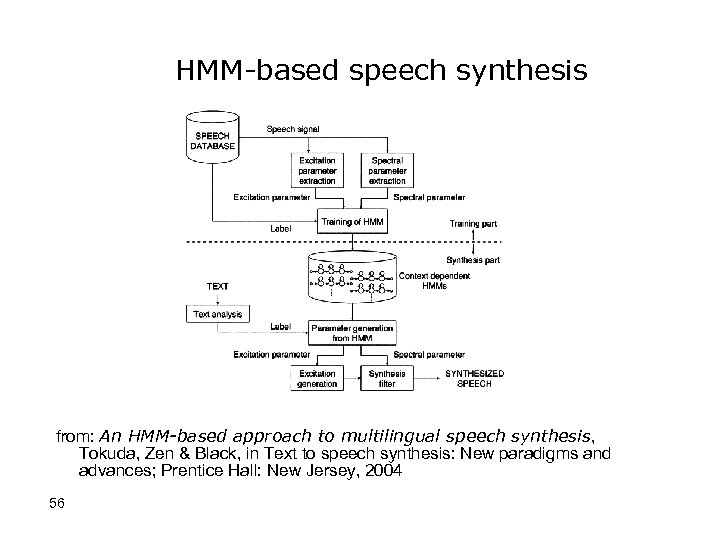 HMM-based speech synthesis from: An HMM-based approach to multilingual speech synthesis, Tokuda, Zen & Black, in Text to speech synthesis: New paradigms and advances; Prentice Hall: New Jersey, 2004 56
 End of this part 57