


 Скачать презентацию Introduction to Software Testing Chapter 1 Introduction
913d89b45d68387e4ae79baeb4ca64c9.ppt
- Количество слайдов: 91
 Introduction to Software Testing Chapter 1 Introduction & The Model-Driven Test Design Process Paul Ammann & Jeff Offutt http: //www. cs. gmu. edu/~offutt/softwaretest/ Updated 24 -August 2010
 Testing in the 21 st Century n Software defines behavior – network routers, finance, switching networks, other infrastructure n Today’s software market : Industry is going – is much bigger through a revolution in – is more competitive what testing means to – has more users the success of software products n Embedded Control Applications – – – n airplanes, air traffic control spaceships watches ovens remote controllers – PDAs – memory seats – DVD players – garage door openers – cell phones Agile processes put increased pressure on testers – Programmers must unit test – with no training, education or tools ! – Tests are key to functional requirements – but who builds those tests ? Introduction to Software Testing (Ch 1) © Ammann & Offutt 2
 OUTLINE 1. Spectacular Software Failures 2. Why Test? 3. What Do We Do When We Test ? • Test Activities and Model-Driven Testing 4. Software Testing Terminology 5. Changing Notions of Testing 6. Test Maturity Levels 7. Summary Introduction to Software Testing (Ch 1) © Ammann & Offutt 3
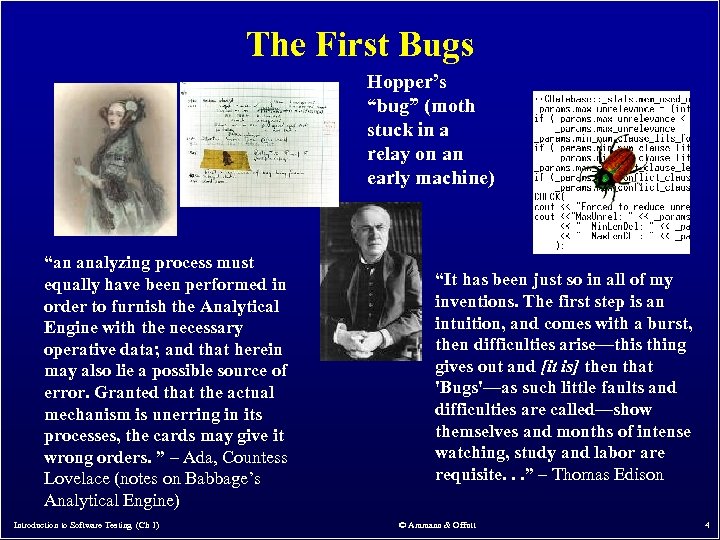 The First Bugs Hopper’s “bug” (moth stuck in a relay on an early machine) “an analyzing process must equally have been performed in order to furnish the Analytical Engine with the necessary operative data; and that herein may also lie a possible source of error. Granted that the actual mechanism is unerring in its processes, the cards may give it wrong orders. ” – Ada, Countess Lovelace (notes on Babbage’s Analytical Engine) Introduction to Software Testing (Ch 1) “It has been just so in all of my inventions. The first step is an intuition, and comes with a burst, then difficulties arise—this thing gives out and [it is] then that 'Bugs'—as such little faults and difficulties are called—show themselves and months of intense watching, study and labor are requisite. . . ” – Thomas Edison © Ammann & Offutt 4
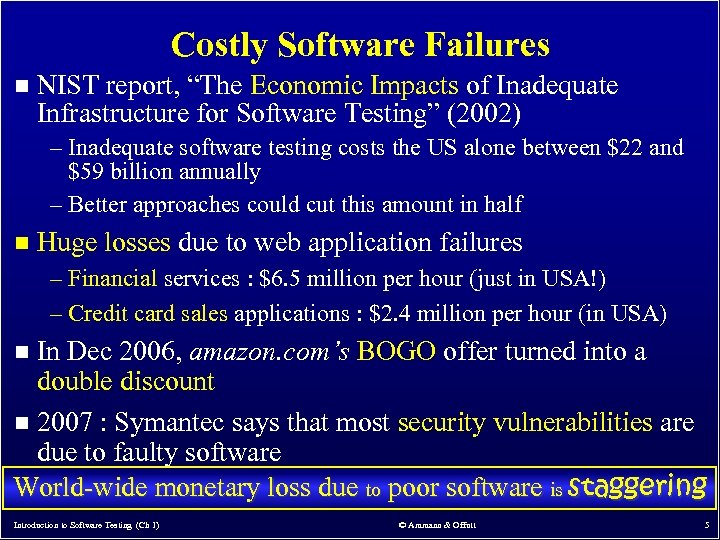 Costly Software Failures n NIST report, “The Economic Impacts of Inadequate Infrastructure for Software Testing” (2002) – Inadequate software testing costs the US alone between $22 and $59 billion annually – Better approaches could cut this amount in half n Huge losses due to web application failures – Financial services : $6. 5 million per hour (just in USA!) – Credit card sales applications : $2. 4 million per hour (in USA) In Dec 2006, amazon. com’s BOGO offer turned into a double discount n 2007 : Symantec says that most security vulnerabilities are due to faulty software World-wide monetary loss due to poor software is staggering n Introduction to Software Testing (Ch 1) © Ammann & Offutt 5
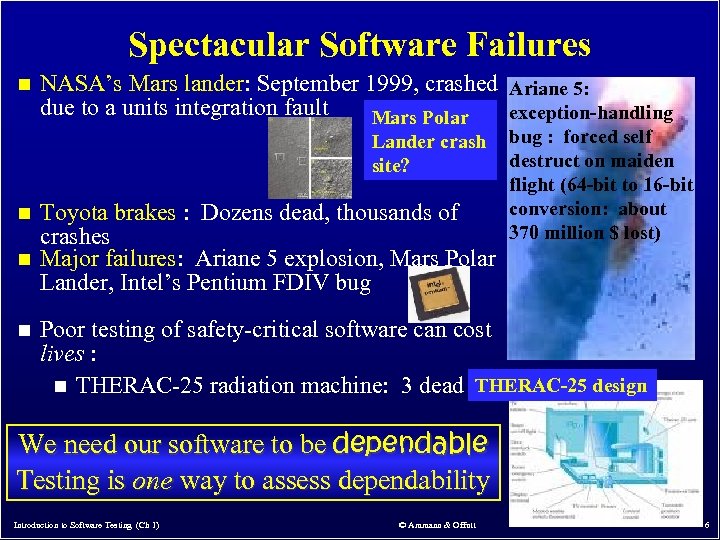 Spectacular Software Failures n NASA’s Mars lander: September 1999, crashed Ariane 5: due to a units integration fault exception-handling Mars Polar Lander crash site? n n n Toyota brakes : Dozens dead, thousands of crashes Major failures: Ariane 5 explosion, Mars Polar Lander, Intel’s Pentium FDIV bug : forced self destruct on maiden flight (64 -bit to 16 -bit conversion: about 370 million $ lost) Poor testing of safety-critical software can cost lives : n THERAC-25 radiation machine: 3 dead THERAC-25 design We need our software to be dependable Testing is one way to assess dependability Introduction to Software Testing (Ch 1) © Ammann & Offutt 6
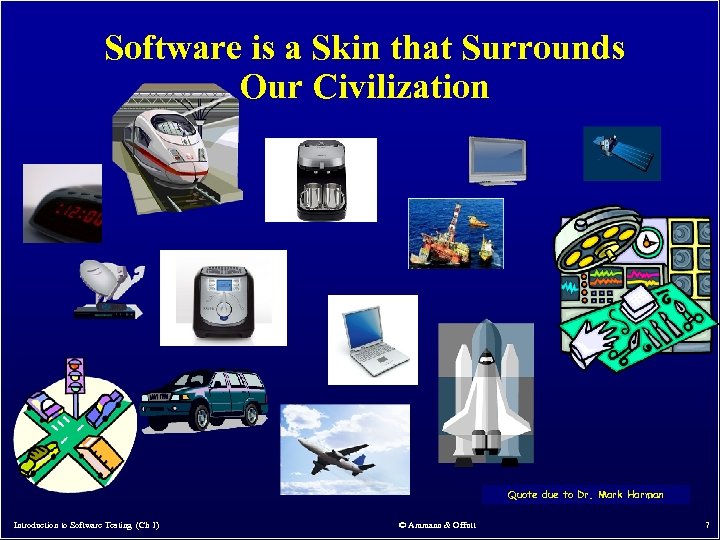 Software is a Skin that Surrounds Our Civilization Quote due to Dr. Mark Harman Introduction to Software Testing (Ch 1) © Ammann & Offutt 7
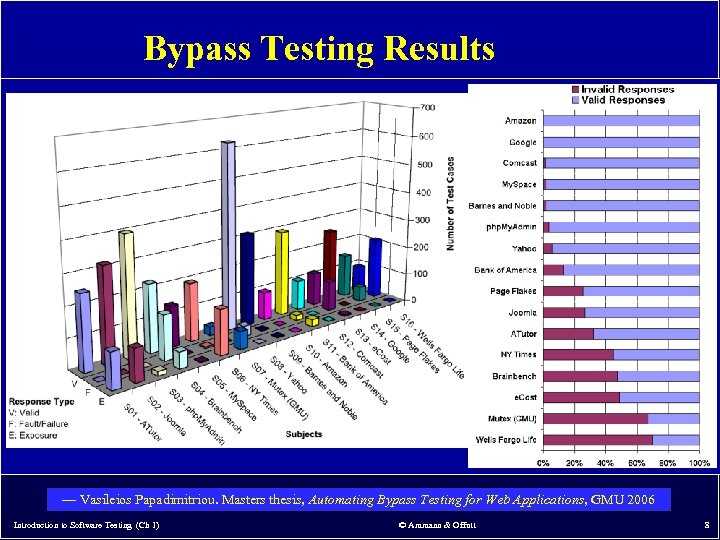 Bypass Testing Results v — Vasileios Papadimitriou. Masters thesis, Automating Bypass Testing for Web Applications, GMU 2006 Introduction to Software Testing (Ch 1) © Ammann & Offutt 8
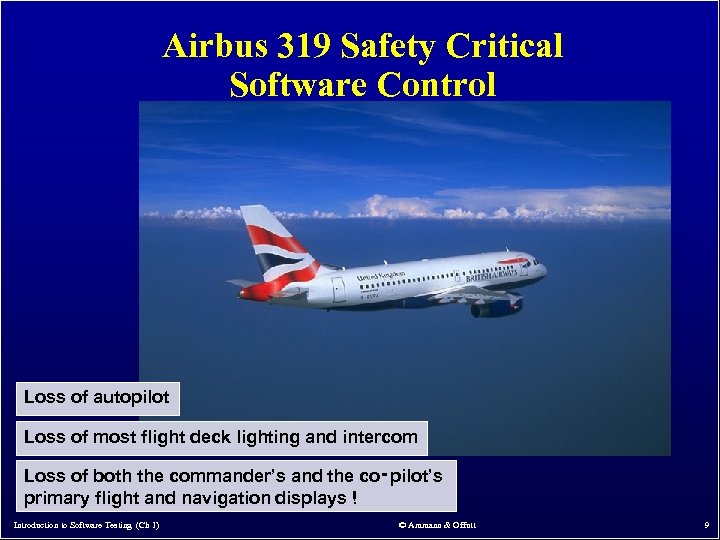 Airbus 319 Safety Critical Software Control Loss of autopilot Loss of most flight deck lighting and intercom Loss of both the commander’s and the co‑pilot’s primary flight and navigation displays ! Introduction to Software Testing (Ch 1) © Ammann & Offutt 9
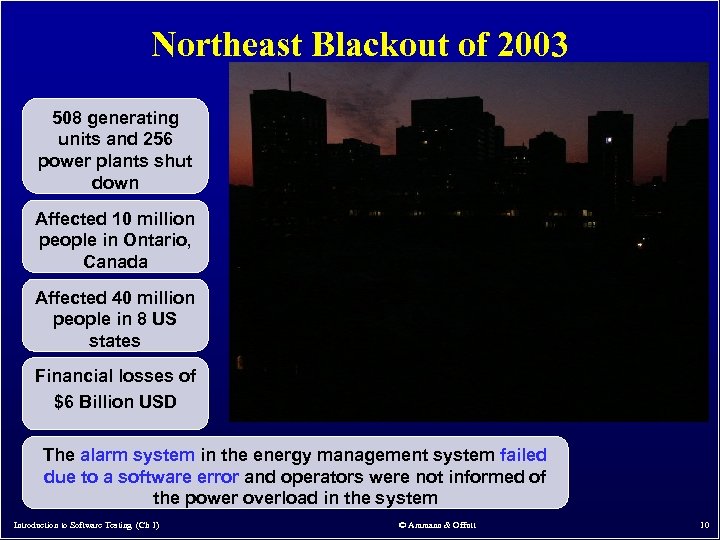 Northeast Blackout of 2003 508 generating units and 256 power plants shut down Affected 10 million people in Ontario, Canada Affected 40 million people in 8 US states Financial losses of $6 Billion USD The alarm system in the energy management system failed due to a software error and operators were not informed of the power overload in the system Introduction to Software Testing (Ch 1) © Ammann & Offutt 10
 What Does This Mean? Software testing is getting more important Introduction to Software Testing (Ch 1) © Ammann & Offutt 11
 Testing in the 21 st Century More safety critical, real-time software n Embedded software is ubiquitous … check your pockets n Enterprise applications means bigger programs, more users n Paradoxically, free software increases our expectations ! n Security is now all about software faults n – Secure software is reliable software n The web offers a new deployment platform – Very competitive and very available to more users – Web apps are distributed – Web apps must be highly reliable Industry desperately needs our inventions ! Introduction to Software Testing (Ch 1) © Ammann & Offutt 12
 OUTLINE 1. Spectacular Software Failures 2. Why Test? 3. What Do We Do When We Test ? • Test Activities and Model-Driven Testing 4. Software Testing Terminology 5. Changing Notions of Testing 6. Test Maturity Levels 7. Summary Introduction to Software Testing (Ch 1) © Ammann & Offutt 13
 Here! Test This! My first “professional” job Big software big Micro. Steff – program software system for the mac V. 1. 5. 1 Jan/2007 MF 2 -HD 1. 44 MB Data. Life Verdatim A stack of computer printouts—and no documentation Introduction to Software Testing (Ch 1) © Ammann & Offutt 14
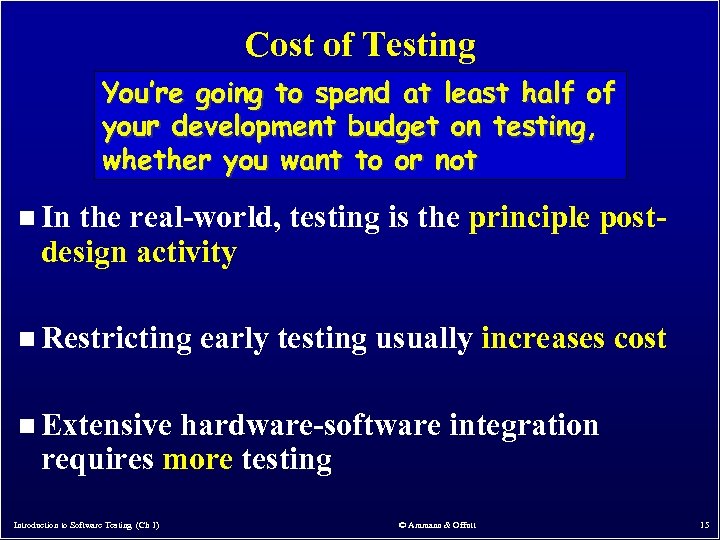 Cost of Testing You’re going to spend at least half of your development budget on testing, whether you want to or not n In the real-world, testing is the principle postdesign activity n Restricting early testing usually increases cost n Extensive hardware-software integration requires more testing Introduction to Software Testing (Ch 1) © Ammann & Offutt 15
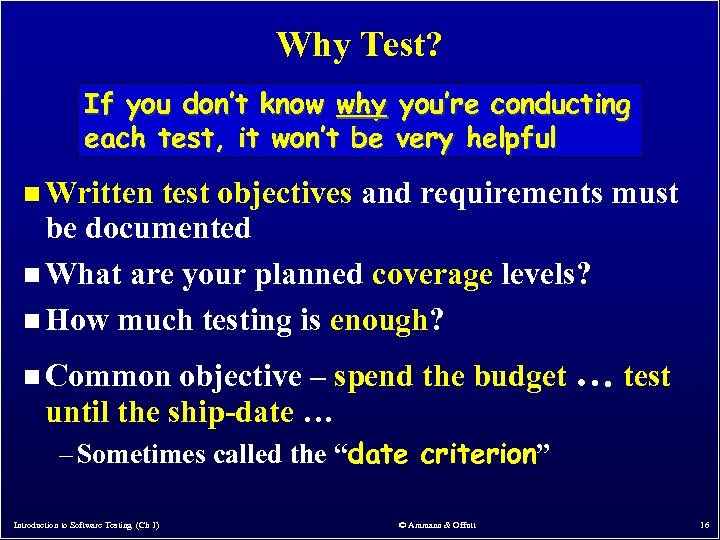 Why Test? If you don’t know why you’re conducting each test, it won’t be very helpful n Written test objectives and requirements must be documented n What are your planned coverage levels? n How much testing is enough? objective – spend the budget … test until the ship-date … n Common – Sometimes called the “date criterion” Introduction to Software Testing (Ch 1) © Ammann & Offutt 16
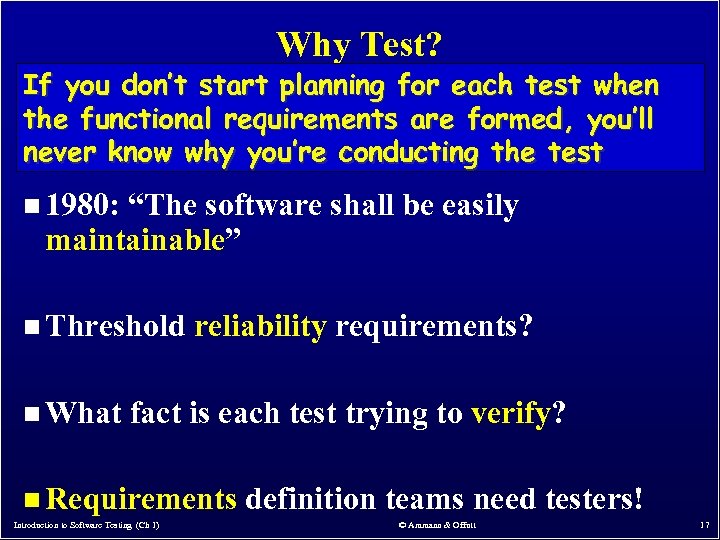 Why Test? If you don’t start planning for each test when the functional requirements are formed, you’ll never know why you’re conducting the test n 1980: “The software shall be easily maintainable” n Threshold n What reliability requirements? fact is each test trying to verify? n Requirements Introduction to Software Testing (Ch 1) definition teams need testers! © Ammann & Offutt 17
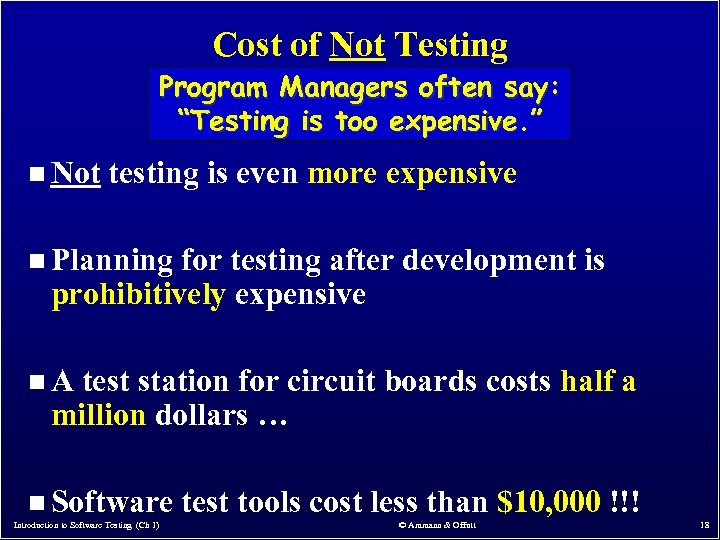 Cost of Not Testing Program Managers often say: “Testing is too expensive. ” n Not testing is even more expensive n Planning for testing after development is prohibitively expensive n. A test station for circuit boards costs half a million dollars … n Software Introduction to Software Testing (Ch 1) test tools cost less than $10, 000 !!! © Ammann & Offutt 18
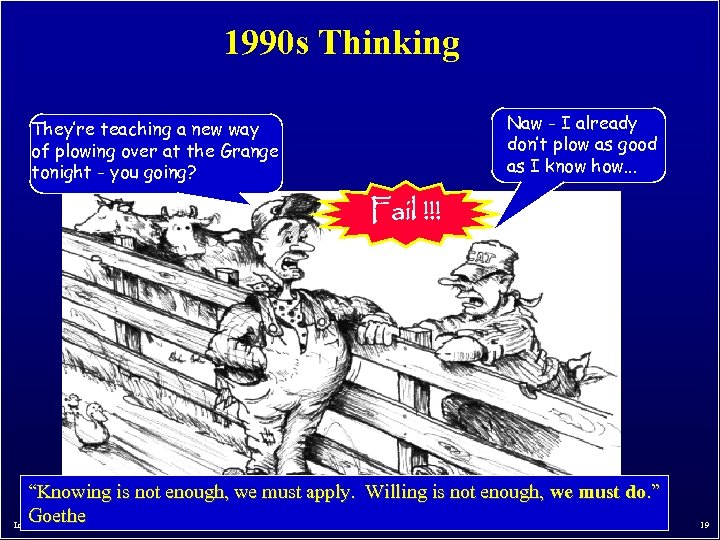 1990 s Thinking Naw - I already don’t plow as good as I know how. . . They’re teaching a new way of plowing over at the Grange tonight - you going? Fail !!! “Knowing is not enough, we must apply. Willing is not enough, we must do. ” Goethe Introduction to Software Testing (Ch 1) © Ammann & Offutt 19
 OUTLINE 1. Spectacular Software Failures 2. Why Test? 3. What Do We Do When We Test ? • Test Activities and Model-Driven Testing 4. Software Testing Terminology 5. Changing Notions of Testing 6. Test Maturity Levels 7. Summary Introduction to Software Testing (Ch 1) © Ammann & Offutt 20
 Test Design in Context n Test Design is the process of designing input values that will effectively test software n Test design is one of several activities for testing software – Most mathematical – Most technically challenging n http: //www. cs. gmu. edu/~offutt/softwaretest/ Introduction to Software Testing (Ch 1) © Ammann & Offutt 21
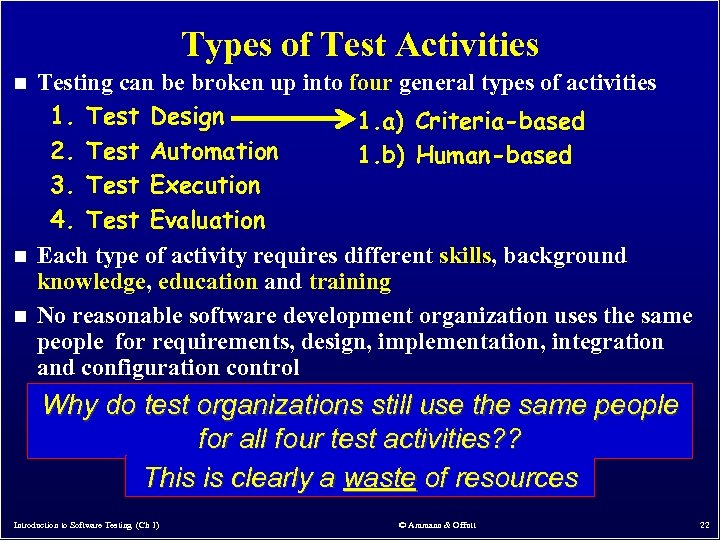 Types of Test Activities n n n Testing can be broken up into four general types of activities 1. Test Design 1. a) Criteria-based 2. Test Automation 1. b) Human-based 3. Test Execution 4. Test Evaluation Each type of activity requires different skills, background knowledge, education and training No reasonable software development organization uses the same people for requirements, design, implementation, integration and configuration control Why do test organizations still use the same people for all four test activities? ? This is clearly a waste of resources Introduction to Software Testing (Ch 1) © Ammann & Offutt 22
 1. Test Design – (a) Criteria-Based Design test values to satisfy coverage criteria or other engineering goal n n This is the most technical job in software testing Requires knowledge of : – Discrete math – Programming – Testing n n Requires much of a traditional CS degree This is intellectually stimulating, rewarding, and challenging Test design is analogous to software architecture on the development side Using people who are not qualified to design tests is a sure way to get ineffective tests Introduction to Software Testing (Ch 1) © Ammann & Offutt 23
 1. Test Design – (b) Human-Based Design test values based on domain knowledge of the program and human knowledge of testing n n n This is much harder than it may seem to developers Criteria-based approaches can be blind to special situations Requires knowledge of : – Domain, testing, and user interfaces n Requires almost no traditional CS – A background in the domain of the software is essential – An empirical background is very helpful (biology, psychology, …) – A logic background is very helpful (law, philosophy, math, …) n This is intellectually stimulating, rewarding, and challenging – But not to typical CS majors – they want to solve problems and build things Introduction to Software Testing (Ch 1) © Ammann & Offutt 24
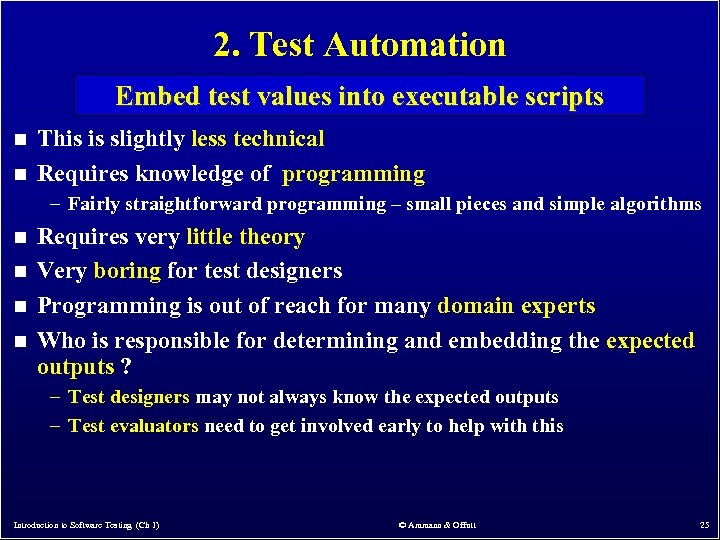 2. Test Automation Embed test values into executable scripts n n This is slightly less technical Requires knowledge of programming – Fairly straightforward programming – small pieces and simple algorithms n n Requires very little theory Very boring for test designers Programming is out of reach for many domain experts Who is responsible for determining and embedding the expected outputs ? – Test designers may not always know the expected outputs – Test evaluators need to get involved early to help with this Introduction to Software Testing (Ch 1) © Ammann & Offutt 25
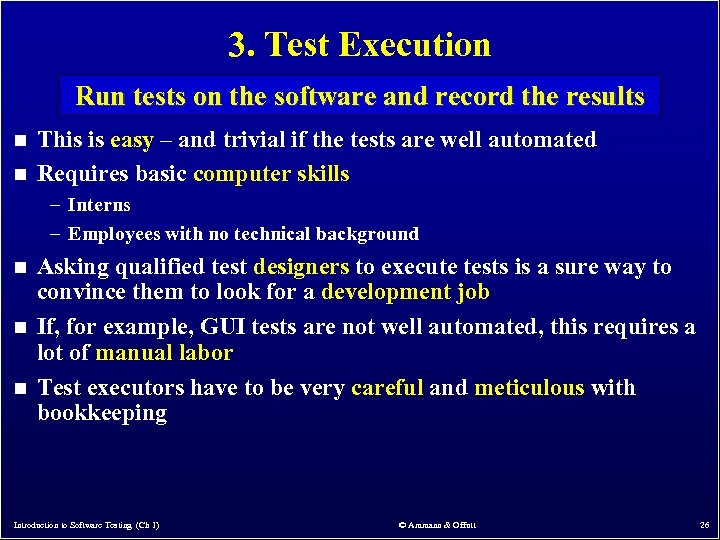 3. Test Execution Run tests on the software and record the results n n This is easy – and trivial if the tests are well automated Requires basic computer skills – Interns – Employees with no technical background n n n Asking qualified test designers to execute tests is a sure way to convince them to look for a development job If, for example, GUI tests are not well automated, this requires a lot of manual labor Test executors have to be very careful and meticulous with bookkeeping Introduction to Software Testing (Ch 1) © Ammann & Offutt 26
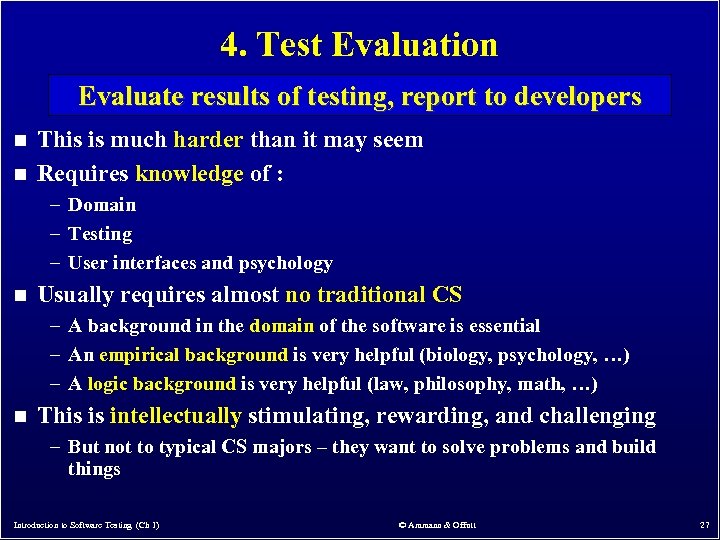 4. Test Evaluation Evaluate results of testing, report to developers n n This is much harder than it may seem Requires knowledge of : – Domain – Testing – User interfaces and psychology n Usually requires almost no traditional CS – A background in the domain of the software is essential – An empirical background is very helpful (biology, psychology, …) – A logic background is very helpful (law, philosophy, math, …) n This is intellectually stimulating, rewarding, and challenging – But not to typical CS majors – they want to solve problems and build things Introduction to Software Testing (Ch 1) © Ammann & Offutt 27
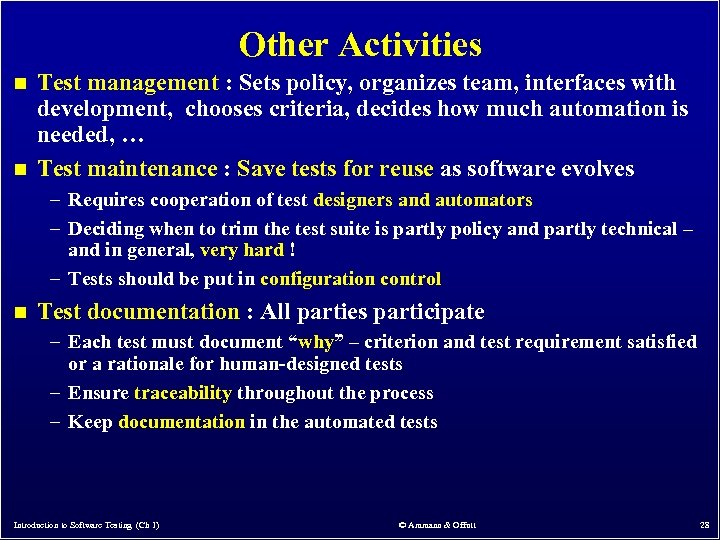 Other Activities n n Test management : Sets policy, organizes team, interfaces with development, chooses criteria, decides how much automation is needed, … Test maintenance : Save tests for reuse as software evolves – Requires cooperation of test designers and automators – Deciding when to trim the test suite is partly policy and partly technical – and in general, very hard ! – Tests should be put in configuration control n Test documentation : All parties participate – Each test must document “why” – criterion and test requirement satisfied or a rationale for human-designed tests – Ensure traceability throughout the process – Keep documentation in the automated tests Introduction to Software Testing (Ch 1) © Ammann & Offutt 28
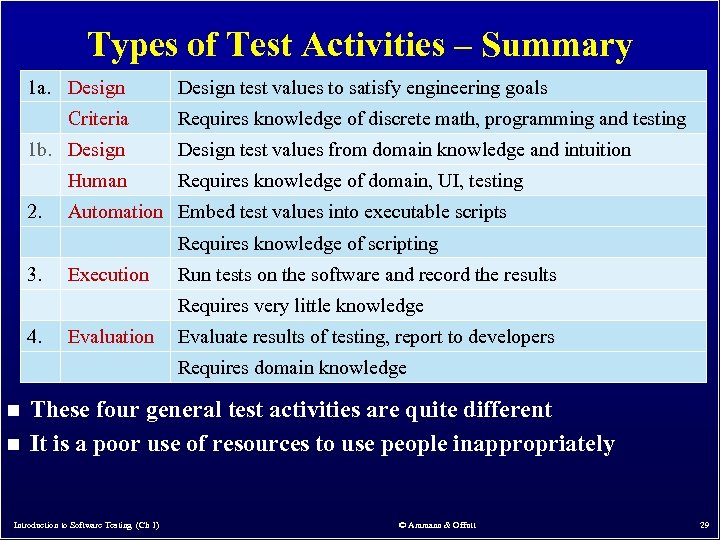 Types of Test Activities – Summary 1 a. Design Criteria 1 b. Design Human 2. Design test values to satisfy engineering goals Requires knowledge of discrete math, programming and testing Design test values from domain knowledge and intuition Requires knowledge of domain, UI, testing Automation Embed test values into executable scripts Requires knowledge of scripting 3. Execution Run tests on the software and record the results Requires very little knowledge 4. Evaluation Evaluate results of testing, report to developers Requires domain knowledge n n These four general test activities are quite different It is a poor use of resources to use people inappropriately Introduction to Software Testing (Ch 1) © Ammann & Offutt 29
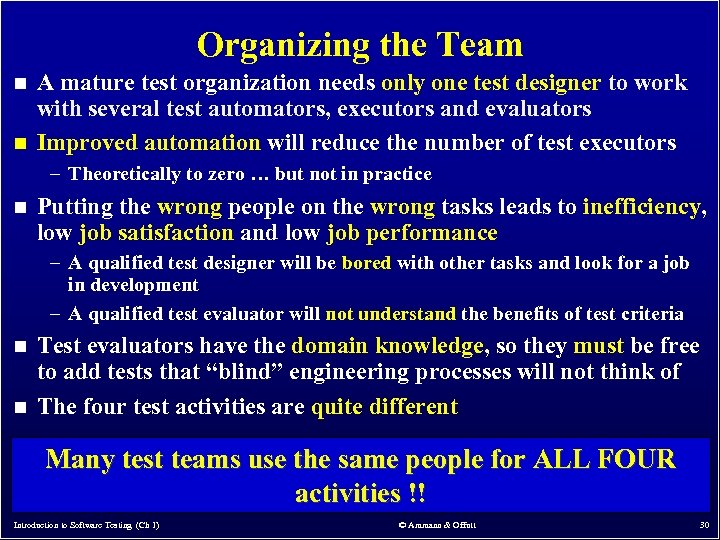 Organizing the Team n n A mature test organization needs only one test designer to work with several test automators, executors and evaluators Improved automation will reduce the number of test executors – Theoretically to zero … but not in practice n Putting the wrong people on the wrong tasks leads to inefficiency, low job satisfaction and low job performance – A qualified test designer will be bored with other tasks and look for a job in development – A qualified test evaluator will not understand the benefits of test criteria n n Test evaluators have the domain knowledge, so they must be free to add tests that “blind” engineering processes will not think of The four test activities are quite different Many test teams use the same people for ALL FOUR activities !! Introduction to Software Testing (Ch 1) © Ammann & Offutt 30
 Applying Test Activities To use our people effectively and to test efficiently we need a process that lets test designers raise their level of abstraction Introduction to Software Testing (Ch 1) © Ammann & Offutt 31
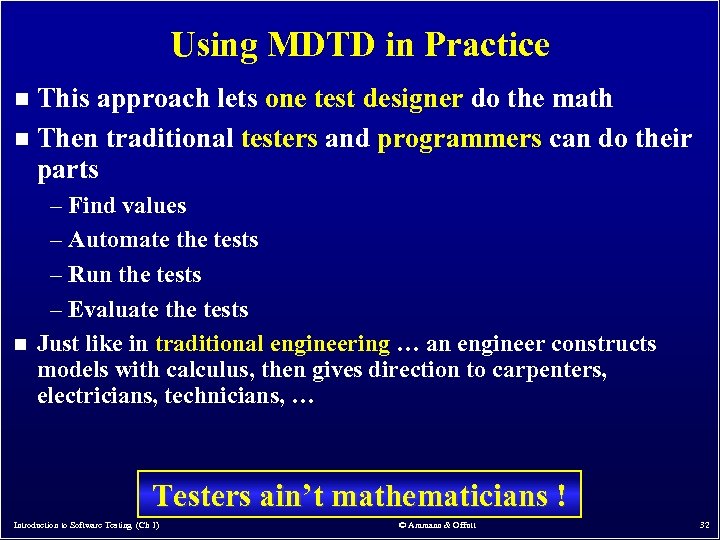 Using MDTD in Practice This approach lets one test designer do the math n Then traditional testers and programmers can do their parts n n – Find values – Automate the tests – Run the tests – Evaluate the tests Just like in traditional engineering … an engineer constructs models with calculus, then gives direction to carpenters, electricians, technicians, … Testers ain’t mathematicians ! Introduction to Software Testing (Ch 1) © Ammann & Offutt 32
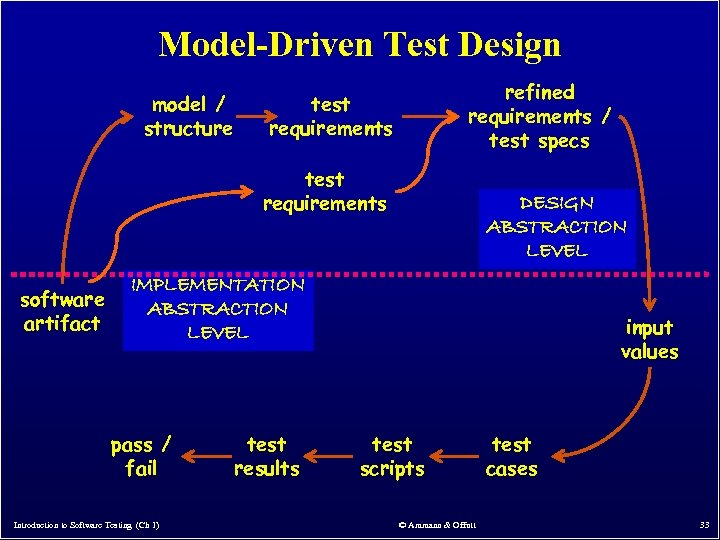 Model-Driven Test Design model / structure refined requirements / test specs test requirements software artifact DESIGN ABSTRACTION LEVEL IMPLEMENTATION ABSTRACTION LEVEL pass / fail Introduction to Software Testing (Ch 1) test results input values test scripts © Ammann & Offutt test cases 33
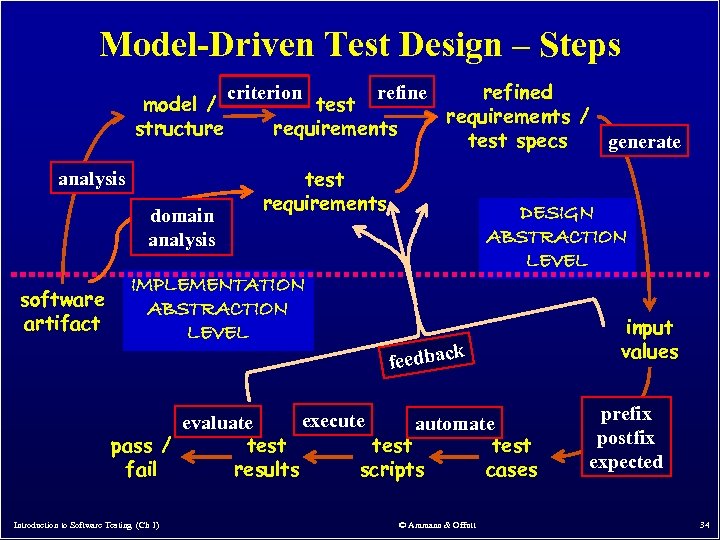 Model-Driven Test Design – Steps model / structure analysis domain analysis software artifact refined test requirements / requirements test specs generate criterion test requirements IMPLEMENTATION ABSTRACTION LEVEL DESIGN ABSTRACTION LEVEL k feedbac execute evaluate automate pass / test fail results scripts cases Introduction to Software Testing (Ch 1) © Ammann & Offutt input values prefix postfix expected 34
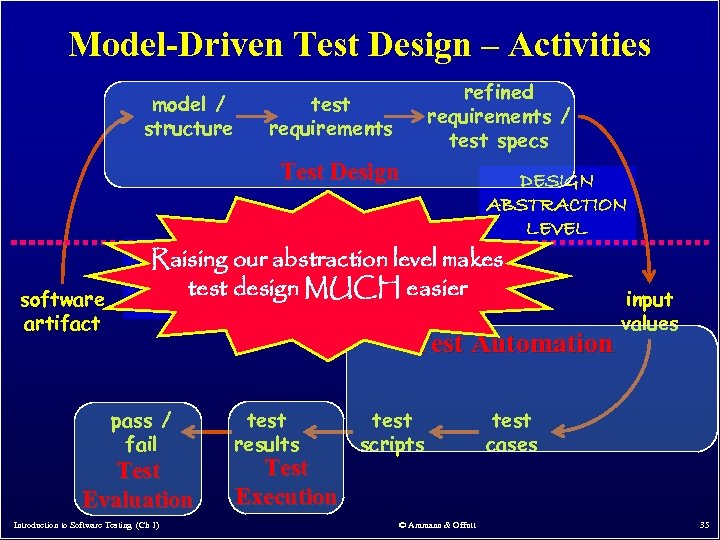 Model-Driven Test Design – Activities model / structure refined requirements / test specs test requirements Test Design software artifact DESIGN ABSTRACTION LEVEL IMPLEMENTATION Raising our abstraction level makes ABSTRACTION test design MUCH easier LEVEL Test Automation pass / fail Test Evaluation Introduction to Software Testing (Ch 1) test results Test Execution test scripts © Ammann & Offutt input values test cases 35
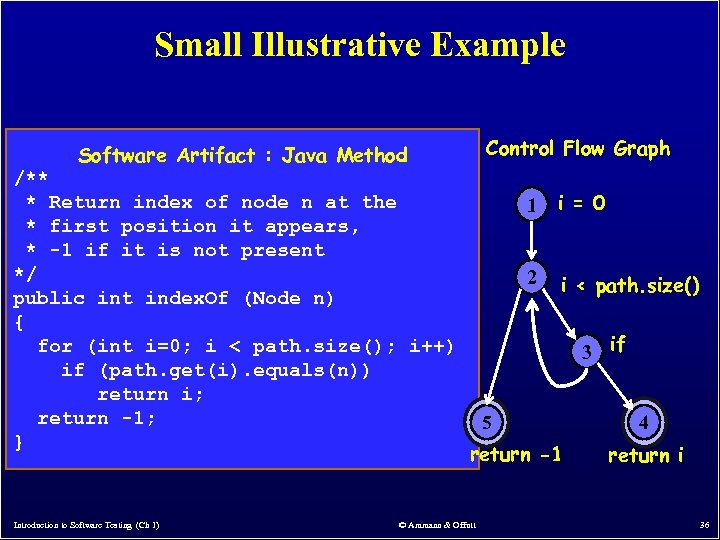 Small Illustrative Example Control Flow Graph Software Artifact : Java Method /** * Return index of node n at the * first position it appears, * -1 if it is not present */ public int index. Of (Node n) { for (int i=0; i < path. size(); i++) if (path. get(i). equals(n)) return i; return -1; } Introduction to Software Testing (Ch 1) 1 i = 0 2 i < path. size() 3 if 5 return -1 © Ammann & Offutt 4 return i 36
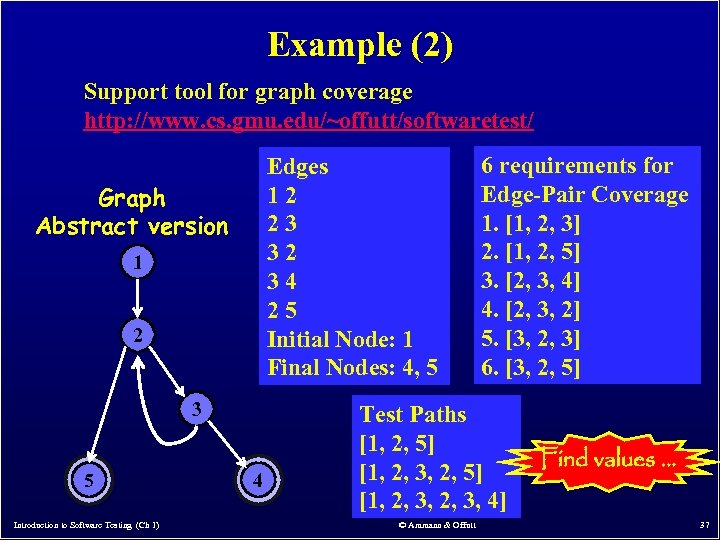 Example (2) Support tool for graph coverage http: //www. cs. gmu. edu/~offutt/softwaretest/ Edges 12 23 32 34 25 Initial Node: 1 Final Nodes: 4, 5 Graph Abstract version 1 2 3 5 Introduction to Software Testing (Ch 1) 4 6 requirements for Edge-Pair Coverage 1. [1, 2, 3] 2. [1, 2, 5] 3. [2, 3, 4] 4. [2, 3, 2] 5. [3, 2, 3] 6. [3, 2, 5] Test Paths [1, 2, 5] [1, 2, 3, 4] © Ammann & Offutt Find values … 37
 Types of Activities in the Book Most of this book is on test design Other activities are well covered elsewhere Introduction to Software Testing (Ch 1) © Ammann & Offutt 38
 OUTLINE 1. Spectacular Software Failures 2. Why Test? 3. What Do We Do When We Test ? • Test Activities and Model-Driven Testing 4. Software Testing Terminology 5. Changing Notions of Testing 6. Test Maturity Levels 7. Summary Introduction to Software Testing (Ch 1) © Ammann & Offutt 39
 Software Testing Terms n Like any field, software testing comes with a large number of specialized terms that have particular meanings in this context n Some of the following terms are standardized, some are used consistently throughout the literature and the industry, but some vary by author, topic, or test organization n The definitions here are intended to be the most commonly used Introduction to Software Testing (Ch 1) © Ammann & Offutt 40
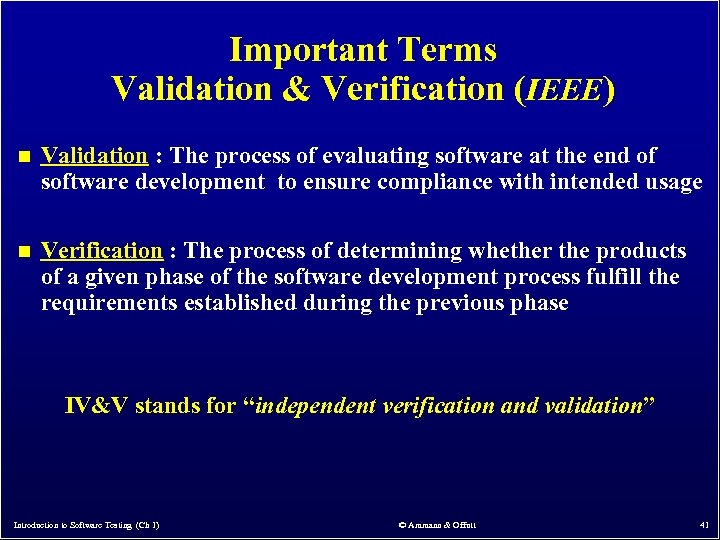 Important Terms Validation & Verification (IEEE) n Validation : The process of evaluating software at the end of software development to ensure compliance with intended usage n Verification : The process of determining whether the products of a given phase of the software development process fulfill the requirements established during the previous phase IV&V stands for “independent verification and validation” Introduction to Software Testing (Ch 1) © Ammann & Offutt 41
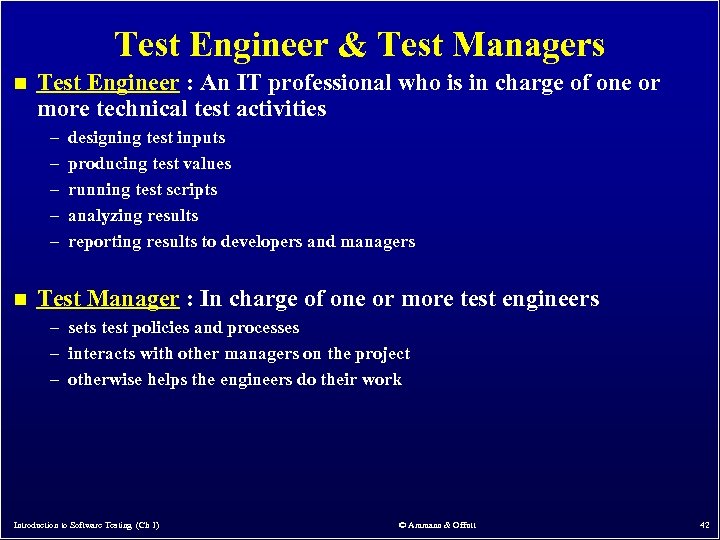 Test Engineer & Test Managers n Test Engineer : An IT professional who is in charge of one or more technical test activities – – – n designing test inputs producing test values running test scripts analyzing results reporting results to developers and managers Test Manager : In charge of one or more test engineers – sets test policies and processes – interacts with other managers on the project – otherwise helps the engineers do their work Introduction to Software Testing (Ch 1) © Ammann & Offutt 42
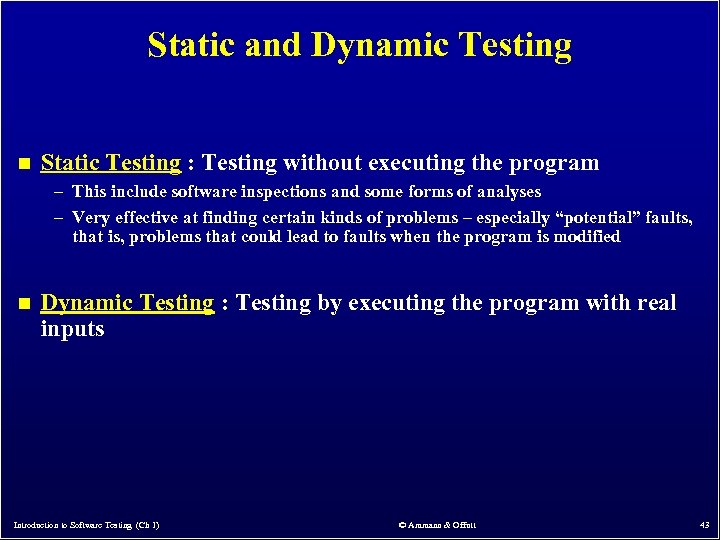 Static and Dynamic Testing n Static Testing : Testing without executing the program – This include software inspections and some forms of analyses – Very effective at finding certain kinds of problems – especially “potential” faults, that is, problems that could lead to faults when the program is modified n Dynamic Testing : Testing by executing the program with real inputs Introduction to Software Testing (Ch 1) © Ammann & Offutt 43
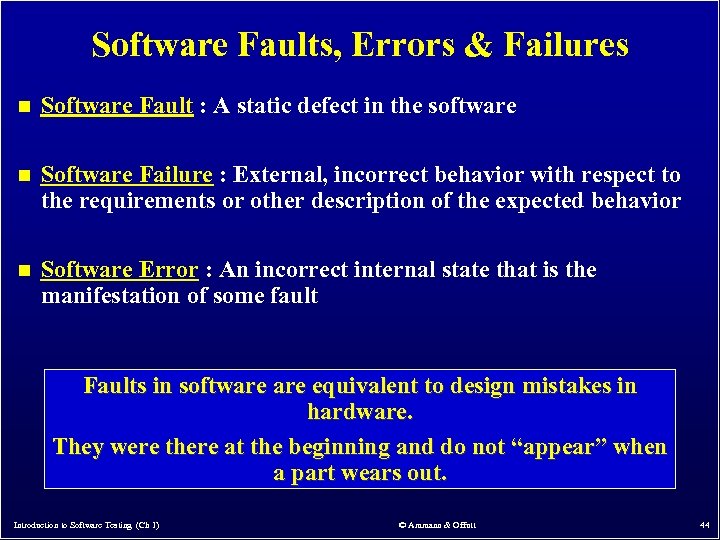 Software Faults, Errors & Failures n Software Fault : A static defect in the software n Software Failure : External, incorrect behavior with respect to the requirements or other description of the expected behavior n Software Error : An incorrect internal state that is the manifestation of some fault Faults in software equivalent to design mistakes in hardware. They were there at the beginning and do not “appear” when a part wears out. Introduction to Software Testing (Ch 1) © Ammann & Offutt 44
 Testing & Debugging n Testing : Finding inputs that cause the software to fail n Debugging : The process of finding a fault given a failure Introduction to Software Testing (Ch 1) © Ammann & Offutt 45
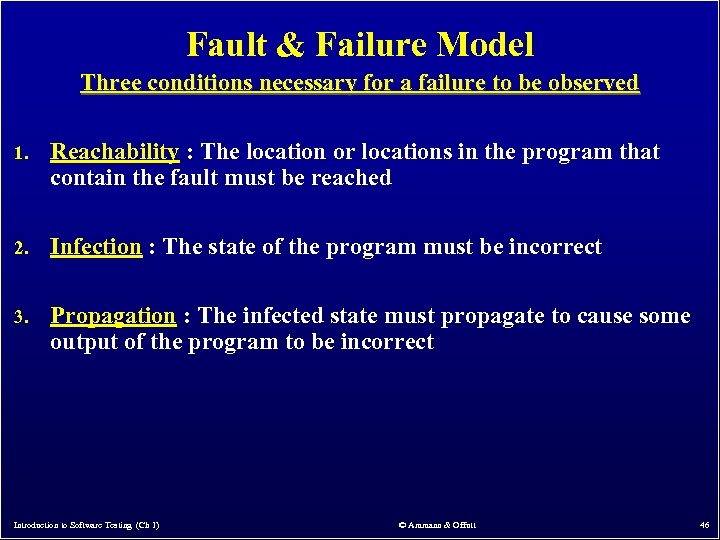 Fault & Failure Model Three conditions necessary for a failure to be observed 1. Reachability : The location or locations in the program that contain the fault must be reached 2. Infection : The state of the program must be incorrect 3. Propagation : The infected state must propagate to cause some output of the program to be incorrect Introduction to Software Testing (Ch 1) © Ammann & Offutt 46
 Test Case n Test Case Values : The values that directly satisfy one test requirement n Expected Results : The result that will be produced when executing the test if the program satisfies it intended behavior Introduction to Software Testing (Ch 1) © Ammann & Offutt 47
 Observability and Controllability n Software Observability : How easy it is to observe the behavior of a program in terms of its outputs, effects on the environment and other hardware and software components – Software that affects hardware devices, databases, or remote files have low observability n Software Controllability : How easy it is to provide a program with the needed inputs, in terms of values, operations, and behaviors – Easy to control software with inputs from keyboards – Inputs from hardware sensors or distributed software is harder – Data abstraction reduces controllability and observability Introduction to Software Testing (Ch 1) © Ammann & Offutt 48
 Inputs to Affect Controllability and Observability n Prefix Values : Any inputs necessary to put the software into the appropriate state to receive the test case values n Postfix Values : Any inputs that need to be sent to the software after the test case values n Two types of postfix values 1. Verification Values : Values necessary to see the results of the test case values 2. Exit Commands : Values needed to terminate the program or otherwise return it to a stable state n Executable Test Script : A test case that is prepared in a form to be executed automatically on the test software and produce a report Introduction to Software Testing (Ch 1) © Ammann & Offutt 49
 Stress Testing Tests that are at the limit of the software’s expected input domain Very large numeric values (or very small) n Very long strings, empty strings n Null references n Very large files n Many users making requests at the same time n Invalid values n Introduction to Software Testing (Ch 1) © Ammann & Offutt 50
 Top-Down and Bottom-Up Testing n Top-Down Testing : Test the main procedure, then go down through procedures it calls, and so on n Bottom-Up Testing : Test the leaves in the tree (procedures that make no calls), and move up to the root. – Each procedure is not tested until all of its children have been tested Introduction to Software Testing (Ch 1) © Ammann & Offutt 51
 White-box and Black-box Testing n n n Black-box testing : Deriving tests from external descriptions of the software, including specifications, requirements, and design White-box testing : Deriving tests from the source code internals of the software, specifically including branches, individual conditions, and statements Model-based testing : Deriving tests from a model of the software (such as a UML diagram MDTD makes these distinctions less important. The more general question is: from what level of abstraction to we derive tests? Introduction to Software Testing (Ch 1) © Ammann & Offutt 52
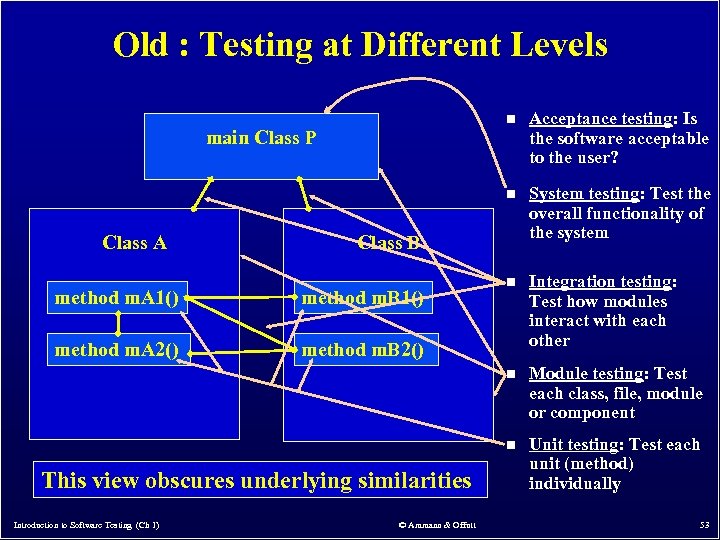 Old : Testing at Different Levels n n n Integration testing: Test how modules interact with each other Module testing: Test each class, file, module or component n Class A System testing: Test the overall functionality of the system n main Class P Acceptance testing: Is the software acceptable to the user? Unit testing: Test each unit (method) individually Class B method m. A 1() method m. B 1() method m. A 2() method m. B 2() This view obscures underlying similarities Introduction to Software Testing (Ch 1) © Ammann & Offutt 53
 OUTLINE 1. Spectacular Software Failures 2. Why Test? 3. What Do We Do When We Test ? • Test Activities and Model-Driven Testing 4. Software Testing Terminology 5. Changing Notions of Testing 6. Test Maturity Levels 7. Summary Introduction to Software Testing (Ch 1) © Ammann & Offutt 54
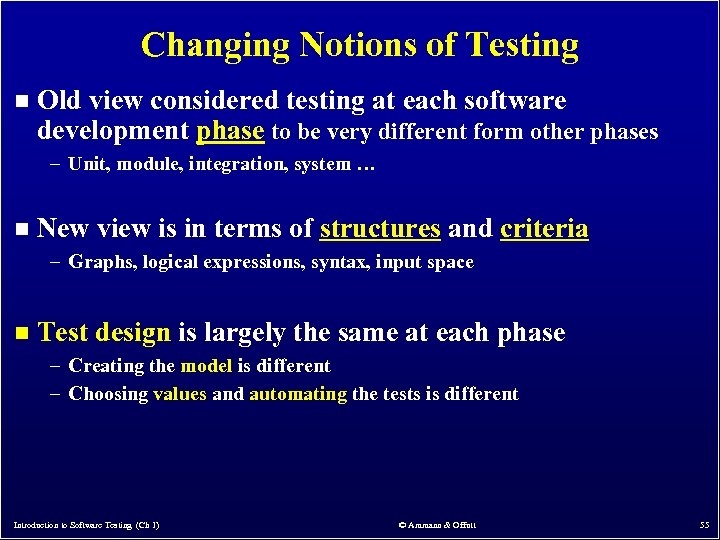 Changing Notions of Testing n Old view considered testing at each software development phase to be very different form other phases – Unit, module, integration, system … n New view is in terms of structures and criteria – Graphs, logical expressions, syntax, input space n Test design is largely the same at each phase – Creating the model is different – Choosing values and automating the tests is different Introduction to Software Testing (Ch 1) © Ammann & Offutt 55
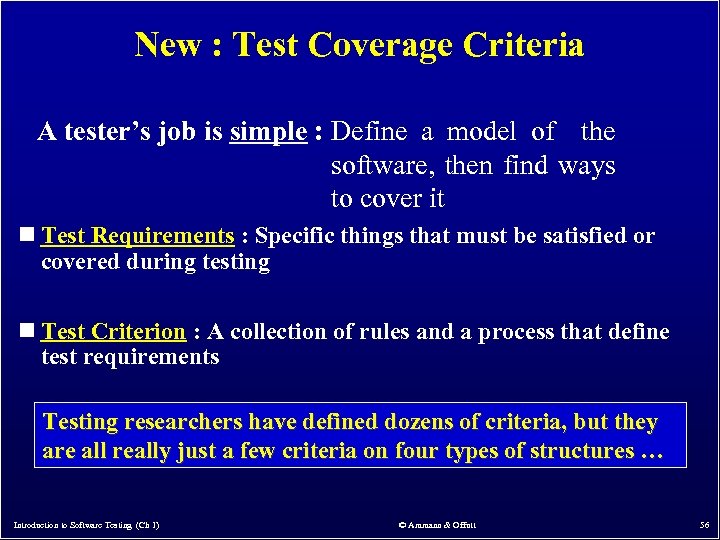 New : Test Coverage Criteria A tester’s job is simple : Define a model of the software, then find ways to cover it g Test Requirements : Specific things that must be satisfied or covered during testing g Test Criterion : A collection of rules and a process that define test requirements Testing researchers have defined dozens of criteria, but they are all really just a few criteria on four types of structures … Introduction to Software Testing (Ch 1) © Ammann & Offutt 56
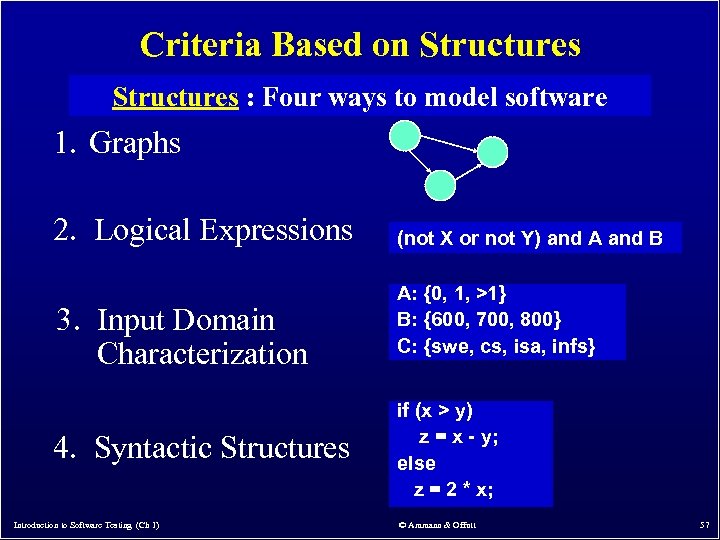 Criteria Based on Structures : Four ways to model software 1. Graphs 2. Logical Expressions 3. Input Domain Characterization 4. Syntactic Structures Introduction to Software Testing (Ch 1) (not X or not Y) and A and B A: {0, 1, >1} B: {600, 700, 800} C: {swe, cs, isa, infs} if (x > y) z = x - y; else z = 2 * x; © Ammann & Offutt 57
 Source of Structures n These structures can be extracted from lots of software artifacts – Graphs can be extracted from UML use cases, finite state machines, source code, … – Logical expressions can be extracted from decisions in program source, guards on transitions, conditionals in use cases, … n This is not the same as “model-based testing, ” which derives tests from a model that describes some aspects of the system under test – The model usually describes part of the behavior – The source is usually not considered a model Introduction to Software Testing (Ch 1) © Ammann & Offutt 58
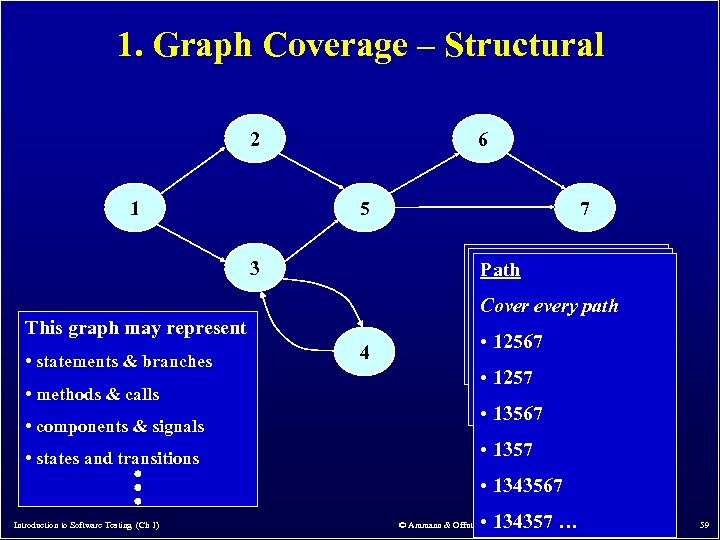 1. Graph Coverage – Structural 2 1 6 5 Node (Statement) Edge (Branch) Path Cover every node Cover every edge Cover every path 3 This graph may represent • statements & branches • methods & calls 7 4 • • • 12567 • • • 1343567 1257 • • 1357 13567 • components & signals • 1357 • states and transitions • 1343567 Introduction to Software Testing (Ch 1) © Ammann & Offutt • 134357 … 59
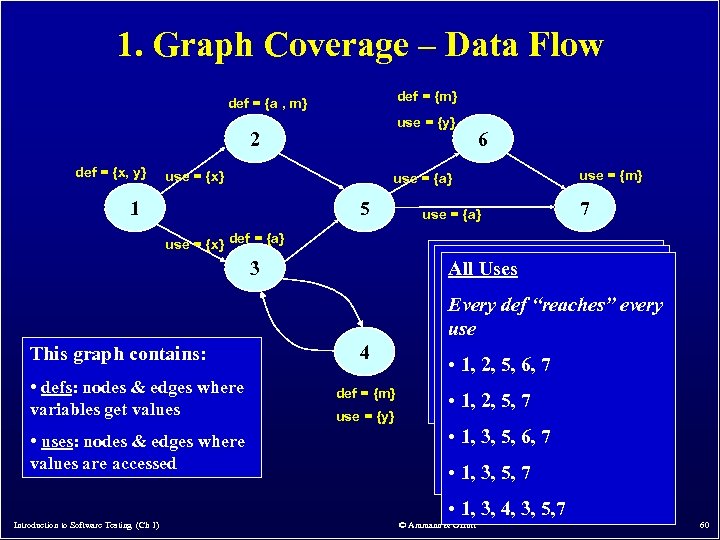 1. Graph Coverage – Data Flow def = {m} def = {a , m} use = {y} 2 def = {x, y} use = {x} 6 use = {a} 1 5 use = {x} def = {a} use = {m} 7 Defs All & Uses Pairs All Uses • Every(1, 2)), (x, 1, (1, 3)) (x, 1, def used once Every def “reaches” every 3 • (y, 1, 4), (y, 1, 6) use This graph contains: • defs: nodes & edges where variables get values • uses: nodes & edges where values are accessed 4 def = {m} use = {y} • 1, 2, 5, 6, 7 • (a, 2, (5, 6)), (a, 2, (5, 7)), (a, 1, 2, 5, • • 1, 2, 5, 76, 7 3, (5, 6)), (a, 3, (5, 7)), • 1, 2, 7), (m, 7 1, 2, 5, 7 • • (m, 3, 4, 3, 5, 4, 7), (m, 6, 7) • 1, 3, 5, 6, 7 • 1, 3, 5, 7 • 1, 3, 4, 3, 5, 7 Introduction to Software Testing (Ch 1) © Ammann & Offutt 60
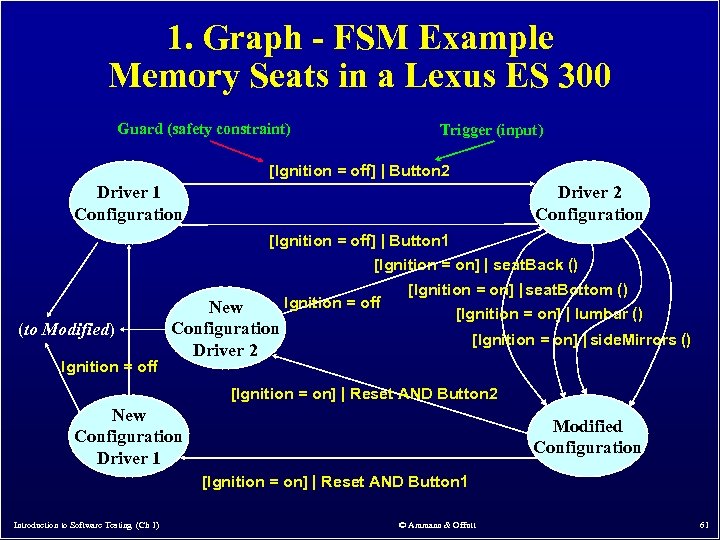 1. Graph - FSM Example Memory Seats in a Lexus ES 300 Guard (safety constraint) Trigger (input) [Ignition = off] | Button 2 Driver 2 Configuration Driver 1 Configuration [Ignition = off] | Button 1 [Ignition = on] | seat. Back () (to Modified) Ignition = off New Configuration Driver 2 Ignition = off [Ignition = on] | seat. Bottom () [Ignition = on] | lumbar () [Ignition = on] | side. Mirrors () [Ignition = on] | Reset AND Button 2 New Configuration Driver 1 Modified Configuration [Ignition = on] | Reset AND Button 1 Introduction to Software Testing (Ch 1) © Ammann & Offutt 61
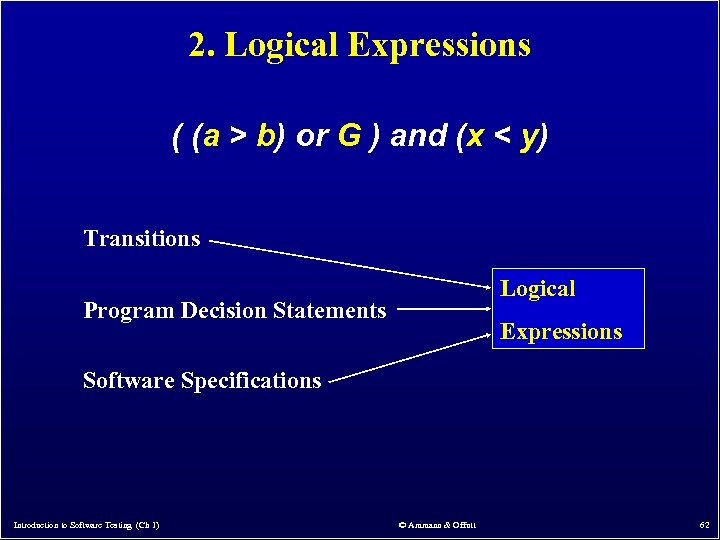 2. Logical Expressions ( (a > b) or G ) and (x < y) Transitions Logical Program Decision Statements Expressions Software Specifications Introduction to Software Testing (Ch 1) © Ammann & Offutt 62
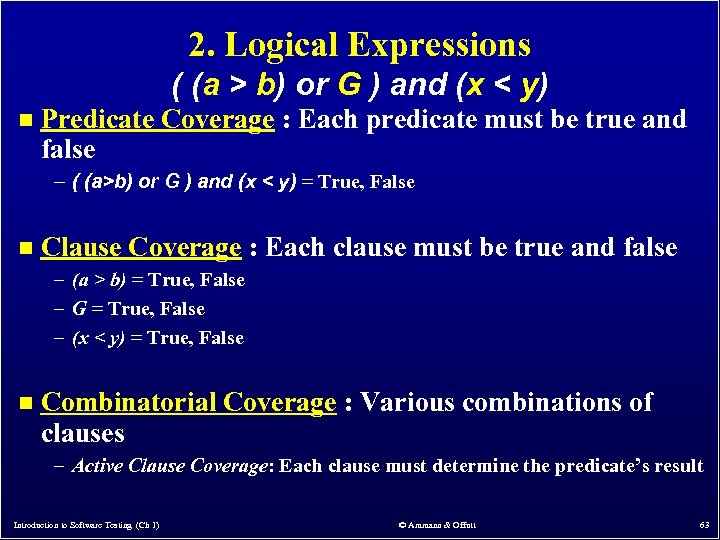 2. Logical Expressions ( (a > b) or G ) and (x < y) n Predicate Coverage : Each predicate must be true and false – ( (a>b) or G ) and (x < y) = True, False n Clause Coverage : Each clause must be true and false – (a > b) = True, False – G = True, False – (x < y) = True, False n Combinatorial Coverage : Various combinations of clauses – Active Clause Coverage: Each clause must determine the predicate’s result Introduction to Software Testing (Ch 1) © Ammann & Offutt 63
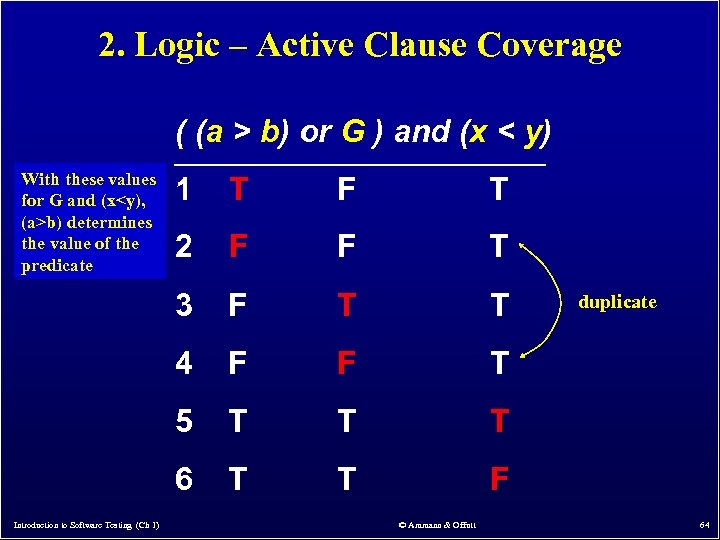 2. Logic – Active Clause Coverage ( (a > b) or G ) and (x < y) With these values for G and (x
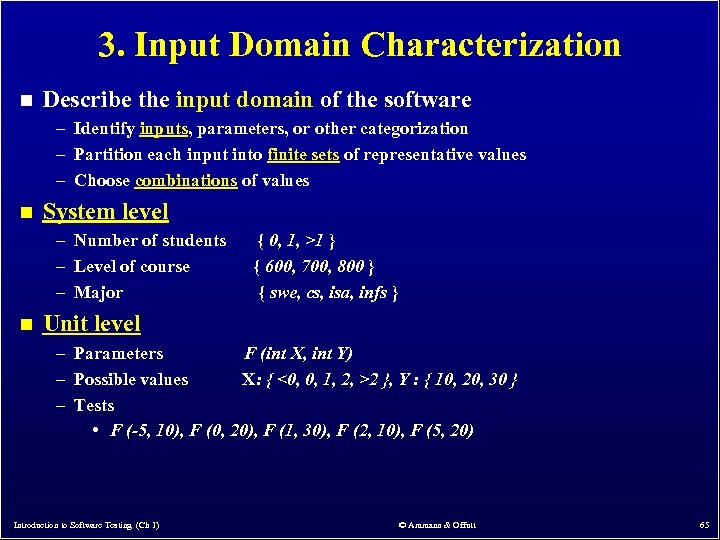 3. Input Domain Characterization n Describe the input domain of the software – Identify inputs, parameters, or other categorization – Partition each input into finite sets of representative values – Choose combinations of values n System level – Number of students – Level of course – Major n { 0, 1, >1 } { 600, 700, 800 } { swe, cs, isa, infs } Unit level – Parameters F (int X, int Y) – Possible values X: { <0, 0, 1, 2, >2 }, Y : { 10, 20, 30 } – Tests • F (-5, 10), F (0, 20), F (1, 30), F (2, 10), F (5, 20) Introduction to Software Testing (Ch 1) © Ammann & Offutt 65
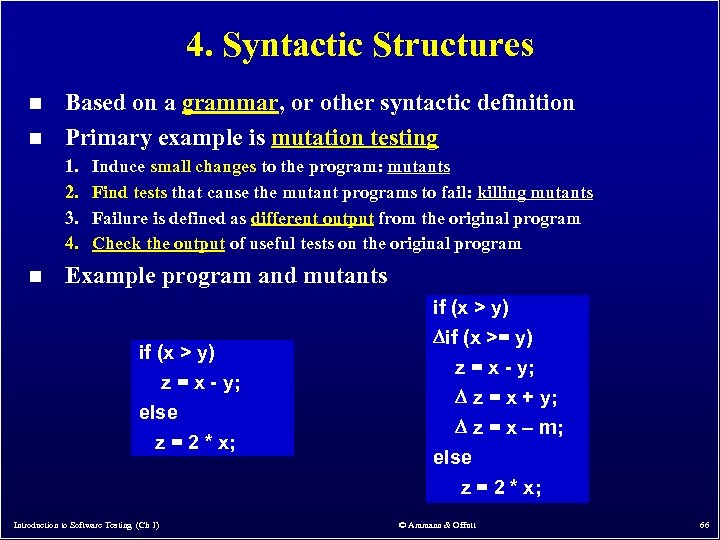 4. Syntactic Structures n n Based on a grammar, or other syntactic definition Primary example is mutation testing 1. 2. 3. 4. n Induce small changes to the program: mutants Find tests that cause the mutant programs to fail: killing mutants Failure is defined as different output from the original program Check the output of useful tests on the original program Example program and mutants if (x > y) z = x - y; else z = 2 * x; Introduction to Software Testing (Ch 1) if (x > y) if (x >= y) z = x - y; z = x + y; z = x – m; else z = 2 * x; © Ammann & Offutt 66
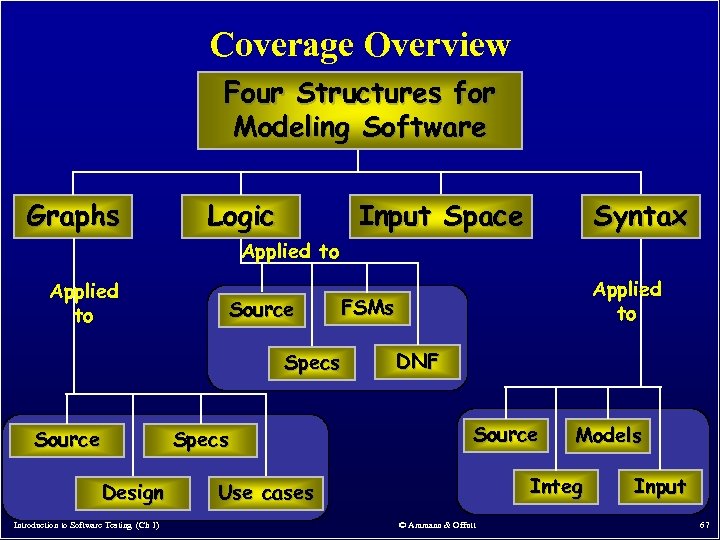 Coverage Overview Four Structures for Modeling Software Graphs Logic Input Space Syntax Applied to Source FSMs Specs Source Specs Design Introduction to Software Testing (Ch 1) Applied to DNF Source Models Integ Use cases © Ammann & Offutt Input 67
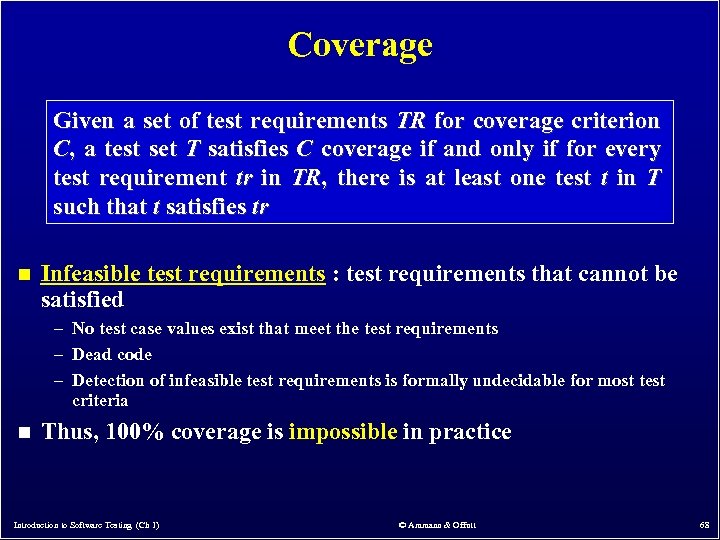 Coverage Given a set of test requirements TR for coverage criterion C, a test set T satisfies C coverage if and only if for every test requirement tr in TR, there is at least one test t in T such that t satisfies tr n Infeasible test requirements : test requirements that cannot be satisfied – No test case values exist that meet the test requirements – Dead code – Detection of infeasible test requirements is formally undecidable for most test criteria n Thus, 100% coverage is impossible in practice Introduction to Software Testing (Ch 1) © Ammann & Offutt 68
 Two Ways to Use Test Criteria 1. Directly generate test values to satisfy the criterion often assumed by the research community most obvious way to use criteria very hard without automated tools 2. Generate test values externally and measure against the criterion usually favored by industry – sometimes misleading – if tests do not reach 100% coverage, what does that mean? Test criteria are sometimes called metrics Introduction to Software Testing (Ch 1) © Ammann & Offutt 69
 Generators and Recognizers Generator : A procedure that automatically generates values to satisfy a criterion n Recognizer : A procedure that decides whether a given set of test values satisfies a criterion n Both problems are provably undecidable for most criteria n It is possible to recognize whether test cases satisfy a criterion far more often than it is possible to generate tests that satisfy the criterion n Coverage analysis tools are quite plentiful n Introduction to Software Testing (Ch 1) © Ammann & Offutt 70
 Comparing Criteria with Subsumption n Criteria Subsumption : A test criterion C 1 subsumes C 2 if and only if every set of test cases that satisfies criterion C 1 also satisfies C 2 n Must be true for every set of test cases Example : If a test set has covered every branch in a program (satisfied the branch criterion), then the test set is guaranteed to also have covered every statement n Introduction to Software Testing (Ch 1) © Ammann & Offutt 71
 Test Coverage Criteria Traditional software testing is expensive and laborintensive n Formal coverage criteria are used to decide which test inputs to use n More likely that the tester will find problems n Greater assurance that the software is of high quality and reliability n A goal or stopping rule for testing n Criteria makes testing more efficient and effective n But how do we start to apply these ideas in practice? Introduction to Software Testing (Ch 1) © Ammann & Offutt 72
 OUTLINE 1. Spectacular Software Failures 2. Why Test? 3. What Do We Do When We Test ? • Test Activities and Model-Driven Testing 4. Software Testing Terminology 5. Changing Notions of Testing 6. Test Maturity Levels 7. Summary Introduction to Software Testing (Ch 1) © Ammann & Offutt 73
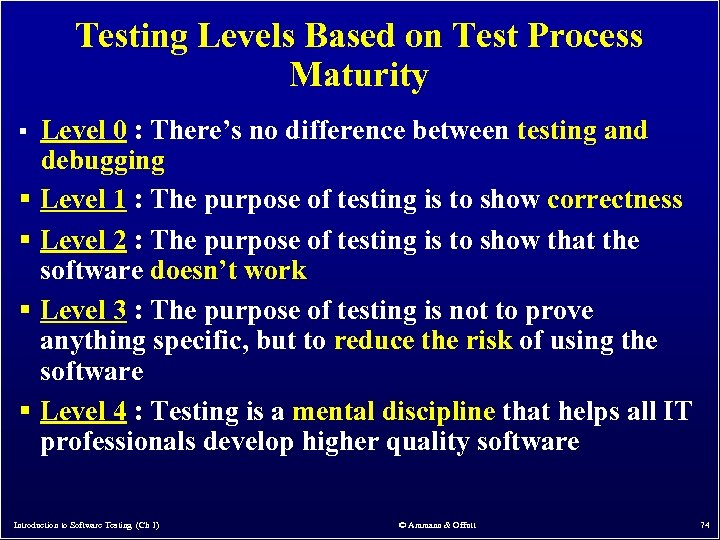 Testing Levels Based on Test Process Maturity § § § Level 0 : There’s no difference between testing and debugging Level 1 : The purpose of testing is to show correctness Level 2 : The purpose of testing is to show that the software doesn’t work Level 3 : The purpose of testing is not to prove anything specific, but to reduce the risk of using the software Level 4 : Testing is a mental discipline that helps all IT professionals develop higher quality software Introduction to Software Testing (Ch 1) © Ammann & Offutt 74
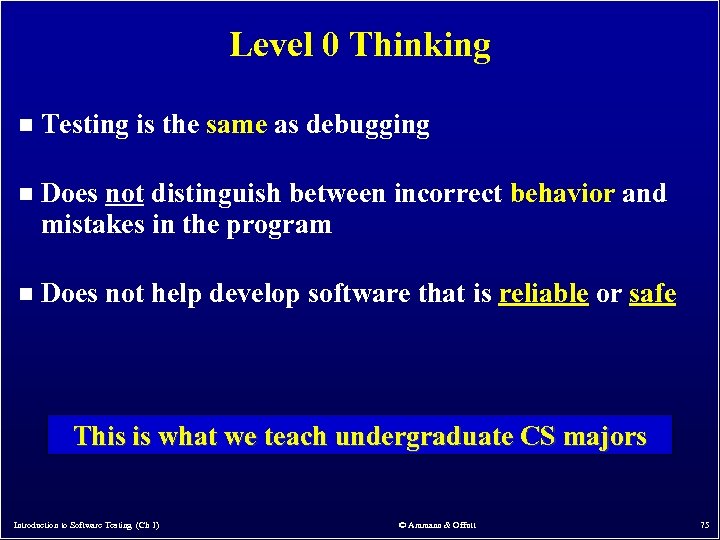 Level 0 Thinking n Testing is the same as debugging n Does not distinguish between incorrect behavior and mistakes in the program n Does not help develop software that is reliable or safe This is what we teach undergraduate CS majors Introduction to Software Testing (Ch 1) © Ammann & Offutt 75
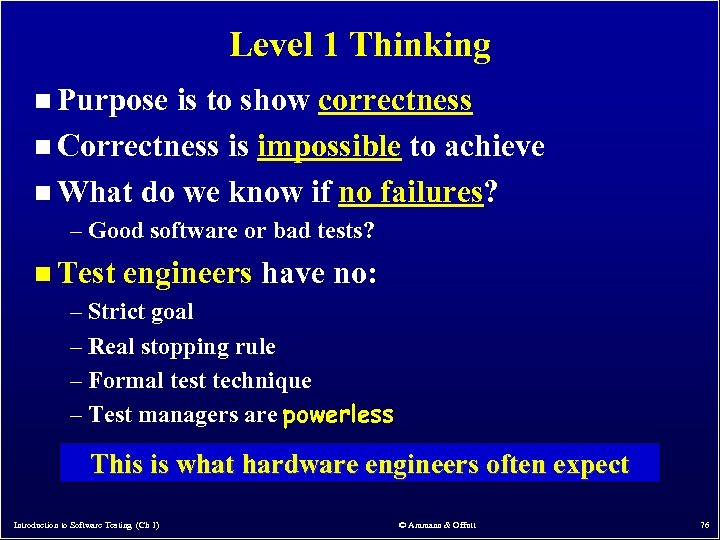 Level 1 Thinking n Purpose is to show correctness n Correctness is impossible to achieve n What do we know if no failures? – Good software or bad tests? n Test engineers have no: – Strict goal – Real stopping rule – Formal test technique – Test managers are powerless This is what hardware engineers often expect Introduction to Software Testing (Ch 1) © Ammann & Offutt 76
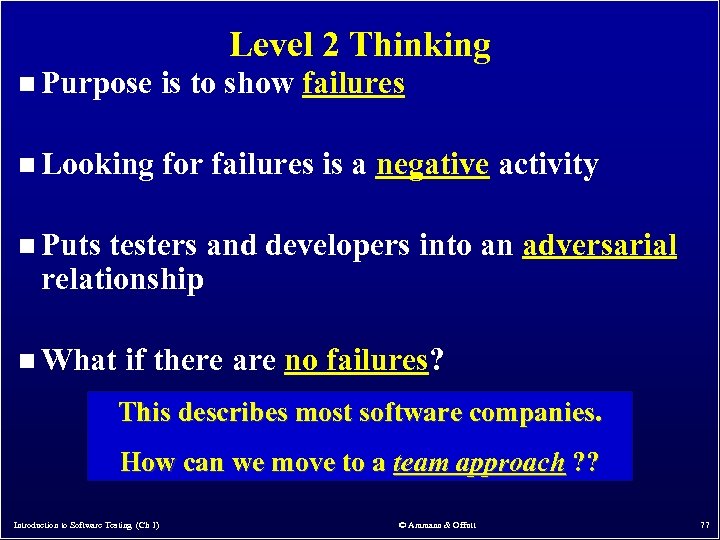 Level 2 Thinking n Purpose is to show failures n Looking for failures is a negative activity n Puts testers and developers into an adversarial relationship n What if there are no failures? This describes most software companies. How can we move to a team approach ? ? Introduction to Software Testing (Ch 1) © Ammann & Offutt 77
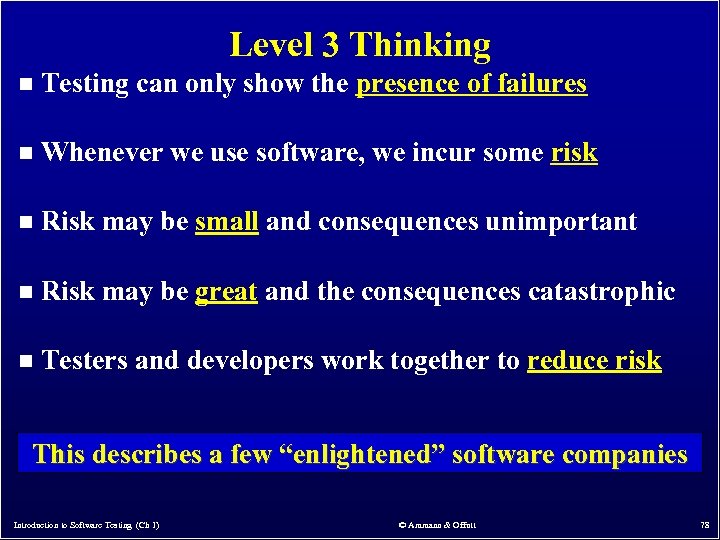 Level 3 Thinking n Testing can only show the presence of failures n Whenever we use software, we incur some risk n Risk may be small and consequences unimportant n Risk may be great and the consequences catastrophic n Testers and developers work together to reduce risk This describes a few “enlightened” software companies Introduction to Software Testing (Ch 1) © Ammann & Offutt 78
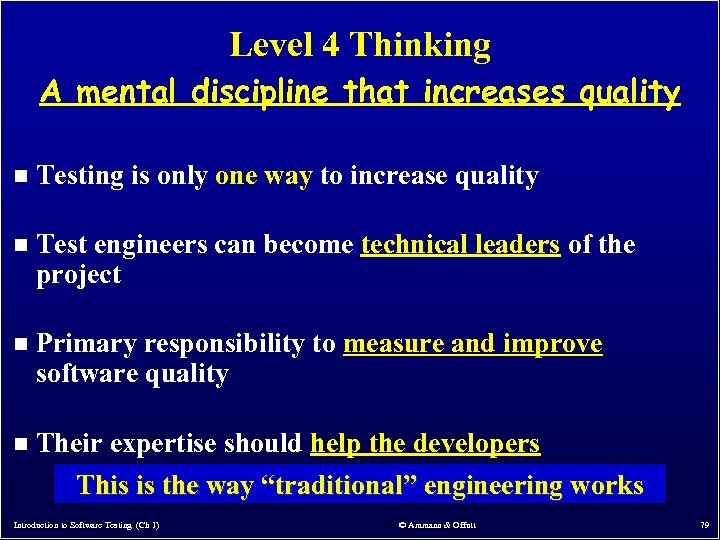 Level 4 Thinking A mental discipline that increases quality n Testing is only one way to increase quality n Test engineers can become technical leaders of the project n Primary responsibility to measure and improve software quality n Their expertise should help the developers This is the way “traditional” engineering works Introduction to Software Testing (Ch 1) © Ammann & Offutt 79
 OUTLINE 1. Spectacular Software Failures 2. Why Test? 3. What Do We Do When We Test ? • Test Activities and Model-Driven Testing 4. Software Testing Terminology 5. Changing Notions of Testing 6. Test Maturity Levels 7. Summary Introduction to Software Testing (Ch 1) © Ammann & Offutt 80
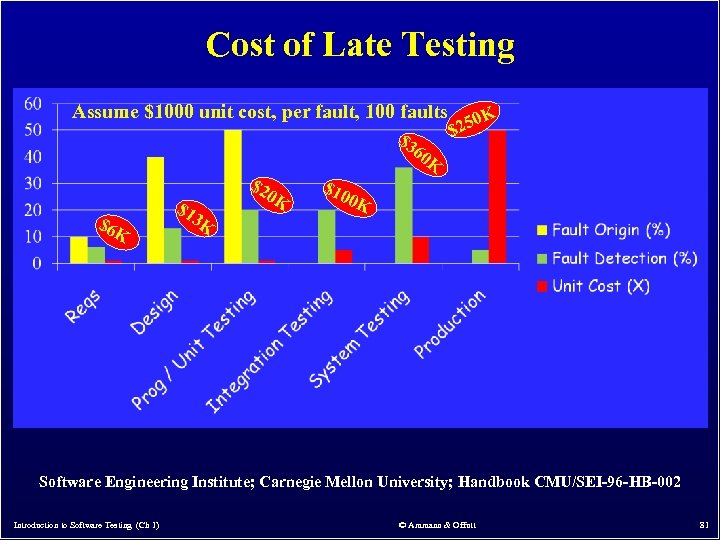 Cost of Late Testing Assume $1000 unit cost, per fault, 100 faults $3 60 $1 $2 $6 K 3 K 0 K K 0 $25 K $10 0 K Software Engineering Institute; Carnegie Mellon University; Handbook CMU/SEI-96 -HB-002 Introduction to Software Testing (Ch 1) © Ammann & Offutt 81
 How to Improve Testing ? Testers need more and better software tools n Testers need to adopt practices and techniques that lead to more efficient and effective testing n – More education – Different management organizational strategies n Testing / QA teams need more technical expertise – Developer expertise has been increasing dramatically n Testing / QA teams need to specialize more – This same trend happened for development in the 1990 s Introduction to Software Testing (Ch 1) © Ammann & Offutt 82
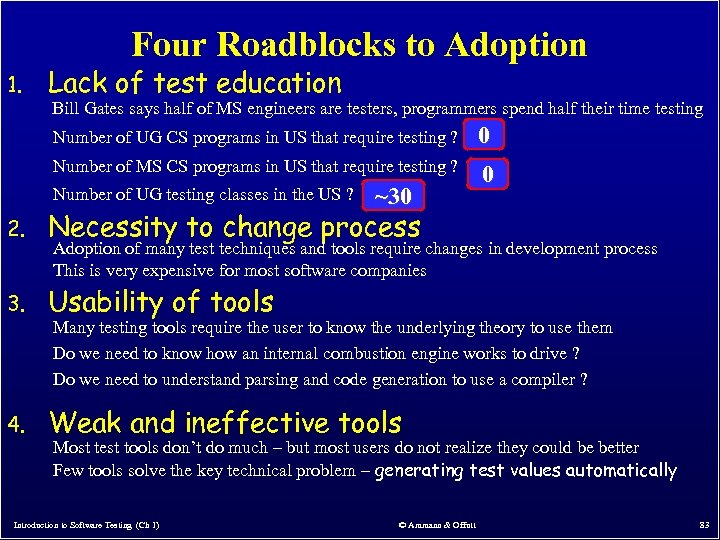 Four Roadblocks to Adoption 1. Lack of test education Bill Gates says half of MS engineers are testers, programmers spend half their time testing Number of UG CS programs in US that require testing ? 0 Number of MS CS programs in US that require testing ? 0 Number of UG testing classes in the US ? ~30 2. Necessity to change process 3. Usability of tools Adoption of many test techniques and tools require changes in development process This is very expensive for most software companies Many testing tools require the user to know the underlying theory to use them Do we need to know how an internal combustion engine works to drive ? Do we need to understand parsing and code generation to use a compiler ? 4. Weak and ineffective tools Most test tools don’t do much – but most users do not realize they could be better Few tools solve the key technical problem – generating test values automatically Introduction to Software Testing (Ch 1) © Ammann & Offutt 83
 Needs From Researchers 1. 2. 3. 4. Isolate : Invent processes and techniques that isolate theory from most test practitioners Disguise : Discover engineering techniques, standards and frameworks that disguise theory Embed : Theoretical ideas in tools Experiment : Demonstrate economic value of criteria-based testing and ATDG (ROI) – – 5. Which criteria should be used and when ? When does the extra effort pay off ? Integrate high-end testing with development Introduction to Software Testing (Ch 1) © Ammann & Offutt 84
 Needs From Educators 1. 2. 3. Disguise theory from engineers in classes Omit theory when it is not needed Restructure curriculum to teach more than test design and theory – – Test automation Test evaluation Human-based testing Test-driven development Introduction to Software Testing (Ch 1) © Ammann & Offutt 85
 Changes in Practice 1. Reorganize test and QA teams to make effective use of individual abilities – Retrain test and QA teams 2. – – Use a process like MDTD Learn more testing concepts Encourage researchers to embed and isolate 3. – 4. One math-head can support many testers We are very responsive to research grants Get involved in curricular design efforts through industrial advisory boards Introduction to Software Testing (Ch 1) © Ammann & Offutt 86
 Future of Software Testing 1. 2. 3. 4. 5. 6. Increased specialization in testing teams will lead to more efficient and effective testing Testing and QA teams will have more technical expertise Developers will have more knowledge about testing and motivation to test better Agile processes put testing first—putting pressure on both testers and developers to test better Testing and security are starting to merge We will develop new ways to test connections within software-based systems Introduction to Software Testing (Ch 1) © Ammann & Offutt 87
 Advantages of Criteria-Based Test Design n Criteria maximize the “bang for the buck” – Fewer tests that are more effective at finding faults n n Comprehensive test set with minimal overlap Traceability from software artifacts to tests – The “why” for each test is answered – Built-in support for regression testing n n A “stopping rule” for testing—advance knowledge of how many tests are needed Natural to automate Introduction to Software Testing (Ch 1) © Ammann & Offutt 88
 Open Questions n Which criteria work best on embedded, highly reliable software? – Which software structure to use? n How can we best automate this testing with robust tools? – – – n n n Deriving the software structure Constructing the test requirements Creating values from test requirements Creating full test scripts Solution to the “mapping problem” Empirical validation Technology transition Application to new domains Introduction to Software Testing (Ch 1) © Ammann & Offutt 89
 Criteria Summary • Many companies still use “monkey testing” • A human sits at the keyboard, wiggles the mouse and bangs the keyboard • No automation • Minimal training required • Some companies automate human-designed tests • But companies that also use automation and criteriabased testing Save money Find more faults Build better software Introduction to Software Testing (Ch 1) © Ammann & Offutt 90
 Summary of Chapter 1’s New Ideas Why do we test – to reduce the risk of using the software n Four types of test activities – test design, automation, execution and evaluation n Software terms – faults, failures, the RIP model, observability and controllability n Four structures – test requirements and criteria n Test process maturity levels – level 4 is a mental discipline that improves the quality of the software n Earlier and better testing can empower the test manager Introduction to Software Testing (Ch 1) © Ammann & Offutt 91