


 Скачать презентацию Introduction to Software Engineering n Softwares n Importance
970a3554758434968d9eff1857f2aad1.ppt
- Количество слайдов: 15
 Introduction to Software Engineering n Softwares n Importance of SWE n Basic SWE Concepts 18 -Mar-18 Introduction to SWE 1
 What is a Software? n Software is a computer program with its documentation such as requirements, design models and user manuals. n Software products may be n n 18 -Mar-18 Generic - developed to be sold to a range of different customers e. g. general PC software such as Excel or Word. Bespoke (custom, tailored) - developed for a single customer according to their specification. Introduction to SWE 2
 Attributes of Good Software n A good software should n deliver the required functionality and performance to the user n be maintainable: can be evolved to meet changing needs; n be dependable: reliable and trustworthy n be efficient : should not waste the system resources n be acceptable by end-user, i. e. , usable, understandable and compatible with other systems. 18 -Mar-18 Introduction to SWE 3
 Software Crisis The notion of software engineering was first proposed in 1968 at a conference to discuss what was then called ‘software crisis’: n n n 18 -Mar-18 Informal (ad-hoc) software development Major projects were sometimes years late and over budget, Softwares were unreliable, difficult to maintain and performed poorly. Introduction to SWE 4
 Some Facts n Failed software projects in USA costs $81 bn annually. n http: //www. itcortex. com/Stat_Failure_Rate. htm n Failure can be severe and expensive. n Problems may happen during any stage of the Software development life-cycle. n Purpose of SWE is to avoid problems and hence failure 18 -Mar-18 Introduction to SWE 5
 Importance of SWE n The economies of ALL developed nations depends (somehow) on software. n More and more systems are software controlled n Software cost often dominate computer system costs. The costs of software on a PC are often greater than the hardware cost. n SWE develop theories, methods and tools that help to build cost-effective and highquality software. 18 -Mar-18 Introduction to SWE 6
 What is Software Engineering? n SWE is an engineering discipline that is concerned with all aspects of software production. n Software engineers should n n adopt a systematic and organised approach to their work, use appropriate tools and techniques depending on the problem to be solved (the development constraints + the resources available. ) 18 -Mar-18 Introduction to SWE 7
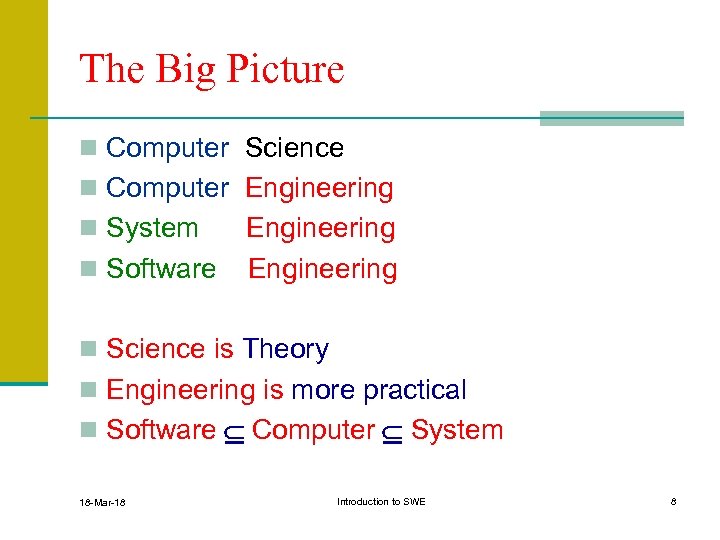 The Big Picture n Computer Science n Computer Engineering n System n Software Engineering n Science is Theory n Engineering is more practical n Software Computer System 18 -Mar-18 Introduction to SWE 8
 SWE vs. Computer Science n Computer science is concerned with theory and fundamentals n SWE is concerned with the practicalities of developing and delivering useful software. n Computer science theories are still insufficient to act as a complete foundation for software engineering. 18 -Mar-18 Introduction to SWE 9
 SWE vs. System Engineering n System engineering is concerned with all aspects of computer-based systems development including hardware, software and process engineering. n SWE is part of the process concerned with developing the software infrastructure, control, applications and databases in the system. n System engineers are involved in system specification, architectural design, integration and deployment. 18 -Mar-18 Introduction to SWE 10
 What is a Software Process (SP)? n SP is a set of activities whose goal is the development or evolution of software. n General activities in all SPs are: n n 18 -Mar-18 Specification: what should the system do and what are its development constraints? Development: production of the software Validation: checking that the software is what the customer wants Evolution: changing the software in response to changing demands. Introduction to SWE 11
 What is a Software Process Model (SPM)? n SPM is a simplified representation of a software process, presented from a specific perspective such as n n n Workflow perspective: sequence of activities; Data-flow perspective: information flow; Role/action perspective: who does what. n Examples of generic SPM n Waterfall n Iterative development n Component-based software engineering 18 -Mar-18 Introduction to SWE 12
 What is CASE? n CASE (Computer-Aided Software Engineering) are software systems that are intended to provide automated support for software process activities. n CASE are often used for method support. n n 18 -Mar-18 Upper-CASE: support the early process activities of requirements and design; Lower-CASE: support later activities such as programming, debugging and testing. Introduction to SWE 13
 Key Challenges Facing Software Engineering n Heterogeneity: developing techniques for building software that can cope with heterogeneous (different) platforms and execution environments n Delivery: developing techniques that lead to faster delivery of software n Trust: developing techniques that demonstrate that software can be trusted by its users. 18 -Mar-18 Introduction to SWE 14
 Summary n SWE is an engineering discipline that is concerned with all aspects of software production. n Software products consist of developed programs and associated documentation. Essential product attributes are maintainability, dependability, efficiency and acceptability. n SP consists of activities that are involved in developing softwares. Basic activities are software specification, development, validation and evolution. n CASE tools are software systems which are designed to support routine activities in the SP 18 -Mar-18 Introduction to SWE 15