 Скачать презентацию Introduction to Shibboleth SWITCHaai Team aai switch ch
24eff711bf7fffdb48464241c8a8022b.ppt
- Количество слайдов: 18



Introduction to Shibboleth SWITCHaai Team aai@switch. ch
Agenda • What is Shibboleth? • Id. P/SP Communication • Shibboleth 1 & 2 • Support Resources © 2012 SWITCH 2
Shibboleth – Origin and Consortium • The Origin • Internet 2 in the US launched the open source project • The name • Word Shibboleth was used to identify members of a group • The standard • Based on Security Assertion Markup Language (SAML) • The Consortium • The new home for Shibboleth development • collect financial contributions from deployers worldwide http: //shibboleth. net © 2012 SWITCH 3
What is Shibboleth? • Technically it’s a project group, like Apache or Eclipse, whose core team maintains a set of software components • Most people think of it as the set of software components • • • Open. SAML C++ and Java libraries Shibboleth Identity Provider (Id. P) Shibboleth Service Provider (SP) Shibboleth Discovery Service (DS) Shibboleth Metadata Aggregator (MA) • Taken together these components make up a federated identity management (FIM) platform. • You might also think of Shibboleth as a multi-protocol platform that enforces a consistent set of policies. © 2012 SWITCH 4
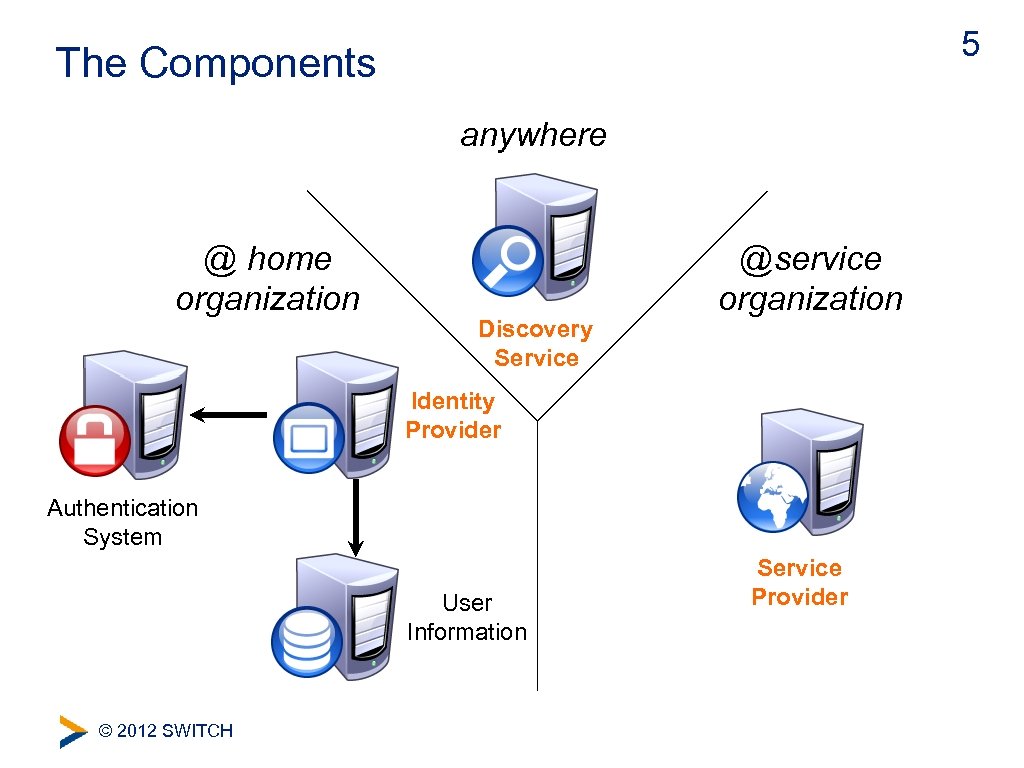
5 The Components anywhere @ home organization Discovery Service @service organization Identity Provider Authentication System User Information © 2012 SWITCH Service Provider
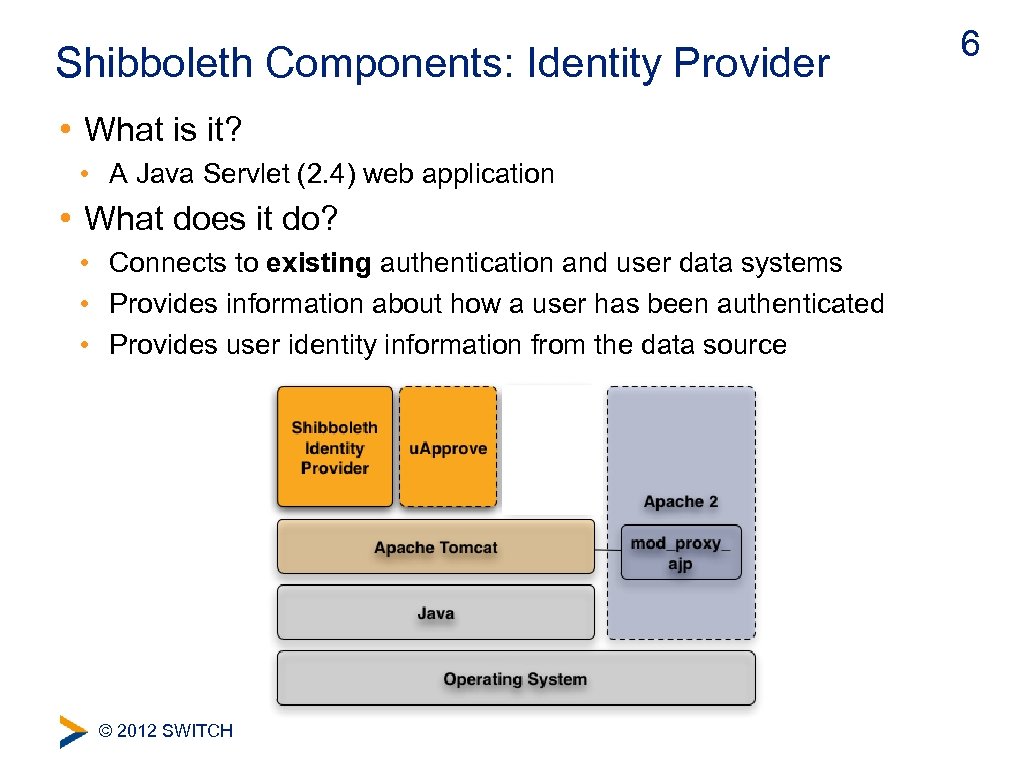
Shibboleth Components: Identity Provider • What is it? • A Java Servlet (2. 4) web application • What does it do? • Connects to existing authentication and user data systems • Provides information about how a user has been authenticated • Provides user identity information from the data source © 2012 SWITCH 6
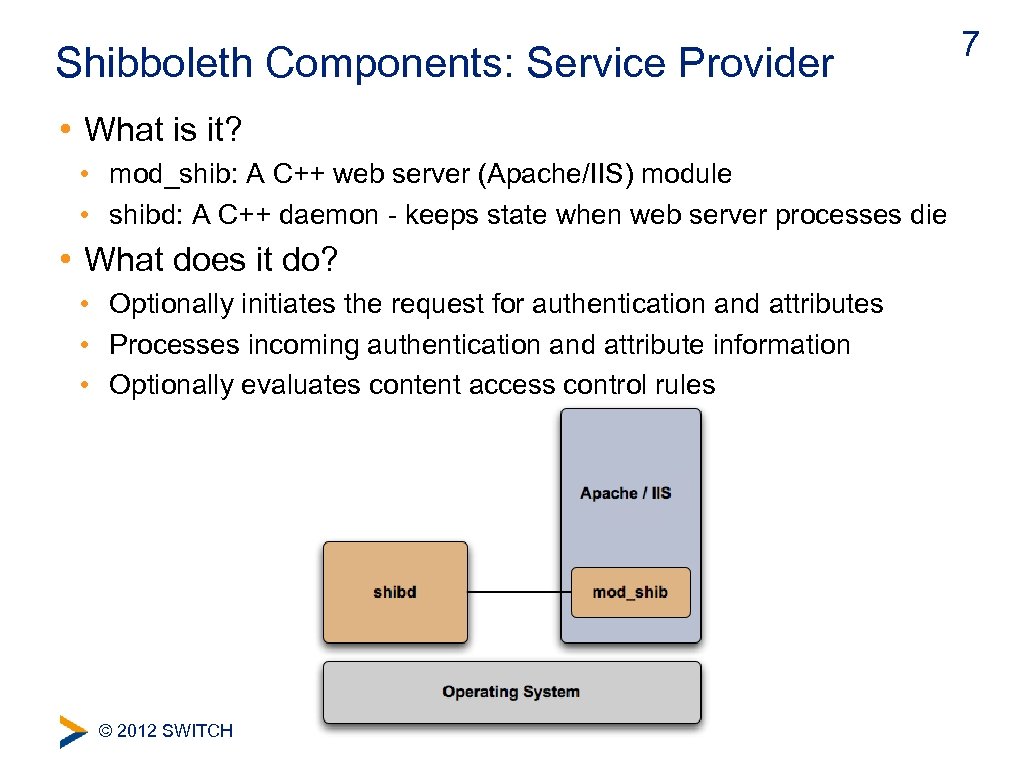
Shibboleth Components: Service Provider • What is it? • mod_shib: A C++ web server (Apache/IIS) module • shibd: A C++ daemon - keeps state when web server processes die • What does it do? • Optionally initiates the request for authentication and attributes • Processes incoming authentication and attribute information • Optionally evaluates content access control rules © 2012 SWITCH 7
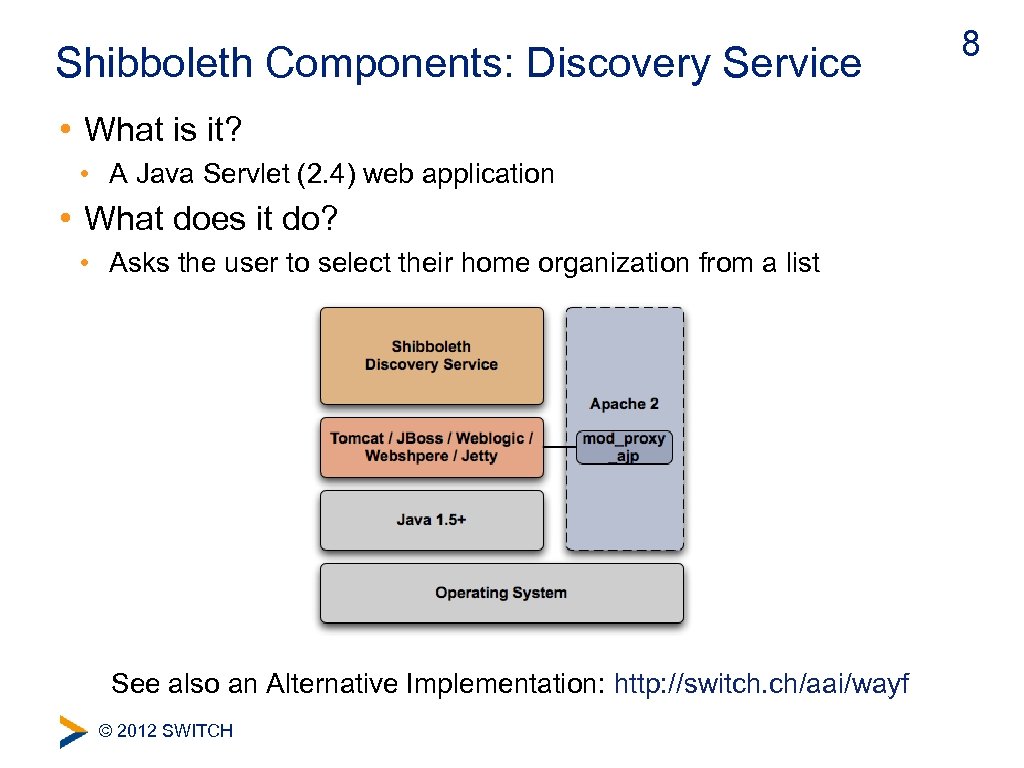
Shibboleth Components: Discovery Service • What is it? • A Java Servlet (2. 4) web application • What does it do? • Asks the user to select their home organization from a list See also an Alternative Implementation: http: //switch. ch/aai/wayf © 2012 SWITCH 8
Terminology (1) 9 • SAML - Security Assertion Markup Language The standard describing the XML messages sent back and forth by the Shibboleth components (two versions: 1. 1, 2. 0) • Profile - Standard describing how to use SAML to accomplish a specific task (e. g. SSO, attribute query) • Binding - Standard that describes how to take a profile message and send it over a specific transport (e. g. HTTP) • Front-channel - A binding that sends message through a user’s browser via redirects or form posts • Back-channel - A binding where the entities connect directly to each other © 2012 SWITCH
Terminology (2) • entity. ID - Unique identifier for an Id. P or SP • Assertion - The unit of information in SAML • Name. ID - An identifier by which an Id. P knows a user • Attribute - A named piece of information about a user © 2012 SWITCH 10
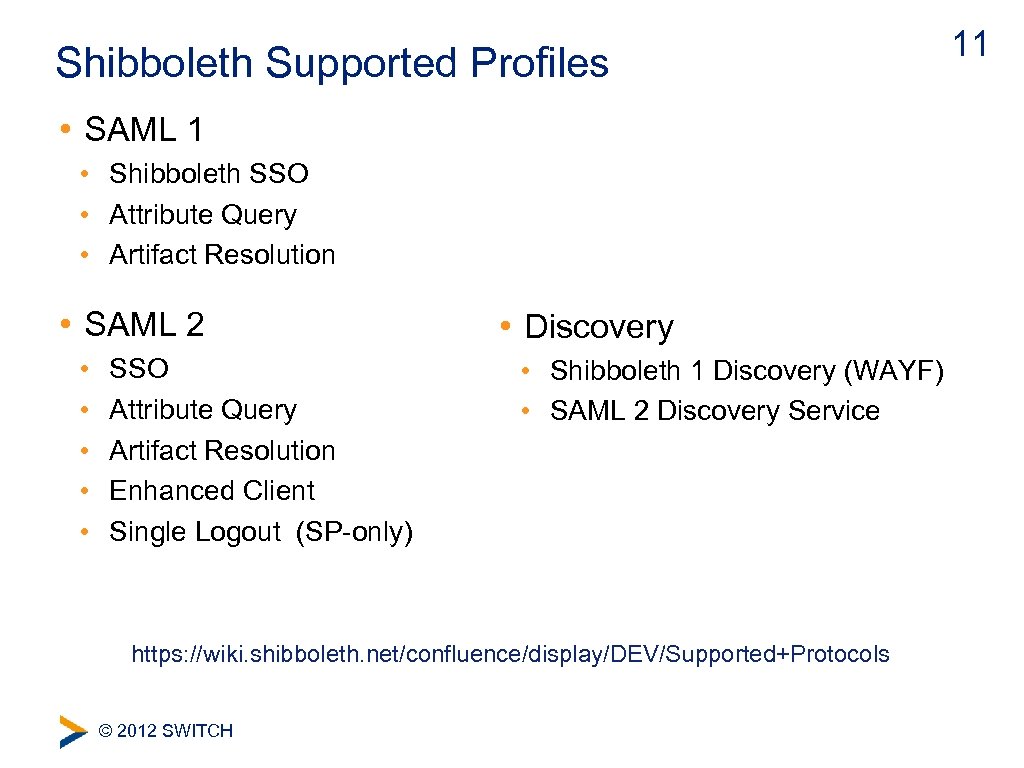
Shibboleth Supported Profiles • SAML 1 • Shibboleth SSO • Attribute Query • Artifact Resolution • SAML 2 • • • SSO Attribute Query Artifact Resolution Enhanced Client Single Logout (SP-only) • Discovery • Shibboleth 1 Discovery (WAYF) • SAML 2 Discovery Service https: //wiki. shibboleth. net/confluence/display/DEV/Supported+Protocols © 2012 SWITCH 11
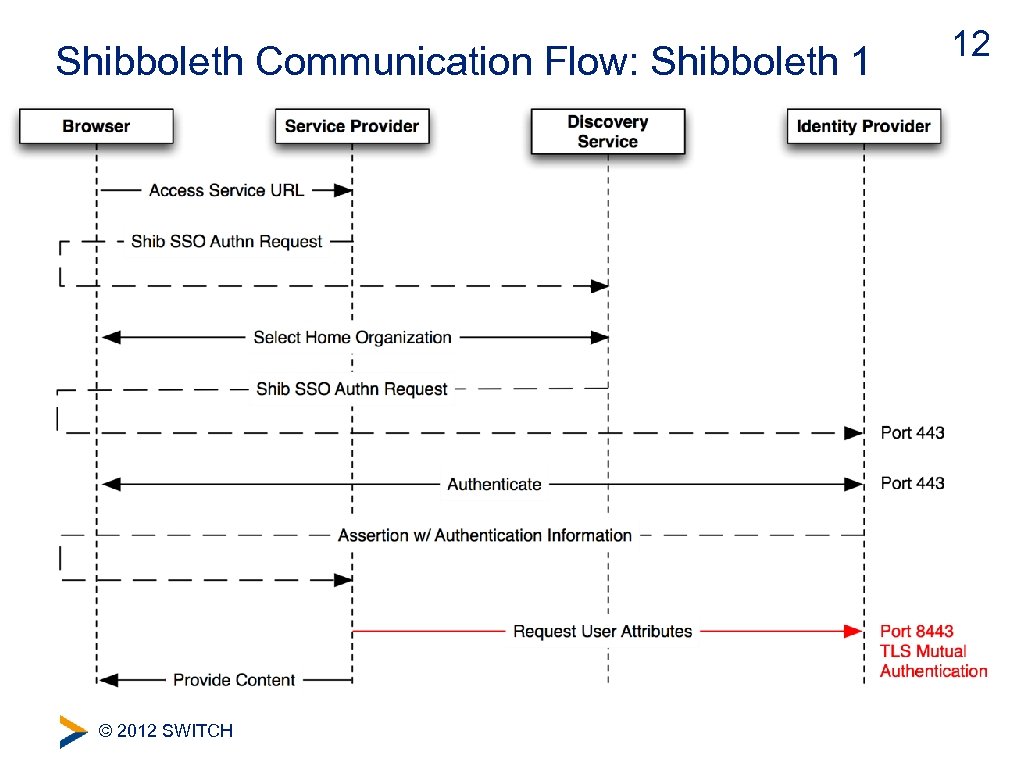
Shibboleth Communication Flow: Shibboleth 1 © 2012 SWITCH 12
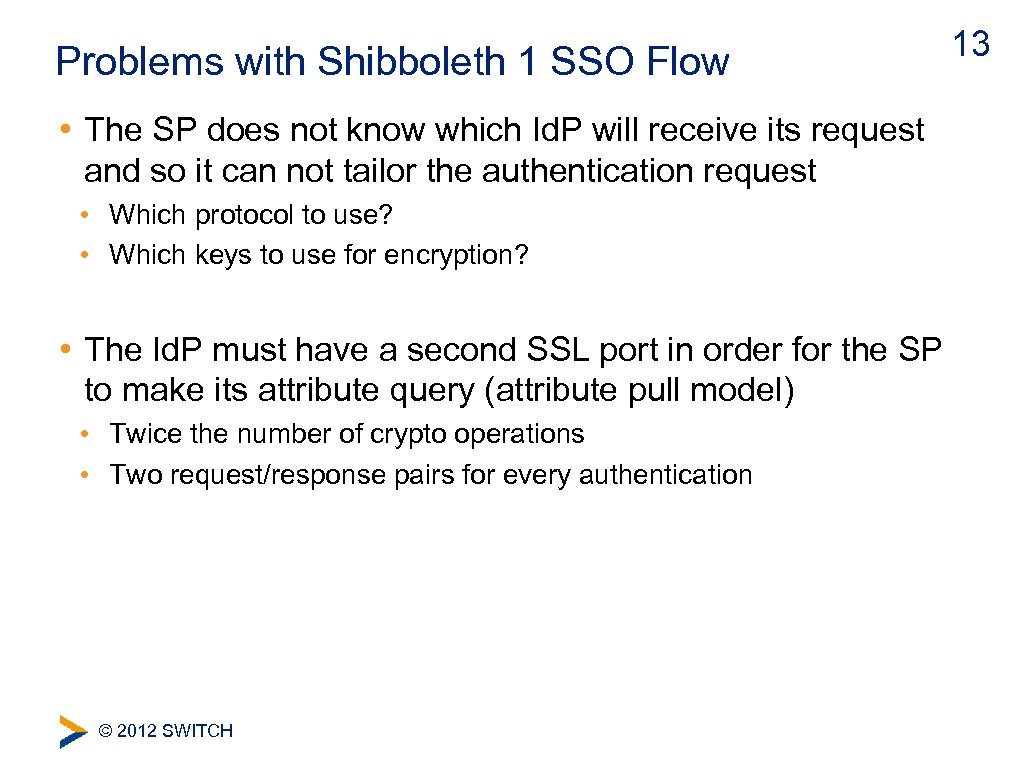
Problems with Shibboleth 1 SSO Flow • The SP does not know which Id. P will receive its request and so it can not tailor the authentication request • Which protocol to use? • Which keys to use for encryption? • The Id. P must have a second SSL port in order for the SP to make its attribute query (attribute pull model) • Twice the number of crypto operations • Two request/response pairs for every authentication © 2012 SWITCH 13
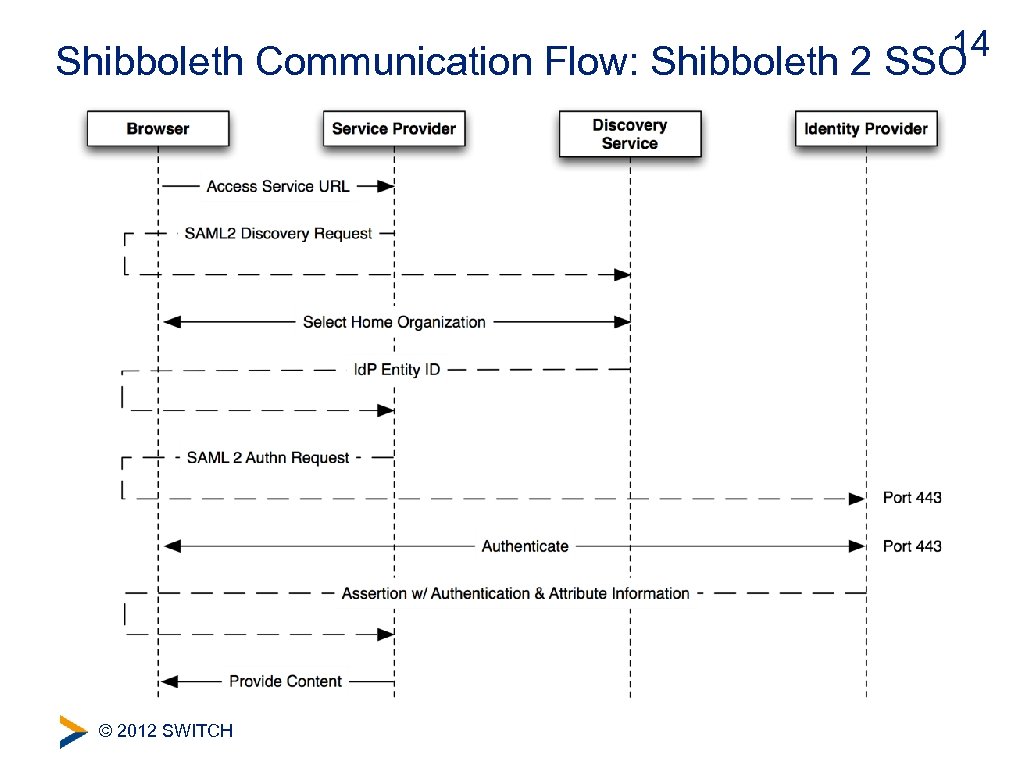
14 Shibboleth Communication Flow: Shibboleth 2 SSO © 2012 SWITCH
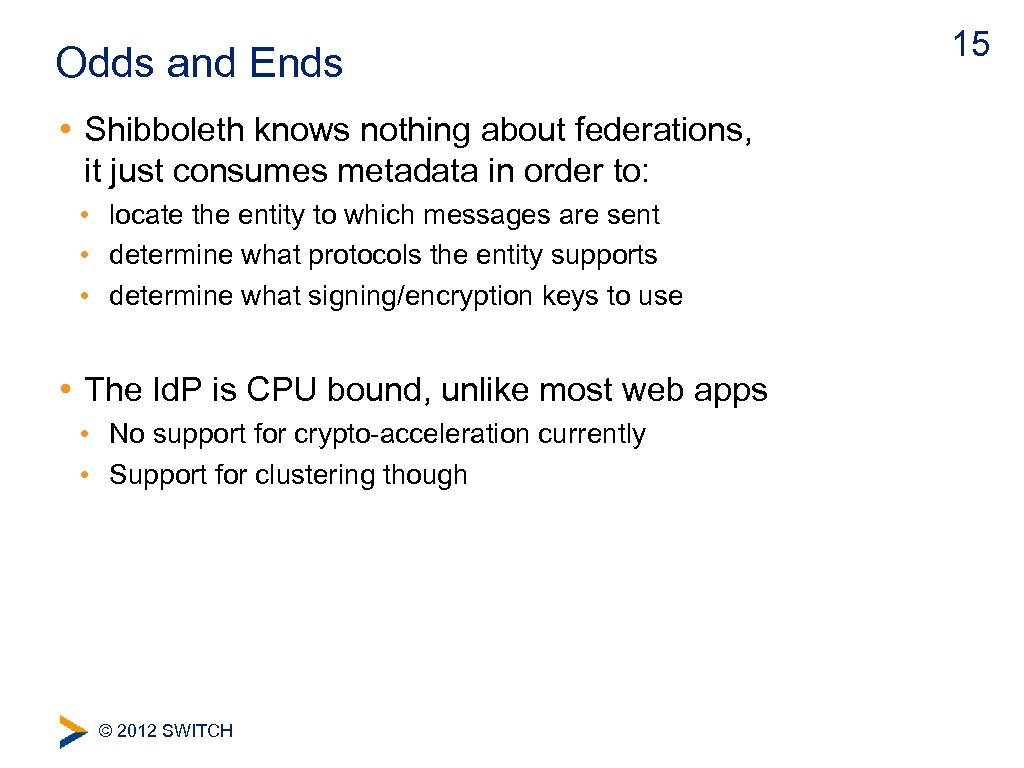
Odds and Ends • Shibboleth knows nothing about federations, it just consumes metadata in order to: • locate the entity to which messages are sent • determine what protocols the entity supports • determine what signing/encryption keys to use • The Id. P is CPU bound, unlike most web apps • No support for crypto-acceleration currently • Support for clustering though © 2012 SWITCH 15
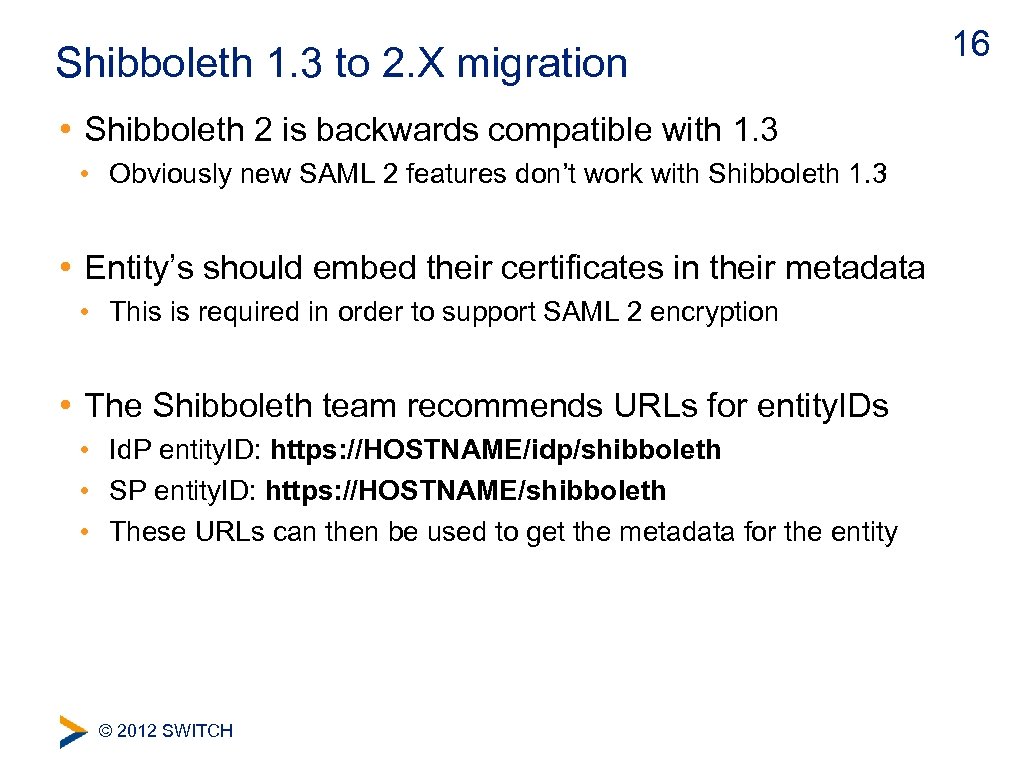
Shibboleth 1. 3 to 2. X migration • Shibboleth 2 is backwards compatible with 1. 3 • Obviously new SAML 2 features don’t work with Shibboleth 1. 3 • Entity’s should embed their certificates in their metadata • This is required in order to support SAML 2 encryption • The Shibboleth team recommends URLs for entity. IDs • Id. P entity. ID: https: //HOSTNAME/idp/shibboleth • SP entity. ID: https: //HOSTNAME/shibboleth • These URLs can then be used to get the metadata for the entity © 2012 SWITCH 16
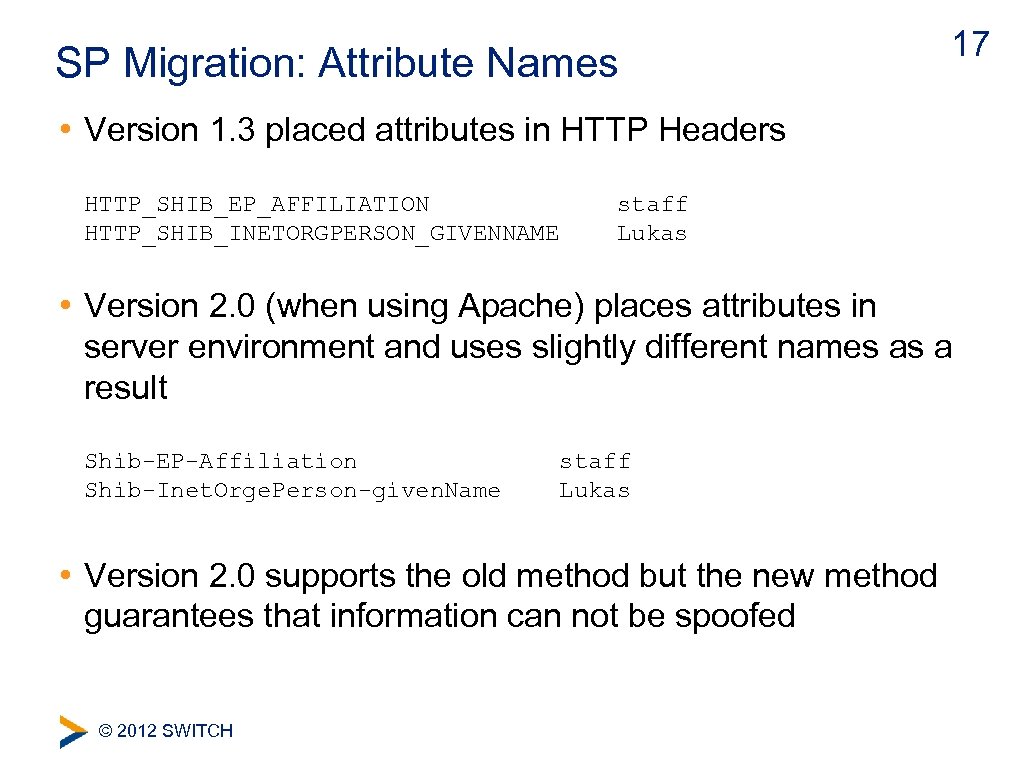
SP Migration: Attribute Names 17 • Version 1. 3 placed attributes in HTTP Headers HTTP_SHIB_EP_AFFILIATION HTTP_SHIB_INETORGPERSON_GIVENNAME staff Lukas • Version 2. 0 (when using Apache) places attributes in server environment and uses slightly different names as a result Shib-EP-Affiliation Shib-Inet. Orge. Person-given. Name staff Lukas • Version 2. 0 supports the old method but the new method guarantees that information can not be spoofed © 2012 SWITCH
Support Resources • First, check with your Federation • http: //switch. ch/aai/support/documents • http: //switch. ch/aai/support/help • Shibboleth Wiki • https: //wiki. shibboleth. net/confluence/display/SHIB 2 • Shibboleth User’s Mailing List Archive • http: //marc. info/? l=shibboleth-users • Shibboleth User’s Mailing List • http: //shibboleth. net/community/lists. html © 2012 SWITCH 18
Скачать презентацию Introduction to Shibboleth SWITCHaai Team aai switch ch
24eff711bf7fffdb48464241c8a8022b.ppt