


 Скачать презентацию Introduction to security valuation A summary Reminder
60527f5f24b69c5fbf462fe1fde74901.ppt
- Количество слайдов: 28
 Introduction to security valuation A summary
 Reminder Valuation always precedes the investment decision. Always.
 Objective Describe the principles and summarize the process of security analysis & valuation.
 Outline • • • Introduction to valuation principles, approach & techniques Discussion of approaches and techniques Analysis of alternative economies and security markets Industry analysis Individual company analysis and stock selection
 Valuation philosophy, approaches, and techniques Valuation philosophy Acknowledges the basic principles that are important in estimating intrinsic values Valuation approach Pertains to the valuation process in general It spells out the steps of the selection process Valuation techniques/methods Refers to the quantitative methods used to estimate intrinsic values for individual securities, industries, and markets
 Valuation philosophy Fundamental analysis • Investors have rational expectations. • It is possible to forecast, hence to estimate intrinsic value as a function of risk and required return Technical analysis • Investors are biased, slow in responding to new information, and overreact • There are recurrent price patterns to be exploited. • It is more meaningful to find trends than to forecast sales, earnings, risk, return, etc.
 Important Valuation philosophy determines what approach and technique to use
 Valuation approaches Top-down (Three-step) Valuing and selecting securities while accounting for the more general economic context • • • Analysis of alternative economies and security markets Industry analysis Individual company analysis and stock selection Bottom-up (Stock picking) Valuing and selecting securities without accounting for the more general economic conditions
 Valuations techniques for markets, industries and securities DCF techniques Intinsic value = PV of future cash flow Relative valuation techniques Require the comparison of various market ratios Both methods should be used in combination
 Analysis of alternative economies and security markets Objective: Estimate future macroeconomic performance Evaluate the trend in corporate earnings and security prices Prevailing view: General economic conditions are associated with firm performance Markets determine individual security returns How it is done in real life • • • Macro technique Micro technique: DCF & relative valuation Trend analysis & extrapolation
 Macro technique Analyze macroeconomic indicators
 Macroeconomic indicators Leading indicators Precede the economic cycle Coincident indicators Synchronized with the economic cycle Lagging indicators Follow in the wake of the economic cycle
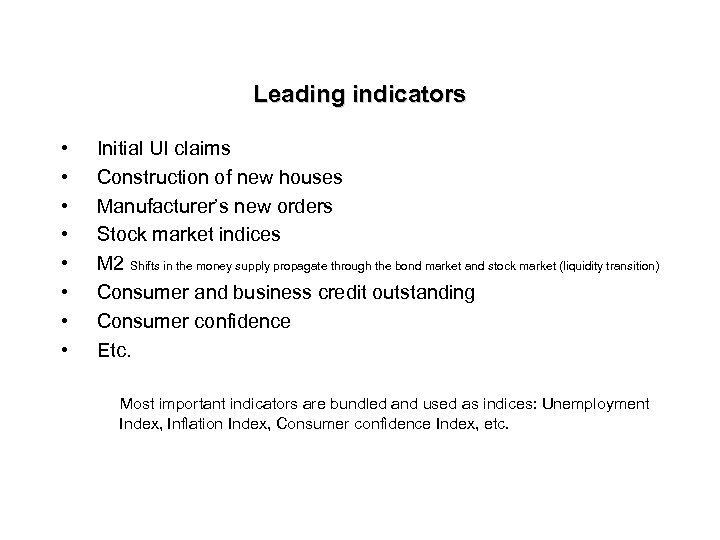 Leading indicators • • Initial UI claims Construction of new houses Manufacturer’s new orders Stock market indices M 2 Shifts in the money supply propagate through the bond market and stock market (liquidity transition) Consumer and business credit outstanding Consumer confidence Etc. Most important indicators are bundled and used as indices: Unemployment Index, Inflation Index, Consumer confidence Index, etc.
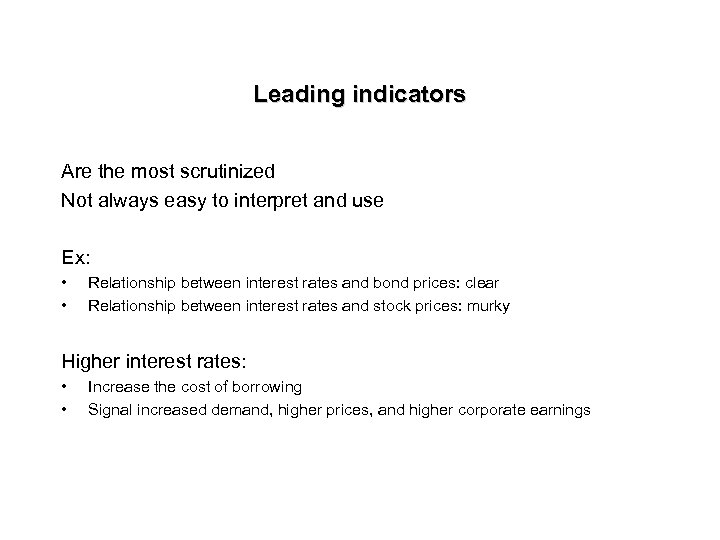 Leading indicators Are the most scrutinized Not always easy to interpret and use Ex: • • Relationship between interest rates and bond prices: clear Relationship between interest rates and stock prices: murky Higher interest rates: • • Increase the cost of borrowing Signal increased demand, higher prices, and higher corporate earnings
 Coincident indicators • Industrial production • Employee’s payrolls • Manufacturing sales • Etc.
 Lagging indicators • Average UI duration • Inventories • Bank’s prime rate • Etc.
 Micro techniques Applied to the market as a whole Often looks at an index of the most representative securities
 Micro techniques: DCF method Require : • Expected growth rate in earnings/dividends/free cash flows • Required rate of return
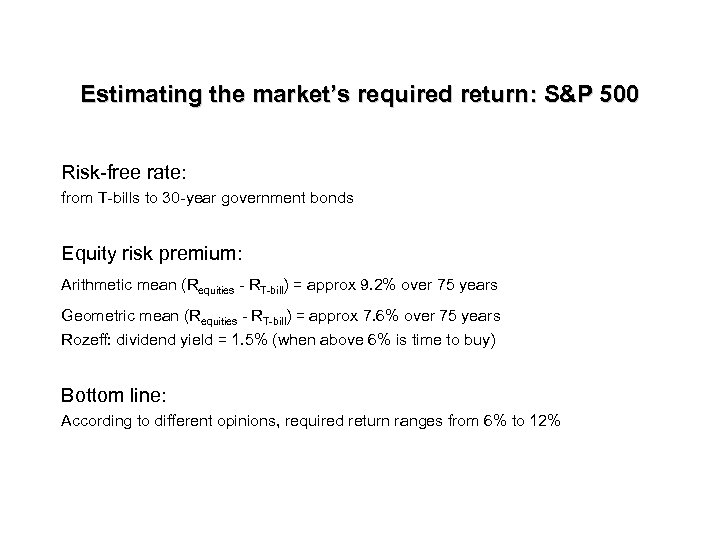 Estimating the market’s required return: S&P 500 Risk-free rate: from T-bills to 30 -year government bonds Equity risk premium: Arithmetic mean (Requities - RT-bill) = approx 9. 2% over 75 years Geometric mean (Requities - RT-bill) = approx 7. 6% over 75 years Rozeff: dividend yield = 1. 5% (when above 6% is time to buy) Bottom line: According to different opinions, required return ranges from 6% to 12%
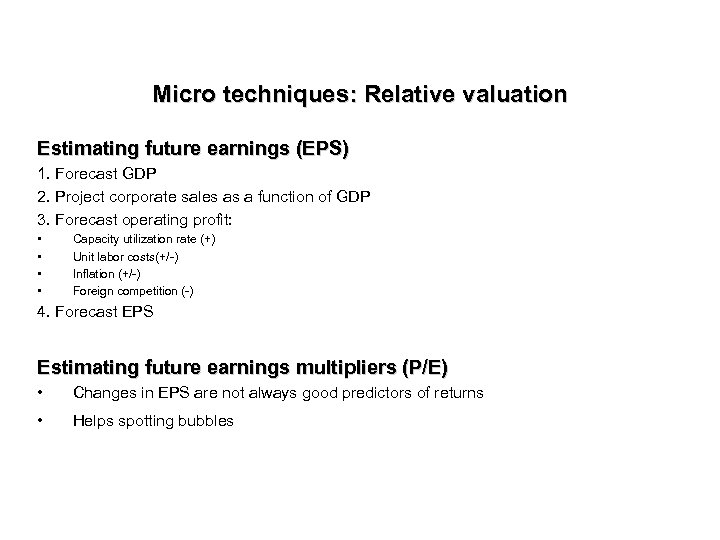 Micro techniques: Relative valuation Estimating future earnings (EPS) 1. Forecast GDP 2. Project corporate sales as a function of GDP 3. Forecast operating profit: • • Capacity utilization rate (+) Unit labor costs(+/-) Inflation (+/-) Foreign competition (-) 4. Forecast EPS Estimating future earnings multipliers (P/E) • Changes in EPS are not always good predictors of returns • Helps spotting bubbles
 Industry analysis Objective Evaluate industry trends and structural changes Methods • • • Cross sectional performance analysis Trend analysis Comparative analysis of firms within an industry
 Results of empirical studies • Returns vary across industries • No patterns of return as a function of time • Returns vary within each industry: differentiation • Consistent pattern of risk differences among industries
 Industry trends and the business cycle Wide-held belief: Industry performance is related to business cycle.
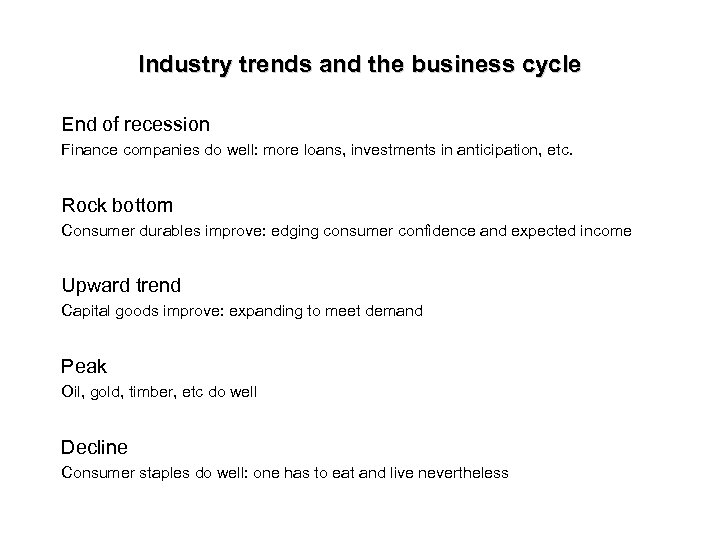 Industry trends and the business cycle End of recession Finance companies do well: more loans, investments in anticipation, etc. Rock bottom Consumer durables improve: edging consumer confidence and expected income Upward trend Capital goods improve: expanding to meet demand Peak Oil, gold, timber, etc do well Decline Consumer staples do well: one has to eat and live nevertheless
 Structural changes • Demographics • Lifestyles • Technology • Politics and regulation
 Individual company analysis and stock selection Objective Identify candidates for the investment decision Investment decision Buy: Intrinsic value > Market price
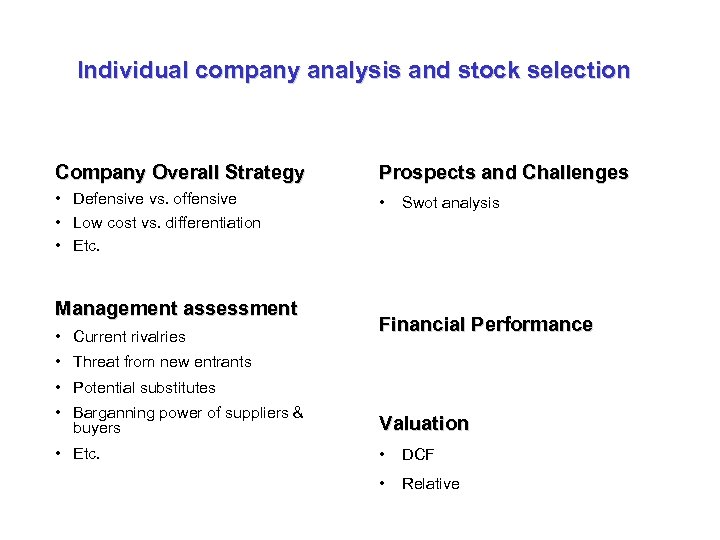 Individual company analysis and stock selection Company Overall Strategy Prospects and Challenges • Defensive vs. offensive • Low cost vs. differentiation • Etc. • Management assessment • Current rivalries Swot analysis Financial Performance • Threat from new entrants • Potential substitutes • Barganning power of suppliers & buyers Valuation • Etc. • DCF • Relative
 Conclusions Intrinsic value is a very elusive concept, subject to personal interpretation Security valuation, although a very complex process, is not a science. The principles, approaches and techniques outlined above reflect the prevailing view among security analysts and portfolio managers.