


 Скачать презентацию Introduction to SAN Storage Presentation Topics What
309b2bb9ef50371e8e4636ad72a6ddcc.ppt
- Количество слайдов: 25
 Introduction to SAN Storage Presentation
 Topics What is a SAN? Why a SAN? SAN Fabric Disk Utilization and Centralization Virtualization and Manageability Backup and Restore High Availability Features: Snapshots, Replication
 What is a SAN? A storage area network (SAN) is a high-speed special-purpose network (or sub-network) that interconnects different kinds of data storage devices with associated data servers on behalf of a larger network of users.
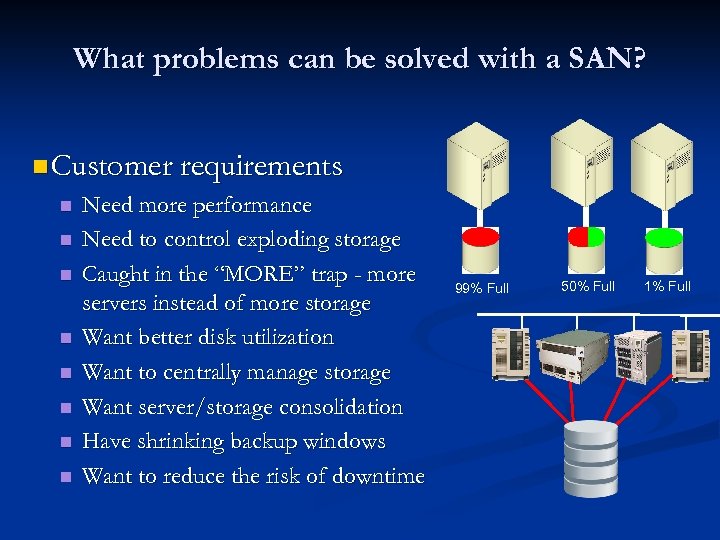 What problems can be solved with a SAN? n Customer requirements n n n n Need more performance Need to control exploding storage Caught in the “MORE” trap - more servers instead of more storage Want better disk utilization Want to centrally manage storage Want server/storage consolidation Have shrinking backup windows Want to reduce the risk of downtime 99% Full 50% Full 1% Full
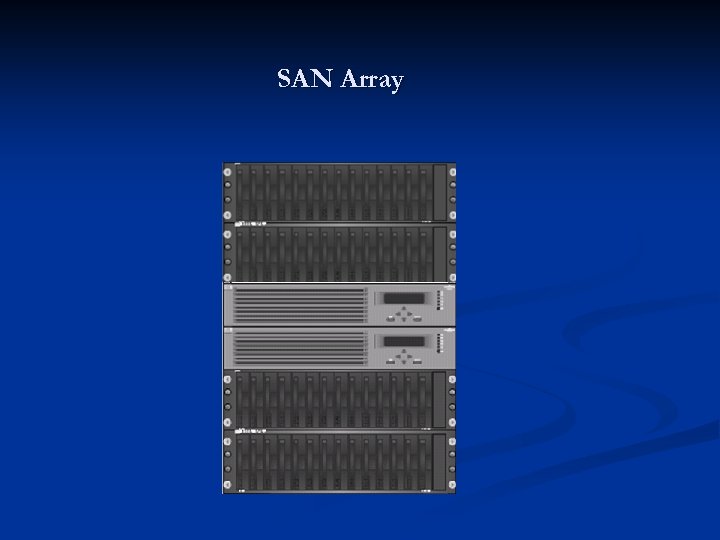 SAN Array
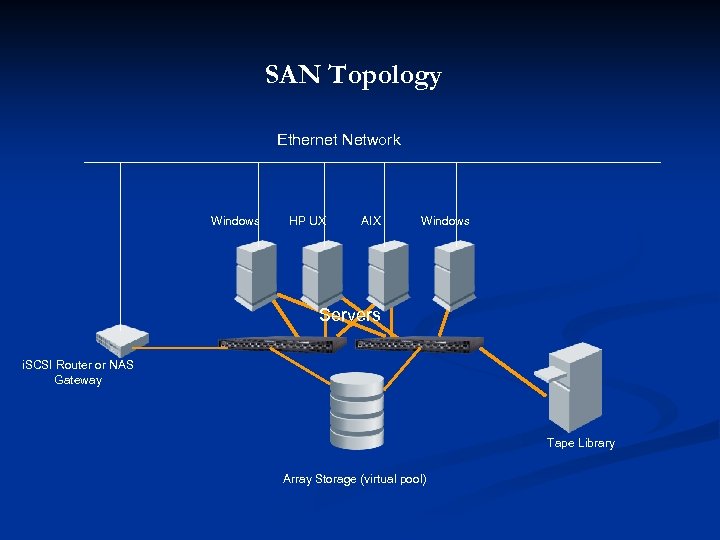 SAN Topology Ethernet Network Windows HP UX AIX Windows Servers i. SCSI Router or NAS Gateway Tape Library Array Storage (virtual pool)
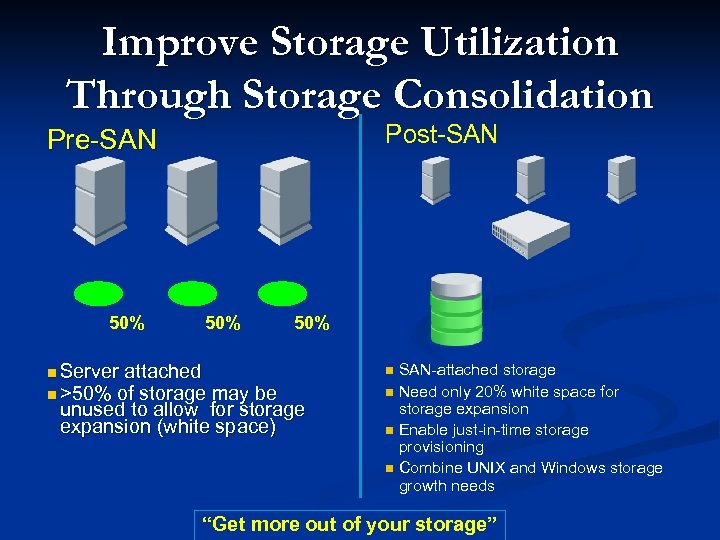 Improve Storage Utilization Through Storage Consolidation Post-SAN Pre-SAN 50% n Server attached n >50% of storage may be 80% 50% unused to allow for storage expansion (white space) SAN-attached storage n Need only 20% white space for storage expansion n Enable just-in-time storage provisioning n Combine UNIX and Windows storage growth needs n “Get more out of your storage”
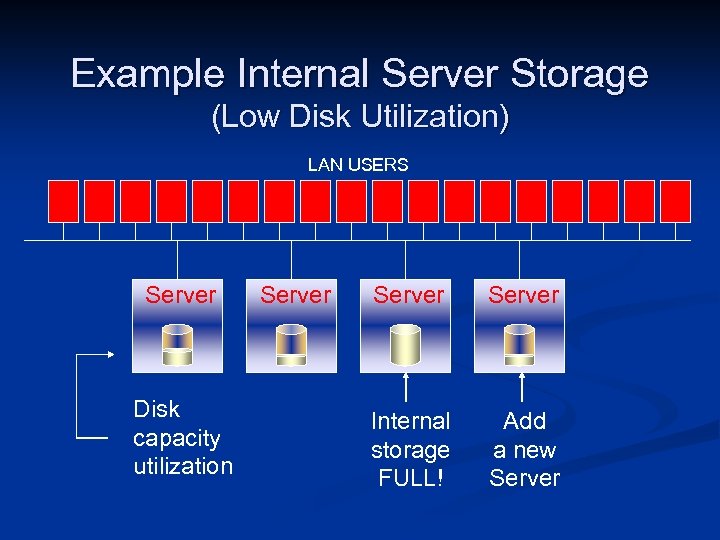 Example Internal Server Storage (Low Disk Utilization) LAN USERS Server Disk capacity utilization Server Internal storage FULL! Add a new Server
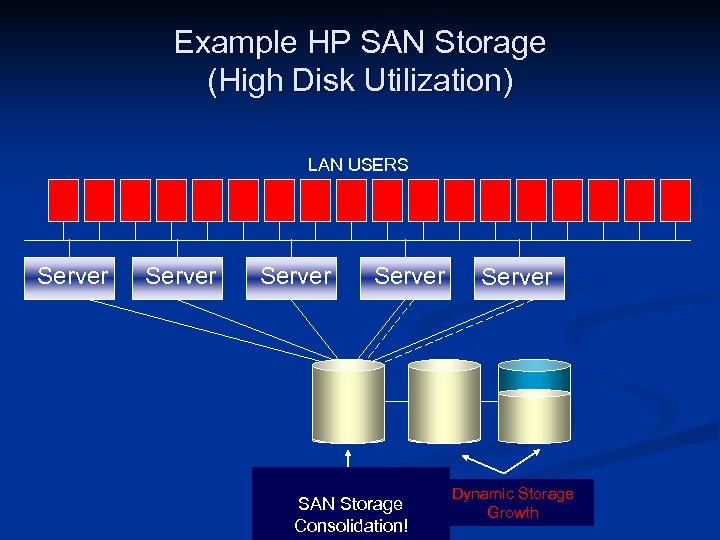 Example HP SAN Storage (High Disk Utilization) LAN USERS Server Migration of drives and data SAN Storage from Smart Array Consolidation! Server Dynamic Storage Growth
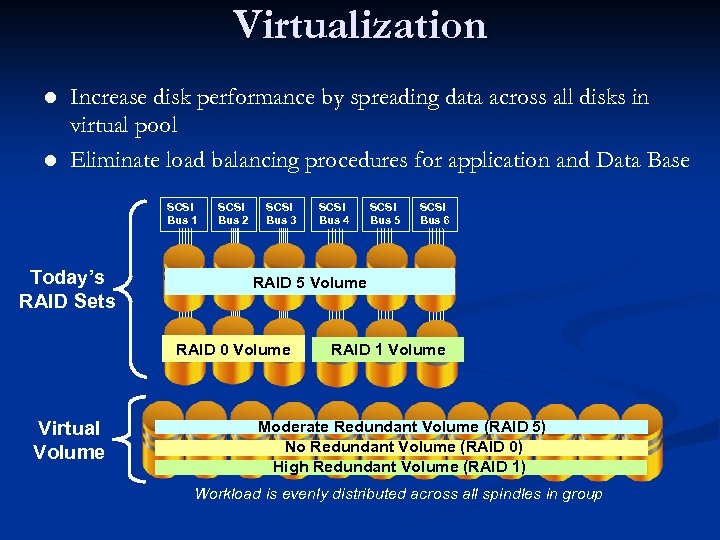 Virtualization Increase disk performance by spreading data across all disks in virtual pool l Eliminate load balancing procedures for application and Data Base l SCSI Bus 1 Today’s RAID Sets SCSI Bus 2 SCSI Bus 3 SCSI Bus 5 SCSI Bus 6 RAID 5 Volume RAID 0 Volume Virtual Volume SCSI Bus 4 RAID 1 Volume Moderate Redundant Volume (RAID 5) No Redundant Volume (RAID 0) High Redundant Volume (RAID 1) Workload is evenly distributed across all spindles in group
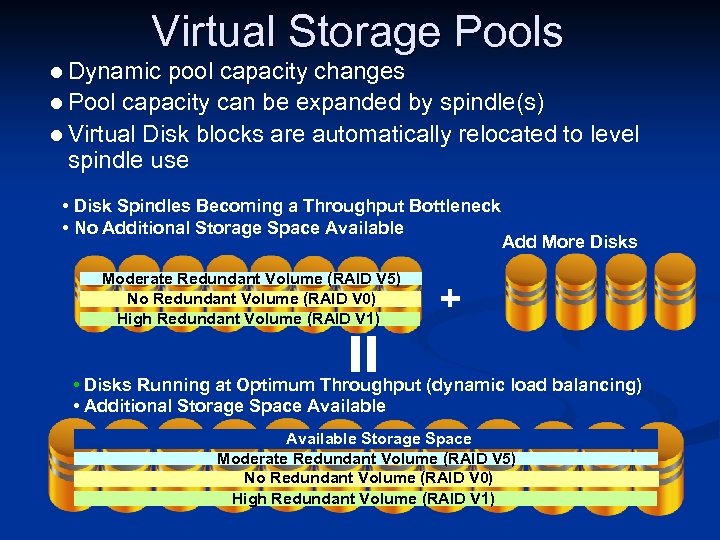 Virtual Storage Pools l Dynamic pool capacity changes l Pool capacity can be expanded by spindle(s) l Virtual Disk blocks are automatically relocated to level spindle use • Disk Spindles Becoming a Throughput Bottleneck • No Additional Storage Space Available + = Moderate Redundant Volume (RAID V 5) No Redundant Volume (RAID V 0) High Redundant Volume (RAID V 1) Add More Disks • Disks Running at Optimum Throughput (dynamic load balancing) • Additional Storage Space Available Storage Space Moderate Redundant Volume (RAID V 5) No Redundant Volume (RAID V 0) High Redundant Volume (RAID V 1)
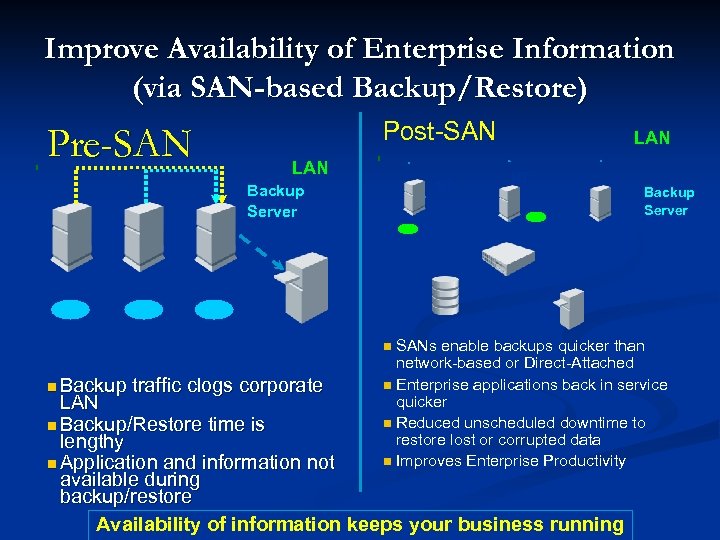 Improve Availability of Enterprise Information (via SAN-based Backup/Restore) Pre-SAN Post-SAN LAN NT Backup Server LAN NT SANs enable backups quicker than network-based or Direct-Attached n Enterprise applications back in service quicker n Reduced unscheduled downtime to restore lost or corrupted data n Improves Enterprise Productivity n n Backup traffic clogs corporate Backup Server LAN n Backup/Restore time is lengthy n Application and information not available during backup/restore Availability of information keeps your business running
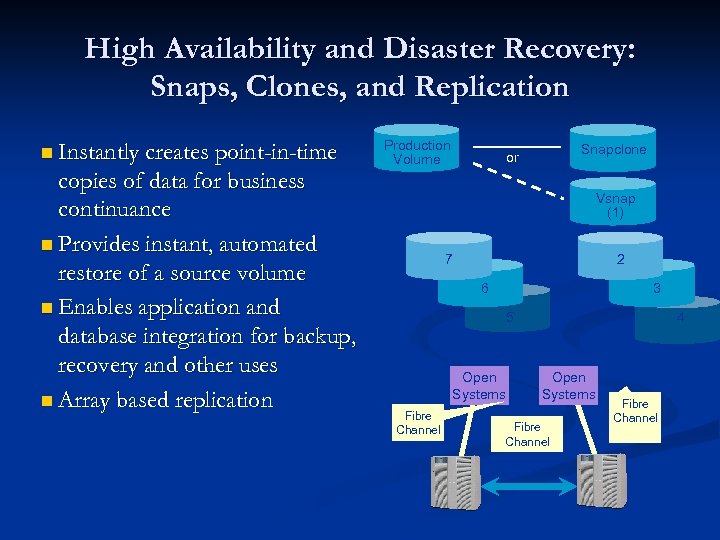 High Availability and Disaster Recovery: Snaps, Clones, and Replication n Instantly creates point-in-time copies of data for business continuance n Provides instant, automated restore of a source volume n Enables application and database integration for backup, recovery and other uses n Array based replication Production Volume Snapclone or Vsnap (1) 7 2 6 3 5 Open Systems Fibre Channel 4 Open Systems Fibre Channel
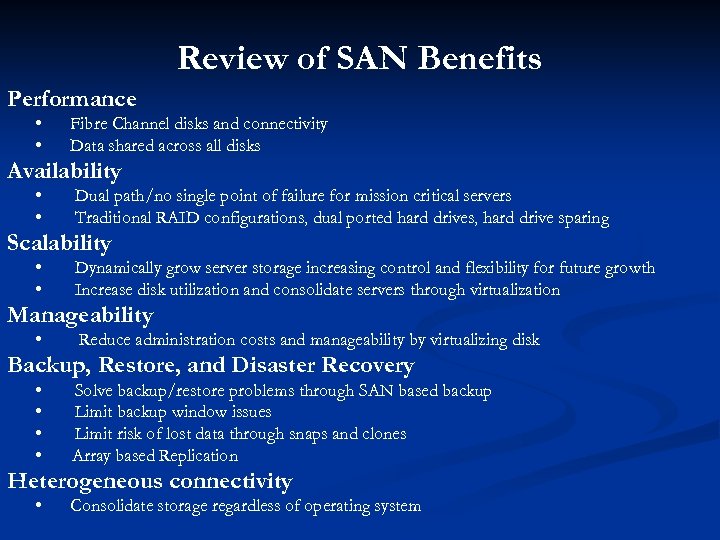 Review of SAN Benefits Performance • • Fibre Channel disks and connectivity Data shared across all disks Availability • • Dual path/no single point of failure for mission critical servers Traditional RAID configurations, dual ported hard drives, hard drive sparing Scalability • • Dynamically grow server storage increasing control and flexibility for future growth Increase disk utilization and consolidate servers through virtualization Manageability • Reduce administration costs and manageability by virtualizing disk Backup, Restore, and Disaster Recovery • • Solve backup/restore problems through SAN based backup Limit backup window issues Limit risk of lost data through snaps and clones Array based Replication Heterogeneous connectivity • Consolidate storage regardless of operating system
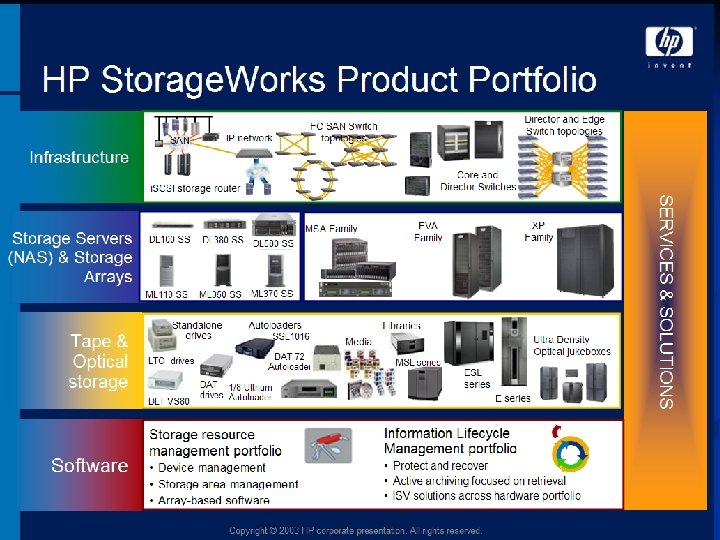
 HP Storage. Works Products
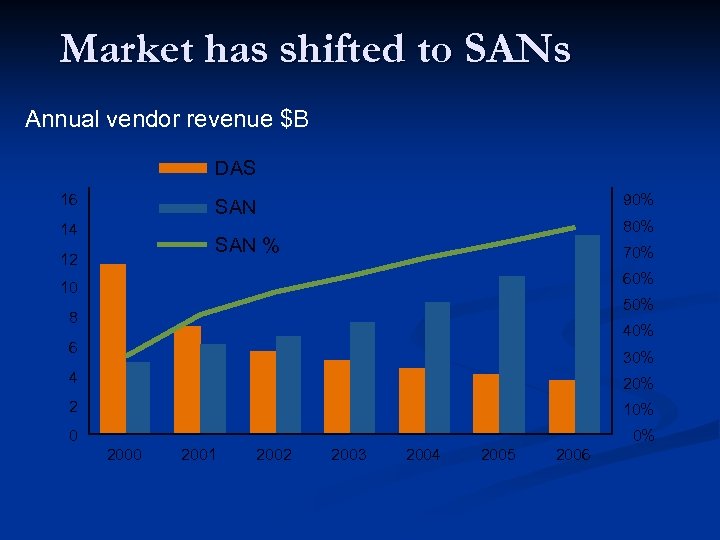 Market has shifted to SANs Annual vendor revenue $B DAS 16 SAN % 14 12 90% 70% 80% 60% 10 50% 8 40% 6 30% 4 20% 2 10% 0 0% 2000 2001 2002 2003 2004 2005 2006
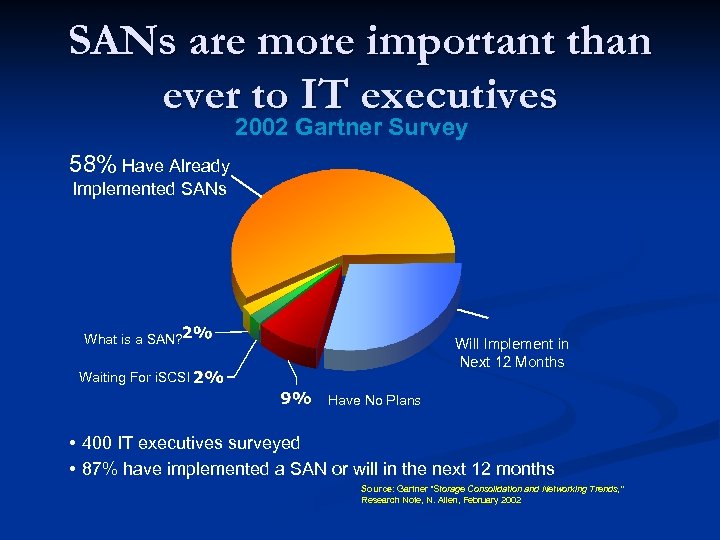 SANs are more important than ever to IT executives 2002 Gartner Survey 58% Have Already Implemented SANs 29% What is a SAN? Will Implement in Next 12 Months Waiting For i. SCSI Have No Plans • 400 IT executives surveyed • 87% have implemented a SAN or will in the next 12 months Source: Gartner “Storage Consolidation and Networking Trends, " Research Note, N. Allen, February 2002
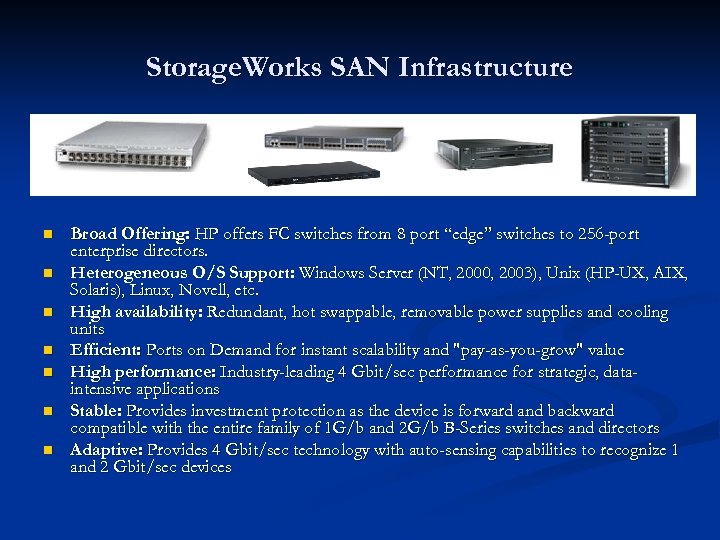 Storage. Works SAN Infrastructure n n n n Broad Offering: HP offers FC switches from 8 port “edge” switches to 256 -port enterprise directors. Heterogeneous O/S Support: Windows Server (NT, 2000, 2003), Unix (HP-UX, AIX, Solaris), Linux, Novell, etc. High availability: Redundant, hot swappable, removable power supplies and cooling units Efficient: Ports on Demand for instant scalability and "pay-as-you-grow" value High performance: Industry-leading 4 Gbit/sec performance for strategic, dataintensive applications Stable: Provides investment protection as the device is forward and backward compatible with the entire family of 1 G/b and 2 G/b B-Series switches and directors Adaptive: Provides 4 Gbit/sec technology with auto-sensing capabilities to recognize 1 and 2 Gbit/sec devices
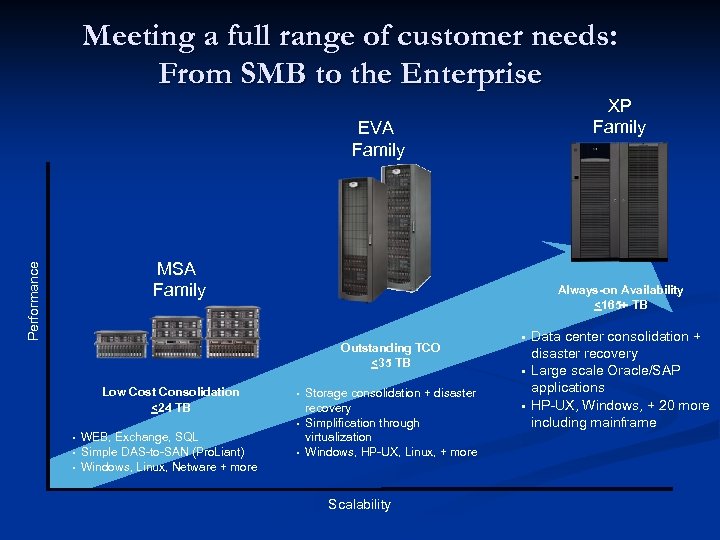 Meeting a full range of customer needs: From SMB to the Enterprise EVA Family Performance XP Family MSA Family Always-on Availability <165+ TB Outstanding TCO <35 TB Low Cost Consolidation <24 TB • • • WEB, Exchange, SQL Simple DAS-to-SAN (Pro. Liant) Windows, Linux, Netware + more • Storage consolidation + disaster recovery Simplification through virtualization Windows, HP-UX, Linux, + more Scalability • • • Data center consolidation + disaster recovery Large scale Oracle/SAP applications HP-UX, Windows, + 20 more including mainframe
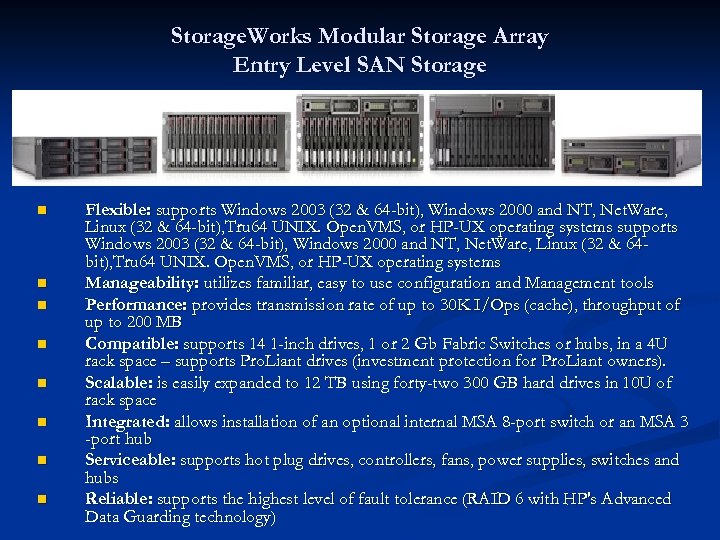 Storage. Works Modular Storage Array Entry Level SAN Storage n n n n Flexible: supports Windows 2003 (32 & 64 -bit), Windows 2000 and NT, Net. Ware, Linux (32 & 64 -bit), Tru 64 UNIX. Open. VMS, or HP-UX operating systems supports Windows 2003 (32 & 64 -bit), Windows 2000 and NT, Net. Ware, Linux (32 & 64 bit), Tru 64 UNIX. Open. VMS, or HP-UX operating systems Manageability: utilizes familiar, easy to use configuration and Management tools Performance: provides transmission rate of up to 30 K I/Ops (cache), throughput of up to 200 MB Compatible: supports 14 1 -inch drives, 1 or 2 Gb Fabric Switches or hubs, in a 4 U rack space – supports Pro. Liant drives (investment protection for Pro. Liant owners). Scalable: is easily expanded to 12 TB using forty-two 300 GB hard drives in 10 U of rack space Integrated: allows installation of an optional internal MSA 8 -port switch or an MSA 3 -port hub Serviceable: supports hot plug drives, controllers, fans, power supplies, switches and hubs Reliable: supports the highest level of fault tolerance (RAID 6 with HP's Advanced Data Guarding technology)
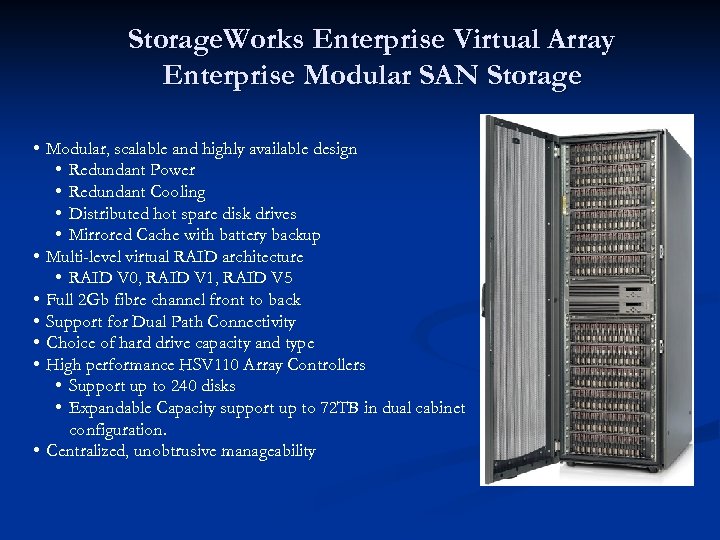 Storage. Works Enterprise Virtual Array Enterprise Modular SAN Storage • Modular, scalable and highly available design • Redundant Power • Redundant Cooling • Distributed hot spare disk drives • Mirrored Cache with battery backup • Multi-level virtual RAID architecture • RAID V 0, RAID V 1, RAID V 5 • Full 2 Gb fibre channel front to back • Support for Dual Path Connectivity • Choice of hard drive capacity and type • High performance HSV 110 Array Controllers • Support up to 240 disks • Expandable Capacity support up to 72 TB in dual cabinet configuration. • Centralized, unobtrusive manageability
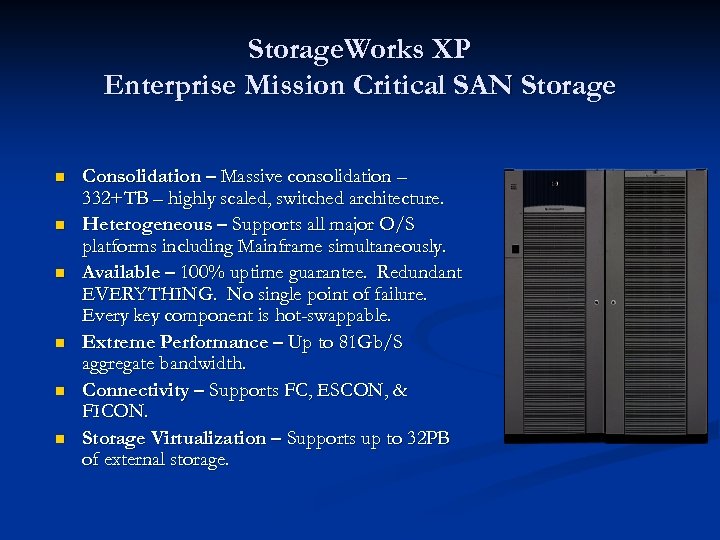 Storage. Works XP Enterprise Mission Critical SAN Storage n n n Consolidation – Massive consolidation – 332+TB – highly scaled, switched architecture. Heterogeneous – Supports all major O/S platforms including Mainframe simultaneously. Available – 100% uptime guarantee. Redundant EVERYTHING. No single point of failure. Every key component is hot-swappable. Extreme Performance – Up to 81 Gb/S aggregate bandwidth. Connectivity – Supports FC, ESCON, & FICON. Storage Virtualization – Supports up to 32 PB of external storage.
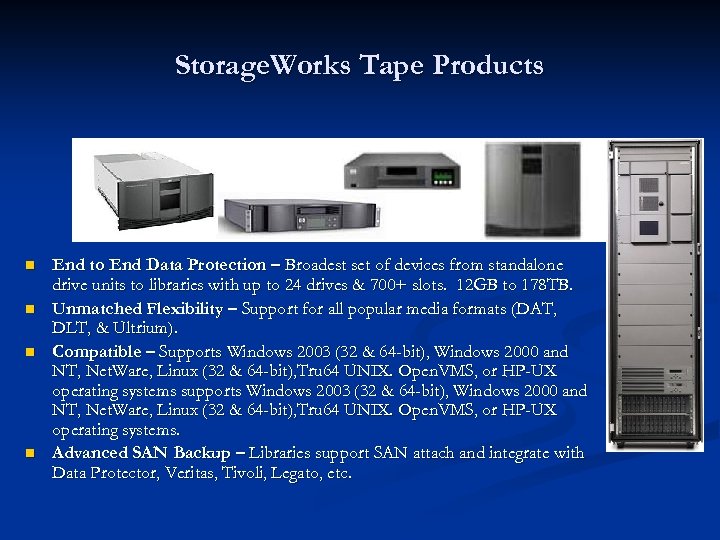 Storage. Works Tape Products n n End to End Data Protection – Broadest set of devices from standalone drive units to libraries with up to 24 drives & 700+ slots. 12 GB to 178 TB. Unmatched Flexibility – Support for all popular media formats (DAT, DLT, & Ultrium). Compatible – Supports Windows 2003 (32 & 64 -bit), Windows 2000 and NT, Net. Ware, Linux (32 & 64 -bit), Tru 64 UNIX. Open. VMS, or HP-UX operating systems supports Windows 2003 (32 & 64 -bit), Windows 2000 and NT, Net. Ware, Linux (32 & 64 -bit), Tru 64 UNIX. Open. VMS, or HP-UX operating systems. Advanced SAN Backup – Libraries support SAN attach and integrate with Data Protector, Veritas, Tivoli, Legato, etc.
 HP Storage. Works ranks first in network storage #1 in Worldwide Disk Storage Systems #1 in External RAID #1 in Storage Area Networks #1 in Tape drives and Automation #1 in Virtualization Technology