 Скачать презентацию Introduction to RDF Based closely upon an earlier
3d6fd411ebbe6e2f20cdc59c4069cbf4.ppt
- Количество слайдов: 60



Introduction to RDF (Based closely upon an earlier presentation by Eric Miller of OCLC) Paul Miller Thomas Hofmann UK Office for Library & Information Networking Australian Museums On-Line p. miller@ukoln. ac. uk thomash@amol. org. au
Metadata: Definition z. Traditionally: ymetadata has been understood as “Data about Data” z. Example(s): ya library catalogue contains information (metadata) about publications (data) ya file system maintains permissions (metadata) about files (data)
Metadata: Definition (Cont. ) z. Metadata describes other data y. One application’s metadata is another application’s data y. Metadata can itself be described by metadata (but that doesn’t make it meta-metadata) z. Example: y. Price lists (metadata) have expiration dates: metadata about metadata. It is still just metadata.
Applications of Metadata z. Cataloguing (Item and Collections) z. Resource Discovery z. Electronic Commerce z. Intelligent Software Agents z. Digital Signatures z. Content Rating z. Intellectual Property Rights z. Privacy Preferences & Policies
Application: Item and Collection Cataloguing z. Describing individual resources ydocuments, pages, images, audio files, etc. z. Describing the content of collections: y. Web sites, databases, directories, etc. z. Relationships among Resources y. Tables of Content, chapters, images…. y. Site Maps ye. g. CIMI collection records
Application: Resource Discovery z. Search engines can better “understand” the contents of a particular page z. More accurate searches z. Additional information aids precision z. Makes it possible to automate searches because less manual “weeding” is needed to process the search results
Application: Electronic Commerce z. Metadata can be used to encode information needed in all stages of electronic commerce ylocating seller/buyer & product xsearching “yellow pages” yagreeing on terms of sale xprices, terms of payment, contractual information ytransactions xdelivery mechanisms, dates, terms
Application: Intelligent Agents zrepresentation and sharing of knowledge yknowledge exchange ymodelling zcommunication yuser-to-agent, agent-toservice zresource discovery ygives web-roaming agents the ability to “understand” their environment
Application: Digital Signatures z. These are key to building the “Web of Trust” z. Required by yagents yelectronic commerce ycollaboration z. RDF will become the preferred way to encode digital signatures on documents and on statements about documents
Application: Content Rating z. Empowering users to select which kinds of web content they wish to see z. Child Protection z. W 3 C PICS (Platform for Internet Content Selection) working group y. US Communications Decency Act of 1996 ysimple metadata architecture yprecursor to RDF
Other Applications z. Privacy Preferences and Policies ydescribing a user’s willingness/reluctance to disclose information about himself/herself ydescribing a site administrator’s desire to gather information about visiting users z. Intellectual Property Rights ycontractual terms related to usage and distribution rights to a document
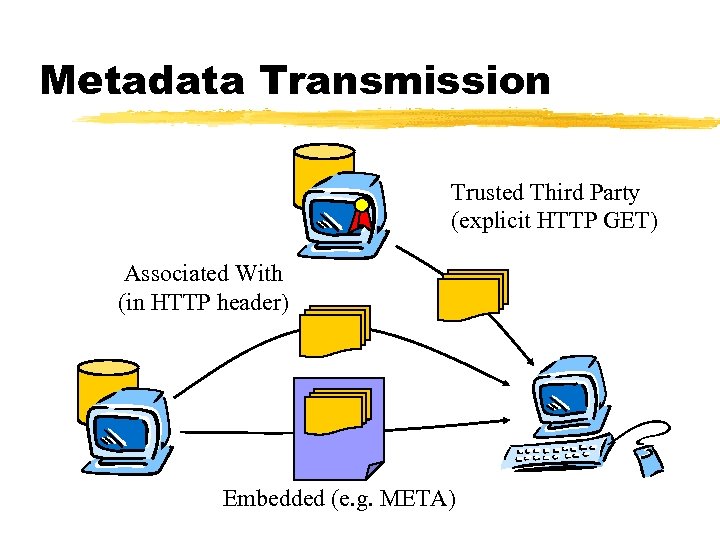
Metadata Transmission Trusted Third Party (explicit HTTP GET) Associated With (in HTTP header) Embedded (e. g. META)
Metadata Assertions z. Metadata requirements will evolve z. The Web is “machine-readable” but not “machine-understandable” z. Metadata is useful ye. g A lot could be gained from structured description of pages, servers, search services, and other resources z. See point 1
Introducing: RDF z. Improve on PICS, HTML, and XML z. Machine understandable metadata z. Support structured values z. Support metadata bureaux z. Encourage authenticated metadata z. Base for a variety of descriptions: ycataloging, privacy, accessibility, IPR, . . .
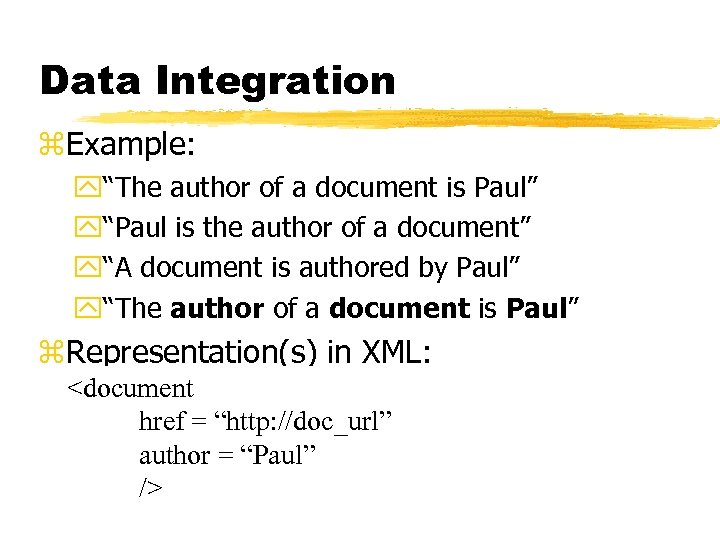
Data Integration z. Example: y“The author of a document is Paul” y“Paul is the author of a document” y“A document is authored by Paul” y“The author of a document is Paul” z. Representation(s) in XML: <document> <author> = “http: //doc_url” href <name> Paul </name> <url> http: //doc_url </url> author = “Paul” </author> Paul </name> <name> /> <url> http: //doc_url </url> </author>
Data Integration (cont. ) z. Complexity of querying XML documents y. N ways of mapping XML to logical structure y. Requires the normalization of all possible representations for effective query z. Mean the same thing to a person z. Mean very different things to a machine z. RDF much less flexible yless flexible == more interoperable! yconsistent way of representing statements
RDF Components z. Formal data model z. Syntax for interchange of data z. Schema Type system (schema model) z. Syntax for machine-understandable schemas z. Query and profile protocols
RDF Data Model z. Imposes structural constraints on the expression of application data models y for consistent encoding, exchange and processing of metadata z. Enables resource description communities to define their own semantics z. Provides for structural interoperability
RDF Data Model z. Directed labelled graphs z. Model elements y. Resource y. Property y. Value y. Statement
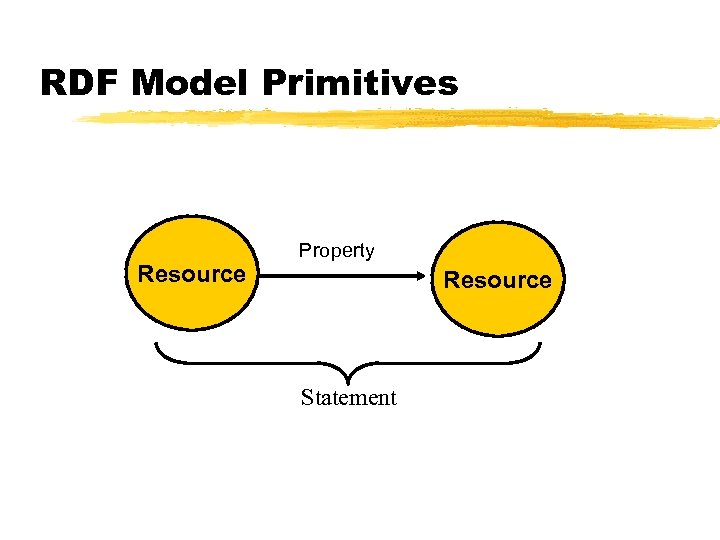
RDF Model Primitives Resource Property Value Resource Statement
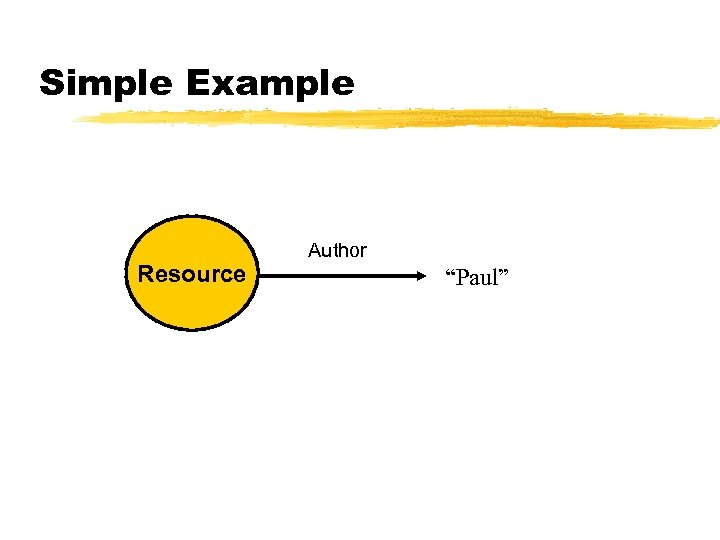
Simple Example Resource Author “Paul”
RDF Syntax z RDF Model defines a formal relationships among resources, properties and values z Syntax is required to. . . y. Store instances of the model into files y. Communicate files from one application to another z W 3 C XML e. Xtensible Markup Language yhttp: //www. w 3. org/XML
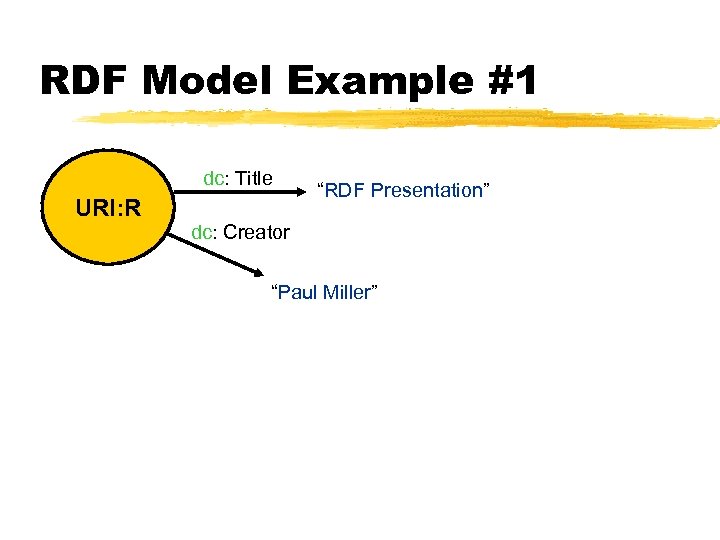
RDF Model Example #1 dc: Title URI: R “RDF Presentation” dc: Creator “Paul Miller”
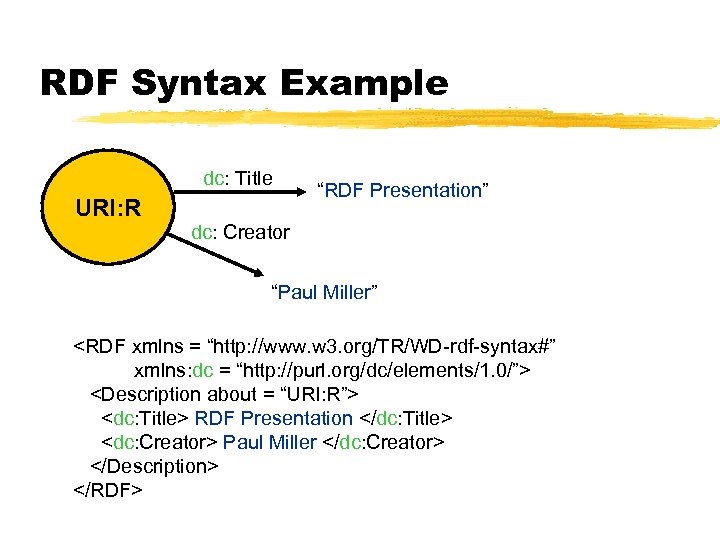
RDF Syntax Example dc: Title URI: R “RDF Presentation” dc: Creator “Paul Miller” <RDF xmlns = “http: //www. w 3. org/TR/WD-rdf-syntax#” xmlns: dc = “http: //purl. org/dc/elements/1. 0/”> <Description about = “URI: R”> <dc: Title> RDF Presentation </dc: Title> <dc: Creator> Paul Miller </dc: Creator> </Description> </RDF>
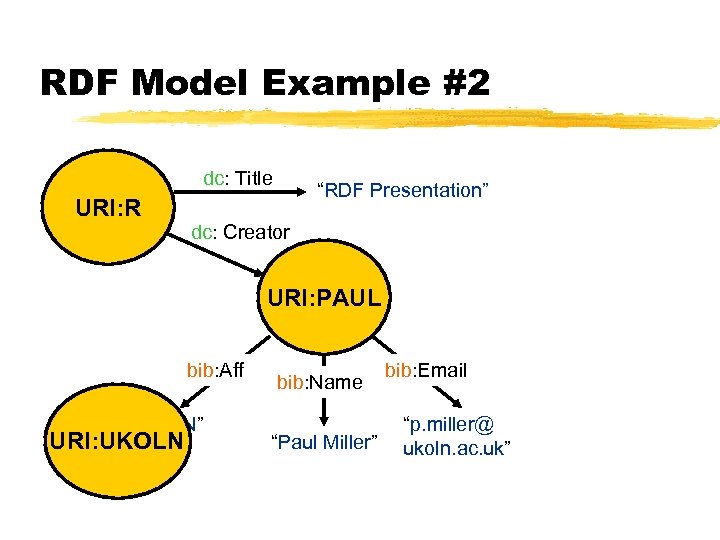
RDF Model Example #2 dc: Title URI: R “RDF Presentation” dc: Creator “Paul Miller” URI: PAUL bib: Aff “UKOLN” URI: UKOLN bib: Name “Paul Miller” bib: Email “p. miller@ ukoln. ac. uk”
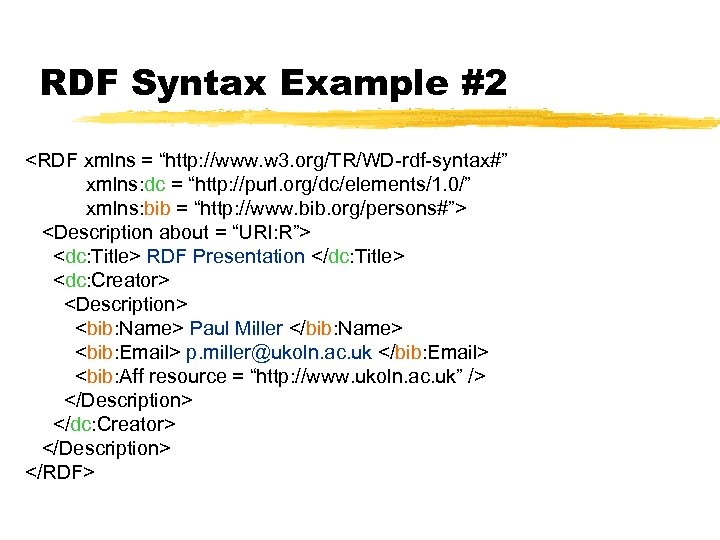
RDF Syntax Example #2 <RDF xmlns = “http: //www. w 3. org/TR/WD-rdf-syntax#” xmlns: dc = “http: //purl. org/dc/elements/1. 0/” xmlns: bib = “http: //www. bib. org/persons#”> <Description about = “URI: R”> <dc: Title> RDF Presentation </dc: Title> <dc: Creator> <Description> <bib: Name> Paul Miller </bib: Name> <bib: Email> p. miller@ukoln. ac. uk </bib: Email> <bib: Aff resource = “http: //www. ukoln. ac. uk” /> </Description> </dc: Creator> </Description> </RDF>
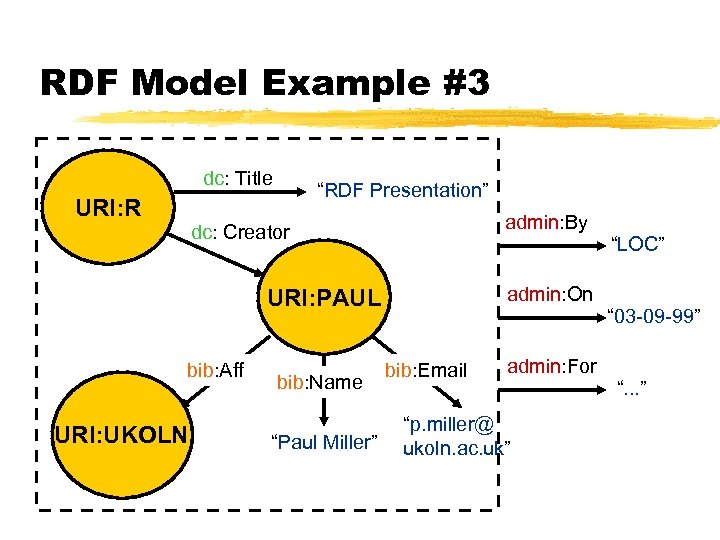
RDF Model Example #3 dc: Title URI: R “RDF Presentation” admin: By dc: Creator admin: On “Eric Miller” URI: PAUL bib: Aff “OCLC” URI: UKOLN bib: Name “Paul Miller” bib: Email admin: For “p. miller@ ukoln. ac. uk” “LOC” “ 03 -09 -99” “. . . ”
Where do you stop? z Model provides enabling technology z Degree of metadata simplicity/complexity is a matter of: y. Resource description communities needs, bestpractice and experience y. Organization/Institution’s Policy y. Economics y. Goals and requirements of implementation
RDF Schemas z Declaration of vocabularies yproperties defined by a particular community ycharacteristics of properties and/or constraints on corresponding values z Schema Type System - Basic Types y. Property, Class, Sub. Class. Of, Domain, Range y. Minimal (but extensible) at this time yminimize significant clashes with typing system designed for XML NG DTDs (1999? ) z Expressible in the RDF model and syntax
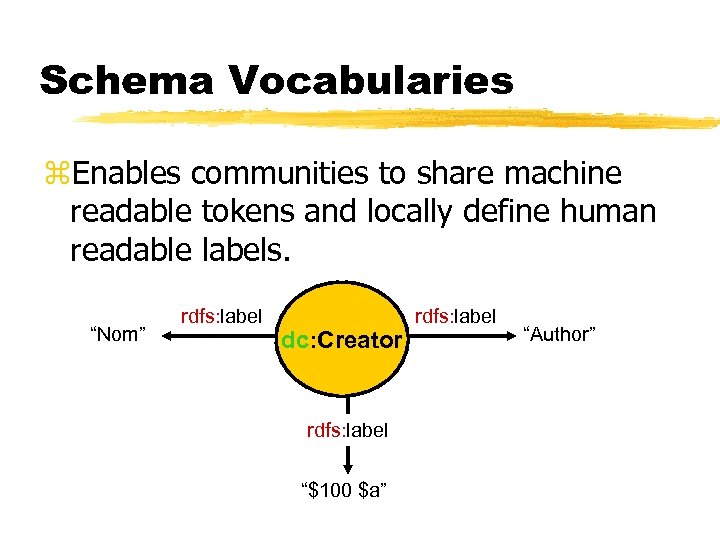
Schema Vocabularies z. Enables communities to share machine readable tokens and locally define human readable labels. “Nom” rdfs: label dc: Creator rdfs: label “$100 $a” rdfs: label “Author”
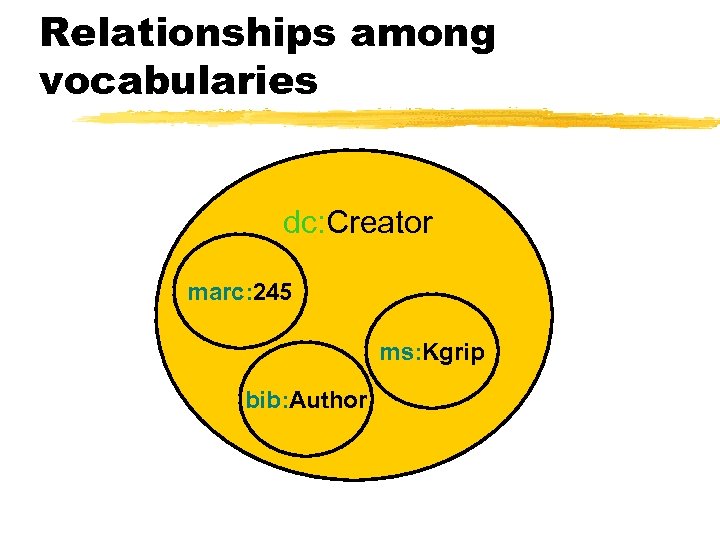
Relationships among vocabularies dc: Creator marc: 245 ms: Kgrip bib: Author
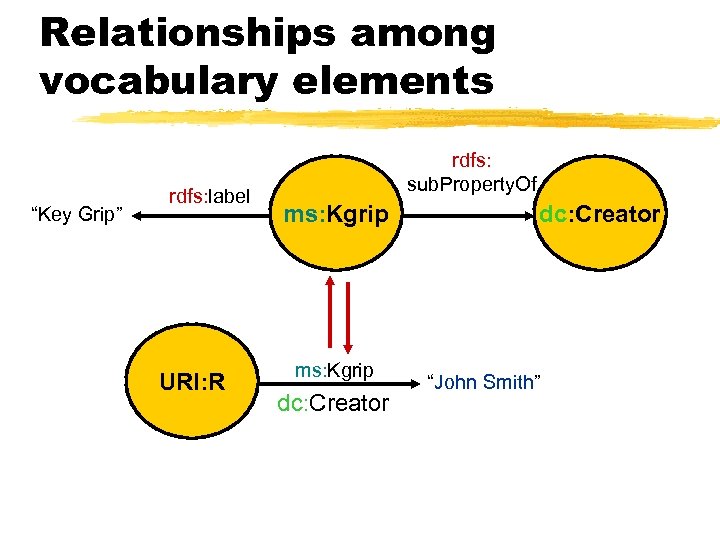
Relationships among vocabulary elements “Key Grip” rdfs: label URI: R rdfs: sub. Property. Of ms: Kgrip dc: Creator “John Smith”
Bringing it together z. RDF Metadata transmission y. Embedded (e. g. <META>), Transmitted with resource (HTTP), Trusted 3 rd Party (HTTP GET) z. RDF Data Model y. Support consistent encoding, exchange and processing of metadata… critical when aggregating data from multiple sources z. RDF Schema y. Declare, define, reuse vocabularies
RDF Summary z. RDF is a general-purpose framework z. RDF provides structured, machineunderstandable metadata for the Web z. Metadata vocabularies can be developed without central coordination z. RDF Schemas describe the meaning of each property name z. Signed RDF is the basis for trust
RDF Information z. W 3 C RDF Model and Syntax Speciation y. Recommendation Status Feb 24, 1999 z. W 3 C RDF Schema Specifications y. Proposed Recommendation Status Mar 4, 1999 z. W 3 C RDF Home Page yhttp: //www. w 3. org/RDF/
RDF and the Dublin Core z. RDF z. Dublin Core y. Overview y. Data Model y. Examples y. Qualification Mechanisms
Dublin Core Data Model z. Application of the RDF Data Model z. Sufficient richness in RDF to support Dublin Core modelling goals z. Defines implementation and extensibility framework for Dublin Core based applications y. CIMI is an example of these applications y. MICI could be an example of these applications
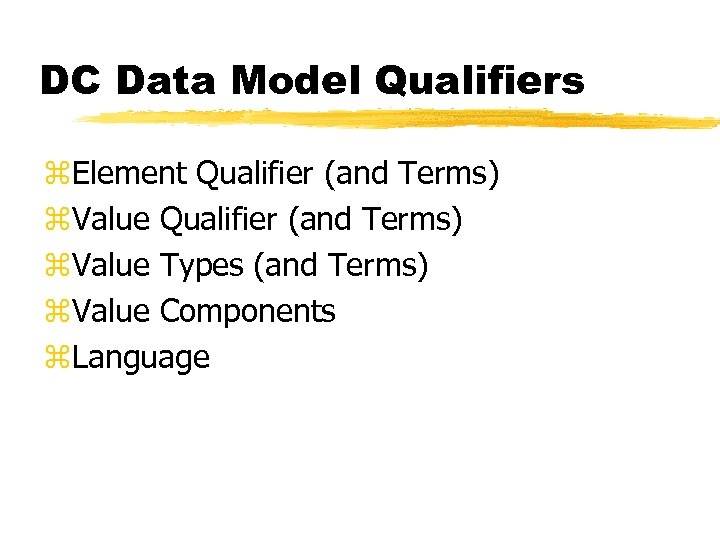
DC Data Model Qualifiers z. Element Qualifier (and Terms) z. Value Types (and Terms) z. Value Components z. Language
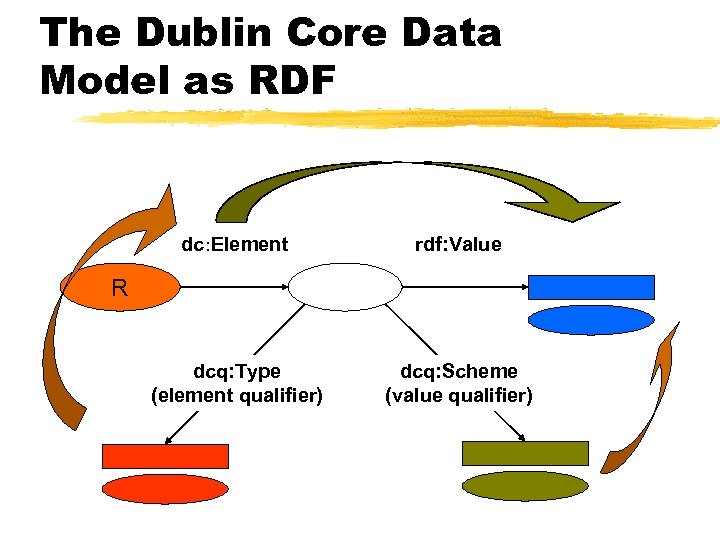
The Dublin Core Data Model as RDF dc: Element rdf: Value dcq: Type (element qualifier) dcq: Scheme (value qualifier) R
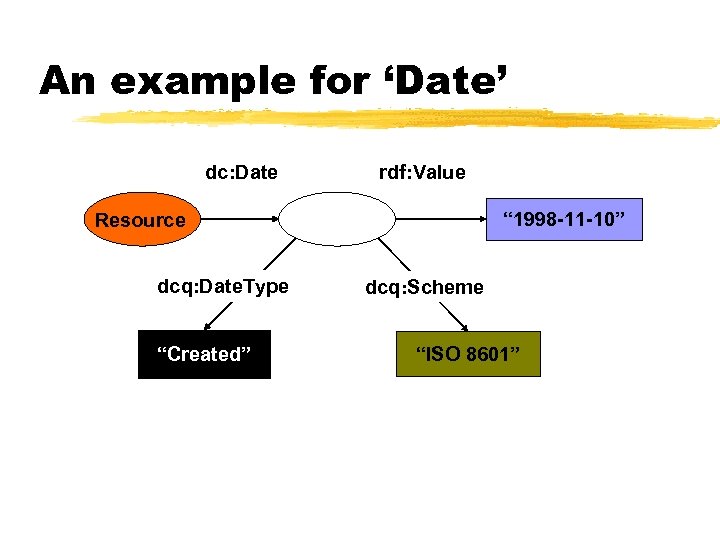
An example for ‘Date’ dc: Date rdf: Value “ 1998 -11 -10” Resource dcq: Date. Type “Created” dcq: Scheme “ISO 8601”
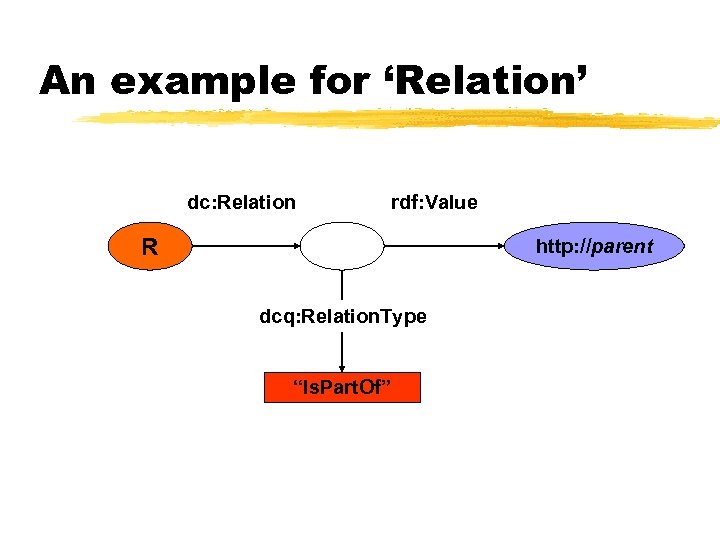
An example for ‘Relation’ dc: Relation rdf: Value R http: //parent dcq: Relation. Type “Is. Part. Of”
Element Qualifier (and Terms) z. Enabling mechanisms in the data model that support the qualification of the element relating the resource and the value ye. g. The term “Illustrator” may be used to qualify the “Creator” element that relates some resource and some value z. Terms y. Resource identifying “Illustrator”
Value Qualifier (and Terms) z. Identifies the encoding, parsing and/or processing rules associated with a value y. LNF: “Lastname, [sp]Firstname” y. ISO 8601: 1998 -10 -01 y. DDC: 325. 251 y. AAT: ionic column z. Terms y. Resources defining LNF, ISO 8601, DDC, AAT, etc.
Language z. Defines the Language of the value ylang=fr “chat” vs. lang=en “chat” z. XML provides a way of handling of language (xml: lang) y. RDF adopts this, DC adopts this
What do you get for this? z. The separation of these constructs is important for extensibility by other resource description communities z. Dublin Core Metadata Initiative will not define an all inclusive set Terms z. It will define a canonical set and the enabling mechanisms for other communities to extend these
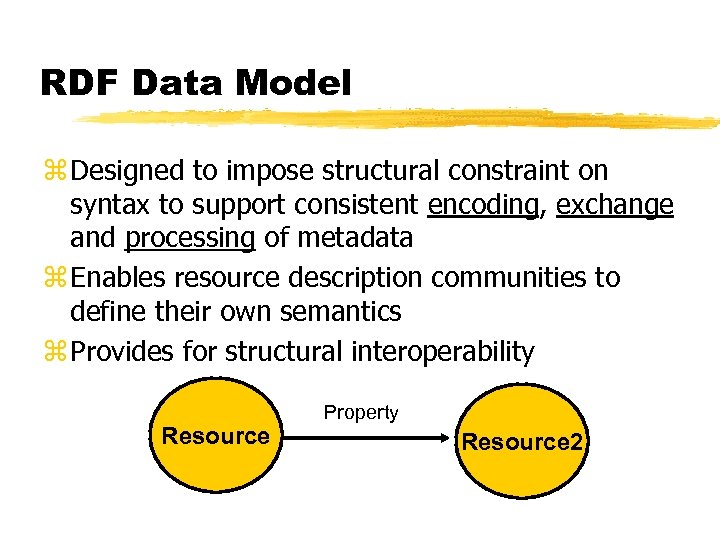
RDF Data Model z Designed to impose structural constraint on syntax to support consistent encoding, exchange and processing of metadata z Enables resource description communities to define their own semantics z Provides for structural interoperability Resource Property Value Resource 2
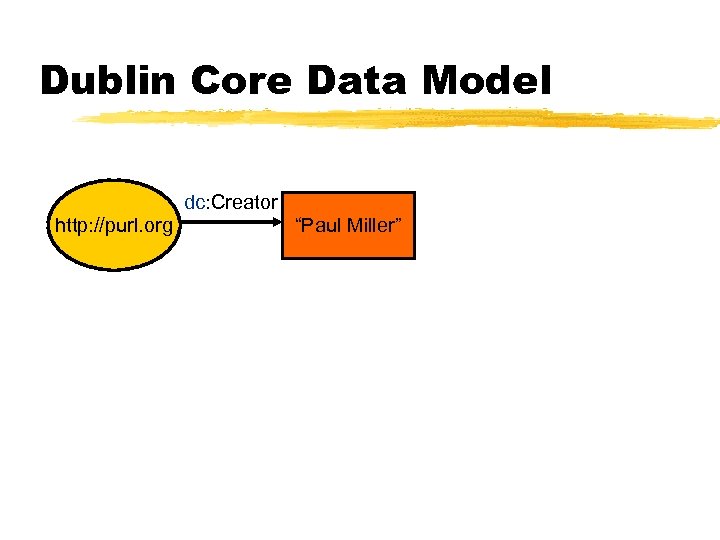
Dublin Core Data Model dc: Creator http: //purl. org “Paul Miller”
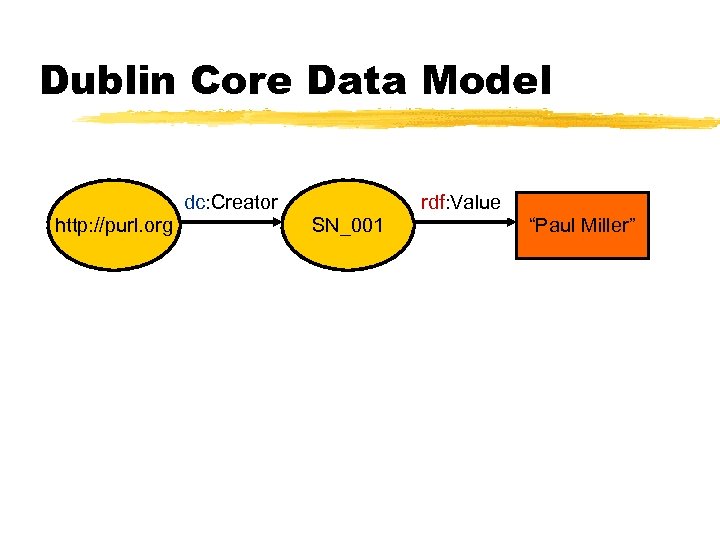
Dublin Core Data Model dc: Creator http: //purl. org rdf: Value SN_001 “Paul Miller”
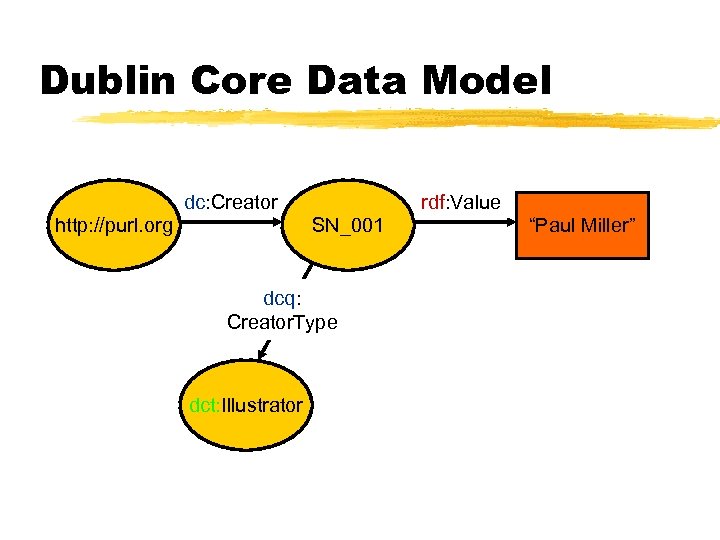
Dublin Core Data Model dc: Creator http: //purl. org rdf: Value SN_001 dcq: Creator. Type dct: Illustrator “Paul Miller”
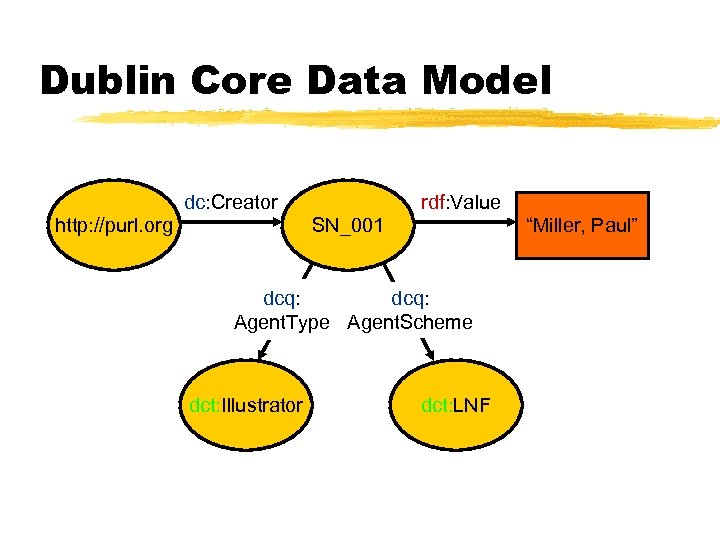
Dublin Core Data Model dc: Creator http: //purl. org rdf: Value SN_001 “Miller, Paul” dcq: Agent. Type Agent. Scheme dct: Illustrator dct: LNF
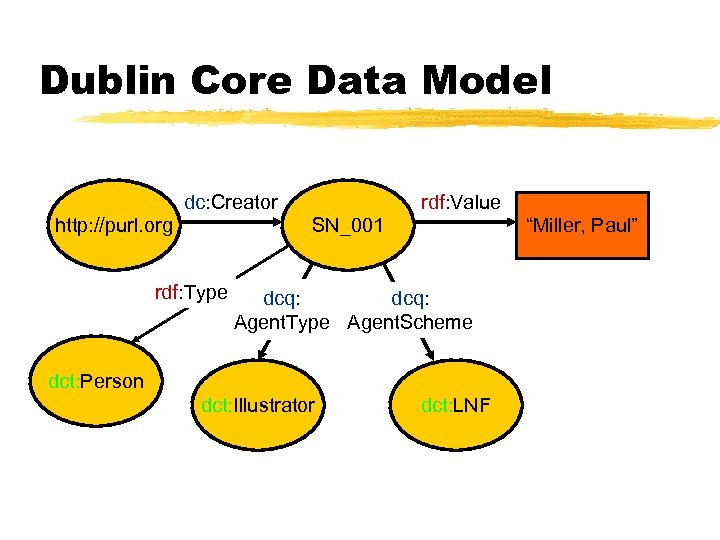
Dublin Core Data Model dc: Creator http: //purl. org rdf: Value SN_001 rdf: Type “Miller, Paul” dcq: Agent. Type Agent. Scheme dct: Person dct: Illustrator dct: LNF
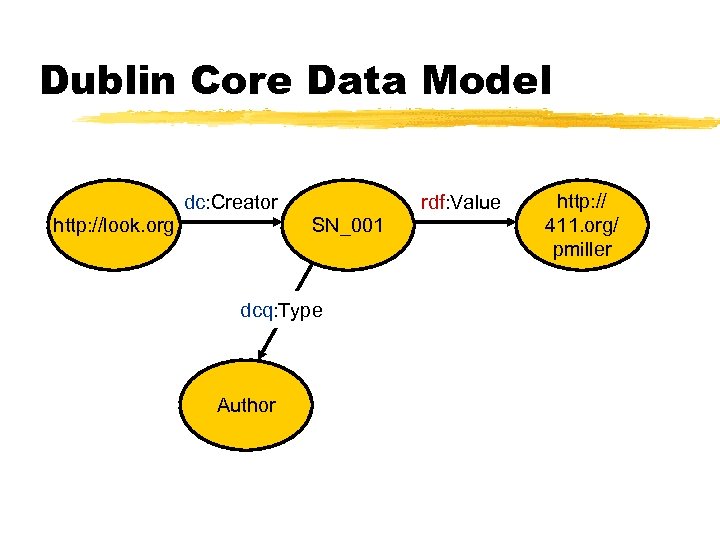
Dublin Core Data Model dc: Creator http: //look. org rdf: Value SN_001 dcq: Type Author http: // 411. org/ pmiller
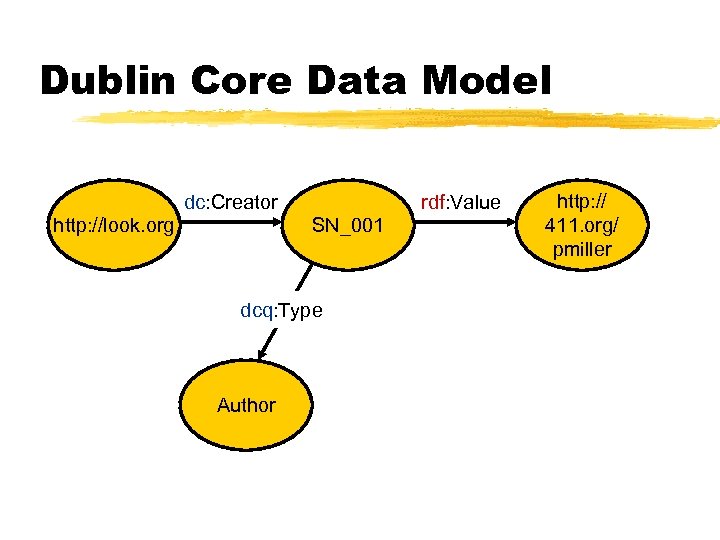
Dublin Core Data Model dc: Creator http: //look. org rdf: Value SN_001 dcq: Type Author http: // 411. org/ pmiller
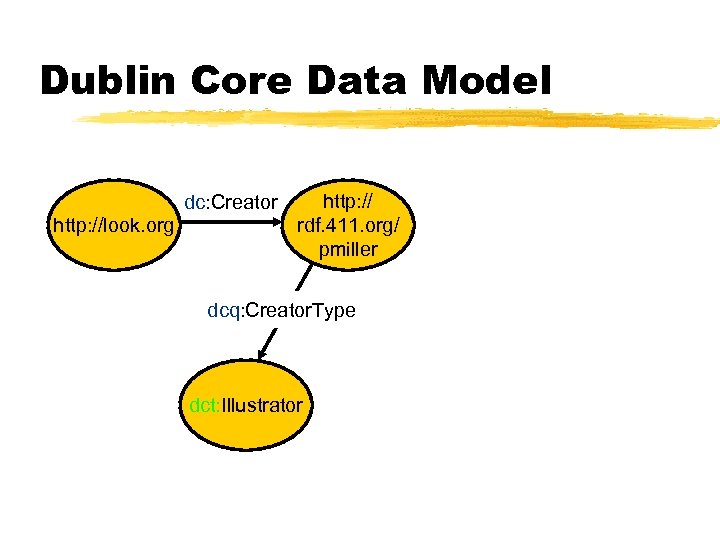
Dublin Core Data Model dc: Creator http: //look. org http: // rdf. 411. org/ pmiller dcq: Creator. Type dct: Illustrator
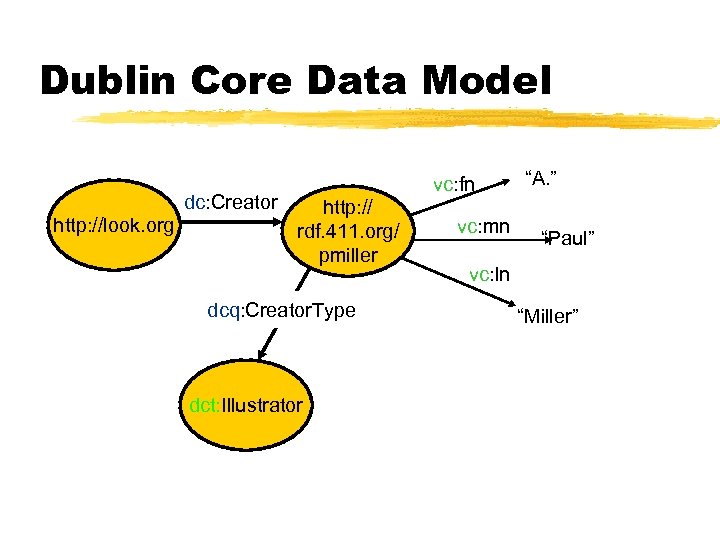
Dublin Core Data Model dc: Creator http: //look. org vc: fn http: // rdf. 411. org/ pmiller dcq: Creator. Type dct: Illustrator vc: mn “A. ” “Paul” vc: ln “Miller”
Dublin Core Data Model dc: Creator http: //look. org http: // rdf. 411. org/ pmiller dcq: Creator. Type
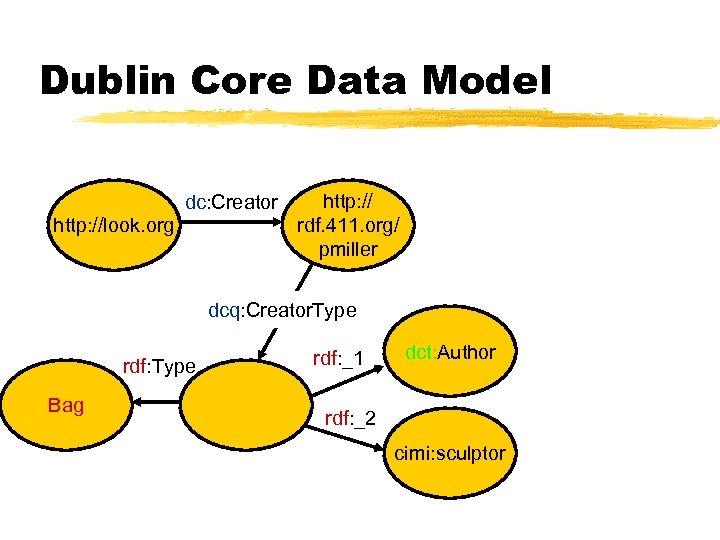
Dublin Core Data Model dc: Creator http: //look. org http: // rdf. 411. org/ pmiller dcq: Creator. Type rdf: Type Bag rdf: _1 dct: Author rdf: _2 cimi: sculptor
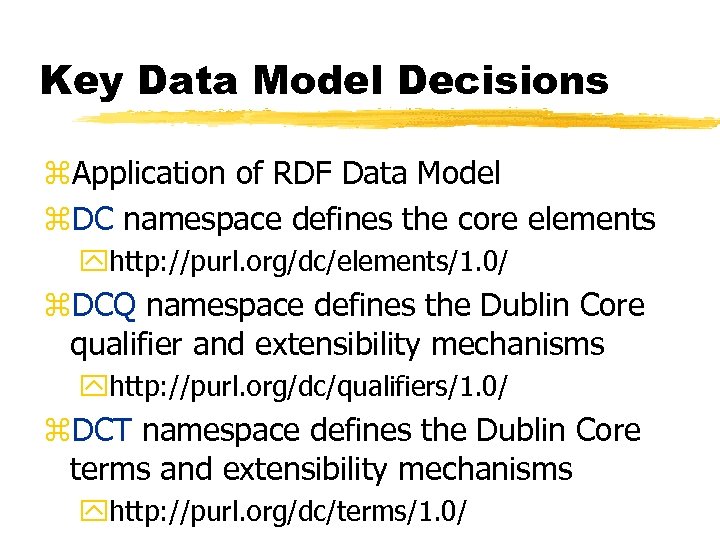
Key Data Model Decisions z. Application of RDF Data Model z. DC namespace defines the core elements yhttp: //purl. org/dc/elements/1. 0/ z. DCQ namespace defines the Dublin Core qualifier and extensibility mechanisms yhttp: //purl. org/dc/qualifiers/1. 0/ z. DCT namespace defines the Dublin Core terms and extensibility mechanisms yhttp: //purl. org/dc/terms/1. 0/
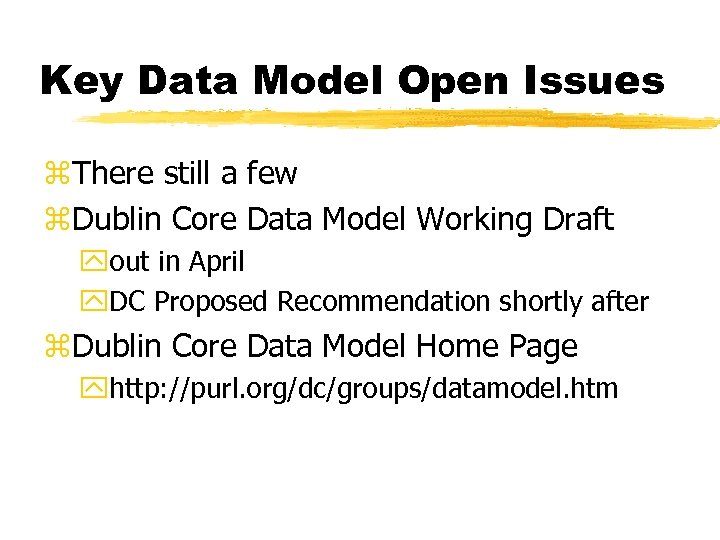
Key Data Model Open Issues z. There still a few z. Dublin Core Data Model Working Draft yout in April y. DC Proposed Recommendation shortly after z. Dublin Core Data Model Home Page yhttp: //purl. org/dc/groups/datamodel. htm
Additional Information z. RDF Home Page yhttp: //www. w 3. org/RDF z. Dublin Core Metadata Initiative yhttp: //purl. org/dc/
Скачать презентацию Introduction to RDF Based closely upon an earlier
3d6fd411ebbe6e2f20cdc59c4069cbf4.ppt