Скачать презентацию INTRODUCTION TO QUALITY MANAGEMENT Philosophy the power of
b1d98f69b1da4f2f5c6c7236753eac61.ppt
- Количество слайдов: 40
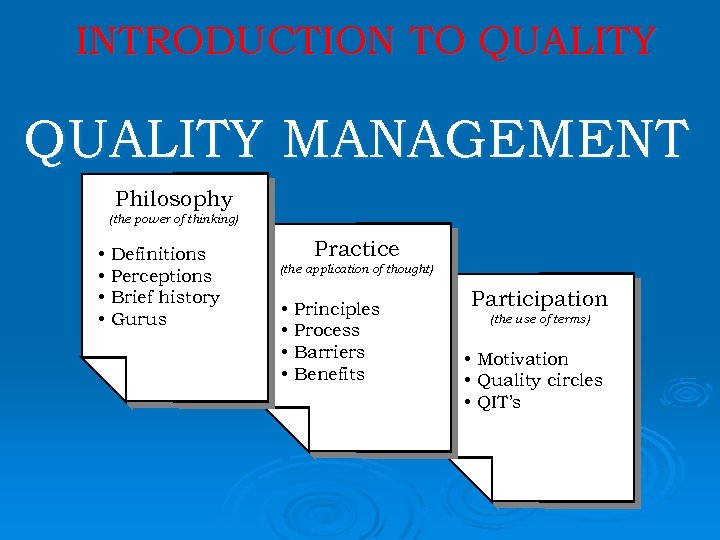 INTRODUCTION TO QUALITY MANAGEMENT Philosophy (the power of thinking) • • Definitions Perceptions Brief history Gurus Practice (the application of thought) • • Principles Process Barriers Benefits Participation (the use of terms) • Motivation • Quality circles • QIT’s
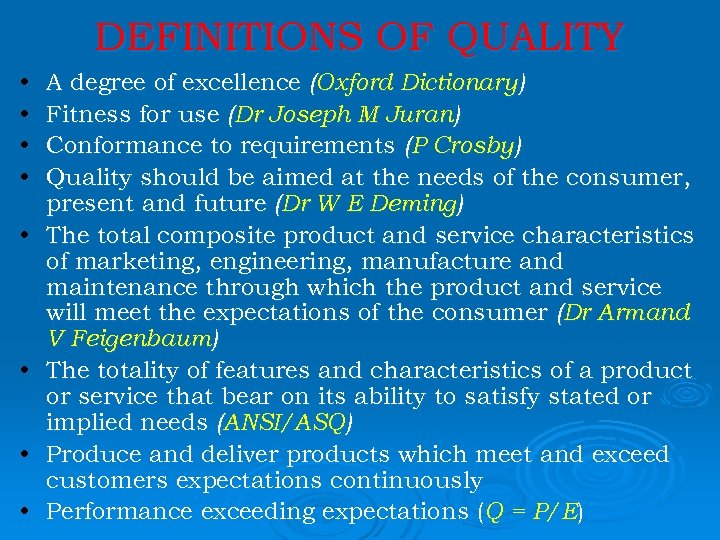 DEFINITIONS OF QUALITY • • A degree of excellence (Oxford Dictionary) Fitness for use (Dr Joseph M Juran) Conformance to requirements (P Crosby) Quality should be aimed at the needs of the consumer, present and future (Dr W E Deming) The total composite product and service characteristics of marketing, engineering, manufacture and maintenance through which the product and service will meet the expectations of the consumer (Dr Armand V Feigenbaum) The totality of features and characteristics of a product or service that bear on its ability to satisfy stated or implied needs (ANSI/ASQ) Produce and deliver products which meet and exceed customers expectations continuously Performance exceeding expectations (Q = P/E)
 QUALITY ADVOCATES • To become familiar with seven quality masters and their philosophies of quality management and continuous improvement • To understand the concepts of managing a total quality environment in order to improve quality, increase productivity and reduce costs • To learn the basic involved in the creation of a system to support an overall quality environment “Most individuals are motivated to do the best they can. Sometimes though, the goal seems too far away and too hard to reach. The problem appears too big to tackle. How does a company deal with these issues? How can managers enable their employees to do their best? ”
 Dr. Walter Shewhart (1891 -1967) • • • - Two aspect of quality (writing) Customer wants (subjective aspect) Physical properties of the goods or service (objective aspect) Another important aspect of quality is the value received for the price paid Create statistical methods to control and improve the quality of the processes that provides goods and services Working at Bell Laboratories in the 1920 s and 1930 s, he the first to encourage the use of statistics to identify, monitor, and eventually remove the sources of variation found in repetitive processes Identified two sources of variation Controlled variation (common causes) is variation present in a process due to the very nature of the process Uncontrolled variation (special or assignable causes) comes from sources external to the process
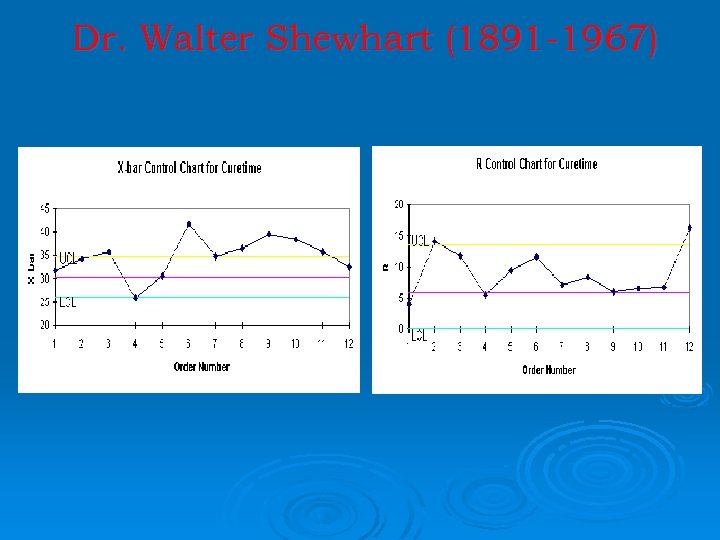
 Dr. Walter Shewhart (1891 -1967) • - • • • - Forth fundamental principle A process under control Exhibiting only controlled variation Future process performance can be predicted 1) within limits 2) on the basis of past performance Develop the formulas and a table of constants used to create the most widely utilized statistical control charts in quality Figure 1 control chart (X-bar and R chart) appeared on 16 May 1924 Control charts have three purpose To define standards for the process To aid in problem-solving efforts to attain the standards To serve to judge if the standards have been met v Tiger Woods used control charts for their training in golf shooting
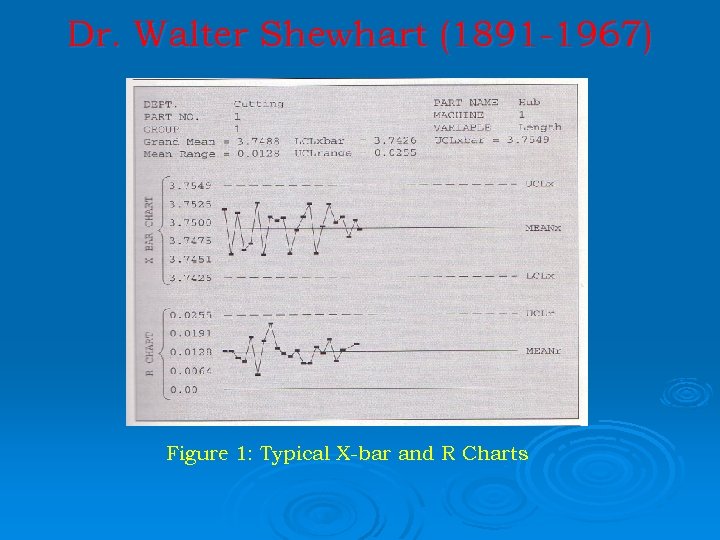 Dr. Walter Shewhart (1891 -1967) Figure 1: Typical X-bar and R Charts
 Dr. Walter Shewhart (1891 -1967)
 Dr. W. Edwards Deming (1900 -1993) • To teach optimal management strategies and practices for organizations focused on quality • Encourage top-level management to get involved in the process of creating an environment that supports continuous improvement • Graduate from Yale University 1928 – his message/ideas was not accepted in the United States • Help turn Japan into an industrial force to be reckoned • Considered improving quality leads to decreased costs, fewer mistakes, fewer delay, and better use of resources; - which in turn leads to improved productivity - which enables a company to capture more of the market - which enables the company to stay in business - which results in providing more jobs • Quality must defined in terms of customer satisfaction • Focus on management involvement, continuous improvement, statistical analysis, goal setting, and communication • Deming’s philosophy encourage company leaders to dedicate themselves and their companies to the long-term improvement of the quality of their products or services
 Dr. W. Edwards Deming (1900 -1993) Aimed primarily at management with his 14 points as a guideline 1. Create a constancy of purpose toward improvement of product and service, with the aim to become competitive and to stay in business and to provide jobs 2. Adopt the new philosophy 3. Cease dependence on inspection to achieve quality 4. End the practice of awarding business on the basis of price tag alone. Instead minimize total cost 5. Constantly and forever improve the system of production and service 6. Institute training on the job 7. Institute leadership 8. Drive out fear 9. Break down barriers between departments 10. Eliminate slogans, exhortations, and targets for the work force 11. Eliminate arbitrary work standards and numerical quotas. Substitute leadership 12. Remove barriers that rob people of their right to pride of workmanship 13. Institute a vigorous program of education and self-improvement 14. Put everybody in the company to work to accomplish the transformation
 Dr. W. Edwards Deming (1900 -1993) • Deming’s point about driving out fear and removing barriers stress the importance of communication • Improved management-employee interaction as well as increased communication between departments will lead to more effective solutions to the challenges of creating a product or providing a service • Use statistics and quality technique espoused by Dr. Shewhart to reducing the variation present in a process. • Process improvement is best carried out in three stages; - Get the process under control by identifying and eliminating the sources of uncontrolled variation. Remove the special causes responsible for this variation - Once the special cause have been removed and the process is stable, improve the process. Tackle the common cause responsible for the controlled variation present in the process. Determine if process changes can remove them from the process. Investigate whether or not waste exists in the process - Monitor the improved process to determine if the changes that were made are working
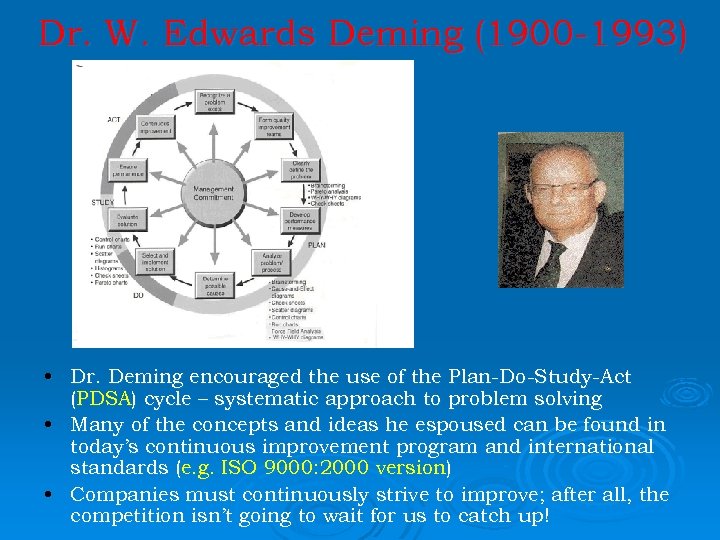 Dr. W. Edwards Deming (1900 -1993) • Dr. Deming encouraged the use of the Plan-Do-Study-Act (PDSA) cycle – systematic approach to problem solving • Many of the concepts and ideas he espoused can be found in today’s continuous improvement program and international standards (e. g. ISO 9000: 2000 version) • Companies must continuously strive to improve; after all, the competition isn’t going to wait for us to catch up!
 Dr. Joseph M. Juran (1904 – xxxx) • Approach involves creating awareness of the need to improve, making quality improvement an integral part of each job, providing training in quality methods, establishing team problem solving, and recognizing results • Quality is a concept that needs to be found in all aspects of a business • Companies can reduce the costs associated with poor quality and remove chronic waste from their organization • Three managerial processes (Juran Trilogy Program); 1. Quality Planning encourages the development of methods to stay in tune with customer’s needs and expectations 2. Quality Control involves comparing products produced with goals and specifications 3. Quality Improvement involves the ongoing process of improvement necessary for the company’s continued success
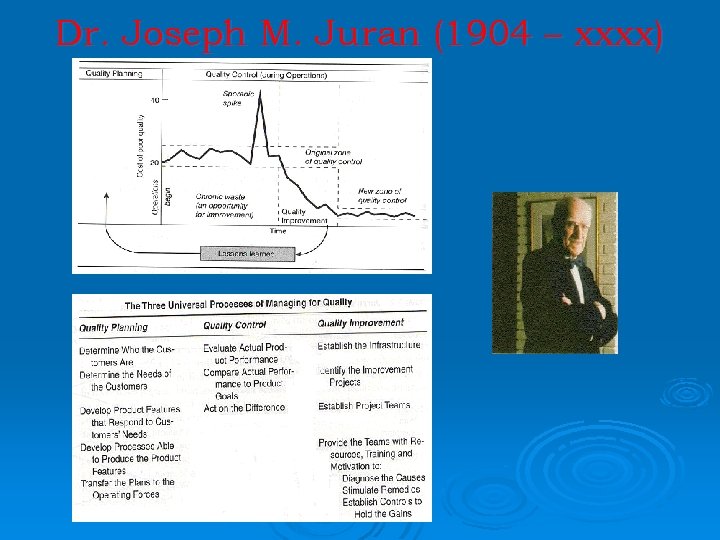 Dr. Joseph M. Juran (1904 – xxxx)
 Dr. Joseph M. Juran (1904 – xxxx) • Forth fundamentals (Juran on Leadership for Quality: An Executive Handbook) 1. Upper management leadership 2. Continuous education 3. Annual planning for quality improvement and 4. Cost reduction • Successful improvement efforts encourage breakthroughs in knowledge and attitudes • Project-by-Project implementation procedure, project teams are set up to investigate and solve specific problems (Figure 2) • The project teams should be composed of individuals with diverse backgrounds • Diversified group also aids in implementing the solutions found
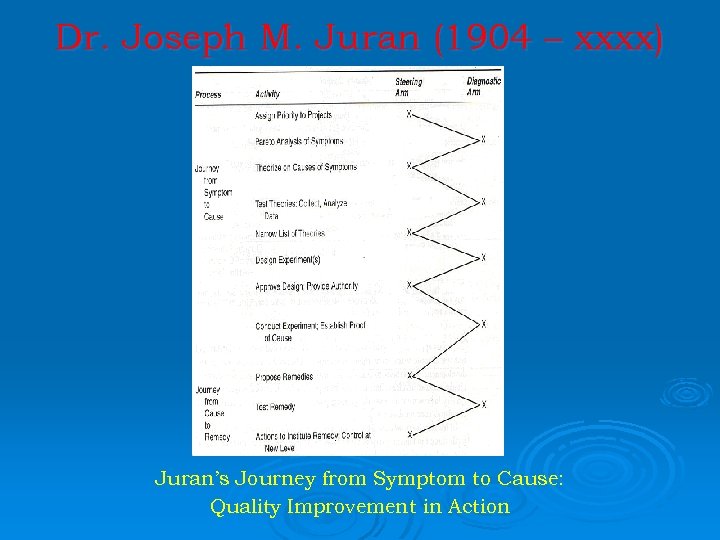 Dr. Joseph M. Juran (1904 – xxxx) Juran’s Journey from Symptom to Cause: Quality Improvement in Action
 Dr. Armand Feigenbaum (1920 – xxxx) • Considered to be the originator of the total quality movement • Defined quality based on a customer’s actual experience with the product or service • Graduate from MIT and published Total Quality Control in 1951 • He predicted that quality would become a significant customersatisfaction issue – consumers have come to expert quality to be an essential dimension of the product or service they are purchasing • Quality is not a factor to be managed but a method of “managing, operating, and integrating the marketing, technology, production, information, and finance areas throughout a company’s quality value chain with the subsequent favorable impact on manufacturing and service effectiveness” (article Changing Concepts and Management of Quality Worldwide, Dec. 1997) • Quality system are a method of managing an organization to achieve customer satisfaction, lower overall costs, higher profits, and greater employee • Statistical methods and problem-solving techniques should be utilized to effectively support business strategies aimed at achieve customer satisfaction
 Philip Crosby (1926 – 2001) • Four absolutes of quality management set expectations for a continuous improvement process to meet 1. Quality Definition : Conformance to requirements - Customer requirements must define the products or service in terms of measurable characteristics 2. Quality System : Prevention of Defects - The system that needs to be in place in order to ensure that the products or services provided by a company meet the requirements of the customer 3. Quality Performance Standard : Zero Defects - Refers to making products correctly the first time, with no imperfections 4. Quality Management : Cost of Quality - Cost associated with providing customers with a product or service that conforms to their expectations
 Dr. Kaoru Ishikawa (1915 -1989) • One of the first individuals to encourage total quality control • Quality must be defined broadly and focused in every aspects of an organization, including the quality of information, processes, service, price, systems, and people • All individuals employed by a company should become involved in quality problem solving • He advocated the use of seven quality tools (Figure 3) • Ishikawa developed the cause-and-effect diagram (early 1950 s) - Used to find the root cause of problems - Also called the Ishikawa diagram or fish-bone diagram • Also promoted the use of quality circles, teams that meet to solve quality problems related to their own work • Participants receive training in the seven tools, determine appropriate problems to work on, develop solutions, and establish new procedures to lock in quality improvements
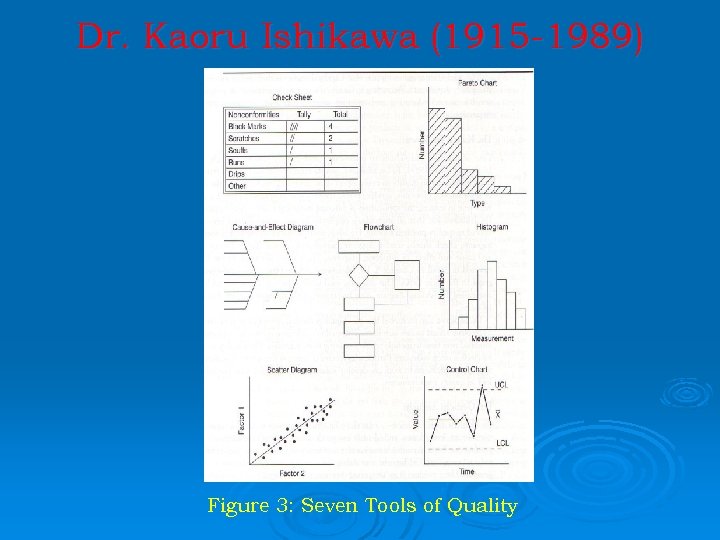 Dr. Kaoru Ishikawa (1915 -1989) Figure 3: Seven Tools of Quality
 Dr. Genichi Taguchi (1924 – xxxx) • Developed methods that seek to improve quality and consistency, lower losses, and identify key product and process characteristics before production • Taguchi method emphasize consistency of performance and significantly reduced variation • Taguchi methods design the experiment to systematically weed out a product’s or process’s insignificant elements There are four basic steps; 1. Select the process/product to be studied 2. Identify the important variables 3. Reduce variation on the important variables through redesign, process improvement, and tolerance 4. Open up tolerances on unimportant variables
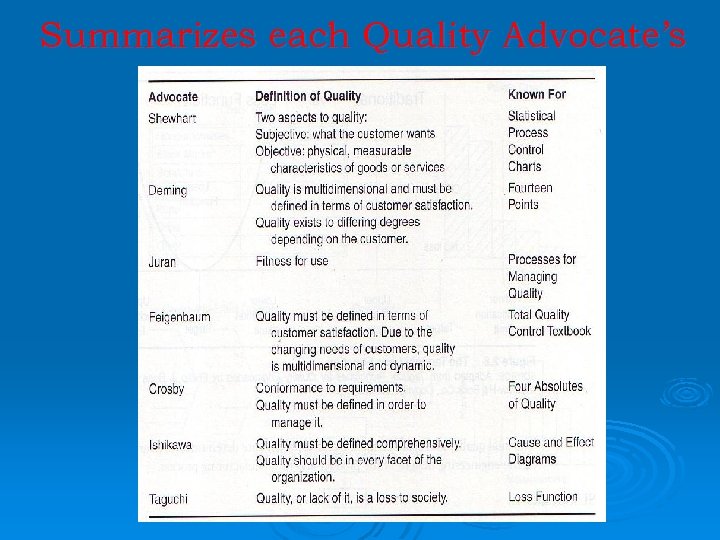 Summarizes each Quality Advocate’s
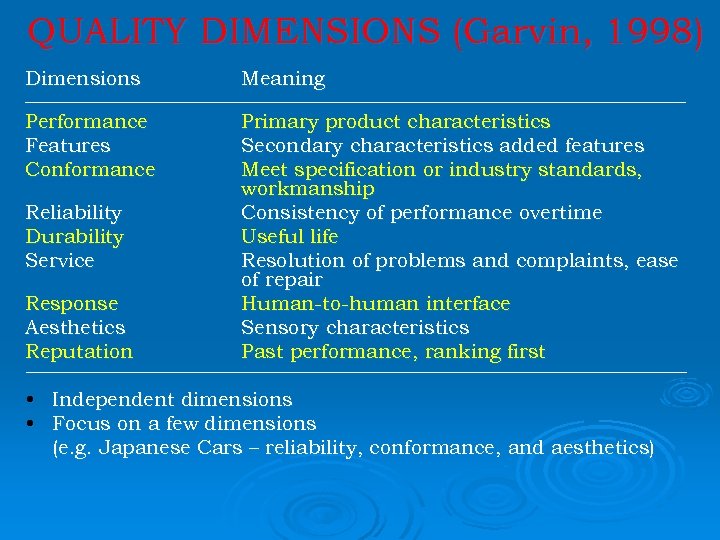 QUALITY DIMENSIONS (Garvin, 1998) Dimensions Meaning Performance Features Conformance Primary product characteristics Secondary characteristics added features Meet specification or industry standards, workmanship Consistency of performance overtime Useful life Resolution of problems and complaints, ease of repair Human-to-human interface Sensory characteristics Past performance, ranking first Reliability Durability Service Response Aesthetics Reputation • Independent dimensions • Focus on a few dimensions (e. g. Japanese Cars – reliability, conformance, and aesthetics)
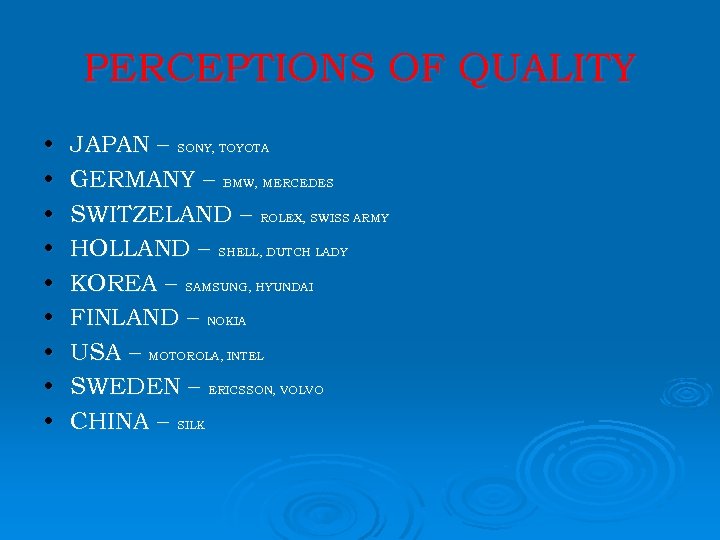 PERCEPTIONS OF QUALITY • • • JAPAN – SONY, TOYOTA GERMANY – BMW, MERCEDES SWITZELAND – ROLEX, SWISS ARMY HOLLAND – SHELL, DUTCH LADY KOREA – SAMSUNG, HYUNDAI FINLAND – NOKIA USA – MOTOROLA, INTEL SWEDEN – ERICSSON, VOLVO CHINA – SILK
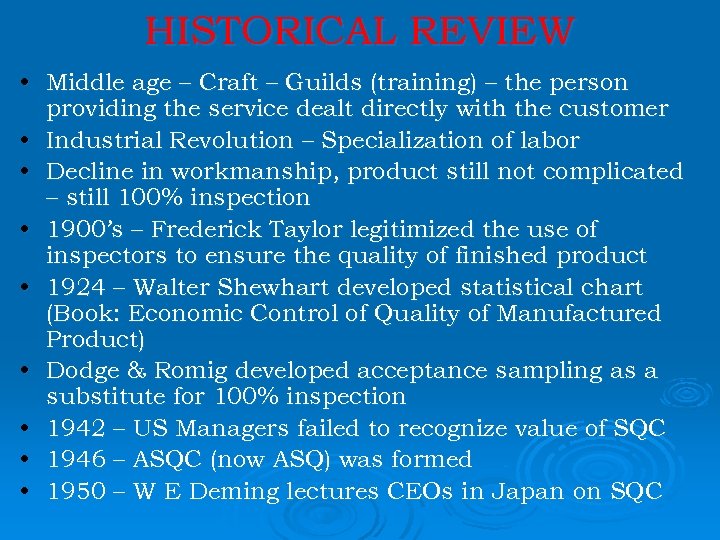 HISTORICAL REVIEW • Middle age – Craft – Guilds (training) – the person providing the service dealt directly with the customer • Industrial Revolution – Specialization of labor • Decline in workmanship, product still not complicated – still 100% inspection • 1900’s – Frederick Taylor legitimized the use of inspectors to ensure the quality of finished product • 1924 – Walter Shewhart developed statistical chart (Book: Economic Control of Quality of Manufactured Product) • Dodge & Romig developed acceptance sampling as a substitute for 100% inspection • 1942 – US Managers failed to recognize value of SQC • 1946 – ASQC (now ASQ) was formed • 1950 – W E Deming lectures CEOs in Japan on SQC
 HISTORICAL REVIEW • 1954 – Joseph Juran went to Japan – Management’s responsibility for quality • 1960 – Quality Control Circle (QCC) formed in Japan – quality improvement • 1980’s – US Quality Movement, TQM concepts published • Late 1980’s – Automotive industry emphasize SPC, suppliers required to use Malcolm Balridge Award established (to measure TQM implementation), Taguchi method, Design of Experiments (DOE) • 1990’s – ISO 9000 series became Global QA standard, QS 9000 introduced by automotive industry customer satisfaction ISO 14000 • 2000 – New ISO 9000: 2000 version, Six Sigma Program introduce information technology
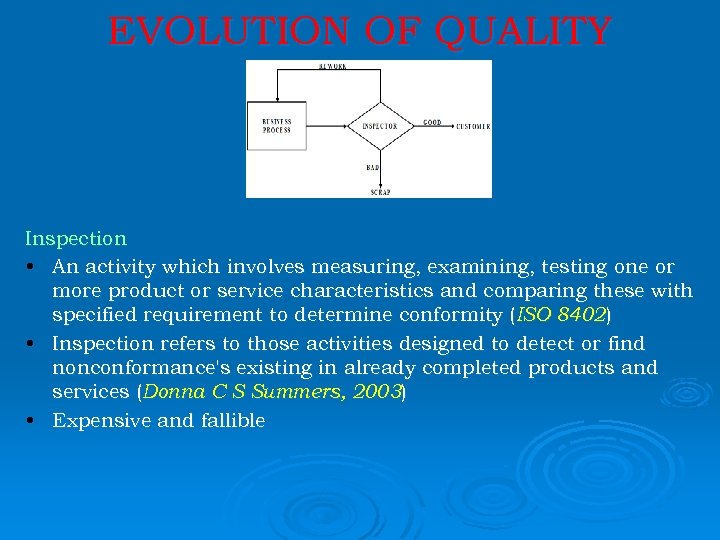 EVOLUTION OF QUALITY Inspection • An activity which involves measuring, examining, testing one or more product or service characteristics and comparing these with specified requirement to determine conformity (ISO 8402) • Inspection refers to those activities designed to detect or find nonconformance's existing in already completed products and services (Donna C S Summers, 2003) • Expensive and fallible
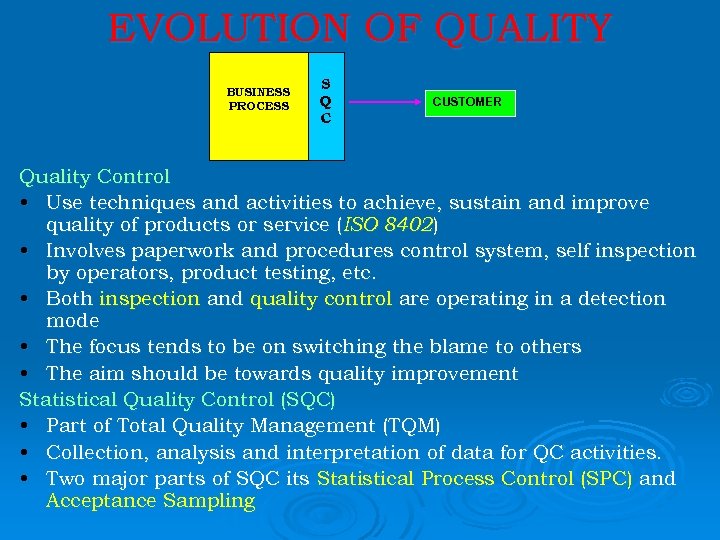 EVOLUTION OF QUALITY BUSINESS PROCESS S Q C CUSTOMER Quality Control • Use techniques and activities to achieve, sustain and improve quality of products or service (ISO 8402) • Involves paperwork and procedures control system, self inspection by operators, product testing, etc. • Both inspection and quality control are operating in a detection mode • The focus tends to be on switching the blame to others • The aim should be towards quality improvement Statistical Quality Control (SQC) • Part of Total Quality Management (TQM) • Collection, analysis and interpretation of data for QC activities. • Two major parts of SQC its Statistical Process Control (SPC) and Acceptance Sampling
 EVOLUTION OF QUALITY Quality Assurance • All those planned or systematic actions necessary to provide adequate confidence that a product or service will satisfy given requirements for quality (ISO 8402) • Need systems and procedures to ensure consistency in methods for producing products • It is a prevention based approach rather than detection • ISO standards are part of quality assurance system
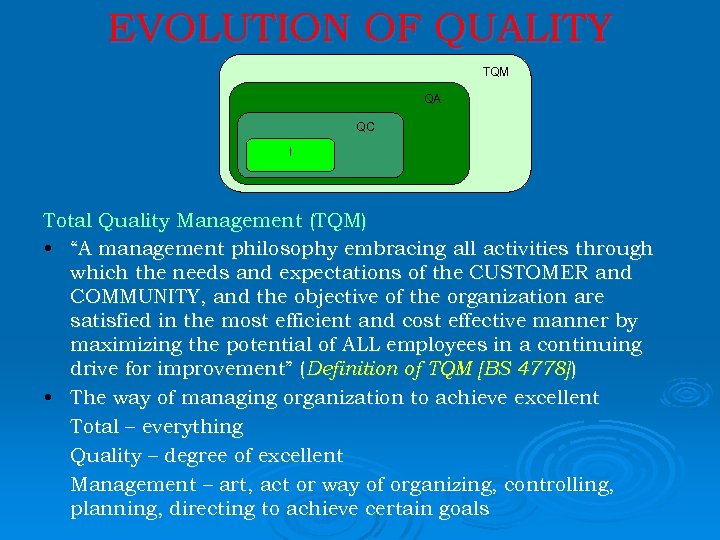 EVOLUTION OF QUALITY TQM QA QC I Total Quality Management (TQM) • “A management philosophy embracing all activities through which the needs and expectations of the CUSTOMER and COMMUNITY, and the objective of the organization are satisfied in the most efficient and cost effective manner by maximizing the potential of ALL employees in a continuing drive for improvement” (Definition of TQM [BS 4778]) • The way of managing organization to achieve excellent Total – everything Quality – degree of excellent Management – art, act or way of organizing, controlling, planning, directing to achieve certain goals
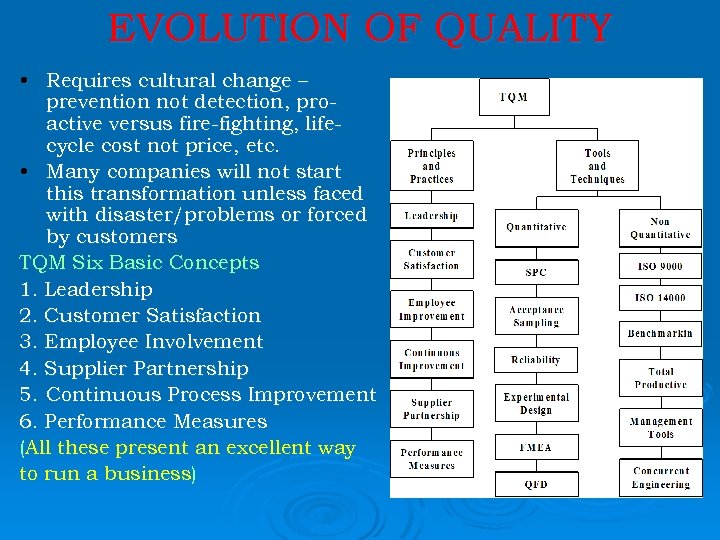 EVOLUTION OF QUALITY • Requires cultural change – prevention not detection, proactive versus fire-fighting, lifecycle cost not price, etc. • Many companies will not start this transformation unless faced with disaster/problems or forced by customers TQM Six Basic Concepts 1. Leadership 2. Customer Satisfaction 3. Employee Involvement 4. Supplier Partnership 5. Continuous Process Improvement 6. Performance Measures (All these present an excellent way to run a business)
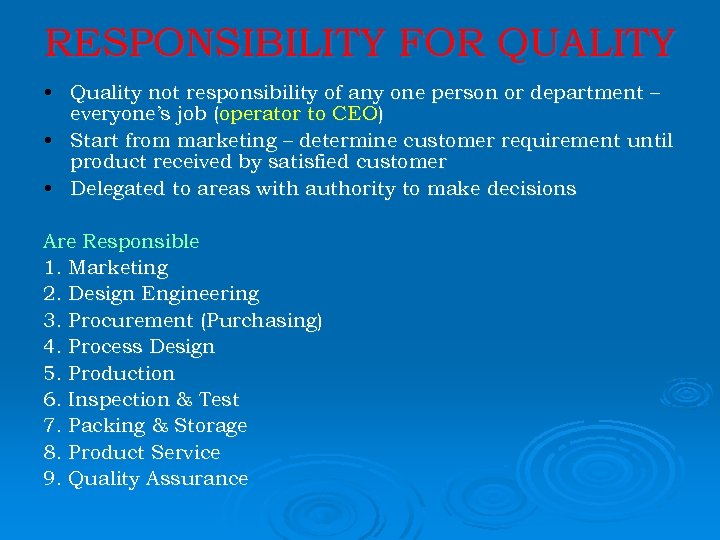 RESPONSIBILITY FOR QUALITY • Quality not responsibility of any one person or department – everyone’s job (operator to CEO) • Start from marketing – determine customer requirement until product received by satisfied customer • Delegated to areas with authority to make decisions Are Responsible 1. Marketing 2. Design Engineering 3. Procurement (Purchasing) 4. Process Design 5. Production 6. Inspection & Test 7. Packing & Storage 8. Product Service 9. Quality Assurance
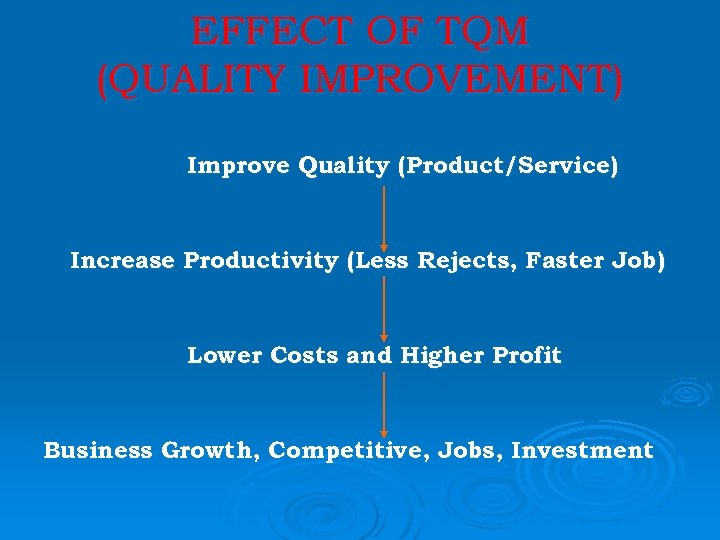 EFFECT OF TQM (QUALITY IMPROVEMENT) Improve Quality (Product/Service) Increase Productivity (Less Rejects, Faster Job) Lower Costs and Higher Profit Business Growth, Competitive, Jobs, Investment
 QUALITY IMPROVEMENT STRATEGY • All failures/problems has ROOT CAUSE • Causes are preventable • Prevention cheaper than cure Based on the three concepts, strategy used as follow; 1. Reduce failure costs by problem solving 2. Invest in the ‘right’ prevention actions 3. Reduce appraisal costs where appropriate ~ statistically sound 4. Continuously evaluate & redirect prevention effort to gain further improvement
 COMPUTERS AND QUALITY CONTROL Need computers and software as tools to assist Quality function • • • Data collection Data analysis and reporting Statistical analysis Process control Test and Inspection (e. g. automated test) System design Examples commonly statistical package Minitab (engineering based) SPSS (more for survey questionnaire)
 QUALITY COST • Final analysis – value of QC/QA/TQM initiative and program's based on ability to contribute to profits • Therefore, most effective performance measure is cost of poor quality • Efficiency of any business measured in RM, $ (monetary value) • Cost of poor quality can be found – same as for cost of maintenance, production, design, inspection, etc. • Measure, program, analyze and budget the cost of poor quality (COPQ) or (PONC) • COSTS , PROFIT • Quality costs involves all department; purchasing, design, etc.
 QUALITY COST What is Quality Costs ? Cost of poor quality are “those costs associated with non-achievement of product/service quality defined by the requirements” • Quality cost – used in pursuit of quality improvement, market share, customer satisfaction, and basic data for TQM • High quality cost – inefficient, ineffective management • Quality Cost Program quantifies magnitude quality problem in mgmt. language ($); - 20% of sales dollars in manufacturing - 35% of sales dollars in service • Develop Quality Cost Program - Identify opportunities for improvement - Justification for corrective action - Every sen saved profits v Take care of the penny and penny will take care of itself!!!
 QUALITY COST • Final analysis – value of QC/QA/TQM initiative and program's based on ability to contribute to profits • Therefore, most effective performance measure is cost of poor quality • Efficiency of any business measured in RM, $ (monetary value) • Cost of poor quality can be found – same as for cost of maintenance, production, design, inspection, etc. • Measure, program, analyze and budget the cost of poor quality (COPQ) or (PONC) • COSTS , PROFIT • Quality costs involves all department; purchasing, design, etc. • Principle advantage – identify hidden costs which is not able to detect in operation • Program – comprehensive and not ‘fire-fighting’ problem • Real improvement occurs – ROOT CAUSE OF PROBLEM identified and eliminated
 QUALITY COST CATEGORIES & ELEMENTS • Prevention - Prevention achieved by examining experience gained from identification of specific causes of failures, and developing specific activities for incorporation into basic management system that make it difficult or impossible for error/failure to occur again • Appraisal - Cost incurred to determine degree on conformance to quality requirements (e. g. incoming inspection, source inspection, etc. ) • Failures; 1) Internal 2) External - Cost incurred when products/services, components, materials, fail to meet requirements 1) before, 2) after transfer of ownership to customer - Internal ~ purchasing errors, rework, repair, scrap, etc. - External ~ complaint investigation, returned good, warranty costs, etc.
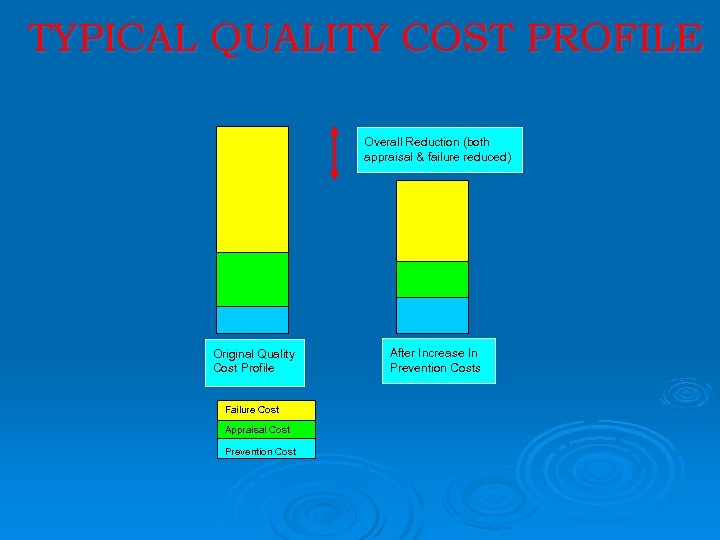 TYPICAL QUALITY COST PROFILE Overall Reduction (both appraisal & failure reduced) Original Quality Cost Profile Failure Cost Appraisal Cost Prevention Cost After Increase In Prevention Costs