


 Скачать презентацию Introduction to QI and HIT Unit 1 c
0417de6fcd10c8d7d3f5fbfe0995d2cc.ppt
- Количество слайдов: 22
 Introduction to QI and HIT Unit 1 c: Relationship of QI and HIT This material was developed by Johns Hopkins University, funded by the Department of Health and Human Services, Office of the National Coordinator for Health Information Technology under Award Number IU 24 OC 000013.
 Objective • Analyze the ways that HIT can either help or hinder quality improvement Component 12/Unit 1 Health IT Workforce Curriculum 2. 0/Spring 2011 Version 2
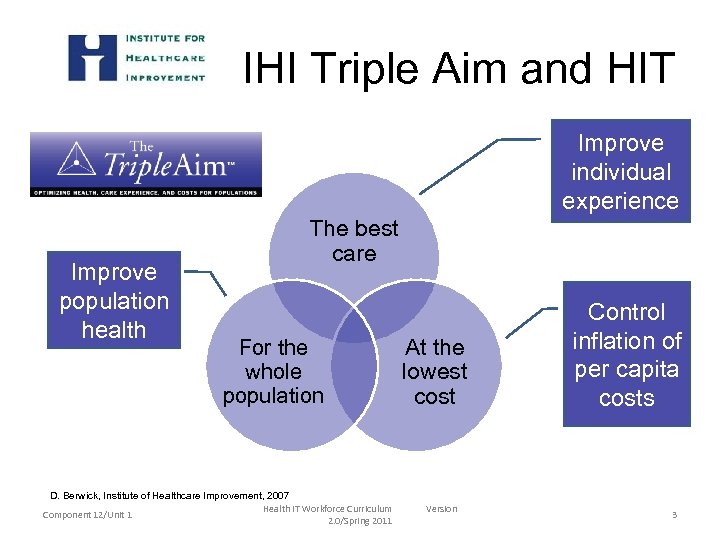 IHI Triple Aim and HIT Improve individual experience Improve population health The best care For the whole population D. Berwick, Institute of Healthcare Improvement, 2007 Health IT Workforce Curriculum Component 12/Unit 1 2. 0/Spring 2011 At the lowest cost Version Control inflation of per capita costs 3
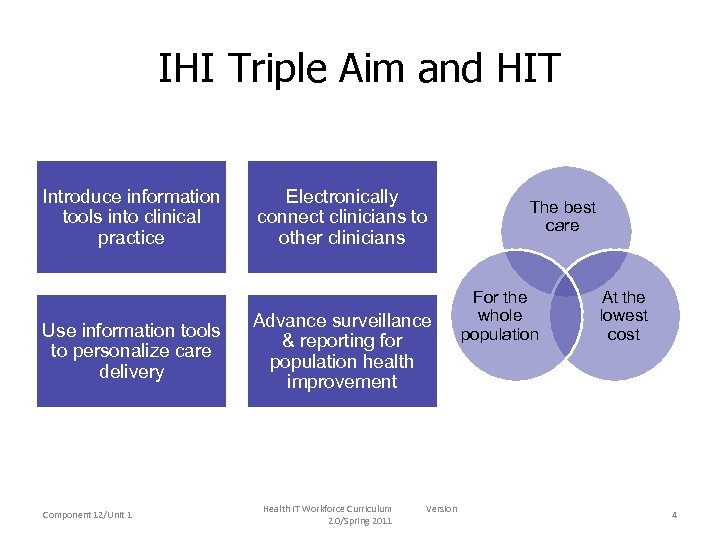 IHI Triple Aim and HIT Introduce information tools into clinical practice Use information tools to personalize care delivery Component 12/Unit 1 Electronically connect clinicians to other clinicians Advance surveillance & reporting for population health improvement Health IT Workforce Curriculum 2. 0/Spring 2011 Version The best care For the whole population At the lowest cost 4
 IOM Aims and HIT Health care should be: Component 12/Unit 1 • • • Safe Effective Patient-centered Timely Efficient Equitable Health IT Workforce Curriculum 2. 0/Spring 2011 Version Image: Amazon. com 5
 Benefits of HIT Improvement of patient safety, efficiency, effectiveness, equity, timeliness, and patient -centeredness. Image: MS Clipart Component 12/Unit 1 Health IT Workforce Curriculum 2. 0/Spring 2011 Version 6
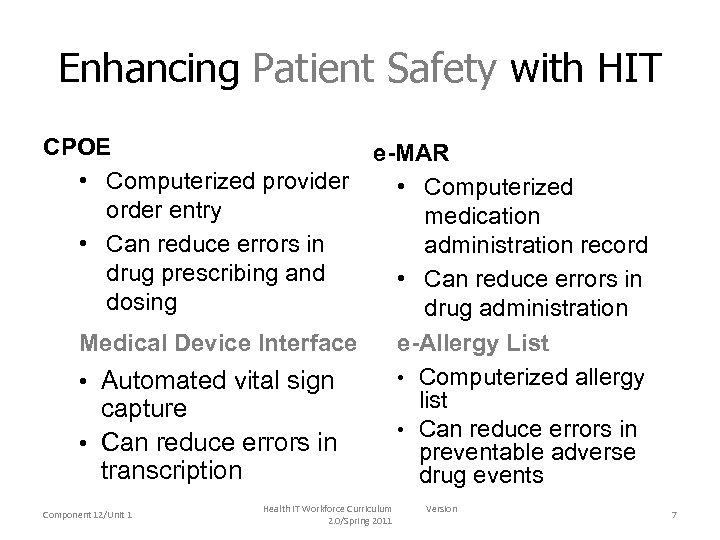 Enhancing Patient Safety with HIT CPOE • Computerized provider order entry • Can reduce errors in drug prescribing and dosing e-MAR • Computerized medication administration record • Can reduce errors in drug administration Medical Device Interface e-Allergy List • Computerized allergy • Automated vital sign list capture • Can reduce errors in preventable adverse transcription drug events Component 12/Unit 1 Health IT Workforce Curriculum 2. 0/Spring 2011 Version 7
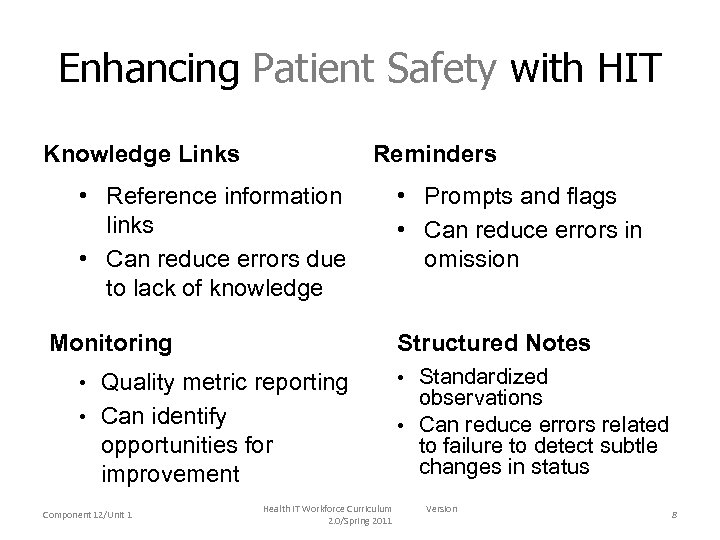 Enhancing Patient Safety with HIT Knowledge Links Reminders • Reference information links • Can reduce errors due to lack of knowledge Monitoring Structured Notes • Quality metric reporting • Can identify opportunities for improvement Component 12/Unit 1 • Prompts and flags • Can reduce errors in omission Health IT Workforce Curriculum 2. 0/Spring 2011 • Standardized observations • Can reduce errors related to failure to detect subtle changes in status Version 8
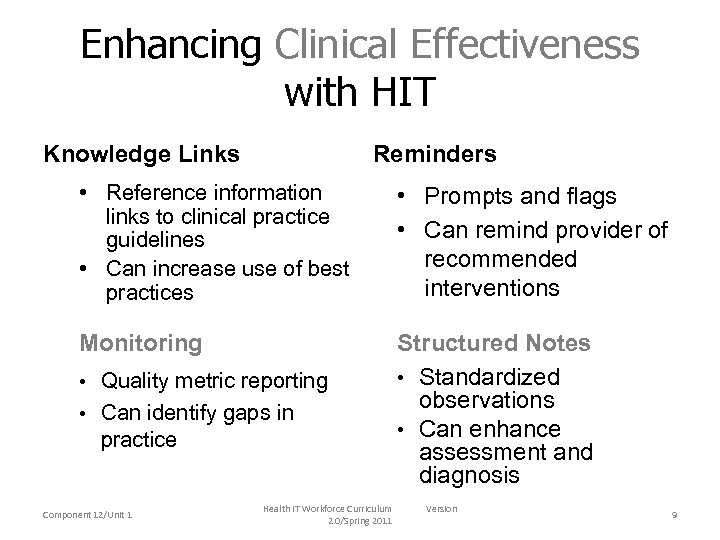 Enhancing Clinical Effectiveness with HIT Knowledge Links Reminders • Reference information links to clinical practice guidelines • Can increase use of best practices • Prompts and flags • Can remind provider of recommended interventions Monitoring Structured Notes • Standardized observations • Can enhance assessment and diagnosis • Quality metric reporting • Can identify gaps in practice Component 12/Unit 1 Health IT Workforce Curriculum 2. 0/Spring 2011 Version 9
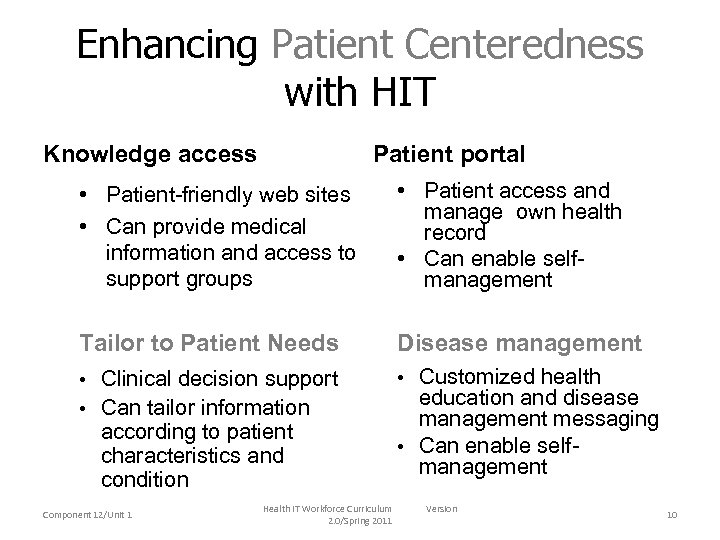 Enhancing Patient Centeredness with HIT Knowledge access Patient portal • Patient-friendly web sites • Can provide medical information and access to support groups • Patient access and manage own health record • Can enable selfmanagement Tailor to Patient Needs Disease management • Clinical decision support • Customized health • Can tailor information according to patient characteristics and condition Component 12/Unit 1 Health IT Workforce Curriculum 2. 0/Spring 2011 education and disease management messaging • Can enable selfmanagement Version 10
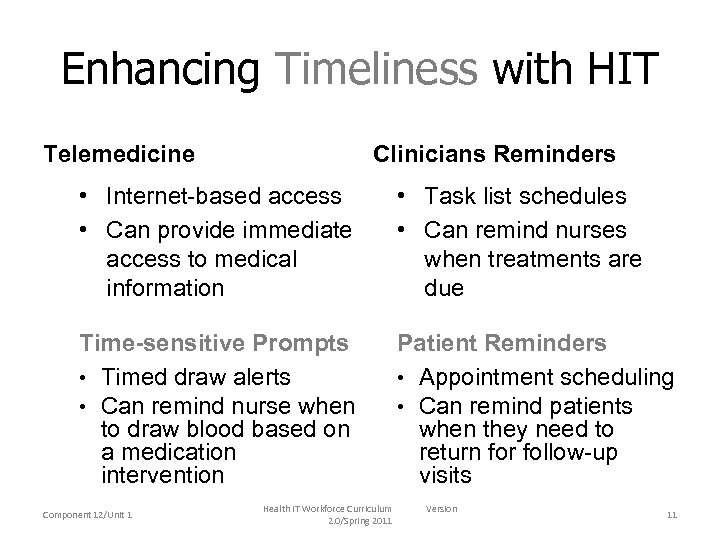 Enhancing Timeliness with HIT Telemedicine Clinicians Reminders • Internet-based access • Can provide immediate access to medical information • Task list schedules • Can remind nurses when treatments are due Time-sensitive Prompts • Timed draw alerts • Can remind nurse when to draw blood based on a medication intervention Patient Reminders • Appointment scheduling • Can remind patients when they need to return for follow-up visits Component 12/Unit 1 Health IT Workforce Curriculum 2. 0/Spring 2011 Version 11
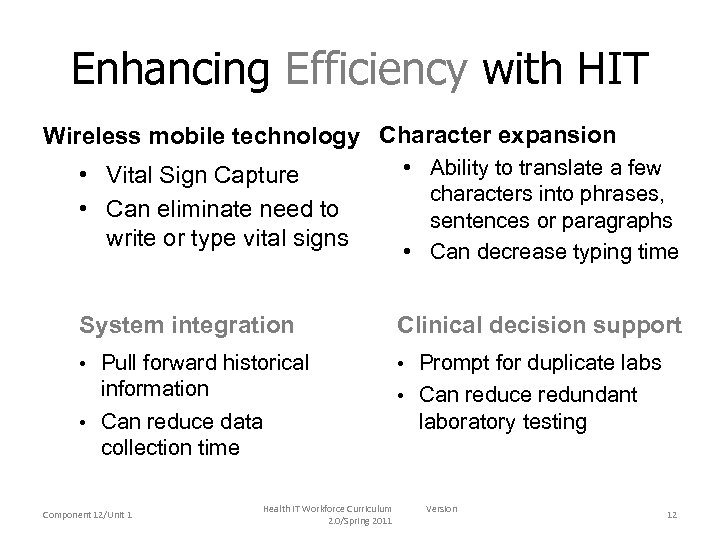 Enhancing Efficiency with HIT Wireless mobile technology Character expansion • Vital Sign Capture • Can eliminate need to write or type vital signs • Ability to translate a few characters into phrases, sentences or paragraphs • Can decrease typing time System integration Clinical decision support • Pull forward historical • Prompt for duplicate labs information • Can reduce data collection time • Can reduce redundant Component 12/Unit 1 Health IT Workforce Curriculum 2. 0/Spring 2011 laboratory testing Version 12
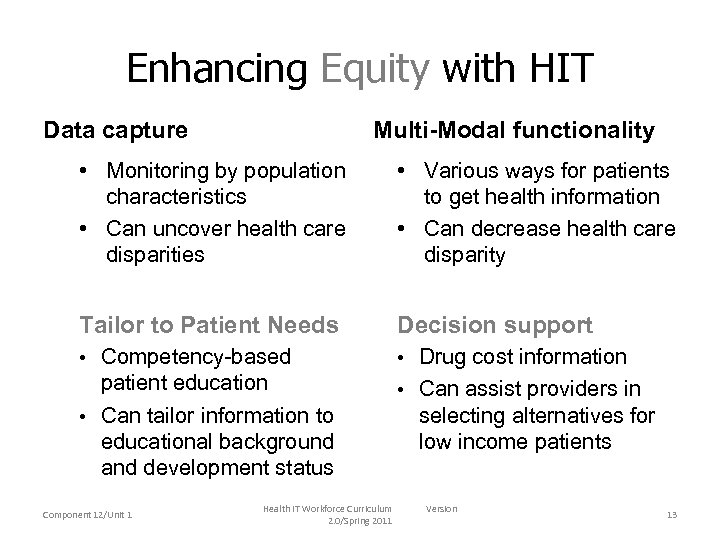 Enhancing Equity with HIT Data capture Multi-Modal functionality • Monitoring by population characteristics • Can uncover health care disparities • Various ways for patients to get health information • Can decrease health care disparity Tailor to Patient Needs Decision support • Competency-based • Drug cost information patient education • Can tailor information to educational background and development status • Can assist providers in Component 12/Unit 1 Health IT Workforce Curriculum 2. 0/Spring 2011 selecting alternatives for low income patients Version 13
 UNINTENDED CONSEQUENCES OF HIT Work-arounds and artifacts can lead to unintended consequences. Image: MS Clipart Component 12/Unit 1 Health IT Workforce Curriculum 2. 0/Spring 2011 Version 14
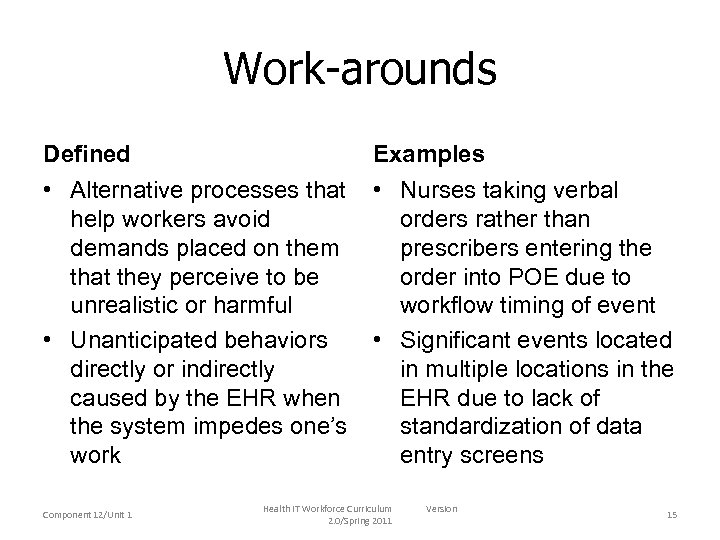 Work-arounds Defined Examples • Alternative processes that help workers avoid demands placed on them that they perceive to be unrealistic or harmful • Unanticipated behaviors directly or indirectly caused by the EHR when the system impedes one’s work • Nurses taking verbal orders rather than prescribers entering the order into POE due to workflow timing of event • Significant events located in multiple locations in the EHR due to lack of standardization of data entry screens Component 12/Unit 1 Health IT Workforce Curriculum 2. 0/Spring 2011 Version 15
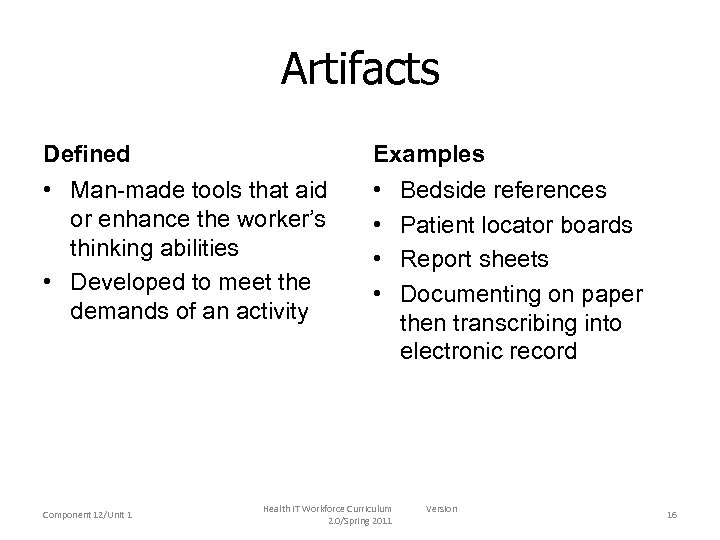 Artifacts Defined Examples • Man-made tools that aid or enhance the worker’s thinking abilities • Developed to meet the demands of an activity • • Component 12/Unit 1 Health IT Workforce Curriculum 2. 0/Spring 2011 Bedside references Patient locator boards Report sheets Documenting on paper then transcribing into electronic record Version 16
 HIT & Workarounds Dr. Foxwood creates a new order each time he wants to re-order a medicine. The nurse enters a verbal order to discontinue the previous order, so that the previous drug doesn’t appear on medication administration list. Dr. Foxwood fails to co-sign the discontinuation order because he sees this as an administrative task. Component 12/Unit 1 Health IT Workforce Curriculum 2. 0/Spring 2011 Version 17
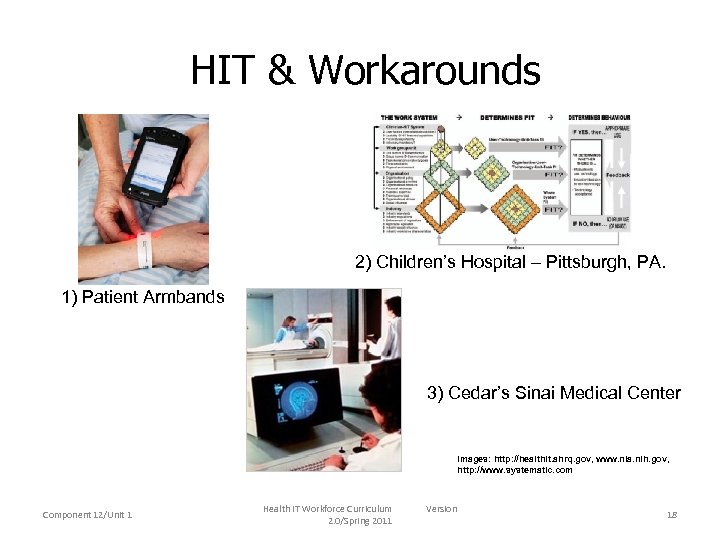 HIT & Workarounds 2) Children’s Hospital – Pittsburgh, PA. 1) Patient Armbands 3) Cedar’s Sinai Medical Center Images: http: //healthit. ahrq. gov, www. nia. nih. gov, http: //www. systematic. com Component 12/Unit 1 Health IT Workforce Curriculum 2. 0/Spring 2011 Version 18
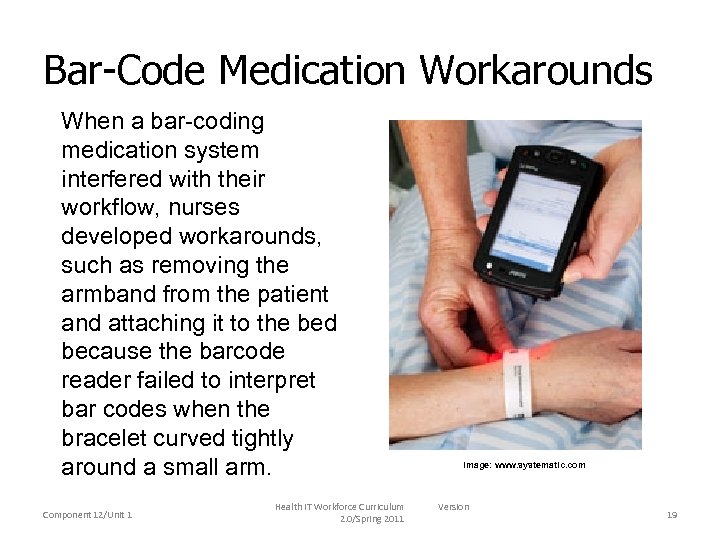 Bar-Code Medication Workarounds When a bar-coding medication system interfered with their workflow, nurses developed workarounds, such as removing the armband from the patient and attaching it to the bed because the barcode reader failed to interpret bar codes when the bracelet curved tightly around a small arm. Component 12/Unit 1 Health IT Workforce Curriculum 2. 0/Spring 2011 Image: www. systematic. com Version 19
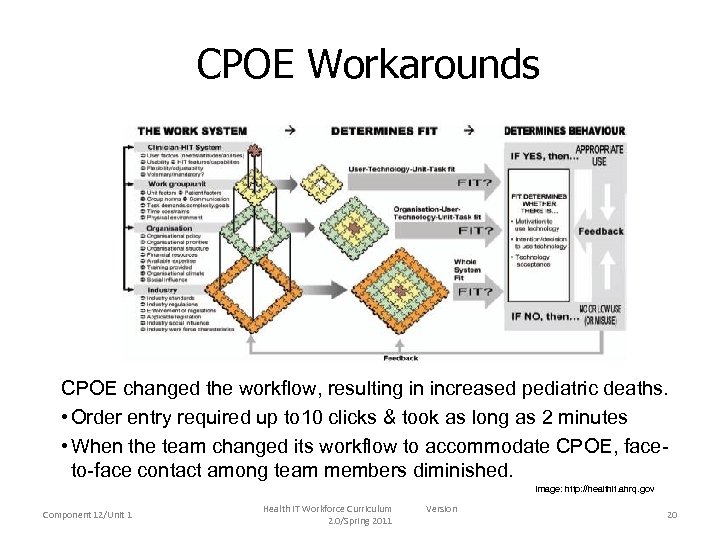 CPOE Workarounds CPOE changed the workflow, resulting in increased pediatric deaths. • Order entry required up to 10 clicks & took as long as 2 minutes • When the team changed its workflow to accommodate CPOE, faceto-face contact among team members diminished. Image: http: //healthit. ahrq. gov Component 12/Unit 1 Health IT Workforce Curriculum 2. 0/Spring 2011 Version 20
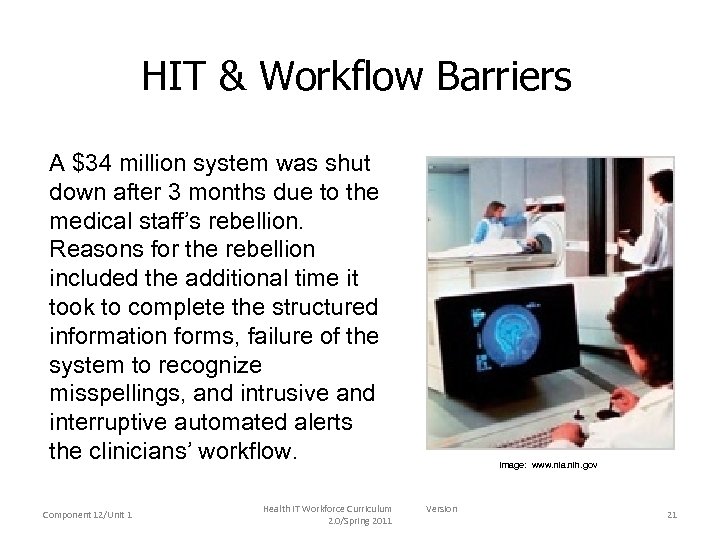 HIT & Workflow Barriers A $34 million system was shut down after 3 months due to the medical staff’s rebellion. Reasons for the rebellion included the additional time it took to complete the structured information forms, failure of the system to recognize misspellings, and intrusive and interruptive automated alerts the clinicians’ workflow. Component 12/Unit 1 Health IT Workforce Curriculum 2. 0/Spring 2011 Image: www. nia. nih. gov Version 21
 Summary for Unit 1 c: • When designed well and used as intended, HIT can – Improve safety, effectiveness, efficiency, equity, timeliness, and patient-centeredness of care – Work to accomplish the best care for the whole population at the lowest cost • When designed poorly and subject to workarounds, HIT can result in unintended adverse consequences Component 12/Unit 1 Health IT Workforce Curriculum 2. 0/Spring 2011 Version 22