 Скачать презентацию Introduction to Proverbs Ecclesiastes Song of Solomon
82d66f53ab4e1ef9fcbcd70704cac626.ppt
- Количество слайдов: 39



Introduction to Proverbs, Ecclesiastes & Song of Solomon 27 April 2008 1
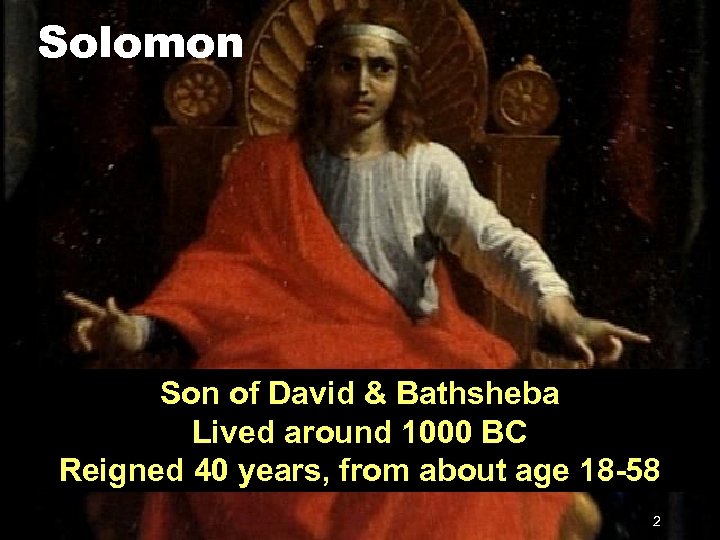
Solomon Son of David & Bathsheba Lived around 1000 BC Reigned 40 years, from about age 18 -58 2
Solomon’s Request for Wisdom At Gibeon the Lord appeared to Solomon in a dream by night; and God said, “Ask! What shall I give you? ” And Solomon said: “… Your servant is in the midst of Your people who You have chosen, a great people, too numerous to be numbered or counted. Therefore give you Your servant an understanding heart to judge Your people, that I may discern between good and evil. For who is able to judge this great people of Yours? ” - 1 Kings 3: 8, 9 NKJV 3
God’s Answer to Solomon Then God said to him: “Because you have asked this thing, and have not asked long life for yourself, nor have asked riches for yourself, nor have asked the life of your enemies, but have asked for yourself understanding to discern justice, behold, I have done according to your words; see, I have given you a wise and understanding heart, so that there has not been anyone like you before you, nor shall any like you arise after you. ” - 1 Kings 3: 11, 12 NKJV 4
Solomon’s Downfall But King Solomon loved many foreign women … from the nations of whom the LORD had said to the children of Israel, “You shall not intermarry with them, nor they with you. Surely they will turn away your hearts after their gods. ” … And he had seven hundred wives, princesses, and three hundred concubines … when Solomon was old … his wives turned his heart after other gods; and his heart was not loyal to the LORD his God, as was the heart of his father David. – 1 Kings 11: 1 -4 NKJV 5
Nehemiah’s Commentary Did not Solomon king of Israel sin by these things? Yet among many nations there was no king like him, who was beloved of his God; and God made him king over all Israel. Nevertheless pagan women caused even him to sin. – Nehemiah 13: 26 NKJV 6
God’s Response So the LORD became angry with Solomon, because his heart had turned from the LORD God of Israel, who had appeared to him twice, Therefore the LORD said to Solomon, “Because you have done this, and have not kept My covenant and My statutes, which I have commanded you, I will surely tear the kingdom away from you and give it to your servant. However I will not tear away the whole kingdom; I will give one tribe to your son for the sake of My servant David, and for the sake of Jerusalem which I have chosen. ” – 1 Kings 11: 9, 11, 13 NKJV 7
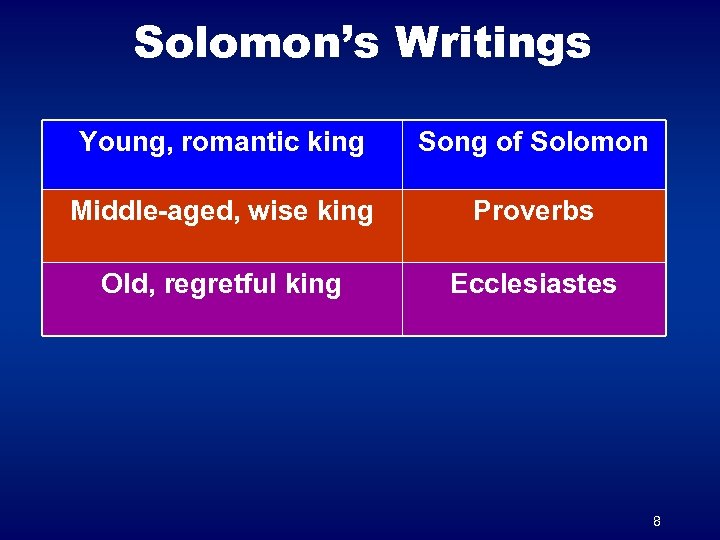
Solomon’s Writings Young, romantic king Song of Solomon Middle-aged, wise king Proverbs Old, regretful king Ecclesiastes 8
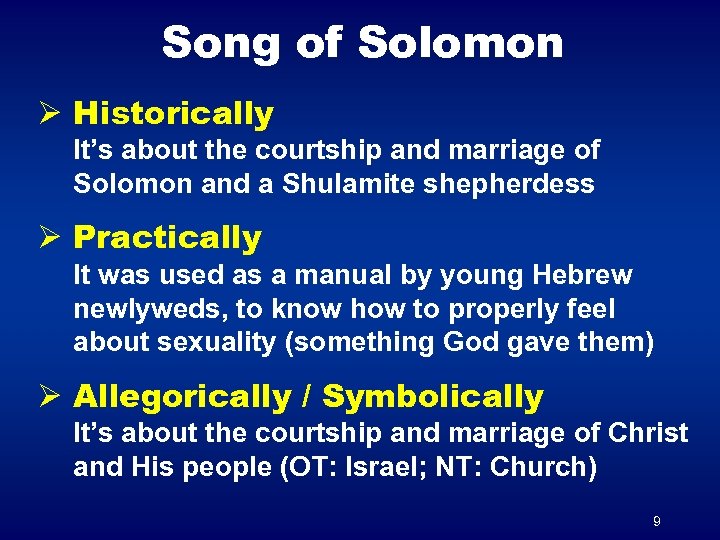
Song of Solomon Ø Historically It’s about the courtship and marriage of Solomon and a Shulamite shepherdess Ø Practically It was used as a manual by young Hebrew newlyweds, to know how to properly feel about sexuality (something God gave them) Ø Allegorically / Symbolically It’s about the courtship and marriage of Christ and His people (OT: Israel; NT: Church) 9
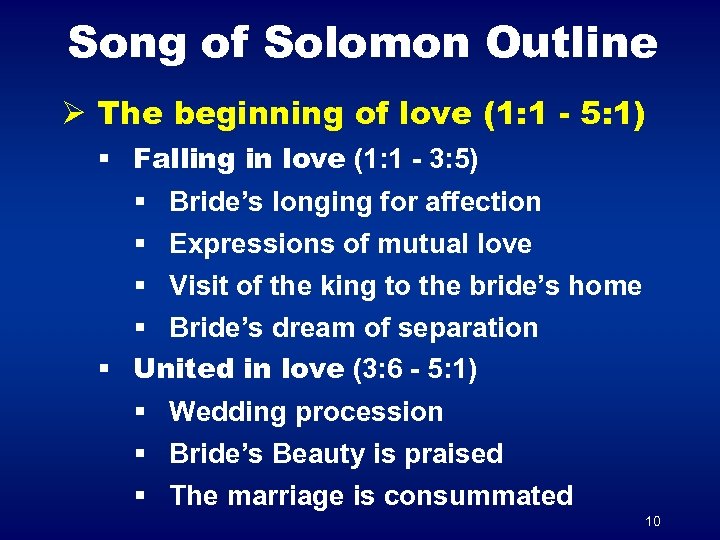
Song of Solomon Outline Ø The beginning of love (1: 1 - 5: 1) § Falling in love (1: 1 - 3: 5) § Bride’s longing for affection § Expressions of mutual love § Visit of the king to the bride’s home § Bride’s dream of separation § United in love (3: 6 - 5: 1) § Wedding procession § Bride’s Beauty is praised § The marriage is consummated 10
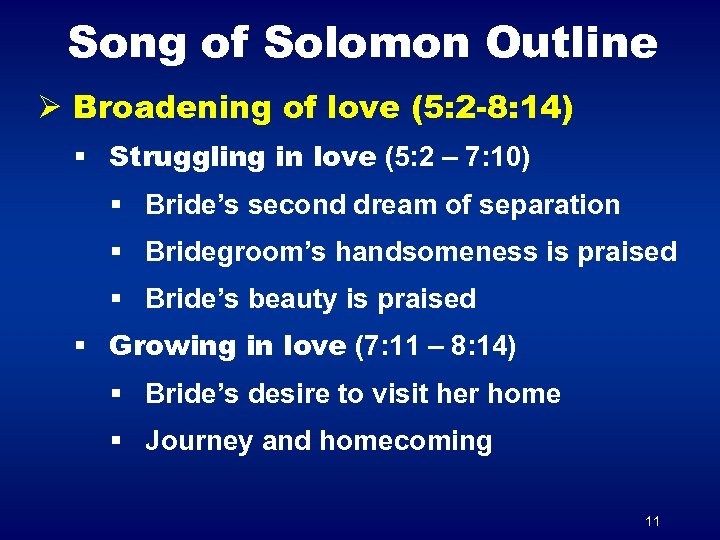
Song of Solomon Outline Ø Broadening of love (5: 2 -8: 14) § Struggling in love (5: 2 – 7: 10) § Bride’s second dream of separation § Bridegroom’s handsomeness is praised § Bride’s beauty is praised § Growing in love (7: 11 – 8: 14) § Bride’s desire to visit her home § Journey and homecoming 11
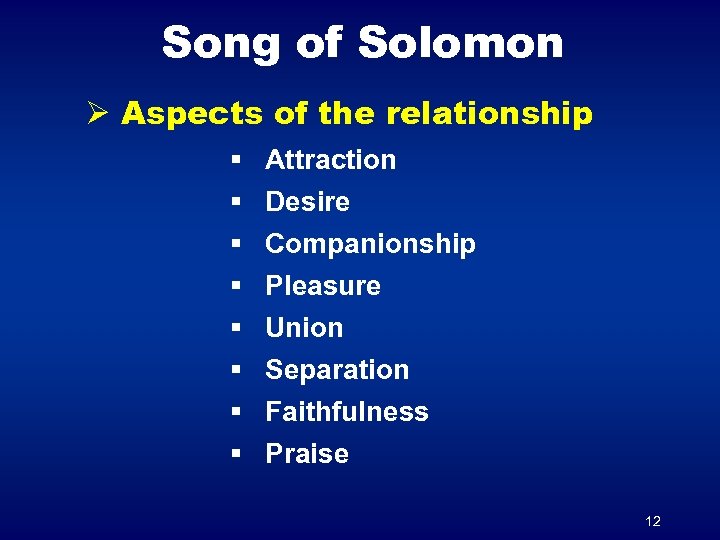
Song of Solomon Ø Aspects of the relationship § § § § Attraction Desire Companionship Pleasure Union Separation Faithfulness Praise 12
Song of Solomon Ø Drama Written primarily from the point of view of the Shulamite Ø Characters / Speakers: § The bride (Shulamite) § The beloved / groom (Solomon) § The chorus (daughters of Jerusalem) 13
The Bride (Shulamite) Ø A shepherdess Ø Dark skin from working in the sun Ø Perhaps woman # 141 of Solomon “There are sixty queens and eighty concubines” (S. S. 6: 8) Ø If most of Solomon’s wives and concubines were political arrangements, then perhaps this was his only pure romance up to that point 14
SS Application 1. View sexuality as God does – something good, but designed to be used only within the boundaries of marriage 2. Understand that men usually have a stronger sexual drive than women, and without this, few men would ever marry, and the human race would probably die out. God planned it this way. 3. The purpose of marriage from God’s point of view is to produce godly offspring (Mal. 2: 15) 15
SS Application 4. Understand the seriousness of fornication (any sexual relationship not approved by God, including pre-marital sex, adultery and homosexuality) Flee fornication. Every sin that a man does is outside the body, but he who commits fornication sins against his own body. (1 Cor. 6: 18) Fornication is idolatry and damages the resurrected body of a believer – IF he / she is a true believer – the willful sinner has no Biblical basis for assurance of salvation! 16
SS Application 5. Avoid music, TV shows and movies that excite the passions. Flee youthful lusts; but pursue righteousness, faith, love, peace with those who call on the Lord out of a pure heart. (2 Tim. 2: 22 NKJV) 6. In 1 Cor. 7, Paul says that it’s better not to marry, but if you can’t control yourself it’s not sin to marry. 17
SS Application 7. If you or your husband can’t control sexual desires when you are apart from each other, then unless he insists you be here, don’t live apart from each other! Ø Don’t gamble! You are only asking for trouble, heartbreak, pain and regret. Ø God will hold YOU partly responsible if he commits adultery! 18
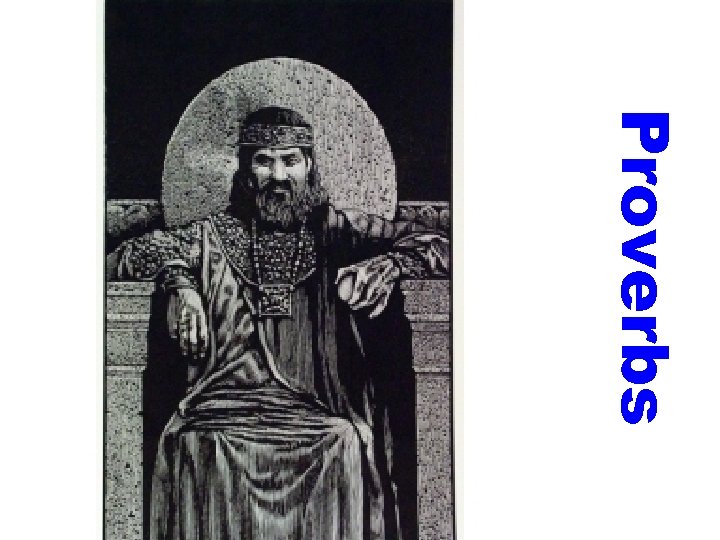
Proverbs 19
Proverbs Ø Mashal in Hebrew – means “comparison, similar, parallel” Ø Basic principles for living Ø Teach wisdom (skillful living), especially in human relationships Ø Truths without obligation (principles, not commands, of God) Ø Easily memorized, but can take a lifetime to learn / implement 20
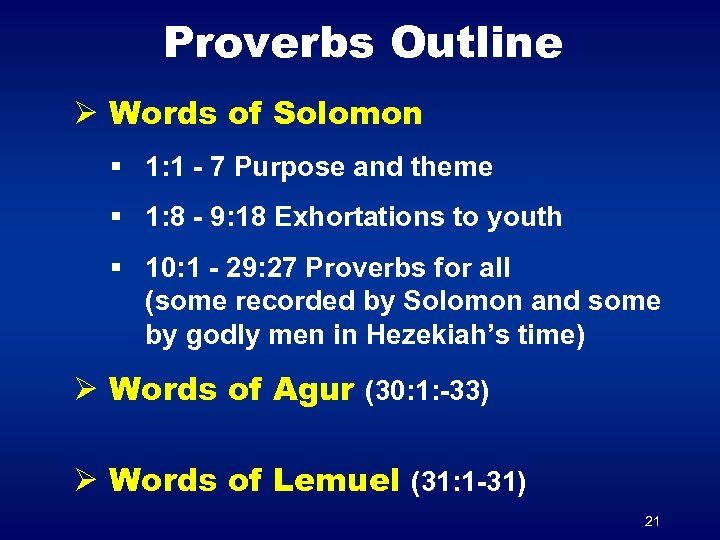
Proverbs Outline Ø Words of Solomon § 1: 1 - 7 Purpose and theme § 1: 8 - 9: 18 Exhortations to youth § 10: 1 - 29: 27 Proverbs for all (some recorded by Solomon and some by godly men in Hezekiah’s time) Ø Words of Agur (30: 1: -33) Ø Words of Lemuel (31: 1 -31) 21
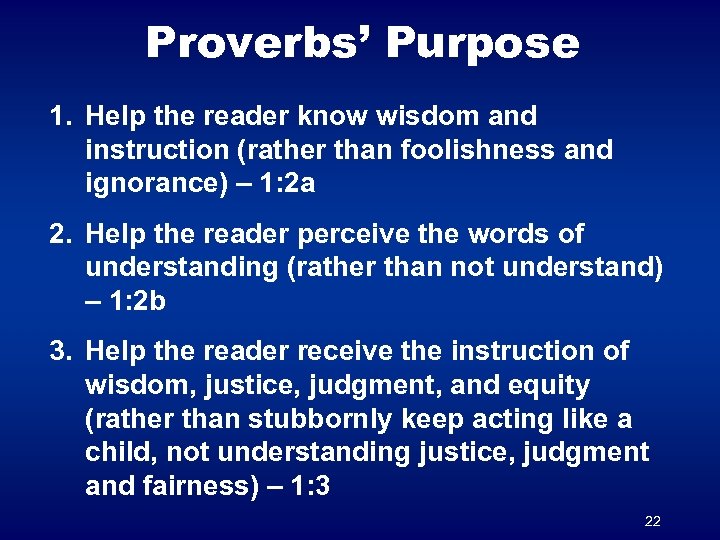
Proverbs’ Purpose 1. Help the reader know wisdom and instruction (rather than foolishness and ignorance) – 1: 2 a 2. Help the reader perceive the words of understanding (rather than not understand) – 1: 2 b 3. Help the reader receive the instruction of wisdom, justice, judgment, and equity (rather than stubbornly keep acting like a child, not understanding justice, judgment and fairness) – 1: 3 22
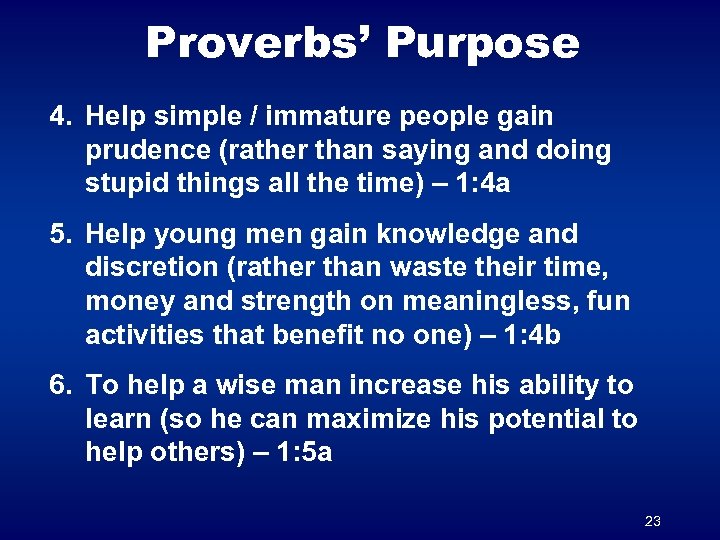
Proverbs’ Purpose 4. Help simple / immature people gain prudence (rather than saying and doing stupid things all the time) – 1: 4 a 5. Help young men gain knowledge and discretion (rather than waste their time, money and strength on meaningless, fun activities that benefit no one) – 1: 4 b 6. To help a wise man increase his ability to learn (so he can maximize his potential to help others) – 1: 5 a 23
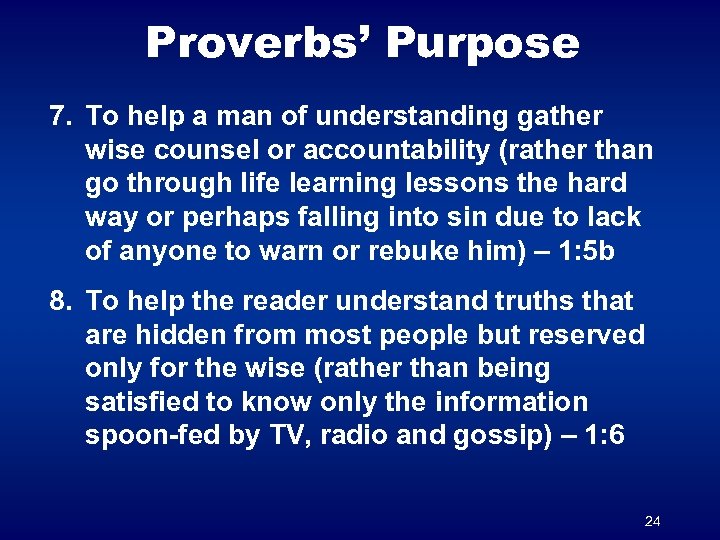
Proverbs’ Purpose 7. To help a man of understanding gather wise counsel or accountability (rather than go through life learning lessons the hard way or perhaps falling into sin due to lack of anyone to warn or rebuke him) – 1: 5 b 8. To help the reader understand truths that are hidden from most people but reserved only for the wise (rather than being satisfied to know only the information spoon-fed by TV, radio and gossip) – 1: 6 24
Skill & Discipline Ø Wisdom (hokhmah) means “skill, ” so it is something that takes time and practice Ø Instruction (musar) means “discipline, ” so it is something that requires sacrifice, focus, and hard work. Mentoring from someone older is also helpful. Ø The ultimate goal is a righteous life – to help solve the problems around you instead of adding to the problems 25
Wisdom & Fearing God “The fear of the Lord is the beginning of knowledge, but fools despise wisdom and instruction. ” – Pr. 1: 7 NKJV Ø Respect or reverence is on your terms and only requires agreement, not submission Ø Fear is on God’s terms and requires obedient submission to His commands Ø So a desire to obey God’s commands is a prerequisite to gaining spiritual knowledge Ø Ignoring God’s commands (and those who teach God’s commands) means you retain your natural foolishness 26
Wisdom & Fearing God Ø The object of fear is God’s judgment (Law of the Harvest) Do not be deceived. God is not mocked. A man reaps what he sows. – Gal. 6: 7 Ø So fearing God requires an expectation that temporal behavior will have eternal consequences Ø Grace means that the prodigal son gets to sit at his father’s table Ø The Law of the Harvest means that the prodigal son suffers loss and can’t get back the inheritance he squandered. 27
Fools Ø Fools are not mentally retarded people Ø Fools are self-sufficient, ordering their lives as if there were no God, no Judgment and/or no Law of the Harvest Ø In Proverbs and elsewhere in the Old Testament, a fool often denoted someone who was morally deficient, i. e. , ethically and/or sexually immoral 28
Worldly Vs. Divine Wisdom Who is wise and understanding among you? Let him show by good conduct that his works are done in the meekness of wisdom. But if you have bitter envy and self-seeking in your hearts, do not boast and lie against the truth. This wisdom does not descend from above, but is earthly, sensual, demonic. For where envy and self-seeking exist, confusion and every evil thing are there. – James 3: 13 -16 NKJV 29
Worldly Vs. Divine Wisdom But the wisdom that is from above is first pure, then peaceable, gentle, willing to yield, full of mercy and good fruits, without partiality and without hypocrisy. Now the fruit of righteousness is sown in peace by those who make peace. – James 3: 17, 18 NKJV 30
Proverbs Application 1. Develop a healthy fear of God. Remember, respect is on your terms and does not require submission; fear is on God’s terms and requires obedient submission to His commands 2. As you read through Proverbs, write down and memorize the ones that speak most to your own personal need and pray for God’s help to change your bad habits 3. Be willing to take correction rather than resent it 31
Ecclesiastes 32
Ecclesiastes Ø Written by Solomon at the end of his life, looking back Ø It expresses Solomon’s regret for his folly and wasted time due to carnality and idolatry “I had it all; I tried it all; it doesn’t satisfy; I sinned; don’t make my mistakes!” Ø Basic principles for living 33
Ecclesiastes Ø Written especially for young people who still have time to change their course in life Remember now your Creator in the days of your youth, before the difficult days come … when you lose your strength, lose your hearing, lose your good eyesight, lose your courage, lose your sexual desire … (Ecc. 12: 1 -5) 34
Ecclesiastes Outline Ø Thesis: “All is Vanity” (1: 1 - 11 ) Ø Proof: “Life is Vain” (1: 12 -6: 12) Ø Counsel: “Fear God and keep His commandments” (7: 1 -12: 14) 35
Ecclesiastes Truths Ø We all must die; life is short Ø All the work of man’s hand is vanity Ø Man’s importance is not determined by success but by God’s declaration Ø Significance is not found in achievement or accumulation of things but in serving people Ø The words of God are intended to move us toward action 36
Ecclesiastes Application 1. Don’t give all your time, money and strength to things that will not last. Be sure to invest time in the Word of God, building your relationship with Jesus and serving whomever God puts into your life, especially your husband children. 2. Memorize some to remind you of sober truths about life 3. Visit old people to learn from their lives and imagine what you might be like when you grow old – to keep life in perspective 37
Bibliography Special thanks goes to the following: § Bruce Wilkinson & Kenneth Boa for their information in Talk Thru the Bible § Walt Henrichsen for his wisdom and insight shared during Bible studies he has led and in books, articles and e-mails he has written § Edward Reese for his chronology and dating in The Reese Chronological Bible 38

The End 39
Скачать презентацию Introduction to Proverbs Ecclesiastes Song of Solomon
82d66f53ab4e1ef9fcbcd70704cac626.ppt