


 Скачать презентацию INTRODUCTION TO PEDAGOGICAL ACTIVITY Girfanova Lyudmila Petrovna
през на англ введ в пед деят.pptx
- Количество слайдов: 24
 INTRODUCTION TO PEDAGOGICAL ACTIVITY Girfanova Lyudmila Petrovna
 LECTURE № 1 Theme: “Essence of Education as a Social Phenomenon. Condition and Tendencies in the Educational System Development in Russia”
 Items: 1. Notion of education and its essence as a sociocultural phenomenon. 2. Tendencies of education development in Russia.
 “Education is a unique purposeful process of upbringing and tuition which being a socially significant welfare is directed to the interests of a human being, family, society and state. Education is also a sum total of acquired knowledge, skills and habits, valuable purposes, experience and competence in a certain field of knowledge. Education is aimed at the development of intellectual, spiritual, moral, creative, physical and (or) professional skills and habits of a student and satisfaction of his educational requirements and interests”. (Federal Law of the Russian Federation from 29 th December 2012. N 27 - FL “About education in the Russian Federation”).
 “Upbringing is an activity directed at the development of a person which creates conditions for self-determination and socializing of a person on the basis of sociocultural, spiritual and moral values while a student should be taught to observe and follow rules and norms of behavior accepted in society in the interests of human being, family, society and state. Upbringing is a specially organized activity of teachers and pupils in order to realize aims of education within the pedagogical process”
 “Tuition is a process aimed at organizing the students’ activity in order to obtain knowledge, skills and habits, acquiring activity experience, development of aptitude and mental facilities. Students should also be taught to use the acquired knowledge in everyday life and to continue studying within their lifetime. Tuition is a special method of education directed at the development of a personality by means of learning, scientific knowledge and means of activity”. “Tuition is a reciprocal process between a teacher and a student, when pupils learn social experience and students’ qualities are being shaped”.
 Education possesses a historical and cultural character since it is a constituent part of culture. It shows the level of society development at a certain historical epoch. It fulfills the functions of tuition, upbringing and development of a man, transmission (transition) of culture from generation to generation.
 Basic sociocultural functions and developing potential of modern education: • Education as one of the optimum and intensive means of adopting a person to the world of science and culture. • Education as means of socializing of people and continuity (succession) of generations. • Education as a mechanism of constructing of social and spiritual life of a human being and as a branch of mass spiritual production. • Education as a process of transmitting culturally-constructed patterns of human activity. • Education as a function of development of regional systems and national traditions. • Education as a social institution through which basic cultural values and aims of society development are rendered (passed) to younger generation. • Education as an active accelerator of cultural changes and innovations in social life and in a single individual.
 “Socialization” is a process of a formation of an individual, who gradually learns the requirements of society, acquires socially significant characteristics of mentality and behavior, which regulate his interrelation with society.
 Main principles of state policy and law regulations are as follows: • Recognition of education priorities. • Realization of the right of every individual to education, inadmissibility of discrimination in the sphere of education. • Humanistic character of education, priority of life and health of an individual, rights of personal freedom, free development of an individual, training of mutual respect, love to labor, patriotism, responsibility, law-abidance, careful attitude to nature and environment, rational use of nature. • Unity of educational space on the territory of the Russian Federation, protection and development of ethno-cultural peculiarities and traditions of peoples of the Russian Federation in a multinational state.
 • Creation of favourable conditions in the Russian Federation for integration of the educational system and its coordination with other educational systems on the basis of equality and mutual benefit. • Secular character of education in state, municipal organizations. • Freedom of choice for receiving education according to aptitudes and requirements of an individual, creating conditions for self-realization of every man, unlimited development of his capabilities, including freedom of right in choosing the form of gaining education, forms of tuition, educational institution and orientation of tuition. The teaching staff has got freedom of forms and methods of tuition and upbringing.
 • To provide the right to receive education within person’s lifetime according to requirements of every individual. The system of education should be adopted according to the level of knowledge of an individual, peculiarities of his development, and also abilities and interests of an individual. • Autonomous character of educational institutions, academic rights and freedom of the teaching staff and students, which is included into the Federal Law, informational clarity and public records of educational institutions. • Democratic character of educational administration; teaching staff, students and parents of underage students should be guaranteed legitimate rights for participating in administration of educational institutions. • Free and unlimited competition should exist in the sphere of education. • State and contractual (agreed) regulations in the sphere of education should be combined.
 New conditions of modern education (According to A. S. Gayazov) • The transition (entrance) of the new world community into a period of growing social, economic, scientific, technological and cultural changes; the emerge of postindustrial civilization. • Vast and highly effective usage of information and scientific knowledge as a creative power of society, its strategic resources, factors of development, and also products and results of labour. • Higher responsibility of the educational system to the involvement of an individual to knowledge in the world of labour, shaping his attitude to the whole world.
 • The necessity of formulating a more exact position of an individual to morality and general viewpoint. Consequently, the strategy of education should be coordinated with the strategy of development of society as a whole, and coordinate it with the strategy of development of an individual. • It is necessary to determine the integrated direction of education due to the fact that Russian system of education enters the European educational space. • The final aim of educational activity is a competence of a man.
 So, modern system of education is characterized by the following orientations: • • Making education humane; Making the content of education humanitarian; Diversification; Standardization; Integration; Fundamental character of the content of education; Continuity of education.
 The continuity of the system of education in Russia is as follows (according to V. A. Mizherikhov): • The unity of successive professional programs of high, higher and post-higher pedagogical education. • A net of interrelated educational institutions and organizations of high, higher and post-university pedagogical education. • Federal-regional administrative system of pedagogical education.
 Successive pedagogical education presupposes not only successive chain of pedagogical educational institutions preparing teachers of a certain subject, but also realization of individual requirements of a man.
 Kinds of Education 1. 2. 3. 4. General education Professional education Extra education Professional training (mastering) All these kinds of education insure a possibility to realize the right of a person for education within all his life (long-life education)
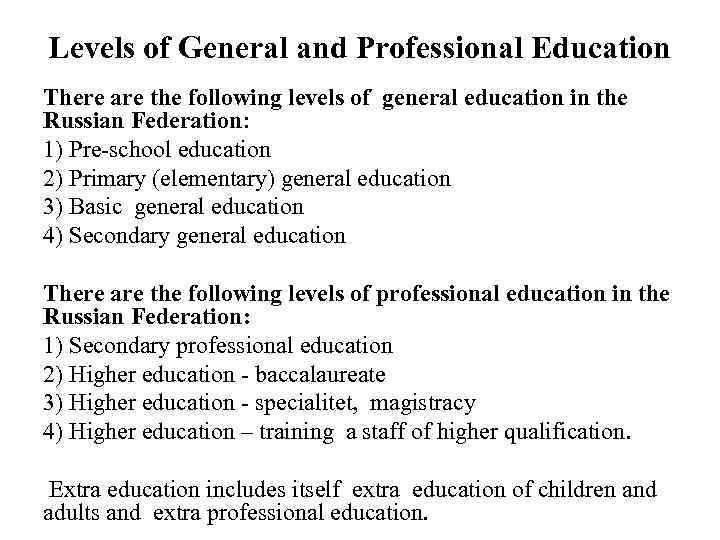 Levels of General and Professional Education There are the following levels of general education in the Russian Federation: 1) Pre-school education 2) Primary (elementary) general education 3) Basic general education 4) Secondary general education There are the following levels of professional education in the Russian Federation: 1) Secondary professional education 2) Higher education - baccalaureate 3) Higher education - specialitet, magistracy 4) Higher education – training a staff of higher qualification. Extra education includes itself extra education of children and adults and extra professional education.
 Language of Education One is guaranteed to receive education in the Russian Federation in the state languages of the Russian Federation and the choice of a language of education within possibilities of the educational system as well.
 Forms of Education’s Receiving and Forms of Tuition One can receive education in the Russian Federation: 1) In organizations, realizing educational activity. 2) Outside organizations, realizing educational activity (in the forms of family education and self education). Tuition can be organized directly at an educational organization, by correspondence and in mixed form.
 Types of educational organizations Educational organizations are subdivided into types in accordance with educational curriculums, which are the main purpose of their activity. There are the following types of educational organizations, realizing the basic educational curriculums: 1) Preschool educational organization. 2) General educational organization. 3) Professional educational organization (secondary).
 Types of educational organizations 4) Educational organization of higher education. It does not only teach, but must carry out scientific activity as well. There also various types of educational organizations in the Russian Federation, realizing extra educational programs (curriculums).
 Structure of Educational System 1. System of education includes itself: 1) федеральные государственные образовательные стандарты и федеральные государственные требования, образовательные стандарты, образовательные программы различных вида, уровня и (или) направленности; 2) организации, осуществляющие образовательную деятельность, педагогических работников, обучающихся и родителей (законных представителей) несовершеннолетних обучающихся; 3) федеральные государственные органы и органы государственной власти субъектов Российской Федерации, осуществляющие государственное управление в сфере образования, и органы местного самоуправления, осуществляющие управление в сфере образования, созданные ими консультативные, совещательные и иные органы; 4) организации, осуществляющие обеспечение образовательной деятельности, оценку качества образования; 5) объединения юридических лиц, работодателей и их объединений, общественные объединения, осуществляющие деятельность в сфере образования.