


 Скачать презентацию Introduction to Patient Safety Research Developing Solutions Cluster
13d3e7e24944cf9cced4708e1ec649ce.ppt
- Количество слайдов: 23
 Introduction to Patient Safety Research Developing Solutions: Cluster Randomized Clinical Trial
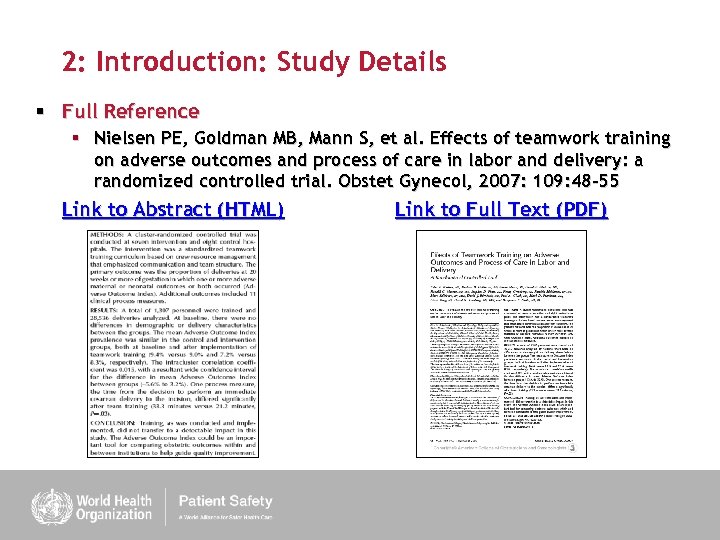 2: Introduction: Study Details § Full Reference § Nielsen PE, Goldman MB, Mann S, et al. Effects of teamwork training on adverse outcomes and process of care in labor and delivery: a randomized controlled trial. Obstet Gynecol, 2007: 109: 48 -55 Link to Abstract (HTML) Link to Full Text (PDF) Presentation # - Developing Solutions: Cluster Randomized Clinical Trial
 3: Introduction: Patient Safety Research Team § Lead Researcher - Col. Peter E. Nielsen, MD § Chairman, Department of Obstetrics and Gynaecology, § Madigan Army Medical Center in Tacoma, WA, USA § Field of expertise: patient safety, team training, labour management § Other team members: § § § § Marlene B. Goldman, Sc. D Susan Mann, MD David E. Shapiro, Ph. D Ronald G. Marcus, MB, BCh Stephen D. Pratt, MD Penny Greenberg, RN Patricia Mc. Namee, RN, MS § § § § Mary Salisbury, RN, MSN David J. Birnbach, MD Paul A. Gluck, MD Mark D. Pearlman, MD Heidi King, MS David N. Tornberg, MD, MPH Benjamin P. Sachs, MB, BS Presentation # - Developing Solutions: Cluster Randomized Clinical Trial
 4: Background: Opening Points § In the 1980 s, US Department of Defense (Do. D) developed crew resource management (CRM) training to improve the safety of air operations § Crew resource management: “error management capability to detect, avoid, trap or mitigate the effects of human error and therefore prevent fatal accidents. ” § CRM attempts to capitalize on the ability of each crew (team) member to see, analyze, and react to the same situation in ways that reduce the potential for error Presentation # - Developing Solutions: Cluster Randomized Clinical Trial
 5: Background: Study Rationale § US Institute of Medicine reports suggest that implementing team training could reduce medical errors and improve patient safety § Do. D has a long-standing interest in evaluating the concept of CRM as a teamwork tool to reduce human errors in medicine § Early prospective observational studies with multiple military and civilian hospitals showed promise for improving patient safety § Obstetrics provides a good setting to test this teamwork tool § Labor and delivery environment requires intense, error-free vigilance and effective communication between many different clinical disciplines § Delivery is the number one admission diagnosis in Do. D hospitals Presentation # - Developing Solutions: Cluster Randomized Clinical Trial
 6: Background: Setting the Research Team § MAMC Department of Obstetrics and Gynaecology approached by the Do. D Patient Safety Office § Madigan Army Medical Center (MAMC) previously participated in a pilot project on team training in the Emergency Department § MAMC collaborated with Beth Israel Deaconess Medical Centre (BIDMC) in Boston to perform the study § Research expertise drawn from combined staff of MAMC and BIDMC, as well as from patient safety experts within national organizations § Funding § Obtained through the Do. D Patient Safety Office of the Tricare Management Activity (TMA) Presentation # - Developing Solutions: Cluster Randomized Clinical Trial
 7: Methods: Study Design § Design: cluster-randomized clinical trial § Intervention was a standardized teamwork training curriculum based on CRM that emphasized communication and team structure § Objective: § To evaluate the effect of teamwork training on the occurrence of adverse outcomes and process of care in labor and delivery Presentation # - Developing Solutions: Cluster Randomized Clinical Trial
 8: Methods: Study Population and Setting § Setting: § Hospital labour and delivery units at 15 US hospitals § 1 307 labor and delivery room personnel trained § Population: § All women with a pregnancy of 20– 43 weeks of gestation from December 31, 2002 to March 31, 2004 § 28, 536 deliveries analyzed in intervention hospitals § Data collection completed for 94. 4% of deliveries at control hospitals and 95. 9% of deliveries Presentation # - Developing Solutions: Cluster Randomized Clinical Trial
 9: Methods: Study Recruitment § A balanced, masked randomization scheme at the hospital level § Assigned seven hospitals to receive a teamwork-training curriculum and eight hospitals to a control arm § All possible allocations of the hospitals to two arms balanced for hospital type and funding level § Trial was not blinded, with personnel at each site aware of their assignment to either the intervention or control arm Presentation # - Developing Solutions: Cluster Randomized Clinical Trial
 10: Method: Study Administration § Clinical staff from the seven intervention hospitals attended an instructor training session § Coordination Course based on crew resource management and a curriculum used in hospital emergency and obstetric departments § Trainers returned to their respective hospitals to conduct onsite training sessions for obstetrics, anesthesiology and nursing staff § Structured each unit into core work teams and coordinating teams § Result: multidisciplinary contingency team of experienced physicians and nurses trained to respond in a coordinated way to obstetric emergencies Presentation # - Developing Solutions: Cluster Randomized Clinical Trial
 11: Methods: Data Collection § Data collection was divided into two periods: § Baseline: two months before teamwork training § Post-implementation: five months after the teamwork curriculum was adopted § All staff training occurred after baseline data collection period § Data collected during and immediately after delivery under the supervision of centrally trained data coordinators Presentation # - Developing Solutions: Cluster Randomized Clinical Trial
 12: Methods: Outcome Measures § Adverse Outcome Index developed to capture the proportion of all deliveries with at least one undesirable outcome and to serve as the primary response variable § Adverse Outcomes Index defined as the number patients with one or more adverse outcome divided by the total number of deliveries § A second weighted index outcome measure, the Weighted Adverse Outcome Score, developed to assess the occurrence, number and relative severity of outcomes Presentation # - Developing Solutions: Cluster Randomized Clinical Trial
 13: Methods: Data Analysis and Interpretation § All analyses conducted at the hospital level according to a prespecified written analysis plan § Primary analyses performed to assess the effectiveness of the intervention were cluster-level analyses of covariance § during the baseline and post-implementation periods were summarized and compared using group means in the implementation and control arms § Baseline characteristics of the hospitals and the patient populations, § Hospital-specific values of the outcome measures and process measures § Baseline § Intracluster correlation coefficients for the outcome measures and each process measure for all 15 hospitals Presentation # - Developing Solutions: Cluster Randomized Clinical Trial
 14: Results: Key Findings § At baseline, there were no differences in demographic or delivery characteristics between the groups § Mean Adverse Outcome Index prevalence was similar in the control and intervention groups § Both at baseline (9. 4% vs 9. 0%) AND § After implementation of teamwork training (7. 2% vs 8. 3%) § One process measure, time from the decision to perform an immediate cesarean delivery to the incision, differed significantly after team training (33. 3 minutes vs 21. 2 minutes) Presentation # - Developing Solutions: Cluster Randomized Clinical Trial
 15: Conclusion: Main Points § Training, as conducted and implemented, did not confer a detectable impact in this study § Adverse Outcome Index could be an important tool for comparing obstetric outcomes within and between institutions to help guide quality improvement § Further need for implementation and evaluation of teamwork training programs in obstetrics § Developing a set of uniformly defined outcome and process measure will provide a foundation for future trials to improve patient care Presentation # - Developing Solutions: Cluster Randomized Clinical Trial
 16: Conclusion: Discussion § There a number of possible explanations for why this study did not demonstrate a significant impact on defined measures § Training may not have been effective § Team work that results in a detectable impact my require more training time and time to develop expertise § Measures chosen may not teamwork behaviour or medical errors in obstetrics Presentation # - Developing Solutions: Cluster Randomized Clinical Trial
 17: Conclusion: Study Impact § Academic impact § Provided a basis to further discuss how to implement and measure the effects of teamwork training in medicine § Policy impact § Implemented integration of multiple disciplines participating in handoffs and included a common language § Practice impact § Provided a basis for patient safety teamwork training in all Do. D hospitals § Patient impact § Demonstrated improved response time for emergent Cesarean delivery Presentation # - Developing Solutions: Cluster Randomized Clinical Trial
 18: Conclusion: Practical Considerations § Study durations: § Approximately 66 months § Cost § About $250, 000 USD § Required resources § Use of data management company as third party to ensure data integrity, and statistician with expertise in design protocol § Required competencies § Patient safety experts from a wide variety of specialties that care for women in labour § No ethical approval required Presentation # - Developing Solutions: Cluster Randomized Clinical Trial
 19: Author Reflections: Lessons and Advice § If you could do one thing differently in this study, what would it be? § "Quantify the team’s ability to make behaviour changes and increase the intervention duration. " § Advice for researchers: § Consider using the US Agency for Healthcare Research and Quality, Department of Health and Human Services and US Department of Defense team training program known as Team. STEPPS (Team Strategies and Tools to Enhance Performance and Patient Safety). Presentation # - Developing Solutions: Cluster Randomized Clinical Trial
 20: Author Reflections: Lessons and Advice (2) § Research is adaptable to developing countries’ settings § "Bring together stakeholders involved in caring for women in labor and develop consensus for implementing team training. " § Ideas for future research: § Combine team training with simulation tools/devices directly on medical units § Evaluate incorporation of best clinical practice and debriefing for teamwork behaviour to reduce adverse outcomes Presentation # - Developing Solutions: Cluster Randomized Clinical Trial
 21: Author Reflections: Overcoming Barriers § Initial problems included coordination and approval of the protocol with each individual Institutional Review Board (IRB) and agreement on adverse clinical outcomes § Addressed with meticulous attention to detail in writing protocol, diligent work on the part of the Principle Investigator at each site § Other major problems were in study design and determining the power analysis § Agreement on which clinical outcomes to use required a panel of experts from a variety of disciplines and organizations in order to come to an agreement Presentation # - Developing Solutions: Cluster Randomized Clinical Trial
 22: Author Reflections: Alternative Designs § Funding constraints and practical implementation influenced study design requirements. Research team also considered: § Splitting labour and delivery units into two arms: intervention and control • However, crossover of staff and potential confusion on the unit precluded this design § Placing observers on labour and delivery to provide feedback on compliance with teamwork behaviours as well as record errors and/or near misses • Funding constraints precluded placing observers on labour units Presentation # - Developing Solutions: Cluster Randomized Clinical Trial
 23: Additional Resources § Team. STEPPS Curriculum: www. usuhs. mil/cerps/teamstepps. html § Team. STEPPS CD-ROM and DVD Multimedia Curriculum Kit from the AHRQ Publications Clearinghouse at 1 -800 -358 -9295 or ahrqpubs@ahrq. hhs. gov. Presentation # - Developing Solutions: Cluster Randomized Clinical Trial