


 Скачать презентацию Introduction to Networks and the Internet CMPE 150
80cc389e7a7ea532fca721fc1baa944a.ppt
- Количество слайдов: 44
 Introduction to Networks and the Internet CMPE 150 Fall 2005 Lecture 2 CMPE 150 - Introduction to Computer Networks 1
 Announcements • Permission codes. • Labs. • Homework 1. CMPE 150 - Introduction to Computer Networks 2
 Last class… • What’s a computer network? • Why networks? • Examples of networks: – Postal system. – Telephone network. • Telephone network: – Voice. – Real-time. CMPE 150 - Introduction to Computer Networks 3
 Last class (cont’d) • The evolution of the telephone system. • Addressing. CMPE 150 - Introduction to Computer Networks 4
 Today • Data networks. CMPE 150 - Introduction to Computer Networks 5
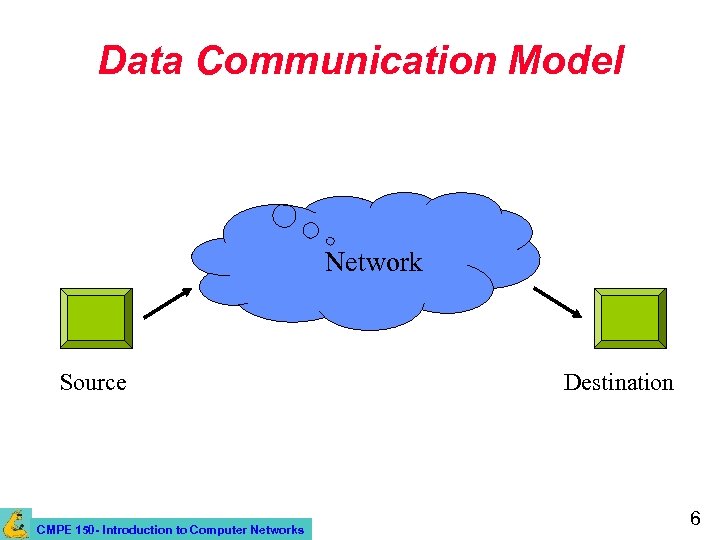 Data Communication Model Network Source CMPE 150 - Introduction to Computer Networks Destination 6
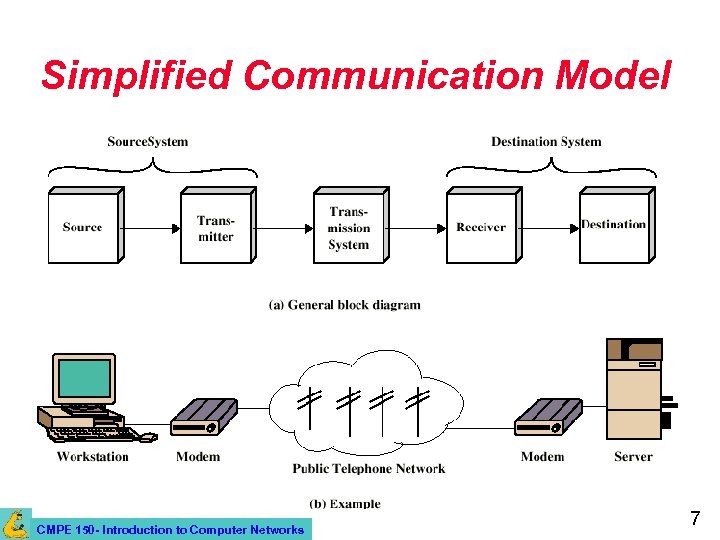 Simplified Communication Model CMPE 150 - Introduction to Computer Networks 7
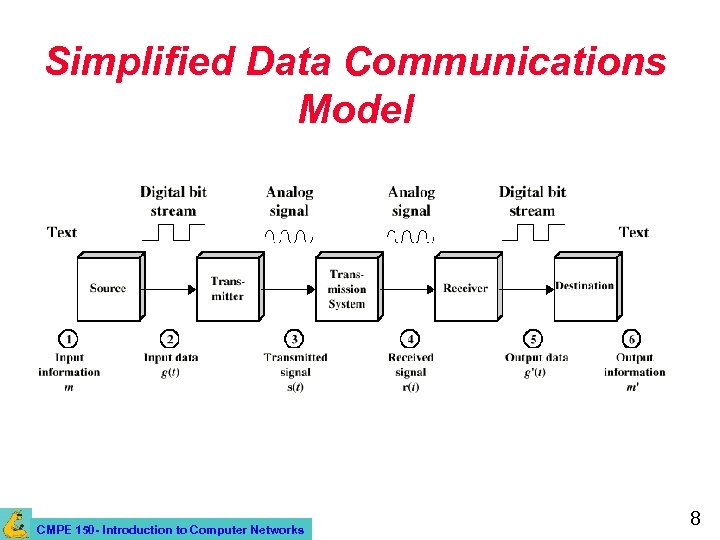 Simplified Data Communications Model CMPE 150 - Introduction to Computer Networks 8
 CMPE 150 - Introduction to Computer Networks 9
 Components • End systems (or hosts), • Routers/switches/bridges, and • Links (twisted pair, coaxial cable, fiber, radio, etc. ). CMPE 150 - Introduction to Computer Networks 10
 Components (cont’d) • Source – generates data to be transmitted • Transmitter – Converts data into transmittable signals • Transmission System – Carries data • Receiver – Converts received signal into data • Destination – Takes incoming data CMPE 150 - Introduction to Computer Networks 11
 Key Tasks • Transmission. • Signal Generation. • Synchronization. • Error detection and correction. • Addressing and routing • End-to-end Recovery. • Security. CMPE 150 - Introduction to Computer Networks 12
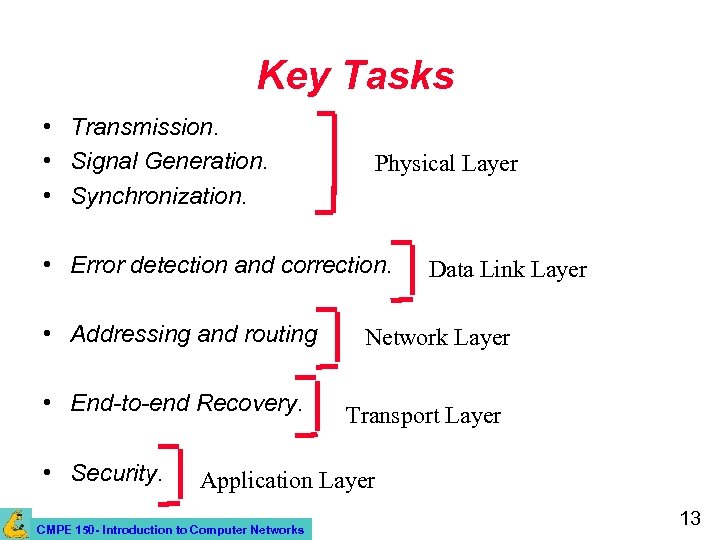 Key Tasks • Transmission. • Signal Generation. • Synchronization. Physical Layer • Error detection and correction. • Addressing and routing • End-to-end Recovery. • Security. Data Link Layer Network Layer Transport Layer Application Layer CMPE 150 - Introduction to Computer Networks 13
 Networking • Point to point communication not usually practical – Devices are too far apart. – Large set of devices would need impractical number of connections. • Solution is a communications network. CMPE 150 - Introduction to Computer Networks 14
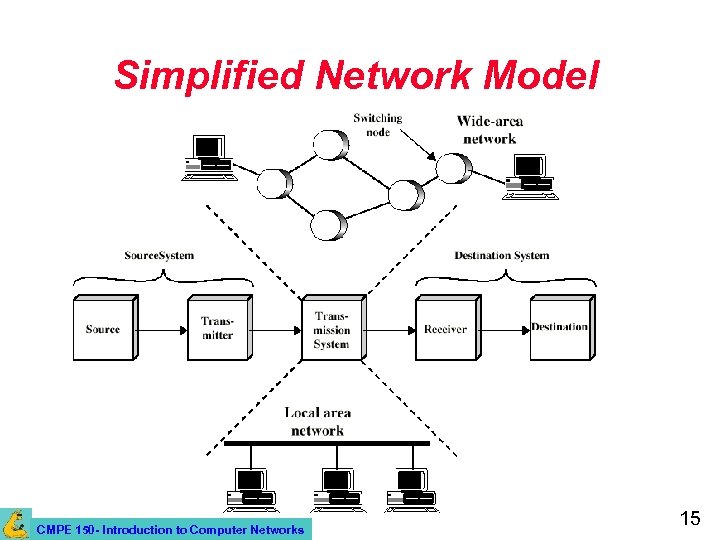 Simplified Network Model CMPE 150 - Introduction to Computer Networks 15
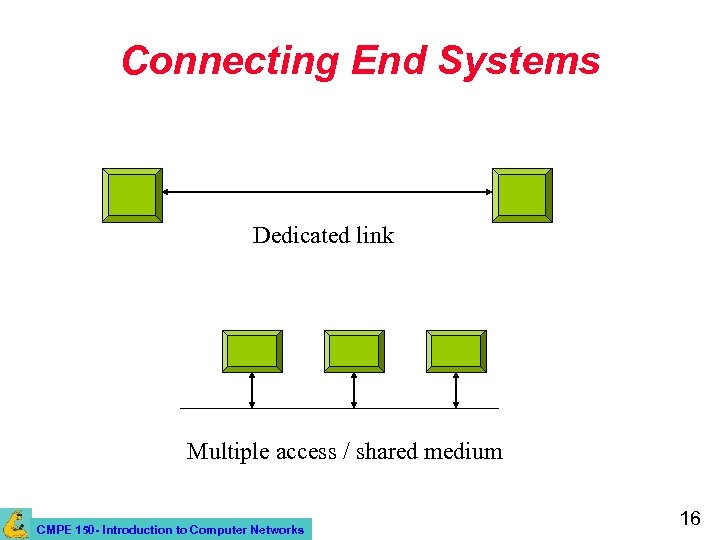 Connecting End Systems Dedicated link Multiple access / shared medium CMPE 150 - Introduction to Computer Networks 16
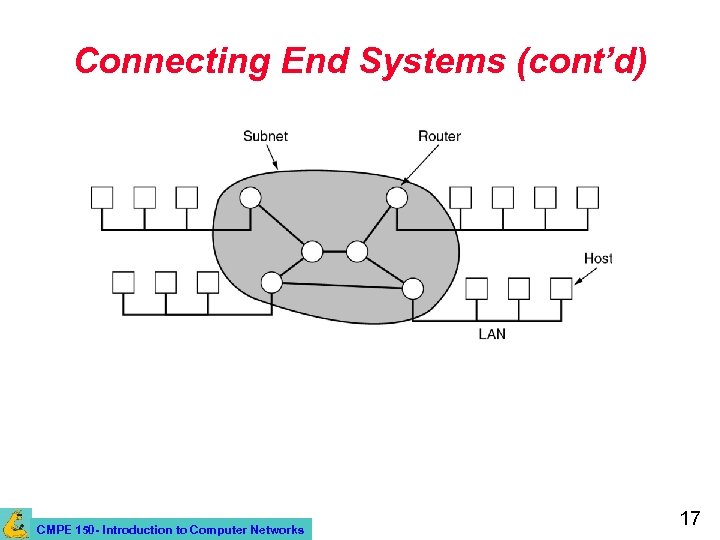 Connecting End Systems (cont’d) CMPE 150 - Introduction to Computer Networks 17
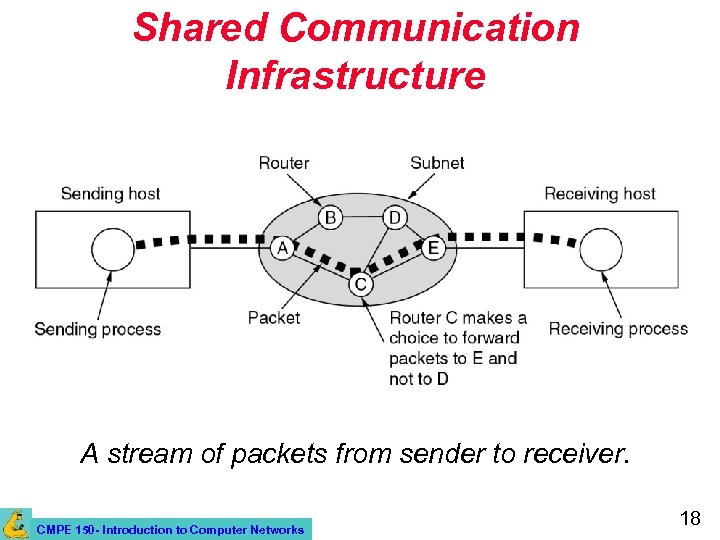 Shared Communication Infrastructure A stream of packets from sender to receiver. CMPE 150 - Introduction to Computer Networks 18
 Types of Data Networks • Several ways to classify data networks. • For example, according to “coverage”. – Local Area Networks (LANs) typically provide networking capabilities within a building, campus. • Typically within 5 -mile radius. – Wide-Area Networks (WANs) span greater geographic distances (e. g. , world-wide). – Metropolitan Area Networks (MANs) span more restricted distances, e. g. , geographic regions (e. g. , Los Nettos network in Southern California, etc. ) CMPE 150 - Introduction to Computer Networks 19
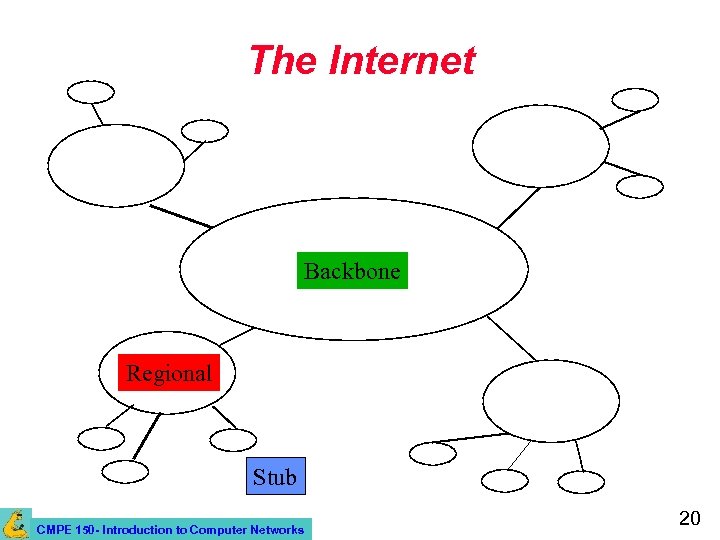 The Internet Backbone Regional Stub CMPE 150 - Introduction to Computer Networks 20
 Types of Networks (cont’d) • Classification according to type of connection. – Dedicated link. – Shared medium (multiple access). – Switched point-to-point. CMPE 150 - Introduction to Computer Networks 21
 Types of Networks (cont’d) • Classification according to topology… • What is network topology? – The way network elements are interconnected. CMPE 150 - Introduction to Computer Networks 22
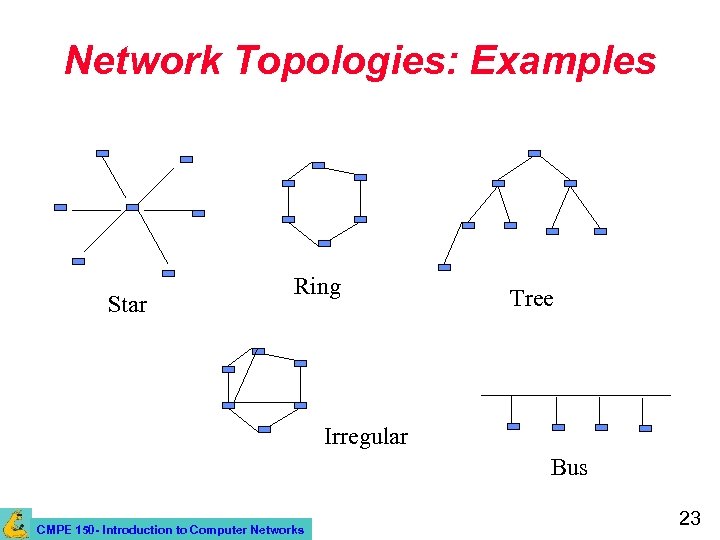 Network Topologies: Examples Star Ring Tree Irregular Bus CMPE 150 - Introduction to Computer Networks 23
 More Concepts… • Network protocols. • Layering. • Network/protocol architecture. CMPE 150 - Introduction to Computer Networks 24
 Network Protocols • Diplomats use rules, called protocols, as guides formal interactions. • A communication protocol is a set of rules that specify the format and meaning of messages exchanged between computers across a network. • A set of related protocols that are designed for compatibility are called protocol suite. CMPE 150 - Introduction to Computer Networks 25
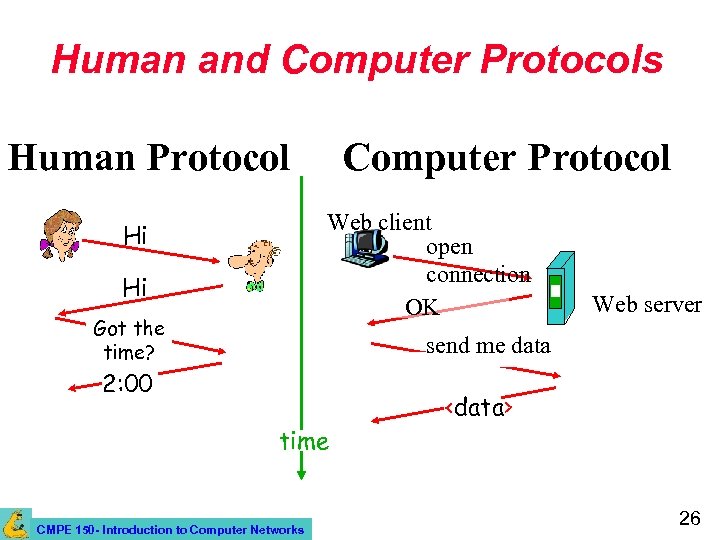 Human and Computer Protocols Human Protocol Computer Protocol Web client open connection OK Hi Hi Got the time? Web server send me data 2: 00 time CMPE 150 - Introduction to Computer Networks 26
 Layering • What is it? • Building complex systems is hard! – Approach: “Divide and conquer”. – Split job into smaller jobs, or layers. • Analogy to other fields. – Building a house: digging, foundation, framing, etc. – Car assembly line… • Basic idea: each step dependent on the previous step but does not need to be aware of how the previous step was done. CMPE 150 - Introduction to Computer Networks 27
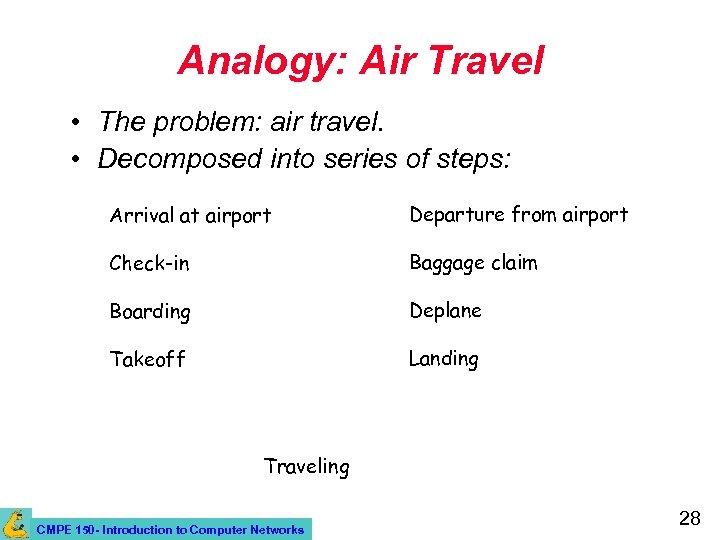 Analogy: Air Travel • The problem: air travel. • Decomposed into series of steps: Arrival at airport Departure from airport Check-in Baggage claim Boarding Deplane Takeoff Landing Traveling CMPE 150 - Introduction to Computer Networks 28
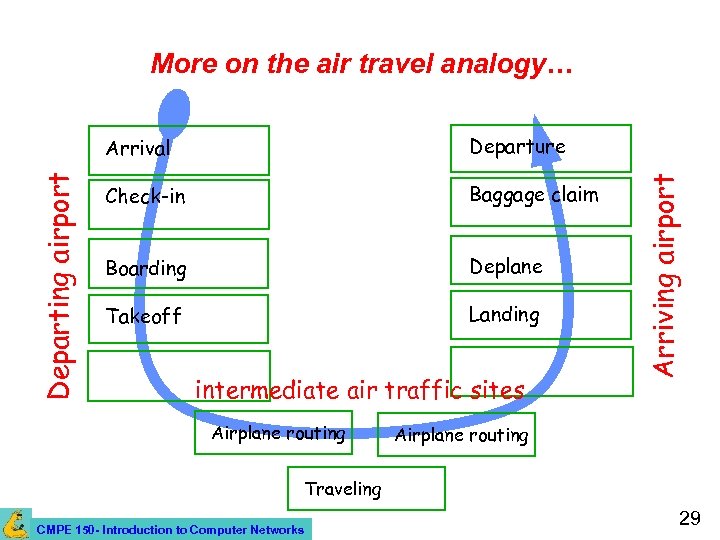 More on the air travel analogy… Departure Check-in Baggage claim Boarding Deplane Takeoff Landing intermediate air traffic sites Airplane routing Arriving airport Departing airport Arrival Airplane routing Traveling CMPE 150 - Introduction to Computer Networks 29
 Protocol Architecture • Task of communication broken up into modules • For example file transfer could use three modules – File transfer application – Communication service module – Network access module CMPE 150 - Introduction to Computer Networks 30
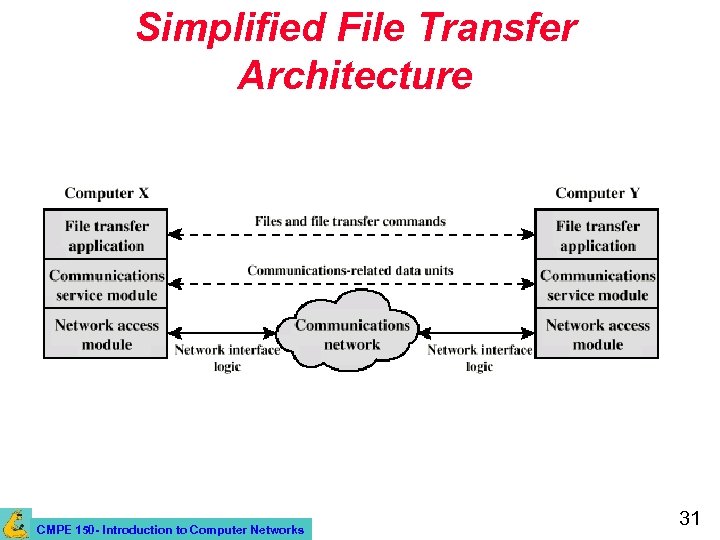 Simplified File Transfer Architecture CMPE 150 - Introduction to Computer Networks 31
 A Three Layer Model • • • Application Layer Transport Layer Network Access Layer CMPE 150 - Introduction to Computer Networks 32
 Network Access Layer • Exchange of data between the computer and the network • Sending computer provides address of destination • May invoke levels of service • Dependent on type of network used (LAN, packet switched etc. ) CMPE 150 - Introduction to Computer Networks 33
 Transport Layer • Reliable data exchange • Independent of network being used • Independent of application CMPE 150 - Introduction to Computer Networks 34
 Application Layer • Support for different user applications • e. g. e-mail, file transfer CMPE 150 - Introduction to Computer Networks 35
 Layered Protocol Design • Layering model is a solution to the problem of complexity in network protocols • The model divides the network protocols into layers, each of which solves part of the network communication problem – Each layer has its own protocol! • Each layer implements a service to the layer above – Relying on services provided by the layers below. CMPE 150 - Introduction to Computer Networks 36
 Layers • Layers are the different components that need to be designed/implemented when designing/implementing networks. • Each layer responsible for a set of functions. • Top layer relies on services provided by bottom layer. • Layer makes it service available to higher layer through an interface. CMPE 150 - Introduction to Computer Networks 37
 Network/Protocol Architecture • Set of layers, what their functions are, the services each of them provide, and the interfaces between them. • A. k. a, protocol architecture or protocol stack. • Examples: – ISO-OSI 7 layer architecture. – TCP-IP architecture (Internet). CMPE 150 - Introduction to Computer Networks 38
 Protocol Data Units (PDU) • At each layer, protocols are used to communicate. • At the source, control information is added to user data at each layer, a. k. a. , encapsulation. • At the receiver, control information is stripped off at each layer going up the stack, a. k. a. , decapsulation. CMPE 150 - Introduction to Computer Networks 39
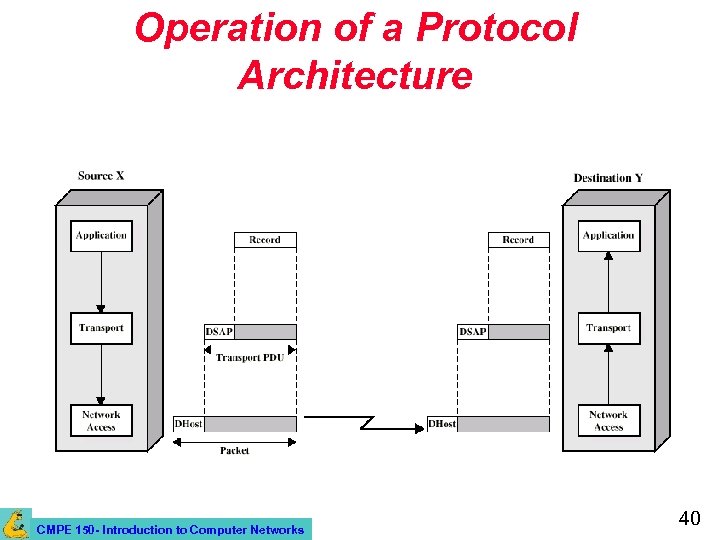 Operation of a Protocol Architecture CMPE 150 - Introduction to Computer Networks 40
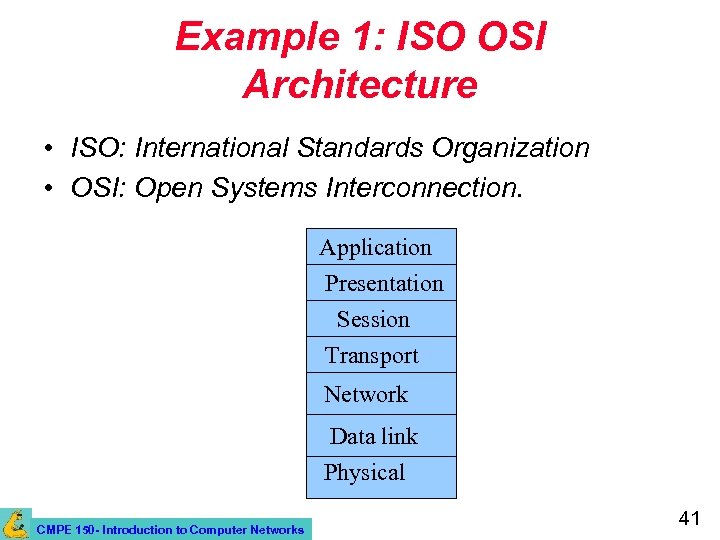 Example 1: ISO OSI Architecture • ISO: International Standards Organization • OSI: Open Systems Interconnection. Application Presentation Session Transport Network Data link Physical CMPE 150 - Introduction to Computer Networks 41
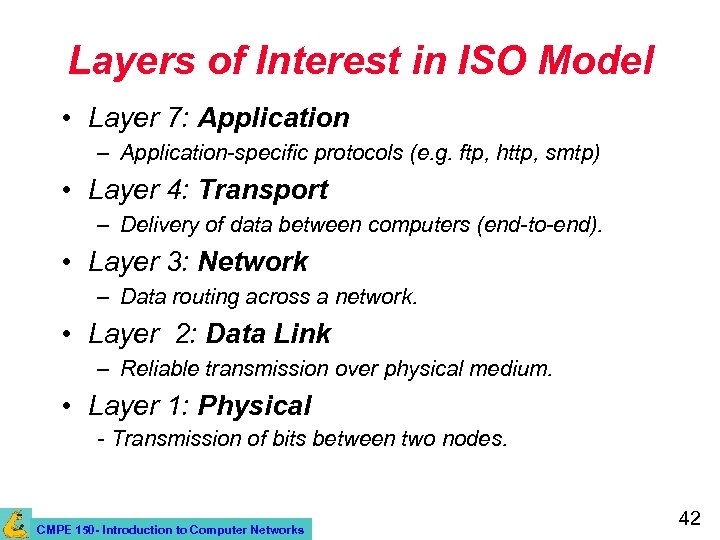 Layers of Interest in ISO Model • Layer 7: Application – Application-specific protocols (e. g. ftp, http, smtp) • Layer 4: Transport – Delivery of data between computers (end-to-end). • Layer 3: Network – Data routing across a network. • Layer 2: Data Link – Reliable transmission over physical medium. • Layer 1: Physical - Transmission of bits between two nodes. CMPE 150 - Introduction to Computer Networks 42
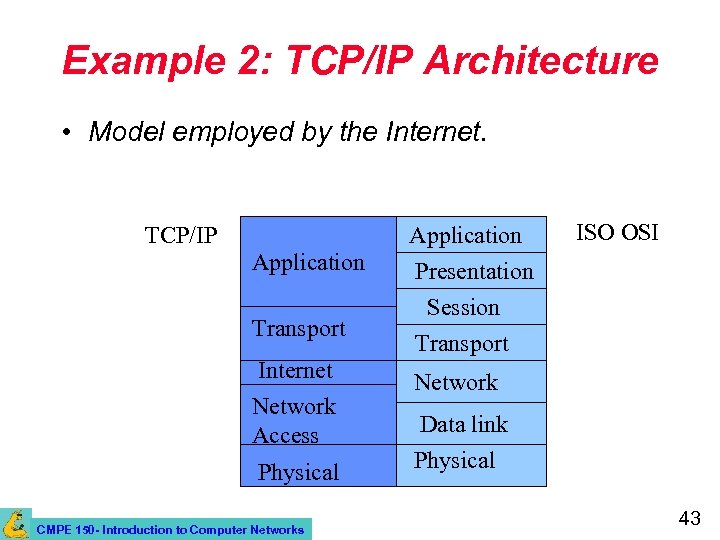 Example 2: TCP/IP Architecture • Model employed by the Internet. TCP/IP Application Transport Internet Network Access Physical CMPE 150 - Introduction to Computer Networks Application Presentation Session Transport ISO OSI Network Data link Physical 43
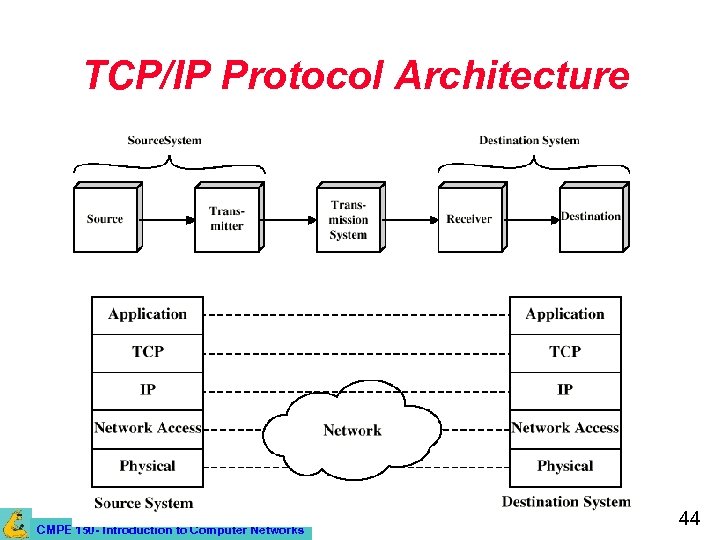 TCP/IP Protocol Architecture CMPE 150 - Introduction to Computer Networks 44