


 Скачать презентацию INTRODUCTION TO MORPHOLOGY AND LEXICOLOGY UNIT 2 WHERE
298f85011a49dce501d5c2bc6fbdb3e3.ppt
- Количество слайдов: 36
 INTRODUCTION TO MORPHOLOGY AND LEXICOLOGY UNIT 2: WHERE DO ENGLISH WORDS COME FROM? 16 th March 2016
 Ch 2: Where do English words come from? 2. 1 The origin of English 2. 2 Historical development of English vocabulary 2. 3 Native English vocabulary 2. 4 The process of borrowing 2. 5 Creating new English words 2. 6 Characteristics of modern English vocabulary
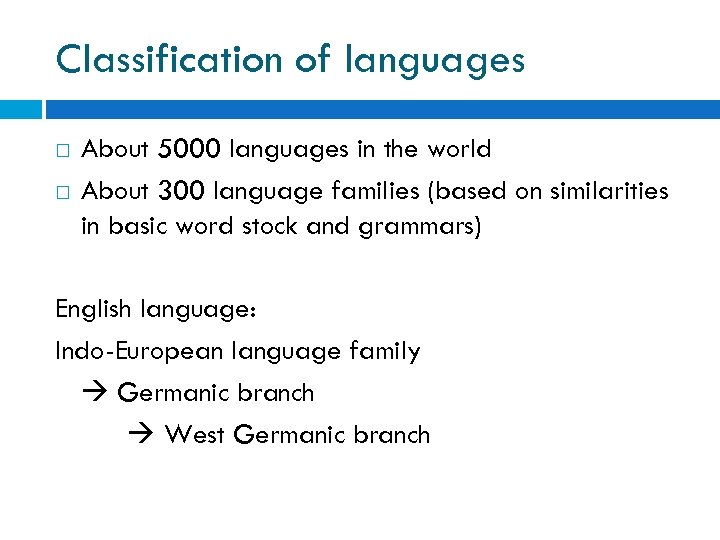 Classification of languages About 5000 languages in the world About 300 language families (based on similarities in basic word stock and grammars) English language: Indo-European language family Germanic branch West Germanic branch
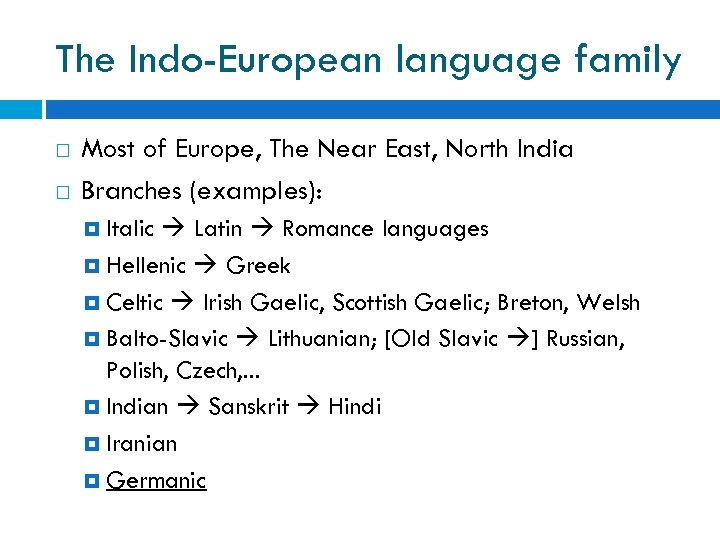 The Indo-European language family Most of Europe, The Near East, North India Branches (examples): Latin Romance languages Hellenic Greek Celtic Irish Gaelic, Scottish Gaelic; Breton, Welsh Balto-Slavic Lithuanian; [Old Slavic ] Russian, Polish, Czech, . . . Indian Sanskrit Hindi Iranian Germanic Italic
 Germanic branch East Germanic branch E. g. , North Germanic branch E. g. , Gothic, Vandalic, Burgundian [extinct] Danish, Sweedish, Norwegian, Icelandic West Germanic branch E. g. , modern German, Dutch, Frisian (NW Netherlands + Friesland), and English Q: Which of the languages is the closest relative to English?
 How English came to England Celts – the first known inhabitants, I-E language 55 -54 BC – Roman invasion (attempt to add the land to the Roman Empire), Romans defeated AD 43 -410 the island of Britain occupied by the Romans (military & government officials) Settlements: Doncaster, Gloucester, Lancaster < lat. CASTRA, ‘camp‘
 How English came to England Withdrawal of Romans invasion of lowlands by the Picts and Scots (tribes in the north of Britain) Celts ask Germanic tribes from across the North Sea for aid (Angles, Saxons, Frisians, and Jutes) The allies became the conquerors Celts were pushed to the fringes of the country (Wales, Cornwall, Cumbria, Scottish highlands) or they left for French Brittany; those who stayed become assimilated to Anglo-Saxon society.
 The name of the language The Celts called the invaders Sassenachs ‘Saxons‘ by the end of 6 th century – the term was replaced by the term Angli ‘Angles‘ C 17 – the usual Latin name for the country was Angli or Anglia Engle in OE, language = Englisc [‘sc‘ /∫/] C 10 – Englaland [ England]
 2. 2 Historical development of English vocabulary The Old English period (450 -1066) The Middle English period (1066 -1500) Early Modern English (1500 -1800) The Modern English period (1800 -present)
 The Old English period (450 -1066) C 5 -C 6 the first scattered OE manuscripts in runic alphabet brought by Anglo-Saxons C 6 – arrival of Christian missionaries from Rome = beginning of literary age Around 700 – glossaries of Latin translated into OE Around 1000 – Beowulf (heroic poem) C 9 – Kind Alfred; Latin works translated into OE Corpus of OE: 3. 5 million words
 OE letters, spelling and words Absence of capital letters Different shapes of some letters; Roman symbols Variation is spelling (even with a single scribe) Words in prose – close to Modern English X poetry OE vs. Modern English: omitting the ge- prefix Geseted > -seted (seated) Geseah > -seah (saw) Gehyrde > -hyrde (heard) X glimplice (suitable), beboden (entrusted), . . .
 OE lexicon: Kennings Frequent coinages (kennings) Kennings = vivid figurative descriptions often involving compounds (Old Norse) Sometimes difficult interpretation (synonyms – shades of meaning; 20 terms for man in Beowulf; poetry) Hronrad (whaleroad) = sea; banhus (bone-house) = body; Moncynnes wead (guardian of mankind) = God
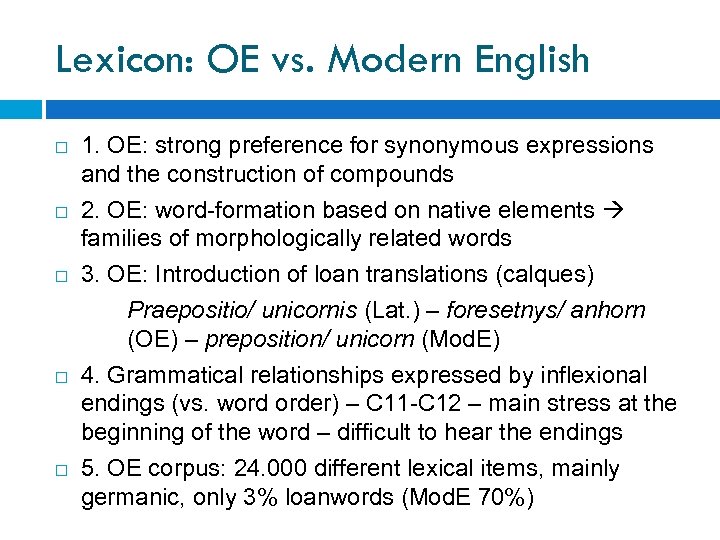 Lexicon: OE vs. Modern English 1. OE: strong preference for synonymous expressions and the construction of compounds 2. OE: word-formation based on native elements families of morphologically related words 3. OE: Introduction of loan translations (calques) Praepositio/ unicornis (Lat. ) – foresetnys/ anhorn (OE) – preposition/ unicorn (Mod. E) 4. Grammatical relationships expressed by inflexional endings (vs. word order) – C 11 -C 12 – main stress at the beginning of the word – difficult to hear the endings 5. OE corpus: 24. 000 different lexical items, mainly germanic, only 3% loanwords (Mod. E 70%)
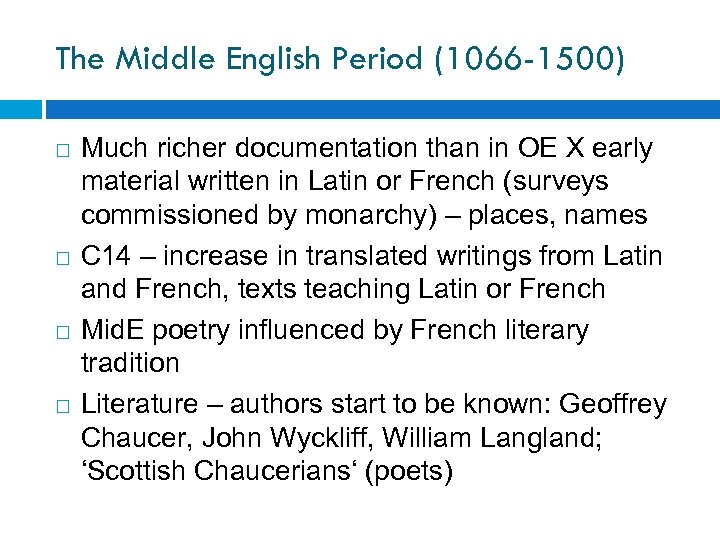 The Middle English Period (1066 -1500) Much richer documentation than in OE X early material written in Latin or French (surveys commissioned by monarchy) – places, names C 14 – increase in translated writings from Latin and French, texts teaching Latin or French Mid. E poetry influenced by French literary tradition Literature – authors start to be known: Geoffrey Chaucer, John Wyckliff, William Langland; ‘Scottish Chaucerians‘ (poets)
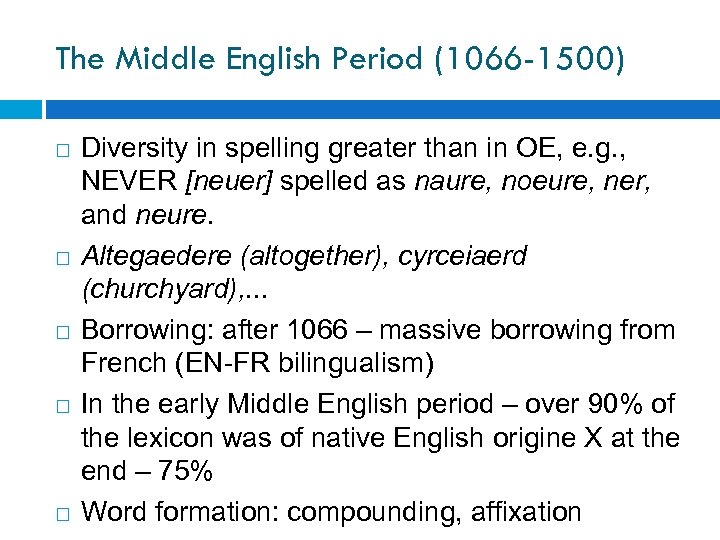 The Middle English Period (1066 -1500) Diversity in spelling greater than in OE, e. g. , NEVER [neuer] spelled as naure, noeure, ner, and neure. Altegaedere (altogether), cyrceiaerd (churchyard), . . . Borrowing: after 1066 – massive borrowing from French (EN-FR bilingualism) In the early Middle English period – over 90% of the lexicon was of native English origine X at the end – 75% Word formation: compounding, affixation
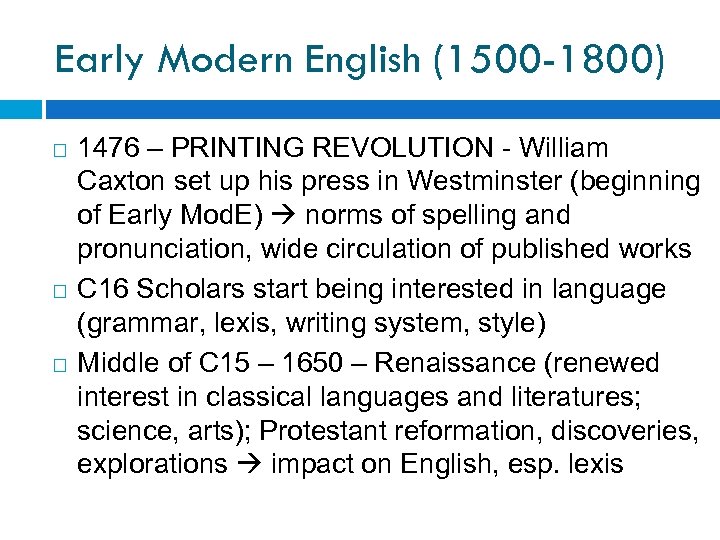 Early Modern English (1500 -1800) 1476 – PRINTING REVOLUTION - William Caxton set up his press in Westminster (beginning of Early Mod. E) norms of spelling and pronunciation, wide circulation of published works C 16 Scholars start being interested in language (grammar, lexis, writing system, style) Middle of C 15 – 1650 – Renaissance (renewed interest in classical languages and literatures; science, arts); Protestant reformation, discoveries, explorations impact on English, esp. lexis
 Early Modern English (1500 -1800) Latin words introduced (translations – theology, medicine) Purists (against borrowings) Renaissance W. Shakespeare, 1564 -1616, info about pronunciation, word formation, syntax, and language use; introduced/ popularized new words King James Bible, 1611, appointed to be read throughout the kingdom, the translators aimed for a dignified style, older forms of language (despite the existing modern ones), conservative
 King James Bible Contains many phrases that have entered the language as idioms, e. g. , can the leopard change its spots, fight the good fight, if the blind lead the blind. . . TASK: Complete the following idioms:
 King James Bible Idioms: A ---- in sheep‘s clothing In the t---- of an eye ( = in a very short time) Money is the ---- of all evil The ---- of the earth (the ones who ‘enhance‘ the flavour of life in this world) By the ---- of my teeth (to describe a situation one barely managed to escape from) A t---- in the flesh (a constant bother/ annoyance to someone)
 Early Modern English (1500 -1800) Borrowing, word formation; semantic changes C 17 many critics felt that English was changing to rapidly and randomly Need to stabilize the language debates on language corruption public attention Grammars, spelling guides, pronunciation manuals, dictionaries (e. g. , Robert Cawdrey, ‘dictionary of hard words‘, 3000 entries, mostly borrowings, e. g. , abbettors glossed as ‘counselors‘, 1 st synonym dict. )
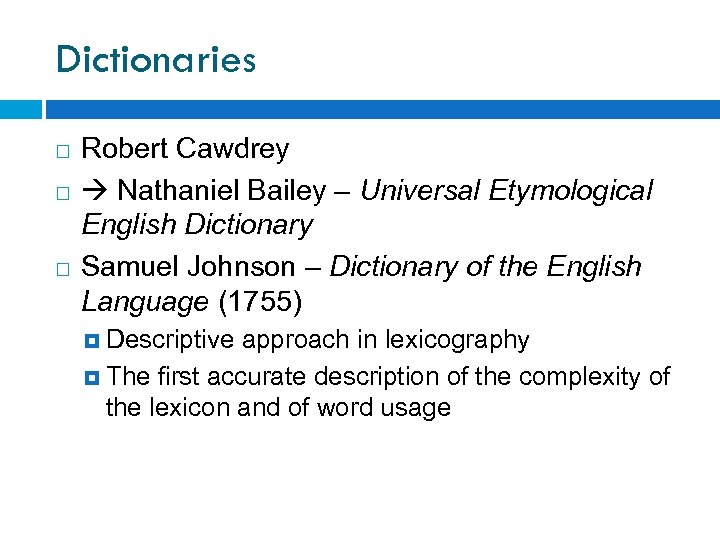 Dictionaries Robert Cawdrey Nathaniel Bailey – Universal Etymological English Dictionary Samuel Johnson – Dictionary of the English Language (1755) Descriptive approach in lexicography The first accurate description of the complexity of the lexicon and of word usage
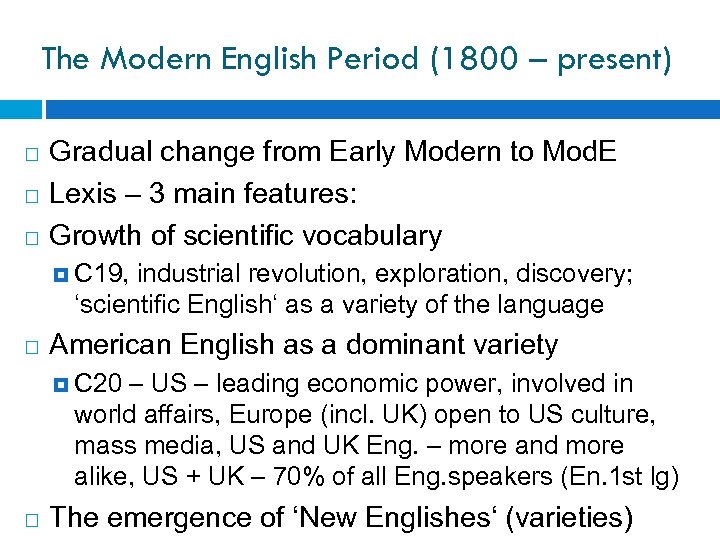 The Modern English Period (1800 – present) Gradual change from Early Modern to Mod. E Lexis – 3 main features: Growth of scientific vocabulary C 19, industrial revolution, exploration, discovery; ‘scientific English‘ as a variety of the language American English as a dominant variety C 20 – US – leading economic power, involved in world affairs, Europe (incl. UK) open to US culture, mass media, US and UK Eng. – more and more alike, US + UK – 70% of all Eng. speakers (En. 1 st lg) The emergence of ‘New Englishes‘ (varieties)
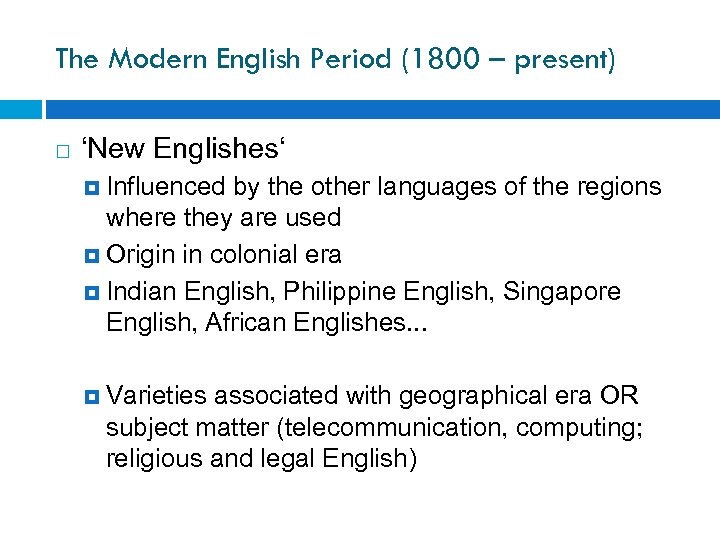 The Modern English Period (1800 – present) ‘New Englishes‘ Influenced by the other languages of the regions where they are used Origin in colonial era Indian English, Philippine English, Singapore English, African Englishes. . . Varieties associated with geographical era OR subject matter (telecommunication, computing; religious and legal English)
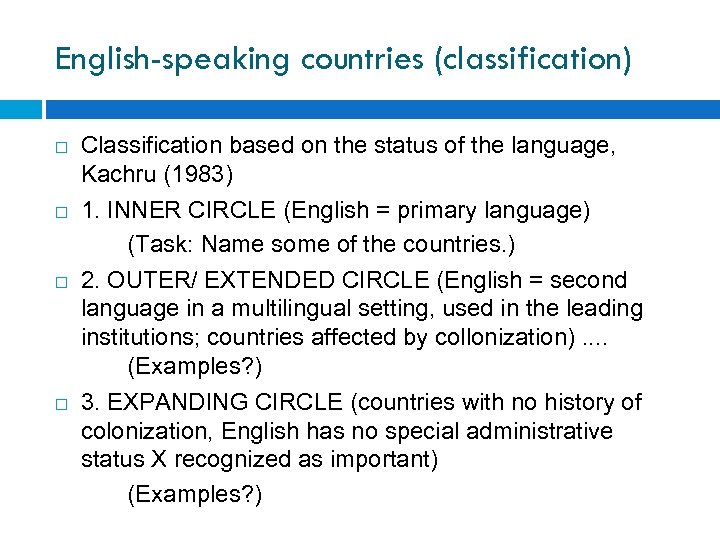 English-speaking countries (classification) Classification based on the status of the language, Kachru (1983) 1. INNER CIRCLE (English = primary language) (Task: Name some of the countries. ) 2. OUTER/ EXTENDED CIRCLE (English = second language in a multilingual setting, used in the leading institutions; countries affected by collonization). . (Examples? ) 3. EXPANDING CIRCLE (countries with no history of colonization, English has no special administrative status X recognized as important) (Examples? )
 Native English Vocabulary What is the origin of the native English vocabulary? (i. e, „Who brought it & who influenced it? “)
 Anglo-Saxon words Represent the native English vocabulary (which is also influenced by the Celtic language) Most of them – common words of the language, the nucelus of the English language Generally short and concrete Parts of the body (arm, bone, chest, eye, ear, foot, hand) The natural landscape (field, hedge, hill, meadow, land) Domestic life and animals (door, house; cow, dog, fish) The calendar (day, month, moon, sun, year) Common adjectives and verbs (dark, wide; do, go, kiss)
 The influence of Celtic on English Not very significant (cf. the conditions of the cultural contact); regionalisms; just a few have survived Binn (bin), carr (rock), luh (Scots: loch, Irish: lough) lake Celtic-based place names: Avon (river), Thames, Don Town names: Dover (water), Eccles (church), London Introduction of a few Celtic words into English from Irish Gaelic (C 17) – brogue, galore, shamrock and from Welsh – crag. Celtic has a rather negligible influence of English.
 Practice and revision: 1 Give the basic characteristics of the Old English vocabulary.
 Practice and revision: 2 Give the basic characteristics of the Middle English vocabulary.
 Practice and revision: 3 Give the basic characteristics of the Early Modern English vocabulary.
 Practice and revision: 4 Give the basic characteristics of the Modern English vocabulary.
 Practice and revision: Try and identify the language of origin of the following words: addendum baguette cannelloni con brio criterion
 Practice and revision: Try and identify the language of origin of the following words: id est (i. e. ) in loco parentis mañana sang-froid vis-à-vis
 Practice and revision: Try and identify the language of origin of the following words: zucchini robot piano yougurt zebra
 Practice and revision: Try and identify the language of origin of the following words: lilac alcohol pretzel power politics gas quark
 Thank you for you attention! Enjoy the rest of the semester!