


 Скачать презентацию Introduction to Molecular Phylogeny Starting point a set
afab4ab42b7b5f6273e5fe82670fb2e4.ppt
- Количество слайдов: 56
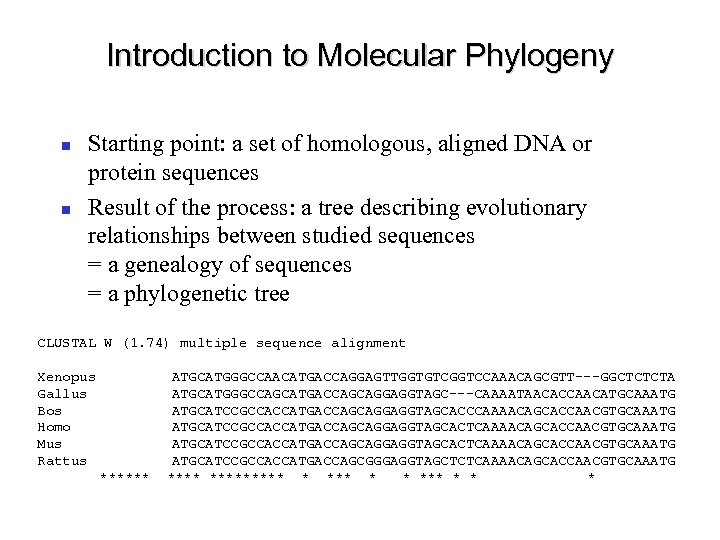 Introduction to Molecular Phylogeny Starting point: a set of homologous, aligned DNA or protein sequences Result of the process: a tree describing evolutionary relationships between studied sequences = a genealogy of sequences = a phylogenetic tree CLUSTAL W (1. 74) multiple sequence alignment Xenopus Gallus Bos Homo Mus Rattus ****** ATGCATGGGCCAACATGACCAGGAGTTGGTGTCGGTCCAAACAGCGTT---GGCTCTCTA ATGCATGGGCCAGCATGACCAGCAGGAGGTAGC---CAAAATAACACCAACATGCAAATG ATGCATCCGCCACCATGACCAGCAGGAGGTAGCACCCAAAACAGCACCAACGTGCAAATG ATGCATCCGCCACCATGACCAGCAGGAGGTAGCACTCAAAACAGCACCAACGTGCAAATG ATGCATCCGCCACCATGACCAGCGGGAGGTAGCTCTCAAAACAGCACCAACGTGCAAATG ********* * * *** *
 Phylogenetic Tree Internal branch : between 2 nodes. External branch : between a node and a leaf Horizontal branch length is proportional to evolutionary distances between sequences and their ancestors (unit = substitution / site). Tree Topology = shape of tree = branching order between nodes
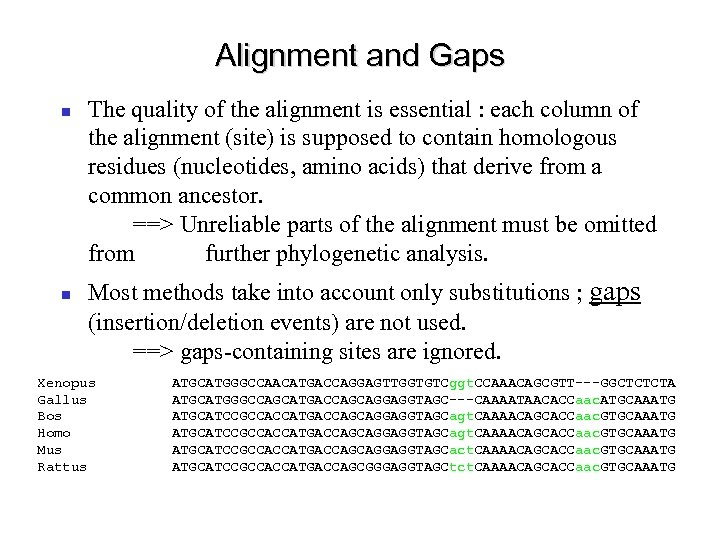 Alignment and Gaps The quality of the alignment is essential : each column of the alignment (site) is supposed to contain homologous residues (nucleotides, amino acids) that derive from a common ancestor. ==> Unreliable parts of the alignment must be omitted from further phylogenetic analysis. Most methods take into account only substitutions ; gaps (insertion/deletion events) are not used. ==> gaps-containing sites are ignored. Xenopus Gallus Bos Homo Mus Rattus ATGCATGGGCCAACATGACCAGGAGTTGGTGTCggt. CCAAACAGCGTT---GGCTCTCTA ATGCATGGGCCAGCATGACCAGCAGGAGGTAGC---CAAAATAACACCaac. ATGCAAATG ATGCATCCGCCACCATGACCAGCAGGAGGTAGCagt. CAAAACAGCACCaac. GTGCAAATG ATGCATCCGCCACCATGACCAGCAGGAGGTAGCact. CAAAACAGCACCaac. GTGCAAATG ATGCATCCGCCACCATGACCAGCGGGAGGTAGCtct. CAAAACAGCACCaac. GTGCAAATG
 Rooted and Unrooted Trees Most phylogenetic methods produce unrooted trees. This is because they detect differences between sequences, but have no means to orient residue changes relatively to time. Two means to root an unrooted tree : The outgroup method : include in the analysis a group of sequences known a priori to be external to the group under study; the root is by necessity on the branch joining the outgroup to other sequences. Make the molecular clock hypothesis : all lineages are supposed to have evolved with the same speed since divergence from their common ancestor. The root is at the equidistant point from all tree leaves.
 Unrooted Tree
 Rooted Tree
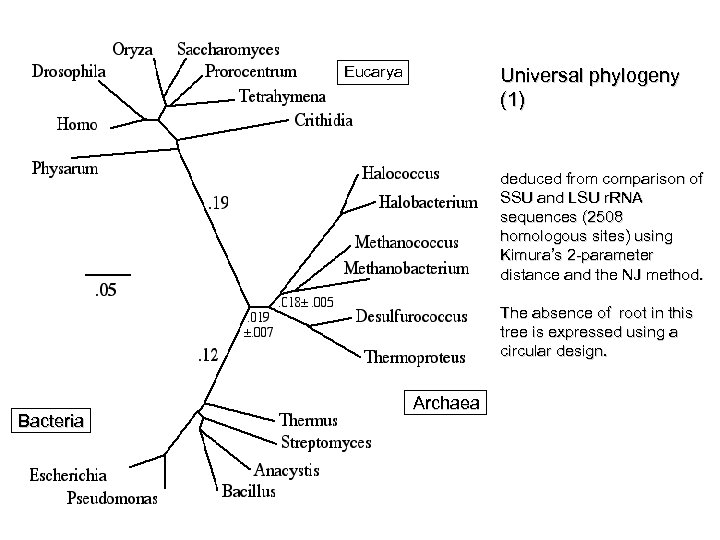 Eucarya Universal phylogeny (1) deduced from comparison of SSU and LSU r. RNA sequences (2508 homologous sites) using Kimura’s 2 -parameter distance and the NJ method. The absence of root in this tree is expressed using a circular design. Bacteria Archaea
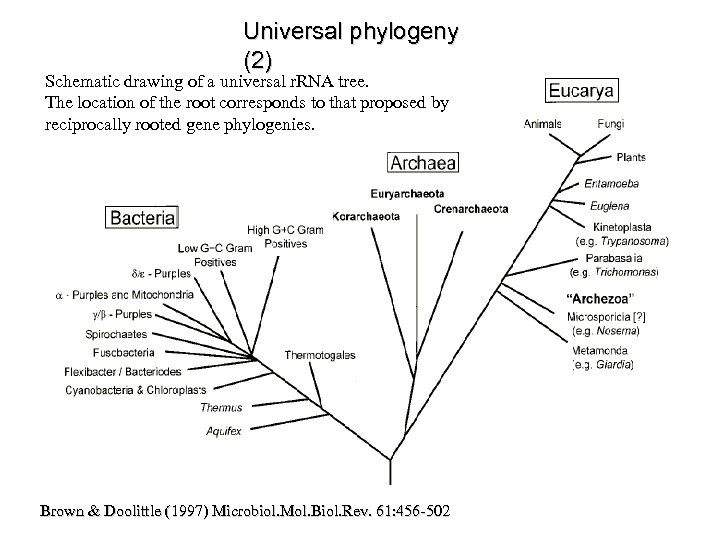 Universal phylogeny (2) Schematic drawing of a universal r. RNA tree. The location of the root corresponds to that proposed by reciprocally rooted gene phylogenies. Brown & Doolittle (1997) Microbiol. Mol. Biol. Rev. 61: 456 -502
 Number of possible tree topologies for n taxa
 Methods for Phylogenetic reconstruction Three main families of methods : Parsimony Distance methods Maximum likelihood methods
 Parsimony (1) Step 1: for a given tree topology (shape), and for a given alignment site, determine what ancestral residues (at tree nodes) require the smallest total number of changes in the whole tree. Let d be this total number of changes. Example: At this site and for this tree shape, at least 3 substitution events are needed to explain the nucleotide pattern at tree leaves. Several distinct scenarios with 3 changes are possible.
 Parsimony (2) Step 2: Compute d (step 1) for each alignment site. Add d values for all alignment sites. This gives the length L of tree. Step 3: Compute L value (step 2) for each possible tree shape. Retain the shortest tree(s) = the tree(s) that require the smallest number of changes = the most parsimonious tree(s).
 Some properties of Parsimony Several trees can be equally parsimonious (same length, the shortest of all possible lengths). The position of changes on each branch is not uniquely defined => parsimony does not allow to define tree branch lengths in a unique way. The number of trees to evaluate grows extremely fast with the number of processed sequences : ð Parsimony can be very computation - intensive. ð The search for the shortest tree must often be restricted to a fraction of the set of all possible tree shapes (heuristic search) => there is no mathematical certainty of finding the shortest (most parsimonious) tree.
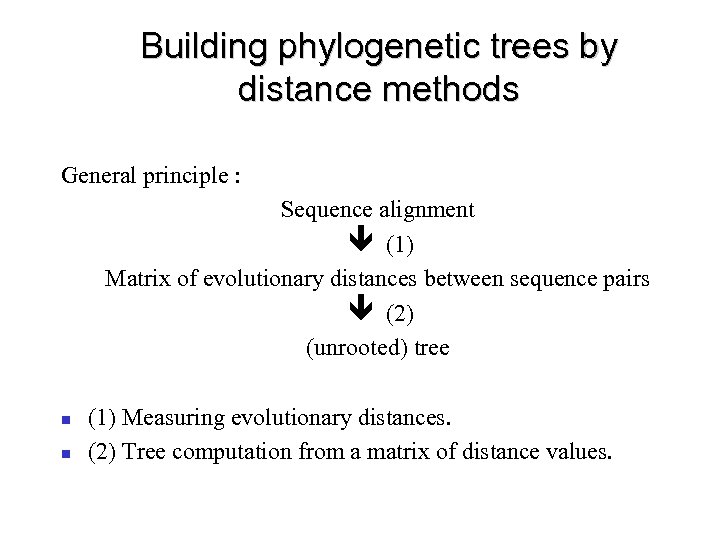 Building phylogenetic trees by distance methods General principle : Sequence alignment ê (1) Matrix of evolutionary distances between sequence pairs ê (2) (unrooted) tree (1) Measuring evolutionary distances. (2) Tree computation from a matrix of distance values.
 Correspondence between trees and distance matrices • Any phylogenetic tree induces a matrix of distances between sequence pairs • “Perfect” distance matrices correspond to a single phylogenetic tree
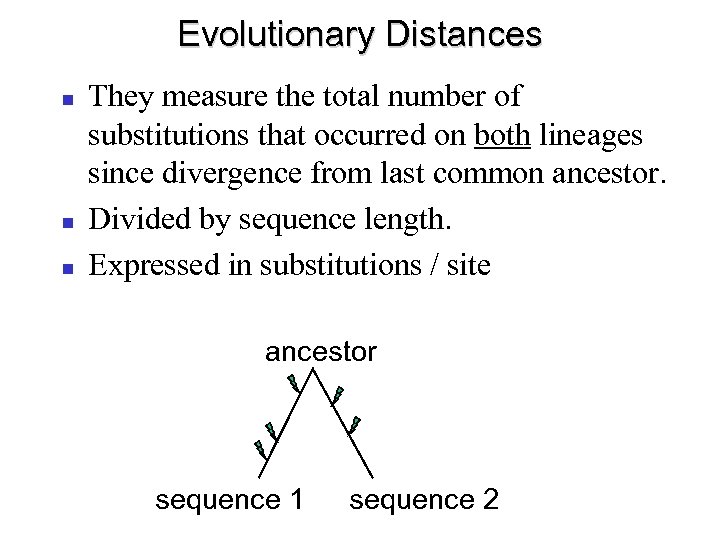 Evolutionary Distances They measure the total number of substitutions that occurred on both lineages since divergence from last common ancestor. Divided by sequence length. Expressed in substitutions / site ancestor sequence 1 sequence 2
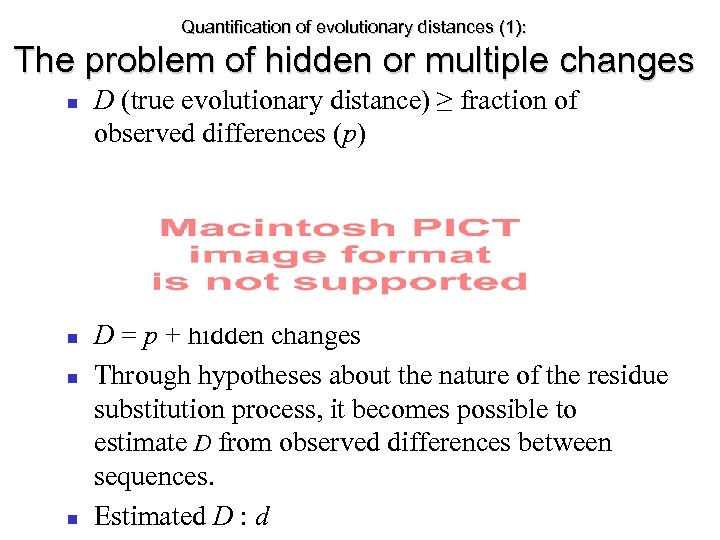 Quantification of evolutionary distances (1): The problem of hidden or multiple changes D (true evolutionary distance) ≥ fraction of observed differences (p) D = p + hidden changes Through hypotheses about the nature of the residue substitution process, it becomes possible to estimate D from observed differences between sequences. Estimated D : d
 Quantification of evolutionary distances(2): Jukes and Cantor’s distance (DNA) Hypotheses of the model (Jukes & Cantor, 1969) : (a) All sites evolve independently and following the same process. (b) All substitutions have the same probability. (c) The base substitution process is constant in time. Quantification of evolutionary distance (d) as a function of the fraction of observed differences (p): N = number of compared sites
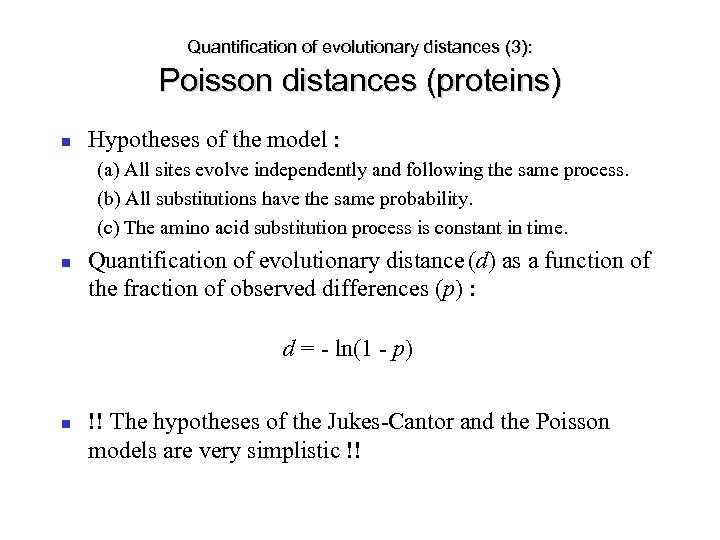 Quantification of evolutionary distances (3): Poisson distances (proteins) Hypotheses of the model : (a) All sites evolve independently and following the same process. (b) All substitutions have the same probability. (c) The amino acid substitution process is constant in time. Quantification of evolutionary distance (d) as a function of the fraction of observed differences (p) : d = - ln(1 - p) !! The hypotheses of the Jukes-Cantor and the Poisson models are very simplistic !!
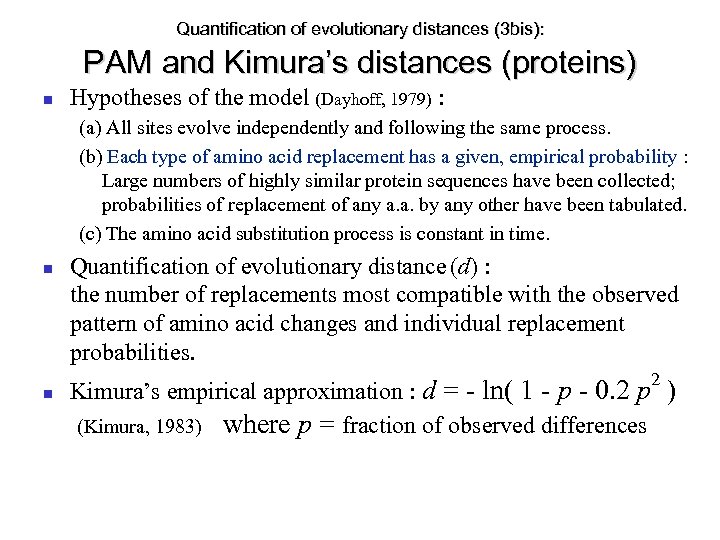 Quantification of evolutionary distances (3 bis): PAM and Kimura’s distances (proteins) Hypotheses of the model (Dayhoff, 1979) : (a) All sites evolve independently and following the same process. (b) Each type of amino acid replacement has a given, empirical probability : Large numbers of highly similar protein sequences have been collected; probabilities of replacement of any a. a. by any other have been tabulated. (c) The amino acid substitution process is constant in time. Quantification of evolutionary distance (d) : the number of replacements most compatible with the observed pattern of amino acid changes and individual replacement probabilities. 2 Kimura’s empirical approximation : d = - ln( 1 - p - 0. 2 p ) (Kimura, 1983) where p = fraction of observed differences
 Quantification of evolutionary distances (4): Kimura’s two parameter distance (DNA) Hypotheses of the model : (a) All sites evolve independently and following the same process. (b) Substitutions occur according to two probabilities : One for transitions, one for transversions. Transitions : G <—>A or C <—>T Transversions : other changes (c) The base substitution process is constant in time. Quantification of evolutionary distance (d) as a function of the fraction of observed differences (p: transitions, q: transversions): Kimura (1980) J. Mol. Evol. 16: 111
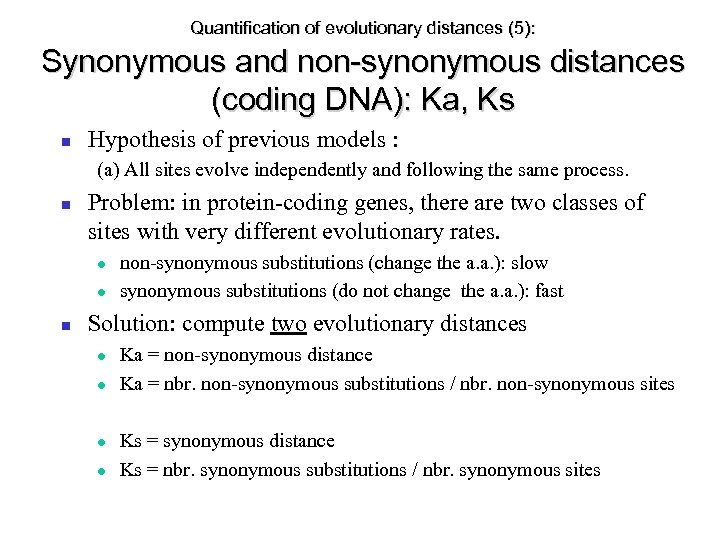 Quantification of evolutionary distances (5): Synonymous and non-synonymous distances (coding DNA): Ka, Ks Hypothesis of previous models : (a) All sites evolve independently and following the same process. Problem: in protein-coding genes, there are two classes of sites with very different evolutionary rates. non-synonymous substitutions (change the a. a. ): slow synonymous substitutions (do not change the a. a. ): fast Solution: compute two evolutionary distances Ka = non-synonymous distance Ka = nbr. non-synonymous substitutions / nbr. non-synonymous sites Ks = synonymous distance Ks = nbr. synonymous substitutions / nbr. synonymous sites
 The genetic code
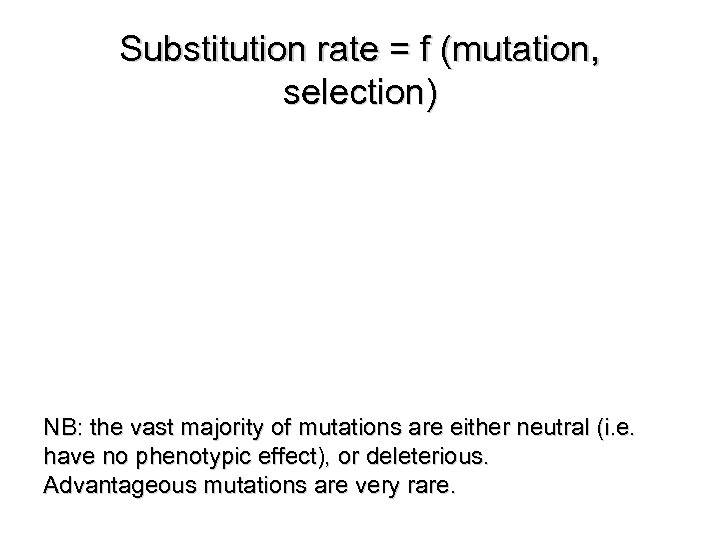 Substitution rate = f (mutation, selection) NB: the vast majority of mutations are either neutral (i. e. have no phenotypic effect), or deleterious. Advantageous mutations are very rare.
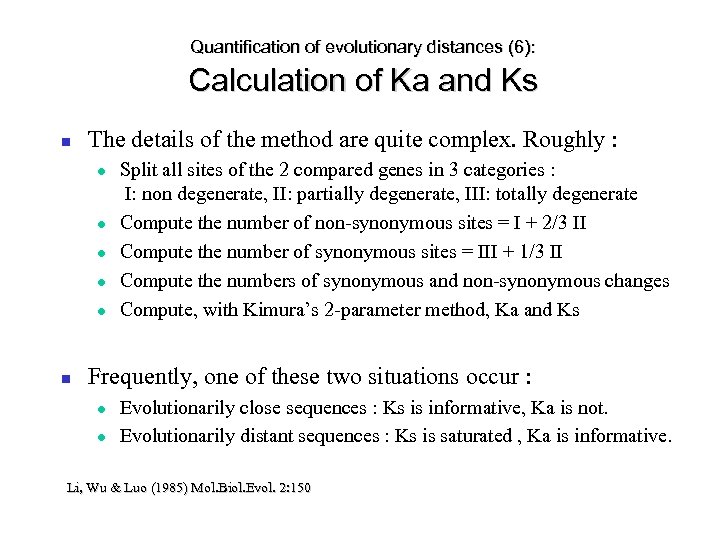 Quantification of evolutionary distances (6): Calculation of Ka and Ks The details of the method are quite complex. Roughly : Split all sites of the 2 compared genes in 3 categories : I: non degenerate, II: partially degenerate, III: totally degenerate Compute the number of non-synonymous sites = I + 2/3 II Compute the number of synonymous sites = III + 1/3 II Compute the numbers of synonymous and non-synonymous changes Compute, with Kimura’s 2 -parameter method, Ka and Ks Frequently, one of these two situations occur : Evolutionarily close sequences : Ks is informative, Ka is not. Evolutionarily distant sequences : Ks is saturated , Ka is informative. Li, Wu & Luo (1985) Mol. Biol. Evol. 2: 150
 Ka and Ks : example Urotrophin gene of rat (AJ 002967) and mouse (Y 12229)
 Saturation: loss of phylogenetic signal When compared homologous sequences have experienced too many residue substitutions since divergence, it is impossible to determine the phylogenetic tree, whatever the tree-building method used. NB: with distance methods, the saturation phenomenon may express itself through mathematical impossibility to compute d. Example: Jukes-Cantor: p 0. 75 => d -- ∞ and V(d) - ∞ NB: often saturation may not be detectable
 Quantification of evolutionary distances (7): Other distance measures Several other, more realistic models of the evolutionary process at the molecular level have been used : Accounting for biased base compositions (Tajima & Nei). Accounting for variation of the evolutionary rate across sequence sites. etc. . .
 Building phylogenetic trees by distance methods General principle : Sequence alignment ê (1) Matrix of evolutionary distances between sequence pairs ê (2) (unrooted) tree (1) Measuring evolutionary distances. (2) Tree computation from a matrix of distance values.
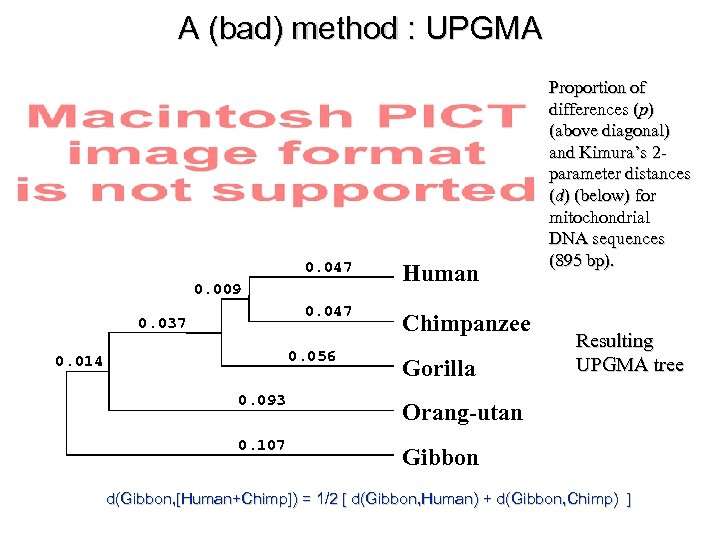 A (bad) method : UPGMA 0. 047 Human 0. 047 Chimpanzee 0. 009 0. 037 0. 056 0. 014 Gorilla 0. 093 Resulting UPGMA tree Orang-utan 0. 107 Proportion of differences (p) (above diagonal) and Kimura’s 2 parameter distances (d) (below) for mitochondrial DNA sequences (895 bp). Gibbon d(Gibbon, [Human+Chimp]) = 1/2 [ d(Gibbon, Human) + d(Gibbon, Chimp) ]
 Example of extremely unequal evolutionary rates Distance-based analysis of 42 LSU r. RNA sequences from microsporidia and other eukaryotes. Distances were corrected for among-site rate variation. Van de peer et al. (2000) Gene 246: 1
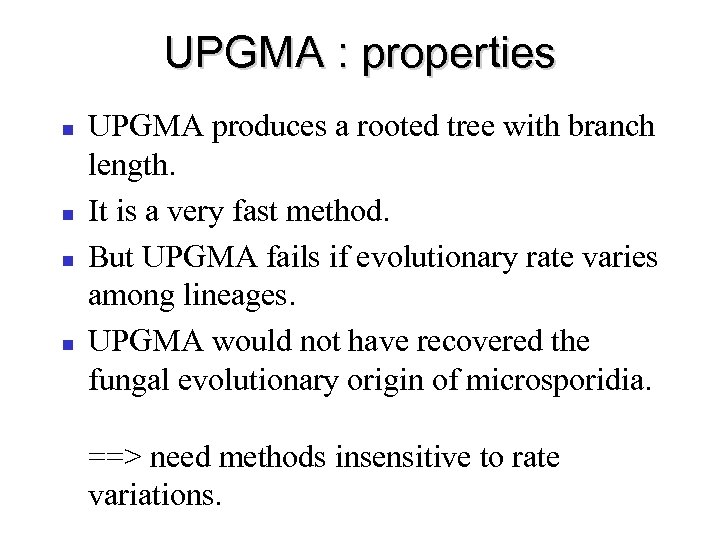 UPGMA : properties UPGMA produces a rooted tree with branch length. It is a very fast method. But UPGMA fails if evolutionary rate varies among lineages. UPGMA would not have recovered the fungal evolutionary origin of microsporidia. ==> need methods insensitive to rate variations.
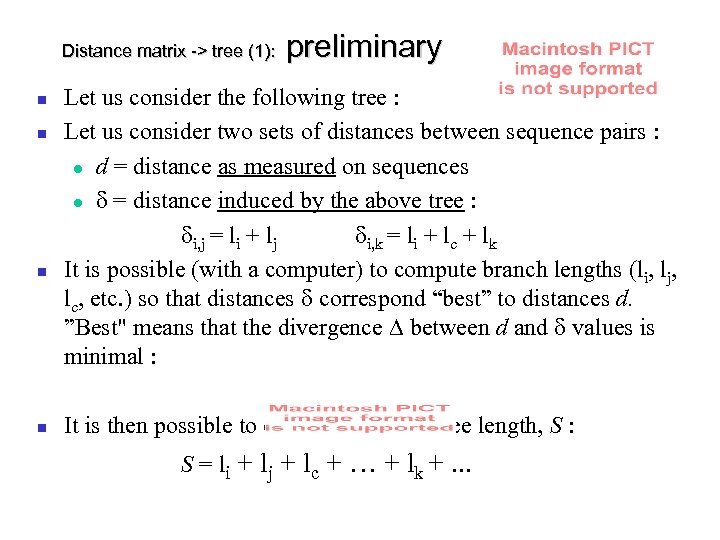 Distance matrix -> tree (1): preliminary Let us consider the following tree : Let us consider two sets of distances between sequence pairs : d = distance as measured on sequences d = distance induced by the above tree : di, j = li + lj di, k = li + lc + lk It is possible (with a computer) to compute branch lengths (li, lj, lc, etc. ) so that distances d correspond “best” to distances d. ”Best" means that the divergence D between d and d values is minimal : It is then possible to compute the total tree length, S : S = li + lj + lc + … + lk +. . .
 Distance matrix -> tree (2): The Minimum Evolution Method Step 1: for a given tree topology (shape), compute branch lengths that minimise D; compute tree length S. Step 2: repeat step 1 for all possible topologies. Keep the tree with smallest S value. Problem: this method is very computation intensive. It is practically not usable with more than ≈ 25 sequences. => approximate (heuristic) methods are used. Example: Neighbor-Joining.
 Distance matrix -> tree (3): The Neighbor-Joining Method: algorithm Start from a star - topology and progressively construct a tree as : Step 1: Use d distances measured between the N sequences Step 2: For all pairs i et j: consider the following tree topology, and compute Si, j , the sum of all “best” branch lengths. (Saitou and Nei have found a simple way to compute Si, j ). Step 3: Retain the pair (i, j) with smallest Si, j value. Group i and j in the tree. Saitou & Nei (1987) Mol. Biol. Evol. 4: 406
 Distance matrix -> tree (4): The Neighbor-Joining Method: algorithm (2) Step 4: Compute new distances d between N-1 objects: pair (i, j) and the N-2 remaining sequences. d(i, j), k = (di, k + dj, k) / 2 Step 5: Return to step 1 as long as N ≥ 4. When N = 3, an (unrooted) tree is obtained Example
 Distance matrix -> tree (5): The Neighbor-Joining Method (NJ): properties NJ is a fast method, even for hundreds of sequences. The NJ tree is an approximation of the minimum evolution tree (that whose total branch length is minimum). In that sense, the NJ method is very similar to parsimony because branch lengths represent substitutions. NJ produces always unrooted trees, that need to be rooted by the outgroup method. NJ always finds the correct tree if distances are tree-like. NJ performs well when substitution rates vary among lineages. Thus NJ should find the correct tree if distances are well estimated.
 Maximum likelihood methods (program fast. DNAml, Olsen & Felsenstein) Hypotheses The substitution process follows a probabilistic model whose mathematical expression, but not parameter values, is known a priori. Sites evolve independently from each other. All sites follow the same substitution process (some methods use a more realistic hypothesis). Substitution probabilities do not change with time on any tree branch. They may vary between branches.
 Maximum likelihood methods (1) Simple example : one - parameter substitution model : v = probability that a base changes per unit time (fast. DNAml uses a more elaborate model)
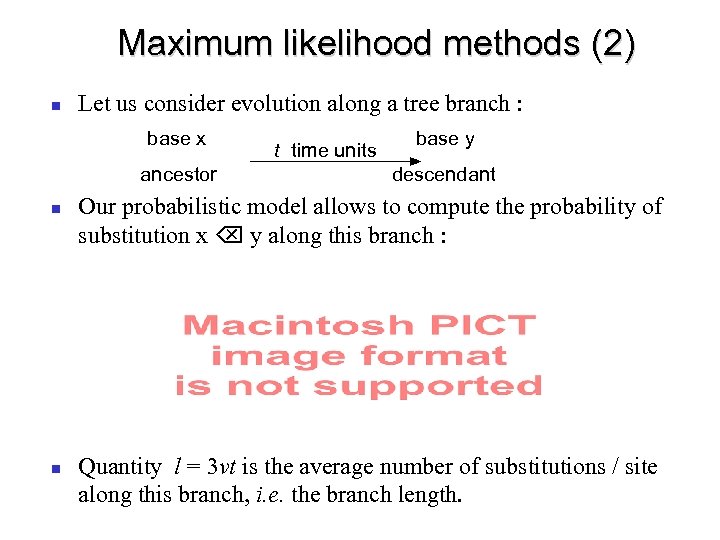 Maximum likelihood methods (2) Let us consider evolution along a tree branch : base x ancestor t time units base y descendant Our probabilistic model allows to compute the probability of substitution x y along this branch : Quantity l = 3 vt is the average number of substitutions / site along this branch, i. e. the branch length.
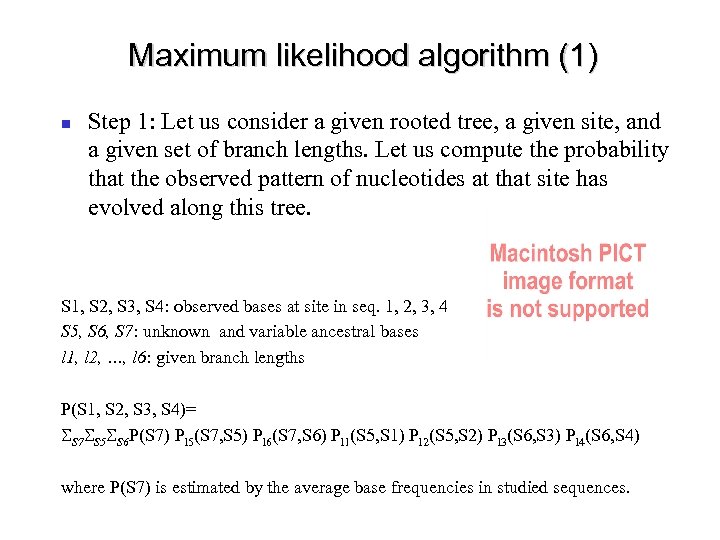 Maximum likelihood algorithm (1) Step 1: Let us consider a given rooted tree, a given site, and a given set of branch lengths. Let us compute the probability that the observed pattern of nucleotides at that site has evolved along this tree. S 1, S 2, S 3, S 4: observed bases at site in seq. 1, 2, 3, 4 S 5, S 6, S 7: unknown and variable ancestral bases l 1, l 2, …, l 6: given branch lengths P(S 1, S 2, S 3, S 4)= SS 7 SS 5 SS 6 P(S 7) Pl 5(S 7, S 5) Pl 6(S 7, S 6) Pl 1(S 5, S 1) Pl 2(S 5, S 2) Pl 3(S 6, S 3) Pl 4(S 6, S 4) where P(S 7) is estimated by the average base frequencies in studied sequences.
 Maximum likelihood algorithm (2) Step 2: Let us compute the probability that entire sequences have evolved : P(Sq 1, Sq 2, Sq 3, Sq 4) = Pall sites P(S 1, S 2, S 3, S 4) Step 2: Let us compute branch lengths l 1, l 2, …, l 6 that give the highest P(Sq 1, Sq 2, Sq 3, Sq 4) value. This is the likelihood of the tree. Step 3: Let us compute the likelihood of all possible trees. The tree predicted by the method is that having the highest likelihood.
 Maximum likelihood : properties This is the best justified method from a theoretical viewpoint. Sequence simulation experiments have shown that this method works better than all others in most cases. But it is a very computer-intensive method. It is nearly always impossible to evaluate all possible trees because there are too many. A partial exploration of the space of possible trees is done. The mathematical certainty of obtaining the most likely tree is lost.
 Reliability of phylogenetic trees: the bootstrap The phylogenetic information expressed by an unrooted tree resides entirely in its internal branches. The tree shape can be deduced from the list of its internal branches. Testing the reliability of a tree = testing the reliability of each internal branch.
 Bootstrap procedure The support of each internal branch is expressed as percent of replicates.
 "bootstrapped” tree
 Bootstrap procedure : properties Internal branches supported by ≥ 90% of replicates are considered as statistically significant. The bootstrap procedure only detects if sequence length is enough to support a particular node. The bootstrap procedure does not help determining if the tree-building method is good. A wrong tree can have 100 % bootstrap support for all its branches!
 Gene tree vs. Species tree The evolutionary history of genes reflects that of species that carry them, except if : horizontal transfer = gene transfer between species (e. g. bacteria, mitochondria) Gene duplication : orthology/ paralogy
 Orthology / Paralogy
 Reconstruction of species phylogeny: artefacts due to paralogy !! Gene loss can occur during evolution : even with complete genome sequences it may be difficult to detect paralogy !!
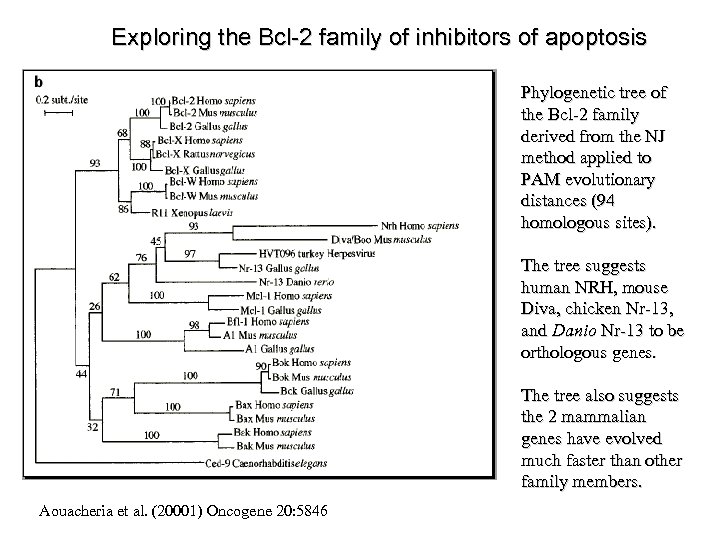 Exploring the Bcl-2 family of inhibitors of apoptosis Phylogenetic tree of the Bcl-2 family derived from the NJ method applied to PAM evolutionary distances (94 homologous sites). The tree suggests human NRH, mouse Diva, chicken Nr-13, and Danio Nr-13 to be orthologous genes. The tree also suggests the 2 mammalian genes have evolved much faster than other family members. Aouacheria et al. (20001) Oncogene 20: 5846
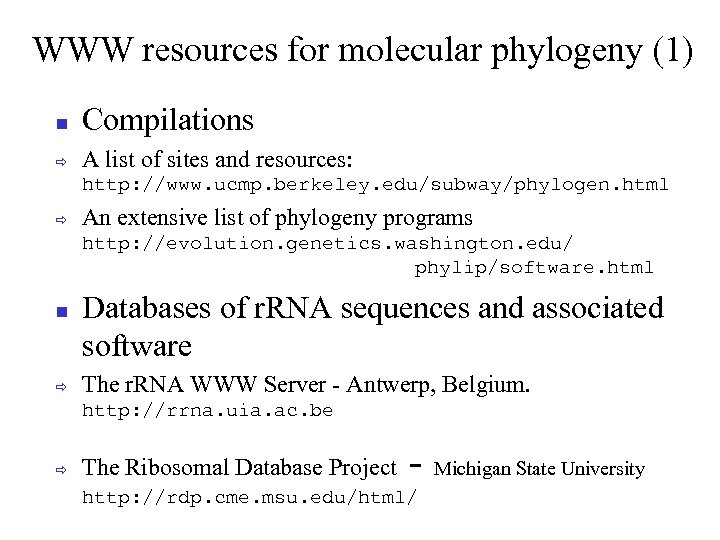 WWW resources for molecular phylogeny (1) Compilations ð A list of sites and resources: http: //www. ucmp. berkeley. edu/subway/phylogen. html ð An extensive list of phylogeny programs http: //evolution. genetics. washington. edu/ phylip/software. html ð Databases of r. RNA sequences and associated software The r. RNA WWW Server - Antwerp, Belgium. http: //rrna. uia. ac. be ð The Ribosomal Database Project - Michigan State University http: //rdp. cme. msu. edu/html/
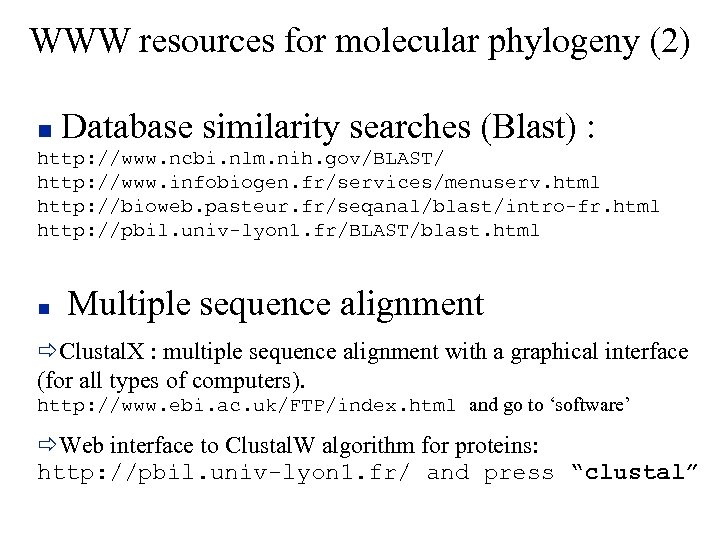 WWW resources for molecular phylogeny (2) Database similarity searches (Blast) : http: //www. ncbi. nlm. nih. gov/BLAST/ http: //www. infobiogen. fr/services/menuserv. html http: //bioweb. pasteur. fr/seqanal/blast/intro-fr. html http: //pbil. univ-lyon 1. fr/BLAST/blast. html Multiple sequence alignment ðClustal. X : multiple sequence alignment with a graphical interface (for all types of computers). http: //www. ebi. ac. uk/FTP/index. html and go to ‘software’ ðWeb interface to Clustal. W algorithm for proteins: http: //pbil. univ-lyon 1. fr/ and press “clustal”
 WWW resources for molecular phylogeny (3) Sequence alignment editor ð SEAVIEW : for windows and unix http: //pbil. univ-lyon 1. fr/software/seaview. html Programs for molecular phylogeny ð PHYLIP : an extensive package of programs for all platforms http: //evolution. genetics. washington. edu/phylip. html ð ð CLUSTALX : beyond alignment, it also performs NJ PAUP* : a very performing commercial package http: //paup. csit. fsu. edu/index. html ð PHYLO_WIN : a graphical interface, for unix only http: //pbil. univ-lyon 1. fr/software/phylowin. html ð WWW-interface at Institut Pasteur, Paris http: //bioweb. pasteur. fr/seqanal/phylogeny
 WWW resources for molecular phylogeny (4) Tree drawing NJPLOT (for all platforms) http: //pbil. univ-lyon 1. fr/software/njplot. html Lecture notes of molecular systematics http: //www. bioinf. org/molsys/lectures. html
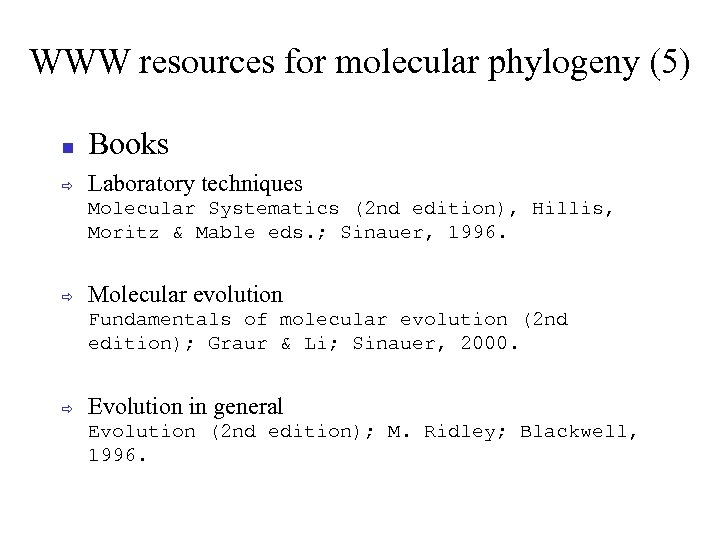 WWW resources for molecular phylogeny (5) Books ð Laboratory techniques Molecular Systematics (2 nd edition), Hillis, Moritz & Mable eds. ; Sinauer, 1996. ð Molecular evolution Fundamentals of molecular evolution (2 nd edition); Graur & Li; Sinauer, 2000. ð Evolution in general Evolution (2 nd edition); M. Ridley; Blackwell, 1996.