 Скачать презентацию Introduction to MODEM Building a Semantic Foundation for
c288d0f36d76996397b76edac1a43a7f.ppt
- Количество слайдов: 12



Introduction to MODEM Building a Semantic Foundation for EA: Reengineering the MODAF™ Meta-Model Based on the IDEAS Foundation Model Lt Col Mikael Hagenbo, Swedish Armed Forces Chairman IDEAS UK MOD Whitehall Main Building, 2012 -06 -21 HEADQUARTERS
Introduction • MODEM is a component of an enterprise architecture description framework that provides a vocabulary for describing an enterprise, its structure as well as its behaviour in a unified manner. • MODEM is an evolution of the metamodel definied by the Ministry of Defence in the UK called M 3. • The reengineering effort adds value since the semantics of the elements within the framework end up being defined properly, thereby enabling exchange of architecture models. • MODEM is based on work performed by the IDEAS group. HEADQUARTERS
MODEM is a descendent of work within the IDEAS group (International Defence Enterprise Architecture Specification) • 2005 -2009: Development of a Model (IDEAS Foundation) for Coalition Architecture Interoperability. • IDEAS is based on semantics in order to deal with semantic heterogeneity between the nations national Architecture Frameworks by the use of an approach based on Business Objects Reference Ontology (BORO)™ Methodology. • IDEAS Foundation has been exploited by US Do. D for DODAF 2. • MODEM (MODAF Ontological Data Exchange Model) is the result of a Swedish led effort within IDEAS aiming for an evolution of M 3 by exploiting the IDEAS foundation. HEADQUARTERS
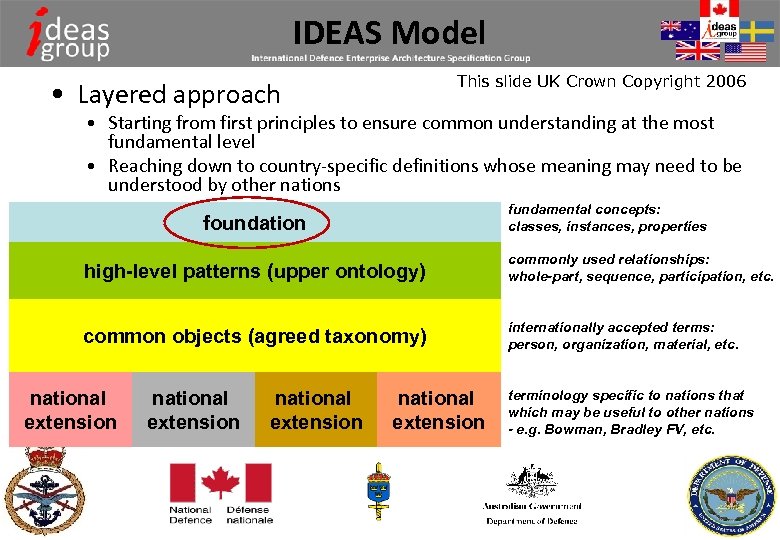
IDEAS Model This slide UK Crown Copyright 2006 • Layered approach • Starting from first principles to ensure common understanding at the most fundamental level • Reaching down to country-specific definitions whose meaning may need to be understood by other nations fundamental concepts: classes, instances, properties foundation high-level patterns (upper ontology) commonly used relationships: whole-part, sequence, participation, etc. common objects (agreed taxonomy) internationally accepted terms: person, organization, material, etc. national extension terminology specific to nations that which may be useful to other nations - e. g. Bowman, Bradley FV, etc.
The MODEM re-engineering aims to: • Harvest the relevant semantic features of UML and the MODAF meta-model and migrate them to MODEM, • Winnow out the irrelevant technical implementation features – particularly the constraints that were stove piping the UML meta-model and the MODAF meta-model built upon it, • Provide a clearer picture of the enterprise – one which reveals the common underlying business patterns across what previously appeared as very different areas, and • Provide a migration path for the existing MODAF models. HEADQUARTERS
Rationale on one slide • MODEM has been developed to be used by the tool vendors in order to create a means of unification, reusability and exchange of architectural artefacts between different tools, used by defence and industrial organisations to develop Enterprise Architecture. • MODEM is an evolution of M 3 based on IDEAS work. • MODEM will, together with the national architecture frameworks in the IDEAS nations, be a building block for a future common defence standard. • NATO is invited to make use of MODEM for NAF. • MODEM is not in any way defence specific and thus not limited to defence use only. HEADQUARTERS
Industry – a crucial partner for defence EA success • Interoperable tools and federated repository solutions are required for successful delivery of defence EA. • MODEM requires an industry agreed implementation profile that could be used for vendors developing software solutions. • Non-UML/Sys. ML tools and UML/Sys. ML tools are equal in importance because of different user categories. • There is a definitive requirement to be able to interoperate without loss of data or relations in the diagrams. • Please join forces and help us fulfil those requirements. • UPDM group is a successful model for industry cooperation. HEADQUARTERS
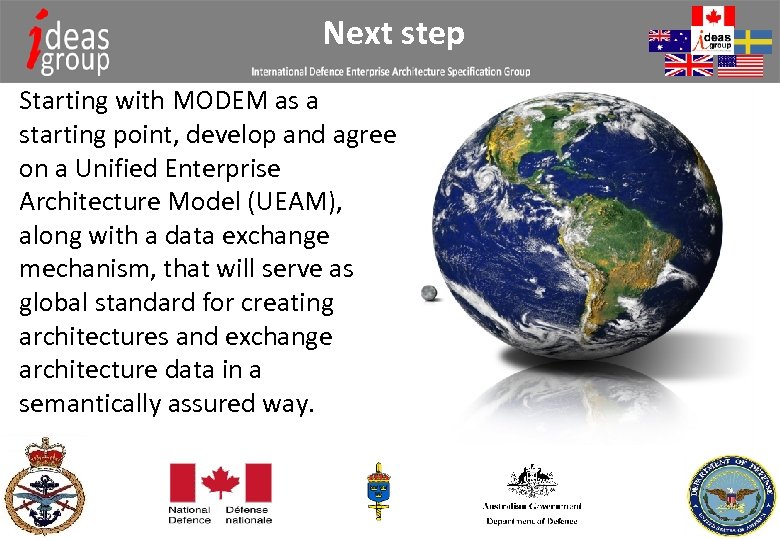
Next step Starting with MODEM as a starting point, develop and agree on a Unified Enterprise Architecture Model (UEAM), along with a data exchange mechanism, that will serve as global standard for creating architectures and exchange architecture data in a semantically assured way.
IDEAS Principal Agreement • Finalize the development and implementation of the International Defence Enterprise Architecture Specification (IDEAS) foundation v 1. 0 in to an Unified Enterprise Architecture Model (UEAM). • Use MODEM and DM 2 as starting points. • Capture unique Canadian government requirement like “security views” in the model. • Align with ISO/IEC 42010: 2011 AUSDAF
IDEAS Principal Agreement • NATO will be invited to make use of the UEAM for the NATO Architecture Framework (NAF). 4
IDEAS Principal Agreement • As a next step for IDEAS the aim is to harvest the knowledge captured in the current national Architecture Frameworks and the NATO Architecture Framework (NAF) and by doing so, expand the scope of the framework. • Invite France to join IDEAS.
IDEAS Principal Agreement • Expansion from only architecture descriptions to a wider scope (Unified Enterprise Architecture Framework (UEAF)) also comprehending: • Life Cycle principles (including methods, methodology, processes and so on), • Design principles (including design rules, reference architectures and so on) • and finally a “traditional” module for architecture descriptions where the UEAM as above as act as a common denominator.
Скачать презентацию Introduction to MODEM Building a Semantic Foundation for
c288d0f36d76996397b76edac1a43a7f.ppt