


 Скачать презентацию Introduction to Media Ethics Main Sources — Thiroux
media ethics.ppt
- Количество слайдов: 33
 Introduction to Media Ethics Main Sources: - Thiroux and Krasemann, Chapter 15 - ASNE (American Society of Newspaper Editors) Statement of Principles - RTNDA (Radio-Television News Directors) Code of Ethics and Professional Conduct àGive a look also to: - The New York Times Guidelines to Integrity -The New York Times Ethical Journalism Handbook - SPJ (Society of Professional Journalists) Code of Ethics
 Media Ethics Media’s ideal the ‘Communication of Truth’
 Media Ethics Elements or Values in Media Ethics (Patterson and Wilkins, 1991, Media Ethics: Issues and Cases, New York, William C. Brown): Dignity: leaving the subject as much self-respect as possible Reciprocity: treating others as you wish to be treated (positive restatement of the Golden Rule) Sufficiency: allocating adequate resources to important issues Accuracy: getting the facts correct, using the right words, and putting things in context Tenacity: knowing when a story is important enough to require additional effort, both personal and institutional Equity: seeking justice for all involved in controversial issues; treating all sources and subjects equally Community: valuing social cohesion equally with individual honor Diversity: covering all segments of the audience fairly and adequately
 Ethical contradictions include: Crime victim ID: The names of witnesses to and victims of a crime are public, and it may be perfectly legal to disclose them before a trial. But this could be highly unethical, since it exposes the witness to intimidation or worse. Even when a public trial is held, journalists usually withhold the names of juvenile offenders and rape victims even though they are matters of public record.
 Classified info: It may be illegal to publish certain “classified” (secret) information about a government agency’s mistakes, and yet there are cases where journalists go ahead and publish because they are following their ethical duty to serve as watchdogs on government (recent scandal with Merkel’s cell phone)
 Ads and body image: Some kinds of advertising may be perfectly legal and yet push social boundaries and images into ethically unacceptable directions. For example, the tendency to emphasize extremely thin and unhealthy body shapes for women is often considered unethical
 Ads and truthfulness: It may be illegal to fabricate information in advertising, yet social critics do it for reasons they believe are highly ethical, such as poking fun at tobacco advertising or the lack of corporate accountability on environmental issues.
 Media Ethics: 1. ASNE (American Society of Newspaper Editors) Statement of Principles ASNE's Statement of Principles was originally adopted in 1922 as the "Canons of Journalism. " The document was revised and renamed "Statement of Principles" in 1975. PREAMBLE. The First Amendment, protecting freedom of expression from abridgment by any law, guarantees to the people through their press a constitutional right, and thereby places on newspaper people a particular responsibility.
 Media Ethics: 1. ASNE (American Society of Newspaper Editors) Statement of Principles ARTICLE I - Responsibility. The primary purpose of gathering and distributing news and opinion is to serve the general welfare by informing the people and enabling them to make judgments on the issues of the time. Newspapermen and women who abuse the power of their professional role for selfish motives or unworthy purposes are faithless to that public trust. The American press was made free not just to inform or just to serve as a forum for debate but also to bring an independent scrutiny to bear on the forces of power in the society, including the conduct of official power at all levels of government. ARTICLE II - Freedom of the Press. Freedom of the press belongs to the people. It must be defended against encroachment or assault from any quarter, public or private. Journalists must be constantly alert to see that the public's business is conducted in public. They must be vigilant against all who would exploit the press for selfish purposes.
 Media Ethics: 1. ASNE (American Society of Newspaper Editors) Statement of Principles ARTICLE III - Independence. Journalists must avoid impropriety and the appearance of impropriety as well as any conflict of interest or the appearance of conflict. They should neither accept anything nor pursue any activity that might compromise or seem to compromise their integrity. ARTICLE IV - Truth and Accuracy. Good faith with the reader is the foundation of good journalism. Every effort must be made to assure that the news content is accurate, free from bias and in context, and that all sides are presented fairly. Editorials, analytical articles and commentary should be held to the same standards of accuracy with respect to facts as news reports. Significant errors of fact, as well as errors of omission, should be corrected promptly and prominently.
 Media Ethics: 1. ASNE (American Society of Newspaper Editors) Statement of Principles ARTICLE V - Impartiality. To be impartial does not require the press to be unquestioning or to refrain from editorial expression. Sound practice, however, demands a clear distinction for the reader between news reports and opinion. Articles that contain opinion or personal interpretation should be clearly identified. ARTICLE VI - Fair Play. Journalists should respect the rights of people involved in the news, observe the common standards of decency and stand accountable to the public for the fairness and accuracy of their news reports. Persons publicly accused should be given the earliest opportunity to respond. Pledges of confidentiality to news sources must be honored at all costs, and therefore should not be given lightly. Unless there is clear and pressing need to maintain confidences, sources of information should be identified.
 Media Ethics: 2. RTNDA (Radio-Television News Directors) Code of Ethics and Professional Conduct PUBLIC TRUST: Professional electronic journalists should recognize that their first obligation is to the public. Professional electronic journalists should: • Understand that any commitment other than service to the public undermines trust and credibility. • Recognize that service in the public interest creates an obligation to reflect the diversity of the community and guard against oversimplification of issues or events. • Provide a full range of information to enable the public to make enlightened decisions. • Fight to ensure that the public's business is conducted in public.
 Media Ethics: 2. RTNDA (Radio-Television News Directors) Code of Ethics and Professional Conduct TRUTH: Professional electronic journalists should pursue truth aggressively and present the news accurately, in context, and as completely as possible. Professional electronic journalists should: • Continuously seek the truth. • Resist distortions that obscure the importance of events. • Clearly disclose the origin of information and label all material provided by outsiders. Professional electronic journalists should not: • Report anything known to be false. • Manipulate images or sounds in any way that is misleading. • Plagiarize. • Present images or sounds that are reenacted without informing the public.
 Media Ethics: 2. RTNDA (Radio-Television News Directors) Code of Ethics and Professional Conduct FAIRNESS: Professional electronic journalists should present the news fairly and impartially, placing primary value on significance and relevance. Professional electronic journalists should: • Treat all subjects of news coverage with respect and dignity, showing particular compassion to victims of crime or tragedy. • Exercise special care when children are involved in a story and give children greater privacy protection than adults. • Seek to understand the diversity of their community and inform the public without bias or stereotype. • Present a diversity of expressions, opinions, and ideas in context. • Present analytical reporting based on professional perspective, not personal bias. • Respect the right to a fair trial.
 Media Ethics: 2. RTNDA (Radio-Television News Directors) Code of Ethics and Professional Conduct INTEGRITY: Professional electronic journalists should present the news with integrity and decency, avoiding real or perceived conflicts of interest, and respect the dignity and intelligence of the audience as well as the subjects of news. Professional electronic journalists should not: • Pay news sources who have a vested interest in a story. • Accept gifts, favors, or compensation from those who might seek to influence coverage. • Engage in activities that may compromise their integrity or independence.
 Media Ethics: 2. RTNDA (Radio-Television News Directors) Code of Ethics and Professional Conduct INTEGRITY Professional electronic journalists should: • Identify sources whenever possible. Confidential sources should be used only when it is clearly in the public interest to gather or convey important information or when a person providing information might be harmed. Journalists should keep all commitments to protect a confidential source. • Clearly label opinion and commentary. • Guard against extended coverage of events or individuals that fails to significantly advance a story, place the event in context, or add to the public knowledge. • Refrain from contacting participants in violent situations while the situation is in progress. • Use technological tools with skill and thoughtfulness, avoiding techniques that skew facts, distort reality, or sensationalize events. • Use surreptitious newsgathering techniques, including hidden cameras or microphones, only if there is no other way to obtain stories of significant public importance and only if the technique is explained to the audience. • Disseminate the private transmissions of other news organizations only with permission.
 Media Ethics: 2. RTNDA (Radio-Television News Directors) Code of Ethics and Professional Conduct INDEPENDENCE: Professional electronic journalists should defend the independence of all journalists from those seeking influence or control over news content. Professional electronic journalists should: • Gather and report news without fear or favor, and vigorously resist undue influence from any outside forces, including advertisers, sources, story subjects, powerful individuals, and special interest groups. • Resist those who would seek to buy or politically influence news content or who would seek to intimidate those who gather and disseminate the news • Determine news content solely through editorial judgment and not as the result of outside influence. • Resist any self-interest or peer pressure that might erode journalistic duty and service to the public. • Recognize that sponsorship of the news will not be used in any way to determine, restrict, or manipulate content. • Refuse to allow the interests of ownership or management to influence news judgment and content inappropriately. • Defend the rights of the free press for all journalists, recognizing that any professional or government licensing of journalists is a violation of that freedom.
 Media Ethics: 2. RTNDA (Radio-Television News Directors) Code of Ethics and Professional Conduct ACCOUNTABILITY: Professional electronic journalists should recognize that they are accountable for their actions to the public, the profession, and themselves. Professional electronic journalists should: • Actively encourage adherence to these standards by all journalists and their employers. • Respond to public concerns. Investigate complaints and correct errors promptly and with as much prominence as the original report. • Explain journalistic processes to the public, especially when practices spark questions or controversy. • Recognize that professional electronic journalists are duty-bound to conduct themselves ethically. • Refrain from ordering or encouraging courses of action that would force employees to commit an unethical act. • Carefully listen to employees who raise ethical objections and create environments in which such objections and discussions are encouraged. • Seek support for and provide opportunities to train employees in ethical decision-making.
 An Example: THE MEDIA AND TERRORISM Wilkinson, Chapter 9 Hoffman, Chapter 5 Griset, Chapter 4
 THE MEDIA AND TERRORISM
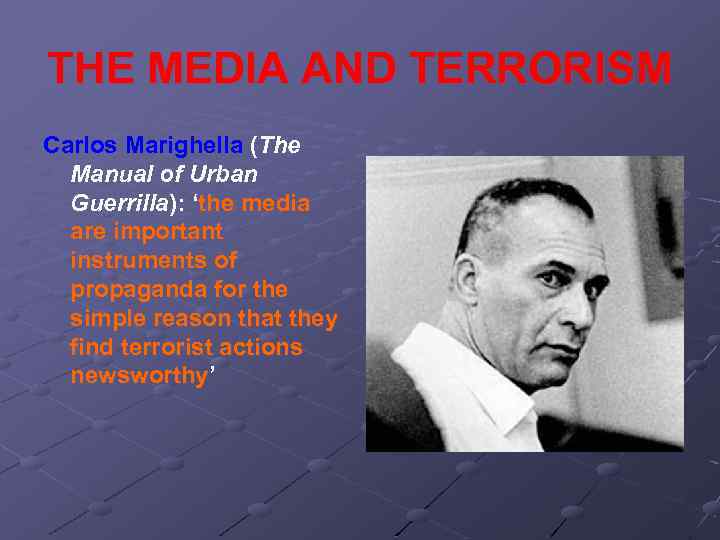 THE MEDIA AND TERRORISM Carlos Marighella (The Manual of Urban Guerrilla): ‘the media are important instruments of propaganda for the simple reason that they find terrorist actions newsworthy’
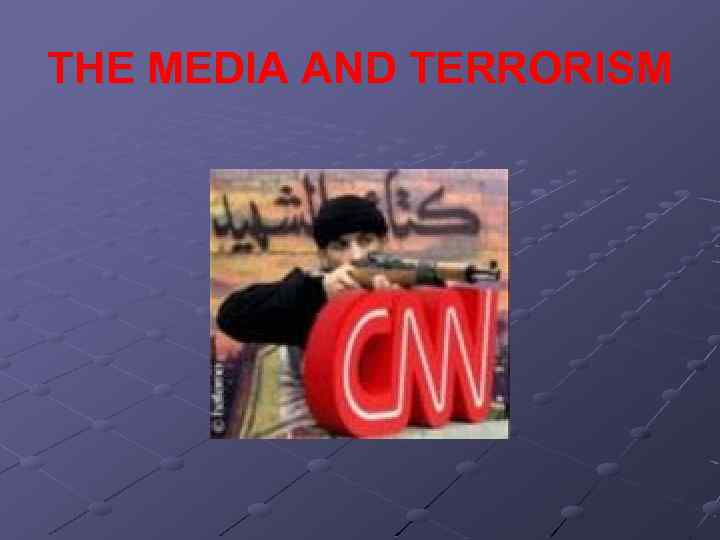
 THE MEDIA AND TERRORISM Modern mass media are not the prime underlying cause of terrorism: word of mouth in sacred temples and marketplaces worked as well BUT there is certainly a relationship of mutual benefit between terrorists and mass media - Terrorists want prime time audience and worldwide publicity - Mass media find in terrorism an endless source of sensational news stories
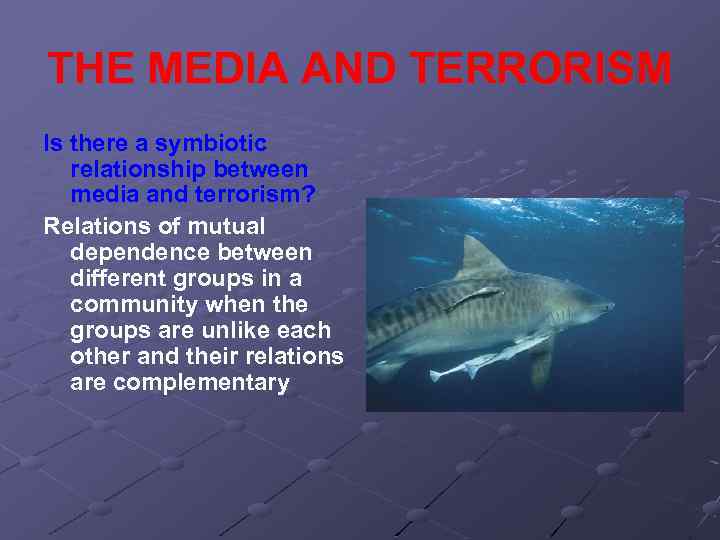 THE MEDIA AND TERRORISM Is there a symbiotic relationship between media and terrorism? Relations of mutual dependence between different groups in a community when the groups are unlike each other and their relations are complementary
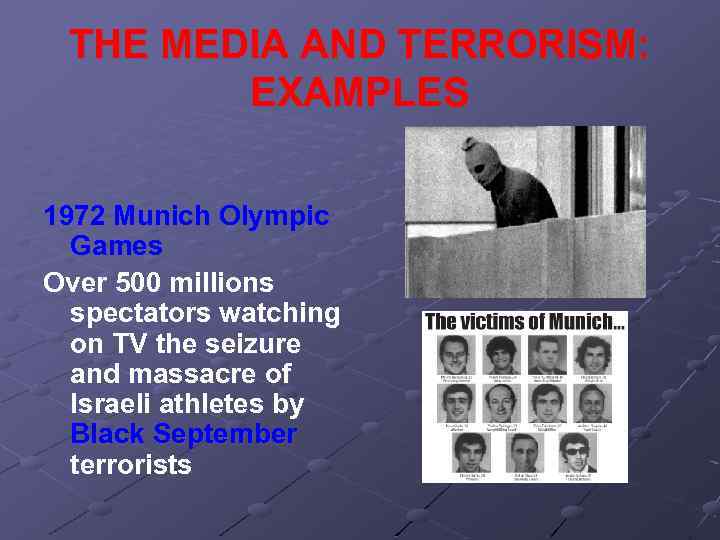 THE MEDIA AND TERRORISM: EXAMPLES 1972 Munich Olympic Games Over 500 millions spectators watching on TV the seizure and massacre of Israeli athletes by Black September terrorists
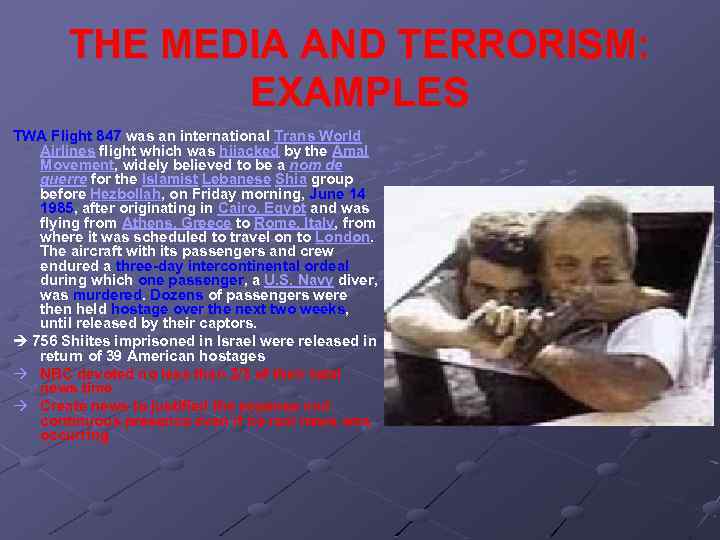 THE MEDIA AND TERRORISM: EXAMPLES TWA Flight 847 was an international Trans World Airlines flight which was hijacked by the Amal Movement, widely believed to be a nom de guerre for the Islamist Lebanese Shia group before Hezbollah, on Friday morning, June 14 1985, after originating in Cairo, Egypt and was flying from Athens, Greece to Rome, Italy, from where it was scheduled to travel on to London. The aircraft with its passengers and crew endured a three-day intercontinental ordeal during which one passenger, a U. S. Navy diver, was murdered. Dozens of passengers were then held hostage over the next two weeks, until released by their captors. 756 Shiites imprisoned in Israel were released in return of 39 American hostages à NBC devoted no less than 2/3 of their total news time à Create news to justified the expense and continuous presence even if no real news was occurring
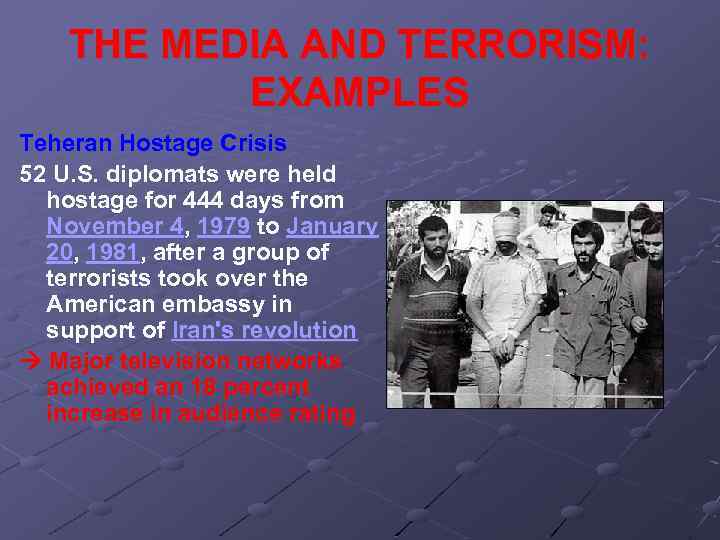 THE MEDIA AND TERRORISM: EXAMPLES Teheran Hostage Crisis 52 U. S. diplomats were held hostage for 444 days from November 4, 1979 to January 20, 1981, after a group of terrorists took over the American embassy in support of Iran's revolution Major television networks achieved an 18 percent increase in audience rating
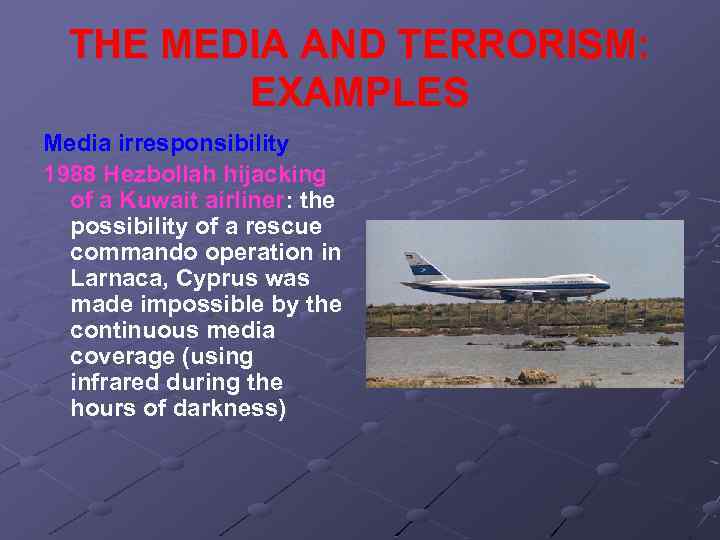 THE MEDIA AND TERRORISM: EXAMPLES Media irresponsibility 1988 Hezbollah hijacking of a Kuwait airliner: the possibility of a rescue commando operation in Larnaca, Cyprus was made impossible by the continuous media coverage (using infrared during the hours of darkness)
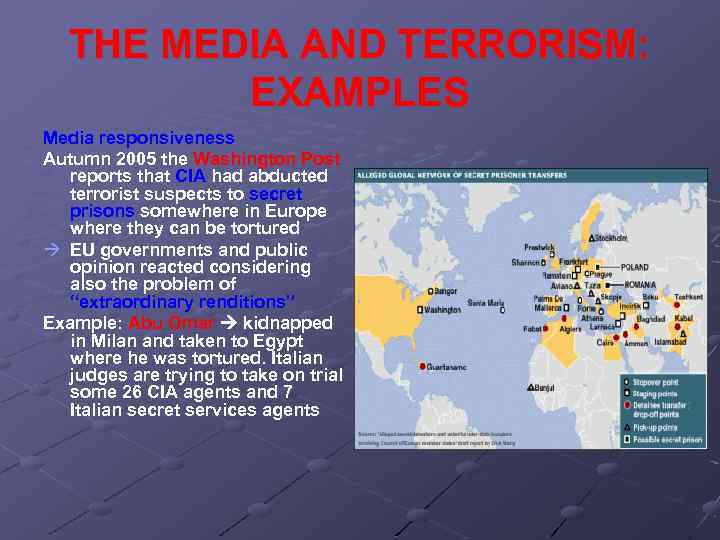 THE MEDIA AND TERRORISM: EXAMPLES Media responsiveness Autumn 2005 the Washington Post reports that CIA had abducted terrorist suspects to secret prisons somewhere in Europe where they can be tortured à EU governments and public opinion reacted considering also the problem of “extraordinary renditions” Example: Abu Omar kidnapped in Milan and taken to Egypt where he was tortured. Italian judges are trying to take on trial some 26 CIA agents and 7 Italian secret services agents
 THE MEDIA AND TERRORISM: MEDIA’S REPORT (Descriptive) Four traditions of reporting related to terrorist events: 1) Information: factual and reliably documented 2) Sensationalist: coverage includes emotions, alarm, threat, anger, and fear 3) Feature stories: the focus is on individuals as heroes, villains, victims, and perpetrators 4) Didactic: educating the public
 THE MEDIA AND TERRORISM: MEDIA’S REPORT (Descriptive) - Competition between networks and scoops: 1) Being the first on the scene 2) Being the first to report undisclosed information - Hold attention: from ‘hard news’ to ‘human-interest-type’ (for example, the grief and anguish of family and friends of terrorist victims and/or hostages)
 THE MEDIA AND TERRORISM: GOVERNMENT - Coverage to advance their agenda and not that of terrorists (for example, focus on non-state terrorism) - Separate terrorists from the media - Have the media present terrorists as criminals - In hostage situations to provide information to authorities - Keeping the public reasonably calm - Control terrorist access to outside data and not to reveal planned or current anti-terrorist actions - To boost the image of government agencies
 THE MEDIA AND TERRORISM: PROBLEMS 1) Impact on public perception of personal risk from terrorism: effect on the willingness to travel (for example, after the TWA hijacking 850, 000 persons cancelled their travel and holiday reservations; an additional 200, 000 Americans rebooked their foreign holydays to US destinations 2) Time pressures on the government: the ‘CNN Syndrome’ not just an ‘opinion shaper’, but a ‘policy driver’ 3) Providing legitimacy
 THE MEDIA AND TERRORISM: OPTIONS 1) 2) 3) Laissez-faire Media censorship of statutory regulations Media voluntary self-restraint The underlying problem: Free speech VS (Governmental? ) Censorship Notice: media cooperation with law enforcement in support of government is more likely than media cooperation with terrorist aims.