


 Скачать презентацию Introduction to LOINC and RELMA PHIN Conference
96ea477f205c724faf817ec11b6438aa.ppt
- Количество слайдов: 52
 Introduction to LOINC and RELMA PHIN Conference – August 2008 James T. Case MS, DVM, Ph. D Professor, Clinical Diagnostic Informatics California Animal Health and Food Safety Laboratory University of California, Davis
 Acknowledgements • RELMA Development Team • • • John Hook, Mark Fisher, Ryan Phillips, Karen Ahmad, and more! Kathy Mercer Clem Mc. Donald Dan Vreeman The Lab LOINC Committee Funding Support • NLM, Regenstrief Institute, NCI, CDC © 2008 Regenstrief Institute and James Case
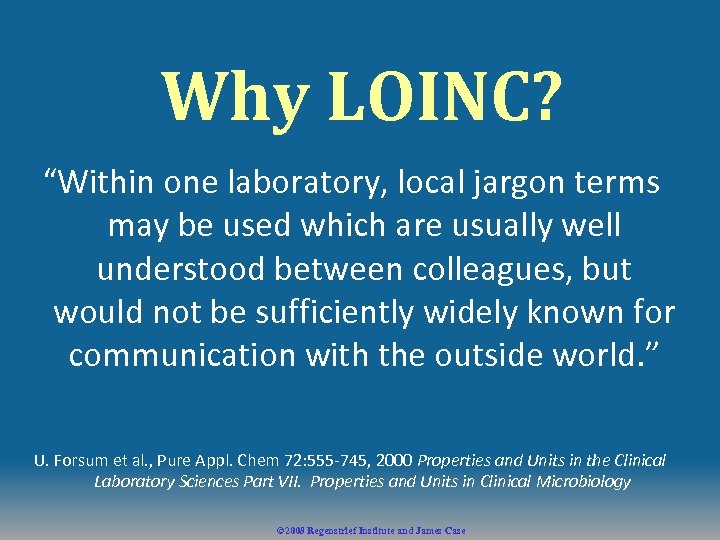 Why LOINC? “Within one laboratory, local jargon terms may be used which are usually well understood between colleagues, but would not be sufficiently widely known for communication with the outside world. ” U. Forsum et al. , Pure Appl. Chem 72: 555 -745, 2000 Properties and Units in the Clinical Laboratory Sciences Part VII. Properties and Units in Clinical Microbiology © 2008 Regenstrief Institute and James Case
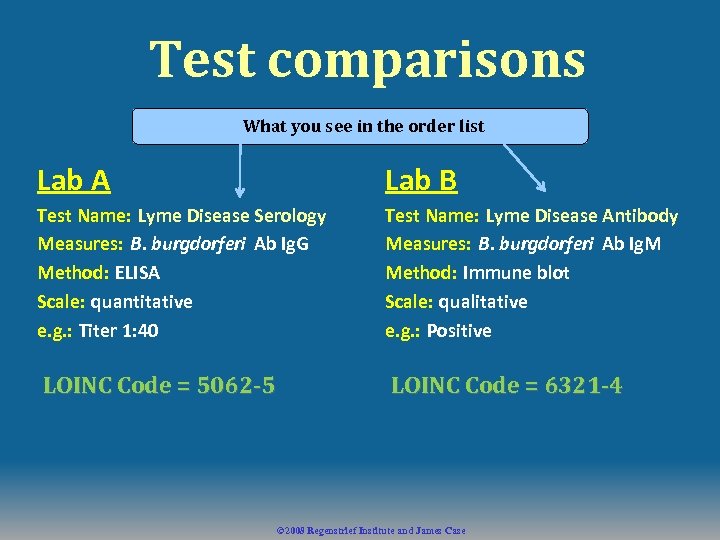 Test comparisons What you see in the order list Lab A Lab B Test Name: Lyme Disease Serology Measures: B. burgdorferi Ab Ig. G Method: ELISA Scale: quantitative e. g. : Titer 1: 40 Test Name: Lyme Disease Antibody Measures: B. burgdorferi Ab Ig. M Method: Immune blot Scale: qualitative e. g. : Positive LOINC Code = 5062 -5 LOINC Code = 6321 -4 © 2008 Regenstrief Institute and James Case
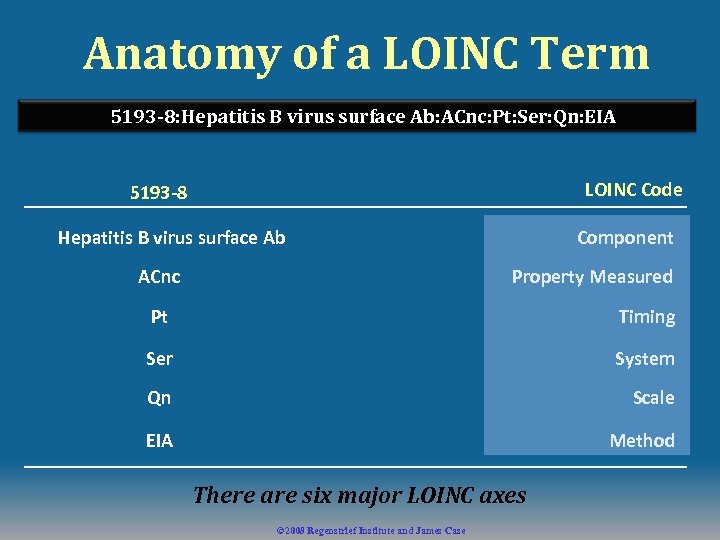 Anatomy of a LOINC Term 5193 -8: Hepatitis B virus surface Ab: ACnc: Pt: Ser: Qn: EIA LOINC Code 5193 -8 Hepatitis B virus surface Ab ACnc Component Property Measured Pt Timing Ser System Qn Scale EIA Method There are six major LOINC axes © 2008 Regenstrief Institute and James Case
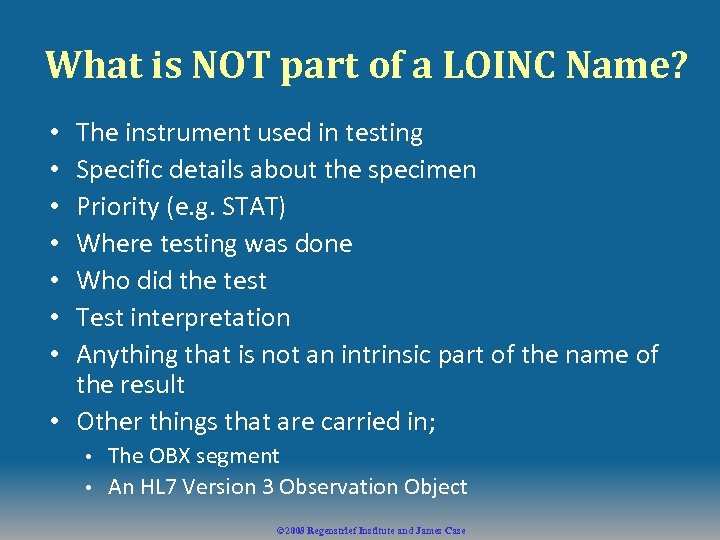 What is NOT part of a LOINC Name? The instrument used in testing Specific details about the specimen Priority (e. g. STAT) Where testing was done Who did the test Test interpretation Anything that is not an intrinsic part of the name of the result • Other things that are carried in; • • • The OBX segment An HL 7 Version 3 Observation Object © 2008 Regenstrief Institute and James Case
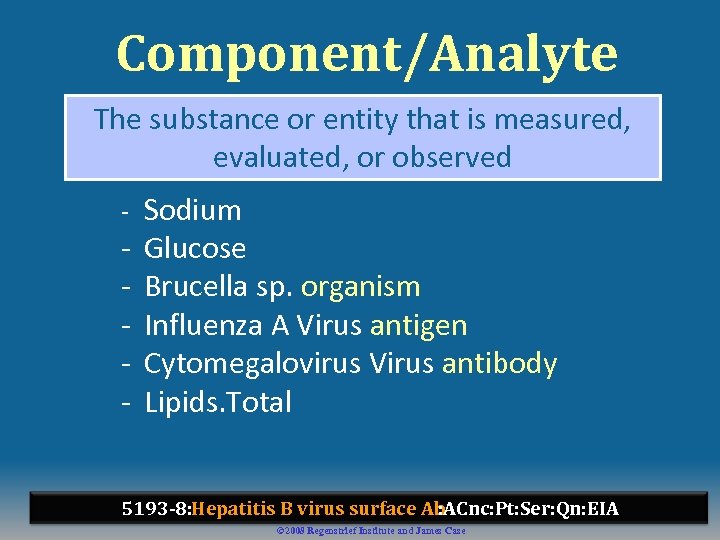 Component/Analyte The substance or entity that is measured, evaluated, or observed - - Sodium Glucose Brucella sp. organism Influenza A Virus antigen Cytomegalovirus Virus antibody Lipids. Total 5193 -8: Hepatitis B virus surface Ab : ACnc: Pt: Ser: Qn: EIA © 2008 Regenstrief Institute and James Case
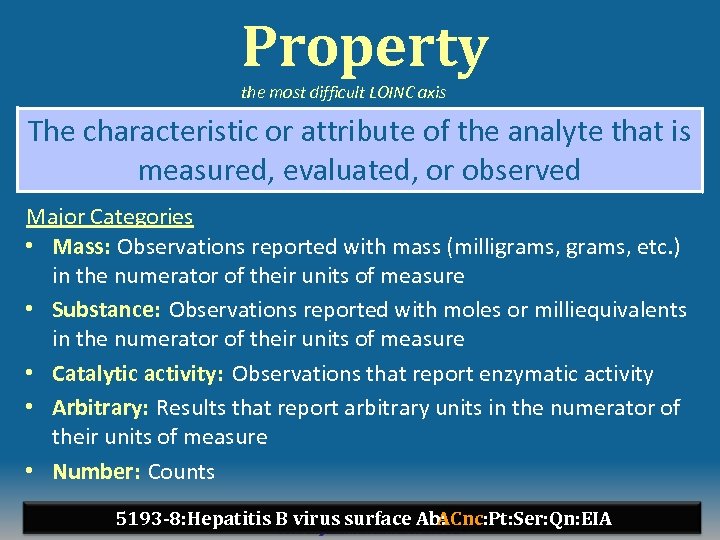 Property the most difficult LOINC axis The characteristic or attribute of the analyte that is measured, evaluated, or observed Major Categories • Mass: Observations reported with mass (milligrams, etc. ) in the numerator of their units of measure • Substance: Observations reported with moles or milliequivalents in the numerator of their units of measure • Catalytic activity: Observations that report enzymatic activity • Arbitrary: Results that report arbitrary units in the numerator of their units of measure • Number: Counts 5193 -8: Hepatitis B virus surface James Case Ab: ACnc: Pt: Ser: Qn: EIA © 2008 Regenstrief Institute and
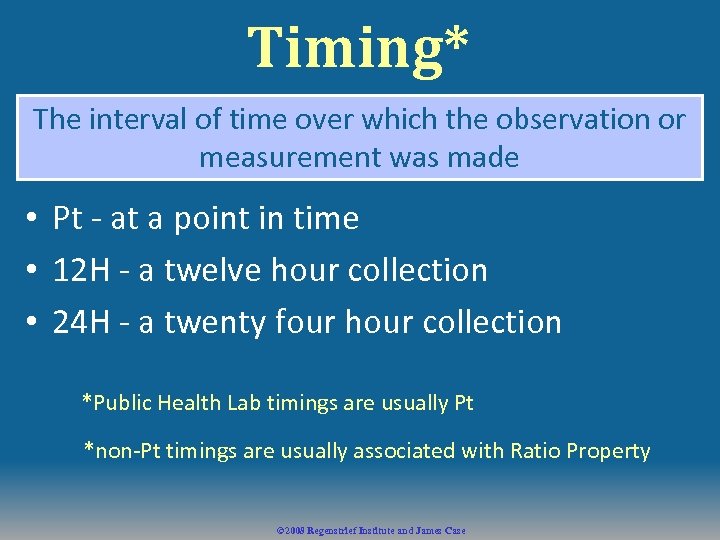 Timing* The interval of time over which the observation or measurement was made • Pt - at a point in time • 12 H - a twelve hour collection • 24 H - a twenty four hour collection *Public Health Lab timings are usually Pt *non-Pt timings are usually associated with Ratio Property © 2008 Regenstrief Institute and James Case
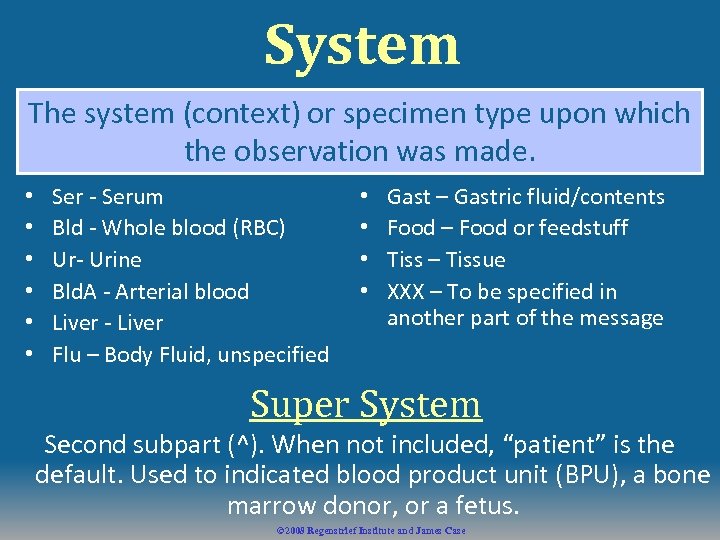 System The system (context) or specimen type upon which the observation was made. • • • Ser - Serum Bld - Whole blood (RBC) Ur- Urine Bld. A - Arterial blood Liver - Liver Flu – Body Fluid, unspecified • • Gast – Gastric fluid/contents Food – Food or feedstuff Tiss – Tissue XXX – To be specified in another part of the message Super System Second subpart (^). When not included, “patient” is the default. Used to indicated blood product unit (BPU), a bone marrow donor, or a fetus. © 2008 Regenstrief Institute and James Case
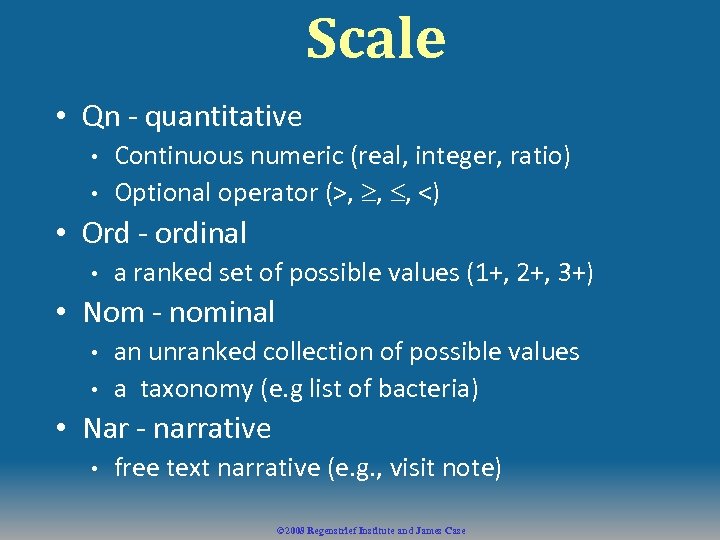 Scale • Qn - quantitative • • Continuous numeric (real, integer, ratio) Optional operator (>, , , <) • Ord - ordinal • a ranked set of possible values (1+, 2+, 3+) • Nom - nominal • • an unranked collection of possible values a taxonomy (e. g list of bacteria) • Nar - narrative • free text narrative (e. g. , visit note) © 2008 Regenstrief Institute and James Case
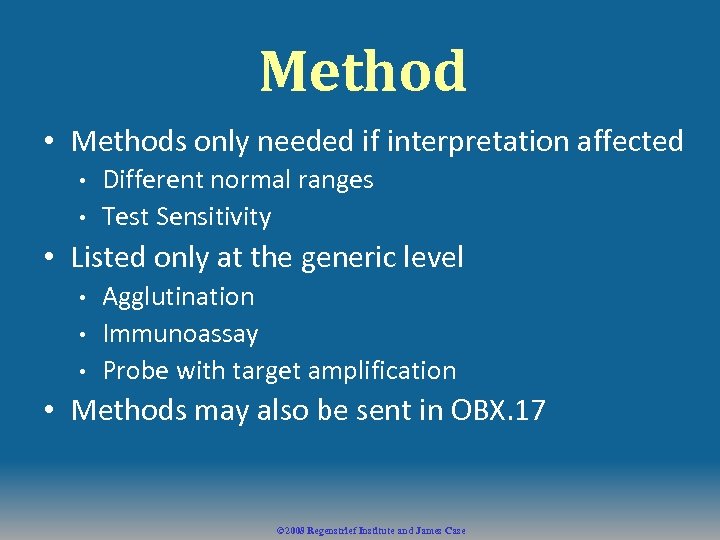 Method • Methods only needed if interpretation affected • • Different normal ranges Test Sensitivity • Listed only at the generic level • • • Agglutination Immunoassay Probe with target amplification • Methods may also be sent in OBX. 17 © 2008 Regenstrief Institute and James Case
 Mapping Terms to LOINC Things to Remember • The thing ordered is not always the thing measured: • • • Blood Culture – live organism(s) identified VDRL – Treponema pallidum Ab Urinalysis – lots of different things • The question (what am I measuring? ) is not the answer (e. g. Pos) • You are mapping the question, not the answer! • You must know the specifics of the component being tested for (what is this test actually measuring? ) © 2008 Regenstrief Institute and James Case
 ® RELMA Regenstrief LOINC Mapping Assistant
 RELMA Functions • • Manual and automated mapping assistant Same free use as LOINC (see license) Comes with the LOINC files and indexes RELMA tools transform local words in local file • User creates file of local term/name and codes • Assigns LOINC term to local test/battery code © 2008 Regenstrief Institute and James Case
 © 2008 Regenstrief Institute and James Case
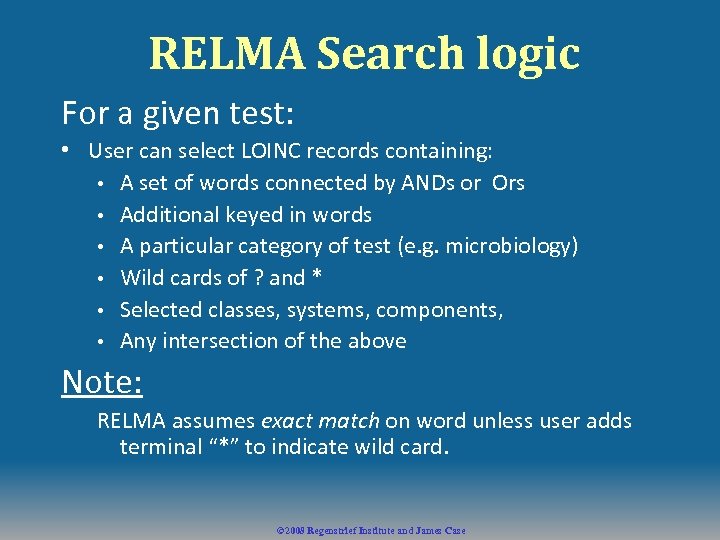 RELMA Search logic For a given test: • User can select LOINC records containing: • A set of words connected by ANDs or Ors • Additional keyed in words • A particular category of test (e. g. microbiology) • Wild cards of ? and * • Selected classes, systems, components, • Any intersection of the above Note: RELMA assumes exact match on word unless user adds terminal “*” to indicate wild card. © 2008 Regenstrief Institute and James Case
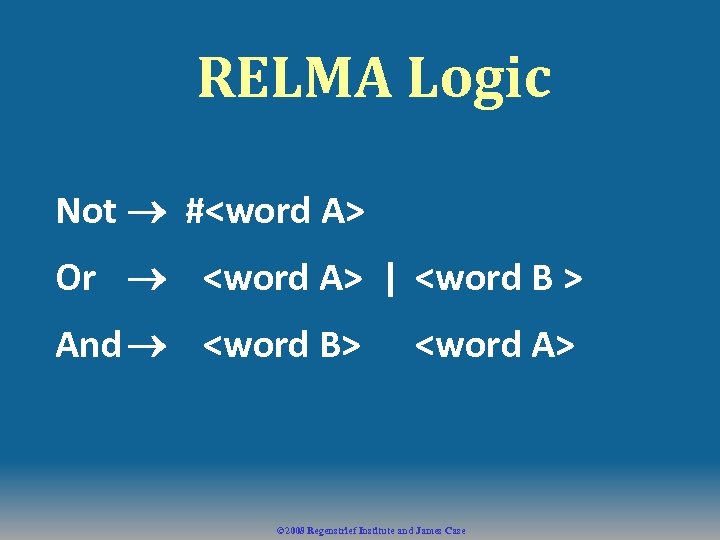 RELMA Logic Not #
 Importing Local Terms into RELMA © 2008 Regenstrief Institute and James Case
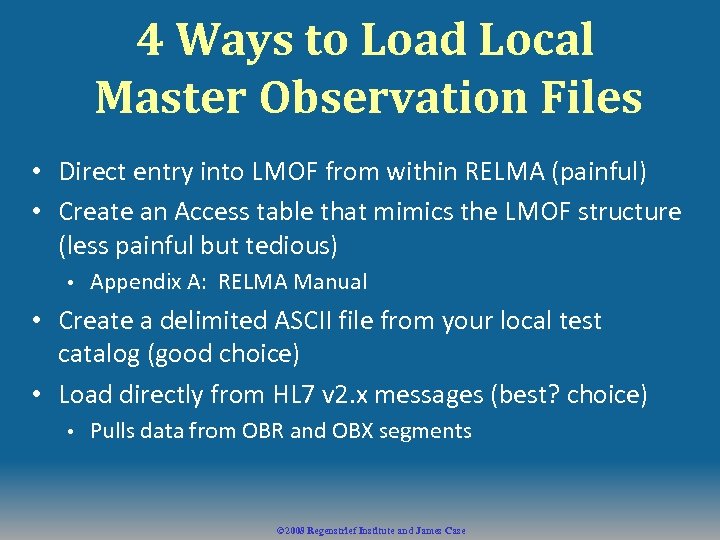 4 Ways to Load Local Master Observation Files • Direct entry into LMOF from within RELMA (painful) • Create an Access table that mimics the LMOF structure (less painful but tedious) • Appendix A: RELMA Manual • Create a delimited ASCII file from your local test catalog (good choice) • Load directly from HL 7 v 2. x messages (best? choice) • Pulls data from OBR and OBX segments © 2008 Regenstrief Institute and James Case
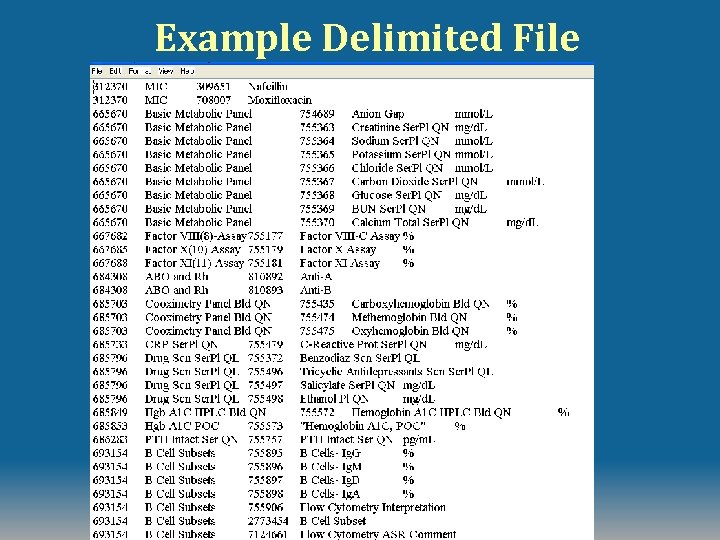 Example Delimited File © 2008 Regenstrief Institute and James Case
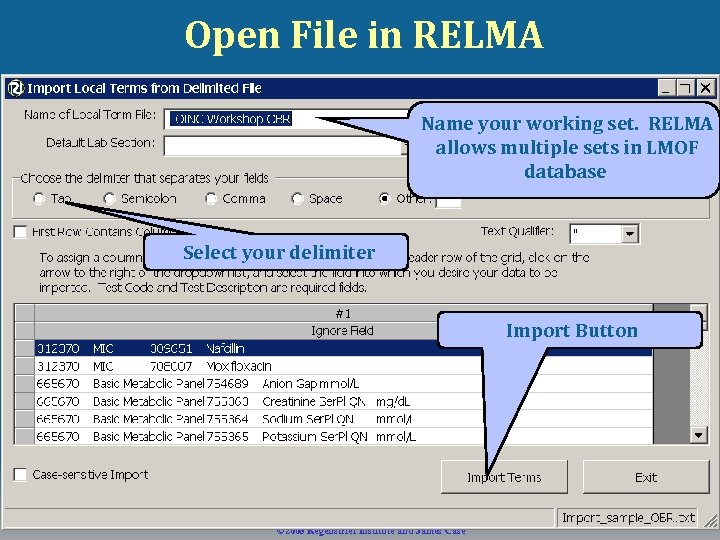 Open File in RELMA Name your working set. RELMA allows multiple sets in LMOF database Select your delimiter Import Button © 2008 Regenstrief Institute and James Case
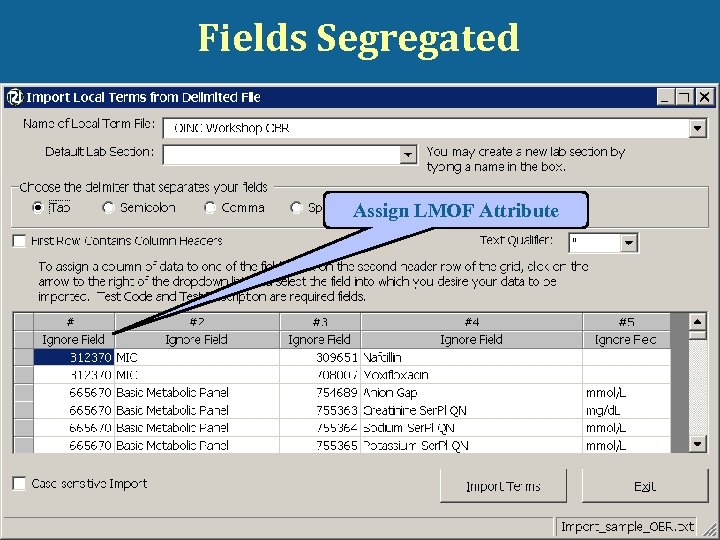 Fields Segregated Assign LMOF Attribute © 2008 Regenstrief Institute and James Case
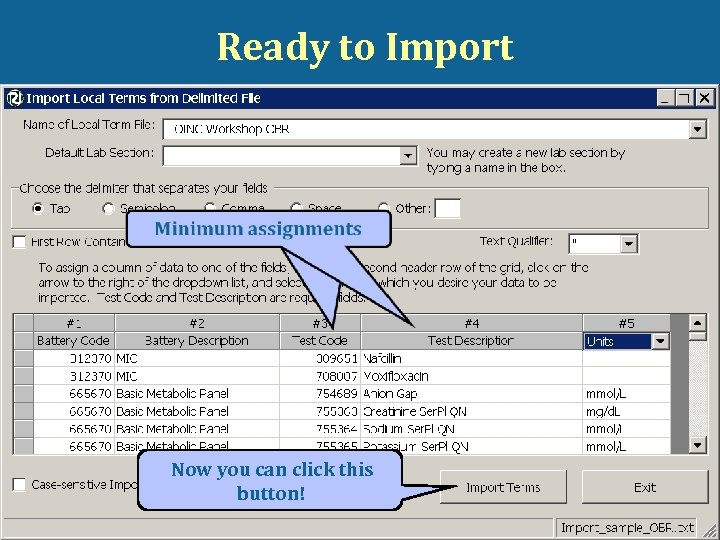 Ready to Import Now you can click this button! © 2008 Regenstrief Institute and James Case
 Alternative (best) Way • Use large set of HL 7 messages • Automatically make dataset of: • • • OBR ID OBR description OBX ID OBX description Sample of results with • • Real values Units Abnormal flags Normal ranges © 2008 Regenstrief Institute and James Case
 Preparing your Data for Mapping • Improve mapping success by: • • Expanding abbreviations Standardizing colloquial terms Ignoring “administrative” terms Standardizing time references • Can be done prior to importing • Better to use tools built into RELMA © 2008 Regenstrief Institute and James Case
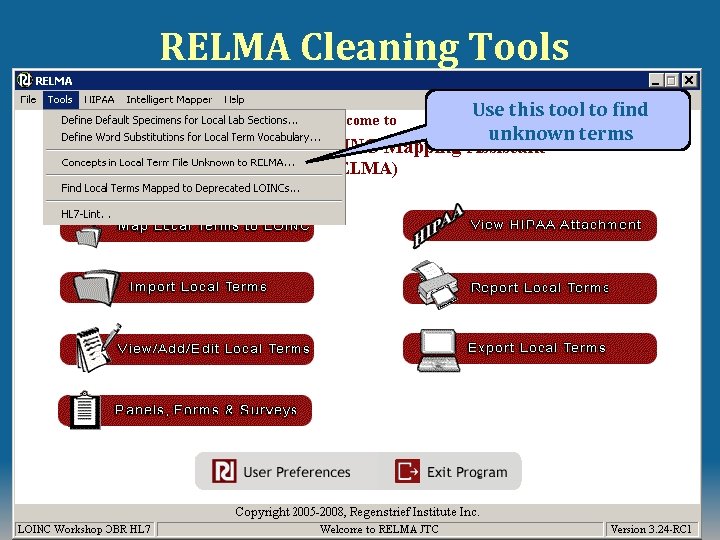 RELMA Cleaning Tools Use this tool to find unknown terms © 2008 Regenstrief Institute and James Case
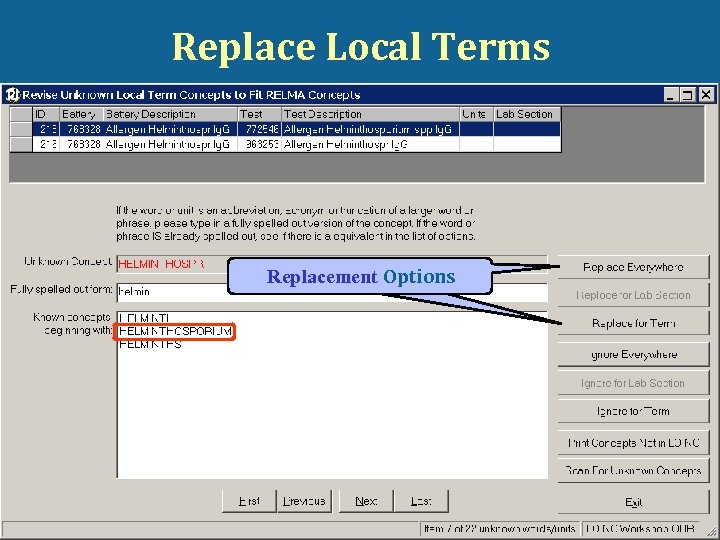 Replace Local Terms Replacement Options Assign LMOF Attribute © 2008 Regenstrief Institute and James Case
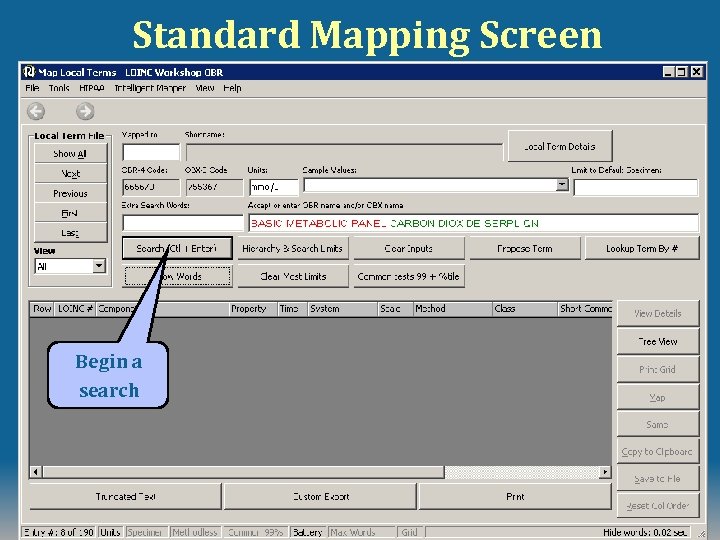 Standard Mapping Screen Begin a search © 2008 Regenstrief Institute and James Case
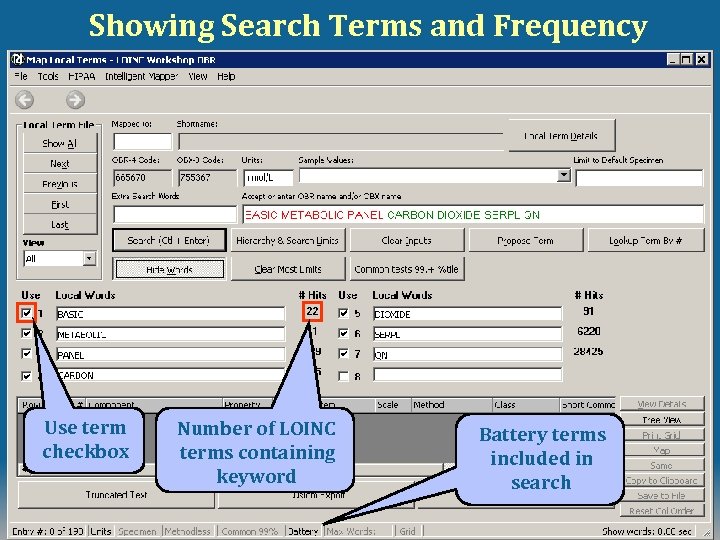 Showing Search Terms and Frequency Use term checkbox Number of LOINC terms containing keyword © 2008 Regenstrief Institute and James Case Battery terms included in search
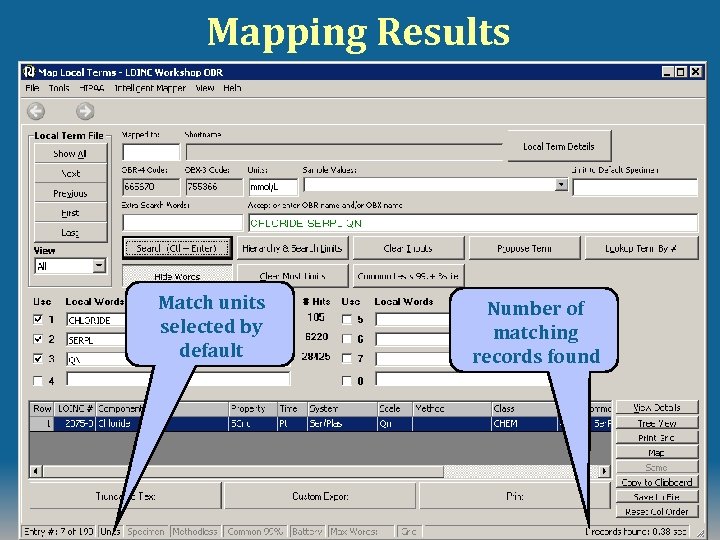 Mapping Results Match units selected by default Number of matching records found © 2008 Regenstrief Institute and James Case
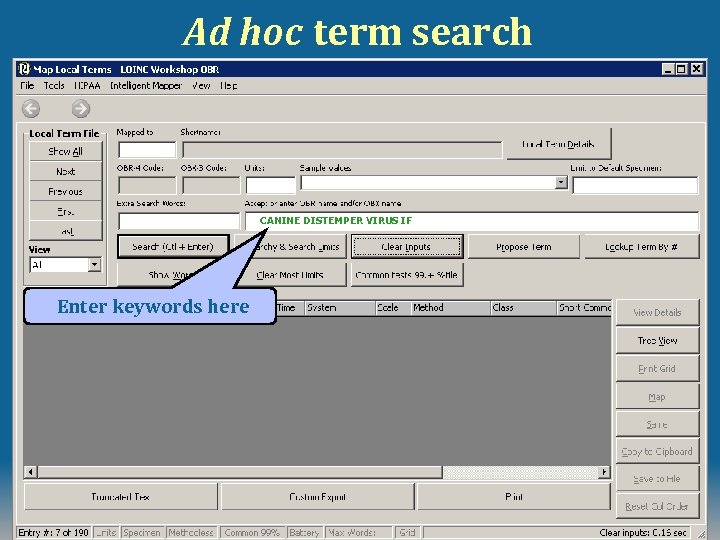 Ad hoc term search CANINE DISTEMPER VIRUS IF Enter keywords here © 2008 Regenstrief Institute and James Case
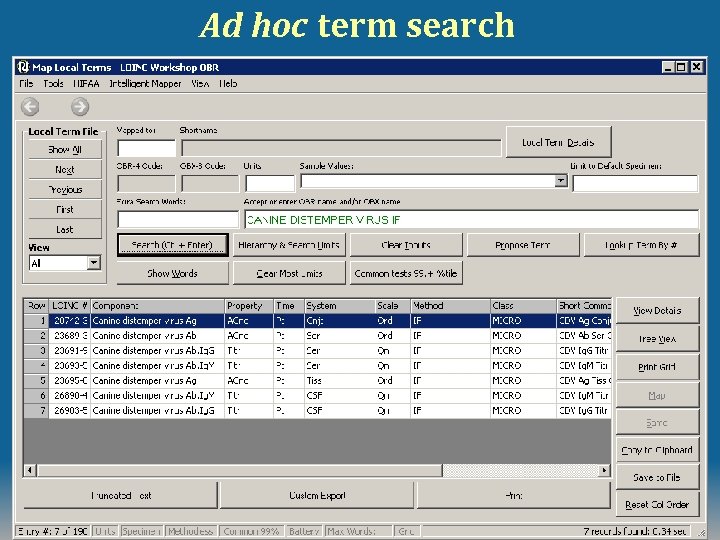 Ad hoc term search © 2008 Regenstrief Institute and James Case
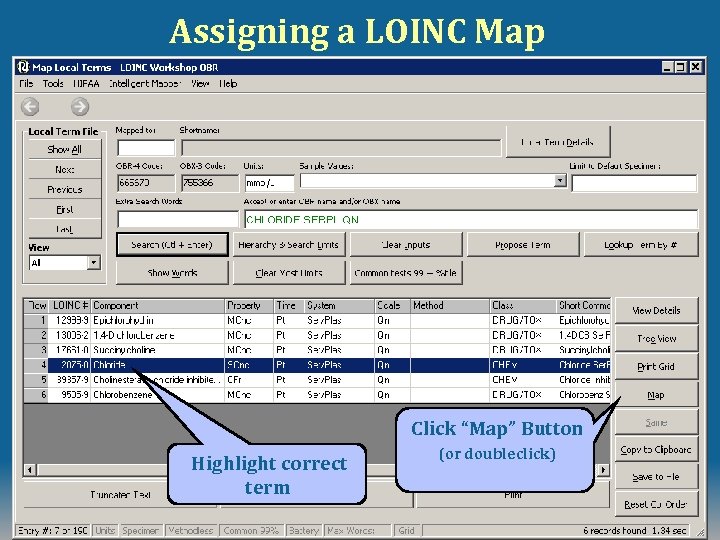 Assigning a LOINC Map Click “Map” Button Highlight correct term (or doubleclick) © 2008 Regenstrief Institute and James Case
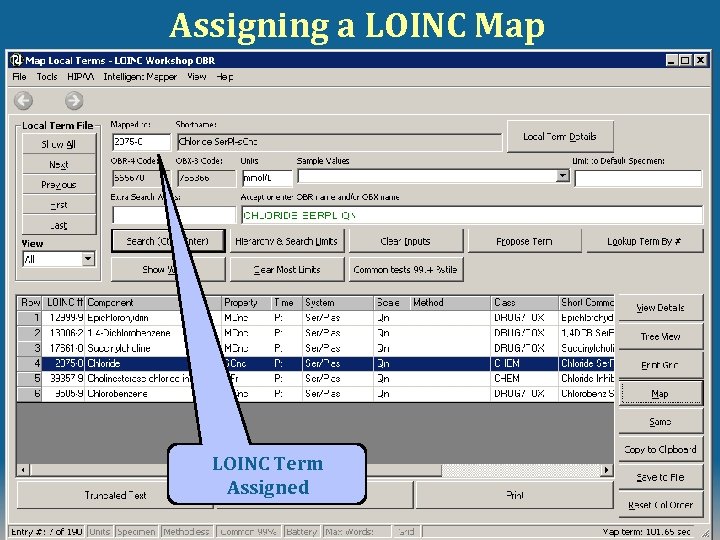 Assigning a LOINC Map LOINC Term Assigned © 2008 Regenstrief Institute and James Case
 Setting Search Limits Narrows search to specific subset of LOINC terms Reduces number of candidate terms Limits can be applied to all components Component attribute can be further restricted by number of words • Tree structure allows for hierarchical constraints • • © 2008 Regenstrief Institute and James Case
 RELMA - Search Constraints • Controls general search constraints including: • • • Limit to LOINC terms compatible with submitted units Force match with any specimen contained in name Methodless terms only (now enhanced) Limit to components with N or fewer words in their name Pop up search timing statistics after each search • Use carefully or search may not be successful (Note parallel control switches at bottom of screen) © 2008 Regenstrief Institute and James Case
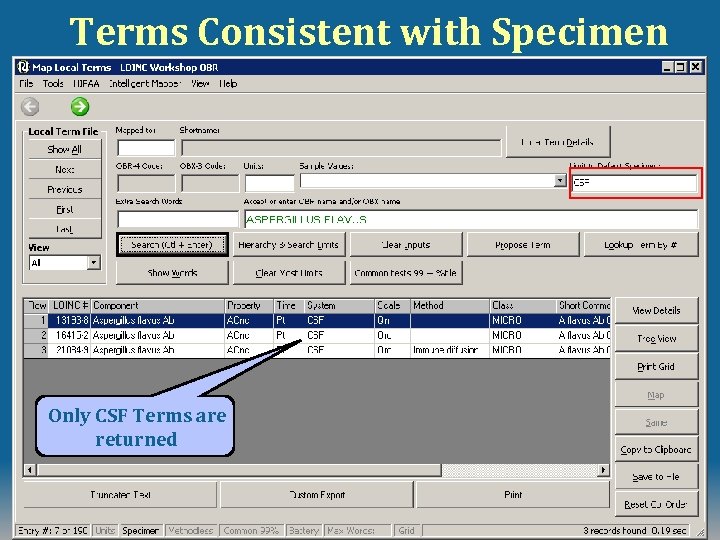 Terms Consistent with Specimen Only CSF Terms are returned © 2008 Regenstrief Institute and James Case
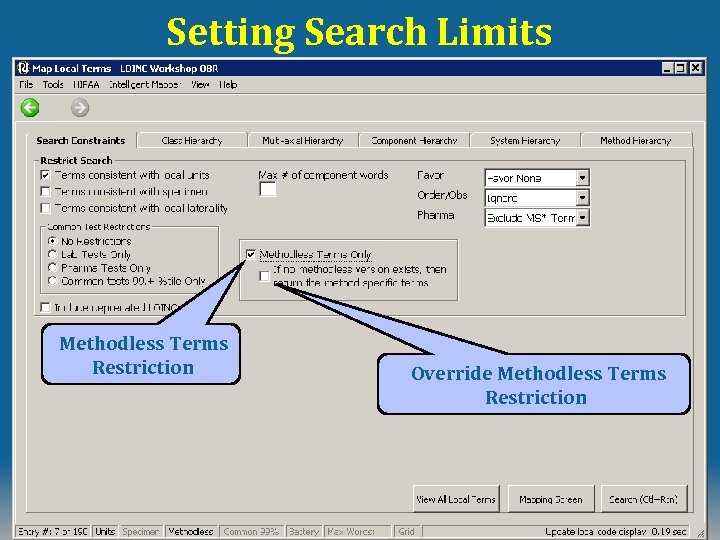 Setting Search Limits Methodless Terms Restriction Override Methodless Terms Restriction © 2008 Regenstrief Institute and James Case
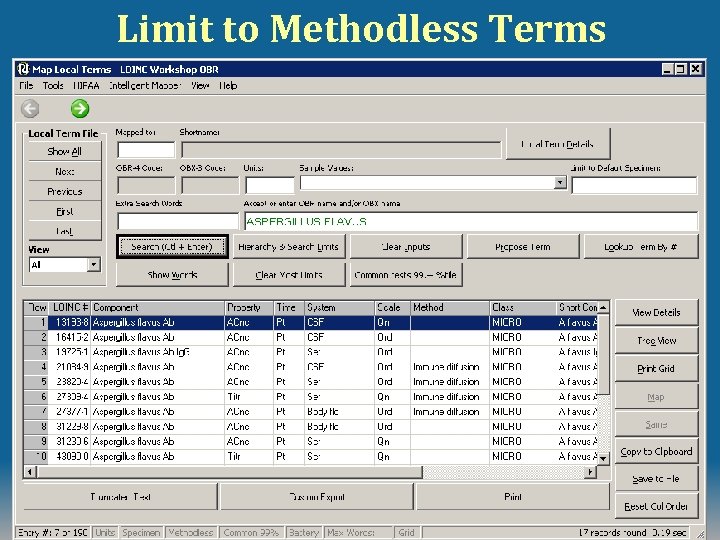 Limit to Methodless Terms © 2008 Regenstrief Institute and James Case
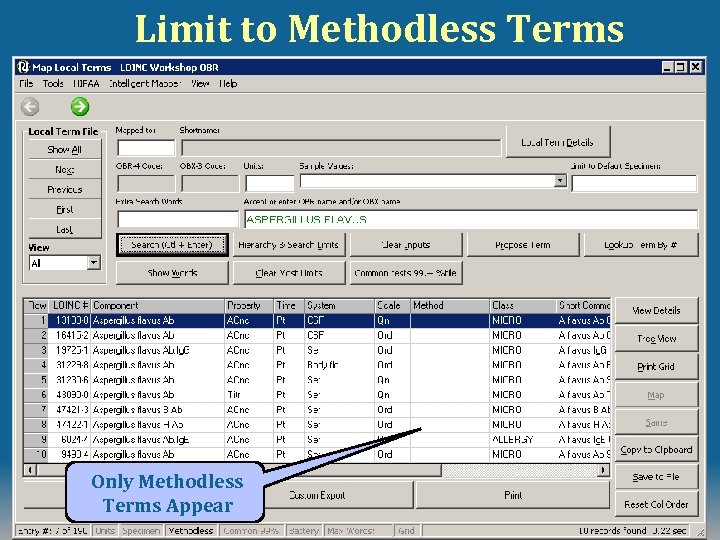 Limit to Methodless Terms Only Methodless Terms Appear © 2008 Regenstrief Institute and James Case
 More on Methodless Terms • Some LOINC categories do not have methodless terms • Checking methodless only will remove these from view on results grid • Checking additional box allows these to be seen © 2008 Regenstrief Institute and James Case
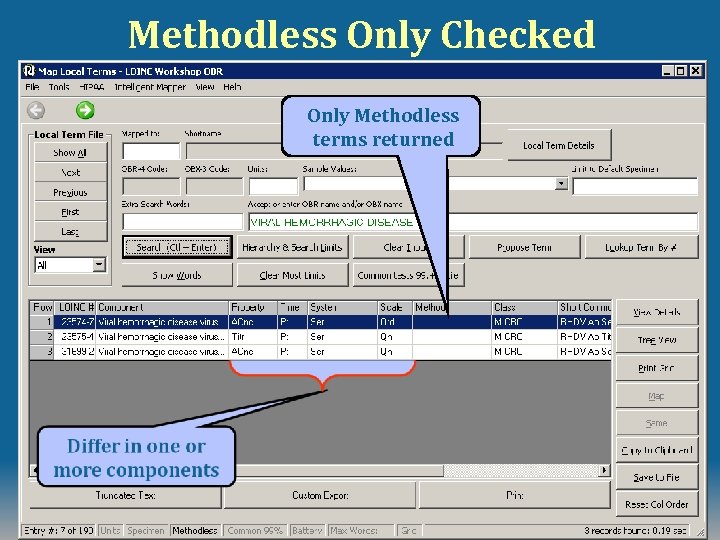 Methodless Only Checked Only Methodless terms returned © 2008 Regenstrief Institute and James Case
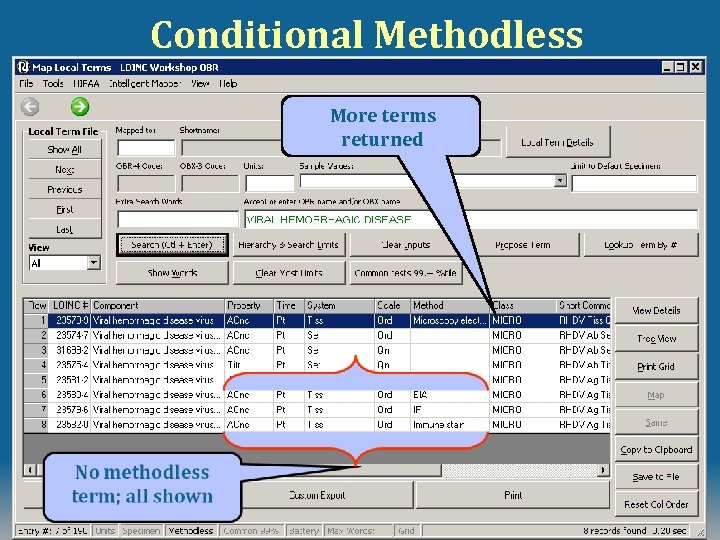 Conditional Methodless More terms returned © 2008 Regenstrief Institute and James Case
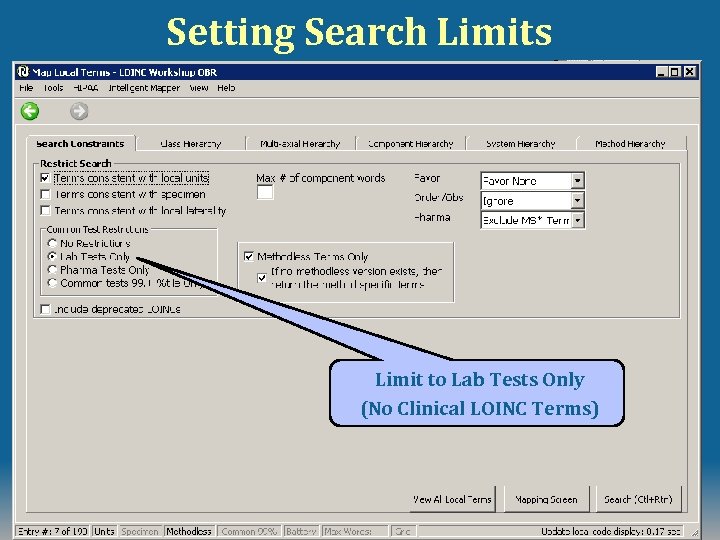 Setting Search Limits Limit to Lab Tests Only (No Clinical LOINC Terms) © 2008 Regenstrief Institute and James Case
 Navigating through the Mapping Process © 2008 Regenstrief Institute and James Case
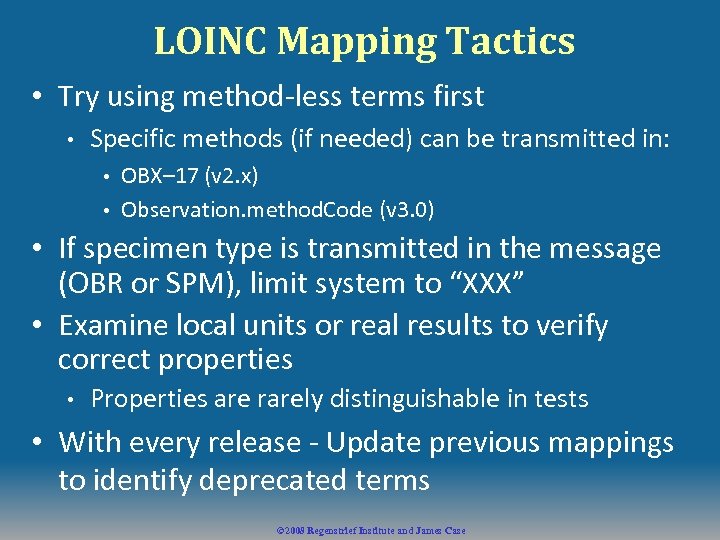 LOINC Mapping Tactics • Try using method-less terms first • Specific methods (if needed) can be transmitted in: • • OBX– 17 (v 2. x) Observation. method. Code (v 3. 0) • If specimen type is transmitted in the message (OBR or SPM), limit system to “XXX” • Examine local units or real results to verify correct properties • Properties are rarely distinguishable in tests • With every release - Update previous mappings to identify deprecated terms © 2008 Regenstrief Institute and James Case
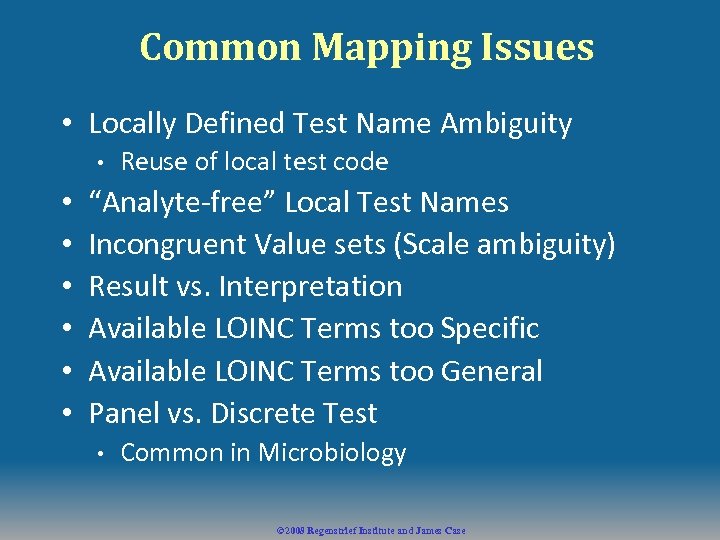 Common Mapping Issues • Locally Defined Test Name Ambiguity • • Reuse of local test code “Analyte-free” Local Test Names Incongruent Value sets (Scale ambiguity) Result vs. Interpretation Available LOINC Terms too Specific Available LOINC Terms too General Panel vs. Discrete Test • Common in Microbiology © 2008 Regenstrief Institute and James Case
 Search Hints and Tips • Keywords with zero frequency are ignored • May need to rephrase – use synonym • Some causes for no returned terms • • Too many keywords in search – uncheck some Limits applied that don’t make sense • • E. g. Method-less tests plus Method tree set to EIA Did not find and revise words not in RELMA • Local units not in RELMA • Units are GREAT discriminators • You may have tests that need to be added to LOINC © 2008 Regenstrief Institute and James Case
 Using LOINC and SNOMED Together
 Where do LOINC and SNOMED Fit? Remember: • LOINC represents the question: • • Is there any Botulism toxin in my specimen? (33708 -9) Organisms identified in specimen? (634 -6) • SNOMED represents the answer: • • Negative (SCTID 260385009) E. coli O 157: H 7 (SCTID 103429008) © 2008 Regenstrief Institute and James Case
 Where do LOINC and SNOMED Fit? • In an HL 7 message, LOINC may be used: • • • In OBR-4 (Universal Service Identifier) In OBX-3 (Observation Identifier) In Version 3 - Observation. code • SNOMED may be used: • • In OBX-5 (where nominal values are needed) Almost anyplace else in an HL 7 message where coded values are needed © 2008 Regenstrief Institute and James Case