 Скачать презентацию Introduction to lobbying 1 Definition of lobbying and
Introduction to lobbying.pptx
- Количество слайдов: 16



Introduction to lobbying 1. Definition of lobbying and related terms 2. Tasks and functions of lobbying 3. History of lobbying activities
Definition of lobbying • Lobbying is the attempt to influence government and its institutions in the formulation of policy.
• According to the Soviet Foreign words dictionary, lobbying is the system of agencies of monopolies which try to influence on legislative bodies of the USA using different methods (even bribery) in order to enact or defeat a bill. That is why lobbying as a process in CIS and continental Europe is perceived negatively.
• Lobbying is any action designed to influence the actions of the institutions of government. That means it covers all parts of central and local government and other public bodies, both in the country and internationally.
• Classical definition of lobbying. It is the special system and practice of realization of interests of corporations and public groups by focused influence on legislative and executive bodies.
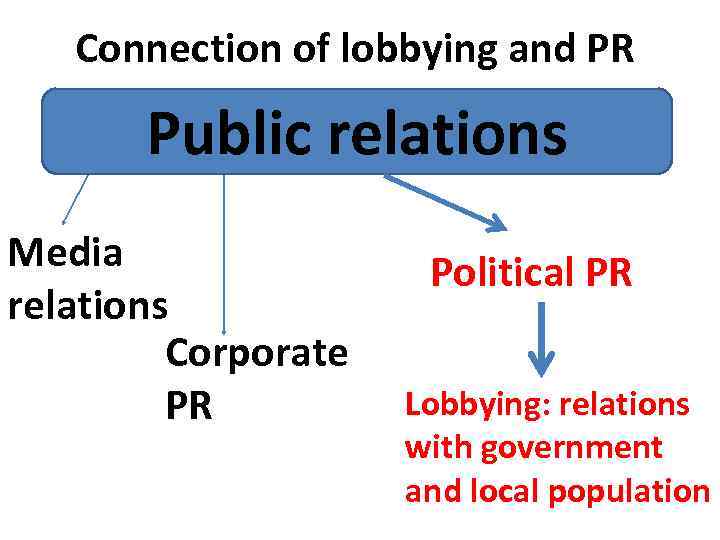
Connection of lobbying and PR Public relations Media relations Corporate PR Political PR Lobbying: relations with government and local population
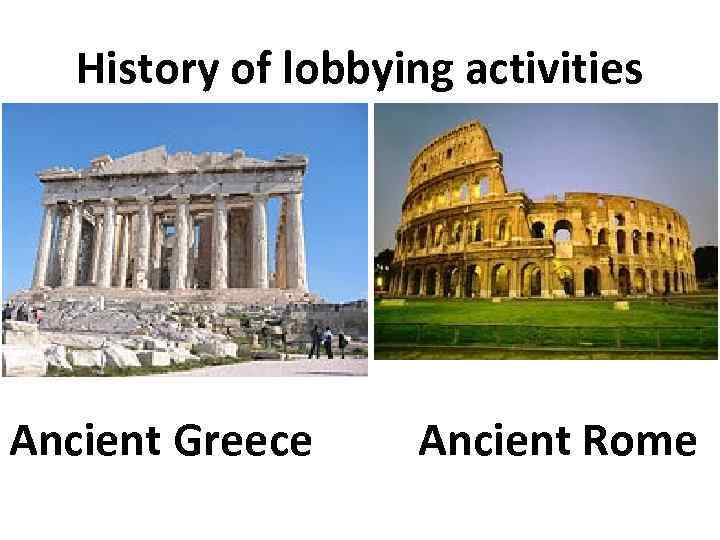
History of lobbying activities Ancient Greece Ancient Rome
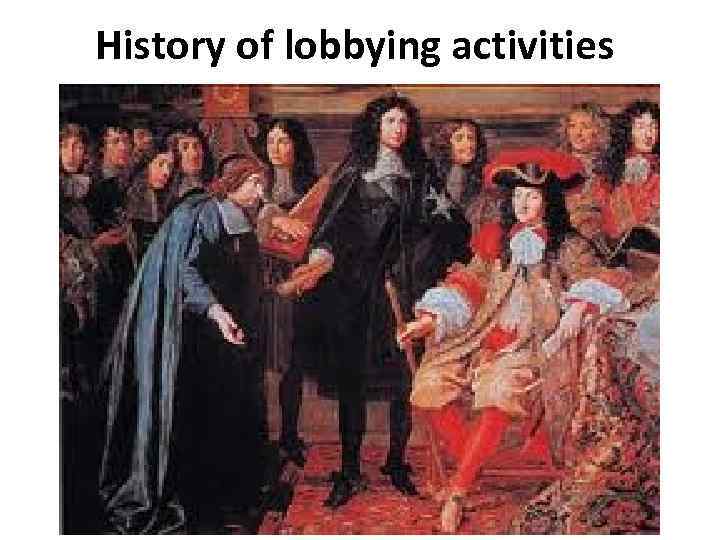
History of lobbying activities
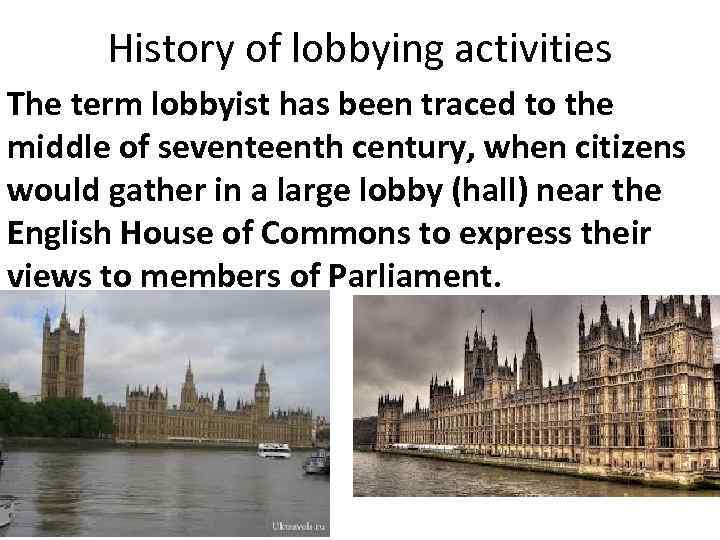
History of lobbying activities The term lobbyist has been traced to the middle of seventeenth century, when citizens would gather in a large lobby (hall) near the English House of Commons to express their views to members of Parliament.
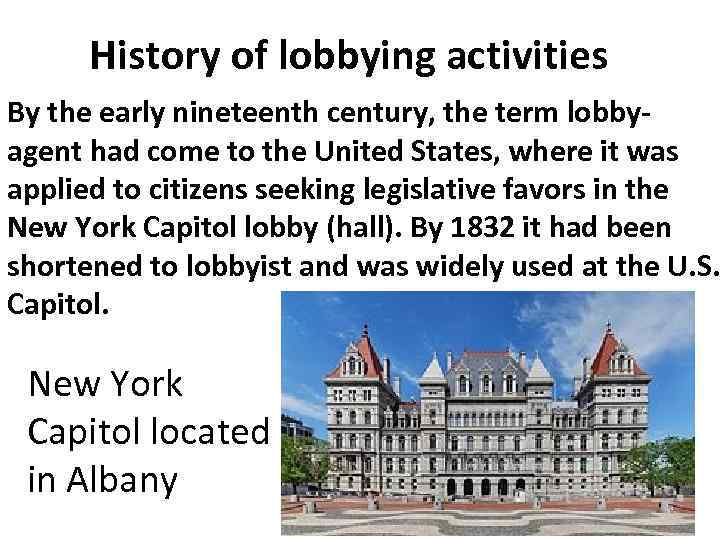
History of lobbying activities By the early nineteenth century, the term lobbyagent had come to the United States, where it was applied to citizens seeking legislative favors in the New York Capitol lobby (hall). By 1832 it had been shortened to lobbyist and was widely used at the U. S. Capitol. New York Capitol located in Albany
History of lobbying activities • Lobbying as a specific political phenomenon appeared in the USA. The term originates in Washington in 1860 s. Those seeking to influence President Ulysses Grant would gather in the lobby (hall) of the Willard Hotel and try to attract the great man’s attention in order to raise specific areas of concern with him. After a while President Grant tired of their attentions and referred to them as lobbyists.
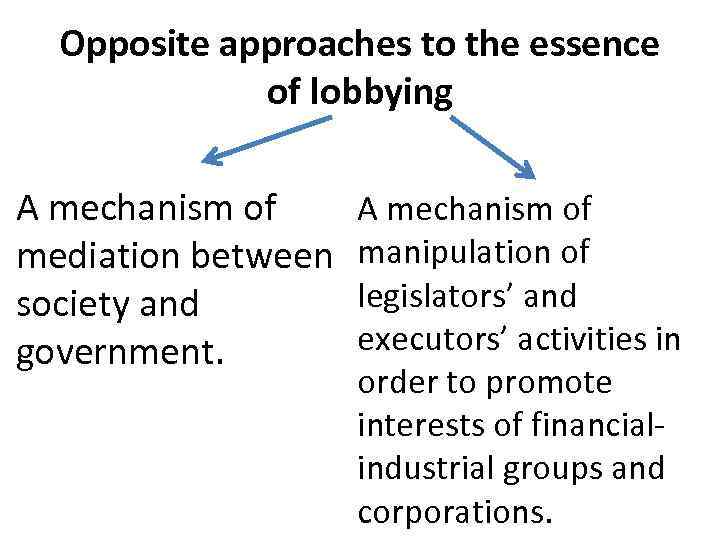
Opposite approaches to the essence of lobbying A mechanism of mediation between society and government. A mechanism of manipulation of legislators’ and executors’ activities in order to promote interests of financialindustrial groups and corporations.
• Today’s lobbying (in its civilized forms) is widely accepted legal mechanism of influence on governmental apparatus from below.
The main task of lobbying • Bills and normative acts of government should take into account specific interests of public groups and organizations which do not contradict with public interests.
Functions of lobbying 1. Lobbying has a function of mediation between public and government bodies. 2. Lobbying as an institution fulfills a function of regulation of public interests’ pluralism. Every person, public organization has own specific interests. They aspire to protect them using all accessible tools within juridical norms. These interests can collide. That is why one needs mechanisms to elaborate the priorities to solving these disputes. Lobbying is this mechanism.
Functions of lobbying • Function of lobbying as a special political phenomenon bases on the right of every citizen in democratic society to address his or her requirements and suggestions to government and state officials. This way lobbying provides the transparency of political process, expands the participators of political activity, limit the unlimited power of state power. Lobbying becomes the instrument of pluralistic democracy functioning. Lobbying allows public groups which are deprived of politics participation to take part in this process.
Скачать презентацию Introduction to lobbying 1 Definition of lobbying and
Introduction to lobbying.pptx