 Скачать презентацию Introduction to Learning Theory and Course Design Bernard
ece3a0f4658b003dd50c07d34d554751.ppt
- Количество слайдов: 71



Introduction to Learning Theory and Course Design Bernard Scott p Cranfield University George Roberts p Oxford Brookes University
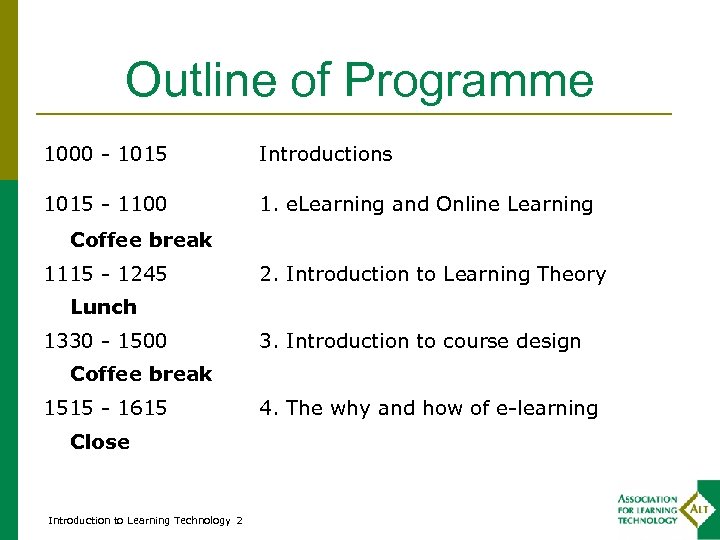
Outline of Programme 1000 - 1015 Introductions 1015 - 1100 1. e. Learning and Online Learning Coffee break 1115 - 1245 2. Introduction to Learning Theory Lunch 1330 - 1500 3. Introduction to course design Coffee break 1515 - 1615 Close Introduction to Learning Technology 2 4. The why and how of e-learning
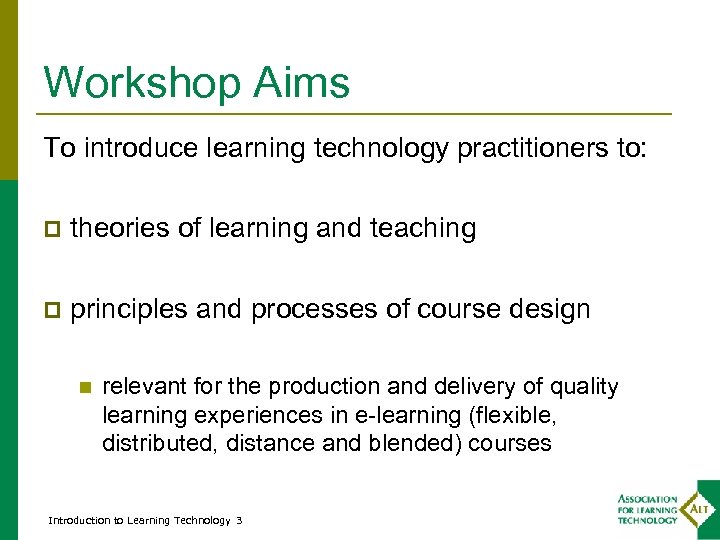
Workshop Aims To introduce learning technology practitioners to: p theories of learning and teaching p principles and processes of course design n relevant for the production and delivery of quality learning experiences in e-learning (flexible, distributed, distance and blended) courses Introduction to Learning Technology 3
Introductions p Introduce yourself p What is your role in your organisation? p What do you want from the day? Introduction to Learning Technology 4

1. e. Learning and Online Learning 1015 - 1100
The Big Picture p p p Globalisation Liberalisation Participation Innovation Education and training policy replaces industrial policy as the means by which governments seek to make regions economically competitive Introduction to Learning Technology 6
What’s happening, then? Chips with e-verything ICT is becoming Everywhere Background Personal Fast Mobile Merging Multi/multiple media Introduction to Learning Technology 7 Ubiquitous Ambient Adaptive and Aware High-speed Wireless (wifi and telephony) Convergent (TV, radio, learning, work, leisure) All Connected, Always on
Widening participation policies adopted by successive British governments have been focused in two conflicting directions: n emancipatory and empowering for the individual: stimulate the growth of autonomous, entrepreneurial, ITliterate, multi-skilled individuals capable of creating and taking advantage of the opportunities inherent in a post fordist economy n ensuring a supply of appropriately skilled workers for industry: create a compliant low-expectation labour force inured to the demands of flexibilisation in order to attract inward investment not on the basis of high skills available but on the basis of low costs Introduction to Learning Technology 8
Learning Technologies Multimedia presentations p Electronic whiteboards p Interactive classrooms p CAL, CBT, simulations p Virtual reality p Video conferencing p Online learning p Introduction to Learning Technology 9
Online Learning p Using the Internet for L&T (DL or blended) n n n Learning materials (RBL) Other resources Computer mediated communication (CMC) Computer aided assessment (CAA) VLEs, MLEs, LMSs, LCMSs, IMS Introduction to Learning Technology 10
Activity What are some advantages and disadvantages of OLL? Note down two points for and two points against.
Some advantages of OLL (1) Flexible re time and place p Interactive p Immediate p Modifiable p Non-linear p Richness of resources p Shared access to resources p Introduction to Learning Technology 12
Some advantages of OLL (2) Store and archive files and messages p Store and process scores p Adapt to a student’s performance p Provide formative feedback p Introduction to Learning Technology 13
Some disadvantages of OLL (1) Costs to install and maintain p Costs of materials production or acquisition p Training needs (staff and students) p Accessibility issues p Introduction to Learning Technology 14
Some disadvantages of OLL (2) CMC is time intensive p Difficult to be social p CAA has restricted set of question styles p Security issues (confidentiality, plagiarism) p Copyright and IPR issues p Introduction to Learning Technology 15
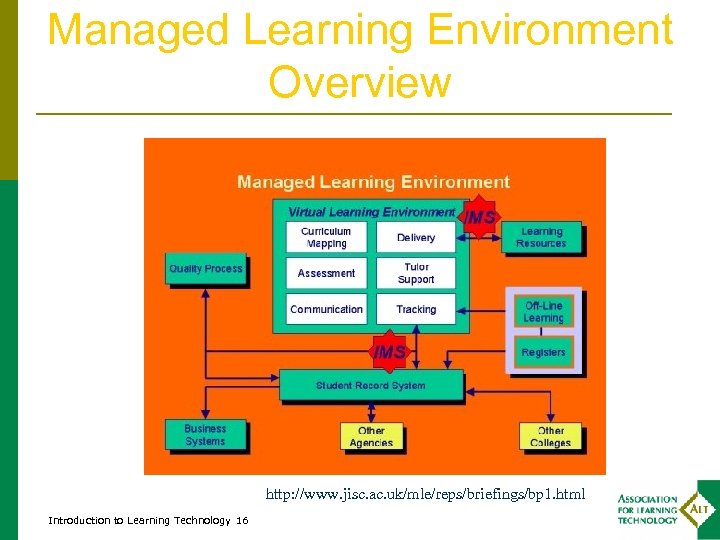
Managed Learning Environment Overview http: //www. jisc. ac. uk/mle/reps/briefings/bp 1. html Introduction to Learning Technology 16

Coffee Break 1100 - 1115
2. Learning Theory 1115 - 1245
Activity What is learning? What do we learn? What helps us to learn? Note down your thoughts Introduction to Learning Technology 19
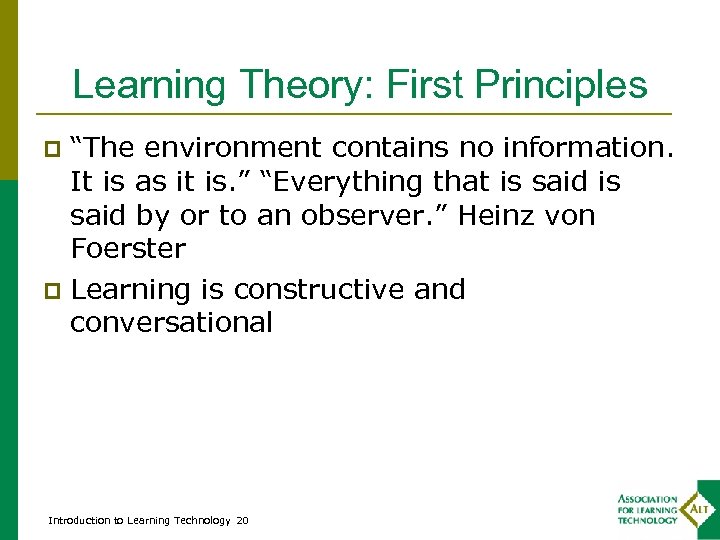
Learning Theory: First Principles “The environment contains no information. It is as it is. ” “Everything that is said by or to an observer. ” Heinz von Foerster p Learning is constructive and conversational p Introduction to Learning Technology 20
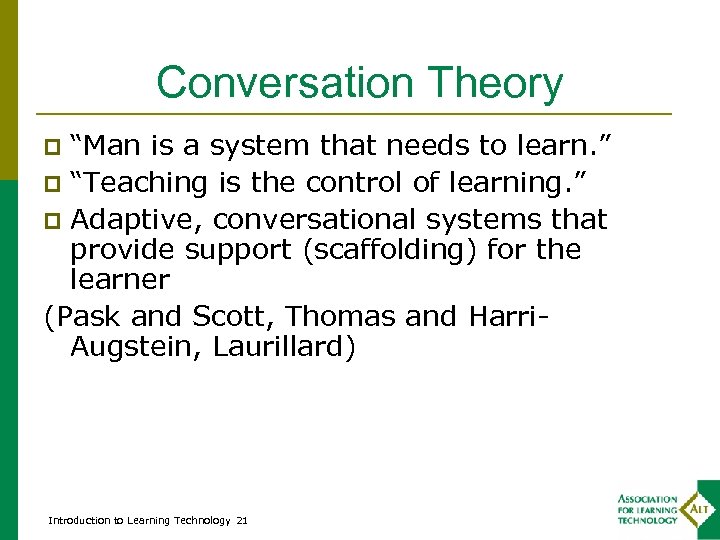
Conversation Theory “Man is a system that needs to learn. ” p “Teaching is the control of learning. ” p Adaptive, conversational systems that provide support (scaffolding) for the learner (Pask and Scott, Thomas and Harri. Augstein, Laurillard) p Introduction to Learning Technology 21
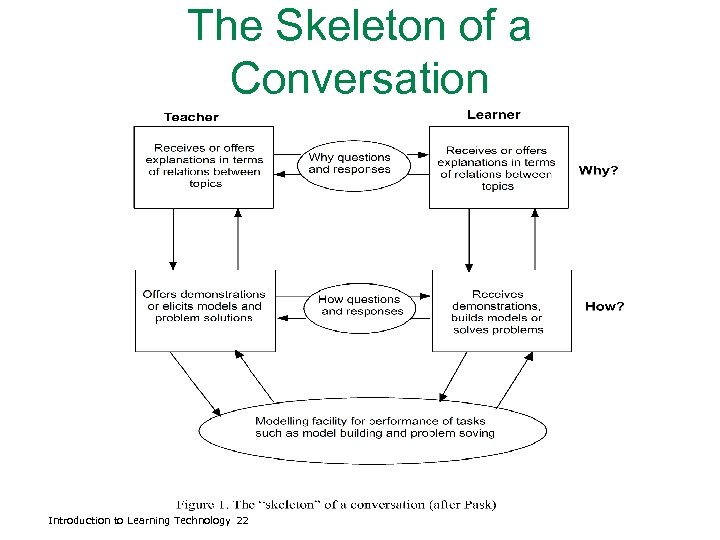
The Skeleton of a Conversation Introduction to Learning Technology 22
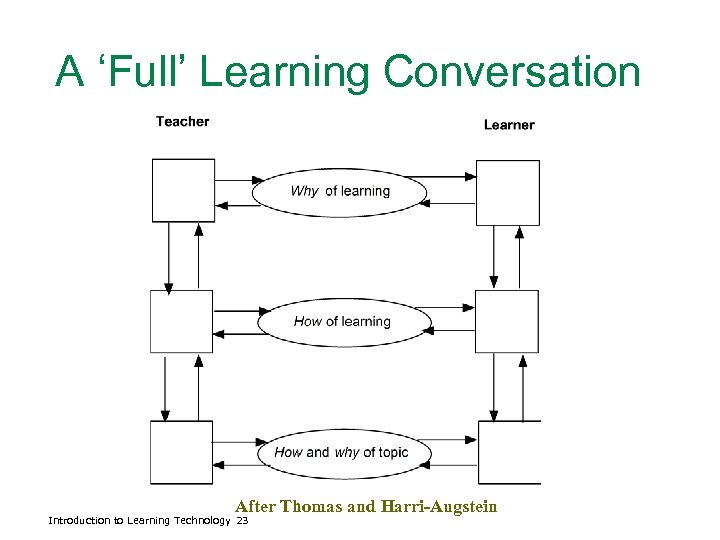
A ‘Full’ Learning Conversation After Thomas and Harri-Augstein Introduction to Learning Technology 23
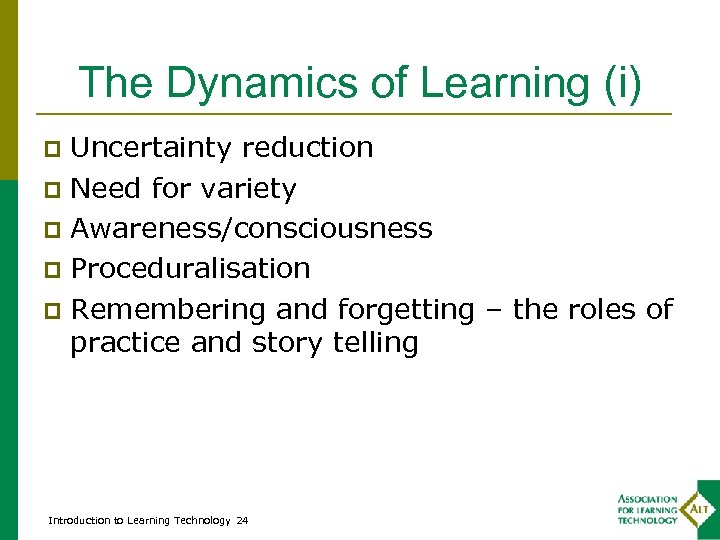
The Dynamics of Learning (i) Uncertainty reduction p Need for variety p Awareness/consciousness p Proceduralisation p Remembering and forgetting – the roles of practice and story telling p Introduction to Learning Technology 24
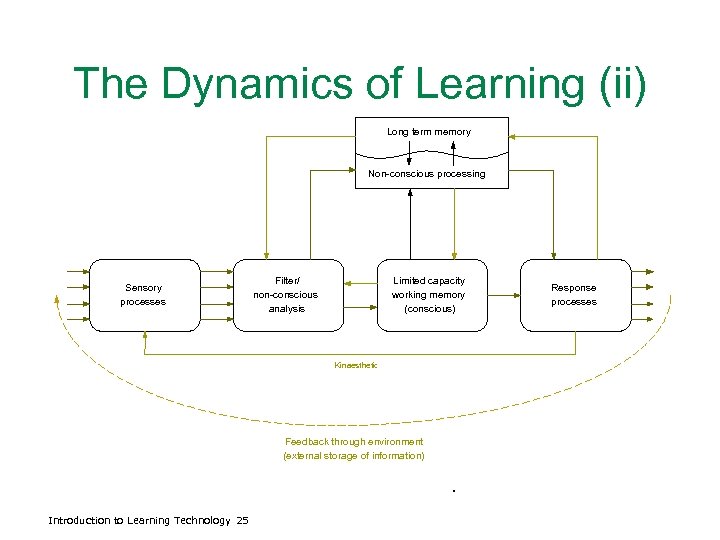
The Dynamics of Learning (ii) Long term memory Non-conscious processing Sensory processes Filter/ non-conscious analysis Limited capacity working memory (conscious) Kinaesthetic Feedback through environment (external storage of information) Introduction to Learning Technology 25 Response processes
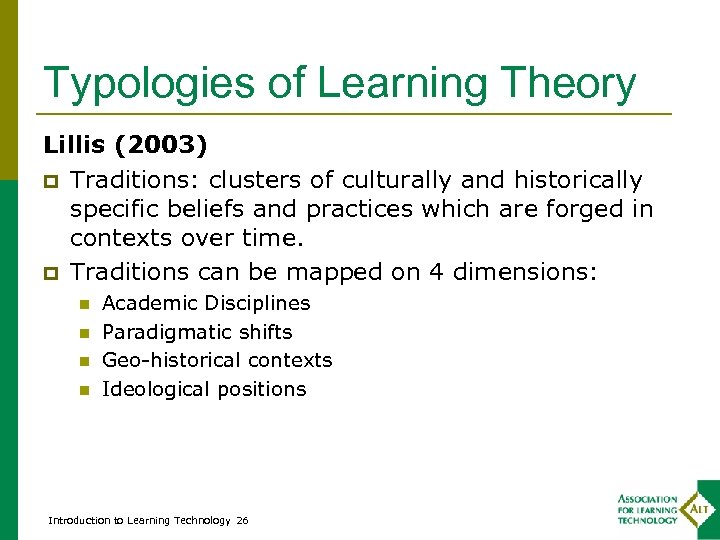
Typologies of Learning Theory Lillis (2003) p Traditions: clusters of culturally and historically specific beliefs and practices which are forged in contexts over time. p Traditions can be mapped on 4 dimensions: n n Academic Disciplines Paradigmatic shifts Geo-historical contexts Ideological positions Introduction to Learning Technology 26
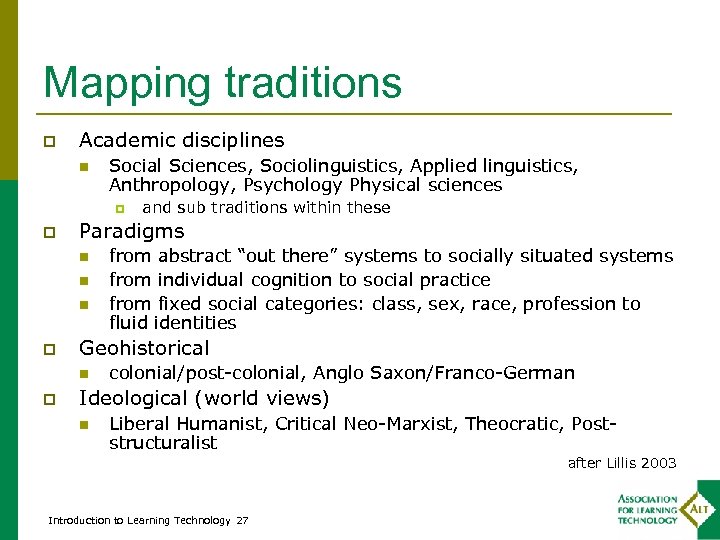
Mapping traditions p Academic disciplines n Social Sciences, Sociolinguistics, Applied linguistics, Anthropology, Psychology Physical sciences p p Paradigms n n n p from abstract “out there” systems to socially situated systems from individual cognition to social practice from fixed social categories: class, sex, race, profession to fluid identities Geohistorical n p and sub traditions within these colonial/post-colonial, Anglo Saxon/Franco-German Ideological (world views) n Liberal Humanist, Critical Neo-Marxist, Theocratic, Poststructuralist after Lillis 2003 Introduction to Learning Technology 27
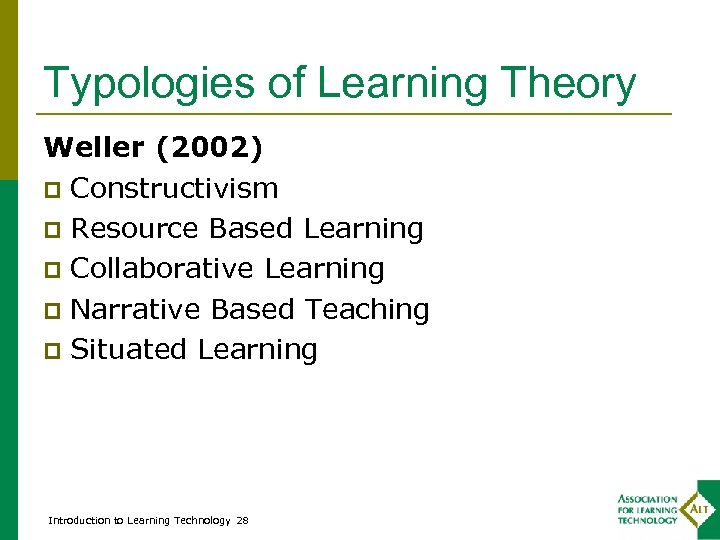
Typologies of Learning Theory Weller (2002) p Constructivism p Resource Based Learning p Collaborative Learning p Narrative Based Teaching p Situated Learning Introduction to Learning Technology 28
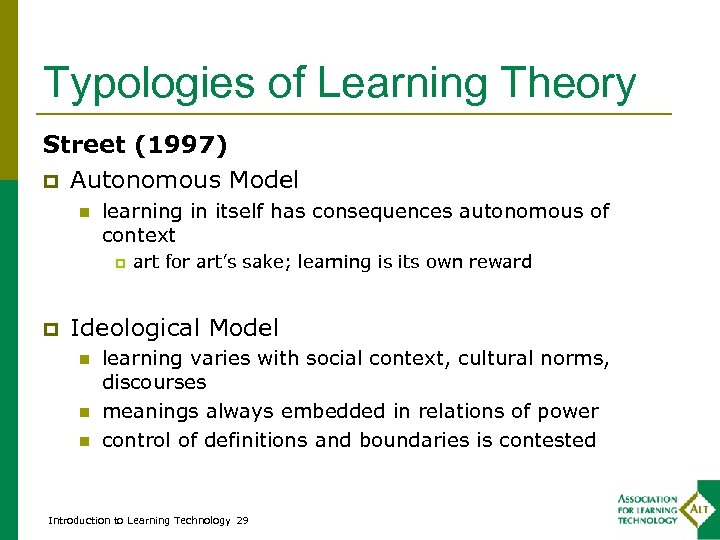
Typologies of Learning Theory Street (1997) p Autonomous Model n learning in itself has consequences autonomous of context p p art for art’s sake; learning is its own reward Ideological Model n n n learning varies with social context, cultural norms, discourses meanings always embedded in relations of power control of definitions and boundaries is contested Introduction to Learning Technology 29
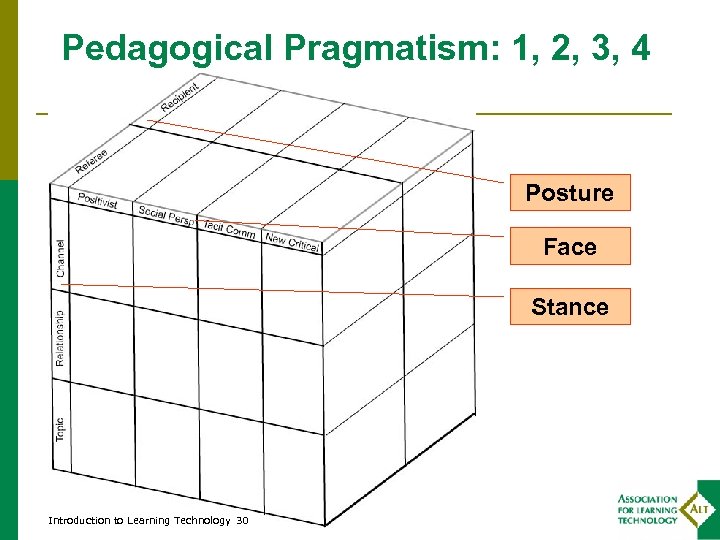
Pedagogical Pragmatism: 1, 2, 3, 4 Posture Face Stance Introduction to Learning Technology 30
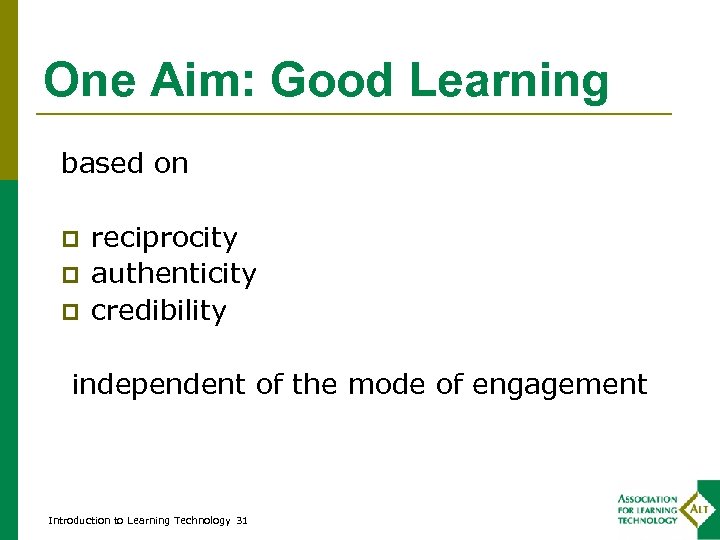
One Aim: Good Learning based on p p p reciprocity authenticity credibility independent of the mode of engagement Introduction to Learning Technology 31
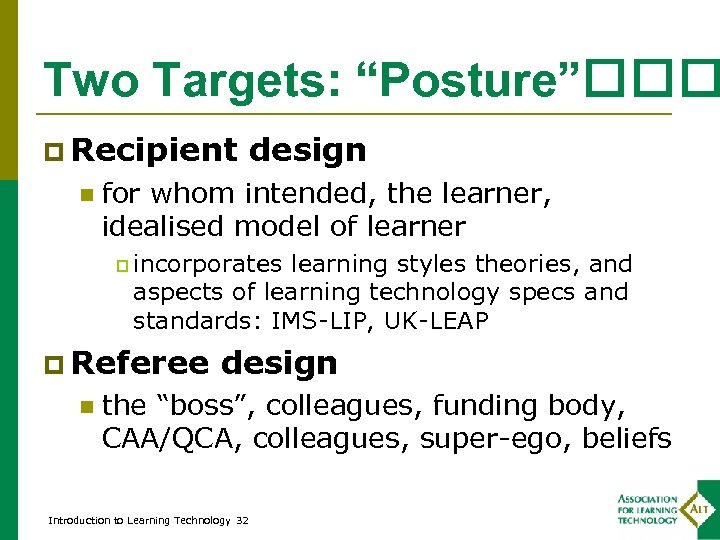
Two Targets: “Posture” p Recipient n design for whom intended, the learner, idealised model of learner p incorporates learning styles theories, and aspects of learning technology specs and standards: IMS-LIP, UK-LEAP p Referee n design the “boss”, colleagues, funding body, CAA/QCA, colleagues, super-ego, beliefs Introduction to Learning Technology 32
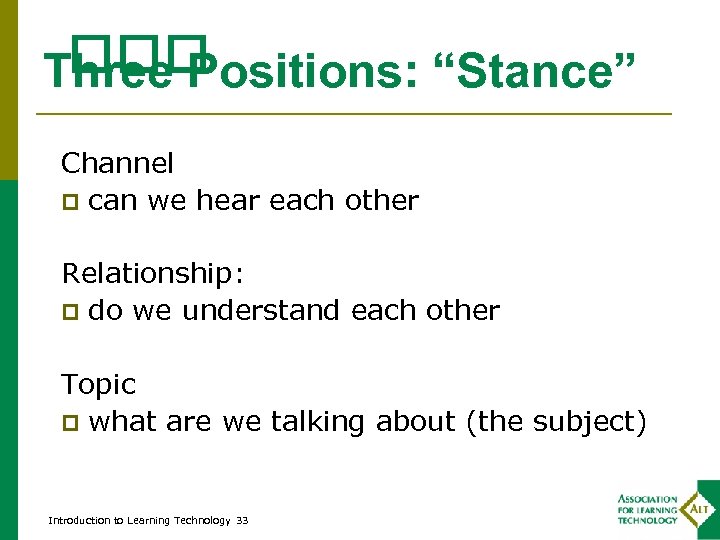
Three Positions: “Stance” Channel p can we hear each other Relationship: p do we understand each other Topic p what are we talking about (the subject) Introduction to Learning Technology 33
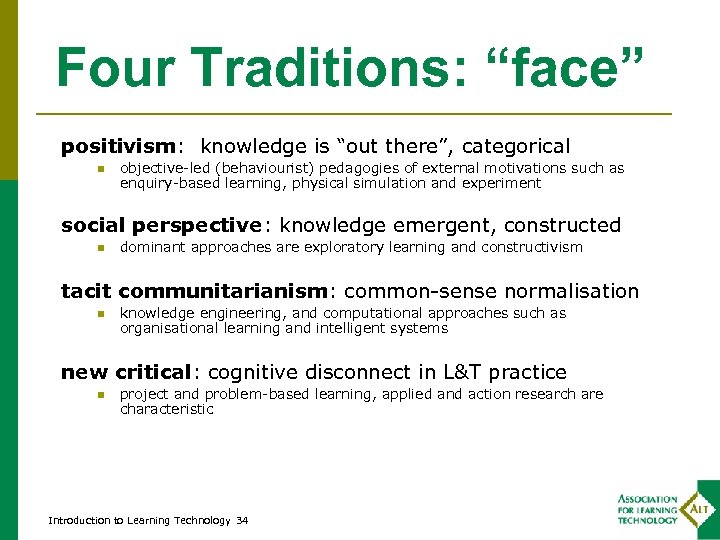
Four Traditions: “face” positivism: knowledge is “out there”, categorical n objective-led (behaviourist) pedagogies of external motivations such as enquiry-based learning, physical simulation and experiment social perspective: knowledge emergent, constructed n dominant approaches are exploratory learning and constructivism tacit communitarianism: common-sense normalisation n knowledge engineering, and computational approaches such as organisational learning and intelligent systems new critical: cognitive disconnect in L&T practice n project and problem-based learning, applied and action research are characteristic Introduction to Learning Technology 34
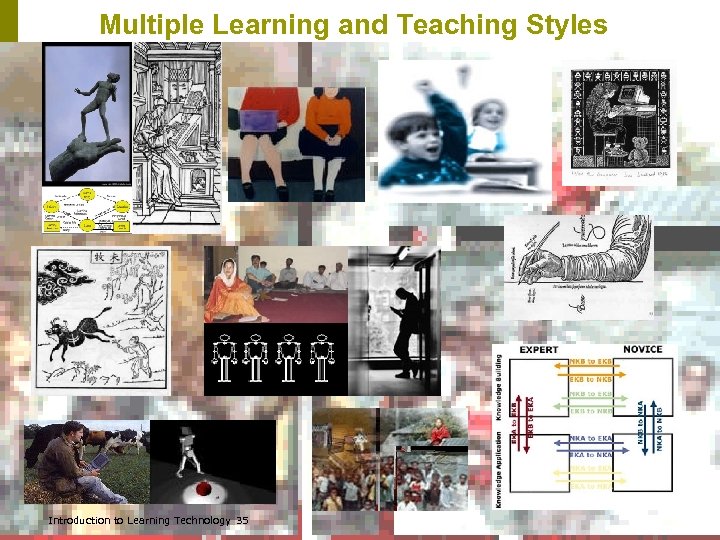
Multiple Learning and Teaching Styles Introduction to Learning Technology 35
Activity How do subject areas differ? How do learners differ? How do we learn to learn? Note down your thoughts Introduction to Learning Technology 36
Lunch! 1245 - 1330
3. Course Design 1330 - 1500
Course Design Coopers and Lybrand (1996): p Up to two thirds of TLTP materials can be deemed amateurish due to the lack of sound pedagogy and instructional design n UK Teaching and Learning Technology Programme (1990 – cont), c. £ 40 m Introduction to Learning Technology 39
Activity What makes for a good course? Note down your thoughts Introduction to Learning Technology 40
Good teaching sets ground rules p provides alternative modes of participation p exemplifies models of engagement p gives access to the experience of the instructor p (cf. Brookfield 2001, Jones 1999) independent of the mode of engagement Introduction to Learning Technology 41
Good practice encourage student-tutor contact p encourage student-student co-operation p encourage active learning p give prompt feedback p emphasise time on task p have and communicate high expectations p respect diverse talents and ways of learning p independent of the mode of engagement Introduction to Learning Technology 42
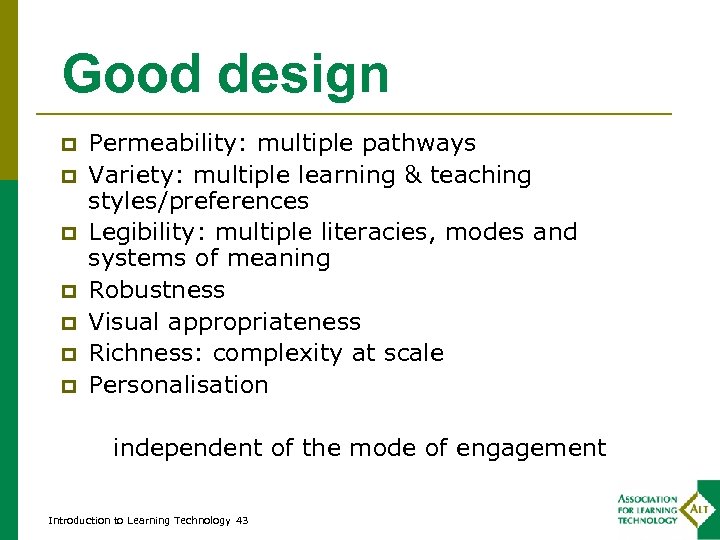
Good design p p p p Permeability: multiple pathways Variety: multiple learning & teaching styles/preferences Legibility: multiple literacies, modes and systems of meaning Robustness Visual appropriateness Richness: complexity at scale Personalisation independent of the mode of engagement Introduction to Learning Technology 43
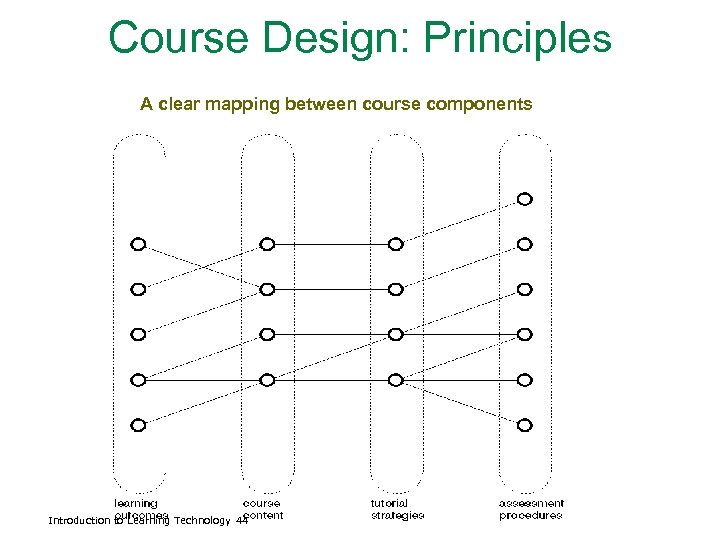
Course Design: Principles A clear mapping between course components Introduction to Learning Technology 44
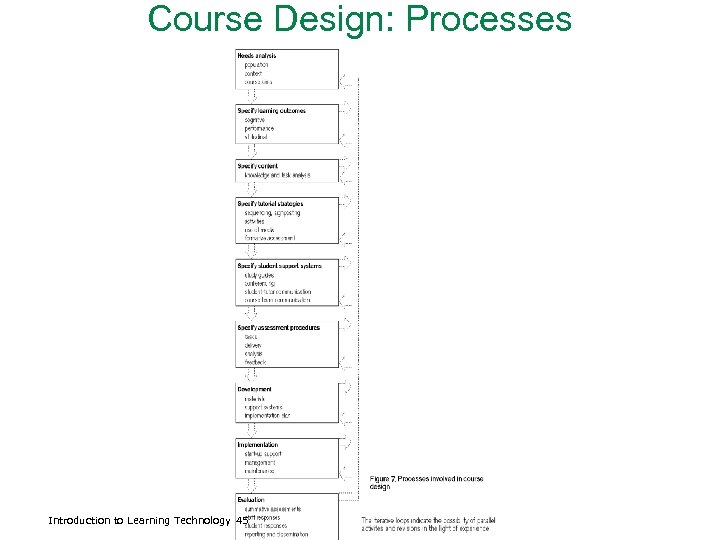
Course Design: Processes Introduction to Learning Technology 45
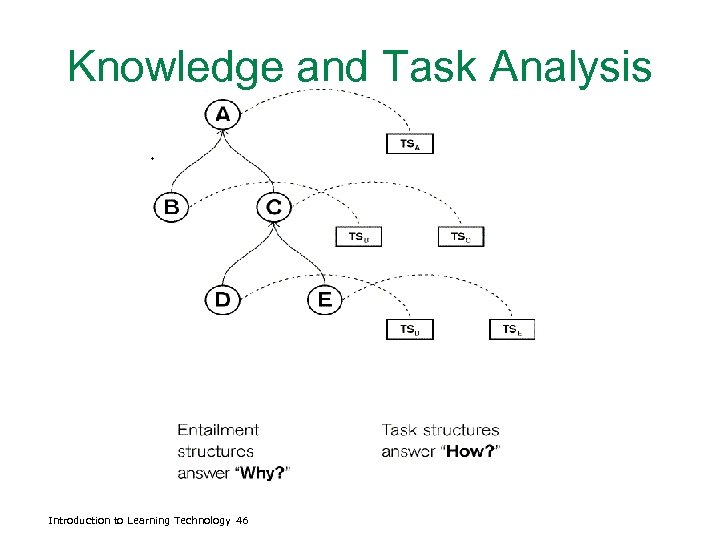
Knowledge and Task Analysis Introduction to Learning Technology 46
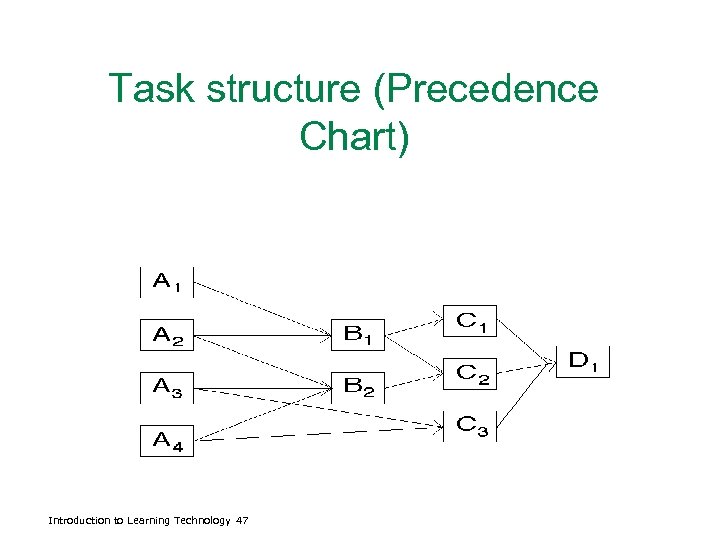
Task structure (Precedence Chart) Introduction to Learning Technology 47
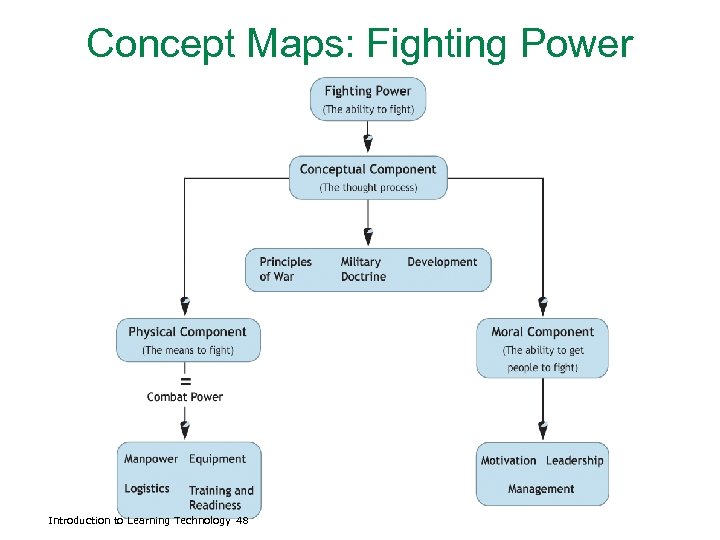
Concept Maps: Fighting Power Introduction to Learning Technology 48
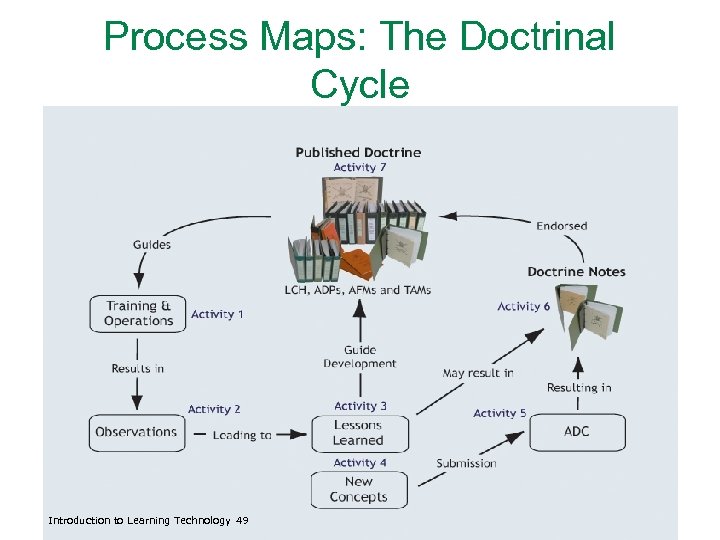
Process Maps: The Doctrinal Cycle Introduction to Learning Technology 49
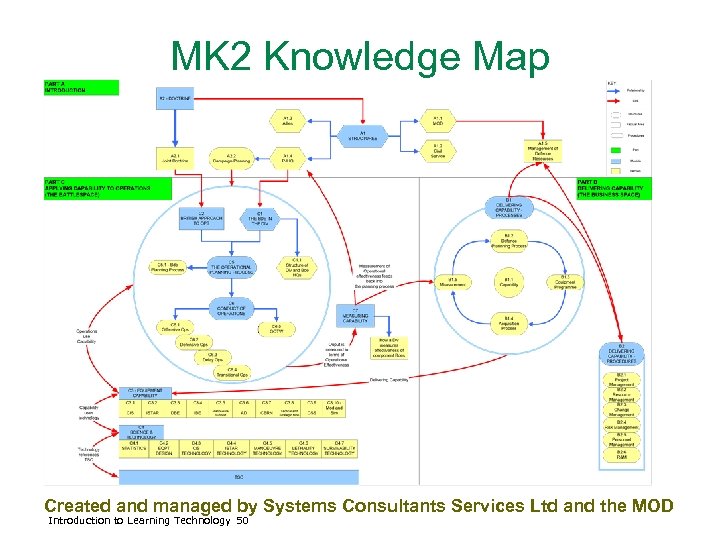
MK 2 Knowledge Map Created and managed by Systems Consultants Services Ltd and the MOD Introduction to Learning Technology 50
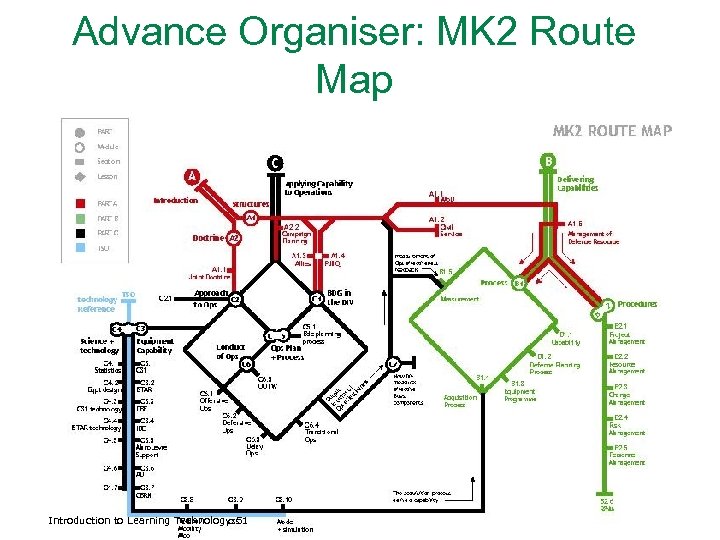
Advance Organiser: MK 2 Route Map Introduction to Learning Technology 51
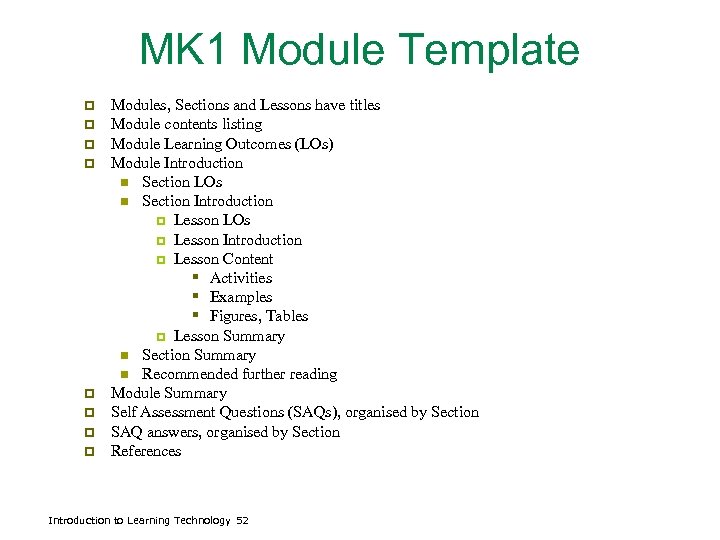
MK 1 Module Template p p p p Modules, Sections and Lessons have titles Module contents listing Module Learning Outcomes (LOs) Module Introduction n Section LOs n Section Introduction p Lesson LOs p Lesson Introduction p Lesson Content § Activities § Examples § Figures, Tables p Lesson Summary n Section Summary n Recommended further reading Module Summary Self Assessment Questions (SAQs), organised by Section SAQ answers, organised by Section References Introduction to Learning Technology 52
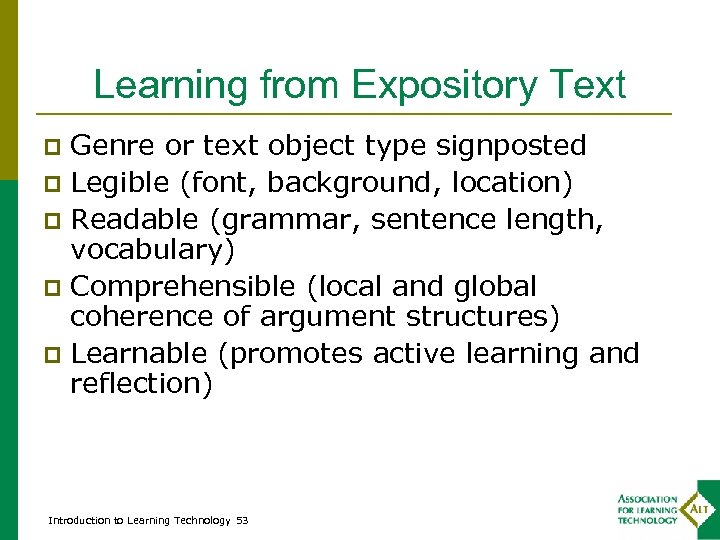
Learning from Expository Text Genre or text object type signposted p Legible (font, background, location) p Readable (grammar, sentence length, vocabulary) p Comprehensible (local and global coherence of argument structures) p Learnable (promotes active learning and reflection) p Introduction to Learning Technology 53
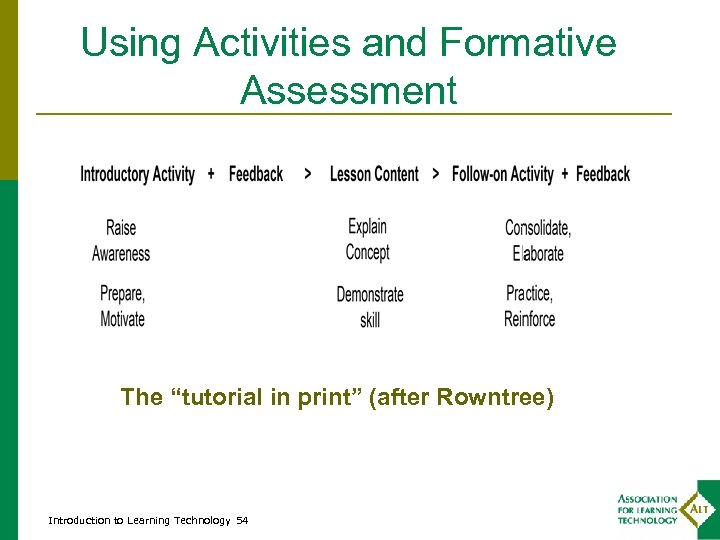
Using Activities and Formative Assessment The “tutorial in print” (after Rowntree) Introduction to Learning Technology 54
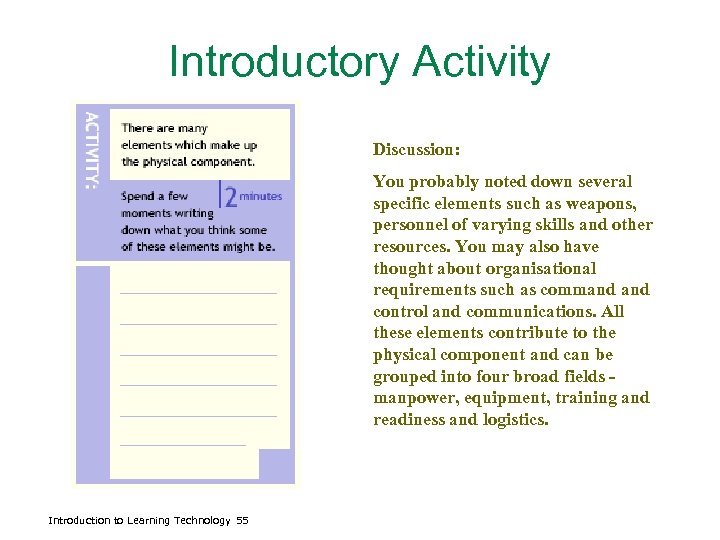
Introductory Activity Discussion: You probably noted down several specific elements such as weapons, personnel of varying skills and other resources. You may also have thought about organisational requirements such as command control and communications. All these elements contribute to the physical component and can be grouped into four broad fields manpower, equipment, training and readiness and logistics. Introduction to Learning Technology 55
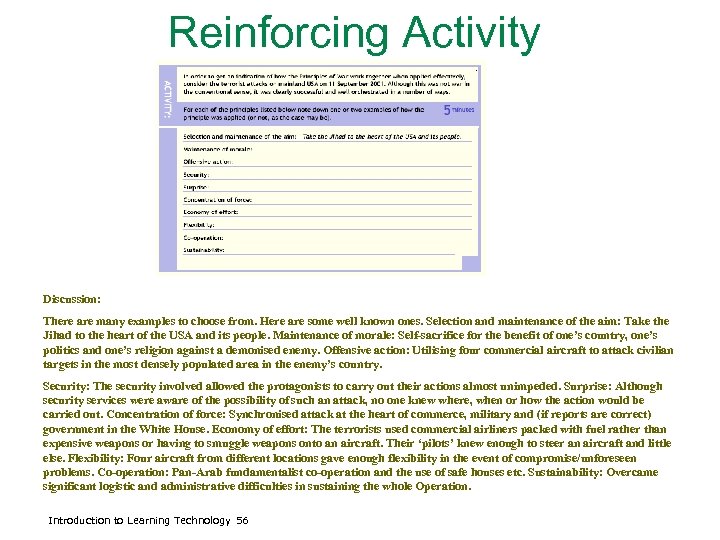
Reinforcing Activity Discussion: There are many examples to choose from. Here are some well known ones. Selection and maintenance of the aim: Take the Jihad to the heart of the USA and its people. Maintenance of morale: Self-sacrifice for the benefit of one’s country, one’s politics and one’s religion against a demonised enemy. Offensive action: Utilising four commercial aircraft to attack civilian targets in the most densely populated area in the enemy’s country. Security: The security involved allowed the protagonists to carry out their actions almost unimpeded. Surprise: Although security services were aware of the possibility of such an attack, no one knew where, when or how the action would be carried out. Concentration of force: Synchronised attack at the heart of commerce, military and (if reports are correct) government in the White House. Economy of effort: The terrorists used commercial airliners packed with fuel rather than expensive weapons or having to smuggle weapons onto an aircraft. Their ‘pilots’ knew enough to steer an aircraft and little else. Flexibility: Four aircraft from different locations gave enough flexibility in the event of compromise/unforeseen problems. Co-operation: Pan-Arab fundamentalist co-operation and the use of safe houses etc. Sustainability: Overcame significant logistic and administrative difficulties in sustaining the whole Operation. Introduction to Learning Technology 56
Delivering MK 2 – The Full Pedagogic Model Searching and learning about resources p Mentor support p Peer-peer learning p Student tracking and assessment p Student records p Integration with residential courses – blended learning p Introduction to Learning Technology 57
Designs for Collaborative Learning Group or individual tasks p Dissemination to peers p Exchange of critical reviews p Revise, iterate p Tutor as learning facilitator, learning coach, subject matter expert, assessor p Introduction to Learning Technology 58
Tea Break 1500 - 1515
4. Why and How of e. Learning 1515 - 1615
Activity and Discussion: The Why and How of e-Learning p Revisit your thoughts about why we should engage in e-learning p Revisit your thoughts about how we should develop and deliver e-learning Introduction to Learning Technology 61
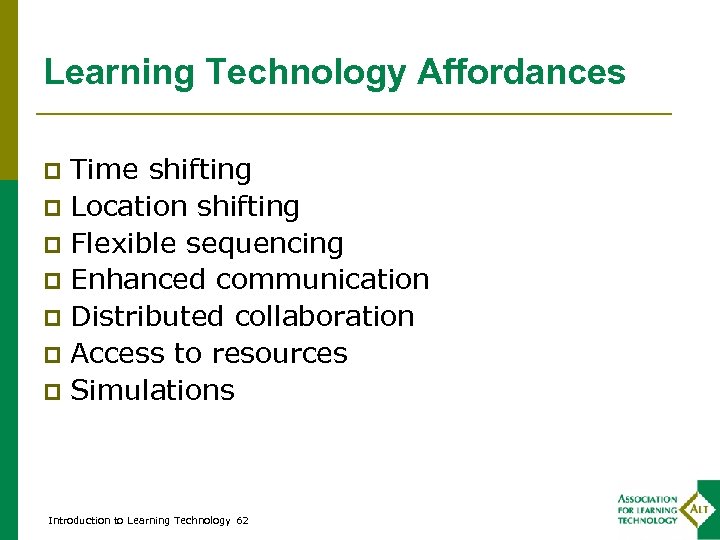
Learning Technology Affordances Time shifting p Location shifting p Flexible sequencing p Enhanced communication p Distributed collaboration p Access to resources p Simulations p Introduction to Learning Technology 62
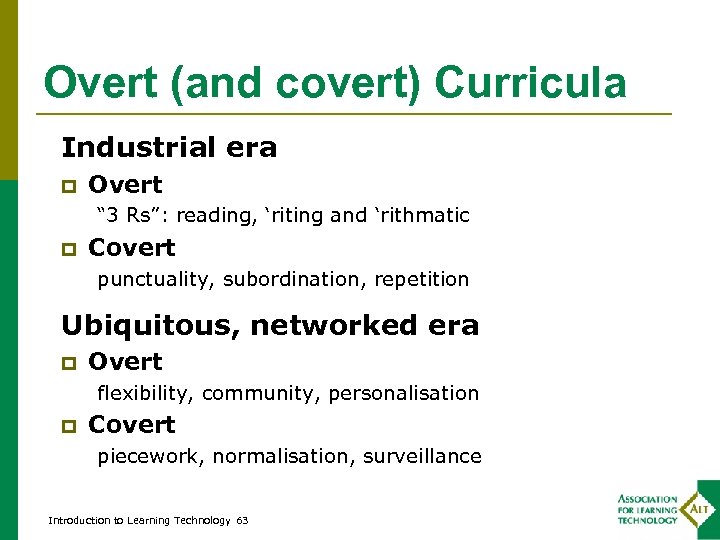
Overt (and covert) Curricula Industrial era p Overt “ 3 Rs”: reading, ‘riting and ‘rithmatic p Covert punctuality, subordination, repetition Ubiquitous, networked era p Overt flexibility, community, personalisation p Covert piecework, normalisation, surveillance Introduction to Learning Technology 63
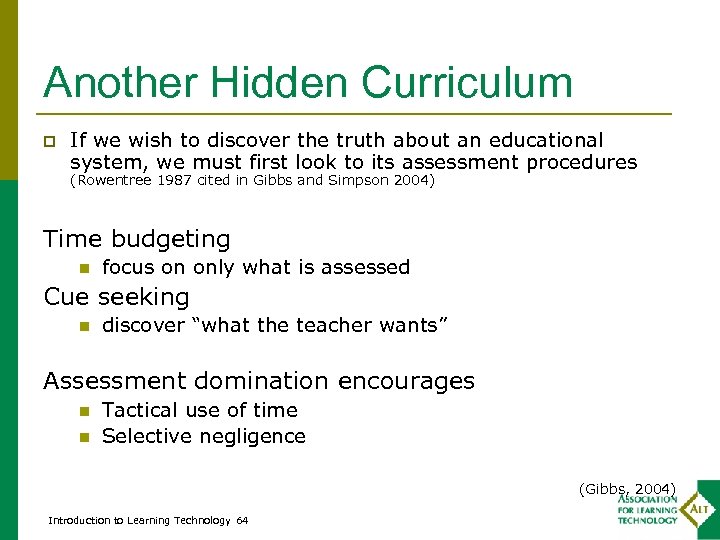
Another Hidden Curriculum p If we wish to discover the truth about an educational system, we must first look to its assessment procedures (Rowentree 1987 cited in Gibbs and Simpson 2004) Time budgeting n focus on only what is assessed Cue seeking n discover “what the teacher wants” Assessment domination encourages n n Tactical use of time Selective negligence (Gibbs, 2004) Introduction to Learning Technology 64
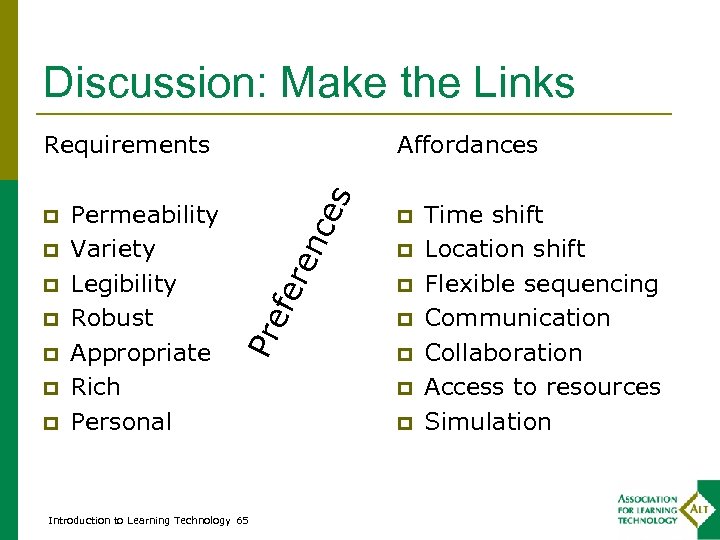
Discussion: Make the Links p p p ce en fer p Permeability Variety Legibility Robust Appropriate Rich Personal Pre p Affordances s Requirements Introduction to Learning Technology 65 p p p p Time shift Location shift Flexible sequencing Communication Collaboration Access to resources Simulation
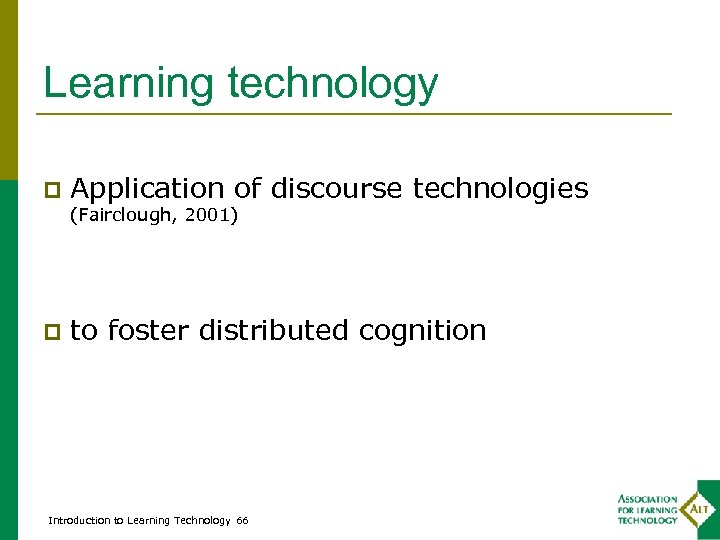
Learning technology p Application of discourse technologies (Fairclough, 2001) p to foster distributed cognition Introduction to Learning Technology 66
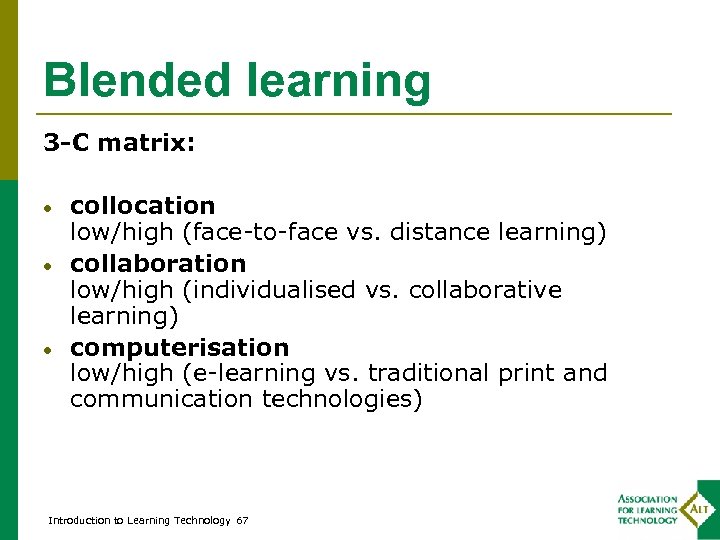
Blended learning 3 -C matrix: · · · collocation low/high (face-to-face vs. distance learning) collaboration low/high (individualised vs. collaborative learning) computerisation low/high (e-learning vs. traditional print and communication technologies) Introduction to Learning Technology 67
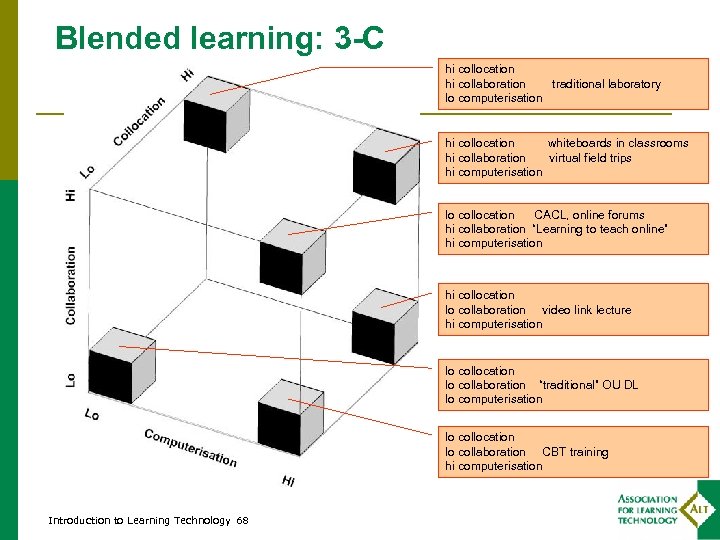
Blended learning: 3 -C hi collocation hi collaboration traditional laboratory lo computerisation hi collocation whiteboards in classrooms hi collaboration virtual field trips hi computerisation lo collocation CACL, online forums hi collaboration “Learning to teach online” hi computerisation hi collocation lo collaboration video link lecture hi computerisation lo collocation lo collaboration “traditional” OU DL lo computerisation lo collocation lo collaboration CBT training hi computerisation Introduction to Learning Technology 68
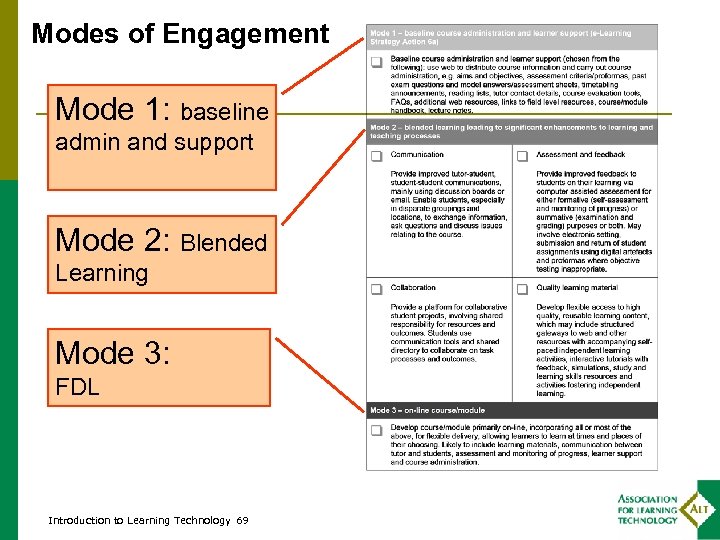
Modes of Engagement Mode 1: baseline admin and support Mode 2: Blended Learning Mode 3: FDL Introduction to Learning Technology 69

Thank you!
References and Resources p p p Gibbs, Graham and Claire Simpson (2004), “Conditions under which assessment supports students’ learning” in LATHE: Learning and Teaching in Higher Education 1(1), 3 -31 Harri-Augstein, S and Thomas, L F (1991). Learning Conversations, London, Routledge. Laurillard, D (2002). Rethinking University Teaching: A Conversational Framework for the Effective Use of Learning Technologies (2 nd Ed), Routledge, London Lillis, Theresa (2003), “Mapping the traditions of a social perspective on language and literacy” in Goodman et al, Language, Literacy and Education, Trentham/Open University Pask, G (1975). Conversation, Cognition and Learning, Elsevier, Amsterdam. Pask, G and Scott, B (1973). "CASTE: a system for exhibiting learning strategies and regulating uncertainty", Int. J. Man-Machine Studies, 5, pp. 17 -52. Rowntree, D (1990). Teaching Through Self-Instruction: How to Develop Open Learning Materials, Kogan Page, London. Ryan, S, Scott, B, Freeman, H and Patel, D (2000). The Virtual University: The Internet and Resource Based Learning, Kogan Page, London. Scott, B et al (2004). The Online Learning Knowledge Garden, http: //ollkg. rmcs. cranfield. ac. uk. Street, Brian (1997), “The implications of the ‘New Literacy Studies’ for literacy education” in Goodman et al, Language, Literacy and Education, Trentham/Open University Weller, Martin (2002) Delivering Learning on the Net. Kogan. Page, Routledge. Falmer Introduction to Learning Technology 71
Скачать презентацию Introduction to Learning Theory and Course Design Bernard
ece3a0f4658b003dd50c07d34d554751.ppt