 Скачать презентацию Introduction to Islamic Banking and Finance Principles and
d5a2f5abea3c3b41609ef8de8b8e3ad8.ppt
- Количество слайдов: 64



Introduction to Islamic Banking and Finance: Principles and Practice M. Kabir Hassan, Rasem N. Kayed, and Umar A. Oseni Chapter 3 Financial Instruments of Islamic Banking and Finance
Learning Objectives Upon completion of this chapter, the reader should be able to: • Describe the sources and uses of funds and the operation of bank accounts by Islamic banks; • Understand how exchange-based contracts are utilized as financial instruments in Islamic finance; • Understand how service-based contracts are utilized as financial instruments in Islamic finance; • Understand how partnership contracts are utilized as financial instruments in Islamic finance; and • Know the nature of supporting contracts in Islamic finance, including the unilateral supporting contracts.
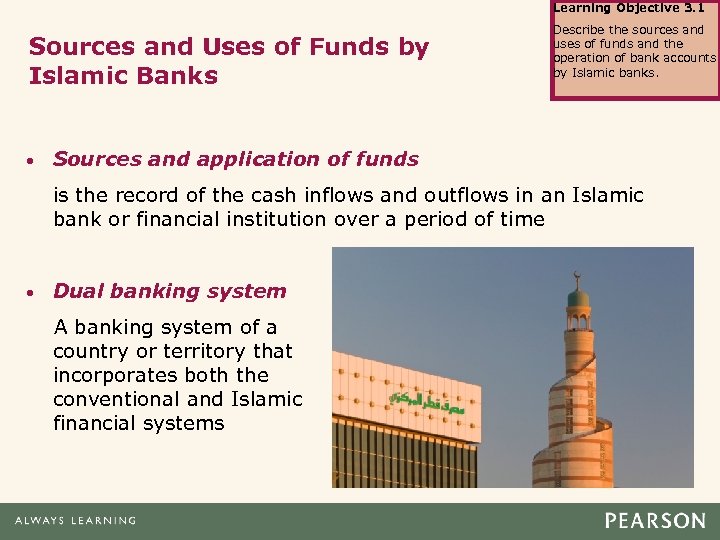
Learning Objective 3. 1 Sources and Uses of Funds by Islamic Banks • Describe the sources and uses of funds and the operation of bank accounts by Islamic banks. Sources and application of funds is the record of the cash inflows and outflows in an Islamic bank or financial institution over a period of time • Dual banking system A banking system of a country or territory that incorporates both the conventional and Islamic financial systems
Learning Objective 3. 1 Sources and Uses of Funds by Islamic Banks Describe the sources and uses of funds and the operation of bank accounts by Islamic banks. Sources of Funds Two major sources 1. Transaction deposits: risk-free funds which do not yield return e. g. current accounts based on the wadi’ah concept 2. Investment deposits: profit-making but have risk of capital loss, depending on amount invested by bank
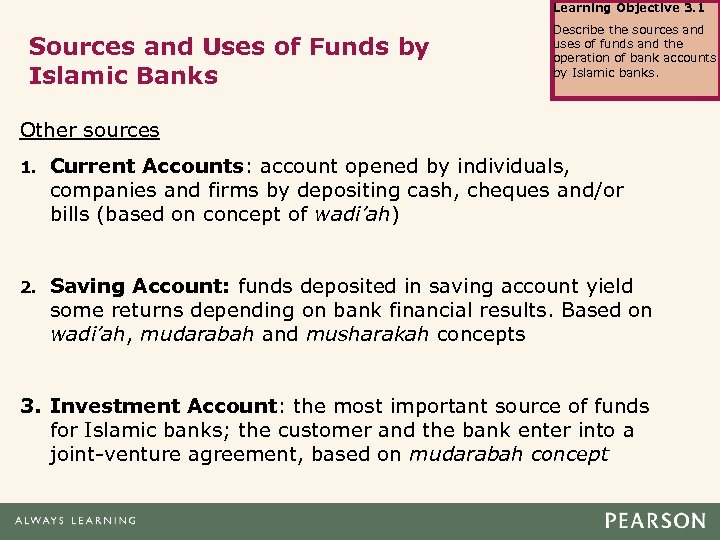
Learning Objective 3. 1 Sources and Uses of Funds by Islamic Banks Describe the sources and uses of funds and the operation of bank accounts by Islamic banks. Other sources 1. Current Accounts: account opened by individuals, companies and firms by depositing cash, cheques and/or bills (based on concept of wadi’ah) 2. Saving Account: funds deposited in saving account yield some returns depending on bank financial results. Based on wadi’ah, mudarabah and musharakah concepts 3. Investment Account: the most important source of funds for Islamic banks; the customer and the bank enter into a joint-venture agreement, based on mudarabah concept
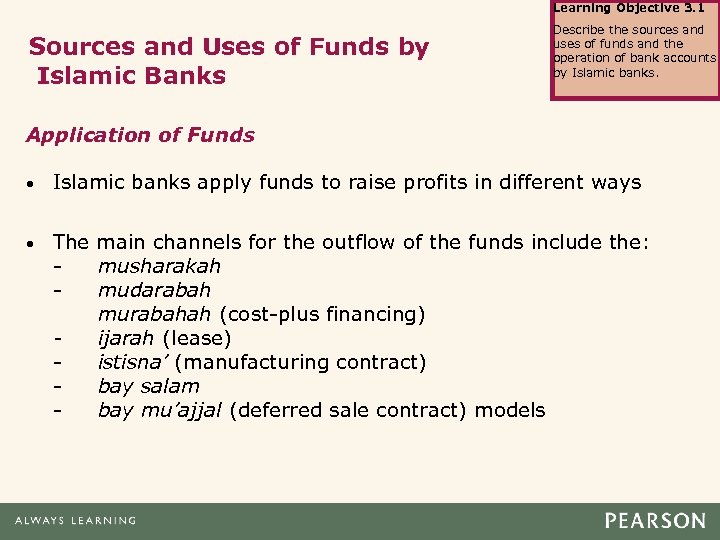
Learning Objective 3. 1 Sources and Uses of Funds by Islamic Banks Describe the sources and uses of funds and the operation of bank accounts by Islamic banks. Application of Funds • Islamic banks apply funds to raise profits in different ways • The main channels for the outflow of the funds include the: musharakah mudarabah murabahah (cost-plus financing) ijarah (lease) istisna’ (manufacturing contract) - bay salam bay mu’ajjal (deferred sale contract) models
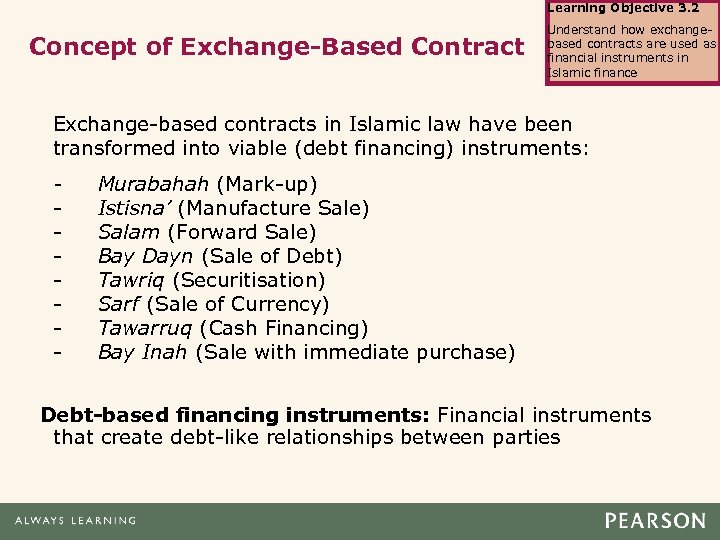
Learning Objective 3. 2 Concept of Exchange-Based Contract Understand how exchangebased contracts are used as financial instruments in Islamic finance Exchange-based contracts in Islamic law have been transformed into viable (debt financing) instruments: - Murabahah (Mark-up) Istisna’ (Manufacture Sale) Salam (Forward Sale) Bay Dayn (Sale of Debt) Tawriq (Securitisation) Sarf (Sale of Currency) Tawarruq (Cash Financing) Bay Inah (Sale with immediate purchase) Debt-based financing instruments: Financial instruments that create debt-like relationships between parties
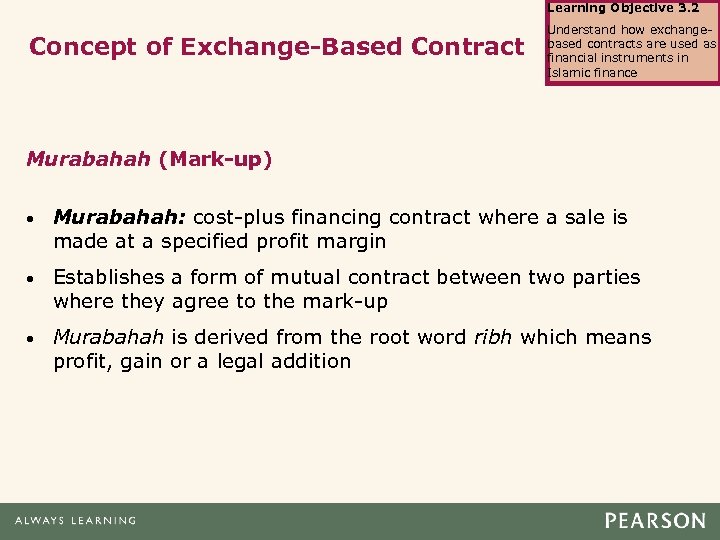
Learning Objective 3. 2 Concept of Exchange-Based Contract Understand how exchangebased contracts are used as financial instruments in Islamic finance Murabahah (Mark-up) • Murabahah: cost-plus financing contract where a sale is made at a specified profit margin • Establishes a form of mutual contract between two parties where they agree to the mark-up • Murabahah is derived from the root word ribh which means profit, gain or a legal addition
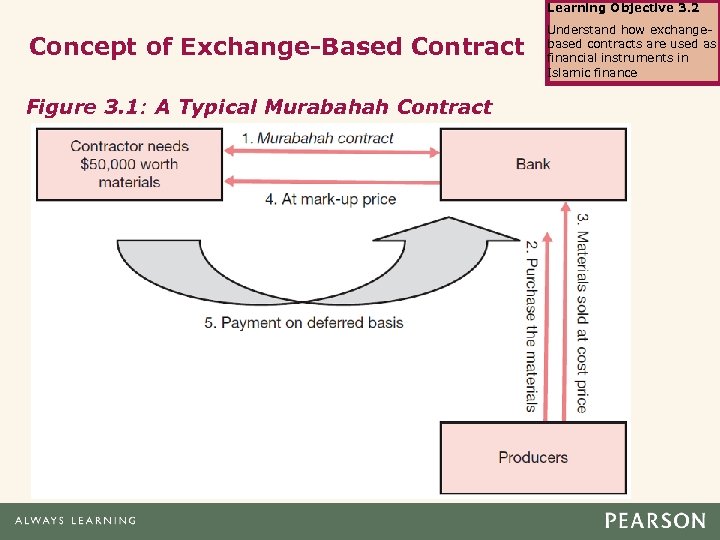
Learning Objective 3. 2 Concept of Exchange-Based Contract Figure 3. 1: A Typical Murabahah Contract Understand how exchangebased contracts are used as financial instruments in Islamic finance
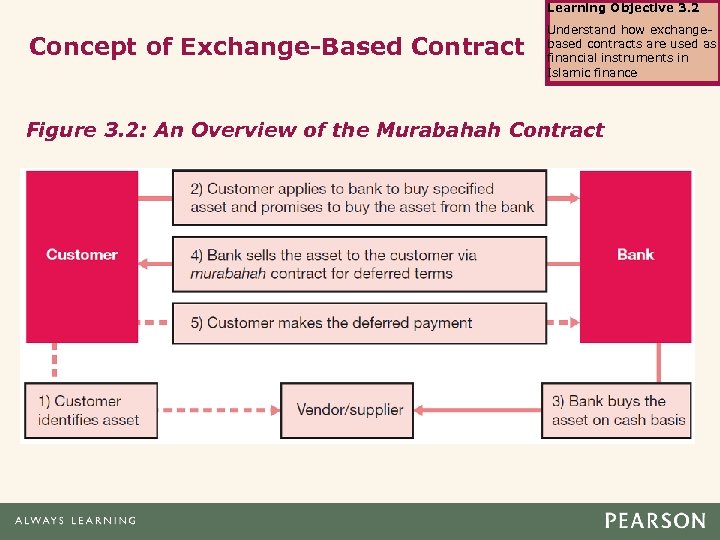
Learning Objective 3. 2 Concept of Exchange-Based Contract Understand how exchangebased contracts are used as financial instruments in Islamic finance Figure 3. 2: An Overview of the Murabahah Contract
Learning Objective 3. 2 Concept of Exchange-Based Contract Understand how exchangebased contracts are used as financial instruments in Islamic finance The specific conditions for a valid murabahah transaction: 1. Goods subject to murabahah 2. Original Cost Price of the Goods and any Addition Procurement Costs 3. Margin of Profit Margin of profit (also net margin): Ratio determining the degree at which profit is realised, calculated by dividing net profits by sales
Learning Objective 3. 2 Concept of Exchange-Based Contract Understand how exchangebased contracts are used as financial instruments in Islamic finance Istisna’ (Manufacturing Contract) • Istisna’: A manufacturing contract of a made-to-order asset based on a deferred delivery basis. It is a transaction on a commodity before the commodity is produced • The manufacturer is morally obliged to produce items: - at the agreed time - in accordance with specifications (price, quality, description) • The price, specification, description and quality of the commodity to be manufactured should be fixed with the consent of the parties to the contract
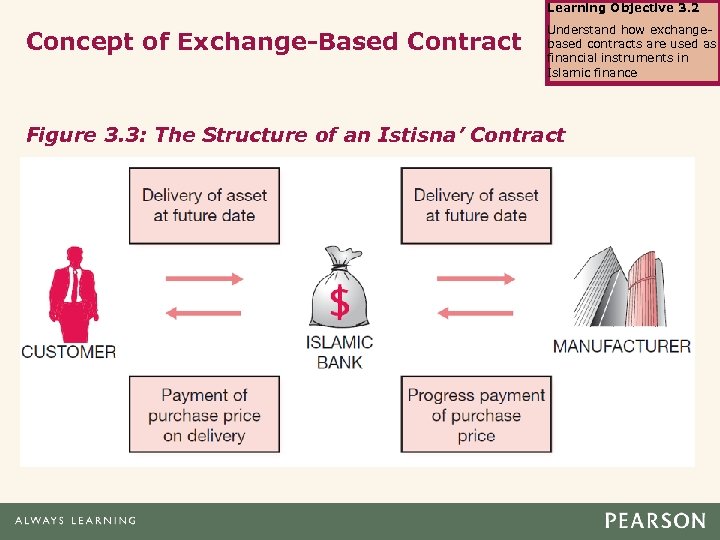
Learning Objective 3. 2 Concept of Exchange-Based Contract Understand how exchangebased contracts are used as financial instruments in Islamic finance Figure 3. 3: The Structure of an Istisna’ Contract
Learning Objective 3. 2 Concept of Exchange-Based Contract Understand how exchangebased contracts are used as financial instruments in Islamic finance The Suitability of Istisna’ The istisna’ structure is most suited for • Project finance • Construction • Manufacture and design of machinery for specific purposes, and • Trade finance
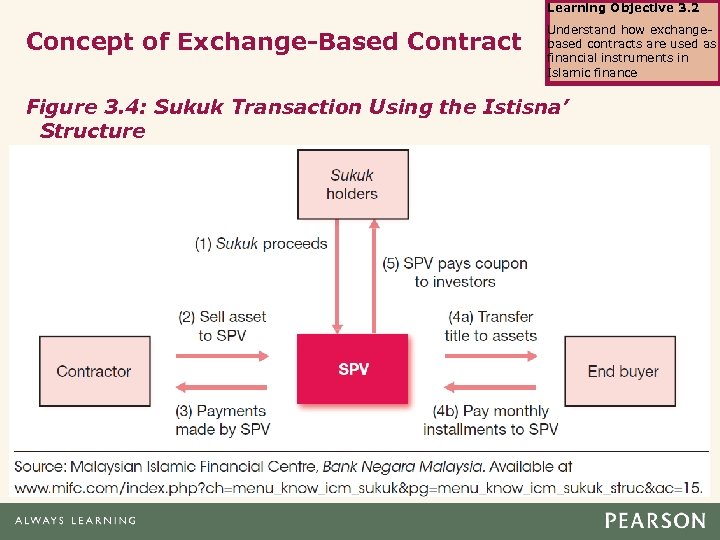
Learning Objective 3. 2 Concept of Exchange-Based Contract Understand how exchangebased contracts are used as financial instruments in Islamic finance Figure 3. 4: Sukuk Transaction Using the Istisna’ Structure
Learning Objective 3. 2 Concept of Exchange-Based Contract Understand how exchangebased contracts are used as financial instruments in Islamic finance Salam or Bay al-salam (Forward Sale) • A forward sale contract where advance payment is made for goods to be delivered later - • does not require the commodity to exist at the time of concluding the contract the delivery of the commodity is deferred Facilitates the commercial activities of farmers before crops are harvested - farmers get paid in advance before a harvest
Learning Objective 3. 2 Concept of Exchange-Based Contract Understand how exchangebased contracts are used as financial instruments in Islamic finance Salam (Forward Sale) There are 10 conditions for the validity of a salam contract as generally agreed upon by Muslim jurists – see page x Bay Dayn (Sale of Debt) • Bay al-dayn (sale of debt) A sale and purchase transaction involving a quality debt • Muslim jurists are not unanimous on the permissibility of this form of sale
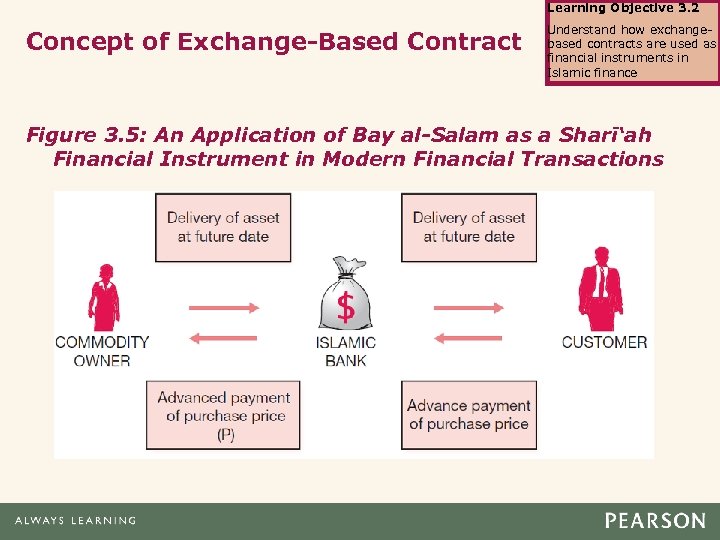
Learning Objective 3. 2 Concept of Exchange-Based Contract Understand how exchangebased contracts are used as financial instruments in Islamic finance Figure 3. 5: An Application of Bay al-Salam as a Sharī‘ah Financial Instrument in Modern Financial Transactions
Learning Objective 3. 2 Concept of Exchange-Based Contract Understand how exchangebased contracts are used as financial instruments in Islamic finance Bay Dayn Position of the Four Major Muslim Schools • Shafi’i School: Sale of debt is allowed to a third party only if the debt was initially guaranteed and was sold in exchange for goods to be delivered immediately • Hanafi School: Sale of debt not allowed in Islamic commercial transactions • Maliki School: Sale of debt allowed subject to conditions • Hanbali School: divides the sale of debt into two: - confirmed debts can be sold on the spot - unconfirmed debts are not tradable
Learning Objective 3. 2 Concept of Exchange-Based Contract Understand how exchangebased contracts are used as financial instruments in Islamic finance Bay al-Inah (Sale with immediate repurchase) • Bay al-Inah: Where a commodity is sold on a cash basis; the seller immediately repurchases the same commodity on a deferred payment basis at a price higher than the initial cash price • Used in different real estate and house financing situations • Bay al-inah is controversial in the global Islamic finance industry
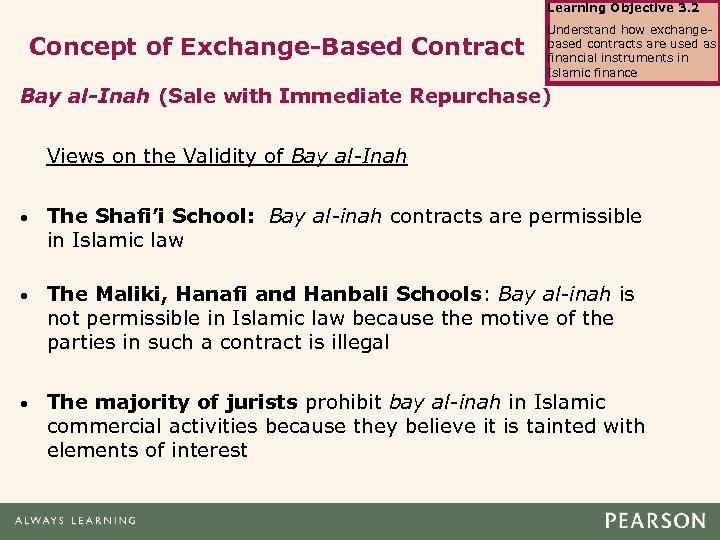
Learning Objective 3. 2 Concept of Exchange-Based Contract Understand how exchangebased contracts are used as financial instruments in Islamic finance Bay al-Inah (Sale with Immediate Repurchase) Views on the Validity of Bay al-Inah • The Shafi’i School: Bay al-inah contracts are permissible in Islamic law • The Maliki, Hanafi and Hanbali Schools: Bay al-inah is not permissible in Islamic law because the motive of the parties in such a contract is illegal • The majority of jurists prohibit bay al-inah in Islamic commercial activities because they believe it is tainted with elements of interest
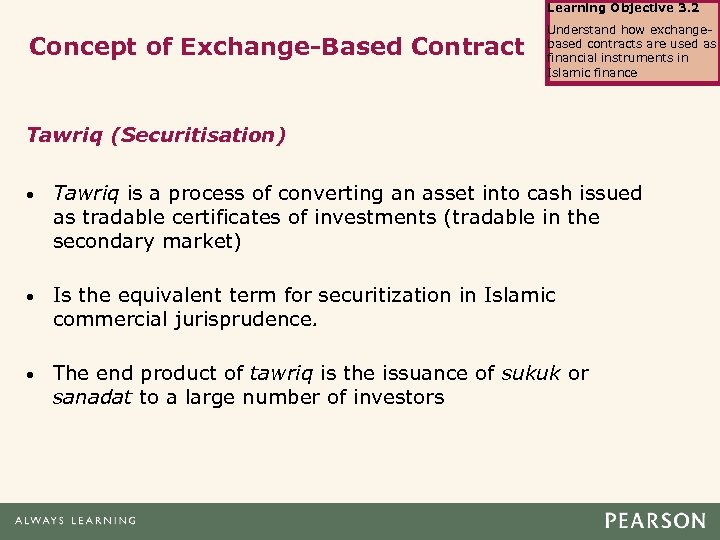
Learning Objective 3. 2 Concept of Exchange-Based Contract Understand how exchangebased contracts are used as financial instruments in Islamic finance Tawriq (Securitisation) • Tawriq is a process of converting an asset into cash issued as tradable certificates of investments (tradable in the secondary market) • Is the equivalent term for securitization in Islamic commercial jurisprudence. • The end product of tawriq is the issuance of sukuk or sanadat to a large number of investors
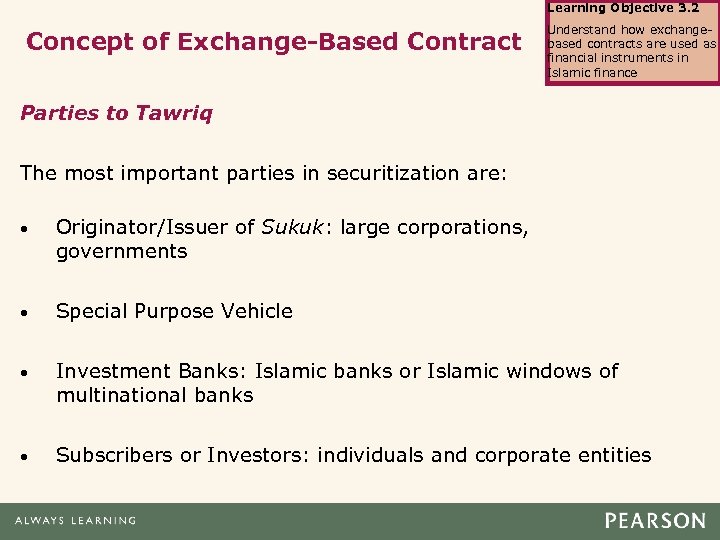
Learning Objective 3. 2 Concept of Exchange-Based Contract Understand how exchangebased contracts are used as financial instruments in Islamic finance Parties to Tawriq The most important parties in securitization are: • Originator/Issuer of Sukuk: large corporations, governments • Special Purpose Vehicle • Investment Banks: Islamic banks or Islamic windows of multinational banks • Subscribers or Investors: individuals and corporate entities
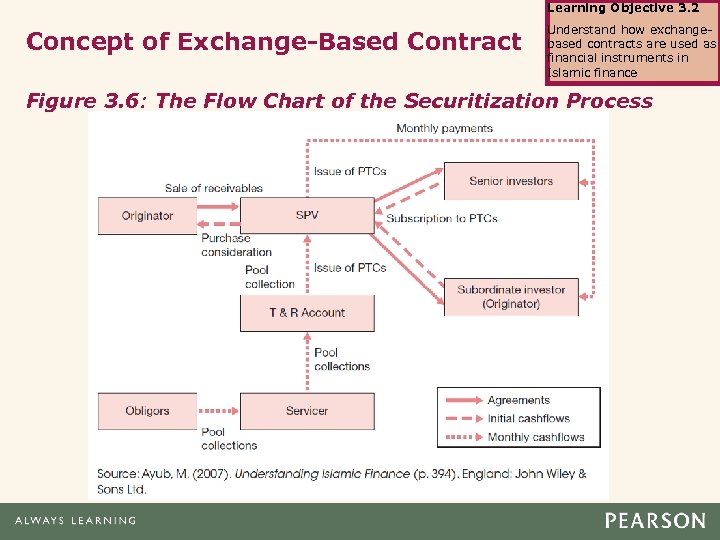
Learning Objective 3. 2 Concept of Exchange-Based Contract Understand how exchangebased contracts are used as financial instruments in Islamic finance Figure 3. 6: The Flow Chart of the Securitization Process
Learning Objective 3. 2 Concept of Exchange-Based Contract Understand how exchangebased contracts are used as financial instruments in Islamic finance Sarf (Sale of Currency) Definition and Nature • bay’ al-sarf: a foreign exchange contract involving exchange of currencies either of the same or of different kinds • The delivery of both currencies has to be made in full at the time of concluding the contract • The contract of exchange must take place at the same sitting where the contract is drawn up
Learning Objective 3. 2 Concept of Exchange-Based Contract Understand how exchangebased contracts are used as financial instruments in Islamic finance Sarf (Sale of Currency) Validity of Foreign Exchange Contract in Islamic Law • Trade in currency is permissible in Islamic law. “Gold for gold, silver for silver, wheat for wheat, barley for barley, dates for dates. . . hand to hand. . . ” (The Hadith) • Limitation: the exchange must be done hand-to-hand in one sitting if it involves different currencies • If the currencies are the same, the currencies being exchanged must be of equal amounts, and the exchange must take place at the same sitting
Learning Objective 3. 2 Concept of Exchange-Based Contract Understand how exchangebased contracts are used as financial instruments in Islamic finance Tawarruq (Cash Financing or Reverse Murabahah) • Hybrid sale contract where a customer approaches a financial institution to purchase a commodity with payment arranged in instalments and in turn sells the commodity to a third party for cash • Permissibility of Tawarruq is based on: - The general principles of a typical contract of sale - The absence of any bit of interest in this transaction (it does not amount to riba) • Permissibility of Tawarruq is subject to: - The person must be in real need of money - No other permissible alternative available - The contract being free of any modicum of riba - The customer having full possession of the commodity
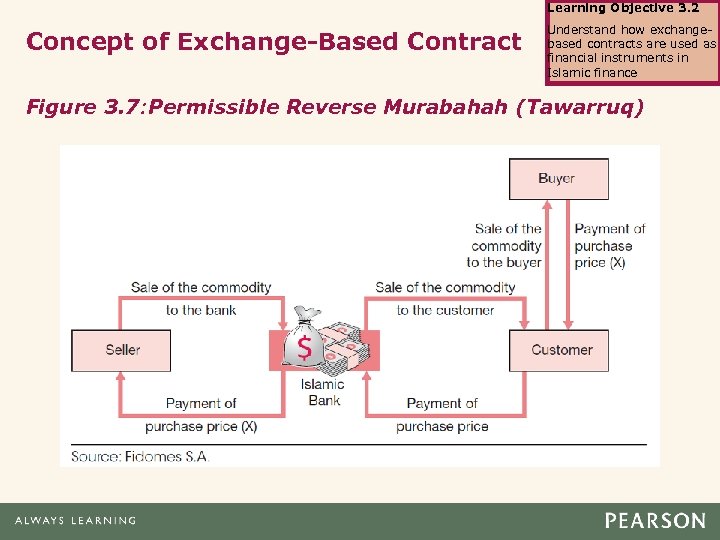
Learning Objective 3. 2 Concept of Exchange-Based Contract Understand how exchangebased contracts are used as financial instruments in Islamic finance Figure 3. 7: Permissible Reverse Murabahah (Tawarruq)
Concept of Service-Based Contract The service-based contracts include: Learning Objective 3. 3 Understand how servicebased contracts are used as financial instruments in Islamic finance • ijarah (leasing) • ijarah muntahia bi al-tamlik (financial lease) • ijarah thumma al-bay (leasing and subsequent purchase) • ujrah (fees) • ju’alah (commission) Ijarah (Leasing) • Ijarah: Financing mechanism involving rental of an asset or hire purchase where a form of rental fee is paid for a stipulated period of time agreed by the parties • In Islamic jurisprudence the term has been used in different ways
Learning Objective 3. 3 Concept of Service-Based Contract • Understand how servicebased contracts are used as financial instruments in Islamic finance Modern application of ijarah are: - Al-ijarah thumma al-bay’ (a contract of lease ending with sale) - Ijarah muntahia bi al-tamlik (leasing ending with ownership) Ijarah Muntahia Bi al-tamlik (Financial Lease) A typical lease contract which concludes in a transfer of legal title and confers ownership on the lessee - Ijarah means lease - Tamlik denotes ownership
Learning Objective 3. 3 Concept of Service-Based Contract Understand how servicebased contracts are used as financial instruments in Islamic finance Ijarah thumma al-bay (Leasing and Subsequent Purchase) • Ijarah thumma al-bay: a contract of lease subsequently followed by a sale contract • Two separate contracts are concluded under this chain transaction - The ijarah contract - The purchase contract
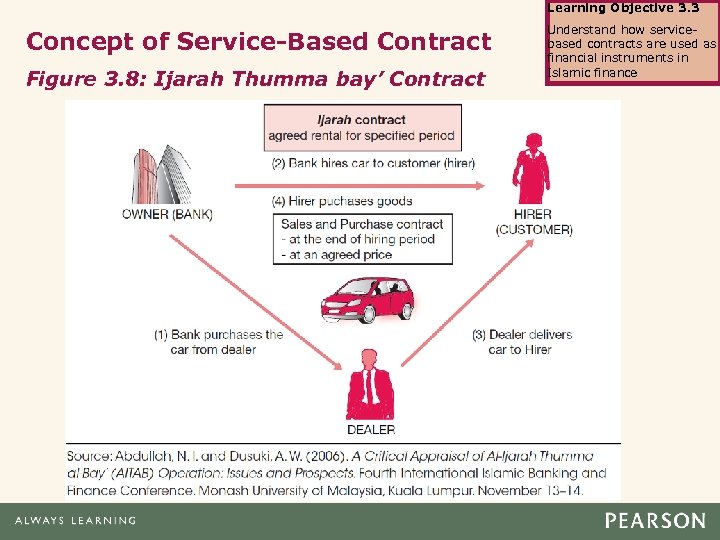
Learning Objective 3. 3 Concept of Service-Based Contract Figure 3. 8: Ijarah Thumma bay’ Contract Understand how servicebased contracts are used as financial instruments in Islamic finance
Learning Objective 3. 3 Concept of Service-Based Contract Understand how servicebased contracts are used as financial instruments in Islamic finance Ijarah mausufah fi dhimmah (Forward Lease) • Ijarah mausufah fi dhimmah lease agreement is concluded on a contract not in existence • The lessor delivers the asset to the lessee in accordance with agreed specifications • The modern application of forward lease is diverse; it can be used in: - medical treatment - education - tourism
Learning Objective 3. 3 Concept of Service-Based Contract Understand how servicebased contracts are used as financial instruments in Islamic finance Ujrah (Fees) • Ujrah: a payment for usufruct in the use of another person’s property or payment for service in contract of ijarah • Most Islamic financial institutions charge service fees for services rendered to customers. Services fees should be paid for through the ujrah scheme • Ujrah has been used by a number of banks for Sharī‘ahcompliant credit card schemes
Learning Objective 3. 3 Concept of Service-Based Contract Understand how servicebased contracts are used as financial instruments in Islamic finance Ju’alah (Commission or Reward) • In the juristic sense, ju’alah is a one-sided contract where reward/commission is given for accomplishment of a task • The legality of the ju’alah contract is established in the Qur’an and Sunnah • There is an element of ju’alah in takaful contracts • Ju’alah may be useful in the recovery of overdue debts
Learning Objective 3. 3 Partnership Contracts in Islamic Finance Understand how servicebased contracts are used as financial instruments in Islamic finance Concept of Equity-Based Contract • The equity-based contracts generally involve some sort of partnership • Partnership contracts which have been transformed into financial instruments are - Mudarabah (trust financing) - Musharakah (joint-venture partnership) - Mmharakah mutanaqisah (diminishing partnership)
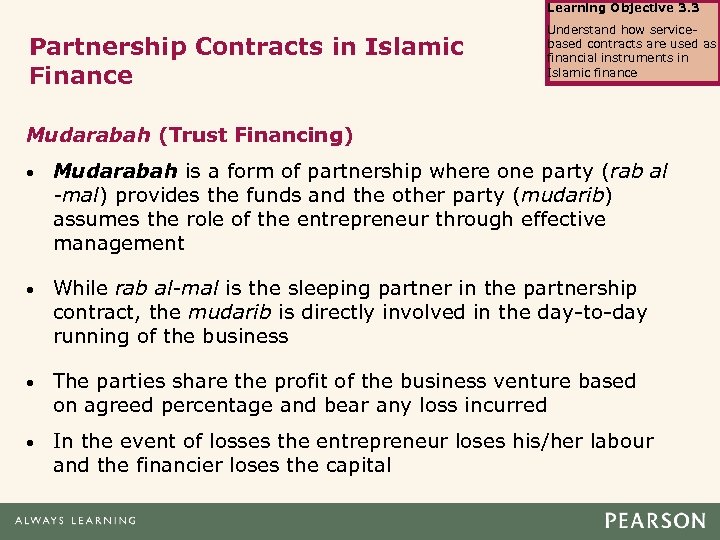
Learning Objective 3. 3 Partnership Contracts in Islamic Finance Understand how servicebased contracts are used as financial instruments in Islamic finance Mudarabah (Trust Financing) • Mudarabah is a form of partnership where one party (rab al -mal) provides the funds and the other party (mudarib) assumes the role of the entrepreneur through effective management • While rab al-mal is the sleeping partner in the partnership contract, the mudarib is directly involved in the day-to-day running of the business • The parties share the profit of the business venture based on agreed percentage and bear any loss incurred • In the event of losses the entrepreneur loses his/her labour and the financier loses the capital
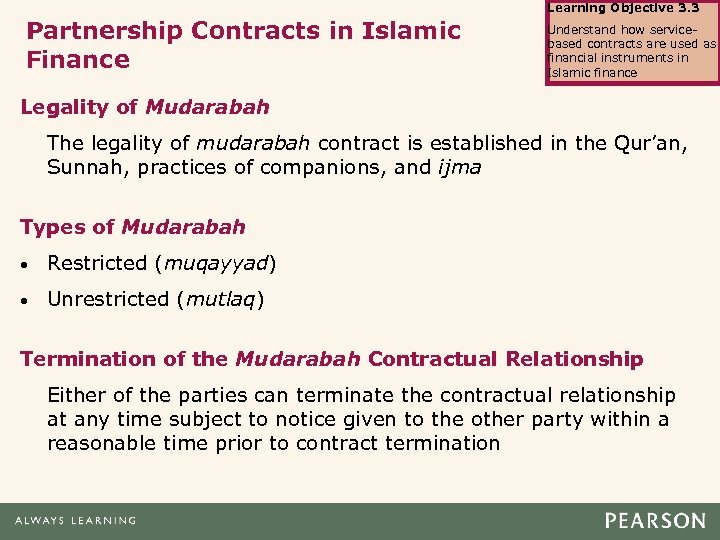
Learning Objective 3. 3 Partnership Contracts in Islamic Finance Understand how servicebased contracts are used as financial instruments in Islamic finance Legality of Mudarabah The legality of mudarabah contract is established in the Qur’an, Sunnah, practices of companions, and ijma Types of Mudarabah • Restricted (muqayyad) • Unrestricted (mutlaq) Termination of the Mudarabah Contractual Relationship Either of the parties can terminate the contractual relationship at any time subject to notice given to the other party within a reasonable time prior to contract termination

Learning Objective 3. 4 Partnership Contracts in Islamic Finance Understand how partnership contracts are used as financial instruments in Islamic finance Modern application of Mudarabah in Islamic banking and finance is being used in: - venture capital - project financing - unit trust - General Investment Account (GIA) - Specific Investment Account (SIA)
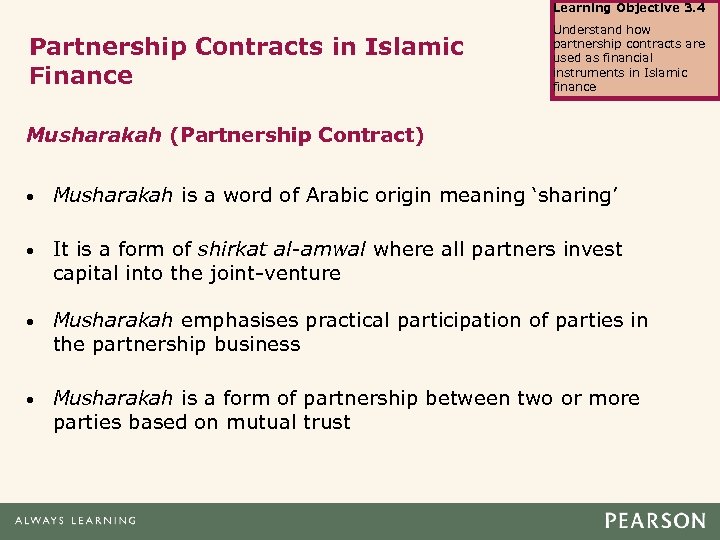
Learning Objective 3. 4 Partnership Contracts in Islamic Finance Understand how partnership contracts are used as financial instruments in Islamic finance Musharakah (Partnership Contract) • Musharakah is a word of Arabic origin meaning ‘sharing’ • It is a form of shirkat al-amwal where all partners invest capital into the joint-venture • Musharakah emphasises practical participation of parties in the partnership business • Musharakah is a form of partnership between two or more parties based on mutual trust
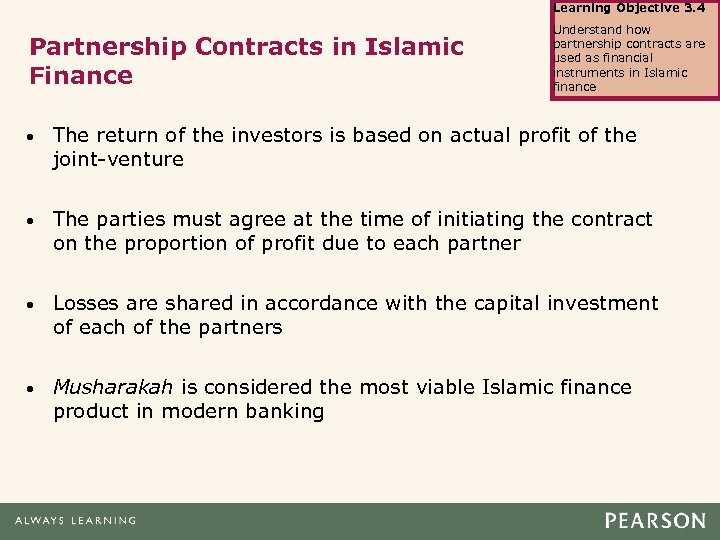
Learning Objective 3. 4 Partnership Contracts in Islamic Finance Understand how partnership contracts are used as financial instruments in Islamic finance • The return of the investors is based on actual profit of the joint-venture • The parties must agree at the time of initiating the contract on the proportion of profit due to each partner • Losses are shared in accordance with the capital investment of each of the partners • Musharakah is considered the most viable Islamic finance product in modern banking
Learning Objective 3. 4 Partnership Contracts in Islamic Finance Understand how partnership contracts are used as financial instruments in Islamic finance Legality of musharakah contract The legality of musharakah contract is established in the Qur’an, Sunnah and the practices of the companions and predecessors of the Prophet (PBUH). Modern application of musharakah Musharakah could be used effectively: - For small and medium enterprise (SME) - In the primary Islamic capital market (where sukuk certificates are issued)
Learning Objective 3. 4 Partnership Contracts in Islamic Finance Understand how partnership contracts are used as financial instruments in Islamic finance Differences between Musharakah and Mudarabah Contracts • Sources of financing the business • Rights of partners to participate in the management of the business • Sharing profits and losses • Liability of the partners • Ownership of assets
Learning Objective 3. 4 Partnership Contracts in Islamic Finance Understand how partnership contracts are used as financial instruments in Islamic finance Musharakah Mutanaqisah (Diminishing Partnership) . . . is long-term financing; a bank’s share in the ownership of a property decreases gradually due to the continuing sale of its shares to the customer against the payment of predetermined instalments • Musharakah Mutanaqisah is a chain of three contracts: - The first contract is that of joint ownership between a client and an enterprise (financier) - The second contract is a contract of lease between the financier and the client under the joint ownership - The third contract is where the client partner concludes another contract with the financing partner
Supporting Contracts Hawalah (Transfer of Debt) Learning Objective 3. 5 Know the nature of supporting contracts in Islamic finance, including the unilateral supporting contracts. In literal terms, hawalah means assignment, bill of exchange, or promissory note. In the juristic sense, it is a special type of security contract which simply means debt assignment. Essential Elements of Hawalah • Muhal: The creditor/person to whom the transfer is made • Muhil: The transferor or debtor who assigns the debt • Muhal ‘alayhi: The transferee of the assigned debt • Al-Muhal bihi: The transferred debt, assigned from one debtor to another • The debt owed by the transferee to the principal debtor • Form of contract. The contract concludes with an offer from the principal debtor and acceptance by transferee & creditor
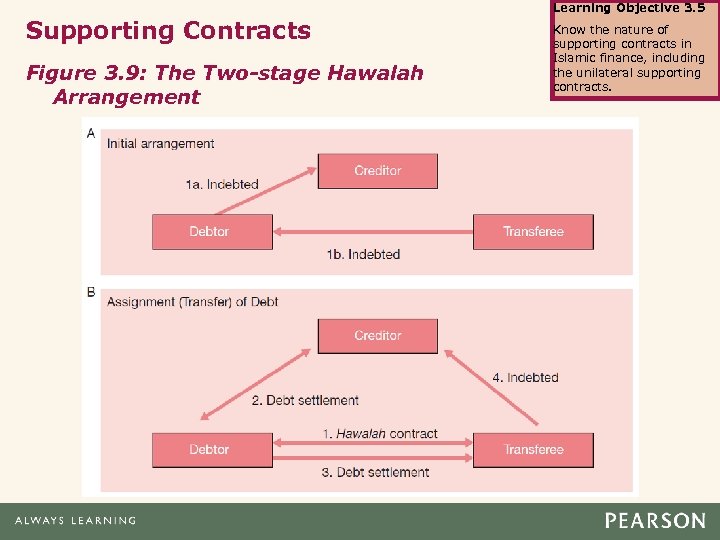
Learning Objective 3. 5 Supporting Contracts Figure 3. 9: The Two-stage Hawalah Arrangement Know the nature of supporting contracts in Islamic finance, including the unilateral supporting contracts.
Learning Objective 3. 5 Supporting Contracts Modern Application of Hawalah The modern application of hawalah comprises: - Bills of exchange (suftajah) - Issuance of cheques against current account - Endorsement of a negotiable instrument - Transfer of money or remittance (al-sarf) Know the nature of supporting contracts in Islamic finance, including the unilateral supporting contracts.
Learning Objective 3. 5 Supporting Contracts Know the nature of supporting contracts in Islamic finance, including the unilateral supporting contracts. Rahn (Collateral/Pledge) A collateral, pledge or mortgage offered as security for a debt that allows the creditor to take away the debt from such security in the event of any default on the part of the debtor • The legality of rahn (mortgage) contract is established in the Qur’an and Sunnah • The significance of rahn contract is that it is a voluntary charitable contract (tabaru’) • The modern application of rahn contract employed in contracts involving credit transactions such as deferred sale or loans from IFIs
Supporting Contracts Muqasah (Setting-off) Muqasah: A debt settlement through a countertransaction or offsetting Types of Muqasah: 1. Muqasah al-Qanuniyyah (Legal Set-off) 2. Muqasah al-Talabiyyah (Set-off on Demand) 3. Muqasah al-Ittifaqiyyah (Consensual Set-off) Types of debt that can be set off: • Duyun al-naqd (currency debts) • Duyun al-‘ard (commodity debts) • Manfa’a (usufruct) Learning Objective 3. 5 Know the nature of supporting contracts in Islamic finance, including the unilateral supporting contracts.
Learning Objective 3. 5 Supporting Contracts Know the nature of supporting contracts in Islamic finance, including the unilateral supporting contracts. Legality of Muqasah Three views have been expressed: • First view: Muqasah is an approved method of settlement of identical debts between two parties • Second view: Muqasah is merely an exception to bay aldayn (sale of debts) • Third view: Muqasah is a sale of debts by its real nature because its subject matter is debt which is intangible
Learning Objective 3. 5 Supporting Contracts Know the nature of supporting contracts in Islamic finance, including the unilateral supporting contracts. Kafalah (Guarantee) Kafalah: A binding promise to be liable for the debt of a principal debtor in case they default or fail to redeem the debt but such liability does not relieve the principal debtor from liability Legality of Kafalah The concept of guarantee has been in practice since the time of the Prophet (PBUH)
Learning Objective 3. 5 Supporting Contracts Know the nature of supporting contracts in Islamic finance, including the unilateral supporting contracts. Elements of Kafalah • Makful ‘anhu (principal debtor or obligor or guaranteed) • Kafil (surety or guarantor) • Makful lahu (creditor or obligee) • Makful bihi (object of guarantee) • Sighah (expression) Types of Kafalah • kafalah bi al-nafs (physical guarantee) • kafalah bi al-mal (financial guarantee)
Learning Objective 3. 5 Supporting Contracts Modern Application of Kafalah Know the nature of supporting contracts in Islamic finance, including the unilateral supporting contracts. The application of kafalah in modern Islamic financial institutions can be seen in: • Documentary credit system which is largely used in international trade • Credit card transactions • Supporting guarantee contract for the following major contracts in Islamic finance: mudarabah, murabahah, ijarahi, salam, istisna, and musharakah
Learning Objective 3. 5 Supporting Contracts Know the nature of supporting contracts in Islamic finance, including the unilateral supporting contracts. Wakalah (Agency) Wakalah Contract establishing an agency relationship between two parties for a purpose though such authority may be general or specific. The principal party is the muwakkil while the agent is the wakil The legitimacy of the concept and practice of Wakalah is established in the Qur’an and Sunnah Modern Application of Wakalah is seen in: - Modern Islamic banking, finance and takaful - Corporate Wakalah - Wakalah model of waqf
Learning Objective 3. 5 Supporting Contracts Know the nature of supporting contracts in Islamic finance, including the unilateral supporting contracts. Wadi‘ah (Safekeeping) Wadi‘ah is a contract that entrusts one’s precious property or money to the care of another, usually a trusted person or a secured corporate entity i. e. the bank • Muslim jurists unanimous in legality of wadi‘ah contract • Wadi‘ah is used in both current accounts and savings account The modern types of Wadi‘ah - Wadi‘ah yad al-amanah (Safe-keeping under a trust) - Wadi‘ah yad al-damanah (Safe-keeping with Guarantee)
Learning Objective 3. 5 Supporting Contracts Know the nature of supporting contracts in Islamic finance, including the unilateral supporting contracts. Concept of Unilateral Supporting Contracts made unilaterally without the usual offer and acceptance at the session of contract - Waqf (endowment) - Ibra’ (foregoing of right) - Hibah (gift) - Wa’ad (promise) - Tabarru’ (donation)
Learning Objective 3. 5 Supporting Contracts Waqf (Endowment) Know the nature of supporting contracts in Islamic finance, including the unilateral supporting contracts. Waqf: A charitable endowment in perpetuity for a specific purpose. It assists the poor and the less privileged in the society or benefits society at large Ibra’ (Forgoing of Right) Ibra’ can be defined as the waiving of one’s financial right or ownership in totality or partially Situations where the Islamic bank is inclined to use ibra': - When the debtor is unable to redeem the debt - When the customer makes an early settlement of a debt as means to encourage such practices
Learning Objective 3. 5 Supporting Contracts Know the nature of supporting contracts in Islamic finance, including the unilateral supporting contracts. Hibah (Gift) Hibah is the gratuitous transfer of property from one person to another without any formal material consideration • Hibah is used by Islamic financial institutions as a supporting Sharī‘ah instrument in other transactions such as al-ijarah thumma al-bay
Learning Objective 3. 5 Supporting Contracts Know the nature of supporting contracts in Islamic finance, including the unilateral supporting contracts. Wa’ad (Promise) Wa’ad: A promise or undertaking by a party to carry out a unilateral contract Examples of Wa'ad: - Murabahah transactions - al-ijarah thumma al-bay’ contracts Muwa’adah which is a derivative of wa’ad is a bilateral promise in a contractual form which may be conditional or unconditional
Learning Objective 3. 5 Supporting Contracts Know the nature of supporting contracts in Islamic finance, including the unilateral supporting contracts. Divergent Opinions of the Muslim Jurists on the Binding Nature of Wa’ad • Fulfilling wa’ad is recommended in financial transactions (Shafi’i school, some Maliki jurists, and Abu Hanifah • Fulfilling wa’ad is obligatory and it is usually enforceable (majority of the Maliki scholars) • Wa'ad is binding and enforceable except in cases where it is otherwise justified (Ibn Shubrimah)
Learning Objective 3. 5 Supporting Contracts Know the nature of supporting contracts in Islamic finance, including the unilateral supporting contracts. Tabarru’ (Donation) • Tabarru’: a gratuitous contract/donation which is unilateral but supportive of underlying contracts such as takaful • Ownership in the subject matter of tabarru’ is transferred at the time of donation from the donor to the done • The concept of tabarru’ is applicable in takaful, as well as in waqf donations managed by an Islamic financial institution for the benefit of the beneficiary
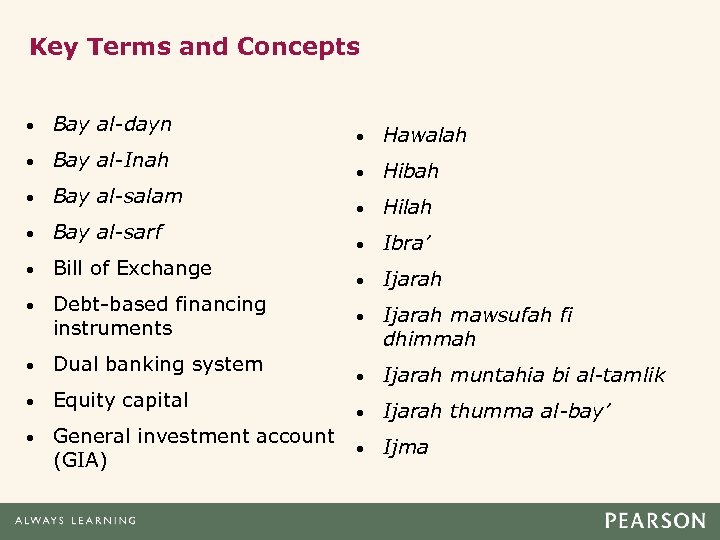
Key Terms and Concepts • Bay al-dayn • Bay al-Inah • Bay al-salam • Bay al-sarf • Bill of Exchange • Debt-based financing instruments • Dual banking system • Equity capital • General investment account • Ijma (GIA) • Hawalah • Hibah • Hilah • Ibra’ • Ijarah mawsufah fi dhimmah • Ijarah muntahia bi al-tamlik • Ijarah thumma al-bay’
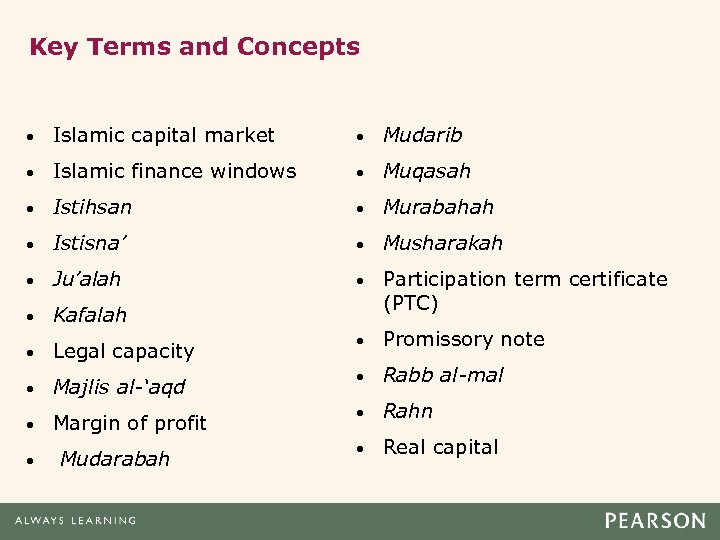
Key Terms and Concepts • Islamic capital market • Mudarib • Islamic finance windows • Muqasah • Istihsan • Murabahah • Istisna’ • Musharakah • Ju’alah • • Kafalah Participation term certificate (PTC) • Legal capacity • Promissory note • Majlis al-‘aqd • Rabb al-mal • Margin of profit • Rahn • Real capital • Mudarabah
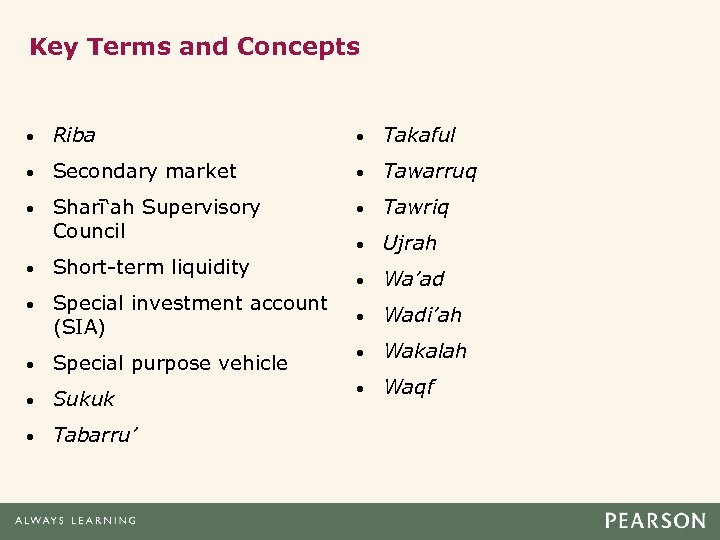
Key Terms and Concepts • Riba • Takaful • Secondary market • Tawarruq • Sharī‘ah Supervisory Council • Tawriq • Ujrah • Wa’ad • Wadi’ah • Wakalah • Waqf • Short-term liquidity • Special investment account (SIA) • Special purpose vehicle • Sukuk • Tabarru’
Скачать презентацию Introduction to Islamic Banking and Finance Principles and
d5a2f5abea3c3b41609ef8de8b8e3ad8.ppt