 Скачать презентацию Introduction to IPv 6 Todd Lammle Sybex Cisco
7e3c95744c42df7de54042b6bef1ff44.ppt
- Количество слайдов: 46



Introduction to IPv 6 Todd Lammle Sybex Cisco Author CEO, Router. Sim, inc President, Global. Net Training, inc Mark’s Buddy
About Todd Lammle • Sybex author – More than 40 titles published on Cisco; Microsoft; and wireless technologies. • President, Global. Net Training Inc. – Cisco, Microsoft, Security and wireless certification hands -on courses. www. globalnettraining. com. • CEO, Router. Sim, LLC – Cisco and Microsoft certification software products. www. routersim. com.
Introduction This session will discuss the history of the Internet and discuss the future protocol IPv 6
Some IP history… • The earliest documentation goes back to 1957 with the launch of Sputnik in Russia and the formation of ARPA by the Do. D • The first RFC was sent in 1969 and it was a request for host software • 1970: ARPANET started using NCP • 1971: 23 hosts are connected together from various universities • 1972: ITWG created and Telnet protocol published as a specification
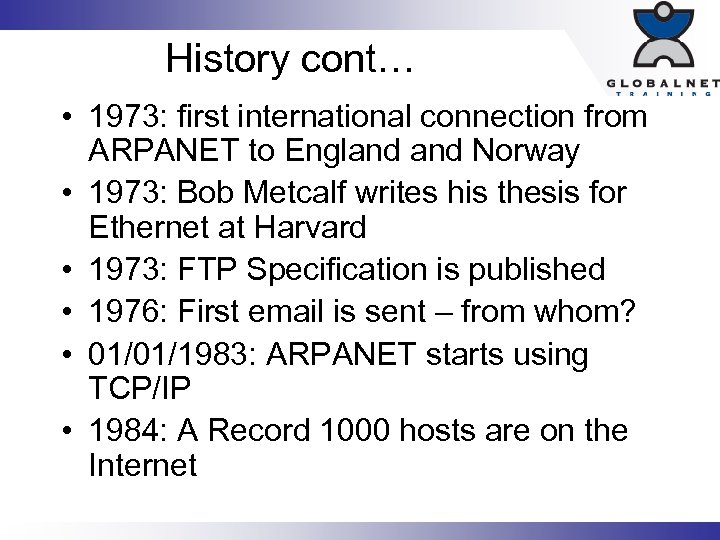
History cont… • 1973: first international connection from ARPANET to England Norway • 1973: Bob Metcalf writes his thesis for Ethernet at Harvard • 1973: FTP Specification is published • 1976: First email is sent – from whom? • 01/01/1983: ARPANET starts using TCP/IP • 1984: A Record 1000 hosts are on the Internet
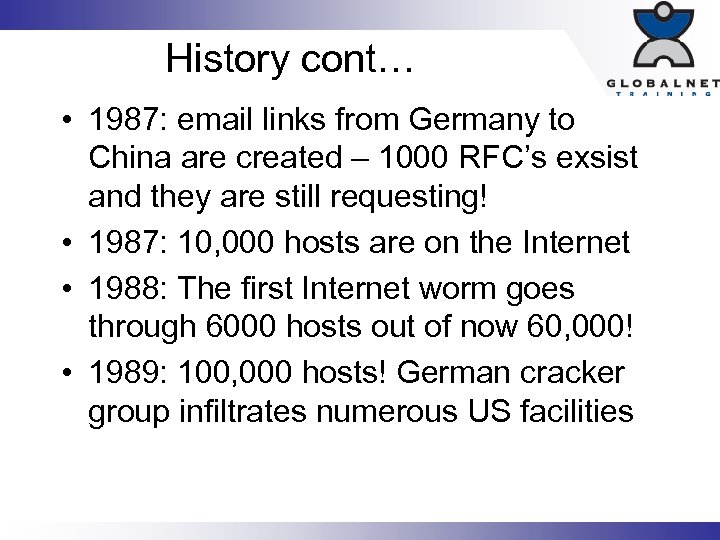
History cont… • 1987: email links from Germany to China are created – 1000 RFC’s exsist and they are still requesting! • 1987: 10, 000 hosts are on the Internet • 1988: The first Internet worm goes through 6000 hosts out of now 60, 000! • 1989: 100, 000 hosts! German cracker group infiltrates numerous US facilities
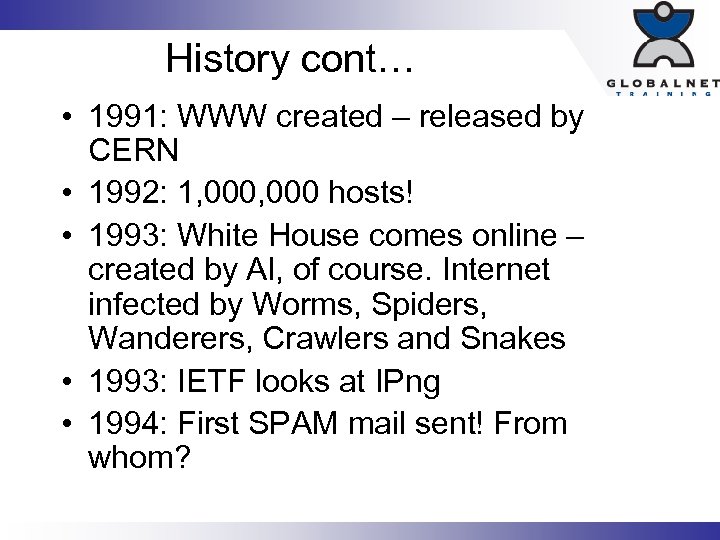
History cont… • 1991: WWW created – released by CERN • 1992: 1, 000 hosts! • 1993: White House comes online – created by Al, of course. Internet infected by Worms, Spiders, Wanderers, Crawlers and Snakes • 1993: IETF looks at IPng • 1994: First SPAM mail sent! From whom?
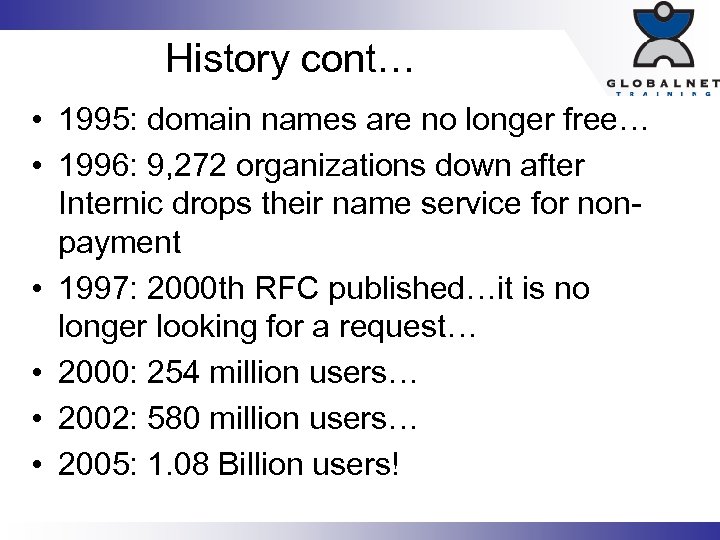
History cont… • 1995: domain names are no longer free… • 1996: 9, 272 organizations down after Internic drops their name service for nonpayment • 1997: 2000 th RFC published…it is no longer looking for a request… • 2000: 254 million users… • 2002: 580 million users… • 2005: 1. 08 Billion users!
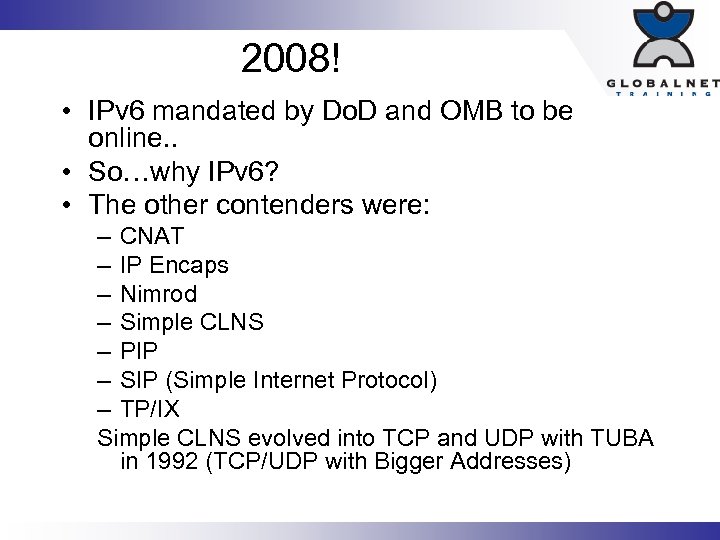
2008! • IPv 6 mandated by Do. D and OMB to be online. . • So…why IPv 6? • The other contenders were: – CNAT – IP Encaps – Nimrod – Simple CLNS – PIP – SIP (Simple Internet Protocol) – TP/IX Simple CLNS evolved into TCP and UDP with TUBA in 1992 (TCP/UDP with Bigger Addresses)
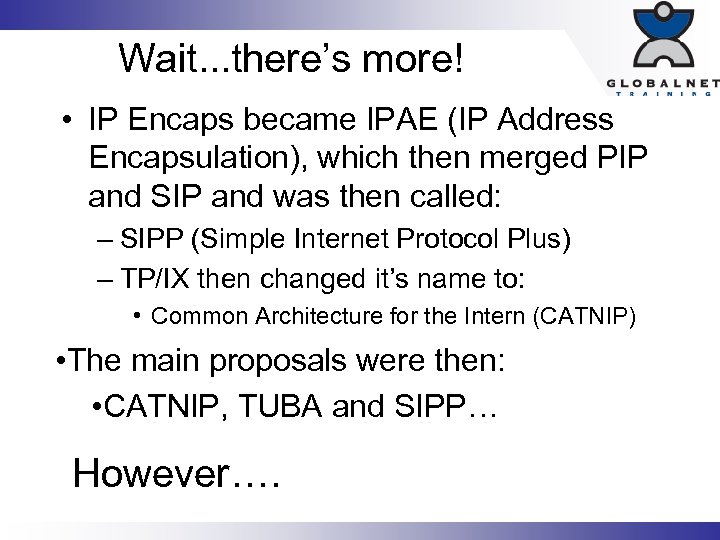
Wait. . . there’s more! • IP Encaps became IPAE (IP Address Encapsulation), which then merged PIP and SIP and was then called: – SIPP (Simple Internet Protocol Plus) – TP/IX then changed it’s name to: • Common Architecture for the Intern (CATNIP) • The main proposals were then: • CATNIP, TUBA and SIPP… However….
IPv 6 • All of the proposals and protocols became obsolete in 1994 when the IETF committee approved the IPv 6 specification. • The core IPv 6 protocols became an IETF draft standard in 1998…
IPv 6 • IPv 6 is an upgrade from IPv 4 • The upgrades are: – Extended address space – Autoconfiguration – Simplification of header format – Improved support for options and extensions
Extended Address Space • The US uses 60% of the allocated IPv 4 addresses – which leaves 40% for the rest of the world • IPv 4 theoretically has a limit of 4. 3 billion addresses • Only 14% of the worlds population has Internet access • We cannot have 20% with the IPv 4 address space…
Autoconfiguration • Vendors of all industries are developing monitoring, control and management systems based on IP • For many of the complex networks or tomorrow, autoconfiguration is a necessity • This is called Stateless • No NAT needed – not even supported!
Extension Headers • New IP header is only 2 times the size of IPv 4 header, but is more flexible in design, streamlined and can have new extensions added • Neighbor Discovery, autoconfiguation and Mobile IPv 6 will push IIPv 6 to all devices, including at least 12 addresses for every car produced • In 2008 all Cell phones will have IPv 6 addresses and become hosts • We need a protocol with extensible and flexible header and autoconfiguration
Mobility • Cellular networks will continue to grow • EVDO Rev B is set to come out late this year at 9 Mbs! • Rev A is at 4 Megs now… • In the UK, cell phones actually outnumber the number of people • Mobility is extremely important! • IPv 6 is elegant in design, supporting mobile users in a highly efficient manner which allows users to move between networks
Who is already running pure IPv 6? • Much of the world with US almost last in development…but will catch up fast! • Japan and Korea • China has probably one of the largest IPv 6 backbones, but we can’t prove it… • EU • India • Australia, Taiwan, Singapore, England Egypt • It’s happening faster then you think it is…
IPv 6 Addressing • IPv 4 is 32 bits long which provides 2, 113, 389 networks • IPv 6 has 128 bits and provides: – Per square meter of earth 340, 282, 366, 920, 463, 374, 607, 341, 768, 211, 456 hosts – 35, 184, 372, 088, 832 networks – Each of these networks can still be subnetted to 65, 536 subnets
Address Types • Unicast: Packets addressed to a unicast address are delivered to a single interface. For load balancing, multiple interfaces can use the same address • Multicast: Packets addressed to a multicast address are delivered to all interfaces identified by the multicast address – same as in IPv 4. Also called oneto-many addresses. An IPv 6 mutlicast address always starts with FF. • Anycast: This type of address identifies multiple interfaces, which is the same as multicast, however, the anycast packet is only delivered to one address, the first one it finds defined in the terms of routing distance. Can be called one-to-one-of-many.
Interfaces and Scopes • IPv 6 addresses assigned to interfaces • Single interfaces can have multiple addresses of all types • Nodes identified by any interface • One unicast can be assigned to multiple interfaces for load sharing • Scopes are global and non-global (link-local) – think of a scope as what we now call a subnet • Scope of an address is encoded as part of the whole address
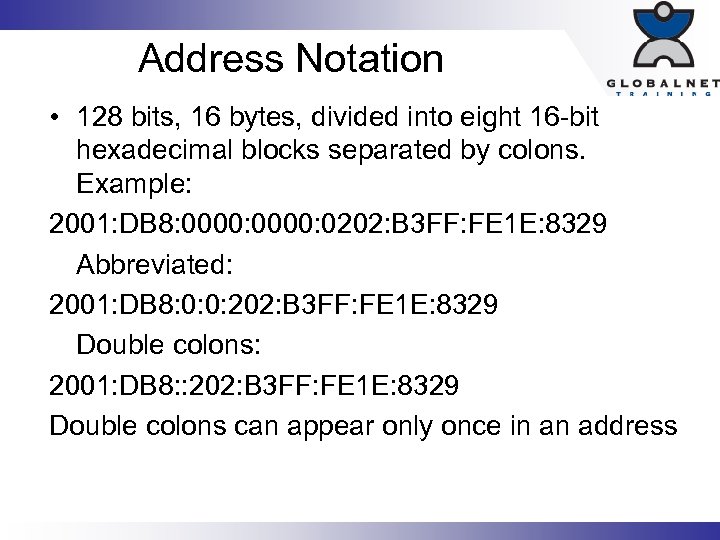
Address Notation • 128 bits, 16 bytes, divided into eight 16 -bit hexadecimal blocks separated by colons. Example: 2001: DB 8: 0000: 0202: B 3 FF: FE 1 E: 8329 Abbreviated: 2001: DB 8: 0: 0: 202: B 3 FF: FE 1 E: 8329 Double colons: 2001: DB 8: : 202: B 3 FF: FE 1 E: 8329 Double colons can appear only once in an address
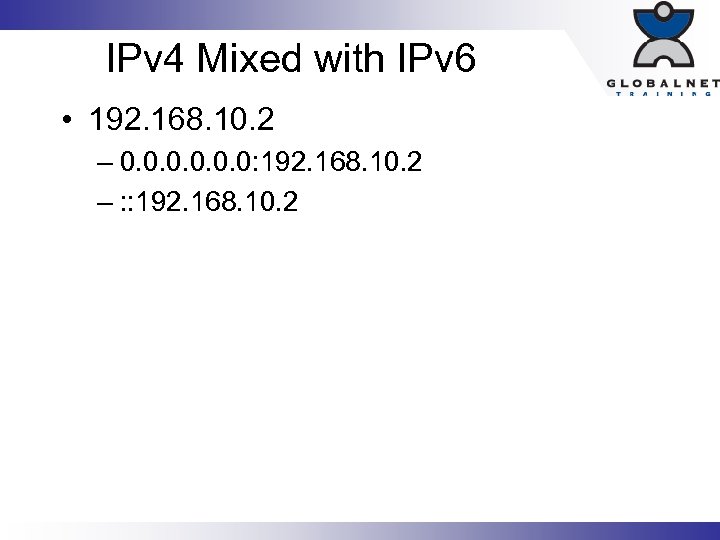
IPv 4 Mixed with IPv 6 • 192. 168. 10. 2 – 0. 0: 192. 168. 10. 2 – : : 192. 168. 10. 2
Aggregatable global unicast addresses • These are referred to just as global addresses and are the equivalent of a public IPv 4 address. • They are routable and reachable on the IPv 6 internet. These addresses were designed to help produce a more efficient, hierarchical addressing and routing infrastructure then in IPv 4.
Prefix Notation • The prefix notation is very similar to the way IPv 4 are written in CIDR format • Used for subnetting and routing
Global Routing Prefixes • Outlines the current assignment of reserved prefixed and special addresses, such as link-local or multicast. • Only 20% of the IPv 6 addresses are reserved • The Internet Assigned Numbers Authority (IANA) is responsible for assigning address space.
Interface ID • A node may discover a subnet ID by listening to Router Advertisement messages sent by a router on its attached link(s), and then fabricating an IPv 6 address for itself by using its IEEE MAC address as the interface ID on that subnet. • A host uses an identifier called the EUI-64 format during autoconfiguration. • Created by the 48 -bit MAC address • The hex digits of 0 xff-fe are inserted between the third and four bytes of the IPv 6 address • For example, a host with the MAC address of 00 -9096 -A 4 -3 F-07, would now look like this: 00 -90 -96 -FFFE-A 4 -3 F-07.
Special Addresses • All zero’s: 0. 0. Typically the source address of a host when you are using stateful. Written as : : . (0. 0 with IPv 4) • Loopback: 127. 0. 0. 1 = : : 1 (0. 0. 1)
6 to 4 Addresses • Used to let IPv 6 hosts or networks communicate over an IPv 4 -only infrastructure.
ISATAP Addresses • Intra-Site automatic Tunnel Address Protocol • Used on dual-stack nodes that are separated by an IPv 4 only infrastructure. • Allows IPv 6 node to automatically tunnel over the IPv 4 network
Teredo addresses • Allows IPv 6 to run on hosts that are behind a NAT device. • IPv 6 is tunneled within UDP
Link-local Addresses • Link-local address is for use on a single link and is not routed • Can be used for autoconfiguration, neighbor discovery for networks with no router. • The link-local addresses are automatically configured on each node and a router will never forward link-local traffic beyond the link. You can tell a link-local address because it always begins with FE 80: :
Site-local addresses • These addresses are equivalent to the private space we use with IPv 4, for example, 10. 0, 172. 16 -31. 0. 0 and 192. 168. 0. 0. • Since IPv 6 does not use NAT, the site-local addresses are used between nodes communicating other nodes in the same organization. • These are not automatically assigned like linklocal addresses and you can tell a site-local address because they always start with FEC 0: :
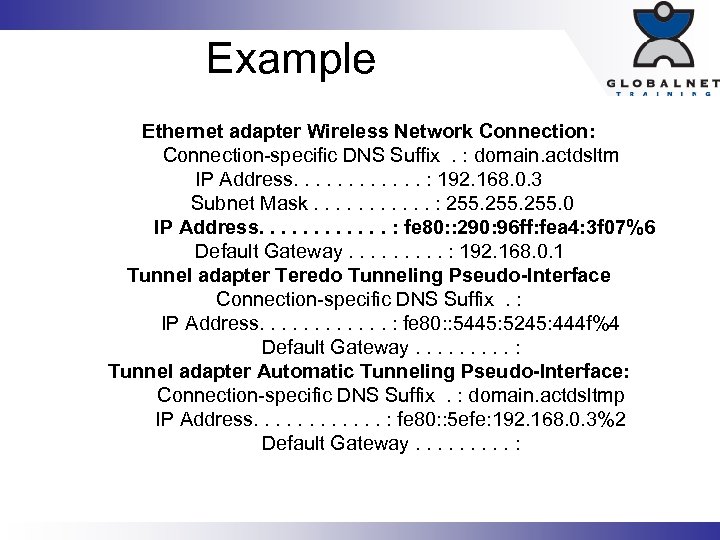
Example Ethernet adapter Wireless Network Connection: Connection-specific DNS Suffix. : domain. actdsltm IP Address. . . : 192. 168. 0. 3 Subnet Mask. . . : 255. 0 IP Address. . . : fe 80: : 290: 96 ff: fea 4: 3 f 07%6 Default Gateway. . : 192. 168. 0. 1 Tunnel adapter Teredo Tunneling Pseudo-Interface Connection-specific DNS Suffix. : IP Address. . . : fe 80: : 5445: 5245: 444 f%4 Default Gateway. . : Tunnel adapter Automatic Tunneling Pseudo-Interface: Connection-specific DNS Suffix. : domain. actdsltmp IP Address. . . : fe 80: : 5 efe: 192. 168. 0. 3%2 Default Gateway. . :
Anycast • Provides redundancy and load balancing in situations where multiple hosts or routers provide the same server. • Originally created for IPv 4 • Designed for DNS and HTTP servers • Not used too often. Shared unicast is typically used. Means a regular unicast address I assigned to multiple interfaces
Multicast • Identifier for a group of nodes identified by the high-order byte FF. • A node can belong to more then one multicast group • When a packet is sent to multicast address, all memebers fo the multicast goup process the packet. • It is refined and improved in IPv 6
ICMPv 6 • Like IPv 4 implementation but much more powerful and contains new functionality. • IGMP is now implemented within ICMP • ARP is now implemented within ICMP • Neighbor discovery (ND): uses Link local addresses for neighbors attached to the same link, find routers, keep track of neighbors, and detect changed linklayer addresses.
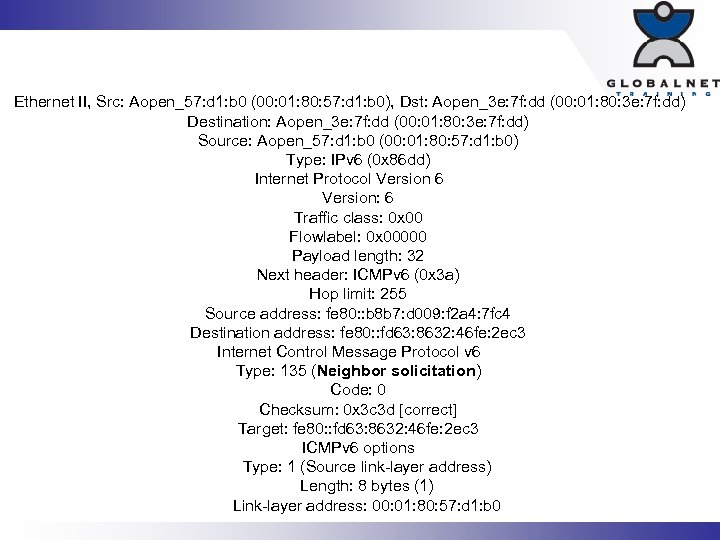
Ethernet II, Src: Aopen_57: d 1: b 0 (00: 01: 80: 57: d 1: b 0), Dst: Aopen_3 e: 7 f: dd (00: 01: 80: 3 e: 7 f: dd) Destination: Aopen_3 e: 7 f: dd (00: 01: 80: 3 e: 7 f: dd) Source: Aopen_57: d 1: b 0 (00: 01: 80: 57: d 1: b 0) Type: IPv 6 (0 x 86 dd) Internet Protocol Version 6 Version: 6 Traffic class: 0 x 00 Flowlabel: 0 x 00000 Payload length: 32 Next header: ICMPv 6 (0 x 3 a) Hop limit: 255 Source address: fe 80: : b 8 b 7: d 009: f 2 a 4: 7 fc 4 Destination address: fe 80: : fd 63: 8632: 46 fe: 2 ec 3 Internet Control Message Protocol v 6 Type: 135 (Neighbor solicitation) Code: 0 Checksum: 0 x 3 c 3 d [correct] Target: fe 80: : fd 63: 8632: 46 fe: 2 ec 3 ICMPv 6 options Type: 1 (Source link-layer address) Length: 8 bytes (1) Link-layer address: 00: 01: 80: 57: d 1: b 0
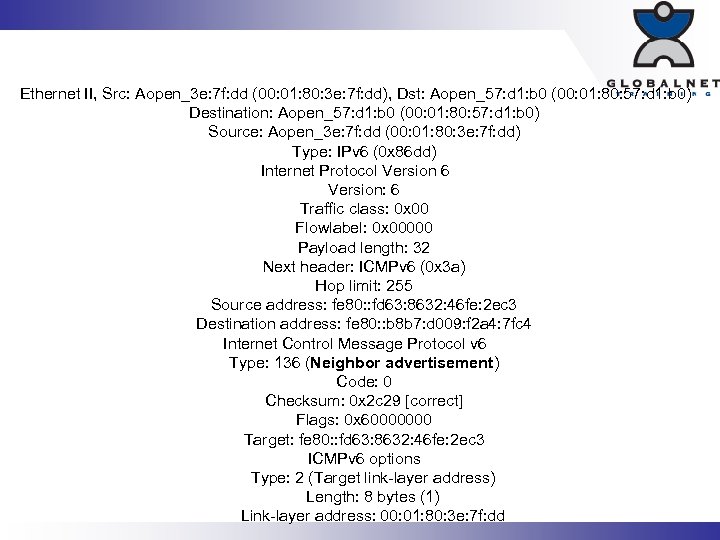
Ethernet II, Src: Aopen_3 e: 7 f: dd (00: 01: 80: 3 e: 7 f: dd), Dst: Aopen_57: d 1: b 0 (00: 01: 80: 57: d 1: b 0) Destination: Aopen_57: d 1: b 0 (00: 01: 80: 57: d 1: b 0) Source: Aopen_3 e: 7 f: dd (00: 01: 80: 3 e: 7 f: dd) Type: IPv 6 (0 x 86 dd) Internet Protocol Version 6 Version: 6 Traffic class: 0 x 00 Flowlabel: 0 x 00000 Payload length: 32 Next header: ICMPv 6 (0 x 3 a) Hop limit: 255 Source address: fe 80: : fd 63: 8632: 46 fe: 2 ec 3 Destination address: fe 80: : b 8 b 7: d 009: f 2 a 4: 7 fc 4 Internet Control Message Protocol v 6 Type: 136 (Neighbor advertisement) Code: 0 Checksum: 0 x 2 c 29 [correct] Flags: 0 x 60000000 Target: fe 80: : fd 63: 8632: 46 fe: 2 ec 3 ICMPv 6 options Type: 2 (Target link-layer address) Length: 8 bytes (1) Link-layer address: 00: 01: 80: 3 e: 7 f: dd
Autoconfiguration • Saves network administrators lots of work • Manual configuration is not required, even in very large networks • Reminder: – Stateful means you are using a DHCP server – Stateless means you are using autoconfiguration – Hosts can use both…
Multicast Routing Discovery • Hosts run MRD for the discovery of multicast routers. • There are three types: – Router Advertisement: sent by routers from a link-local address – Router solicitation: sent by hosts to solicit advertisements messages from routers. – Router Termination: sent by routers to advertise that is stops routing functions.
Security • IPsec must be implemented in the stack • This doesn’t mean that IPv 6 is more secure then IPv 4 can be • IPv 6 security it just easier to implement • AH and ESP can be part of the IPv 6 header extension • At a minimum, ESP must be supported – AH provides integrity and authentication – ESP provides integrity, confidentiality, data origin authentication, anti-replay service and limited traffic flow confidentially.
Routing Protocols • • • RIPng OSPF for IPv 6 (OSPFv 3) IS-IS for IPv 6 BGP EIGRP for IPv 6
Upper-Layer Protocols • • • TCP/UDP DHCP DNS (BIND) Telnet/FTP WWW (www. ipv 6. org/v 6 -www. html)
TCP/UDP • Checksum generated by pseudoheader • TCP/UDP must have new pseudoheader • Checksum now mandatory in UDP
Stateful DHCPv 6 • Not needed • Routers can provide prefix information • Host configuration can be provided by DHCPv 6 server • v 4 and v 6 are different servers • Router Advertisement can inform client to get info from DHCP server
Stateless Autoconfiguration Uses DHCPv 6 server to provide information for hosts, but not IPv 6 addresses -DNS server info -Turn off MAC address as part of the IPv 6 address -etc.
Скачать презентацию Introduction to IPv 6 Todd Lammle Sybex Cisco
7e3c95744c42df7de54042b6bef1ff44.ppt