


 Скачать презентацию Introduction to Information Systems HTM 304 — Management
e5827b57a9b0f996b67a54363ad400c9.ppt
- Количество слайдов: 32
 Introduction to Information Systems HTM 304 - Management Information Systems College of Business Administration California State University @ San Marcos w Authors: Turban, Rainer and Potter w Publisher: John Wiley & Sons, Inc. Copyright 2007 John Wiley & Sons, Inc. Chapter 8 1
 Chapter 8 Organizational Information Systems Copyright 2007 John Wiley & Sons, Inc. Chapter 8 2
 Chapter Outline w 8. 1 Transaction Processing Systems w 8. 2 Functional Area Management Information Systems w 8. 3 Enterprise Resource Planning Systems w 8. 4 Customer Relationship Management Systems w 8. 5 Supply Chain Management Systems w 8. 6 Electronic Data Interchange, Extranets, and Web Services Copyright 2007 John Wiley & Sons, Inc. Chapter 8 3
 Learning Objectives w Describe transaction processing system. w Describe management information systems and the support they provide for each functional area of the organization. w Describe enterprise resource planning systems. Copyright 2007 John Wiley & Sons, Inc. Chapter 8 4
 Learning Objectives (Continued) w Describe customer relationship management systems. w Describe supply chain management systems. w Discuss electronic data interchange, extranets, and Web services. Copyright 2007 John Wiley & Sons, Inc. Chapter 8 5
 8. 1 Transaction Processing Systems w Transaction Processing System (TPS) monitors, collects, stores and processes data generated from all business transations. w Source data automation is the process of automating the TPS data entry as much as possible because of the large volume involved. Copyright 2007 John Wiley & Sons, Inc. Chapter 8 6
 TPSs (Continued) w Batch Processing is when the firm collects data from transactions as they occur, placing them in group or batches, then prepares and processes the batches periodically (say, every night). w Online Transaction Processing (OLTP) is when business transactions are processed online as soon as they occur. Copyright 2007 John Wiley & Sons, Inc. Chapter 8 7
 8. 2 Functional Information Systems w Functional Information Systems also called Management Information Systems (MISs) or Functional Area IS provide information to managers (usually middle-level managers) in the functional areas. w MISs support planning, organizing, and controlling operations. Copyright 2007 John Wiley & Sons, Inc. Chapter 8 8
 MIS Reports w Routine reports - scheduled w Ad-hoc reports – on demand n n n Drill-down reports Key-indicator reports Comparative reports w Exception reports – outside the norm Copyright 2007 John Wiley & Sons, Inc. Chapter 8 9
 Information Systems for Specific Functional Areas w Information Systems that are designed to support a functional area by increasing its internal effectiveness and efficiency in the following areas: accounting, finance, marketing, operations (POM), and human resources management functional areas. Copyright 2007 John Wiley & Sons, Inc. Chapter 8 10
 8. 3 Enterprise Resource Planning Systems w Enterprise Resource Planning (ERP) systems integrate the planning, management and use of all resources of the organization. w ERP’s major objective is to tightly integrate the functional areas of the organization and to enable seamless information flows across the functional areas. Copyright 2007 John Wiley & Sons, Inc. Chapter 8 11
 ERP Systems (Continued) w Business process is a set of related steps or procedures designed to produce a specific outcome. w Business processes supported by ERP modules include Financial and Accounting Processes, Sales and Marketing Processes, Manufacturing and Production Processes and Human Resources Processes. Copyright 2007 John Wiley & Sons, Inc. Chapter 8 12
 ERP Systems (Continued) w Best practices are the most successful solutions or problem-solving methods for achieving a business objective. w Drawbacks to ERP systems are that they can be extremely complex, expensive and timeconsuming to implement. w Leading ERP software vendors include SAP (SAP R/3), Oracle and People. Soft. Copyright 2007 John Wiley & Sons, Inc. Chapter 8 13
 8. 4 Customer Relationship Management w Customer Relationship Management (CRM) is an enterprisewide effort to acquire and retain customers. n n n Includes a one-to-one relationship between a customer and a seller. One simple idea “Treat different customers differently”. Helps keep profitable customers and maximizes lifetime revenue from them. Copyright 2007 John Wiley & Sons, Inc. Chapter 8 14
 CRM Applications w Customer touch point is a method of interaction with a customer, such as telephone, e-mail, a customer service or help desk, conventional mail, Web site and store. w CRM systems provide applications in 3 major areas: n n n Sales - sales force automation (SFA). Marketing – support marketing campaigns & provide opportunities for cross-selling, up-selling and bundling. Customer service – can take many Web-based forms. Copyright 2007 John Wiley & Sons, Inc. Chapter 8 15
 SFA & Marketing w Sales force automation (SFA) functions provide such data as sales prospect and contact information, product configurations and sales quotes. w Marketing n n n Cross-selling refers to the marketing of complementary products to customers. Up-selling is the marketing of higher-value products or services to new or existing customers. Bundling is a type of cross-selling in which a combination of products is sold together at a lower price than the combined costs of the individual products. Copyright 2007 John Wiley & Sons, Inc. Chapter 8 16
 Customer Service w Customer service functions provide information and tools to make call centers, help desks and customer support staff more efficient. w Customer service can take many forms and includes: n n Technical and other information and services Customized products and services Copyright 2007 John Wiley & Sons, Inc. Chapter 8 17
 Customer Service (Continued) Tracking account or order status n Personalized Web pages n FAQs n E-mail and automated response n Call centers n Copyright 2007 John Wiley & Sons, Inc. Chapter 8 18
 8. 5 Supply Chain Management Systems w Supply chain refers to the flow of materials, information, money and services from raw material suppliers, through factories and warehouses, to the end customers. w Supply chain management (SCM) is the function of planning, organizing and optimizing the supply chain’s activities. Copyright 2007 John Wiley & Sons, Inc. Chapter 8 19
 SCM Systems (Continued) w Interorganizational information system (IOS) involves information flows among two or more organizations. w Global information systems are interorganizational information systems that connect companies located in two or more countries. Copyright 2007 John Wiley & Sons, Inc. Chapter 8 20
 Issues in Global IOS Design w Cultural differences w Localization w Economic and Political Differences w Legal issues w Cross-border data transfer which refers to the flow of corporate data across nations’ borders. Copyright 2007 John Wiley & Sons, Inc. Chapter 8 21
 The Structure & Components of Supply Chains w A supply chain involves three segments: n n n Upstream, where sourcing or procurement from external suppliers occurs; Internal, where packaging, assembly or manufacturing takes place; Downstream, where distribution takes place, frequently by external distributors. Copyright 2007 John Wiley & Sons, Inc. Chapter 8 22
 The Structure & Components of Supply Chains (Continued) w Tiers of suppliers, a supplier may have one or more subsuppliers, and the subsupplier may have its own subsupplier(s) and so on. w Material flows are the physical products, raw materials, supplies and so forth that flow along the chain. n Reverse flows – returned products, recycled products and disposal of materials or products. Copyright 2007 John Wiley & Sons, Inc. Chapter 8 23
 The Flows in the Supply Chain (Continued) w Information flows are all data related to demand, shipments, orders, returns and schedules as well as changes in any of these data. w Financial flows are all transfers of money, payments and credit-related data. w A supply chain involves a product life cycle approach, from “dirt to dust”. Copyright 2007 John Wiley & Sons, Inc. Chapter 8 24
 Problems along the Supply Chain w Poor customer service – not delivering products or services when and where the customers need them. w Poor quality product w High inventory costs w Loss of revenues w New technologies Copyright 2007 John Wiley & Sons, Inc. Chapter 8 25
 Problems along the Supply Chain (Continued) w Problems stem mainly from two sources: n n Uncertainties due to demand forecast, delivery times, quality problems in materials and parts that can create production delays; The need to coordinate several activities, internal units and business partners. w Bullwhip effect refers to erratic shifts in orders up and down the supply chain. Copyright 2007 John Wiley & Sons, Inc. Chapter 8 26
 8. 6 Electronic Data Interchange and Extranets w Electronic data interchange (EDI) is a communication standard that enables business partners to exchange routine documents, such as purchase orders, electronically. w EDI translator converts data into a standard format before it is transmitted. Copyright 2007 John Wiley & Sons, Inc. Chapter 8 27
 EDI (Continued) w Business transactions messages include repetitive business transactions such as purchase orders, invoices, credit approvals, shipping notices and confirmations. w Data formatting standards are used. w EDI serves as a catalyst and a stimulus to improve the standard of information that flows between and among organizations. Copyright 2007 John Wiley & Sons, Inc. Chapter 8 28
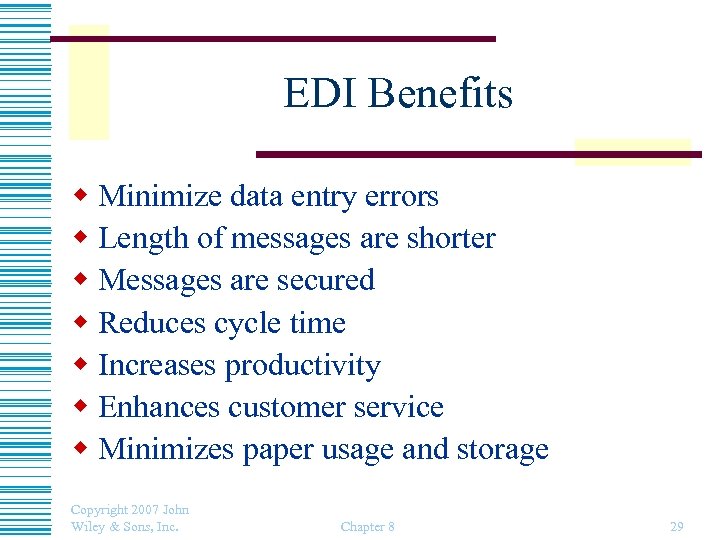 EDI Benefits w Minimize data entry errors w Length of messages are shorter w Messages are secured w Reduces cycle time w Increases productivity w Enhances customer service w Minimizes paper usage and storage Copyright 2007 John Wiley & Sons, Inc. Chapter 8 29
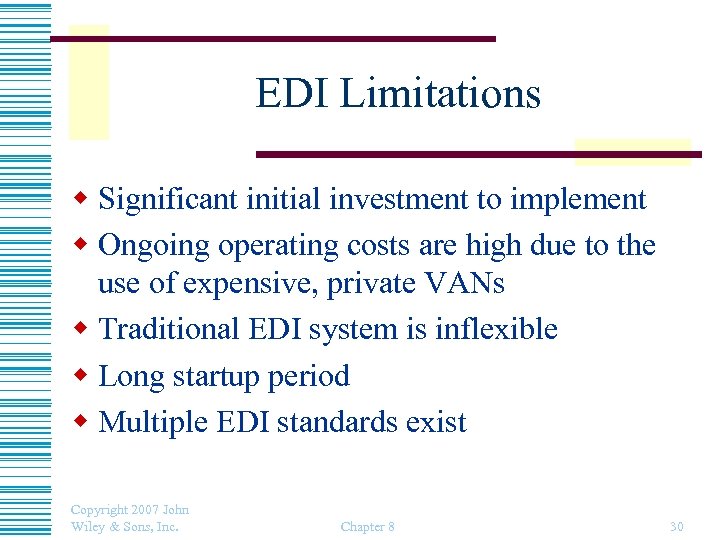 EDI Limitations w Significant initial investment to implement w Ongoing operating costs are high due to the use of expensive, private VANs w Traditional EDI system is inflexible w Long startup period w Multiple EDI standards exist Copyright 2007 John Wiley & Sons, Inc. Chapter 8 30
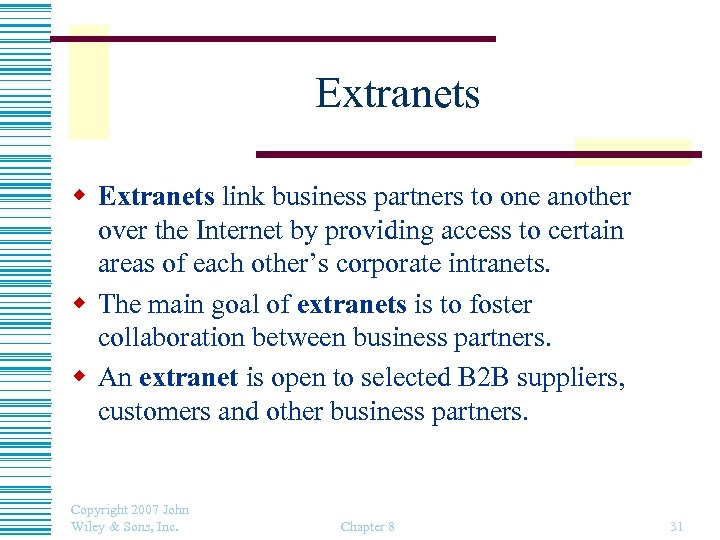 Extranets w Extranets link business partners to one another over the Internet by providing access to certain areas of each other’s corporate intranets. w The main goal of extranets is to foster collaboration between business partners. w An extranet is open to selected B 2 B suppliers, customers and other business partners. Copyright 2007 John Wiley & Sons, Inc. Chapter 8 31
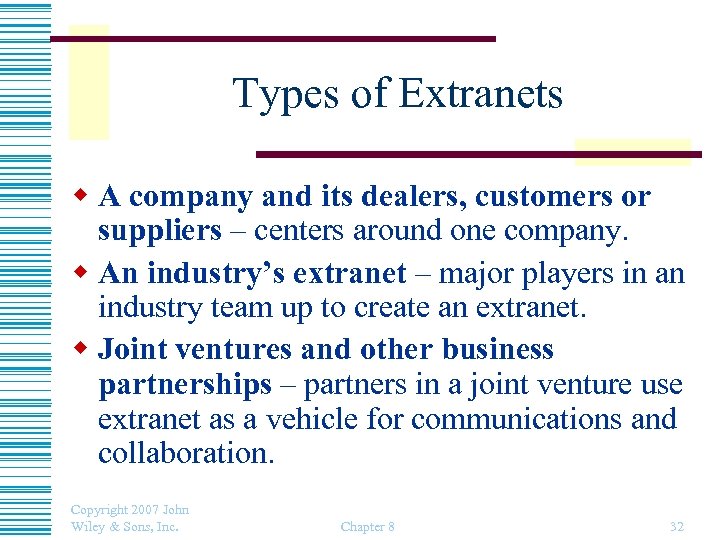 Types of Extranets w A company and its dealers, customers or suppliers – centers around one company. w An industry’s extranet – major players in an industry team up to create an extranet. w Joint ventures and other business partnerships – partners in a joint venture use extranet as a vehicle for communications and collaboration. Copyright 2007 John Wiley & Sons, Inc. Chapter 8 32