


 Скачать презентацию Introduction to Information Retrieval Manning Raghavan Schutze Chapter
28744a791dc894f24cb10cb5a5bb2d8a.ppt
- Количество слайдов: 38
 Introduction to Information Retrieval (Manning, Raghavan, Schutze) Chapter 19 Web search basics
 1. Brief history and overview n Early keyword-based engines n n A hierarchy of categories n n n Altavista, Excite, Infoseek, Inktomi, ca. 1995 -1997 Yahoo! Many problems, popularity declined. Existing variants are About. com and Open Directory Project Classical IR techniques continue to be necessary for web search, by no means sufficient n E. g. , classical IR measures relevancy, web search needs to measure relevancy + authoritativeness
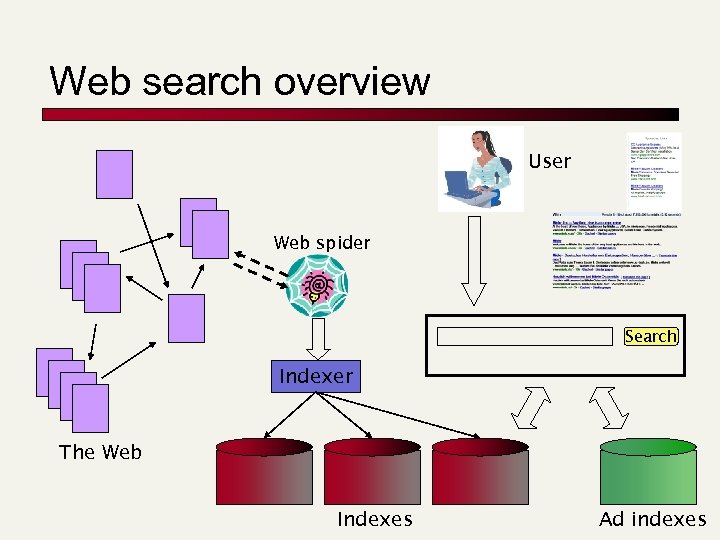 Web search overview User Web spider Search Indexer The Web Indexes Ad indexes
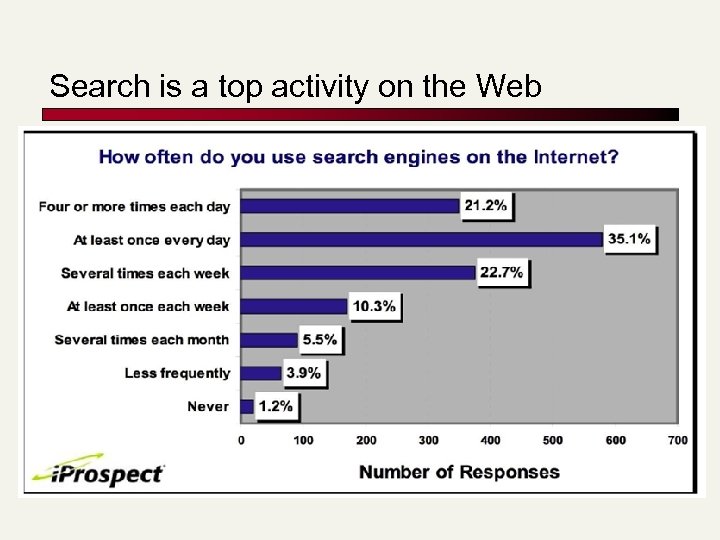 Search is a top activity on the Web
 Without search engines, the web wouldn’t work n n Without search, content is hard to find Without search, there’s no incentive to create content n n n Interest aggregation n n Why publish something if nobody will read it? Why publish something if I don’t’ get ad revenue from it? Unique feature of the Web: a small number of geographically dispersed people with similar interests can find each other Elementary school kids with hemophilia People interested in translating R 5 R 5 Scheme into relatively portable C (open source project) Interest aggregation without search engines is not possible Somebody needs to pay for the web n n Servers, web infrastructure, content creation A large part today is paid by search ads
 Web IR: Differences from traditional IR n n n Links: The web is a hyperlinked document collection Queries: web queries are different, more varied and there a lot of them 8 9 n How many? 10 every day, approaching 10 Users: users are different, more varied and there a lot of them n n Documents: documents are different, more varied and there a lot of them n n n How many? 109 How many? ~ 1011. Indexed 1010 Context: context is more important on the web than in many other IR applications Ads and spam
 2. Web characteristics n n Web document Size of the Web graph Spam
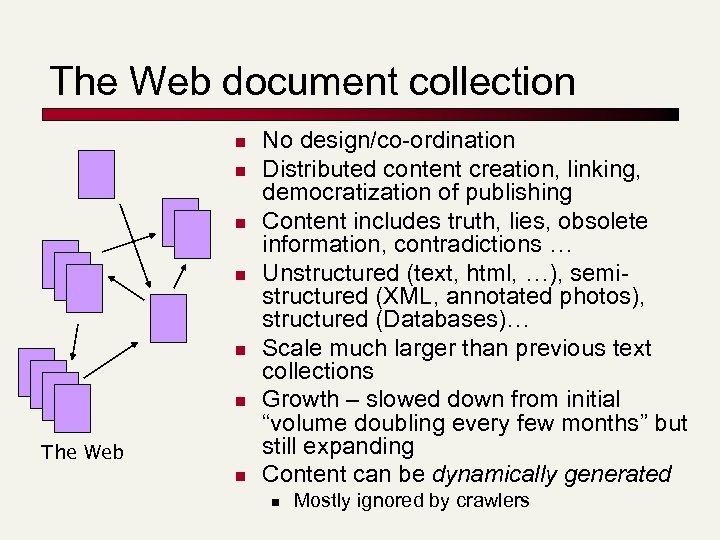 The Web document collection n n n The Web n No design/co-ordination Distributed content creation, linking, democratization of publishing Content includes truth, lies, obsolete information, contradictions … Unstructured (text, html, …), semistructured (XML, annotated photos), structured (Databases)… Scale much larger than previous text collections Growth – slowed down from initial “volume doubling every few months” but still expanding Content can be dynamically generated n Mostly ignored by crawlers
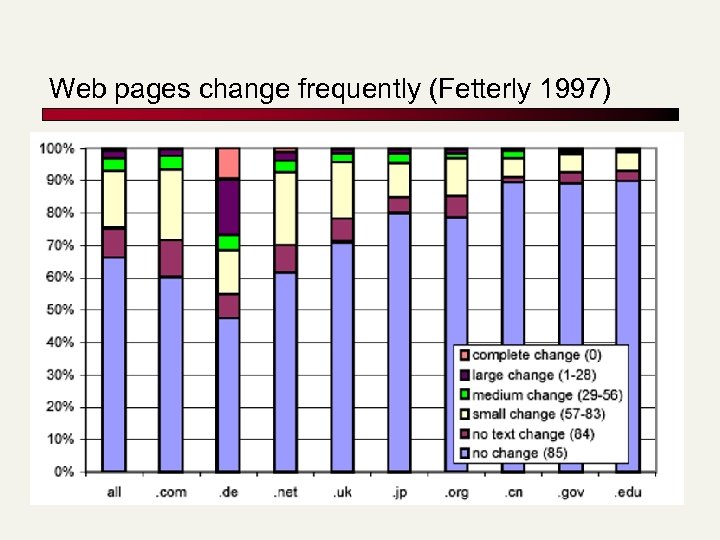 Web pages change frequently (Fetterly 1997)
 Duplicate documents n n Significant duplication: 30 -40% duplicates in some studies Duplicates in search results were common in early days of the Web Today’s search engines eliminate duplicates very effectively Key for high user satisfaction
 Duplicate detection n n The web is full of duplicated content Strict duplicate detection = exact match n n But many, many cases of near duplicates n n Not as common E. g. , Last modified date the only difference between two copies of a page Various techniques n Fingerprint, shingles, sketch
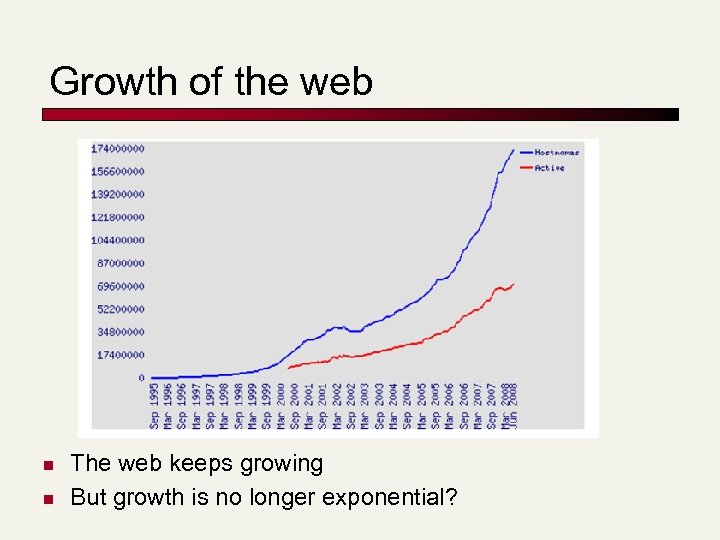 Growth of the web n n The web keeps growing But growth is no longer exponential?
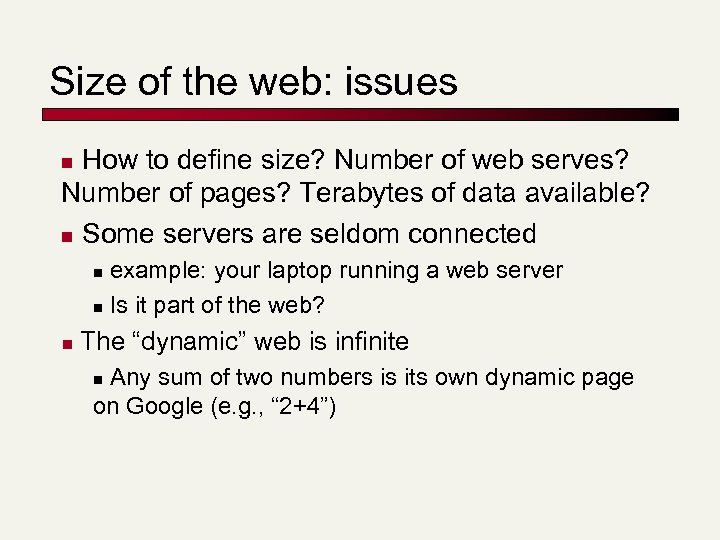 Size of the web: issues How to define size? Number of web serves? Number of pages? Terabytes of data available? n Some servers are seldom connected n example: your laptop running a web server n Is it part of the web? n n The “dynamic” web is infinite Any sum of two numbers is its own dynamic page on Google (e. g. , “ 2+4”) n
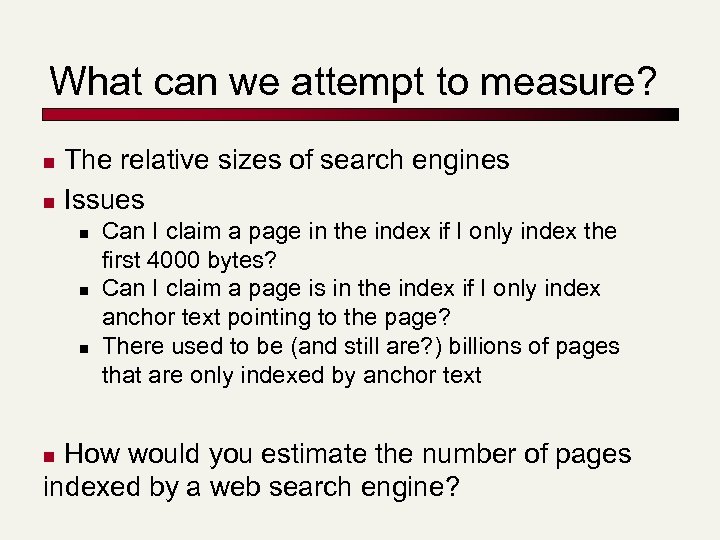 What can we attempt to measure? The relative sizes of search engines n Issues n n Can I claim a page in the index if I only index the first 4000 bytes? Can I claim a page is in the index if I only index anchor text pointing to the page? There used to be (and still are? ) billions of pages that are only indexed by anchor text How would you estimate the number of pages indexed by a web search engine? n
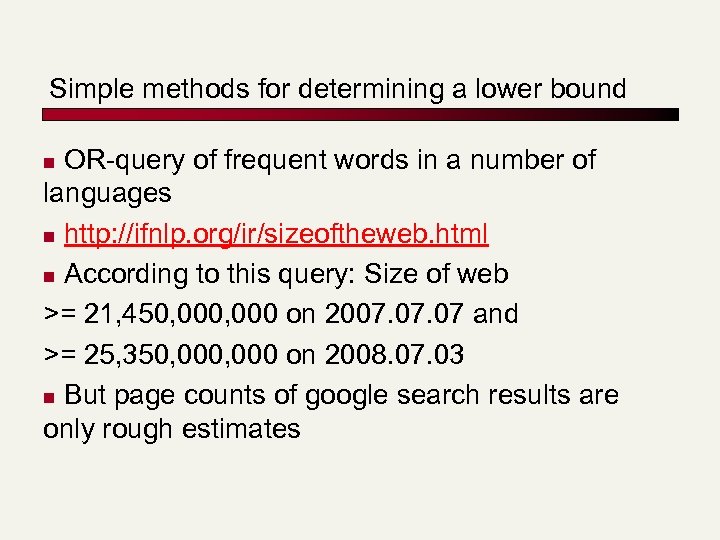 Simple methods for determining a lower bound OR-query of frequent words in a number of languages n http: //ifnlp. org/ir/sizeoftheweb. html n According to this query: Size of web >= 21, 450, 000 on 2007. 07 and >= 25, 350, 000 on 2008. 07. 03 n But page counts of google search results are only rough estimates n
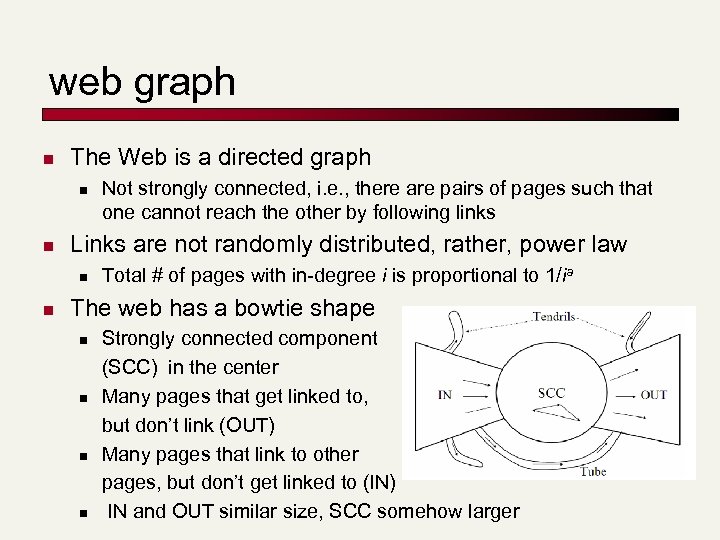 web graph n The Web is a directed graph n n Links are not randomly distributed, rather, power law n n Not strongly connected, i. e. , there are pairs of pages such that one cannot reach the other by following links Total # of pages with in-degree i is proportional to 1/ia The web has a bowtie shape n n Strongly connected component (SCC) in the center Many pages that get linked to, but don’t link (OUT) Many pages that link to other pages, but don’t get linked to (IN) IN and OUT similar size, SCC somehow larger
 Goal of spamming on the web n n n You have a page that will generate lots of revenue for you if people visit it Therefore, you’d like to redirect visitors to this page One way of doing this: get your page ranked highly in search results
 Simplest forms n n First generation engines relied heavily on tf/idf Hidden text: dense repetitions of chosen keywords n Often, the repetitions would be in the same color as the background of the web page. So that repeated terms got indexed by crawlers, but not visible to humans on browsers n Keyword stuffing: misleading meta-tags with excessive repetition of chosen keywords n Used to be effective, most search engines now catch these n Spammers responded with a richer set of spam techniques
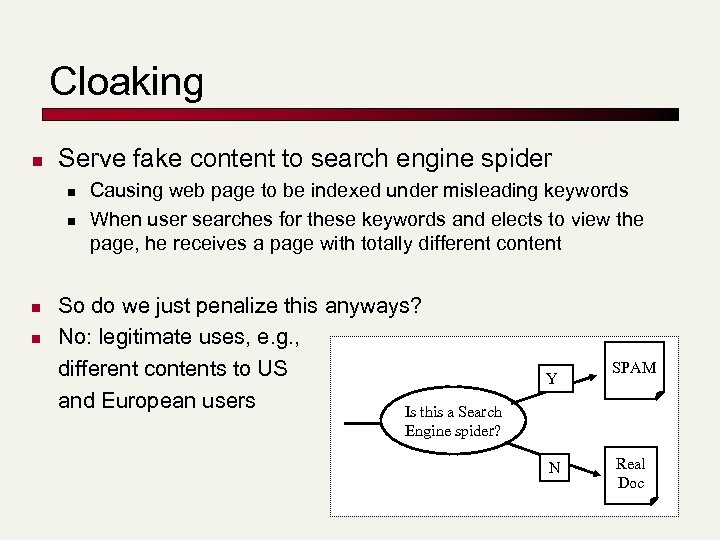 Cloaking n Serve fake content to search engine spider n n Causing web page to be indexed under misleading keywords When user searches for these keywords and elects to view the page, he receives a page with totally different content So do we just penalize this anyways? No: legitimate uses, e. g. , different contents to US and European users Is this a Search Y SPAM Engine spider? N Real Doc
 More spam techniques n Doorway page n n n Lander page n n Contains text/metadata carefully chosen to rank highly on selected keywords When a browser requests the doorway page, it is redirected to a page containing content of a more commercial nature Optimized for a single keyword or a misspelled domain name, designed to attract surfers who will then click on ads Duplication n Get good content from somewhere (steal it or produce it by yourself) Publish a large number of slight variations of it For example, publish the answer to a tax question with the spelling variations of “tax deferred” …
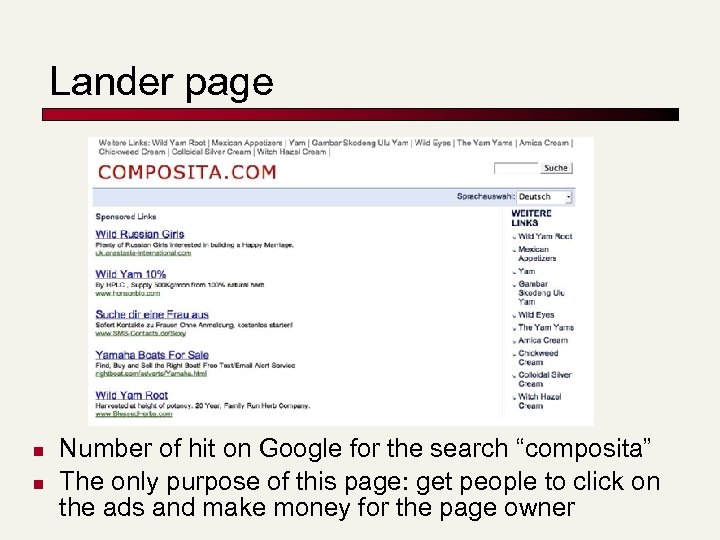 Lander page n n Number of hit on Google for the search “composita” The only purpose of this page: get people to click on the ads and make money for the page owner
 Link spam n n Create lots of links pointing to the page you want to promote Put these links on pages with high (at least non-zero) pagerank n n n Newer registered domains (domain flooding) A set of pages pointing to each other to boost each other’s pagerank (mutual admiration society) Pay somebody to put your link on their highly ranked page (“schuetze horoskop” example”) n n n http: //www-csli. stanford. edu/~hinrich/horoskop-schuetze. html Leave comments that include the link on blogs Link farm
 Search engine optimization n n Promoting a page is not necessarily spam It can also be a legitimate business, which is called SEO n n Motives n n n Commercial, political, religious, lobbies Promotion funded by advertising budget Operators n n You can hire an SEO firm to get your page highly ranked Contractors (Search Engine Optimizers) for lobbies, companies Web masters Hosting services Forums n E. g. , Web master world ( www. webmasterworld. com )
 More on spam n Web search engines have policies on SEO practices they tolerate/block n n http: //help. yahoo. com/help/us/ysearch/index. html http: //www. google. com/intl/en/webmasters/ Adversarial IR: the unending (technical) battle between SEO’s and web search engines Research http: //airweb. cse. lehigh. edu/
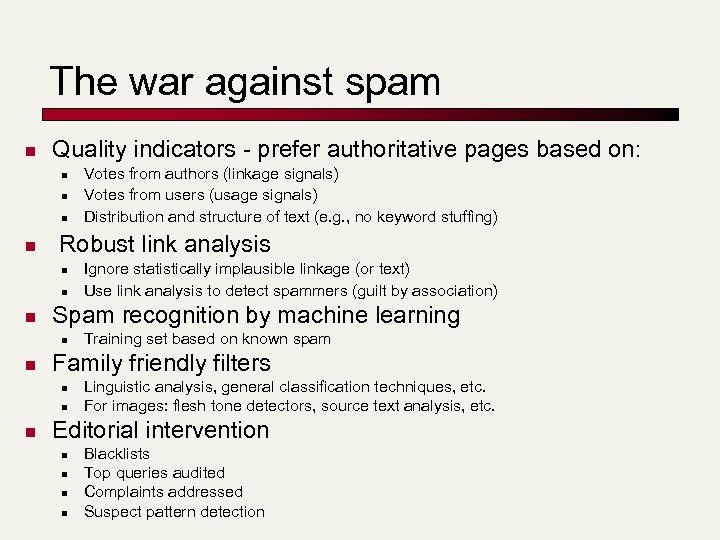 The war against spam n Quality indicators - prefer authoritative pages based on: n n Robust link analysis n n n Training set based on known spam Family friendly filters n n n Ignore statistically implausible linkage (or text) Use link analysis to detect spammers (guilt by association) Spam recognition by machine learning n n Votes from authors (linkage signals) Votes from users (usage signals) Distribution and structure of text (e. g. , no keyword stuffing) Linguistic analysis, general classification techniques, etc. For images: flesh tone detectors, source text analysis, etc. Editorial intervention n n Blacklists Top queries audited Complaints addressed Suspect pattern detection
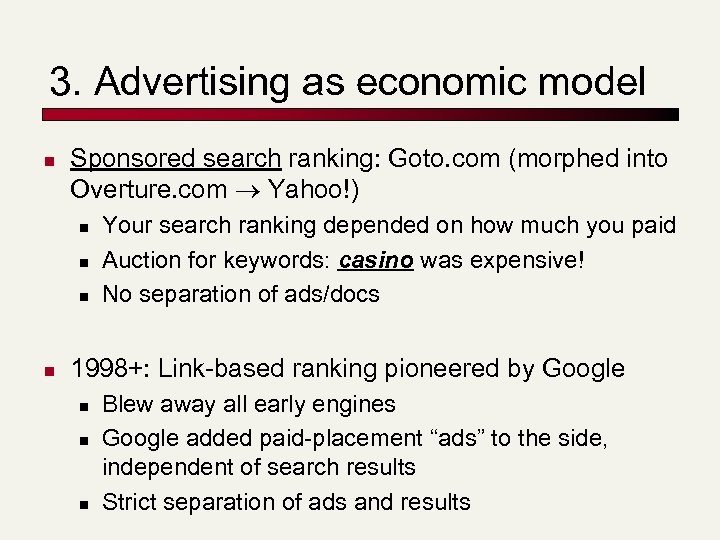 3. Advertising as economic model n Sponsored search ranking: Goto. com (morphed into Overture. com Yahoo!) n n Your search ranking depended on how much you paid Auction for keywords: casino was expensive! No separation of ads/docs 1998+: Link-based ranking pioneered by Google n n n Blew away all early engines Google added paid-placement “ads” to the side, independent of search results Strict separation of ads and results
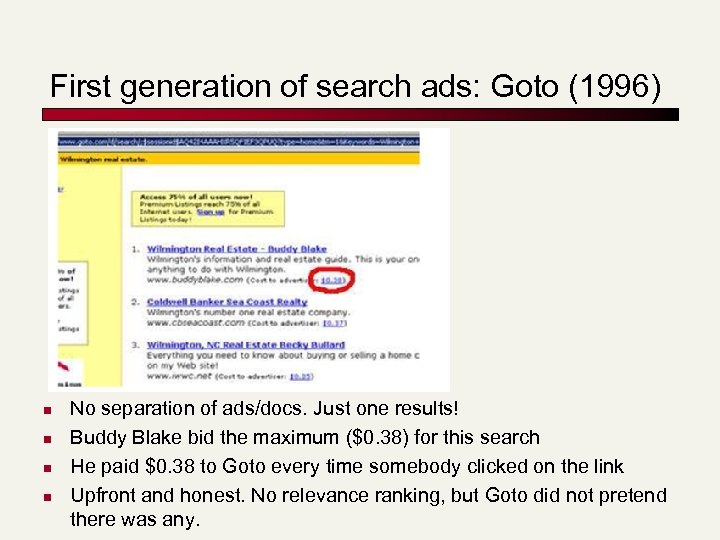 First generation of search ads: Goto (1996) n n No separation of ads/docs. Just one results! Buddy Blake bid the maximum ($0. 38) for this search He paid $0. 38 to Goto every time somebody clicked on the link Upfront and honest. No relevance ranking, but Goto did not pretend there was any.
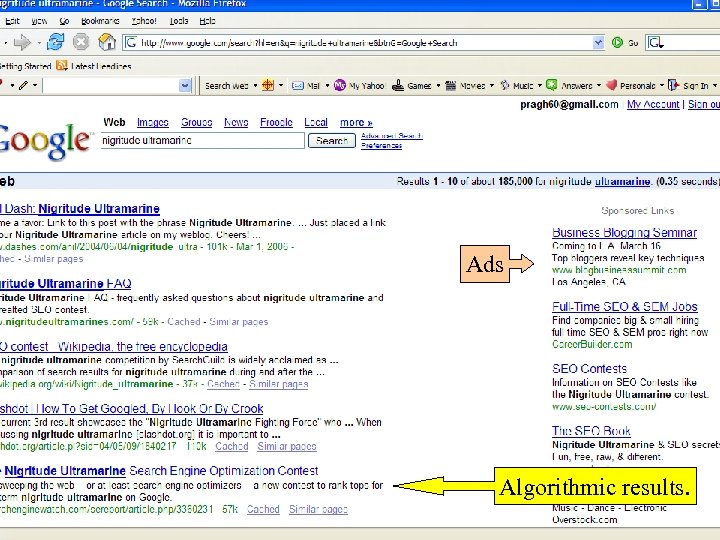 Ads Algorithmic results.
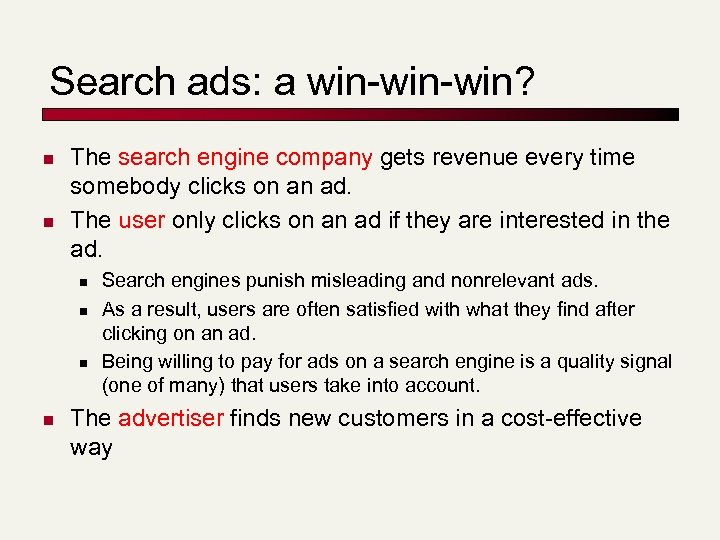 Search ads: a win-win? n n The search engine company gets revenue every time somebody clicks on an ad. The user only clicks on an ad if they are interested in the ad. n n Search engines punish misleading and nonrelevant ads. As a result, users are often satisfied with what they find after clicking on an ad. Being willing to pay for ads on a search engine is a quality signal (one of many) that users take into account. The advertiser finds new customers in a cost-effective way
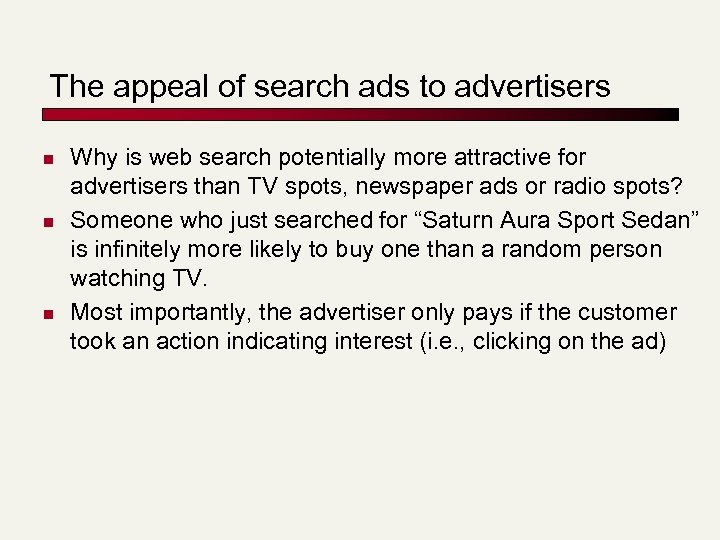 The appeal of search ads to advertisers n n n Why is web search potentially more attractive for advertisers than TV spots, newspaper ads or radio spots? Someone who just searched for “Saturn Aura Sport Sedan” is infinitely more likely to buy one than a random person watching TV. Most importantly, the advertiser only pays if the customer took an action indicating interest (i. e. , clicking on the ad)
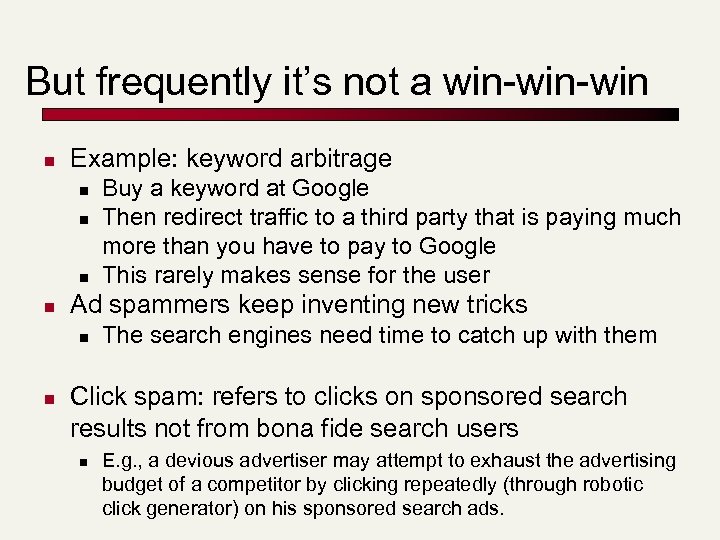 But frequently it’s not a win-win n Example: keyword arbitrage n n Ad spammers keep inventing new tricks n n Buy a keyword at Google Then redirect traffic to a third party that is paying much more than you have to pay to Google This rarely makes sense for the user The search engines need time to catch up with them Click spam: refers to clicks on sponsored search results not from bona fide search users n E. g. , a devious advertiser may attempt to exhaust the advertising budget of a competitor by clicking repeatedly (through robotic click generator) on his sponsored search ads.
 4. Search user experiences n n Users User queries Query distribution User’s empirical evaluations
 Users of web search n n n Use short queries (average < 3) Rarely use operators Don’t want to spend a lot of time on composing a query Only look at the first couple of results Want a simple UI, not a search engine start page overloaded with graphics Extreme variability in terms of user needs, user expectations, experience, knowledge, … n n Industrial/developing world, English/Estonian, old/young, rich/poor, differences in culture and class One interface for hugely divergent needs
![User query needs n Need [Brod 02, RL 04] n n n Informational –](https://present5.com/presentation/28744a791dc894f24cb10cb5a5bb2d8a/image-34.jpg "User query needs n Need [Brod 02, RL 04] n n n Informational –") User query needs n Need [Brod 02, RL 04] n n n Informational – want to learn about something (~40% / 65%) Low hemoglobin n Not a single page containing the info Navigational – want to go to that page (~25% / 15%) United Airlines Transactional – want to do something (web-mediated) (~35% / 20%) n n Downloads n n Access a service Shop Seattle weather Mars surface images Canon S 410 Gray areas n n Car rental Brasil Find a good hub Exploratory search “see what’s there”
User query needs n Need [Brod 02, RL 04] n n n Informational – want to learn about something (~40% / 65%) Low hemoglobin n Not a single page containing the info Navigational – want to go to that page (~25% / 15%) United Airlines Transactional – want to do something (web-mediated) (~35% / 20%) n n Downloads n n Access a service Shop Seattle weather Mars surface images Canon S 410 Gray areas n n Car rental Brasil Find a good hub Exploratory search “see what’s there”
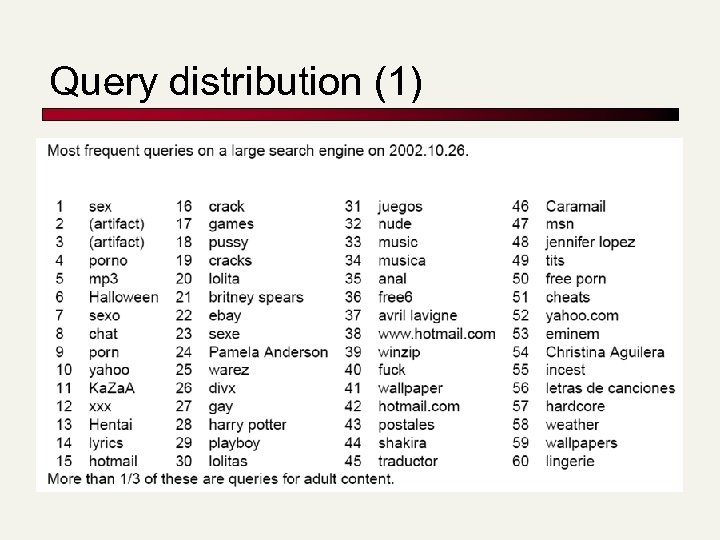 Query distribution (1)
 Query distribution (2) n n n Queries have a power law distribution Recall Zipf’s law: a few very frequent words, a large number of very rare words Same here very frequent queries, a large number of very rare queries Examples of rare queries: search for names, towns, books etc The proportion of adult queries is much lower than 1/3
 Users’ empirical evaluation of results n Quality of pages varies widely n n Relevance is not enough Other desirable qualities (non IR!!) n n Precision vs. recall n n Content: Trustworthy, diverse, non-duplicated, well maintained Web readability: display correctly & fast No annoyances: pop-ups, etc On the web, recall seldom matters What matters n n Precision at 1? Precision above the fold? Comprehensiveness – must be able to deal with obscure queries n Recall matters when the number of matches is very small
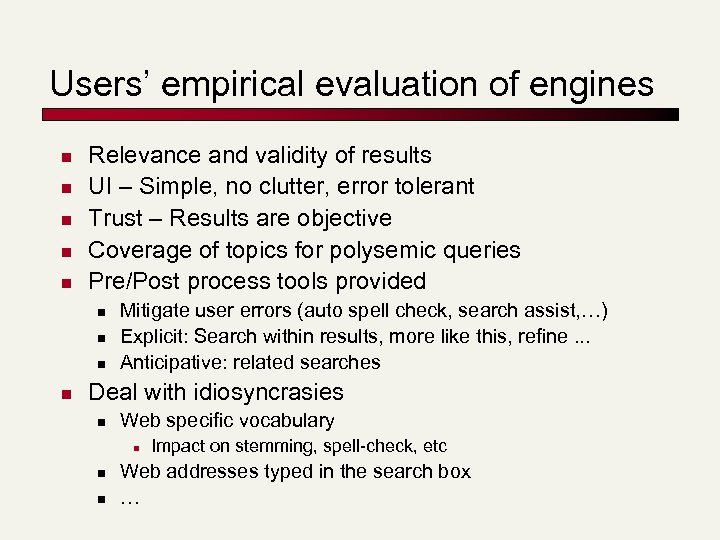 Users’ empirical evaluation of engines n n n Relevance and validity of results UI – Simple, no clutter, error tolerant Trust – Results are objective Coverage of topics for polysemic queries Pre/Post process tools provided n n Mitigate user errors (auto spell check, search assist, …) Explicit: Search within results, more like this, refine. . . Anticipative: related searches Deal with idiosyncrasies n Web specific vocabulary n n n Impact on stemming, spell-check, etc Web addresses typed in the search box …