


 Скачать презентацию Introduction to Information Retrieval Lecture 10 Evaluation
06bcce7fe1f983a75f82d8d246c16417.ppt
- Количество слайдов: 30
 Introduction to Information Retrieval Lecture 10 Evaluation
 Introduction to Information Retrieval Sec. 8. 6 How do you evaluate a search engine / algorithm [say for e-commerce] § How fast does it index? § Number of documents/hour § Incremental indexing – site adds 10 K products/day § How fast does it search? § Latency and CPU needs for site’s 5 million products § Does it recommend related products? § This is all good, but it says nothing about the quality of search § You want the users to be happy with the search experience 2
 Introduction to Information Retrieval How do you tell if users are happy? § Search returns products relevant to users § How do you assess this at scale? § Search results get clicked a lot § Misleading titles/summaries can cause users to click § Users buy after using the search engine § Or, users spend a lot of $ after using the search engine § Repeat visitors/buyers § Do users leave soon after searching? § Do they come back within a week/month/… ? 3
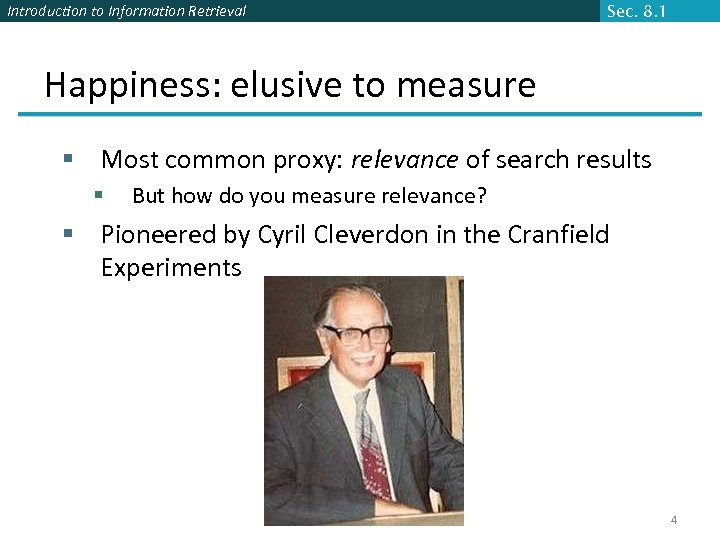 Introduction to Information Retrieval Sec. 8. 1 Happiness: elusive to measure § Most common proxy: relevance of search results § But how do you measure relevance? § Pioneered by Cyril Cleverdon in the Cranfield Experiments 4
 Introduction to Information Retrieval Sec. 8. 1 Measuring relevance § Three elements: 1. A benchmark document collection 2. A benchmark suite of queries 3. An assessment of either Relevant or Nonrelevant for each query and each document 5
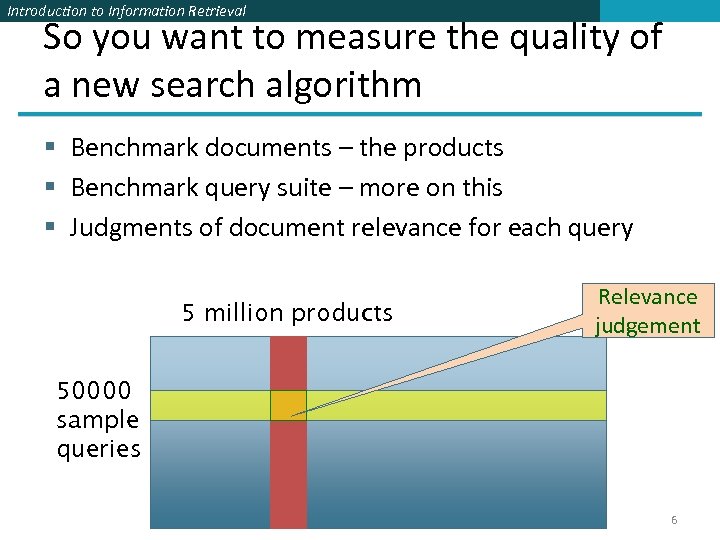 Introduction to Information Retrieval So you want to measure the quality of a new search algorithm § Benchmark documents – the products § Benchmark query suite – more on this § Judgments of document relevance for each query 5 million products Relevance judgement 50000 sample queries 6
 Introduction to Information Retrieval Relevance judgments § Binary (relevant vs. non-relevant) in the simplest case, more nuanced (0, 1, 2, 3 …) in others § What are some issues already? § 5 million times 50 K takes us into the range of a quarter trillion judgments § If each judgment took a human 2. 5 seconds, we’d still need 1011 seconds, or nearly $300 million if you pay people $10 per hour to assess § 10 K new products per day 7
 Introduction to Information Retrieval Crowd source relevance judgments? § Present query-document pairs to low-cost labor on online crowd-sourcing platforms § Hope that this is cheaper than hiring qualified assessors § Lots of literature on using crowd-sourcing for such tasks § Main takeaway – you get some signal, but the variance in the resulting judgments is very high 8
 Introduction to Information Retrieval Sec. 8. 5 What else? § Still need test queries § Must be germane to docs available § Must be representative of actual user needs § Random query terms from the documents generally not a good idea § Sample from query logs if available § Classically (non-Web) § Low query rates – not enough query logs § Experts hand-craft “user needs” 9
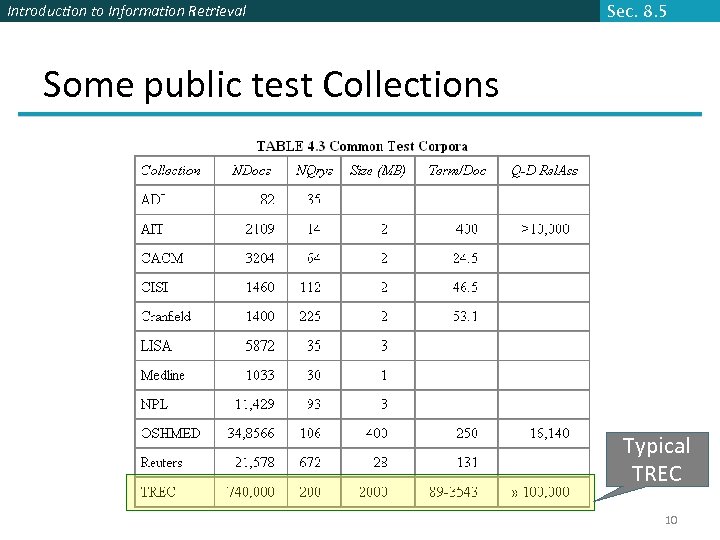 Introduction to Information Retrieval Sec. 8. 5 Some public test Collections Typical TREC 10
 Introduction to Information Retrieval Now we have the basics of a benchmark § Let’s review some evaluation measures § § Precision Recall DCG … 11
 Introduction to Information Retrieval Sec. 8. 1 Evaluating an IR system § Note: user need is translated into a query § Relevance is assessed relative to the user need, not the query § E. g. , Information need: My swimming pool bottom is becoming black and needs to be cleaned. § Query: pool cleaner § Assess whether the doc addresses the underlying need, not whether it has these words 12
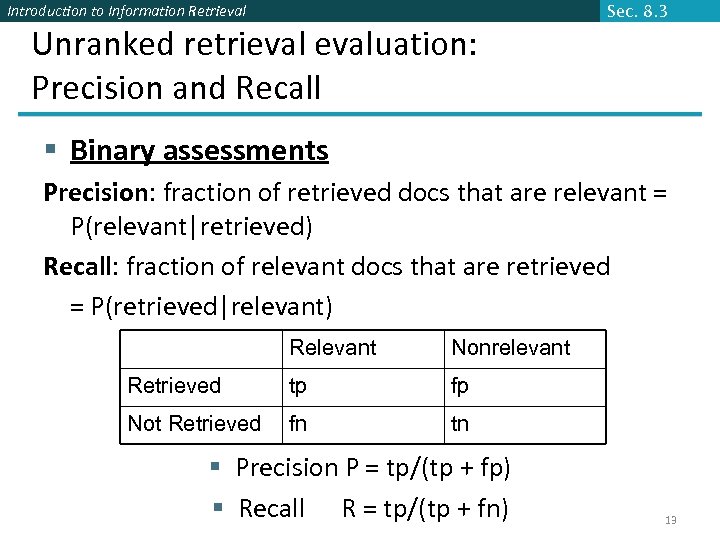 Introduction to Information Retrieval Sec. 8. 3 Unranked retrievaluation: Precision and Recall § Binary assessments Precision: fraction of retrieved docs that are relevant = P(relevant|retrieved) Recall: fraction of relevant docs that are retrieved = P(retrieved|relevant) Relevant Nonrelevant Retrieved tp fp Not Retrieved fn tn § Precision P = tp/(tp + fp) § Recall R = tp/(tp + fn) 13
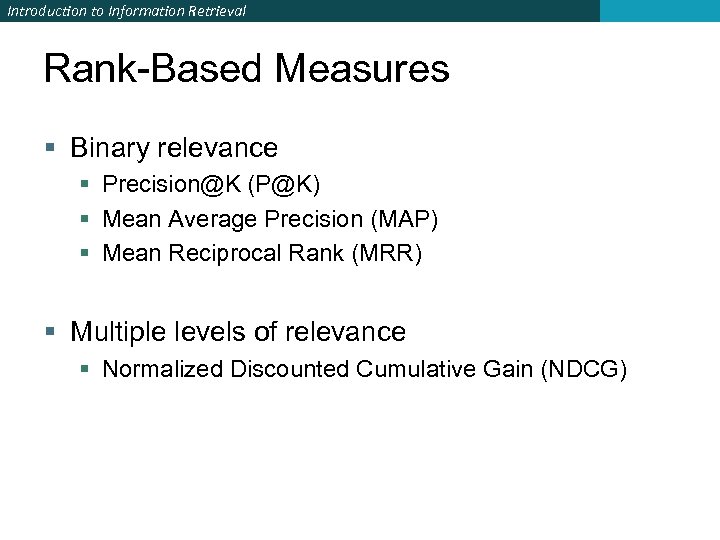 Introduction to Information Retrieval Rank-Based Measures § Binary relevance § Precision@K (P@K) § Mean Average Precision (MAP) § Mean Reciprocal Rank (MRR) § Multiple levels of relevance § Normalized Discounted Cumulative Gain (NDCG)
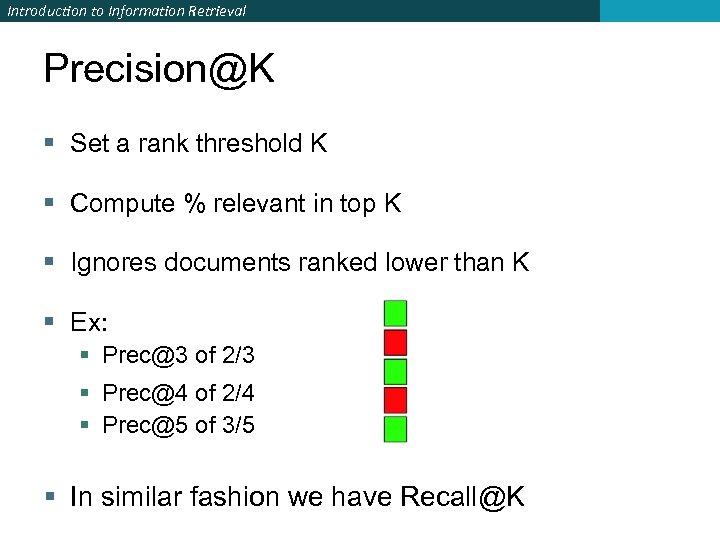 Introduction to Information Retrieval Precision@K § Set a rank threshold K § Compute % relevant in top K § Ignores documents ranked lower than K § Ex: § Prec@3 of 2/3 § Prec@4 of 2/4 § Prec@5 of 3/5 § In similar fashion we have Recall@K
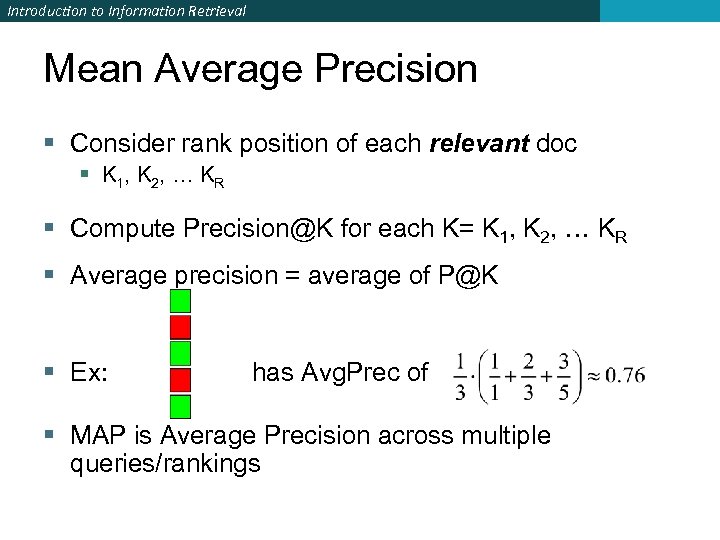 Introduction to Information Retrieval Mean Average Precision § Consider rank position of each relevant doc § K 1, K 2, … K R § Compute Precision@K for each K= K 1, K 2, … KR § Average precision = average of P@K § Ex: has Avg. Prec of § MAP is Average Precision across multiple queries/rankings
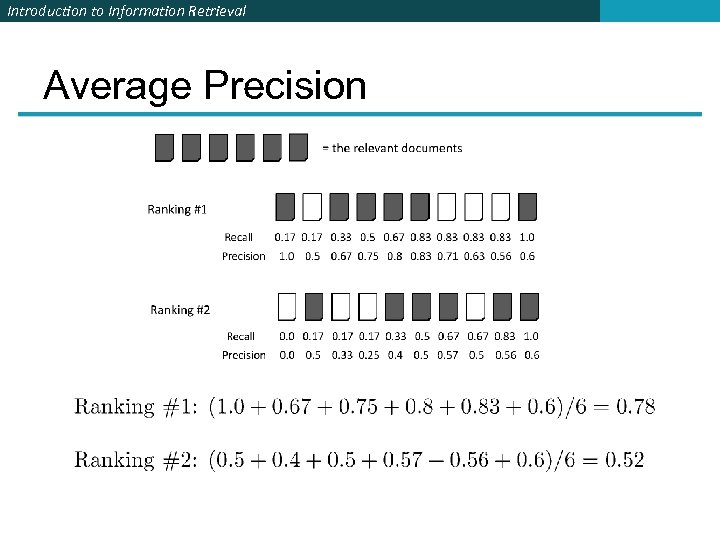 Introduction to Information Retrieval Average Precision
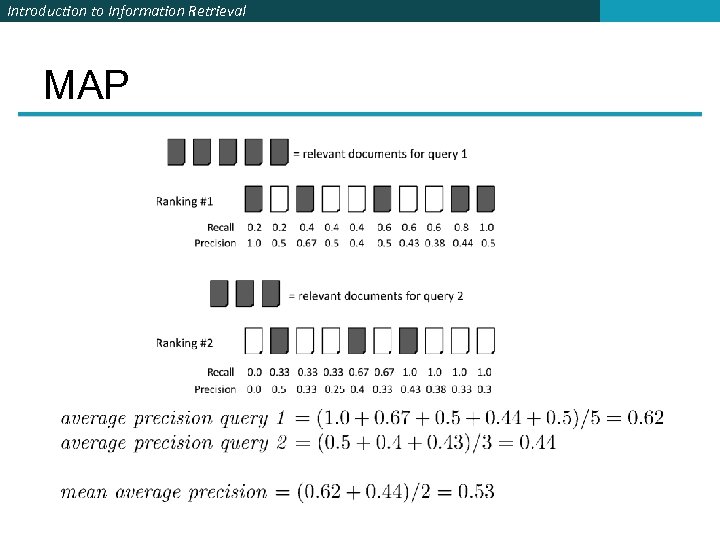 Introduction to Information Retrieval MAP
 Introduction to Information Retrieval Mean average precision § If a relevant document never gets retrieved, we assume the precision corresponding to that relevant doc to be zero § MAP is macro-averaging: each query counts equally § Now perhaps most commonly used measure in research papers § Good for web search? § MAP assumes user is interested in finding many relevant documents for each query § MAP requires many relevance judgments in text collection
 Introduction to Information Retrieval BEYOND BINARY RELEVANCE 20
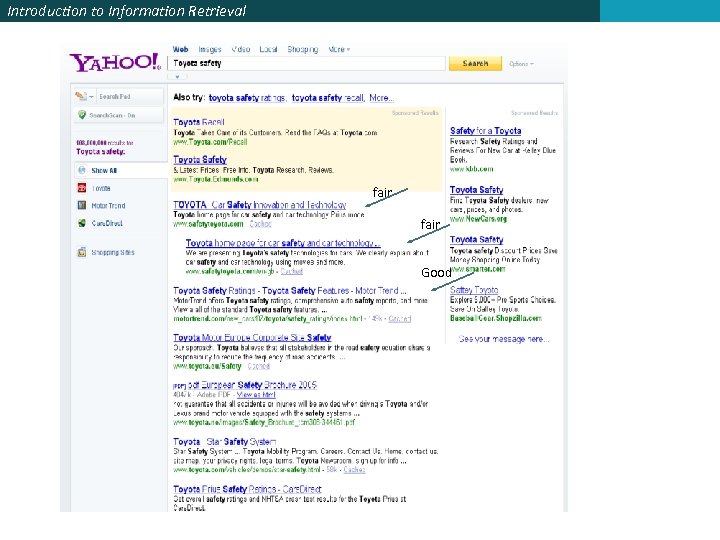 Introduction to Information Retrieval fair Good
 Introduction to Information Retrieval Discounted Cumulative Gain § Popular measure for evaluating web search and related tasks § Two assumptions: § Highly relevant documents are more useful than marginally relevant documents § The lower the ranked position of a relevant document, the less useful it is for the user, since it is less likely to be examined
 Introduction to Information Retrieval Discounted Cumulative Gain § Uses graded relevance as a measure of usefulness, or gain, from examining a document § Gain is accumulated starting at the top of the ranking and may be reduced, or discounted, at lower ranks § Typical discount is 1/log (rank) § With base 2, the discount at rank 4 is 1/2, and at rank 8 it is 1/3
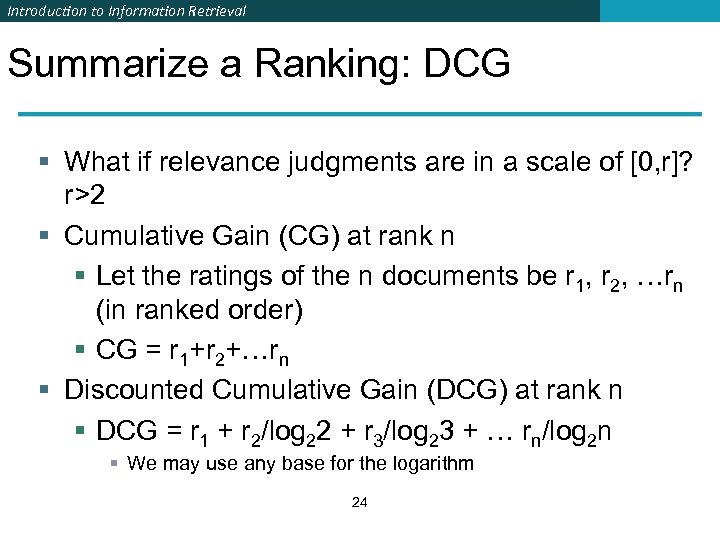 Introduction to Information Retrieval Summarize a Ranking: DCG § What if relevance judgments are in a scale of [0, r]? r>2 § Cumulative Gain (CG) at rank n § Let the ratings of the n documents be r 1, r 2, …rn (in ranked order) § CG = r 1+r 2+…rn § Discounted Cumulative Gain (DCG) at rank n § DCG = r 1 + r 2/log 22 + r 3/log 23 + … rn/log 2 n § We may use any base for the logarithm 24
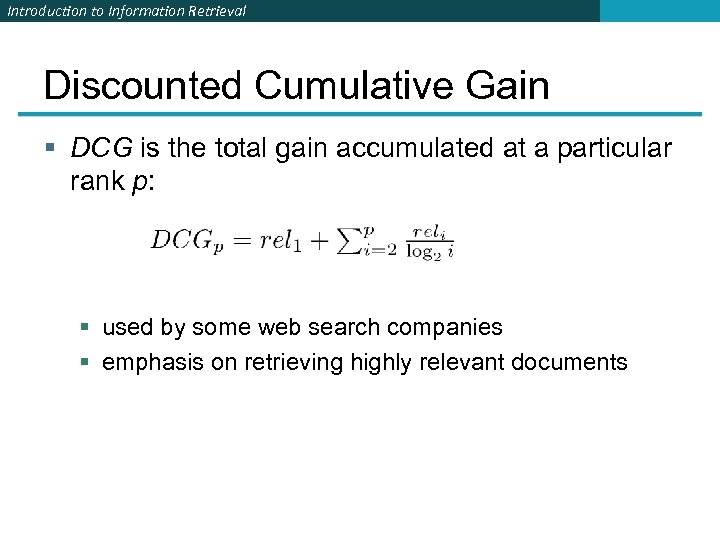 Introduction to Information Retrieval Discounted Cumulative Gain § DCG is the total gain accumulated at a particular rank p: § used by some web search companies § emphasis on retrieving highly relevant documents
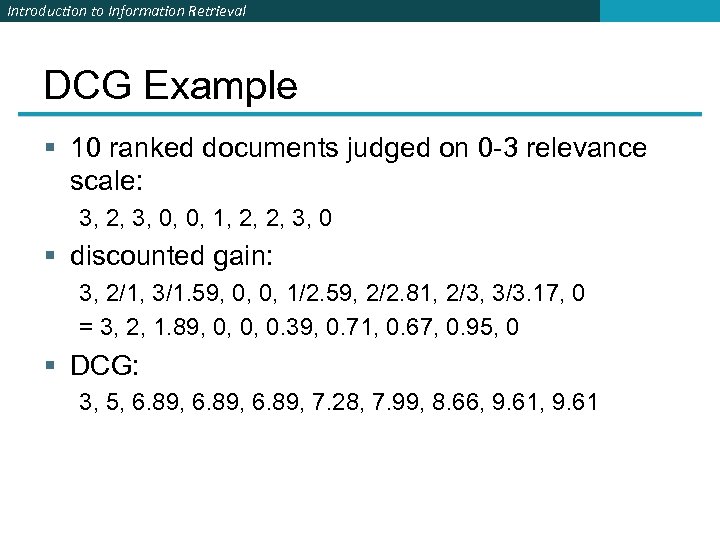 Introduction to Information Retrieval DCG Example § 10 ranked documents judged on 0 -3 relevance scale: 3, 2, 3, 0, 0, 1, 2, 2, 3, 0 § discounted gain: 3, 2/1, 3/1. 59, 0, 0, 1/2. 59, 2/2. 81, 2/3, 3/3. 17, 0 = 3, 2, 1. 89, 0, 0, 0. 39, 0. 71, 0. 67, 0. 95, 0 § DCG: 3, 5, 6. 89, 7. 28, 7. 99, 8. 66, 9. 61
 Introduction to Information Retrieval Summarize a Ranking: NDCG § Normalized Discounted Cumulative Gain (NDCG) at rank n § Normalize DCG at rank n by the DCG value at rank n of the ideal ranking § The ideal ranking would first return the documents with the highest relevance level, then the next highest relevance level, etc § Normalization useful for contrasting queries with varying numbers of relevant results § NDCG is now quite popular in evaluating Web search 27
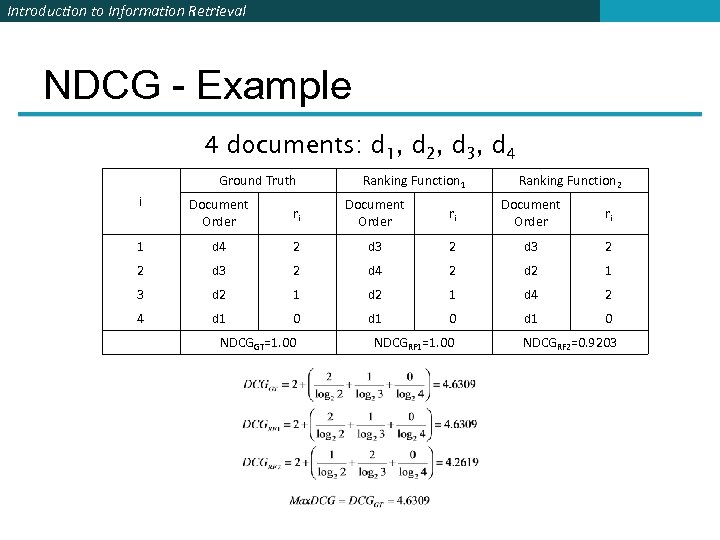 Introduction to Information Retrieval NDCG - Example 4 documents: d 1, d 2, d 3, d 4 Ground Truth Ranking Function 1 Ranking Function 2 i Document Order ri 1 d 4 2 d 3 2 d 4 2 d 2 1 3 d 2 1 d 4 2 4 d 1 0 NDCGGT=1. 00 NDCGRF 1=1. 00 NDCGRF 2=0. 9203
 Introduction to Information Retrieval What if the results are not in a list? § Suppose there’s only one Relevant Document § Scenarios: § known-item search § navigational queries § looking for a fact § Search duration ~ Rank of the answer § measures a user’s effort 29
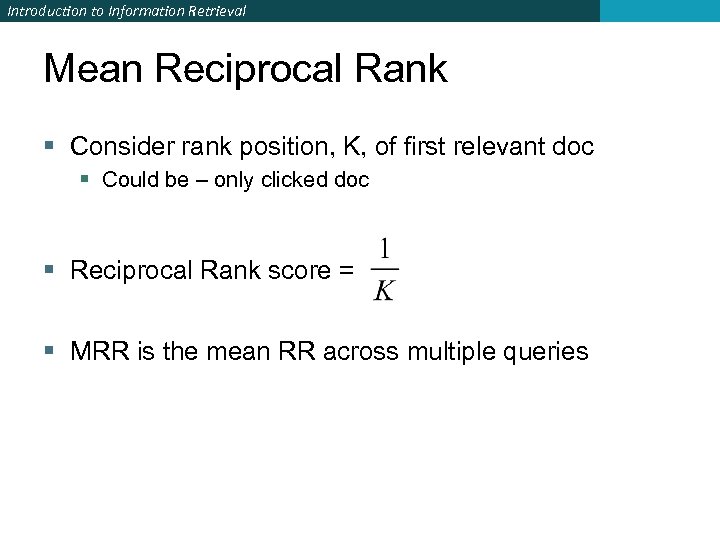 Introduction to Information Retrieval Mean Reciprocal Rank § Consider rank position, K, of first relevant doc § Could be – only clicked doc § Reciprocal Rank score = § MRR is the mean RR across multiple queries