


 Скачать презентацию Introduction to Information Retrieval CS 457 Fall 2011
cf4124facdbc90f7db944e323d1b4230.ppt
- Количество слайдов: 80
 Introduction to Information Retrieval CS 457 Fall 2011 David Kauchak adapted from: http: //www. stanford. edu/class/cs 276/handouts/lecture 1 -intro. ppt
 Introduction to Information Retrieval Administrative § Projects § Status 2 on Friday § Paper next Friday § work on the paper in parallel if you’re not done with experiments by early next week § CS lunch today!
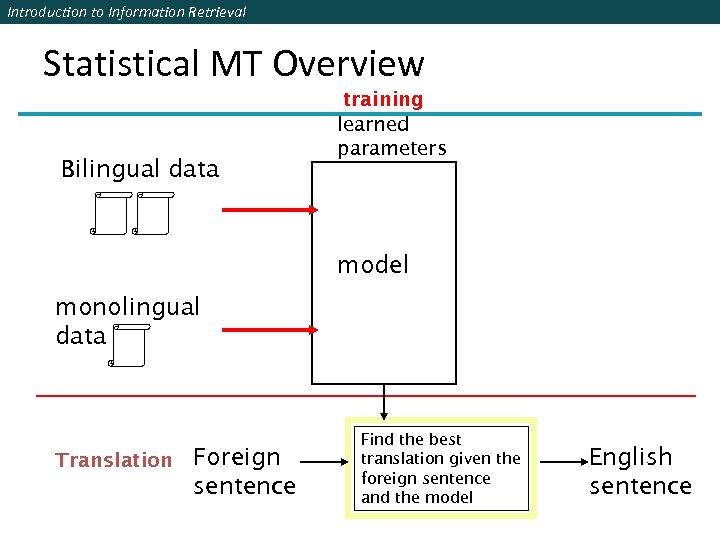 Introduction to Information Retrieval Statistical MT Overview Bilingual data training learned parameters model monolingual data Translation Foreign sentence Find the best translation given the foreign sentence and the model English sentence
 Introduction to Information Retrieval Problems for Statistical MT § Preprocessing § Language modeling § Translation modeling § Decoding § Parameter optimization
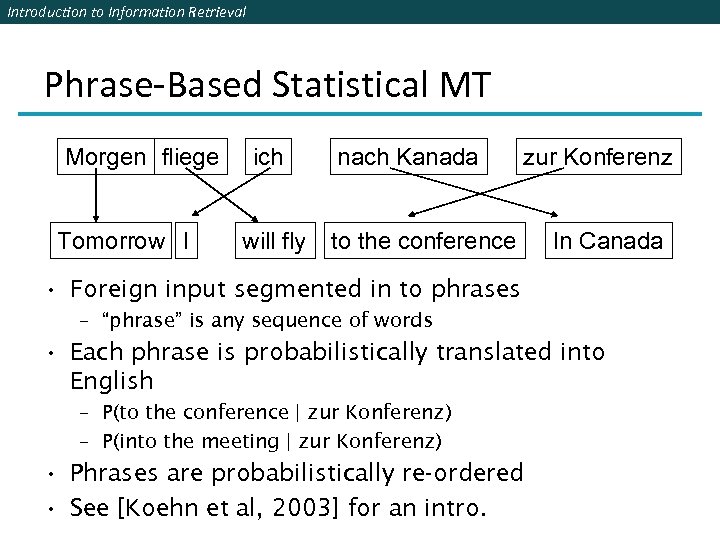 Introduction to Information Retrieval Phrase-Based Statistical MT Morgen fliege Tomorrow I ich will fly nach Kanada zur Konferenz to the conference In Canada • Foreign input segmented in to phrases – “phrase” is any sequence of words • Each phrase is probabilistically translated into English – P(to the conference | zur Konferenz) – P(into the meeting | zur Konferenz) • Phrases are probabilistically re-ordered • See [Koehn et al, 2003] for an intro.
 Introduction to Information Retrieval Information retrieval (IR) § What comes to mind when I say “information retrieval”? § Where have you seen IR? What are some real-world examples/uses? § Search engines § File search (e. g. OS X Spotlight, Windows Instant Search, Google Desktop) § Databases? § Catalog search (e. g. library) § Intranet search (i. e. corporate networks)
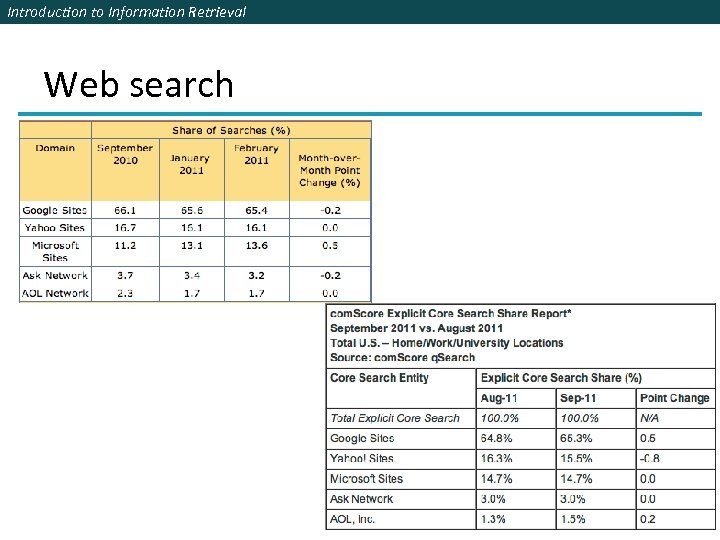
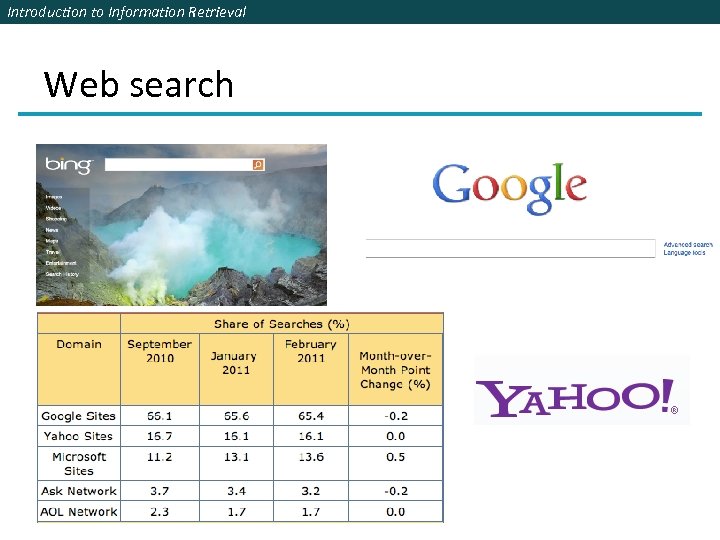 Introduction to Information Retrieval Web search
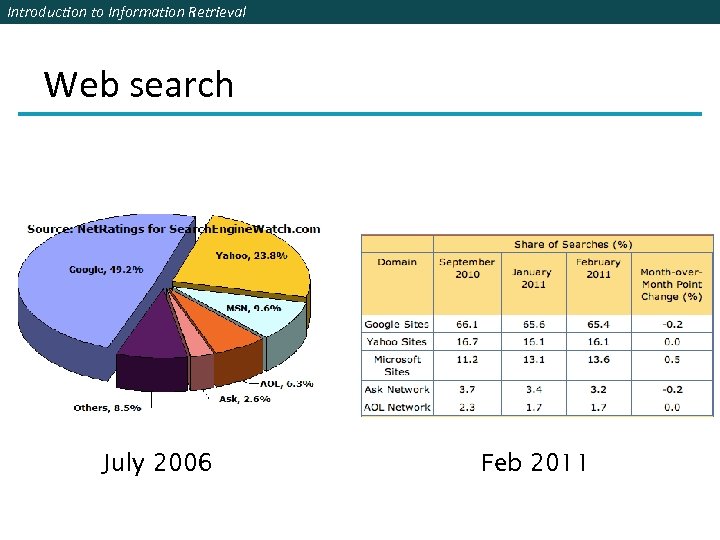 Introduction to Information Retrieval Web search July 2006 Feb 2011
 Introduction to Information Retrieval Web search
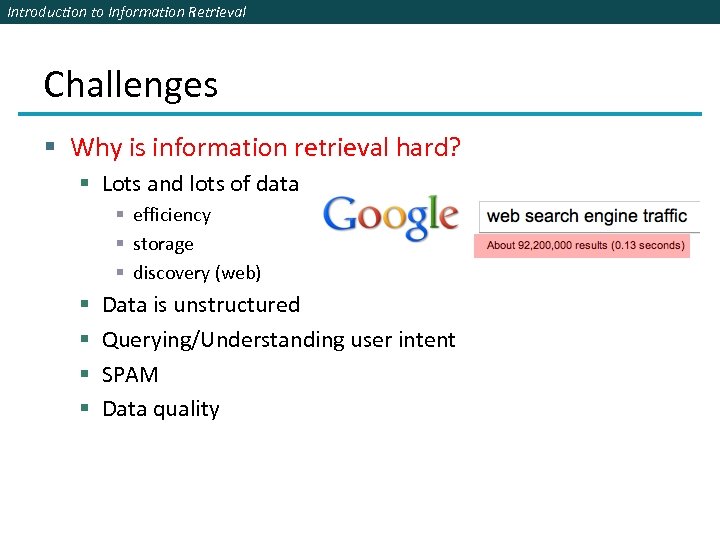 Introduction to Information Retrieval Challenges § Why is information retrieval hard? § Lots and lots of data § efficiency § storage § discovery (web) § § Data is unstructured Querying/Understanding user intent SPAM Data quality
 Introduction to Information Retrieval § Information Retrieval is finding material in documents of an unstructured nature that satisfy an information need from within large collections of digitally stored content
 Introduction to Information Retrieval § Information Retrieval is finding material in documents of an unstructured nature that satisfy an information need from within large collections of digitally stored content ?
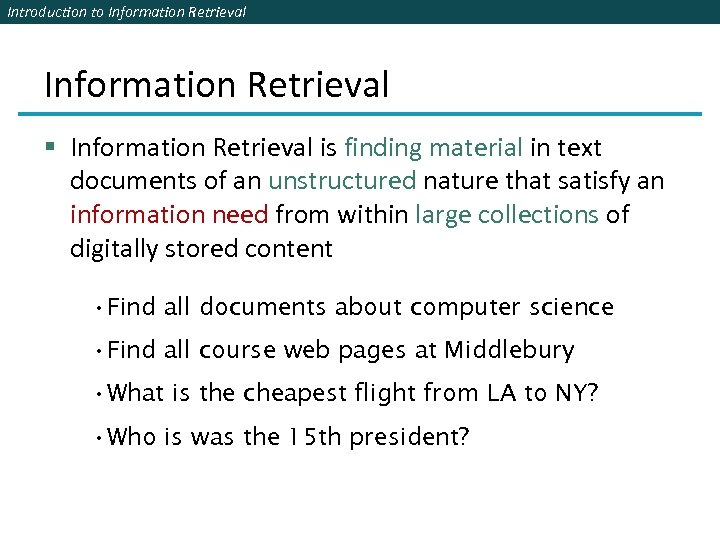 Introduction to Information Retrieval § Information Retrieval is finding material in text documents of an unstructured nature that satisfy an information need from within large collections of digitally stored content • Find all documents about computer science • Find all course web pages at Middlebury • What is the cheapest flight from LA to NY? • Who is was the 15 th president?
 Introduction to Information Retrieval § Information Retrieval is finding material in text documents of an unstructured nature that satisfy an information need from within large collections of digitally stored content What is the difference between an information need and a query?
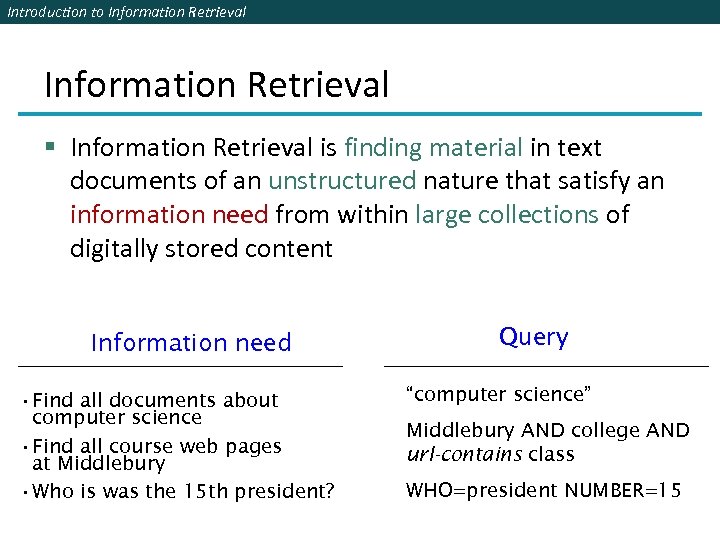 Introduction to Information Retrieval § Information Retrieval is finding material in text documents of an unstructured nature that satisfy an information need from within large collections of digitally stored content Information need • Find all documents about computer science • Find all course web pages at Middlebury • Who is was the 15 th president? Query “computer science” Middlebury AND college AND url-contains class WHO=president NUMBER=15
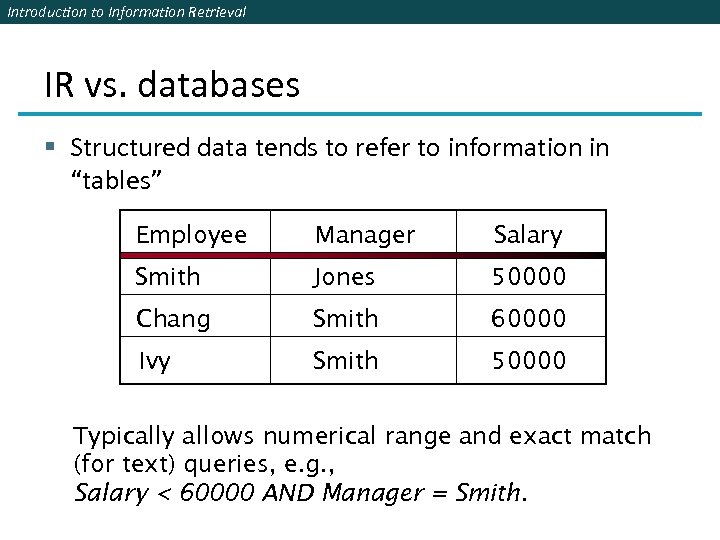 Introduction to Information Retrieval IR vs. databases § Structured data tends to refer to information in “tables” Employee Manager Salary Smith Jones 50000 Chang Smith 60000 Ivy Smith 50000 Typically allows numerical range and exact match (for text) queries, e. g. , Salary < 60000 AND Manager = Smith.
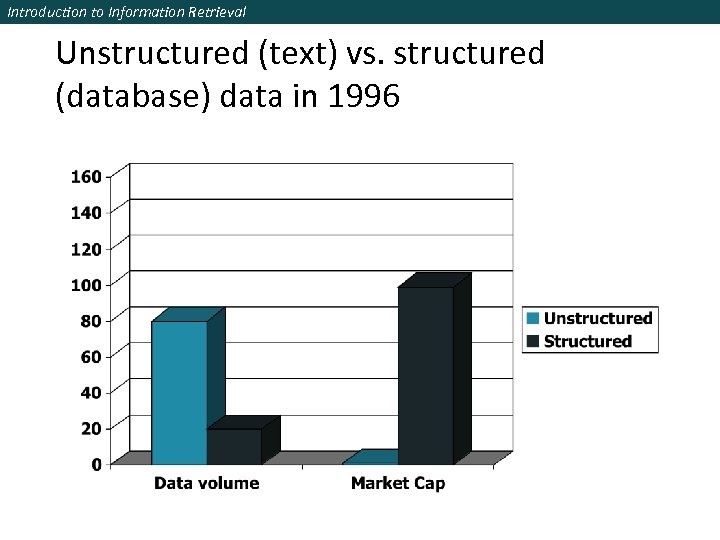 Introduction to Information Retrieval Unstructured (text) vs. structured (database) data in 1996
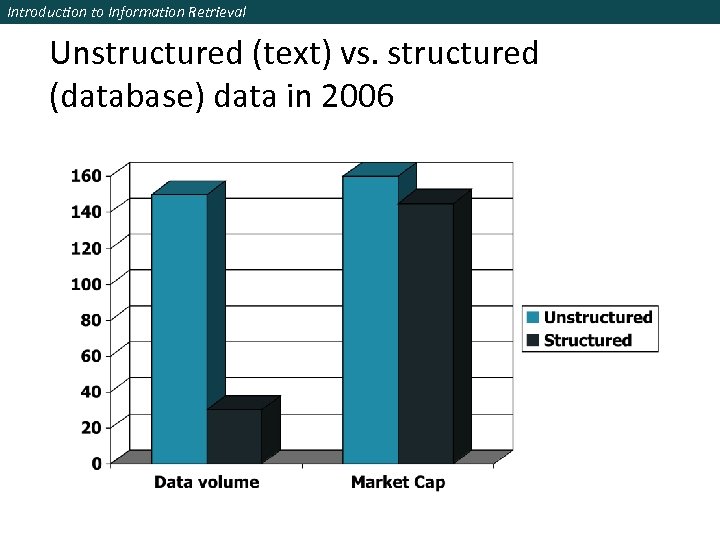 Introduction to Information Retrieval Unstructured (text) vs. structured (database) data in 2006
 Introduction to Information Retrieval Challenges § Why is information retrieval hard? § Lots and lots of data § efficiency § storage § discovery (web) § § Data is unstructured Understanding user intent SPAM Data quality
 Introduction to Information Retrieval Efficiency § 200 million tweets/day over 4 years = ~300 billion tweets § How much data is this? § ~40 TB of data uncompressed for the text itself § ~400 TB of data including additional meta-data § 300 billion web pages? § assume web pages are 100 times longer than tweets § 4 PB of data § 1000 4 TB disks § assume web pages are 1000 times long than tweets § 40 PB of data § 10, 000 4 TB disks § assume web pages are 10, 000 times longer than tweets § 400 PB of data § 100, 000 4 TB disks
 Introduction to Information Retrieval Efficiency § Can we store all of the documents in memory? § How long will it take to do a naïve search of the data? § To search over a small data collection, almost any approach will work (e. g. grep) § At web scale, there are many challenges: § queries need to be really fast! § massive parallelization § redundancy (hard-drives fail, networks fail, …)
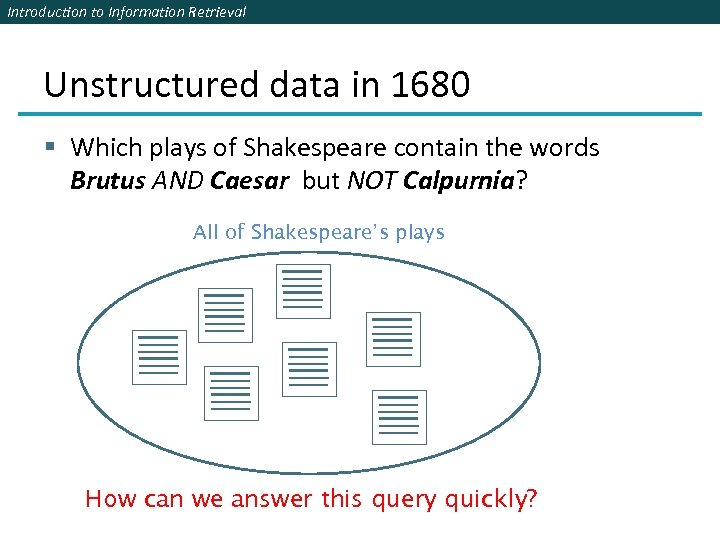 Introduction to Information Retrieval Unstructured data in 1680 § Which plays of Shakespeare contain the words Brutus AND Caesar but NOT Calpurnia? All of Shakespeare’s plays How can we answer this query quickly?
 Introduction to Information Retrieval Unstructured data in 1680 § Which plays of Shakespeare contain the words Brutus AND Caesar but NOT Calpurnia? § Key idea: we can pre-compute some information about the plays/documents that will make queries much faster § What information do we need? § Indexing: for each word, keep track of which documents it occurs in
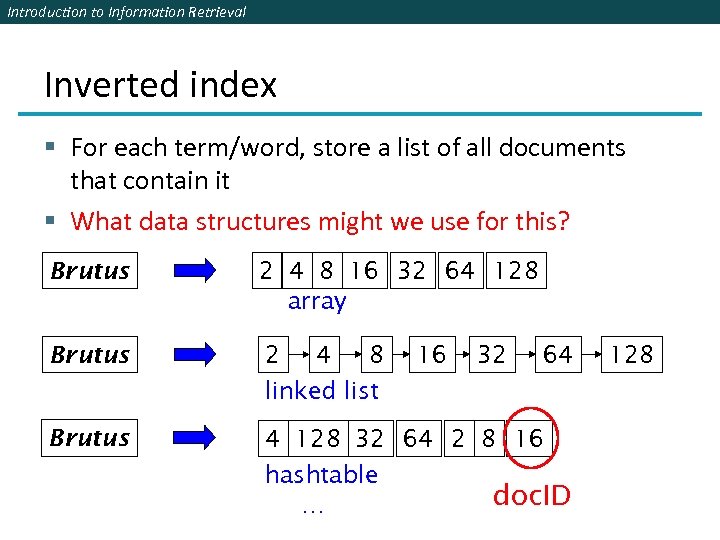 Introduction to Information Retrieval Inverted index § For each term/word, store a list of all documents that contain it § What data structures might we use for this? Brutus 2 4 8 16 32 64 128 array Brutus 2 4 8 linked list Brutus 4 128 32 64 2 8 16 hashtable doc. ID … 16 32 64 128
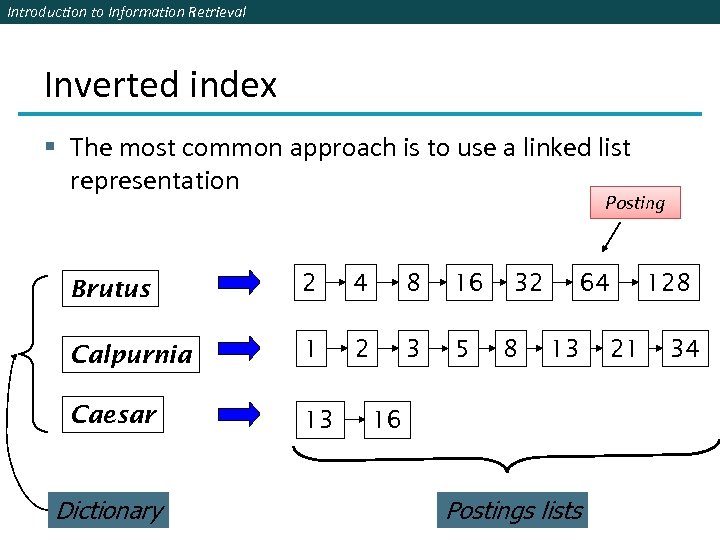 Introduction to Information Retrieval Inverted index § The most common approach is to use a linked list representation Posting Brutus 2 4 8 16 Calpurnia 1 2 3 5 Caesar 13 Dictionary 32 8 64 13 16 Postings lists 21 128 34
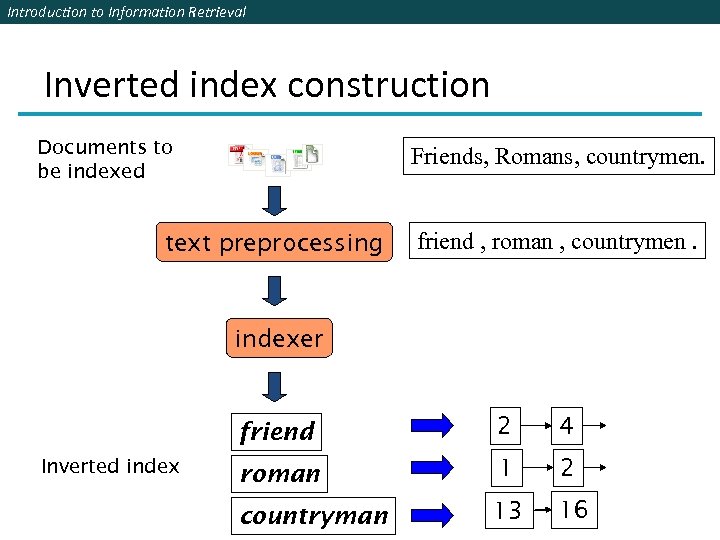 Introduction to Information Retrieval Inverted index construction Documents to be indexed Friends, Romans, countrymen. text preprocessing friend , roman , countrymen. indexer friend Inverted index 2 4 roman 1 2 countryman 13 16
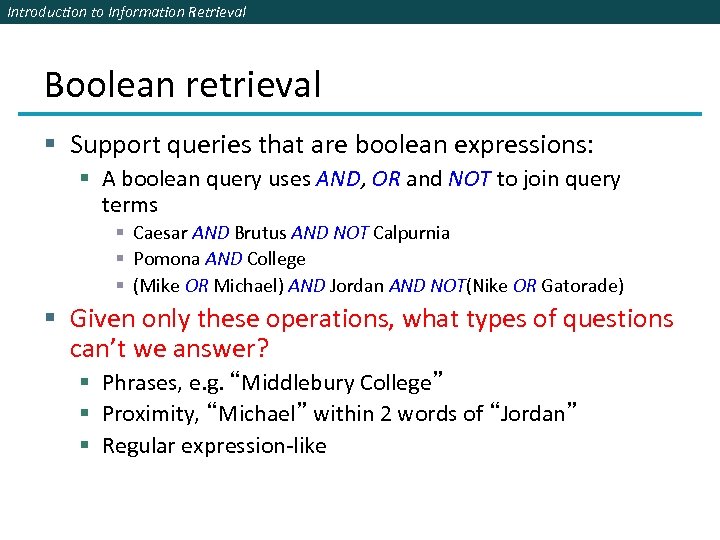 Introduction to Information Retrieval Boolean retrieval § Support queries that are boolean expressions: § A boolean query uses AND, OR and NOT to join query terms § Caesar AND Brutus AND NOT Calpurnia § Pomona AND College § (Mike OR Michael) AND Jordan AND NOT(Nike OR Gatorade) § Given only these operations, what types of questions can’t we answer? § Phrases, e. g. “Middlebury College” § Proximity, “Michael” within 2 words of “Jordan” § Regular expression-like
 Introduction to Information Retrieval Boolean retrieval § Primary commercial retrieval tool for 3 decades § Professional searchers (e. g. , lawyers) still like boolean queries § Why? § You know exactly what you’re getting, a query either matches or it doesn’t § Through trial and error, can frequently fine tune the query appropriately § Don’t have to worry about underlying heuristics (e. g. Page. Rank, term weightings, synonym, etc…)
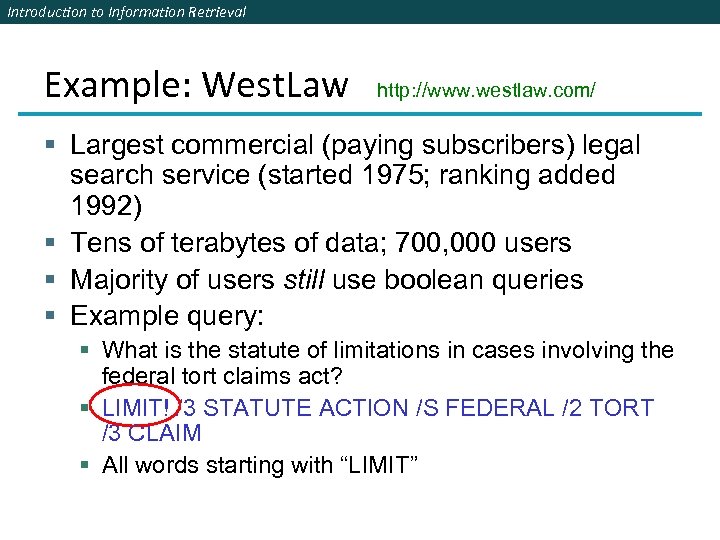 Introduction to Information Retrieval Example: West. Law http: //www. westlaw. com/ § Largest commercial (paying subscribers) legal search service (started 1975; ranking added 1992) § Tens of terabytes of data; 700, 000 users § Majority of users still use boolean queries § Example query: § What is the statute of limitations in cases involving the federal tort claims act? § LIMIT! /3 STATUTE ACTION /S FEDERAL /2 TORT /3 CLAIM § All words starting with “LIMIT”
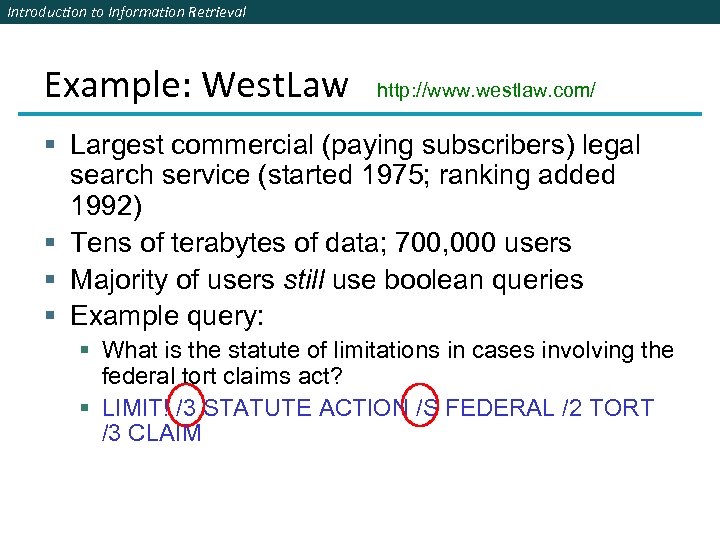 Introduction to Information Retrieval Example: West. Law http: //www. westlaw. com/ § Largest commercial (paying subscribers) legal search service (started 1975; ranking added 1992) § Tens of terabytes of data; 700, 000 users § Majority of users still use boolean queries § Example query: § What is the statute of limitations in cases involving the federal tort claims act? § LIMIT! /3 STATUTE ACTION /S FEDERAL /2 TORT /3 CLAIM
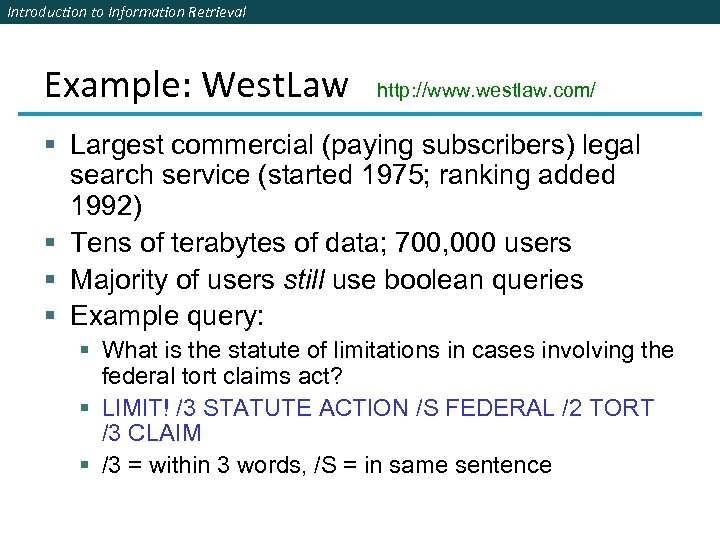 Introduction to Information Retrieval Example: West. Law http: //www. westlaw. com/ § Largest commercial (paying subscribers) legal search service (started 1975; ranking added 1992) § Tens of terabytes of data; 700, 000 users § Majority of users still use boolean queries § Example query: § What is the statute of limitations in cases involving the federal tort claims act? § LIMIT! /3 STATUTE ACTION /S FEDERAL /2 TORT /3 CLAIM § /3 = within 3 words, /S = in same sentence
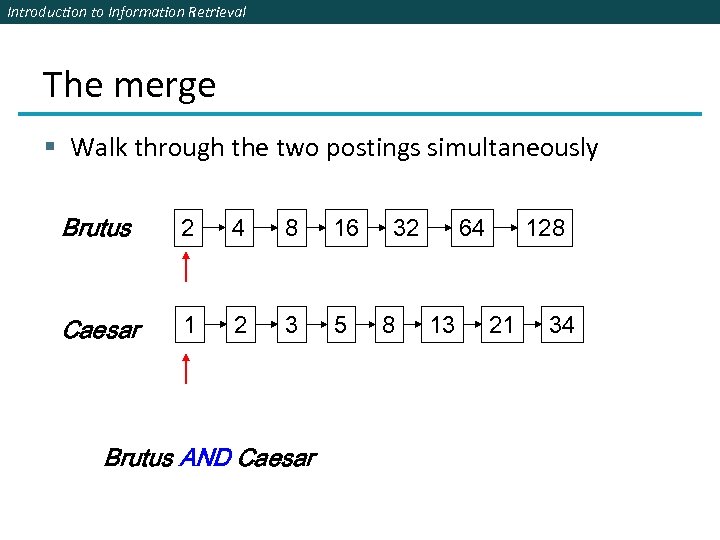
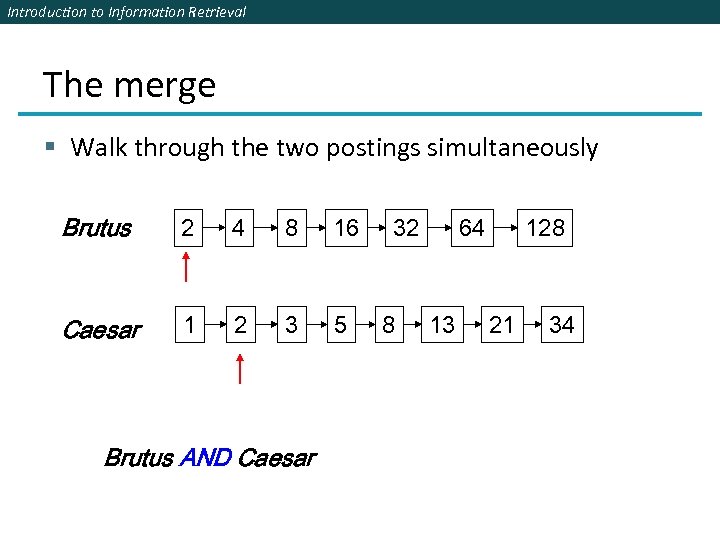
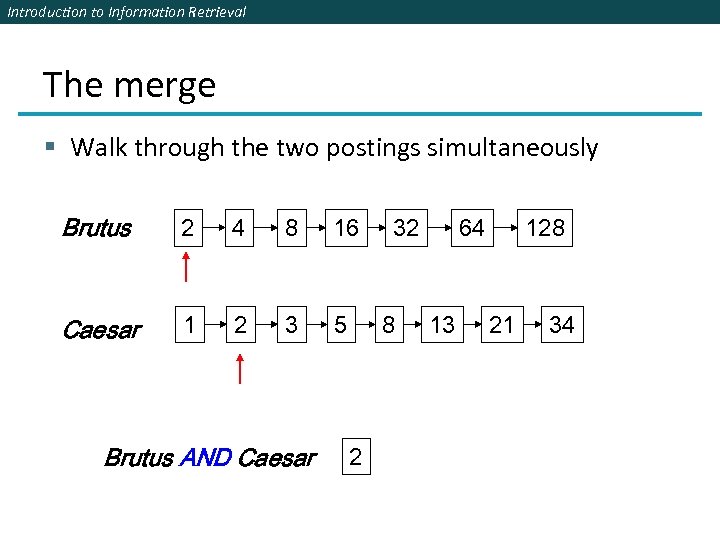
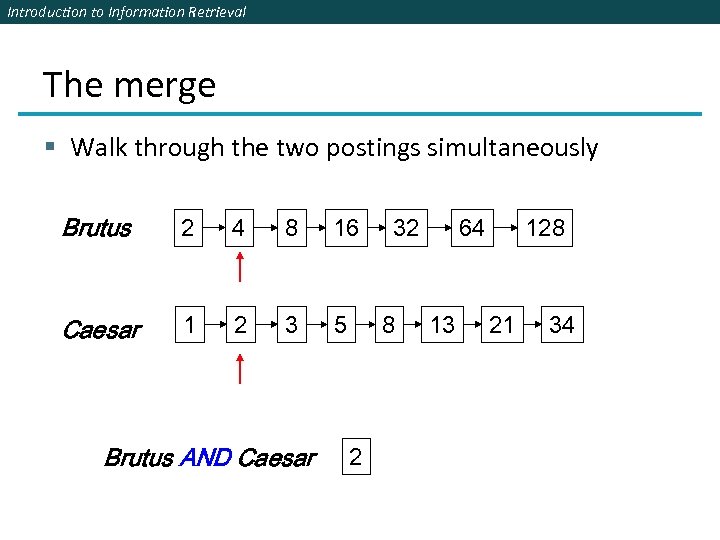
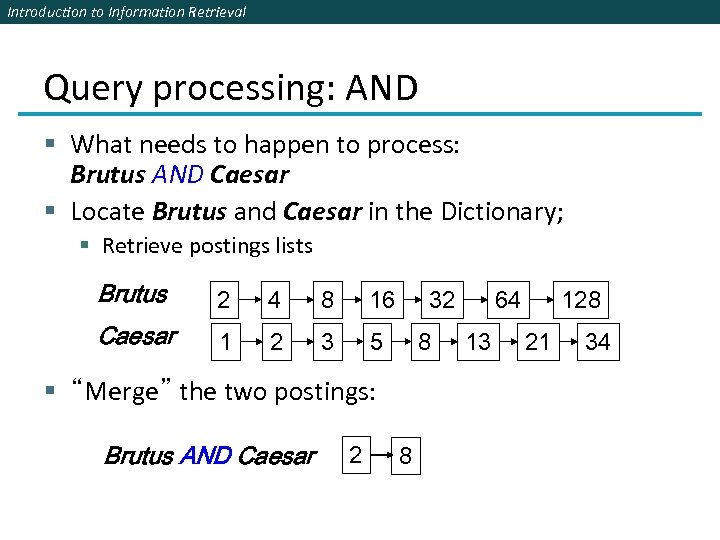 Introduction to Information Retrieval Query processing: AND § What needs to happen to process: Brutus AND Caesar § Locate Brutus and Caesar in the Dictionary; § Retrieve postings lists Brutus 2 4 8 16 Caesar 1 2 3 5 32 8 § “Merge” the two postings: Brutus AND Caesar 2 8 64 13 128 21 34
 Introduction to Information Retrieval The merge § Walk through the two postings simultaneously Brutus 2 4 8 16 Caesar 1 2 3 5 Brutus AND Caesar 32 8 64 13 128 21 34
 Introduction to Information Retrieval The merge § Walk through the two postings simultaneously Brutus 2 4 8 16 Caesar 1 2 3 5 Brutus AND Caesar 32 8 64 13 128 21 34
 Introduction to Information Retrieval The merge § Walk through the two postings simultaneously Brutus 2 4 8 16 Caesar 1 2 3 5 Brutus AND Caesar 32 8 2 64 13 128 21 34
 Introduction to Information Retrieval The merge § Walk through the two postings simultaneously Brutus 2 4 8 16 Caesar 1 2 3 5 Brutus AND Caesar 32 8 2 64 13 128 21 34
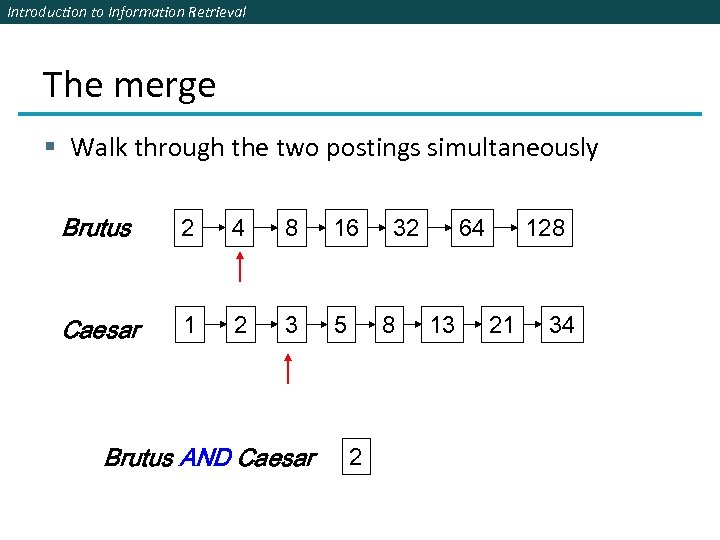 Introduction to Information Retrieval The merge § Walk through the two postings simultaneously Brutus 2 4 8 16 Caesar 1 2 3 5 Brutus AND Caesar 32 8 2 64 13 128 21 34
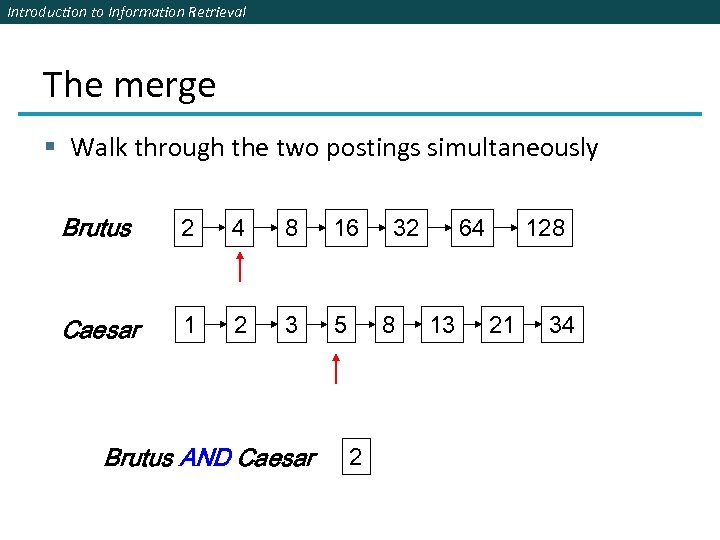 Introduction to Information Retrieval The merge § Walk through the two postings simultaneously Brutus 2 4 8 16 Caesar 1 2 3 5 Brutus AND Caesar 32 8 2 64 13 128 21 34
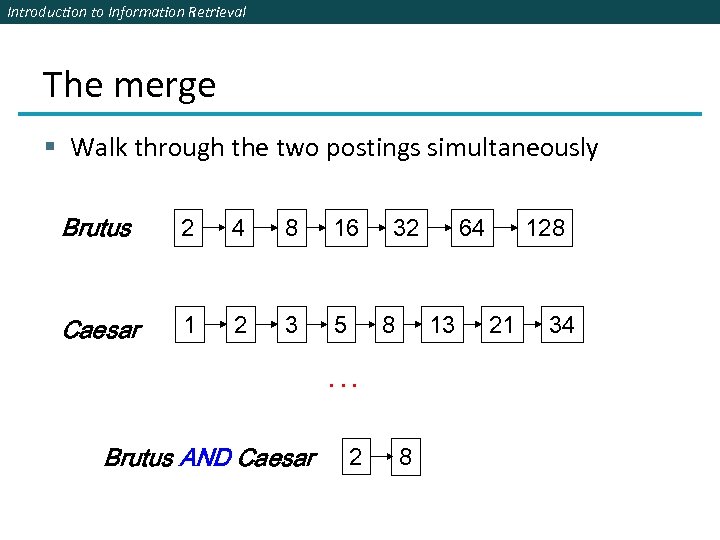 Introduction to Information Retrieval The merge § Walk through the two postings simultaneously Brutus 2 4 8 16 Caesar 1 2 3 5 32 8 13 … Brutus AND Caesar 2 64 8 128 21 34
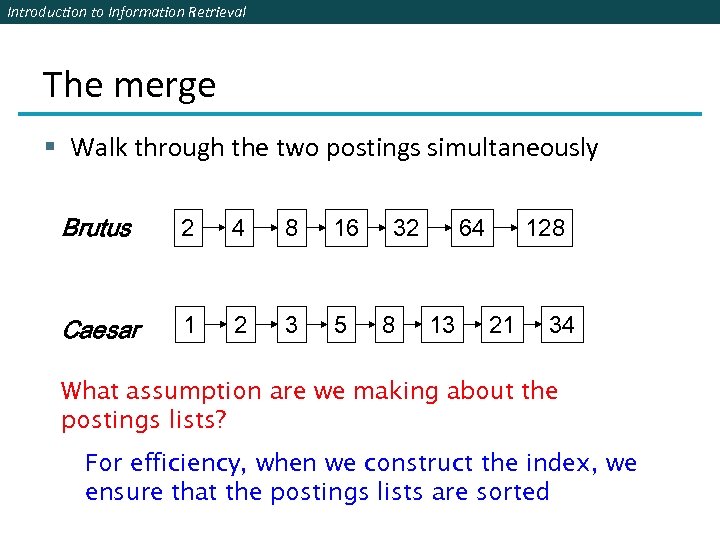 Introduction to Information Retrieval The merge § Walk through the two postings simultaneously Brutus 2 4 8 16 Caesar 1 2 3 5 32 8 64 13 128 21 34 What assumption are we making about the postings lists? For efficiency, when we construct the index, we ensure that the postings lists are sorted
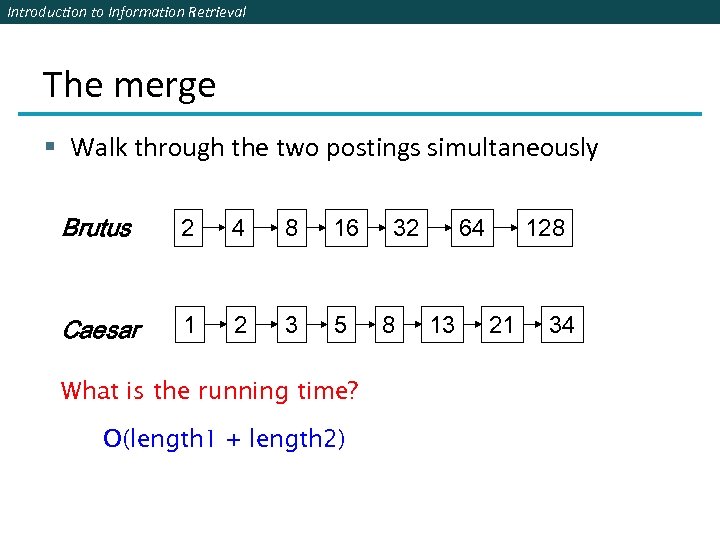 Introduction to Information Retrieval The merge § Walk through the two postings simultaneously Brutus 2 4 8 16 Caesar 1 2 3 5 What is the running time? O(length 1 + length 2) 32 8 64 13 128 21 34
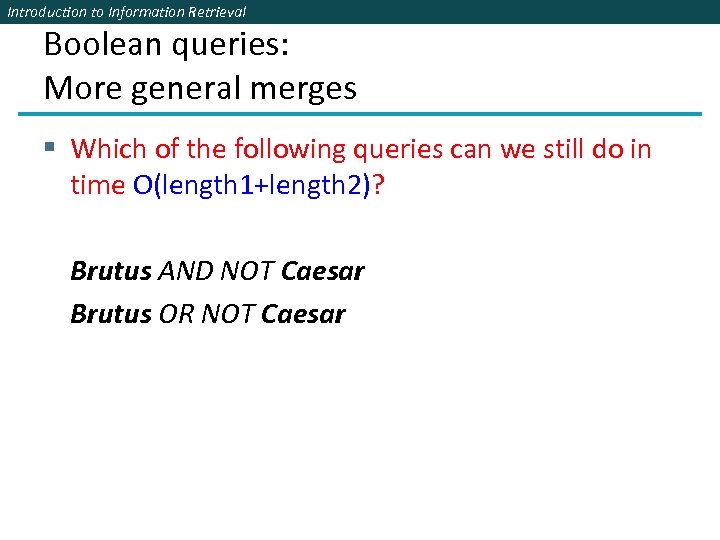 Introduction to Information Retrieval Boolean queries: More general merges § Which of the following queries can we still do in time O(length 1+length 2)? Brutus AND NOT Caesar Brutus OR NOT Caesar
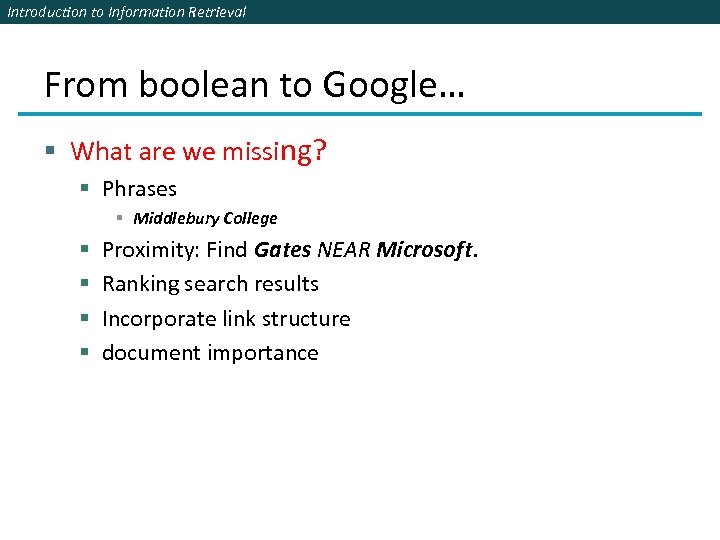 Introduction to Information Retrieval From boolean to Google… § What are we missing? § Phrases § Middlebury College § § Proximity: Find Gates NEAR Microsoft. Ranking search results Incorporate link structure document importance
 Introduction to Information Retrieval From boolean to Google… § Phrases § Middlebury College § § Proximity: Find Gates NEAR Microsoft Ranking search results Incorporate link structure document importance
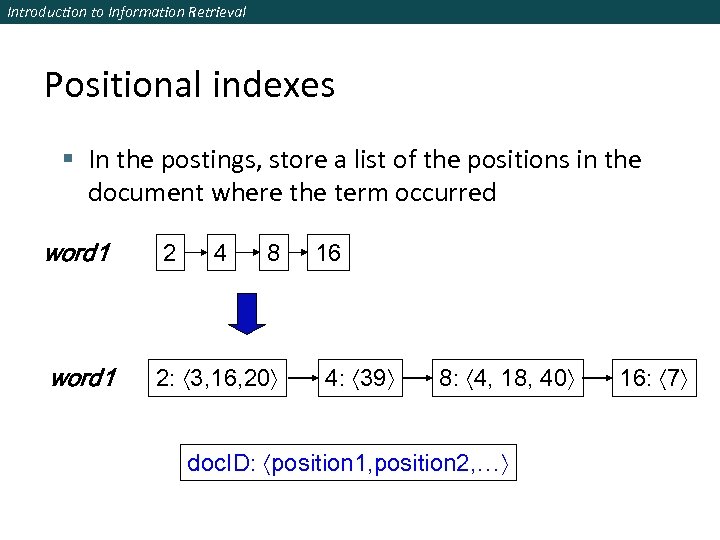 Introduction to Information Retrieval Positional indexes § In the postings, store a list of the positions in the document where the term occurred word 1 2 4 8 2: 3, 16, 20 16 4: 39 8: 4, 18, 40 doc. ID: position 1, position 2, … 16: 7
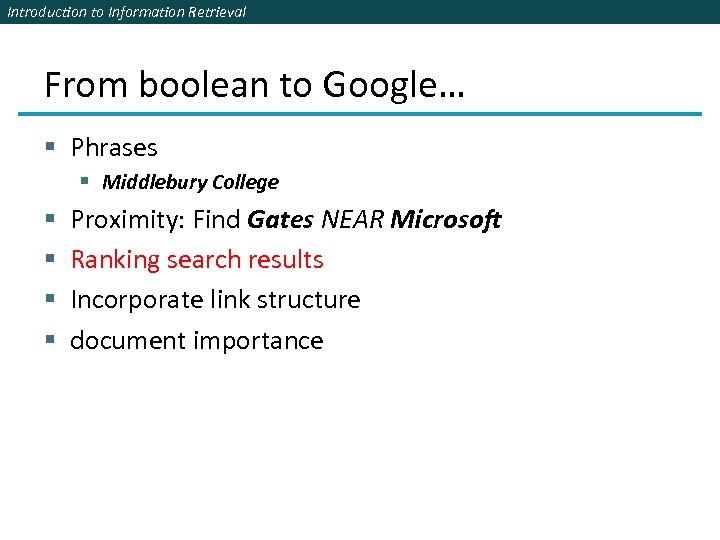 Introduction to Information Retrieval From boolean to Google… § Phrases § Middlebury College § § Proximity: Find Gates NEAR Microsoft Ranking search results Incorporate link structure document importance
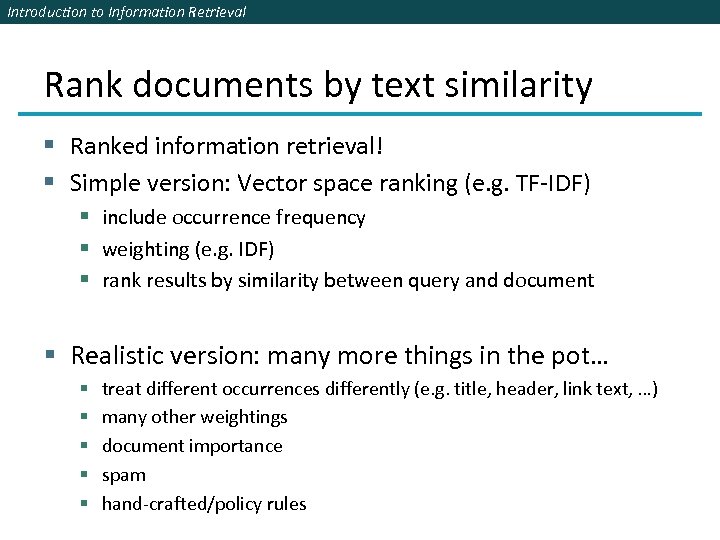 Introduction to Information Retrieval Rank documents by text similarity § Ranked information retrieval! § Simple version: Vector space ranking (e. g. TF-IDF) § include occurrence frequency § weighting (e. g. IDF) § rank results by similarity between query and document § Realistic version: many more things in the pot… § § § treat different occurrences differently (e. g. title, header, link text, …) many other weightings document importance spam hand-crafted/policy rules
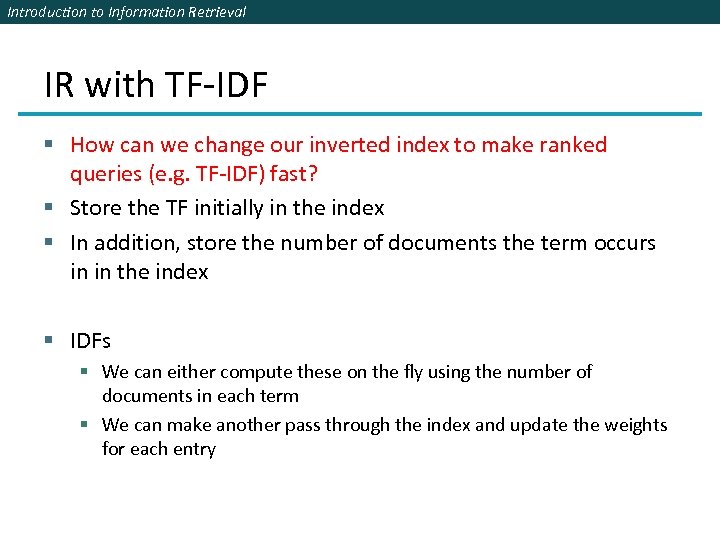 Introduction to Information Retrieval IR with TF-IDF § How can we change our inverted index to make ranked queries (e. g. TF-IDF) fast? § Store the TF initially in the index § In addition, store the number of documents the term occurs in in the index § IDFs § We can either compute these on the fly using the number of documents in each term § We can make another pass through the index and update the weights for each entry
 Introduction to Information Retrieval From boolean to Google… § Phrases § Middlebury College § Proximity: Find Gates NEAR Microsoft § Ranking search results § include occurrence frequency § weighting § treat different occurrences differently (e. g. title, header, link text, …) § Incorporate link structure § document importance
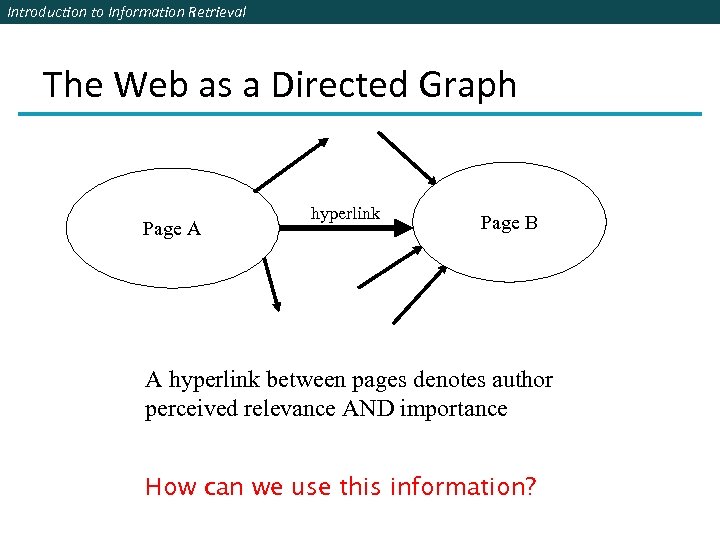 Introduction to Information Retrieval The Web as a Directed Graph Page A hyperlink Page B A hyperlink between pages denotes author perceived relevance AND importance How can we use this information?
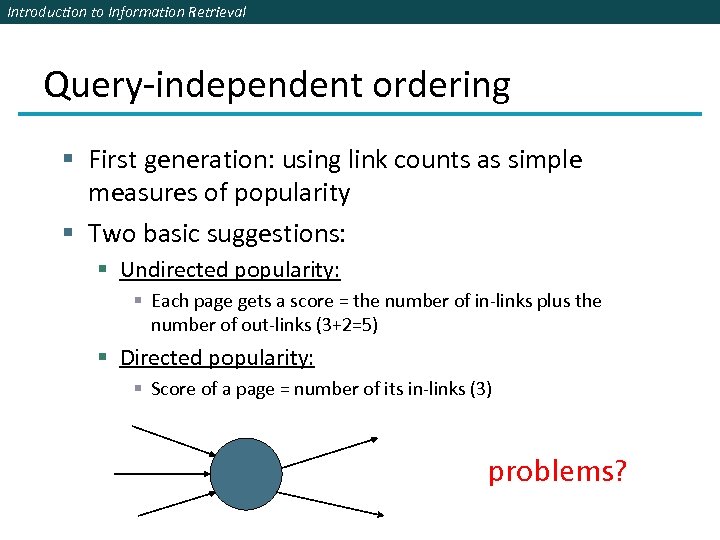 Introduction to Information Retrieval Query-independent ordering § First generation: using link counts as simple measures of popularity § Two basic suggestions: § Undirected popularity: § Each page gets a score = the number of in-links plus the number of out-links (3+2=5) § Directed popularity: § Score of a page = number of its in-links (3) problems?
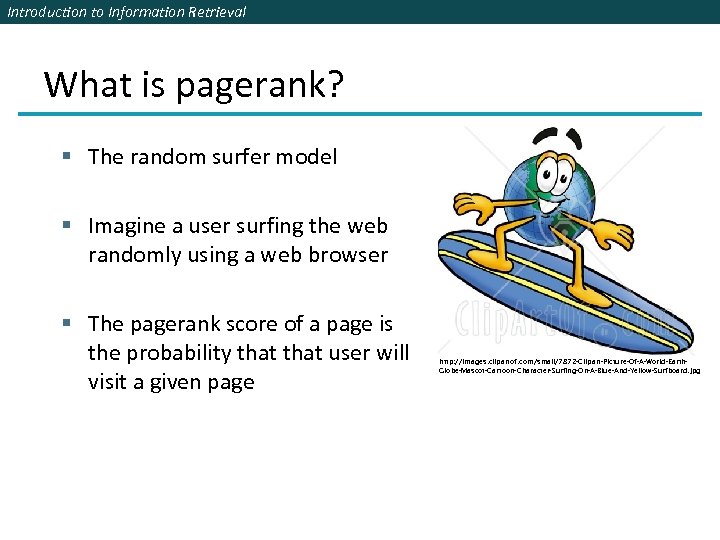 Introduction to Information Retrieval What is pagerank? § The random surfer model § Imagine a user surfing the web randomly using a web browser § The pagerank score of a page is the probability that user will visit a given page http: //images. clipartof. com/small/7872 -Clipart-Picture-Of-A-World-Earth. Globe-Mascot-Cartoon-Character-Surfing-On-A-Blue-And-Yellow-Surfboard. jpg
 Introduction to Information Retrieval Random surfer model § We want to model the behavior of a “random” user interfacing the web through a browser § Model is independent of content (i. e. just graph structure) § What types of behavior should we model and how? § § § Where to start Following links on a page Typing in a url (bookmarks) What happens if we get a page with no outlinks Back button on browser
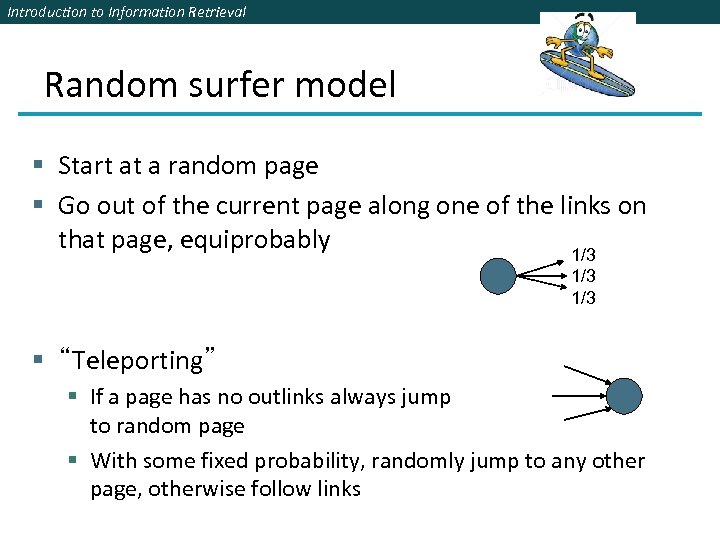 Introduction to Information Retrieval Random surfer model § Start at a random page § Go out of the current page along one of the links on that page, equiprobably 1/3 1/3 § “Teleporting” § If a page has no outlinks always jump to random page § With some fixed probability, randomly jump to any other page, otherwise follow links
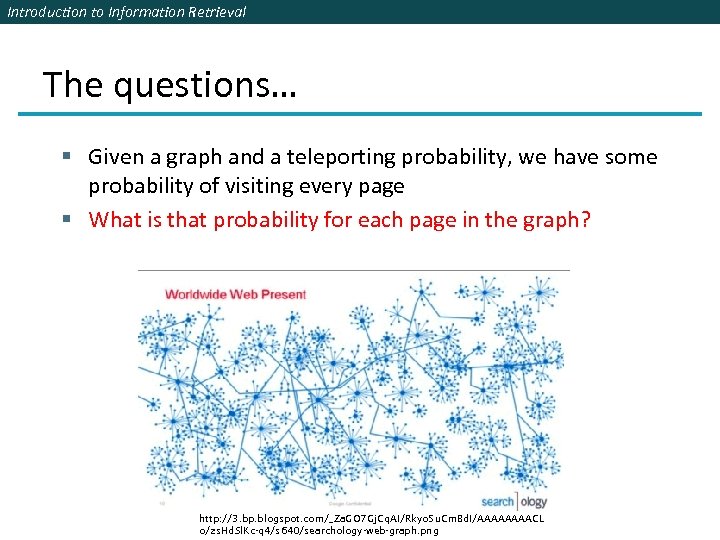 Introduction to Information Retrieval The questions… § Given a graph and a teleporting probability, we have some probability of visiting every page § What is that probability for each page in the graph? http: //3. bp. blogspot. com/_Za. GO 7 Gj. Cq. AI/Rkyo 5 u. Cm. Bd. I/AAAACL o/zs. Hd. Sl. Kc-q 4/s 640/searchology-web-graph. png
 Introduction to Information Retrieval Pagerank summary § Preprocessing: § Given a graph of links, build matrix P § From it compute steady state of each state § An entry is a number between 0 and 1: the pagerank of a page § Query processing: § Retrieve pages meeting query § Integrate pagerank score with other scoring (e. g. tf-idf) § Rank pages by this combined score
 Introduction to Information Retrieval Pagerank problems? § Can still fool pagerank § link farms § Create a bunch of pages that are tightly linked and on topic, then link a few pages to off-topic pages § link exchanges § I’ll pay you to link to me § I’ll link to you if you’ll link to me § buy old URLs § post on blogs, etc. with URLs § Create crappy content (but still may seem relevant)
 Introduction to Information Retrieval IR Evaluation § Like any research area, an important component is how to evaluate a system § What are important features for an IR system? § How might we automatically evaluate the performance of a system? Compare two systems? § What data might be useful?
 Introduction to Information Retrieval Measures for a search engine § How fast does it index (how frequently can we update the index) § How fast does it search § How big is the index § Expressiveness of query language § UI § Is it free? § Quality of the search results
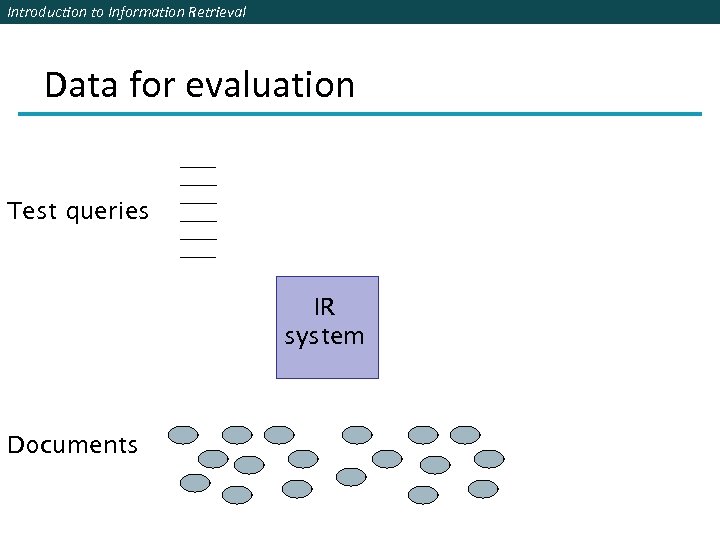 Introduction to Information Retrieval Data for evaluation Test queries IR system Documents
 Introduction to Information Retrieval Many other evaluation measures… § § § F 1 Precision at K 11 -point average precision mean average precision (MAP) score normalized discounted cumulative gain (NDGC) …
 Introduction to Information Retrieval IR Research
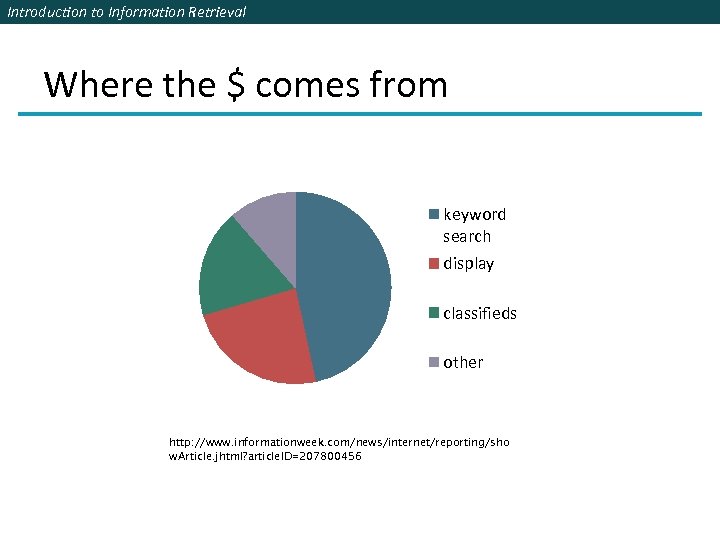
 Introduction to Information Retrieval $$$$ § How do search engines make money? § How much money do they make?
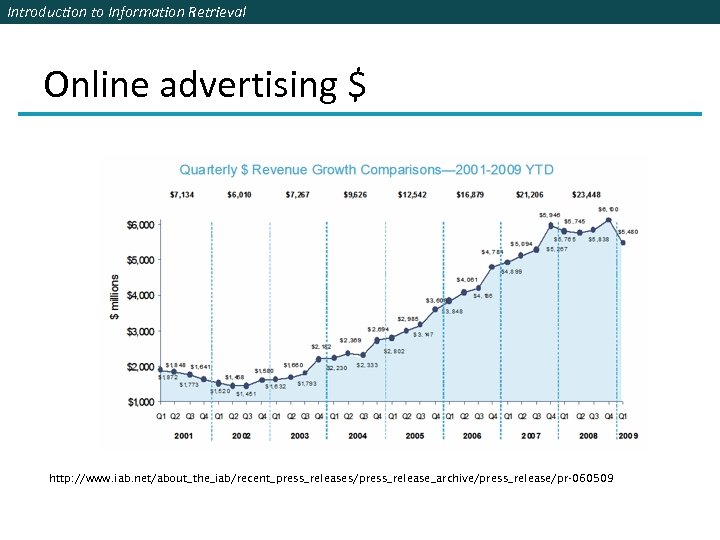 Introduction to Information Retrieval Online advertising $ http: //www. iab. net/about_the_iab/recent_press_releases/press_release_archive/press_release/pr-060509
 Introduction to Information Retrieval Where the $ comes from keyword search display classifieds other http: //www. informationweek. com/news/internet/reporting/sho w. Article. jhtml? article. ID=207800456
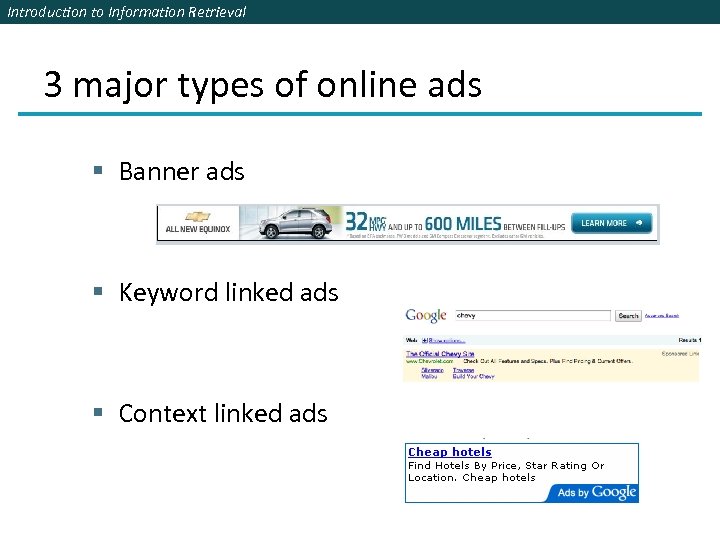 Introduction to Information Retrieval 3 major types of online ads § Banner ads § Keyword linked ads § Context linked ads
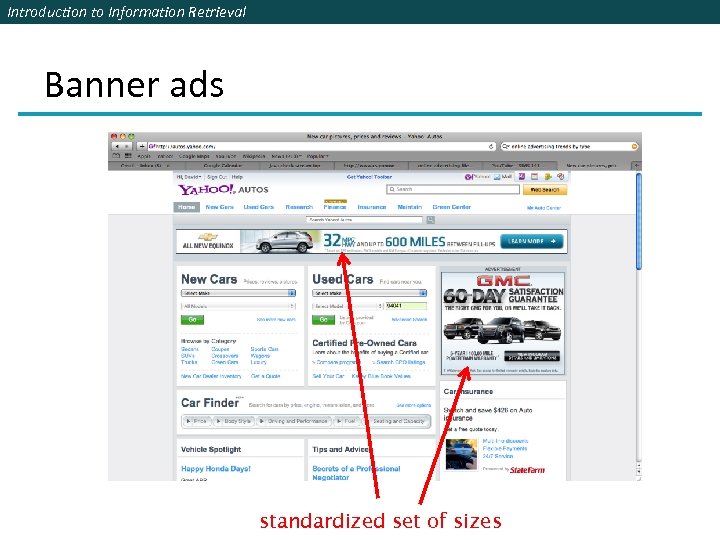 Introduction to Information Retrieval Banner ads standardized set of sizes
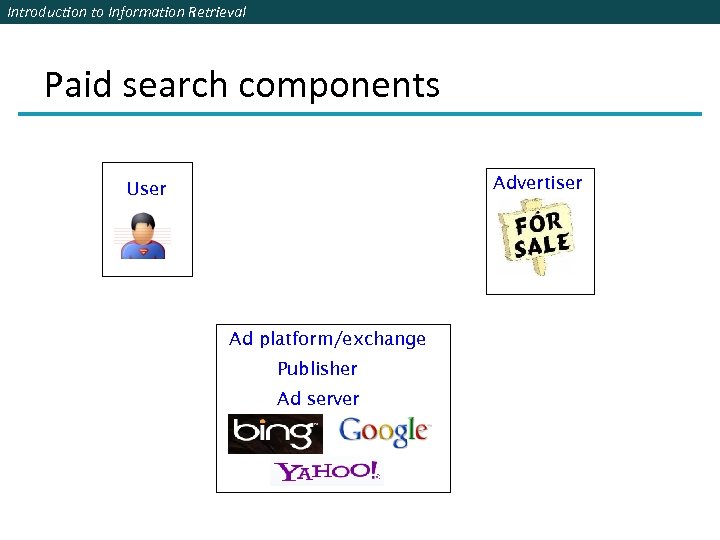 Introduction to Information Retrieval Paid search components Advertiser User Ad platform/exchange Publisher Ad server
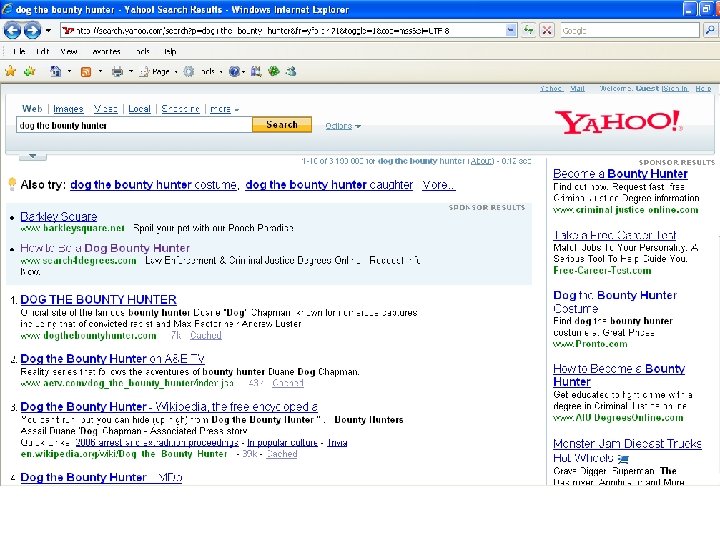
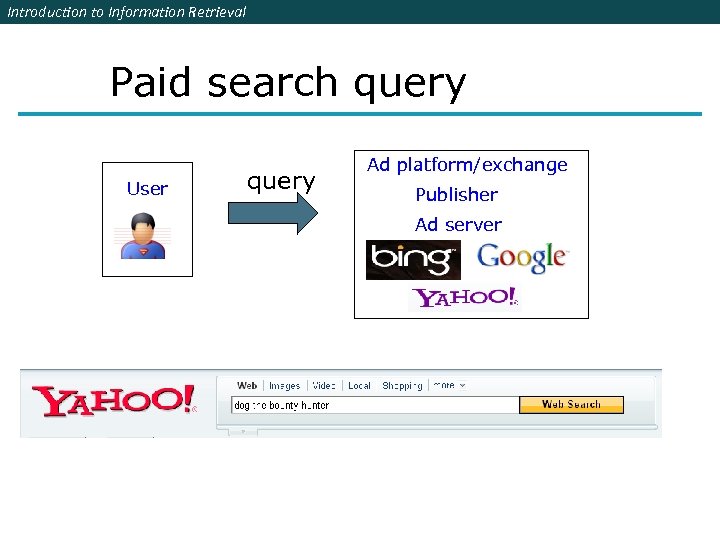 Introduction to Information Retrieval Paid search query User query Ad platform/exchange Publisher Ad server
 Introduction to Information Retrieval
 Introduction to Information Retrieval What is required of the advertiser? Advertiser Ad platform/exchange Publisher Ad server
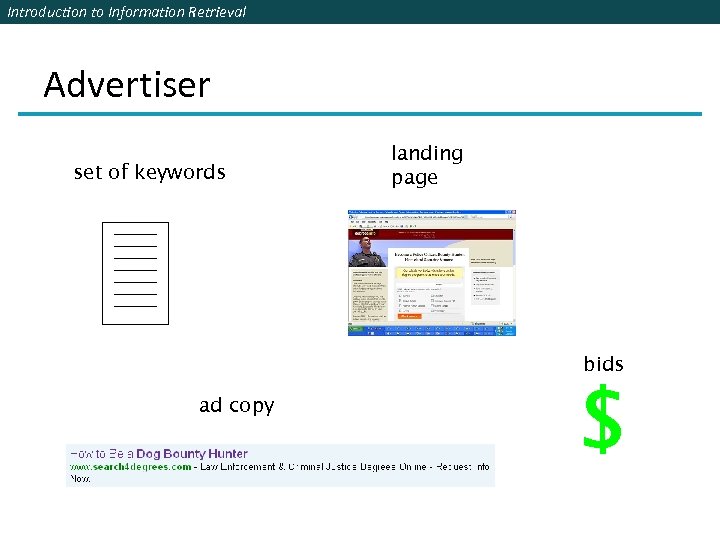 Introduction to Information Retrieval Advertiser set of keywords landing page bids ad copy $
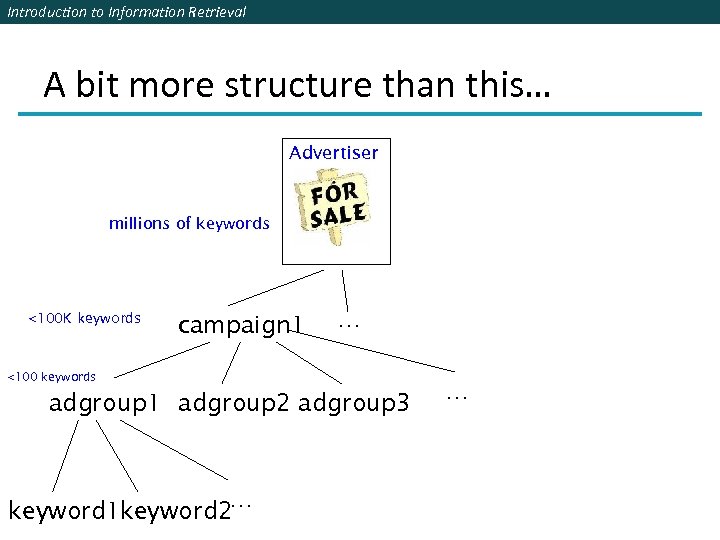 Introduction to Information Retrieval A bit more structure than this… Advertiser millions of keywords <100 K keywords campaign 1 … <100 keywords adgroup 1 adgroup 2 adgroup 3 keyword 1 keyword 2… …
 Introduction to Information Retrieval Adgroups § Adgroups are the key structure § Adcopy and landing pages are associated at the adcopy level § Keywords should be tightly themed § promotes targeting § makes google, yahoo, etc. happy
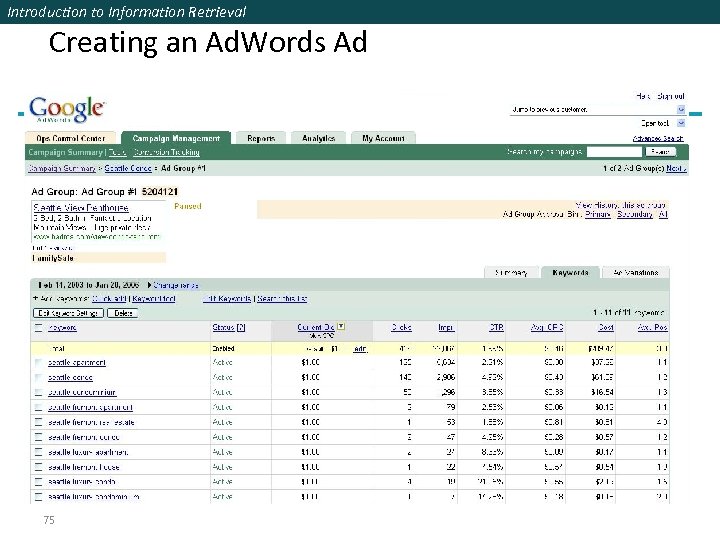 Introduction to Information Retrieval Creating an Ad. Words Ad 75
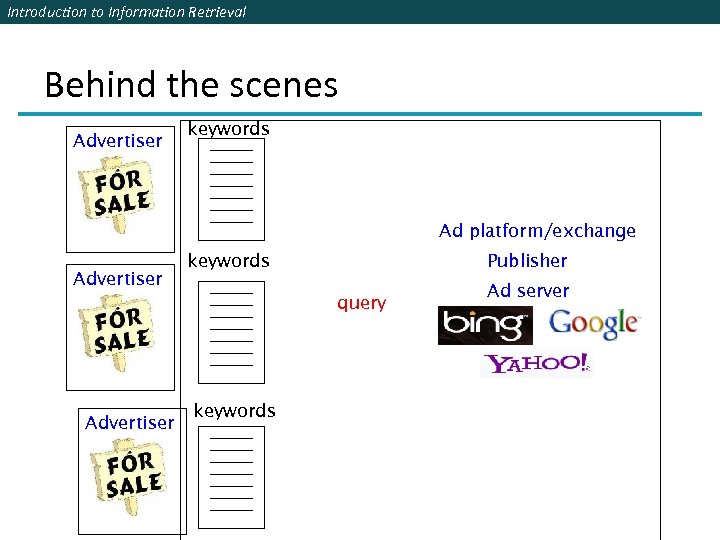 Introduction to Information Retrieval Behind the scenes Advertiser keywords Ad platform/exchange Advertiser keywords Publisher query Advertiser keywords Ad server
 Introduction to Information Retrieval Behind the scenes Advertiser keywords Ad platform/exchange Advertiser keywords Publisher ? query Ad server keywords matching problem
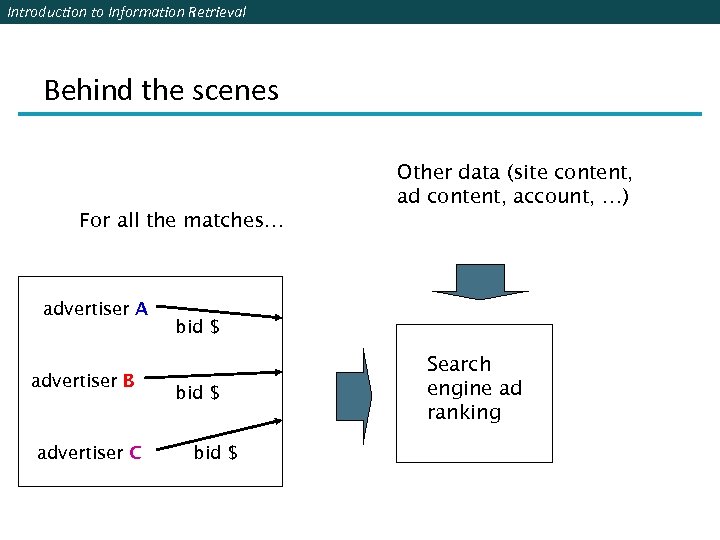 Introduction to Information Retrieval Behind the scenes Other data (site content, ad content, account, …) For all the matches… advertiser A advertiser B advertiser C bid $ Search engine ad ranking
 Introduction to Information Retrieval Behind the scenes: keyword auction Other data (site content, ad content, account, …) Site bids for keyword: “dog the bounty hunter” Web site A Web site B Web site C bid $ Display ranking Web site B Search engine ad ranking Web site A Web site C
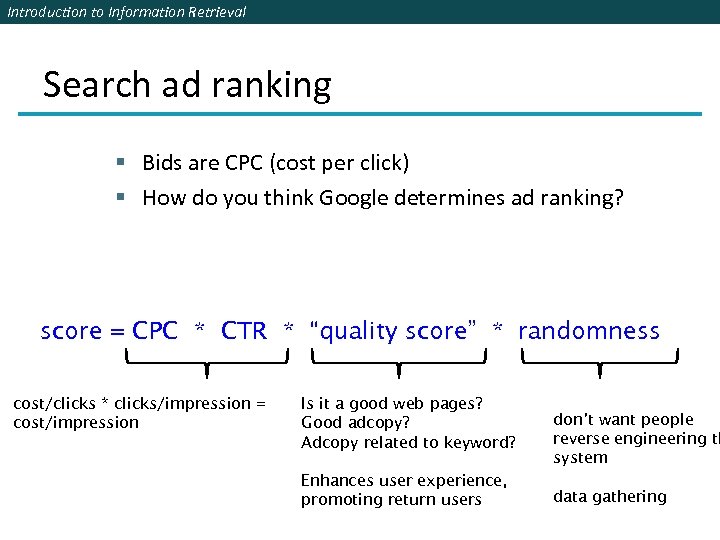 Introduction to Information Retrieval Search ad ranking § Bids are CPC (cost per click) § How do you think Google determines ad ranking? score = CPC * CTR * “quality score” * randomness cost/clicks * clicks/impression = cost/impression Is it a good web pages? Good adcopy? Adcopy related to keyword? Enhances user experience, promoting return users don’t want people reverse engineering th system data gathering