 Скачать презентацию Introduction to Hebrew Linguistics Inleiding Hebreeuwse Taalkunde Uv
e6731d2306bed1fcf48d579e734da38e.ppt
- Количество слайдов: 18



Introduction to Hebrew Linguistics (‘Inleiding Hebreeuwse Taalkunde’) Uv. A, Week 7, March 17, 2011 Haskala, Modern Hebrew, Israeli [Hebrew] Tamás Biró
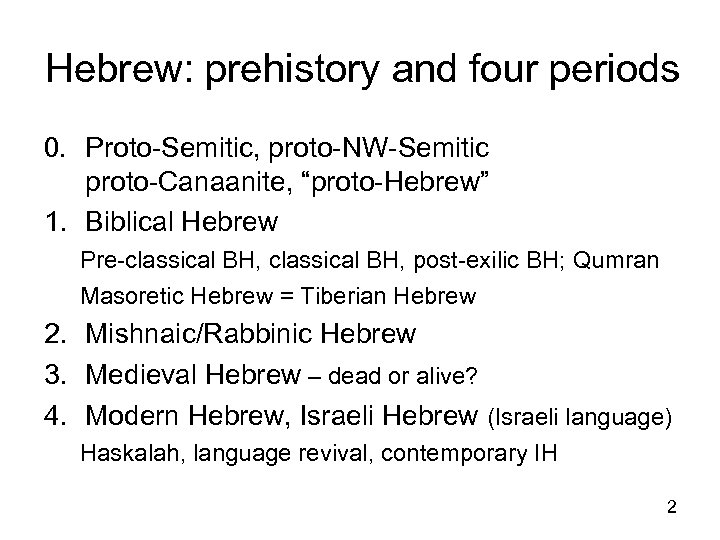
Hebrew: prehistory and four periods 0. Proto-Semitic, proto-NW-Semitic proto-Canaanite, “proto-Hebrew” 1. Biblical Hebrew Pre-classical BH, post-exilic BH; Qumran Masoretic Hebrew = Tiberian Hebrew 2. Mishnaic/Rabbinic Hebrew 3. Medieval Hebrew – dead or alive? 4. Modern Hebrew, Israeli Hebrew (Israeli language) Haskalah, language revival, contemporary IH 2
An imaginary bet • We are in 1881, in Amsterdam. A prophet reveals to us that in 100 years, there will be a national language of the Jewish people. • What is your bet, which language it is going to be? (a) Yiddish (c) Biblical Hebrew (b) German (d) Rabbinic Hebrew
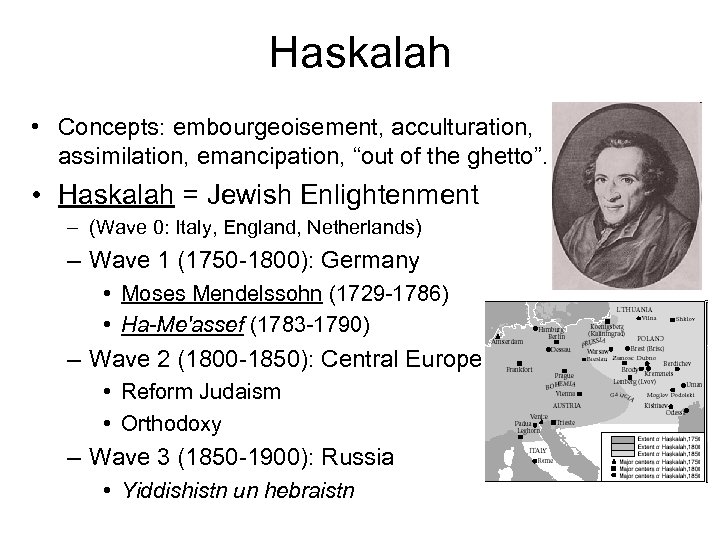
Haskalah • Concepts: embourgeoisement, acculturation, assimilation, emancipation, “out of the ghetto”. • Haskalah = Jewish Enlightenment – (Wave 0: Italy, England, Netherlands) – Wave 1 (1750 -1800): Germany • Moses Mendelssohn (1729 -1786) • Ha-Me'assef (1783 -1790) – Wave 2 (1800 -1850): Central Europe • Reform Judaism • Orthodoxy – Wave 3 (1850 -1900): Russia • Yiddishistn un hebraistn
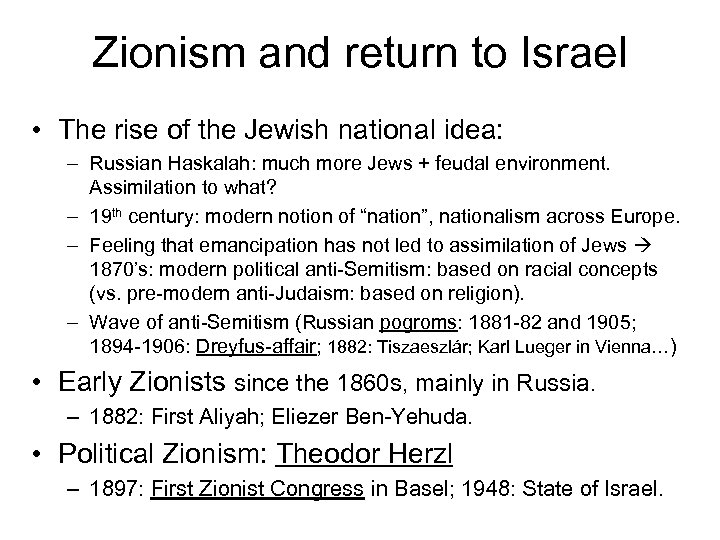
Zionism and return to Israel • The rise of the Jewish national idea: – Russian Haskalah: much more Jews + feudal environment. Assimilation to what? – 19 th century: modern notion of “nation”, nationalism across Europe. – Feeling that emancipation has not led to assimilation of Jews 1870’s: modern political anti-Semitism: based on racial concepts (vs. pre-modern anti-Judaism: based on religion). – Wave of anti-Semitism (Russian pogroms: 1881 -82 and 1905; 1894 -1906: Dreyfus-affair; 1882: Tiszaeszlár; Karl Lueger in Vienna…) • Early Zionists since the 1860 s, mainly in Russia. – 1882: First Aliyah; Eliezer Ben-Yehuda. • Political Zionism: Theodor Herzl – 1897: First Zionist Congress in Basel; 1948: State of Israel.
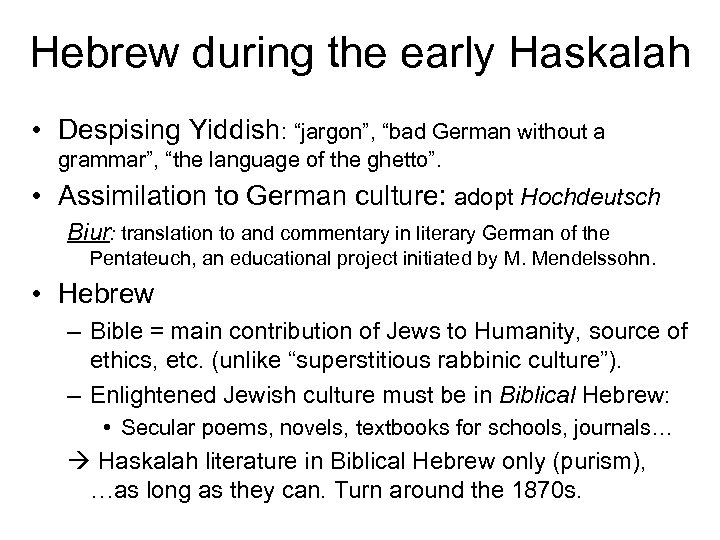
Hebrew during the early Haskalah • Despising Yiddish: “jargon”, “bad German without a grammar”, “the language of the ghetto”. • Assimilation to German culture: adopt Hochdeutsch Biur: translation to and commentary in literary German of the Pentateuch, an educational project initiated by M. Mendelssohn. • Hebrew – Bible = main contribution of Jews to Humanity, source of ethics, etc. (unlike “superstitious rabbinic culture”). – Enlightened Jewish culture must be in Biblical Hebrew: • Secular poems, novels, textbooks for schools, journals… Haskalah literature in Biblical Hebrew only (purism), …as long as they can. Turn around the 1870 s.
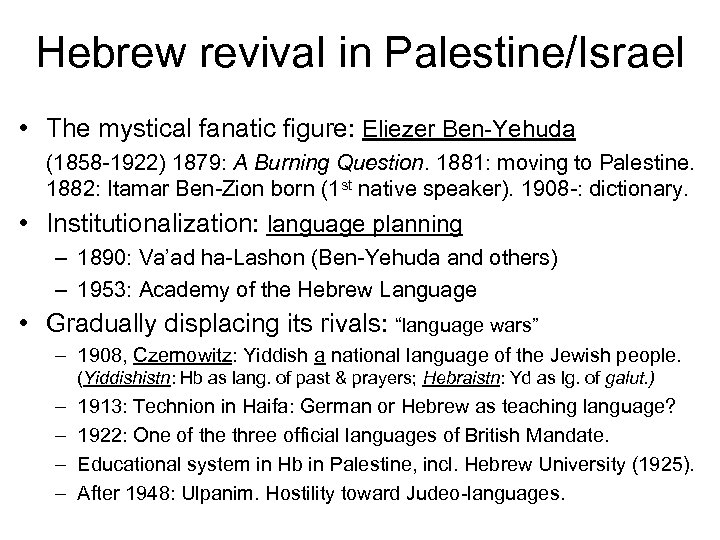
Hebrew revival in Palestine/Israel • The mystical fanatic figure: Eliezer Ben-Yehuda (1858 -1922) 1879: A Burning Question. 1881: moving to Palestine. 1882: Itamar Ben-Zion born (1 st native speaker). 1908 -: dictionary. • Institutionalization: language planning – 1890: Va’ad ha-Lashon (Ben-Yehuda and others) – 1953: Academy of the Hebrew Language • Gradually displacing its rivals: “language wars” – 1908, Czernowitz: Yiddish a national language of the Jewish people. (Yiddishistn: Hb as lang. of past & prayers; Hebraistn: Yd as lg. of galut. ) – – 1913: Technion in Haifa: German or Hebrew as teaching language? 1922: One of the three official languages of British Mandate. Educational system in Hb in Palestine, incl. Hebrew University (1925). After 1948: Ulpanim. Hostility toward Judeo-languages.
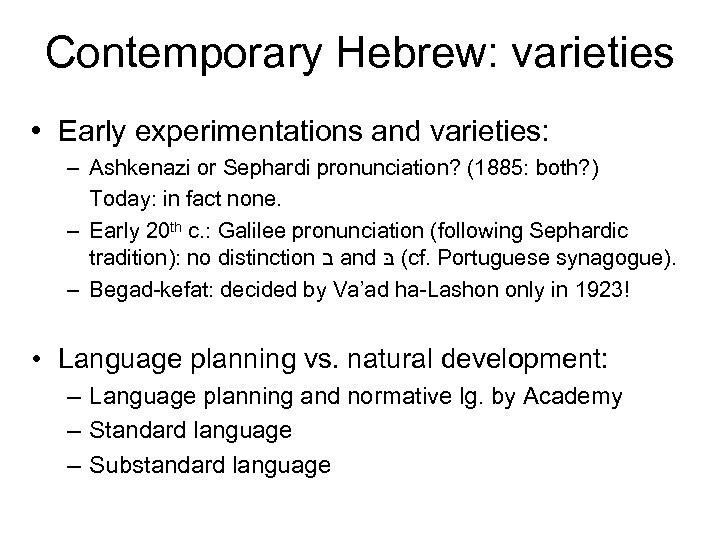
Contemporary Hebrew: varieties • Early experimentations and varieties: – Ashkenazi or Sephardi pronunciation? (1885: both? ) Today: in fact none. – Early 20 th c. : Galilee pronunciation (following Sephardic tradition): no distinction ב and ( בּ cf. Portuguese synagogue). – Begad-kefat: decided by Va’ad ha-Lashon only in 1923! • Language planning vs. natural development: – Language planning and normative lg. by Academy – Standard language – Substandard language
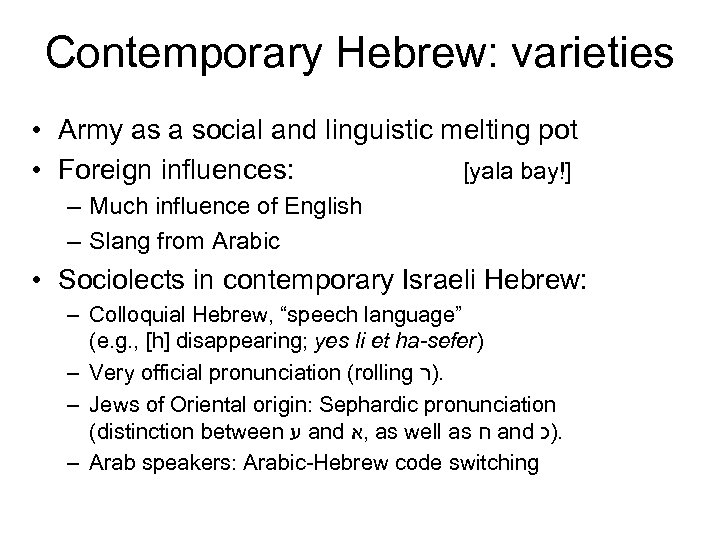
Contemporary Hebrew: varieties • Army as a social and linguistic melting pot • Foreign influences: [yala bay!] – Much influence of English – Slang from Arabic • Sociolects in contemporary Israeli Hebrew: – Colloquial Hebrew, “speech language” (e. g. , [h] disappearing; yes li et ha-sefer) – Very official pronunciation (rolling . )ר – Jews of Oriental origin: Sephardic pronunciation (distinction between ע and , א as well as ח and . )כ – Arab speakers: Arabic-Hebrew code switching
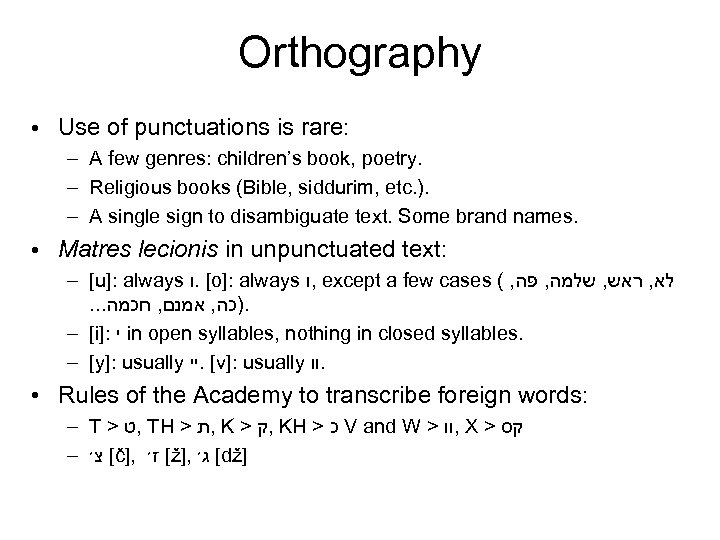
Orthography ● Use of punctuations is rare: – A few genres: children’s book, poetry. – Religious books (Bible, siddurim, etc. ). – A single sign to disambiguate text. Some brand names. ● Matres lecionis in unpunctuated text: – [u]: always [. ו o]: always , ו except a few cases ( , לא, ראש, שלמה, פה . . )כה, אמנם, חכמה – [i]: י in open syllables, nothing in closed syllables. – [y]: usually [. יי v]: usually . וו ● Rules of the Academy to transcribe foreign words: – T > , ט TH > , ת K > , ק KH > כ V and W > , וו X > קס – [ צ׳ č], [ ז׳ ž], [ ג׳ dž]
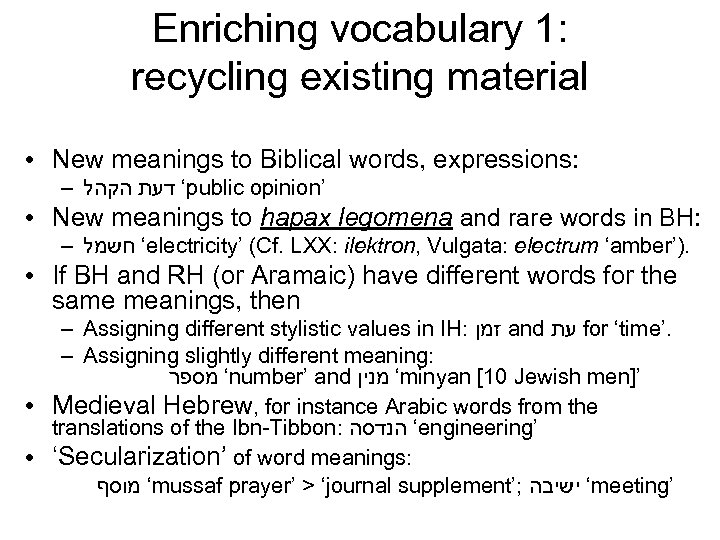
Enriching vocabulary 1: recycling existing material ● New meanings to Biblical words, expressions: – ‘ דעת הקהל public opinion’ ● New meanings to hapax legomena and rare words in BH: – ‘ חשמל electricity’ (Cf. LXX: ilektron, Vulgata: electrum ‘amber’). ● ● ● If BH and RH (or Aramaic) have different words for the same meanings, then – Assigning different stylistic values in IH: זמן and עת for ‘time’. – Assigning slightly different meaning: ‘ מספר number’ and ‘ מנין minyan [10 Jewish men]’ Medieval Hebrew, for instance Arabic words from the translations of the Ibn-Tibbon: ‘ הנדסה engineering’ ‘Secularization’ of word meanings: ‘ מוסף mussaf prayer’ > ‘journal supplement’; ‘ ישיבה meeting’
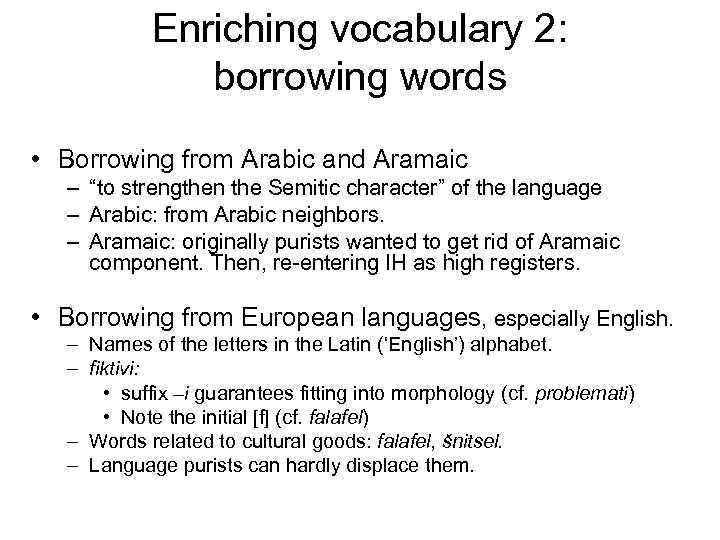
Enriching vocabulary 2: borrowing words • Borrowing from Arabic and Aramaic – “to strengthen the Semitic character” of the language – Arabic: from Arabic neighbors. – Aramaic: originally purists wanted to get rid of Aramaic component. Then, re-entering IH as high registers. • Borrowing from European languages, especially English. – Names of the letters in the Latin (‘English’) alphabet. – fiktivi: • suffix –i guarantees fitting into morphology (cf. problemati) • Note the initial [f] (cf. falafel) – Words related to cultural goods: falafel, šnitsel. – Language purists can hardly displace them.
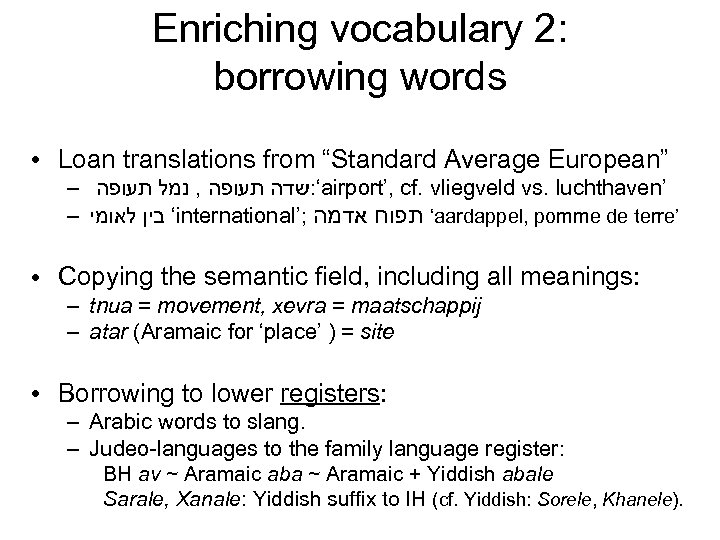
Enriching vocabulary 2: borrowing words ● Loan translations from “Standard Average European” – ‘: שדה תעופה , נמל תעופה airport’, cf. vliegveld vs. luchthaven’ – ‘ בין לאומי international’; ‘ תפוח אדמה aardappel, pomme de terre’ ● Copying the semantic field, including all meanings: – tnua = movement, xevra = maatschappij – atar (Aramaic for ‘place’ ) = site ● Borrowing to lower registers: – Arabic words to slang. – Judeo-languages to the family language register: BH av ~ Aramaic aba ~ Aramaic + Yiddish abale Sarale, Xanale: Yiddish suffix to IH (cf. Yiddish: Sorele, Khanele).
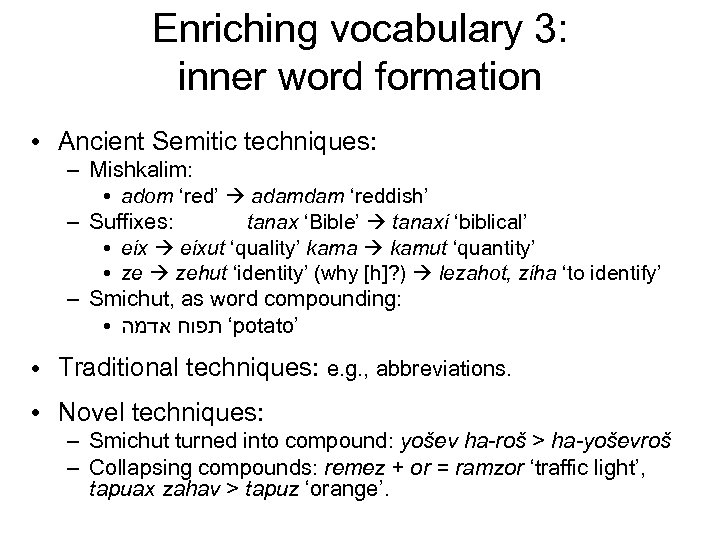
Enriching vocabulary 3: inner word formation ● Ancient Semitic techniques: – Mishkalim: adom ‘red’ adamdam ‘reddish’ – Suffixes: tanax ‘Bible’ tanaxi ‘biblical’ ● eixut ‘quality’ kama kamut ‘quantity’ ● ze zehut ‘identity’ (why [h]? ) lezahot, ziha ‘to identify’ – Smichut, as word compounding: ● ‘ תפוח אדמה potato’ ● ● Traditional techniques: e. g. , abbreviations. ● Novel techniques: – Smichut turned into compound: yošev ha-roš > ha-yoševroš – Collapsing compounds: remez + or = ramzor ‘traffic light’, tapuax zahav > tapuz ‘orange’.
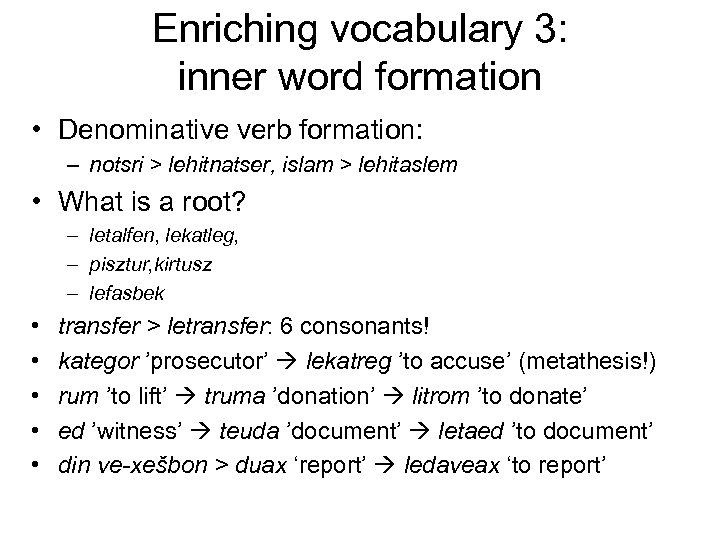
Enriching vocabulary 3: inner word formation • Denominative verb formation: – notsri > lehitnatser, islam > lehitaslem • What is a root? – letalfen, lekatleg, – pisztur, kirtusz – lefasbek • • • transfer > letransfer: 6 consonants! kategor ’prosecutor’ lekatreg ’to accuse’ (metathesis!) rum ’to lift’ truma ’donation’ litrom ’to donate’ ed ’witness’ teuda ’document’ letaed ’to document’ din ve-xešbon > duax ‘report’ ledaveax ‘to report’
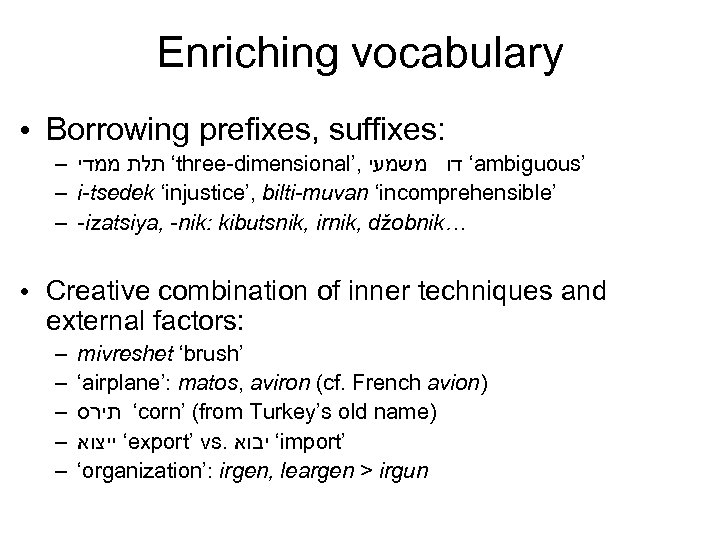
Enriching vocabulary ● Borrowing prefixes, suffixes: – ‘ תלת ממדי three-dimensional’, ‘ דו משמעי ambiguous’ – i-tsedek ‘injustice’, bilti-muvan ‘incomprehensible’ – -izatsiya, -nik: kibutsnik, irnik, džobnik… ● Creative combination of inner techniques and external factors: – – – mivreshet ‘brush’ ‘airplane’: matos, aviron (cf. French avion) ‘ תירס corn’ (from Turkey’s old name) ‘ ייצוא export’ vs. ‘ יבוא import’ ‘organization’: irgen, leargen > irgun
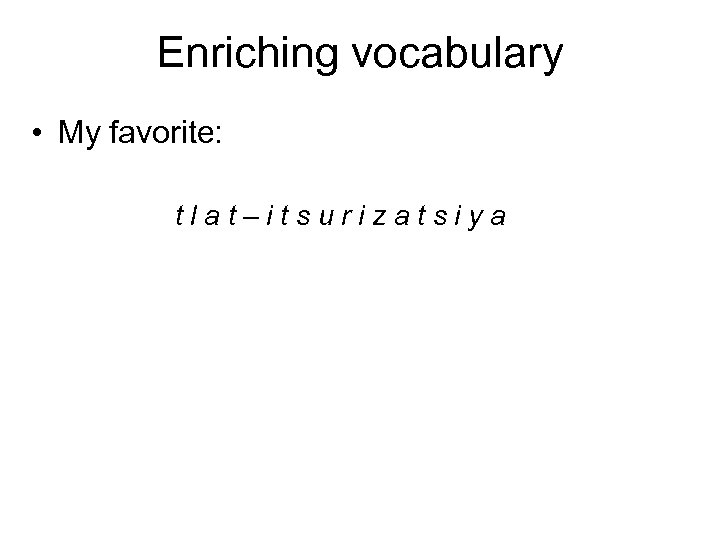
Enriching vocabulary • My favorite: tlat–itsurizatsiya
End of period-by-period linguistics. Next week: field-by-field linguistics. • Assignment and reading: See on separate sheet. See you next week!
Скачать презентацию Introduction to Hebrew Linguistics Inleiding Hebreeuwse Taalkunde Uv
e6731d2306bed1fcf48d579e734da38e.ppt