


 Скачать презентацию Introduction to Health Policy Analysis Juliette Forstenzer Espinosa
d79c0b0bd90506e92fd5afe99f7cdc87.ppt
- Количество слайдов: 67
 Introduction to Health Policy Analysis Juliette Forstenzer Espinosa, MA, JD, LLM Winter/Spring 2016
 2 Discussion Outline Introduction to Policy Analysis Making Public Policy Making Health Policy and Public Health Policy
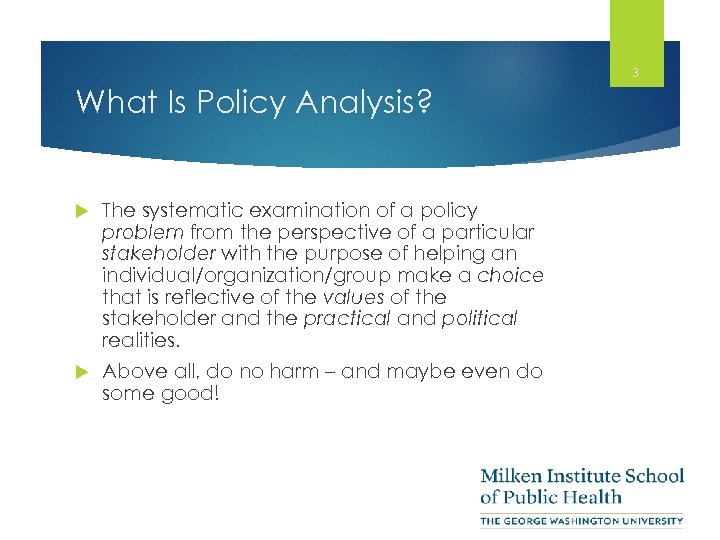 3 What Is Policy Analysis? The systematic examination of a policy problem from the perspective of a particular stakeholder with the purpose of helping an individual/organization/group make a choice that is reflective of the values of the stakeholder and the practical and political realities. Above all, do no harm – and maybe even do some good!
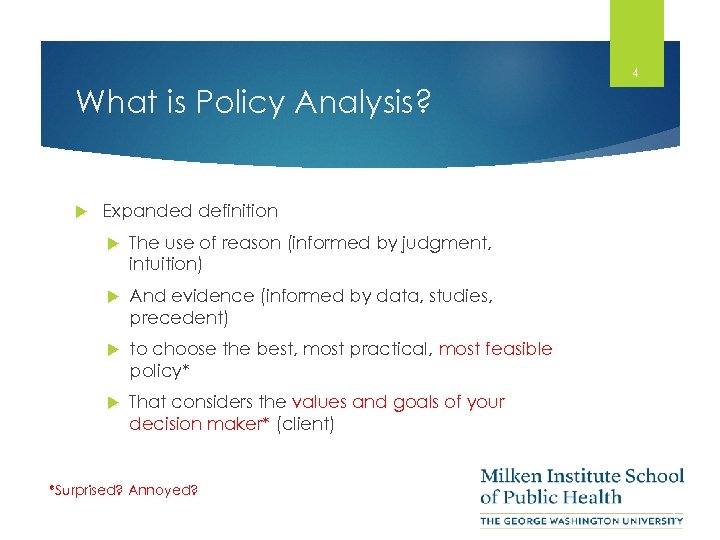 4 What is Policy Analysis? Expanded definition The use of reason (informed by judgment, intuition) And evidence (informed by data, studies, precedent) to choose the best, most practical, most feasible policy* That considers the values and goals of your decision maker* (client) *Surprised? Annoyed? 4
 What Is Policy Analysis? What is the role of policy analysis? 5 To help determine whether to intervene; how to intervene What does policy analysis do? The use of reason and evidence to choose the best policy among a number of options to solve a problem What concerns does this raise in terms of bias, subjectivity, privilege? 5
 6 What Is Policy Analysis? Is policy analysis objective? Should it be? Relies on evidence to identify a problem and to demonstrate that an option is best possible solution to problem How is evidence gathered, framed, presented? Always informed by decision maker’s values and goals Uses judgment and intuition to choose best and most feasible solution 6
 7 Models of Policy Analysis Rational model: Politics and analysis should be separate; objective analysis can lead to a “correct” answer to a policy problem; politics inserted after analysis is completed. Political reason: “Reasoned analysis is necessarily political…always involves choices to include some things and exclude others and to view the world in a particular way…. Policy analysis political argument, and vice versa. ” (D. A. Stone) Which makes more sense? Is it a meaningful distinction?
 8 Conducting a Policy Analysis? How do we conduct a policy analysis? Helpful to have a process – often broken down into two parts The study of the problem AND The study of the consequences of using one option above others to address the problem Tools for policy analysis Economic analysis Quantitative analysis Qualitative analysis Political analysis 8
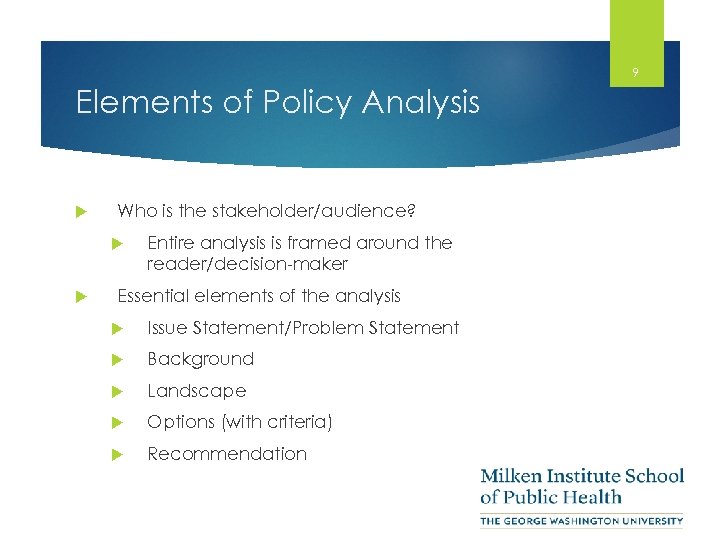 9 Elements of Policy Analysis Who is the stakeholder/audience? Entire analysis is framed around the reader/decision-maker Essential elements of the analysis Issue Statement/Problem Statement Background Landscape Options (with criteria) Recommendation
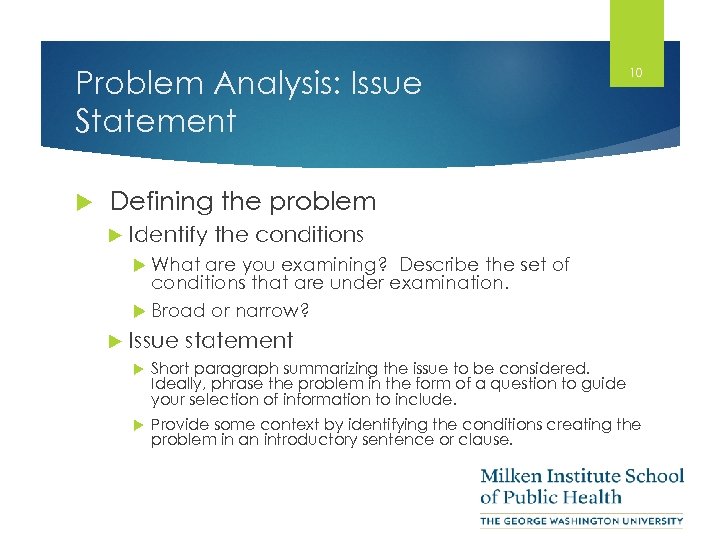 Problem Analysis: Issue Statement 10 Defining the problem Identify the conditions What are you examining? Describe the set of conditions that are under examination. Broad or narrow? Issue statement Short paragraph summarizing the issue to be considered. Ideally, phrase the problem in the form of a question to guide your selection of information to include. Provide some context by identifying the conditions creating the problem in an introductory sentence or clause.
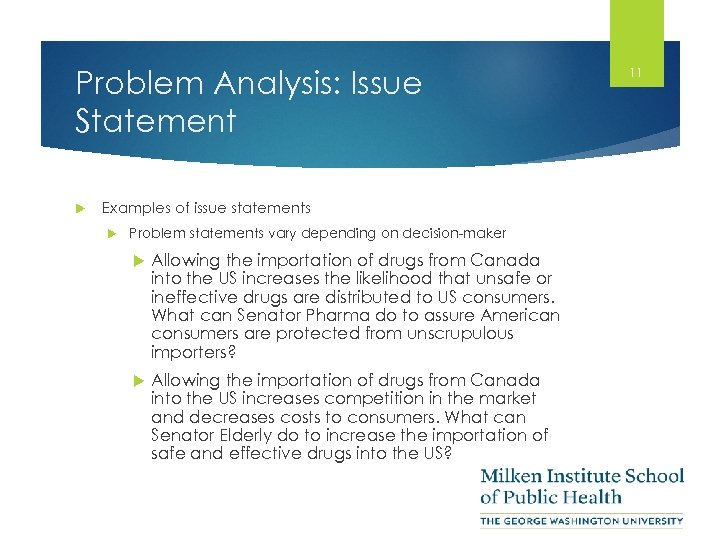 Problem Analysis: Issue Statement Examples of issue statements Problem statements vary depending on decision-maker Allowing the importation of drugs from Canada into the US increases the likelihood that unsafe or ineffective drugs are distributed to US consumers. What can Senator Pharma do to assure American consumers are protected from unscrupulous importers? Allowing the importation of drugs from Canada into the US increases competition in the market and decreases costs to consumers. What can Senator Elderly do to increase the importation of safe and effective drugs into the US? 11
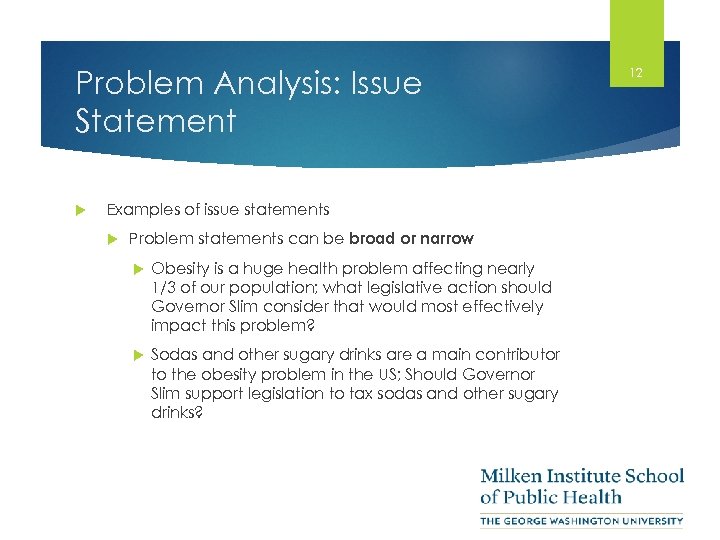 Problem Analysis: Issue Statement Examples of issue statements Problem statements can be broad or narrow Obesity is a huge health problem affecting nearly 1/3 of our population; what legislative action should Governor Slim consider that would most effectively impact this problem? Sodas and other sugary drinks are a main contributor to the obesity problem in the US; Should Governor Slim support legislation to tax sodas and other sugary drinks? 12
 13 Problem Analysis: Background Provides a description of the problem in detail Generally, decision maker could change and background would look about the same Develops the fact base and body of existing evidence Careful in use of statistics/data Display using tables and graphs
 14 Problem Analysis: Background Elements to include in the Background Define key terms; clarify ambiguity E. g. uninsured Identify concrete operational measures of the problem Figure out how to measure with numbers Determine magnitude and scope How big is the problem? What is the impact of the problem? Is the problem growing quickly, slowly declining?
 15 Problem Analysis: Background Elements to include in the Background Identify who is impacted by the problem Who is most affected by the problem? How and why? Are subgroups affected differently Quantify impact on groups and the difference between groups Place boundaries on the problem Where does it exist? National vs. state; urban vs. regional Are there differences in scope, magnitude by region, locale?
 16 Problem Analysis: Background Elements to include in the Background Identify how long the problem has existed What are historical trends Has it improved or worsened Identify how the problem might change over time Look at forecasts; projections (e. g. Medicare will be bankrupt by 2019)
 17 Problem Analysis: Background Problem statement: Teen smoking is a significant public health issue. What policies should Governor Fresh support to bring about the greatest reduction in teen smoking? What background information might we include?
 18 Problem Analysis: Landscape – most important section of the problem analysis Provides more context of the problem Tries to diagnose the problem What is the cause of the problem? How amenable is the problem to a policy intervention? If done well, options fall out of landscape, analysis
 19 Problem Analysis: Landscape Potential elements to include in the Landscape (not all are always relevant) Stakeholders Political landscape Economic factors Legal context Social context Administrative practicality, feasibility Others….
 20 Problem Analysis: Landscape Elements to include in the Landscape Identify the stakeholders Groups, organizations, individuals that are invested in the problem and how it will be solved e. g. Advocacy, lobbying groups, industry, membership organizations, health services orgs, consumers/citizens What is their stake in the issue? How much influence do they have to impact the solution?
 21 Problem Analysis: Landscape Elements to include in the Landscape Describe the political landscape Is this a hot topic politically? Highly contested? Are their differences in how politicians define the problem and the causes of the problem? Are their strong positions according to party lines? Do key constituents, opponents, interest groups have an opinion; who supports or opposes change? Is there a reason to act now (election year? ) Is there a reason to delay?
 22 Problem Analysis: Landscape Elements to include in the Landscape Describe the economic context What are the economic causes of the problem? What is the problem costing individuals, groups, society as a whole? Are certain subgroups disproportionately bearing the burden of the cost? What is the economic impact of addressing; not addressing the problem? Will the economics of the problem play into the solution?
 23 Problem Analysis: Landscape Elements to include in the Landscape Describe the social context Is the problem an individual problem or societal problem? Are there equity issues? Are there ethical and moral issues? Be careful not to elevate all issues to moral/ethical Are vulnerable subgroups disproportionately, negatively affected? Are influential, valued groups affected?
 24 Problem Analysis: Landscape Elements to include in the Landscape Consider the legal factors Are there legal restrictions affecting this problem? Are there legal requirements that impact the analysis? Is the potential for future litigation a concern if action is taken?
 25 Structure of Options Analysis The Options Analysis: 2 basic objectives Proposing, evaluating policy alternatives that address the problem Comparing and measuring different alternatives Determining which option is best course of action Justifying your recommendation
 26 Options Analysis Options analysis Different formats of options analysis depends on the problem under consideration Narrow: Support or oppose a policy under consideration Broad: Select among three policy options to address the problem Problem analysis and options analysis are intimately connected Framework should be consistent throughout Options should fall out of the problem analysis
 Key Elements of Options Analysis Basic steps of options analysis Identify policy options Evaluate policy options according to criteria Choose evaluation criteria Recommend an action NEVER discuss options until you have fully analyzed the problem 27
 Key Elements of Options Analysis Choosing Evaluation Criteria Goal of evaluation criteria To measure and assess the impact of options Purpose of evaluation criteria To establish rules for assessment Helps rank options To minimize temptation to choose “pet” options Provide measurement to justify ranking 28
 Key Elements of Options Analysis Example evaluation criteria Net benefit Cost and financing Efficiency Equity Administrative ease Legality Political feasibility Social acceptability 29
 Key Elements of Options Analysis How do you measure criteria? Established, quantifiable metrics e. g. $$, utilization rates, etc. Qualitative assessments e. g. high, medium, low Not all criteria are equal Let decision-maker guide priorities Weight them according to decision-maker May be determined by available data 30
 Key Elements of Options Analysis Where to identify evaluation criteria? From client – the framework of your PROBLEM analysis Direct measures of interest Indirect measures implied by values and goals From key stakeholders From experience – learn by doing Should match the policy issues analyzed in the problem Ideally chosen before policy options 31
 Key Elements of Options Analysis Identify Options = potential solutions to the problem Brainstorm many possible solutions Do research, Be creative Search and adapt options from analogous situations Develop new, customized ideas Think Incrementally Think Ideally 32
 Key Elements of Options Analysis Identifying options Consider typical policy actions Gov’t providing or purchasing a good for public Taxing or subsidizing to achieve outcome Passing laws and regulations to require action Education and information to persuade action Always consider the status quo Identify 3 to 5 best suited alternatives GO BACK TO PROBLEM to make sure options squarely address problem 33
 Key Elements of Options Analysis Describe Options Once selected 3 -5, provide information that will help in analysis Describe what option is Define the populations that will be affected Analyze options according to evaluation criteria Make an assessment of that option Using data Using qualitative words – high, medium, low Create a matrix, side-by-side as tool Or express in terms of consideration of pros/cons with criteria embedded in that analysis 34
 35 Recommendation Generally you will chose one recommendation for your stakeholder In some situations may have conditional recommendations e. g. : if tax cut passes choose option 1, if tax cut does not pass choose option 2 In some situations may chose combination of options If recommend more than one option need to justify Don’t take easy route of avoiding picking one option unless there is a good reason to do so
 36 Recommendation must be one of the options evaluated Need to be clear why this option chosen from among all the options evaluated Don’t just repeat analysis of option section Identify why this option best for your stakeholder given that all options have pluses and minuses Will relate to values and power of your decisionmaker Must recognize downsides/acknowledge opposition AND address how downsides might be mitigated or overcome
 37 Format Clearly, concisely phrased Background and Landscape can be merged as one section if there is significant overlap in what you want to cover in each section Use of bullets Use of tables – especially to compare options, summarize literature Rating options? This is analysis, not advocacy Respectful of fact that your reader --- NOT you – is the decision-maker LABEL all sections Give headers for each option
 38 Kingdon on Policy Process Inherently messy Problems – Proposals – Politics Why some problems are in focus? Proposals waiting for problems? Politics/events push problems/proposals to the fore? Many “streams” flowing at once – convergence or divergence? Why did politics on health care reform shift for Clinton? Why did it work differently with Obama? Why was public health a major part of this year’s health reform but not under Clinton? Ref. John Kingdon, The Reality of Public Policy Making
 Kingdon on Policy Making Constraints Law, procedures, parties (weak or strong) US political culture of limited government; of equality of opportunity vs. equality of outcome vs. European notion of solidarity Framing an issue to a political perspective – or is it manipulation Big government or cover the uninsured? Kingdon on ethical perspective – does this prevent compromise and “muddling through”? 39
 40 Meltsner’s Seven Deadly Sins 1. 2. 3. 4. 5. 6. 7. Channeled advice (vs. changing landscape) Distant advice Late advice (accurate vs. timely) Superficial advice (keep simple but don’t avoid complexities) Topical advice (manufactured crisis) Change for its own sake (doing nothing can be an appropriate option) Advice without politics Ref. Arnold Meltsner, The Seven Deadly Sins of Policy Analysis
 41 Values and Analysis Values vs. ethics? What role do they play? Does this introduce bias? How do you control for bias? If values play a role, then whose values should drive your analysis?
 Do We Define Problems and Solutions Based on Values? Is the need for health reform a value or a problem identified? What do we mean by health reform? Is the approach to health reform reflected in “values” Private vs. public Health care as a right; health care as a responsibility Are data objective? Biomedical research – endpoints How we count unemployed, uninsured Can we put aside values to make a case? Good vs. cost-effective 42
 43 Making Public Policy What is public policy? A government resolution to a public problem What constitutes a public problem? Public problems are conditions that the public feels are unacceptable and require intervention Could be policy problem, could be public health problem Where does public policy occur? At all levels of government Within different government institutions 43
 44 Making Public Policy Why might government intervene with policy solutions to public problems? Three most common reasons Political Moral reasons ethical reasons Economic reasons 44
 Making Public Policy How does the public sector make policy? Create programs Regulate behaviors of actors in the system TANF (welfare reform); Community Health Centers; Ryan White Act Gas mileage standards; medical malpractice reform Create financial incentives Condition of receipt of public funds (can be part of authorization or appropriations bill - 55 MPH speed limit) Tax treatment (Employer-based health insurance) Administrative policies : Program announcements, policy guidance, regulations 45
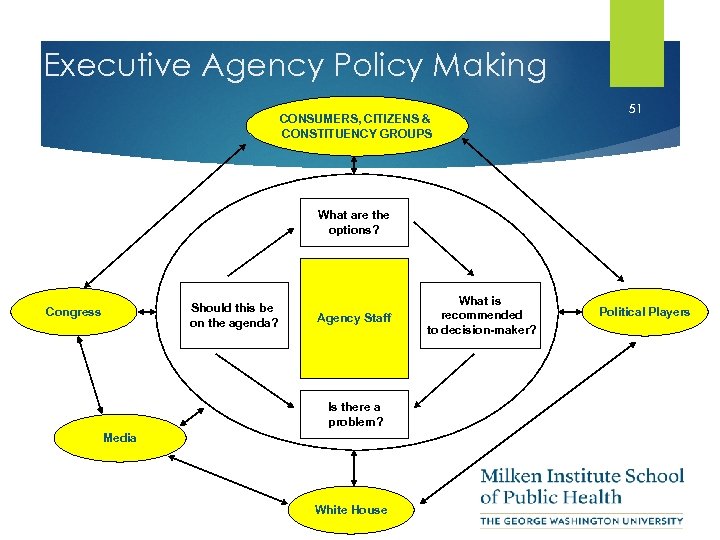
 Making Public Policy? Who Makes Public Policy? Within an agency Between an agency and the White House Office of Management and Budget is part of the Executive Office of the President Between the Executive Branch and the Legislative Branch Special role of the courts 46
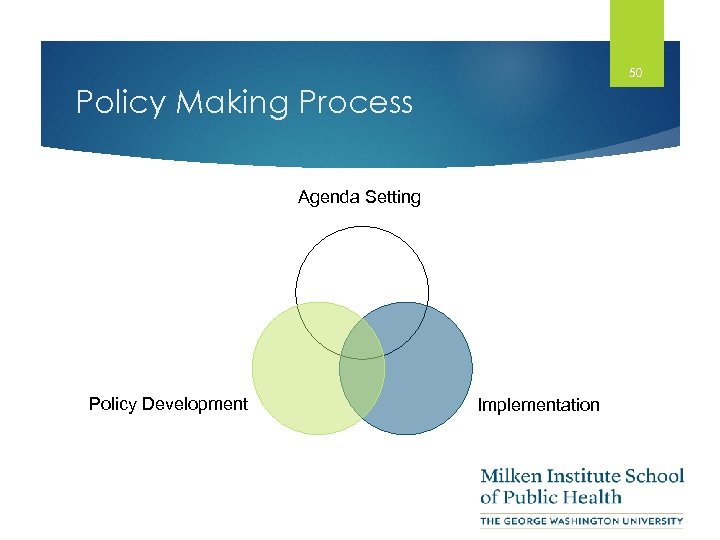
 47 Making Public Policy What is the Public Policy Process? Traditional linear approaches Setting agenda, definition of options, decision, implementation (executive/legislative processes) “how a bill becomes law” Cyclical process Bringing an issue forward at any point in an interactive policy making process
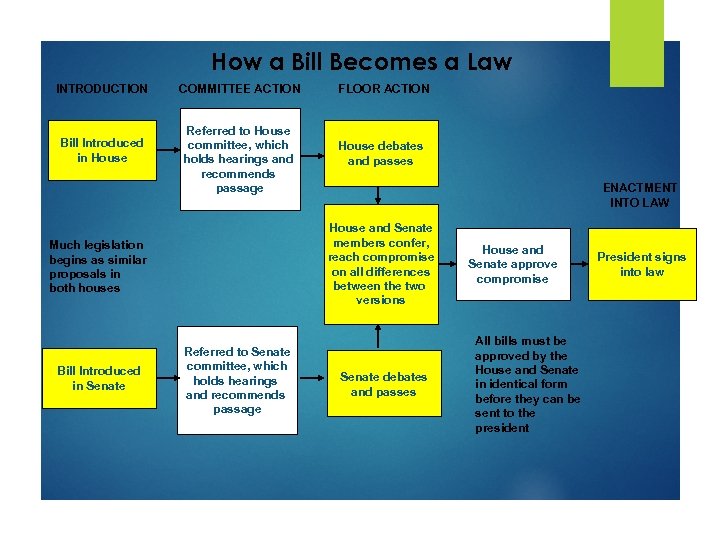 How a Bill Becomes a Law INTRODUCTION Bill Introduced in House COMMITTEE ACTION Referred to House committee, which holds hearings and recommends passage House debates and passes ENACTMENT INTO LAW House and Senate members confer, reach compromise on all differences between the two versions Much legislation begins as similar proposals in both houses Bill Introduced in Senate FLOOR ACTION Referred to Senate committee, which holds hearings and recommends passage Senate debates and passes House and Senate approve compromise All bills must be approved by the House and Senate in identical form before they can be sent to the president President signs into law
 49 Appropriations Process Most linear – clearly defined stages Presidential budget preparation and delivery to Congressional Budget committees process Sets parameters for Congress’ financial deliberations for the year Congressional Appropriations committees process Traditional “how a bill becomes law” process in most years But appropriations is just one stage of the policy making process.
 50 Policy Making Process Agenda Setting Policy Development Implementation
 Executive Agency Policy Making CONSUMERS, CITIZENS & CONSTITUENCY GROUPS 51 What are the options? Should this be on the agenda? Congress Agency Staff Is there a problem? Media White House What is recommended to decision-maker? Political Players
 52 Getting on the Policy Agenda External (often unexpected) events September 11 th and bioterrorism; Enron and accounting reform; Wall Street and financial reform Public or key decision makers are “educated” about the importance of an issue Systematic policy analysis; Public education; Constituency group pressure/influence Nursing shortage Confluence Prior public health infrastructure work influenced response to September 11 th Health care costs and chronic diseases
 The Structure of Policy Making Congress and Executive together Cyclical Authorize new programs Before or after created; to influence funding decisions Funding of new or old programs Funding levels; policy associated with funding decisions Note: multiple budget processes occurring simultaneously 53
 The Structure of Policy Making Executive alone Discretion in creating new programs Influence implementation of existing programs Health reform leaves huge discretion to HHS Congress alone Oversight powers Force decisions Put issues on the agenda Legislative riders/report language 54
 Structure of Policy Making 55 Partners/Constituency Groups/Interest Groups Influence executive branch Relationship with career staff Relationship with political leadership Influence with Congress White House, Department, Agency Generate support for legislation, draft report language, assist in oversight hearing Public education role Generate media interest Generate constituency pressure
 From Policy Analysis to HEALTH Policy Analysis
 57 Health vs. Health Care What do these terms mean? How do they differ? What do we mean by health care policy? What do we mean by public health policy? Do they overlap?
 58 Scope of Health Policy Making What are the agencies involved in pandemic preparedness? What are the agencies involved in obesityrelated policy? What are the agencies involved in encouraging use of electronic health records? Is this too complex to achieve a coherent approach? How can public health take the lead among so many diverse agencies? Replicated at state and local levels
 59 Who Makes Health Policy? What level of government makes health policy? What level of government implements health policy? Health reform, Medicare, Medicaid/SCHIP Public health State variability - policies, access, data
 60 Level of complexity Government structure https: //www. govloop. com/community/blog/government-business-101 -united-states-constitution-the-executive-branch-and-federalcontracting/ How a bill becomes a law http: //www. dailyinfographic. com/wpcontent/uploads/2011/07/howlawsmade. WIRTH 21. jpg HHS organizational chart http: //www. hhs. gov/about/orgchart/
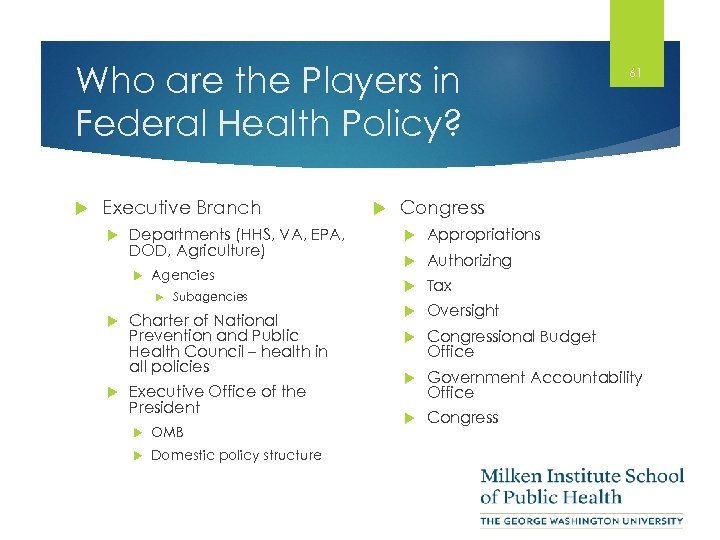 Who are the Players in Federal Health Policy? Executive Branch Departments (HHS, VA, EPA, DOD, Agriculture) Agencies Subagencies Charter of National Prevention and Public Health Council – health in all policies Executive Office of the President OMB Domestic policy structure 61 Congress Appropriations Authorizing Tax Oversight Congressional Budget Office Government Accountability Office Congress
 62 What is Public Health? 1988 Institute of Medicine report The Future of Public Health defined public health as “what we, as a society, do collectively to assure the conditions in which people can be healthy. ” Public health sees “patient” as the population; medical care sees “patient” as individual Tobacco regulatory standard: population health vs. individual health
 Public Health in a Federal System* Who has legal authority? How can the federal government influence behavior of state and local health departments? Who responds to a flu outbreak? Is there also a global component? Who responds to a natural disaster? *This slide could be an entire semester 63
 Core Public Health Functions (IOM, 1988) Assessment and monitoring of the health of communities and populations at risk to identify health problems and priorities Formulating public policies, in collaboration with community and government leaders, designed to solve identified local and national health problems and priorities Assuring that all populations have access to appropriate and cost-effective care, including health promotion and disease prevention services, and evaluation of the effectiveness of care 64
 10 Essential Public Health Services (IOM 2003) 65 Monitor health status to identify community health problems. Diagnose and investigate health problems and health hazards in the community. Inform, educate, and empower people about health issues. Mobilize community partnerships to identify and solve health problems. Develop policies and plans that support individual and community health efforts. Enforce laws and regulations that protect health and ensure safety. Link people to needed personal health services and assure the provision of health care when otherwise unavailable. Assure a competent public health and personal health care workforce. Evaluate effectiveness, accessibility, and quality of personal and population-based health services. Conduct research to attain new insights and innovative solutions to health problems.
 Core/Essential Public Health Functions Who sets policies/standards/methods in each function? Who finances each function? Is all of this a public sector discussion? Different perspective between public health and health care delivery system (financing): Population health vs. individual health Authority challenges between public and private sectors 66
 Resources 67 U. S. Department of Health and Human Services: www. hhs. gov Centers for Medicare & Medicaid Services: www. cms. gov Centers for Disease Control and Prevention: www. cdc. gov GW Deparment of Health Policy: http: //www. gwu. edu/sphhs/departments/healthpolicy/ Kaiser Family Foundation: www. kff. org Commonwealth Fund – www. cmwf. org. Urban Institute – www. urban. org. Center for Health Systems Change: www. hschange. org Center for Budget Priorities and Policy: www. cbpp. org Census Bureau: www. census. gov Bureau of Labor Statistics: www. bls. gov Health Information and the Law: www. healthinfolaw. org