


 Скачать презентацию Introduction to Grids and Grid applications Peter Kacsuk
27a6fee15b41769744ef702c36b07eb1.ppt
- Количество слайдов: 37
 Introduction to Grids and Grid applications Peter Kacsuk and Gergely Sipos MTA SZTAKI www. lpds. sztaki. hu
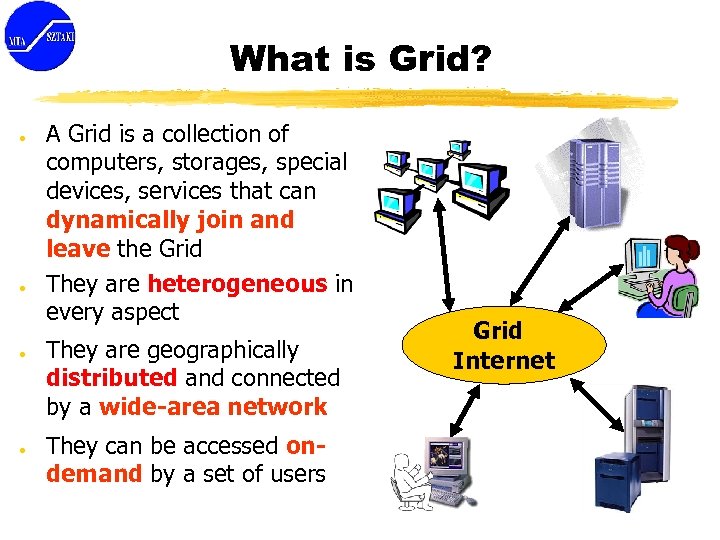 What is Grid? ● ● A Grid is a collection of computers, storages, special devices, services that can dynamically join and leave the Grid They are heterogeneous in every aspect They are geographically distributed and connected by a wide-area network They can be accessed ondemand by a set of users Grid Internet
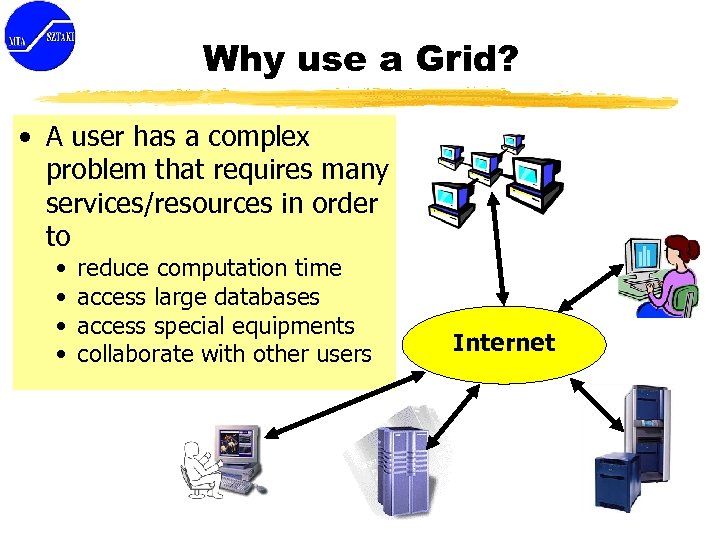 Why use a Grid? • A user has a complex problem that requires many services/resources in order to • • reduce computation time access large databases access special equipments collaborate with other users Internet
 Typical Grid application areas • High-performance computing (HPC) • to achieve higher performance than individual supercomputers/clusters can provide • Reguirement: parallel computing • High-throughput computing (HTC) • To exploit the spare cycles of various computers connected by wide area networks • Collaborative work • Several users can jointly and remotely solve complex problems
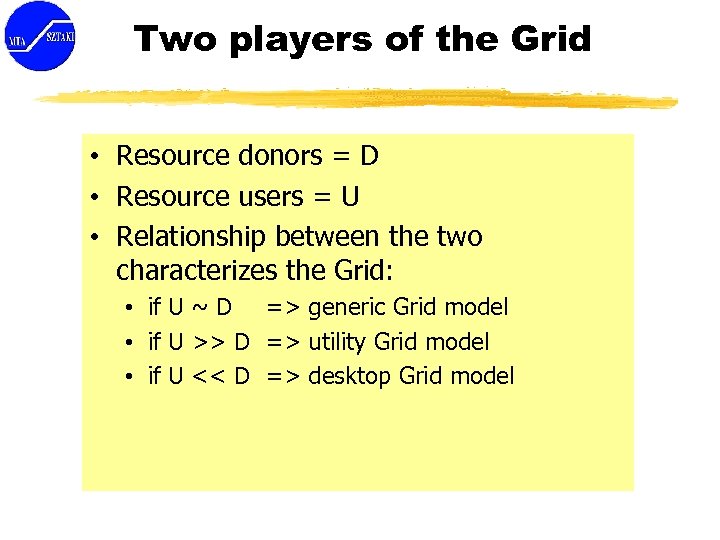 Two players of the Grid • Resource donors = D • Resource users = U • Relationship between the two characterizes the Grid: • if U ~ D => generic Grid model • if U >> D => utility Grid model • if U << D => desktop Grid model
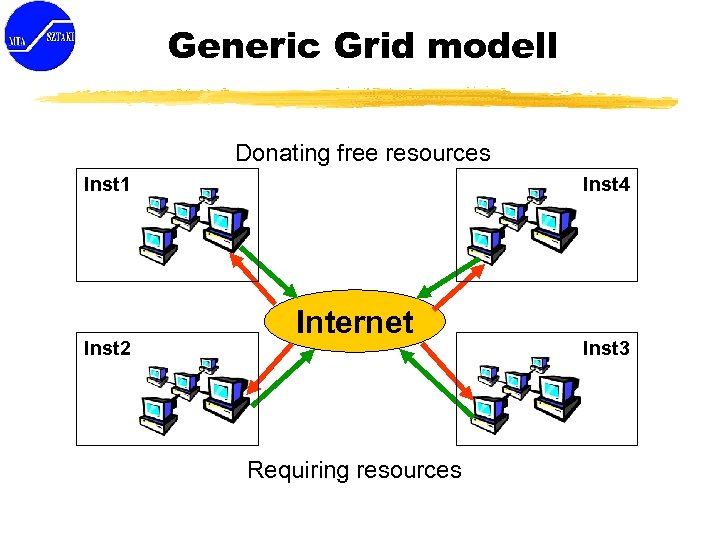 Generic Grid modell Donating free resources Inst 1 Inst 2 Inst 4 Internet Requiring resources Inst 3
 Characteristics of the generic Grid model • A volunteer Grid: Anybody can donate resources • Heterogeneous resources, that dynamically join and leave • Anybody (belonging to the donating institutes) can use the donated resources for solving her/his own applications • Symmetric relationship between donors and users: U~D • Examples: • GT-2 grids • 1 st version of UK NGS • Problems: • Installing and maintaining client and server grid software too complicated • Volunteer Grids are not robust and reliable
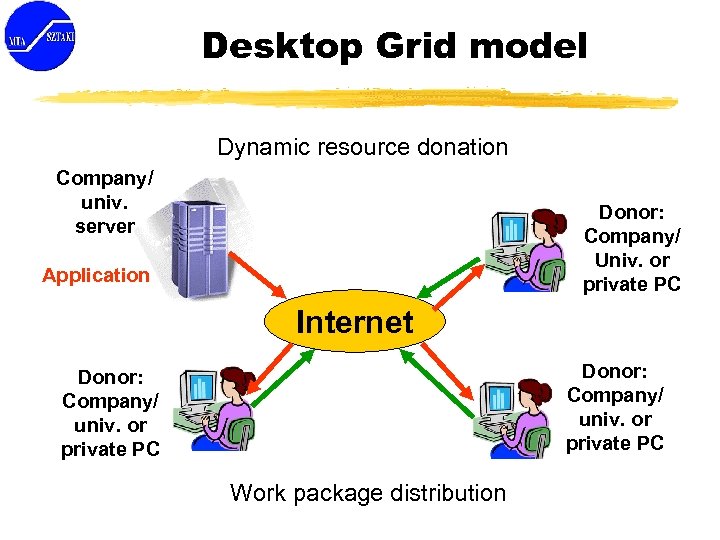 Desktop Grid model Dynamic resource donation Company/ univ. server Donor: Company/ Univ. or private PC Application Internet Donor: Company/ univ. or private PC Work package distribution
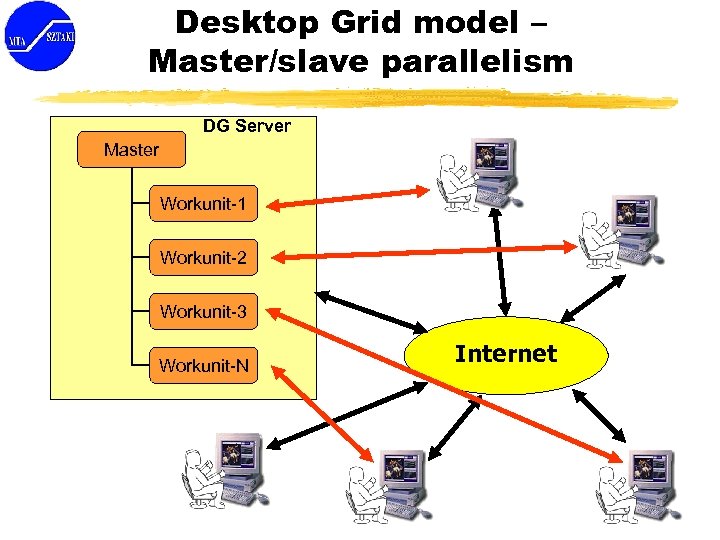 Desktop Grid model – Master/slave parallelism DG Server Master Workunit-1 Workunit-2 Workunit-3 Workunit-N Internet
 Characteristics of the desktop Grid model • A volunteer Grid: Anybody can donate resources • Heterogeneous resources, that dynamically join and leave • One or a small number of projects can use the resources • Asymmetric relationship between donors and users: U << D • Advantage: • Donating a PC is extremely easy • Setting up and maintaining a DG server is much easier than installing the server sw of utility grids
 Types of Desktop Grids • Global Desktop Grid • Aim is to collect resources for grand-challenge scientific problems • Example: • BOINC (SETI@home) • SZTAKI Desktop Grid (SZDG) • Local Desktop Grid • Aim is to enable the quick and easy creation of grid for any community (company, univ. city, etc. ) to solve their own applications • Example: • Local SZDG
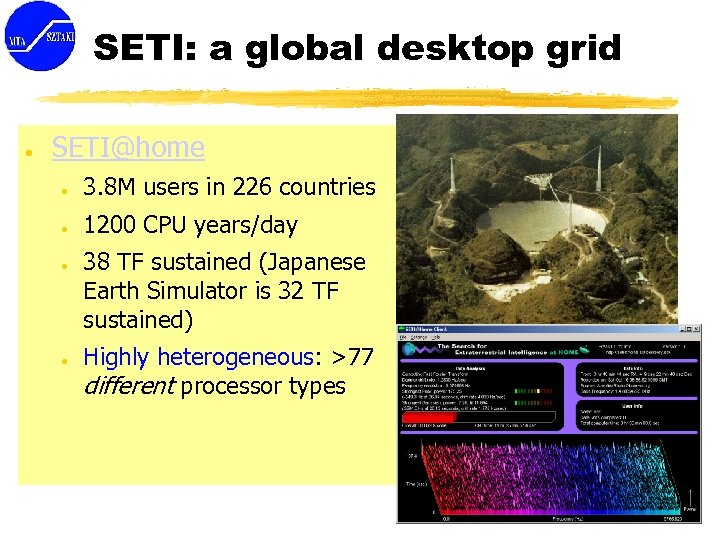 SETI: a global desktop grid ● SETI@home ● 3. 8 M users in 226 countries ● 1200 CPU years/day ● ● 38 TF sustained (Japanese Earth Simulator is 32 TF sustained) Highly heterogeneous: >77 different processor types
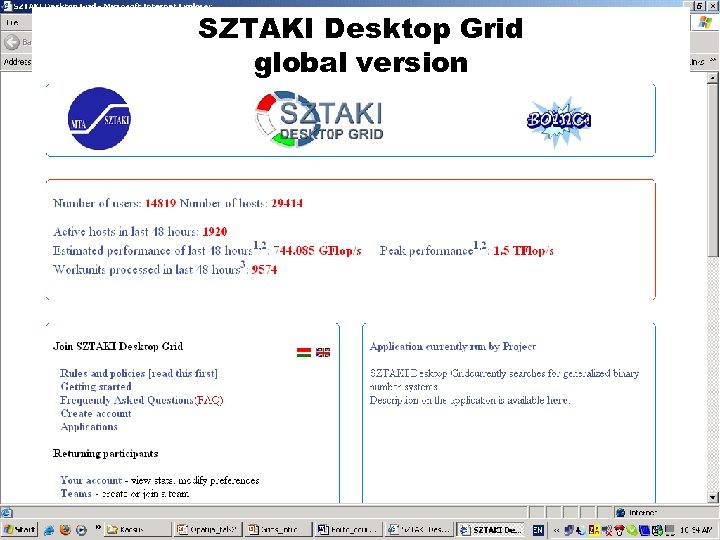 SZTAKI Desktop Grid global version
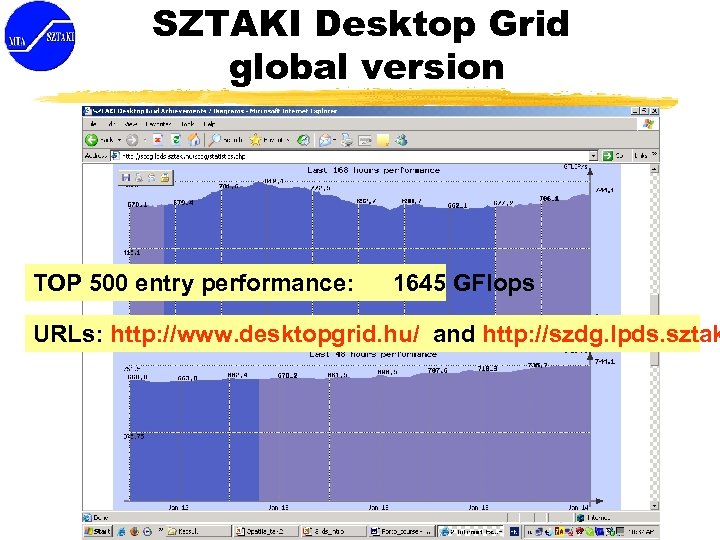 SZTAKI Desktop Grid global version TOP 500 entry performance: 1645 GFlops URLs: http: //www. desktopgrid. hu/ and http: //szdg. lpds. sztak
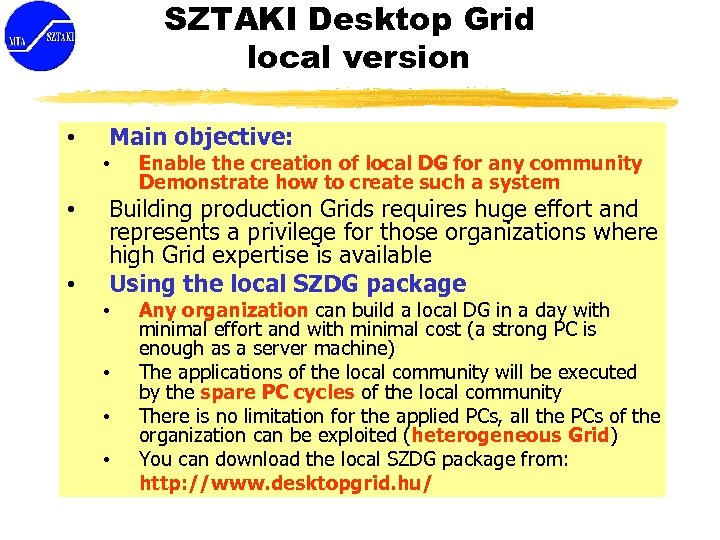 SZTAKI Desktop Grid local version • Main objective: • • • Enable the creation of local DG for any community Demonstrate how to create such a system Building production Grids requires huge effort and represents a privilege for those organizations where high Grid expertise is available Using the local SZDG package • • Any organization can build a local DG in a day with minimal effort and with minimal cost (a strong PC is enough as a server machine) The applications of the local community will be executed by the spare PC cycles of the local community There is no limitation for the applied PCs, all the PCs of the organization can be exploited (heterogeneous Grid) You can download the local SZDG package from: http: //www. desktopgrid. hu/
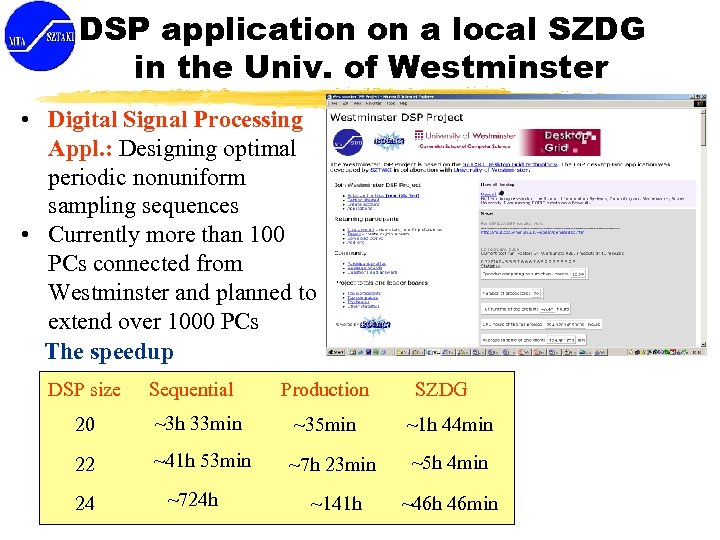 DSP application on a local SZDG in the Univ. of Westminster • Digital Signal Processing Appl. : Designing optimal periodic nonuniform sampling sequences • Currently more than 100 PCs connected from Westminster and planned to extend over 1000 PCs The speedup DSP size Sequential Production SZDG 20 ~3 h 33 min ~35 min ~1 h 44 min 22 ~41 h 53 min ~7 h 23 min ~5 h 4 min ~141 h ~46 h 46 min 24 ~724 h
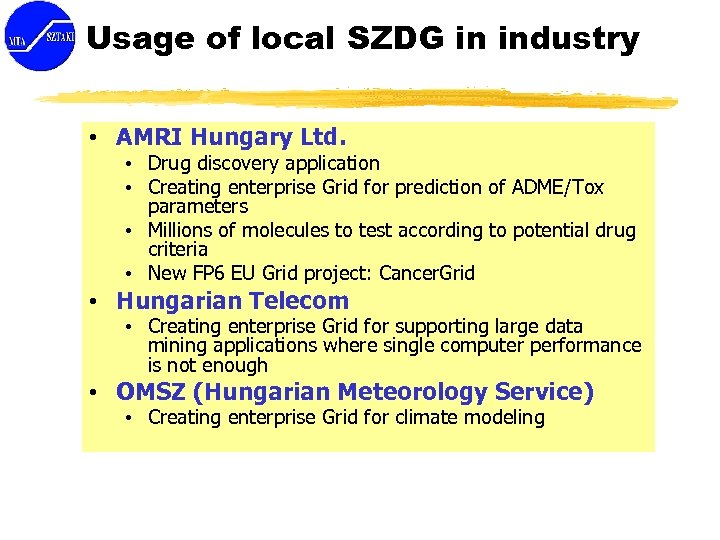 Usage of local SZDG in industry • AMRI Hungary Ltd. • Drug discovery application • Creating enterprise Grid for prediction of ADME/Tox parameters • Millions of molecules to test according to potential drug criteria • New FP 6 EU Grid project: Cancer. Grid • Hungarian Telecom • Creating enterprise Grid for supporting large data mining applications where single computer performance is not enough • OMSZ (Hungarian Meteorology Service) • Creating enterprise Grid for climate modeling
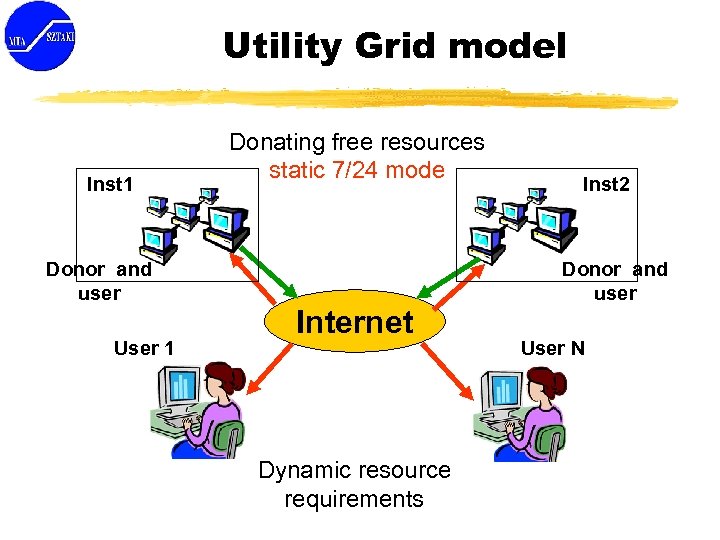 Utility Grid model Inst 1 Donor and user User 1 Donating free resources static 7/24 mode Internet Dynamic resource requirements Inst 2 Donor and user User N
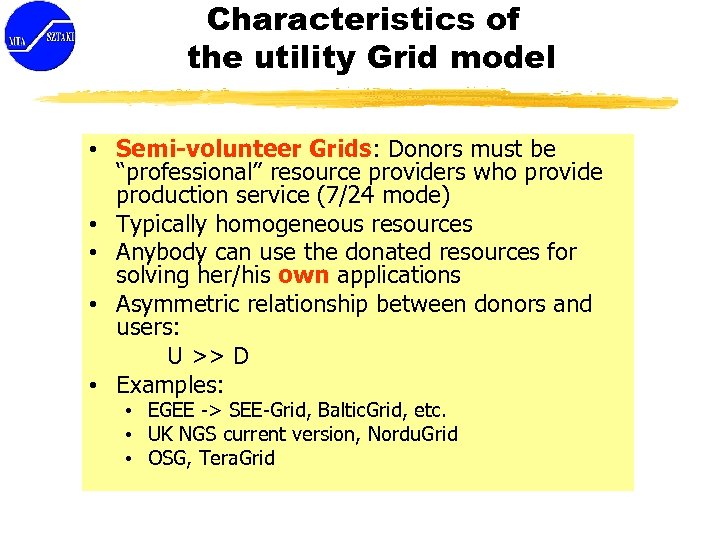 Characteristics of the utility Grid model • Semi-volunteer Grids: Donors must be “professional” resource providers who provide production service (7/24 mode) • Typically homogeneous resources • Anybody can use the donated resources for solving her/his own applications • Asymmetric relationship between donors and users: U >> D • Examples: • EGEE -> SEE-Grid, Baltic. Grid, etc. • UK NGS current version, Nordu. Grid • OSG, Tera. Grid
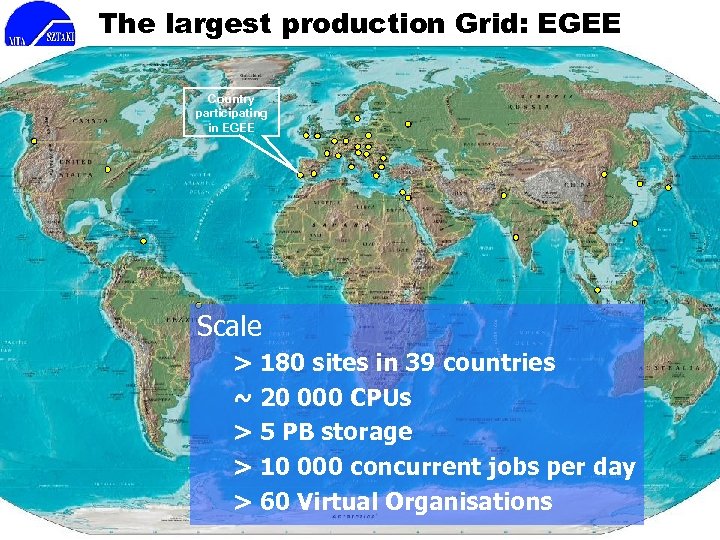 The largest production Grid: EGEE Country participating in EGEE Scale > 180 sites in 39 countries ~ 20 000 CPUs > 5 PB storage > 10 000 concurrent jobs per day > 60 Virtual Organisations
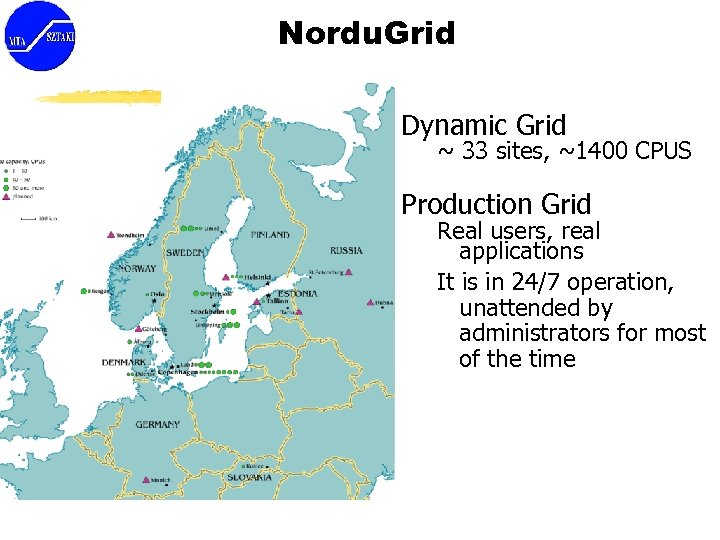 Nordu. Grid Dynamic Grid ~ 33 sites, ~1400 CPUS Production Grid Real users, real applications It is in 24/7 operation, unattended by administrators for most of the time
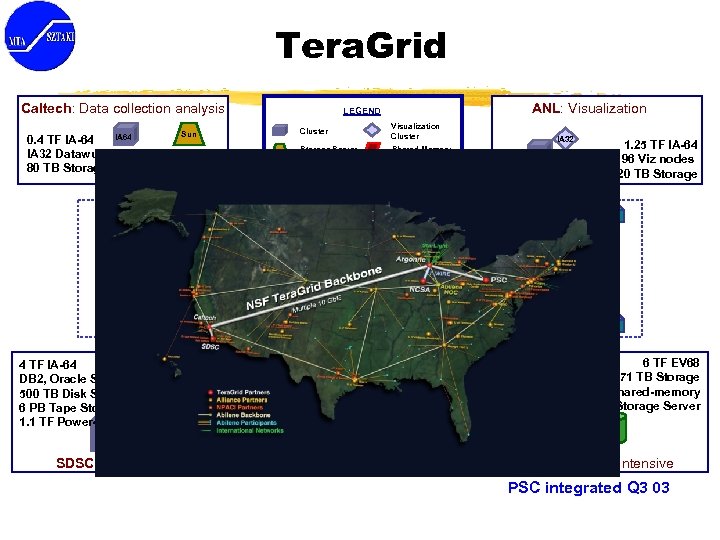 Tera. Grid Caltech: Data collection analysis 0. 4 TF IA-64 IA 32 Datawulf 80 TB Storage ANL: Visualization LEGEND Cluster Visualization Cluster Storage Server Sun IA 64 Shared Memory IA 32 IA 64 IA 32 Disk Storage Backplane Router 1. 25 TF IA-64 96 Viz nodes 20 TB Storage IA 32 Extensible Backplane Network LA Hub 30 Gb/s 40 Gb/s 30 Gb/s 4 TF IA-64 DB 2, Oracle Servers 500 TB Disk Storage 6 PB Tape Storage 1. 1 TF Power 4 IA 64 Chicago Hub Sun IA 64 10 TF IA-64 128 large memory nodes 230 TB Disk Storage 3 PB Tape Storage GPFS and data mining Pwr 4 SDSC: Data Intensive NCSA: Compute Intensive EV 7 EV 68 6 TF EV 68 71 TB Storage 0. 3 TF EV 7 shared-memory 150 TB Storage Server Sun PSC: Compute Intensive PSC integrated Q 3 03
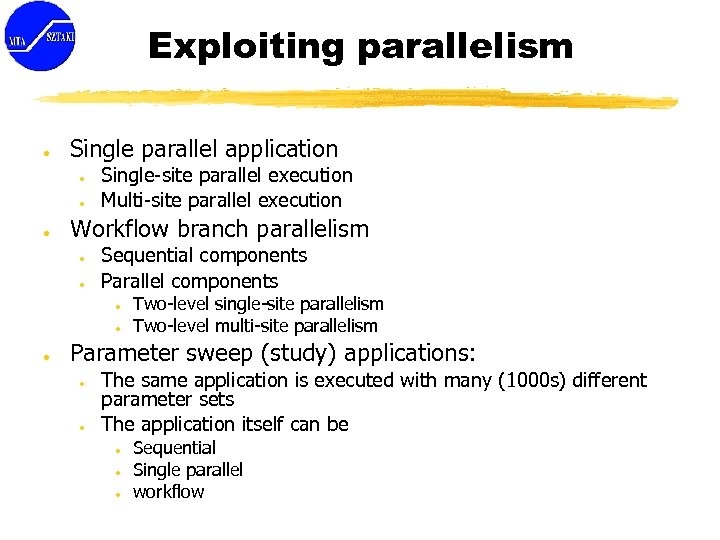 Exploiting parallelism ● Single parallel application ● ● ● Single-site parallel execution Multi-site parallel execution Workflow branch parallelism ● ● Sequential components Parallel components ● ● ● Two-level single-site parallelism Two-level multi-site parallelism Parameter sweep (study) applications: ● ● The same application is executed with many (1000 s) different parameter sets The application itself can be ● ● ● Sequential Single parallel workflow
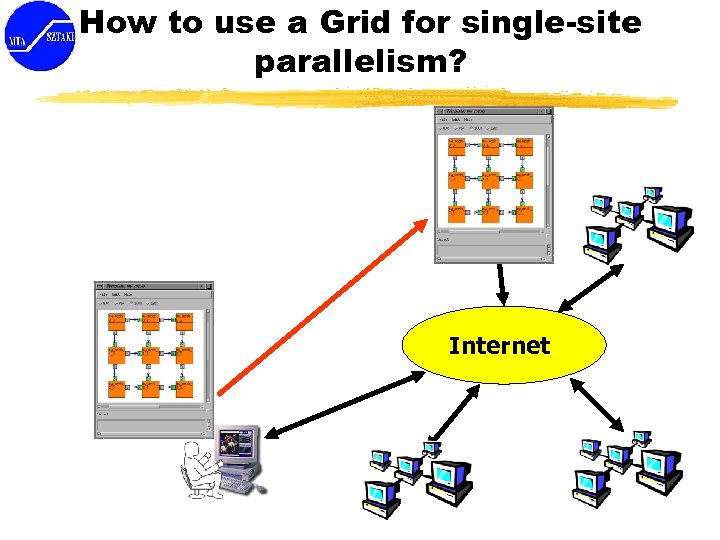 How to use a Grid for single-site parallelism? Internet
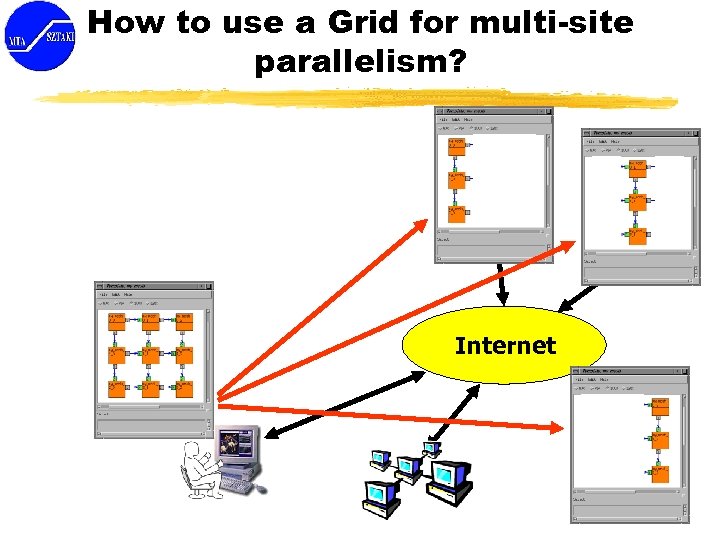 How to use a Grid for multi-site parallelism? Internet
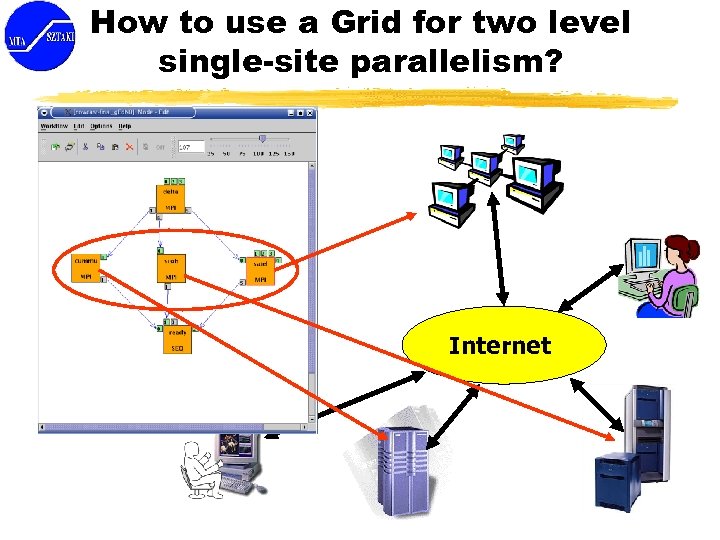 How to use a Grid for two level single-site parallelism? Internet
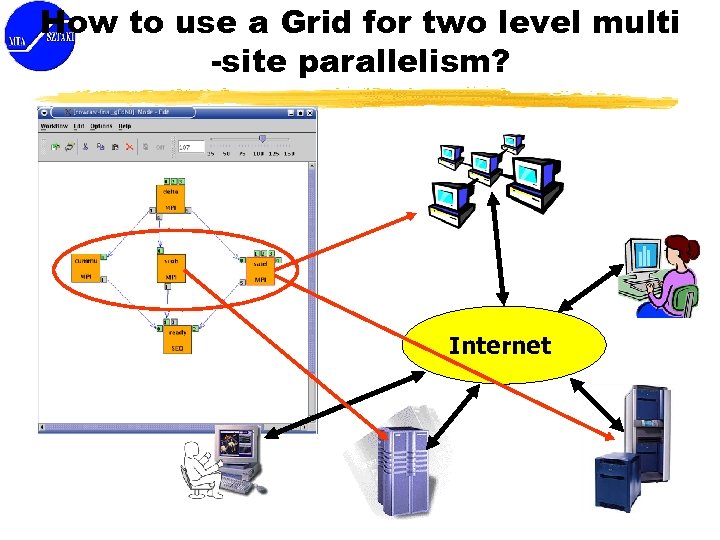 How to use a Grid for two level multi -site parallelism? Internet
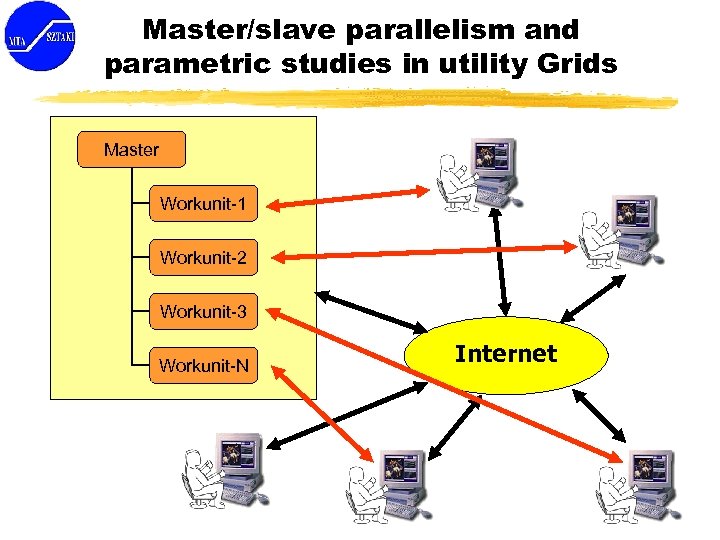 Master/slave parallelism and parametric studies in utility Grids Master Workunit-1 Workunit-2 Workunit-3 Workunit-N Internet
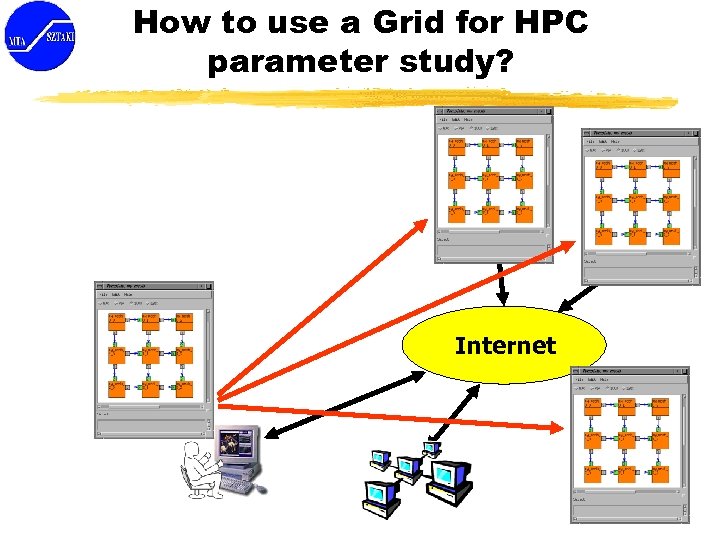 How to use a Grid for HPC parameter study? Internet
 Typical Grid Applications ● ● Computation intensive ● Interactive simulation (climate modeling) ● Very large-scale simulation and analysis (galaxy formation, gravity waves, battlefield simulation) ● Engineering (parameter studies, linked component models) Data intensive ● Experimental data analysis (high-energy physics) ● Image and sensor analysis (astronomy, climate study, ecology) Distributed collaboration ● Online instrumentation (microscopes, x-ray devices, etc. ) ● Remote visualization (climate studies, biology) ● Engineering (large-scale structural testing, chemical engineering) In all cases, the problems were big enough that they required people in several organization to collaborate and share computing resources, data, instruments.
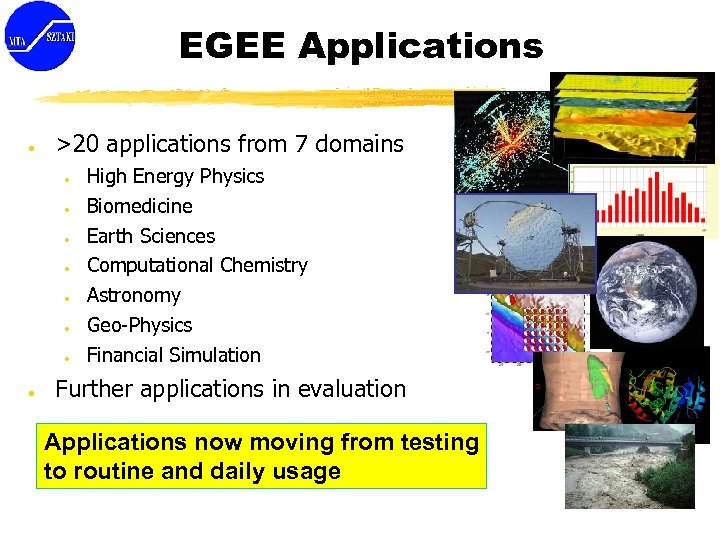 EGEE Applications ● >20 applications from 7 domains ● ● ● ● High Energy Physics Biomedicine Earth Sciences Computational Chemistry Astronomy Geo-Physics Financial Simulation Further applications in evaluation Applications now moving from testing to routine and daily usage
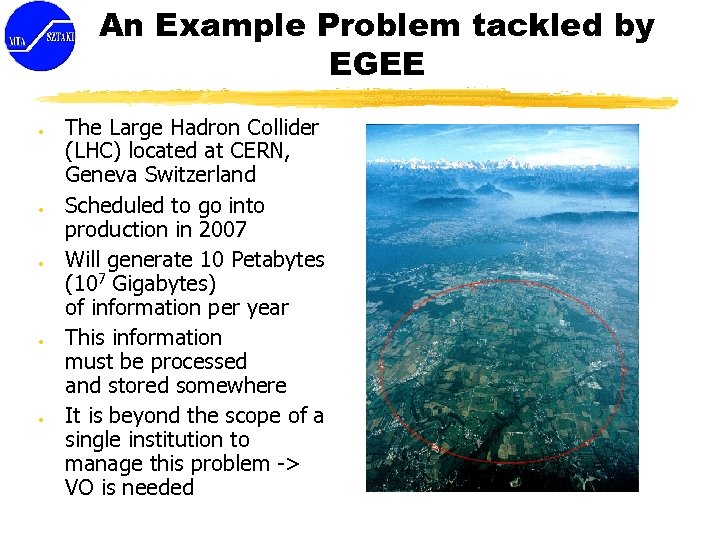 An Example Problem tackled by EGEE ● ● ● The Large Hadron Collider (LHC) located at CERN, Geneva Switzerland Scheduled to go into production in 2007 Will generate 10 Petabytes (107 Gigabytes) of information per year This information must be processed and stored somewhere It is beyond the scope of a single institution to manage this problem -> VO is needed
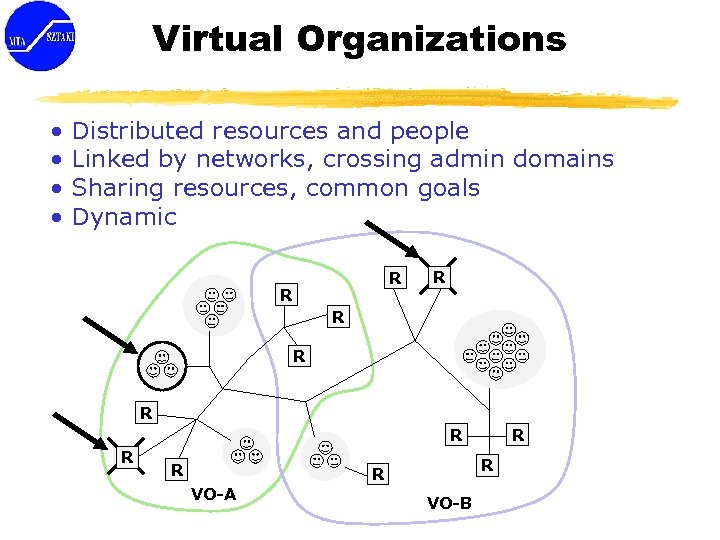 Virtual Organizations • • Distributed resources and people Linked by networks, crossing admin domains Sharing resources, common goals Dynamic R R R VO-A R VO-B
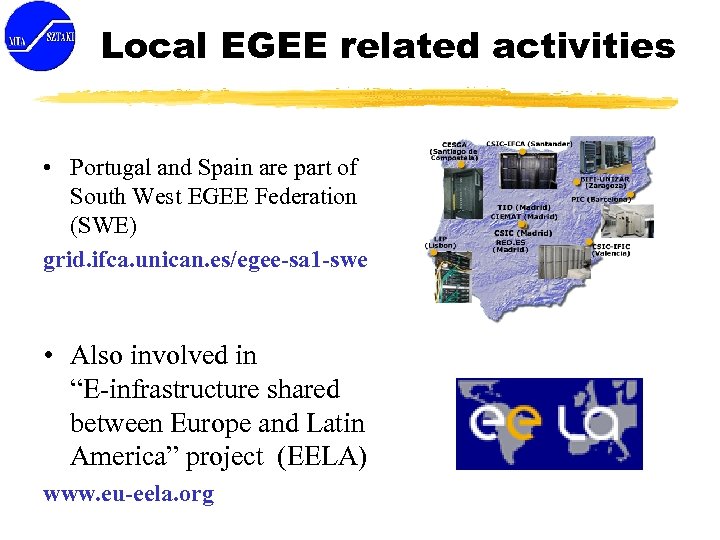 Local EGEE related activities • Portugal and Spain are part of South West EGEE Federation (SWE) grid. ifca. unican. es/egee-sa 1 -swe • Also involved in “E-infrastructure shared between Europe and Latin America” project (EELA) www. eu-eela. org
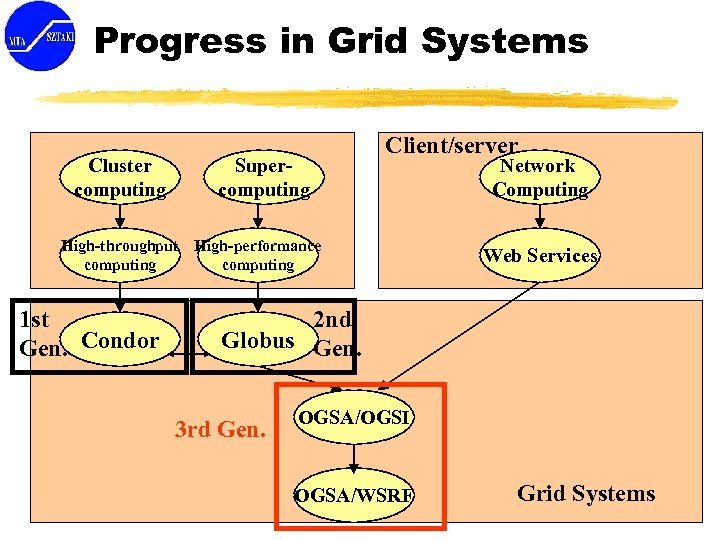 Progress in Grid Systems Cluster computing Supercomputing Client/server High-throughput High-performance computing 1 st Gen. Condor Network Computing Web Services 2 nd Globus Gen. 3 rd Gen. OGSA/OGSI OGSA/WSRF Grid Systems
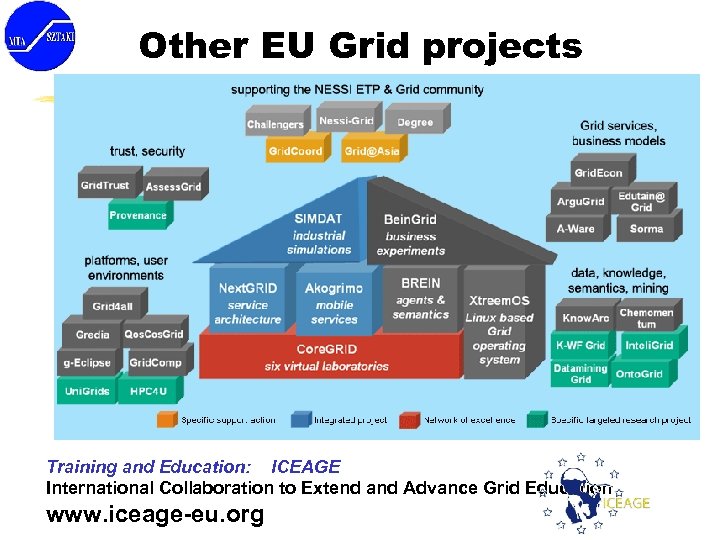 Other EU Grid projects Training and Education: ICEAGE International Collaboration to Extend and Advance Grid Education www. iceage-eu. org
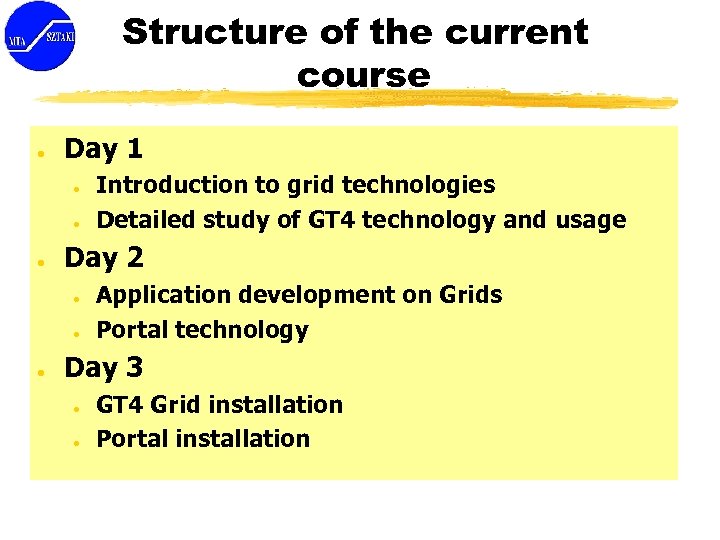 Structure of the current course ● Day 1 ● ● ● Day 2 ● ● ● Introduction to grid technologies Detailed study of GT 4 technology and usage Application development on Grids Portal technology Day 3 ● ● GT 4 Grid installation Portal installation