


 Скачать презентацию Introduction to Game Theory The Prisoners Dilemma and
GT_11_PD_repeated_games_handout.ppt
- Количество слайдов: 34
 Introduction to Game Theory The Prisoners’ Dilemma and Repeated Games Chapter 11 Jarek Neneman neneman@uni. lodz. pl 601305093
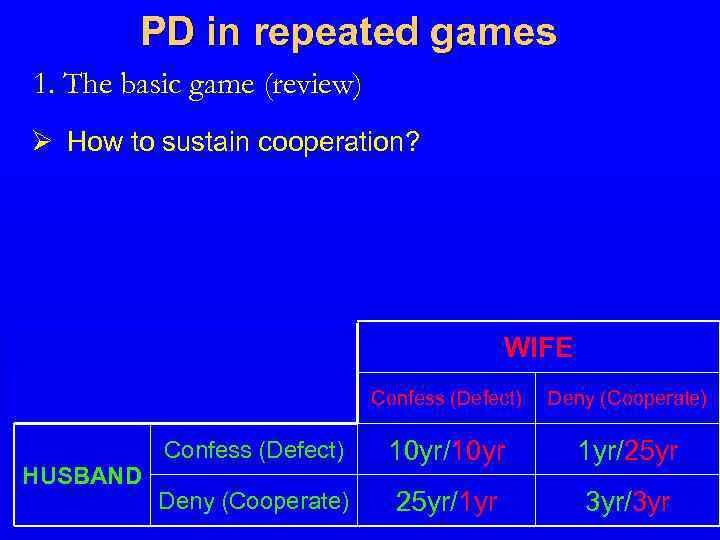 PD in repeated games 1. The basic game (review) Ø How to sustain cooperation? WIFE Confess (Defect) HUSBAND Deny (Cooperate) Confess (Defect) 10 yr/10 yr 1 yr/25 yr Deny (Cooperate) 25 yr/1 yr 3 yr/3 yr
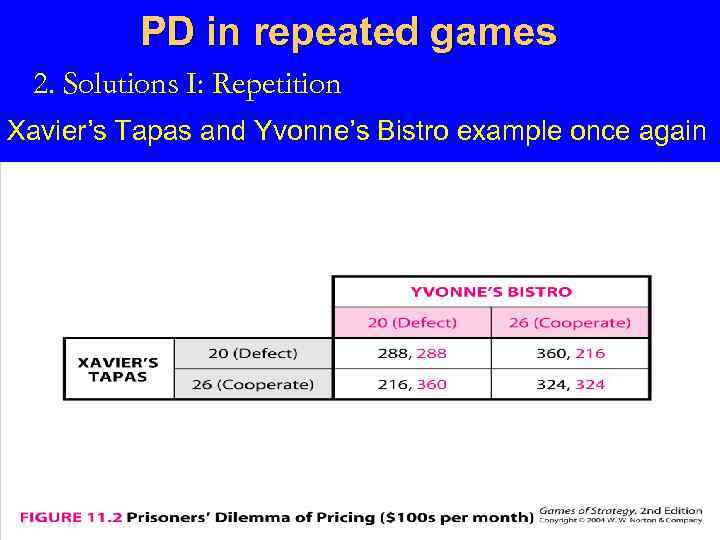 PD in repeated games 2. Solutions I: Repetition Xavier’s Tapas and Yvonne’s Bistro example once again
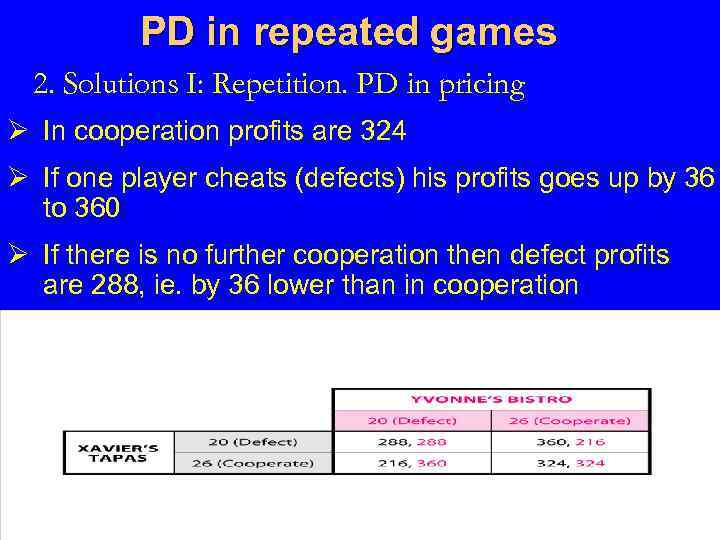 PD in repeated games 2. Solutions I: Repetition. PD in pricing Ø In cooperation profits are 324 Ø If one player cheats (defects) his profits goes up by 36 to 360 Ø If there is no further cooperation then defect profits are 288, ie. by 36 lower than in cooperation
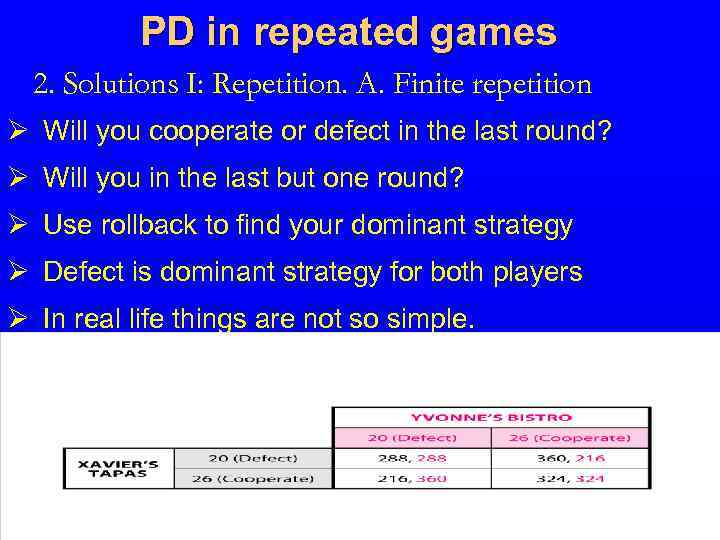 PD in repeated games 2. Solutions I: Repetition. A. Finite repetition Ø Will you cooperate or defect in the last round? Ø Will you in the last but one round? Ø Use rollback to find your dominant strategy Ø Defect is dominant strategy for both players Ø In real life things are not so simple.
 PD in repeated games 2. Solutions I: Repetition. B. Infinite repetition Ø Contingent strategies - Trigger strategies – cooperation, as long as rival does so, otherwise there is a period of punishment Ø Trigger strategies: ØGrim strategy ØTit-for-tat (TFT)
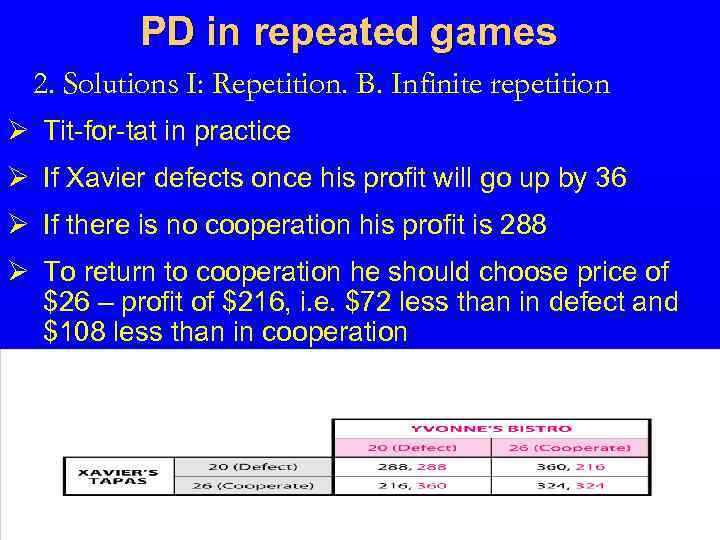 PD in repeated games 2. Solutions I: Repetition. B. Infinite repetition Ø Tit-for-tat in practice Ø If Xavier defects once his profit will go up by 36 Ø If there is no cooperation his profit is 288 Ø To return to cooperation he should choose price of $26 – profit of $216, i. e. $72 less than in defect and $108 less than in cooperation
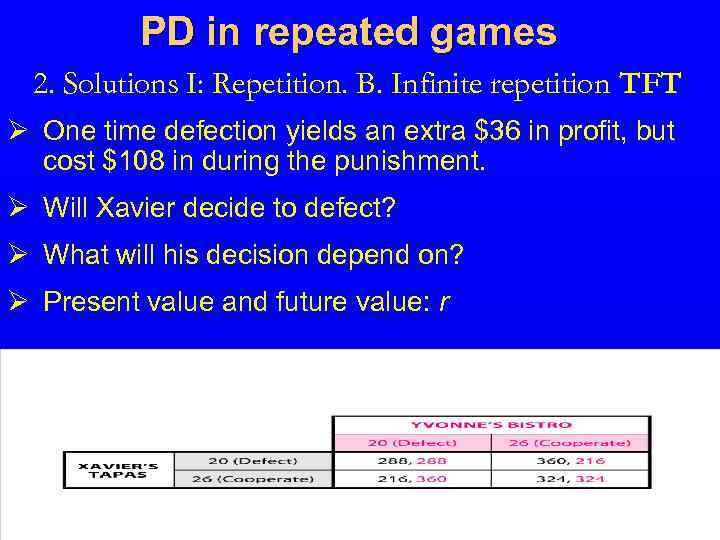 PD in repeated games 2. Solutions I: Repetition. B. Infinite repetition TFT Ø One time defection yields an extra $36 in profit, but cost $108 in during the punishment. Ø Will Xavier decide to defect? Ø What will his decision depend on? Ø Present value and future value: r
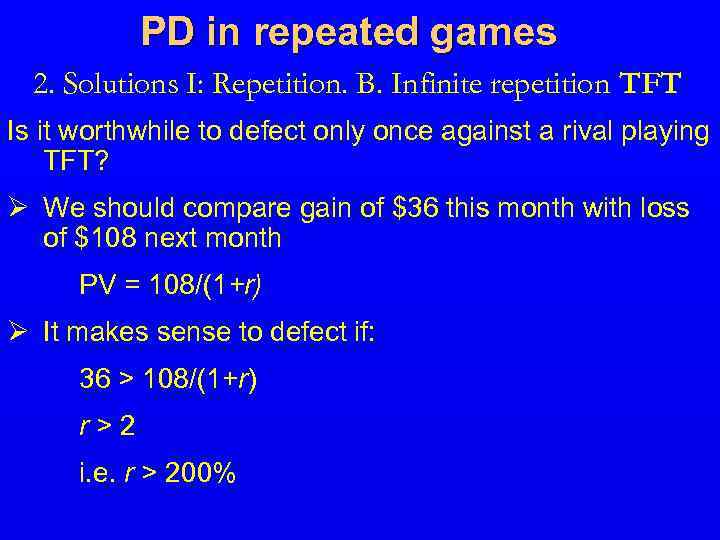 PD in repeated games 2. Solutions I: Repetition. B. Infinite repetition TFT Is it worthwhile to defect only once against a rival playing TFT? Ø We should compare gain of $36 this month with loss of $108 next month PV = 108/(1+r) Ø It makes sense to defect if: 36 > 108/(1+r) r>2 i. e. r > 200%
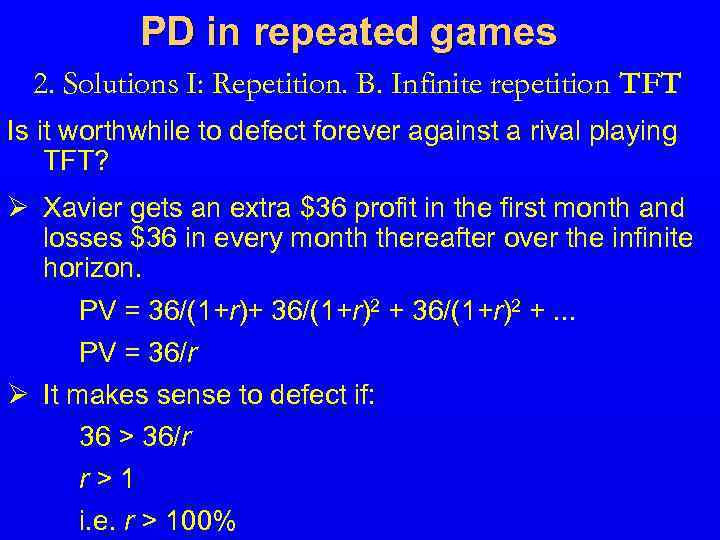 PD in repeated games 2. Solutions I: Repetition. B. Infinite repetition TFT Is it worthwhile to defect forever against a rival playing TFT? Ø Xavier gets an extra $36 profit in the first month and losses $36 in every month thereafter over the infinite horizon. PV = 36/(1+r)+ 36/(1+r)2 +. . . PV = 36/r Ø It makes sense to defect if: 36 > 36/r r>1 i. e. r > 100%
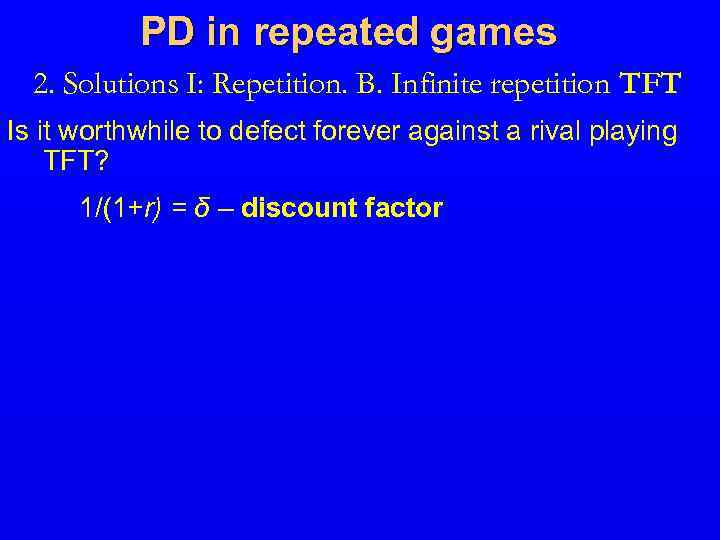 PD in repeated games 2. Solutions I: Repetition. B. Infinite repetition TFT Is it worthwhile to defect forever against a rival playing TFT? 1/(1+r) = δ – discount factor
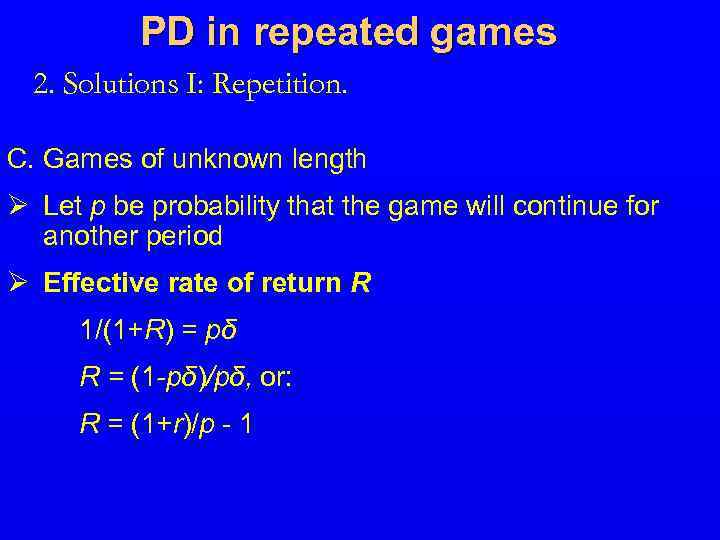 PD in repeated games 2. Solutions I: Repetition. C. Games of unknown length Ø Let p be probability that the game will continue for another period Ø Effective rate of return R 1/(1+R) = pδ R = (1 -pδ)/pδ, or: R = (1+r)/p - 1
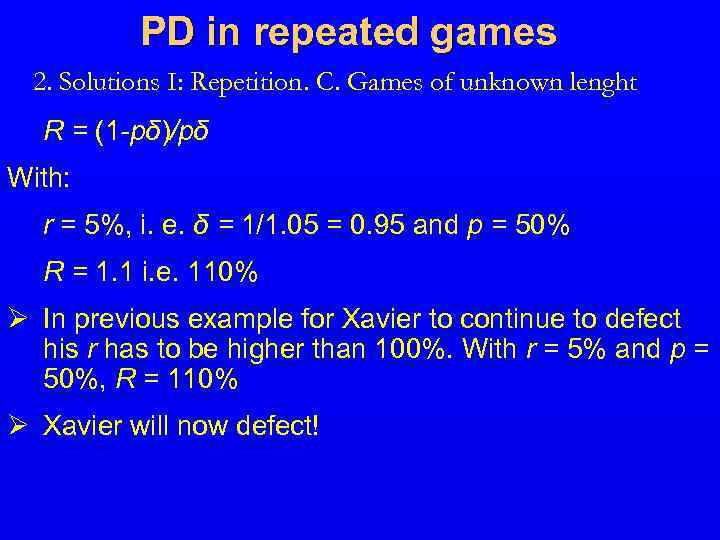 PD in repeated games 2. Solutions I: Repetition. C. Games of unknown lenght R = (1 -pδ)/pδ With: r = 5%, i. e. δ = 1/1. 05 = 0. 95 and p = 50% R = 1. 1 i. e. 110% Ø In previous example for Xavier to continue to defect his r has to be higher than 100%. With r = 5% and p = 50%, R = 110% Ø Xavier will now defect!
 PD in repeated games 2. Solutions I: Repetition. D. General Theory Real life. - If times are bad and entire industry is on the verge of collapse then competition is: more fierce (less cooperation) or less fierce (more cooperation? Obviously: less cooperation, as „there is no future” - WWI example
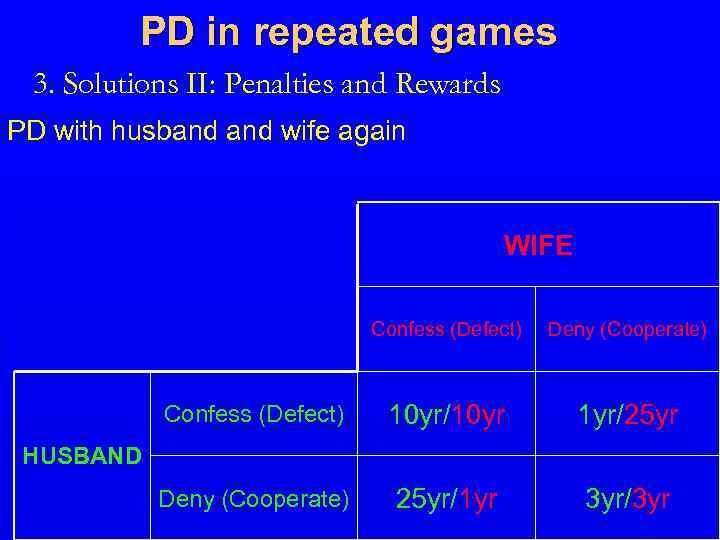 PD in repeated games 3. Solutions II: Penalties and Rewards PD with husband wife again WIFE Confess (Defect) Deny (Cooperate) Confess (Defect) 10 yr/10 yr 1 yr/25 yr Deny (Cooperate) 25 yr/1 yr 3 yr/3 yr HUSBAND
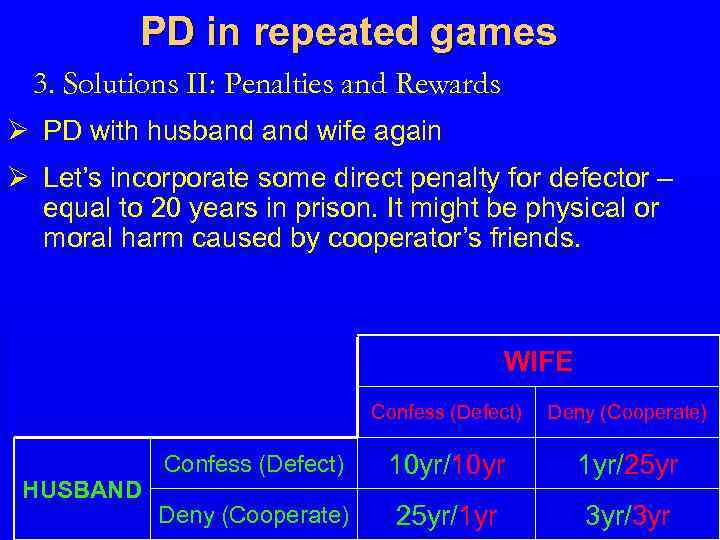 PD in repeated games 3. Solutions II: Penalties and Rewards Ø PD with husband wife again Ø Let’s incorporate some direct penalty for defector – equal to 20 years in prison. It might be physical or moral harm caused by cooperator’s friends. WIFE Confess (Defect) HUSBAND Deny (Cooperate) Confess (Defect) 10 yr/10 yr 1 yr/25 yr Deny (Cooperate) 25 yr/1 yr 3 yr/3 yr
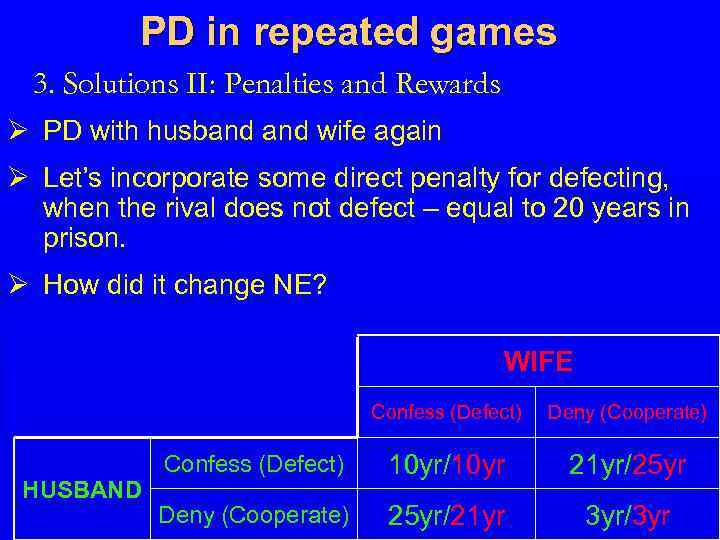 PD in repeated games 3. Solutions II: Penalties and Rewards Ø PD with husband wife again Ø Let’s incorporate some direct penalty for defecting, when the rival does not defect – equal to 20 years in prison. Ø How did it change NE? WIFE Confess (Defect) HUSBAND Deny (Cooperate) Confess (Defect) 10 yr/10 yr 21 yr/25 yr Deny (Cooperate) 25 yr/21 yr 3 yr/3 yr
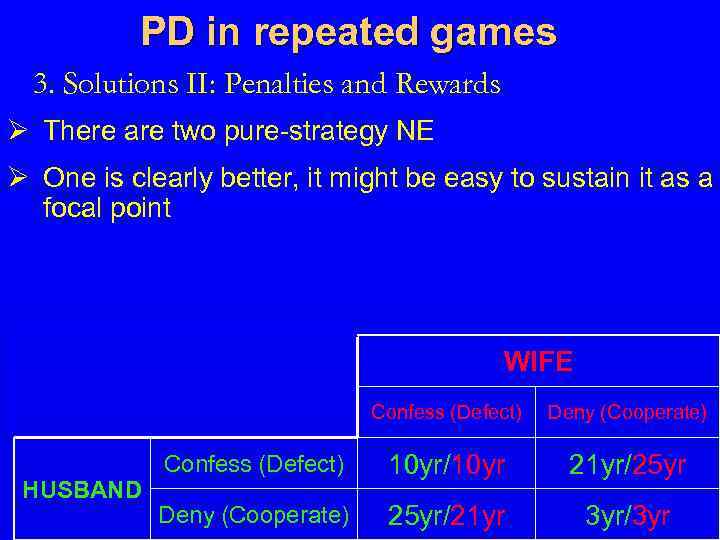 PD in repeated games 3. Solutions II: Penalties and Rewards Ø There are two pure-strategy NE Ø One is clearly better, it might be easy to sustain it as a focal point WIFE Confess (Defect) HUSBAND Deny (Cooperate) Confess (Defect) 10 yr/10 yr 21 yr/25 yr Deny (Cooperate) 25 yr/21 yr 3 yr/3 yr
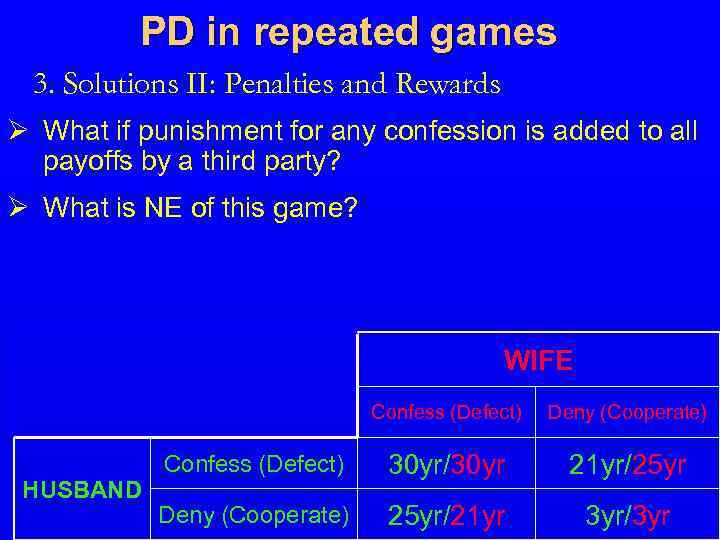 PD in repeated games 3. Solutions II: Penalties and Rewards Ø What if punishment for any confession is added to all payoffs by a third party? Ø What is NE of this game? WIFE Confess (Defect) HUSBAND Deny (Cooperate) Confess (Defect) 30 yr/30 yr 21 yr/25 yr Deny (Cooperate) 25 yr/21 yr 3 yr/3 yr
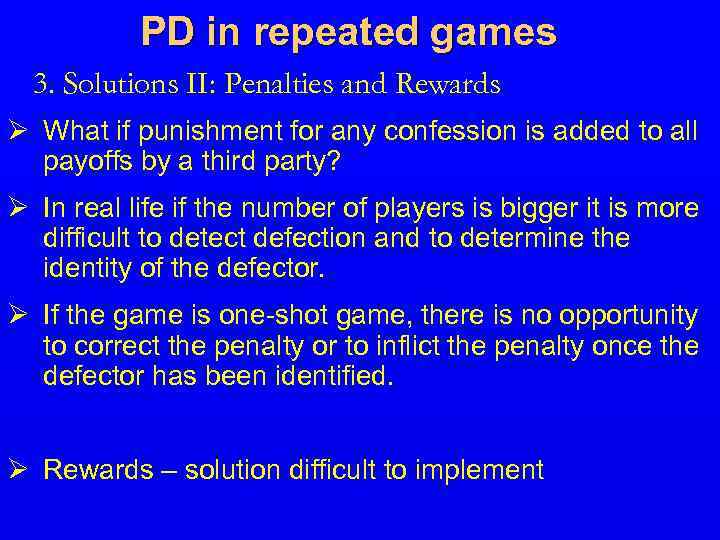 PD in repeated games 3. Solutions II: Penalties and Rewards Ø What if punishment for any confession is added to all payoffs by a third party? Ø In real life if the number of players is bigger it is more difficult to detect defection and to determine the identity of the defector. Ø If the game is one-shot game, there is no opportunity to correct the penalty or to inflict the penalty once the defector has been identified. Ø Rewards – solution difficult to implement
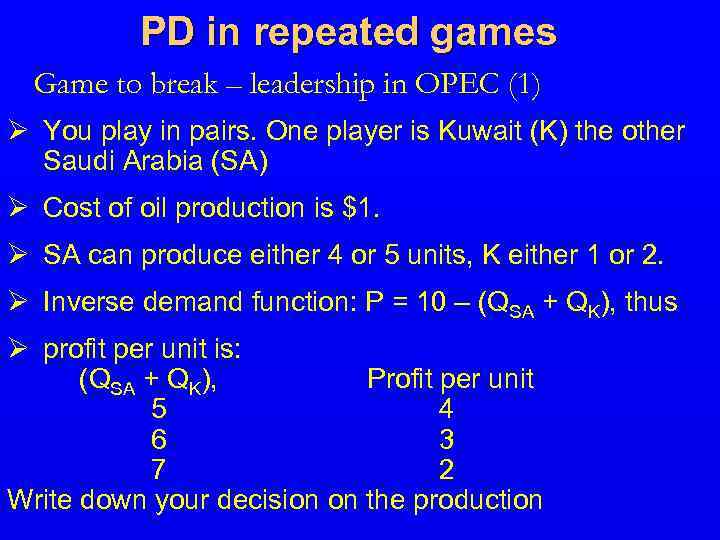 PD in repeated games Game to break – leadership in OPEC (1) Ø You play in pairs. One player is Kuwait (K) the other Saudi Arabia (SA) Ø Cost of oil production is $1. Ø SA can produce either 4 or 5 units, K either 1 or 2. Ø Inverse demand function: P = 10 – (QSA + QK), thus Ø profit per unit is: (QSA + QK), Profit per unit 5 4 6 3 7 2 Write down your decision on the production
 PD in repeated games Game to break – leadership in OPEC (2) Ø Cost of oil production is $1. Ø SA can produce either 4 or 5 units, K either 1 or 2. Ø Inverse demand function: P = 10 – (QSA + QK), thus profit per unit is: (QSA + QK), 5 6 7 Profit per unit 4 3 2 Now switch partners and play as if you were the other country Write down your decision on the production
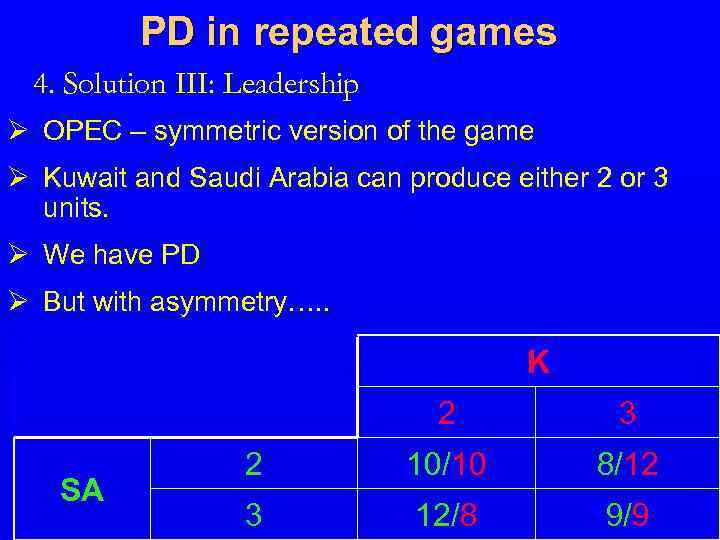 PD in repeated games 4. Solution III: Leadership Ø OPEC – symmetric version of the game Ø Kuwait and Saudi Arabia can produce either 2 or 3 units. Ø We have PD Ø But with asymmetry…. . K 2 SA 3 2 10/10 8/12 3 12/8 9/9
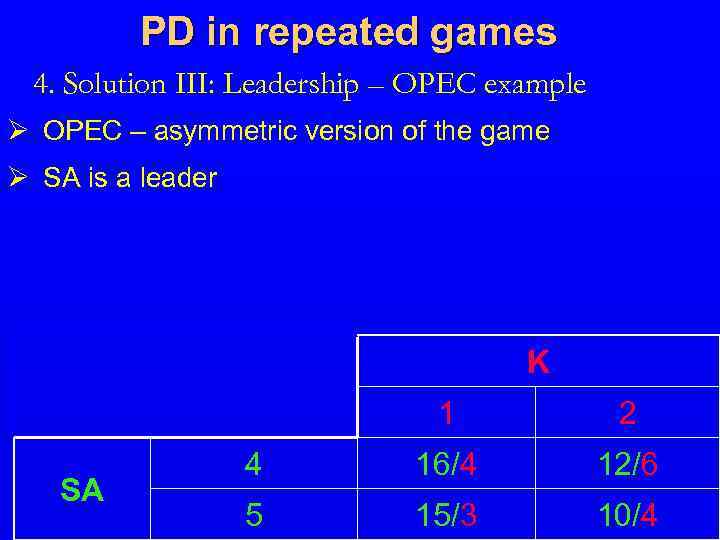 PD in repeated games 4. Solution III: Leadership – OPEC example Ø OPEC – asymmetric version of the game Ø SA is a leader K 1 SA 2 4 16/4 12/6 5 15/3 10/4
 PD in repeated games 5. Experimental evidence Ø In real life people start off by cooperation even in games with known and finite length. Ø Only in the last few plays does the defection emerge. Ø WHY? Ø Perhaps: Ø they are not sure when the game is over Ø to gain reputation Ø they believe their opponents are naive
 PD in repeated games 5. Experimental evidence Ø Robert Axelrod organized a „league tournament” of 14 computer programs to fight each other. Ø There were 200 repetition in each run. Ø At beginning „nice” programs did well. Ø But the wining strategy was Tit-for-tat, submitted by Anatole Rapoport. Ø Four properties of TFT: Ø at once forgiving – „Don’t be envious” Ø nice – „Don’t be the first to defect” Ø provocable – „Reciprocate both cooperation and defection” Ø clear – „Don’t be too clever”
 PD in repeated games 5. Experimental evidence Ø But TFT is not flawless: Ø It assumes no errors: mistakes „echo” back and forth Ø No way of saying “enough is enough” Ø TFT is too easily provoked
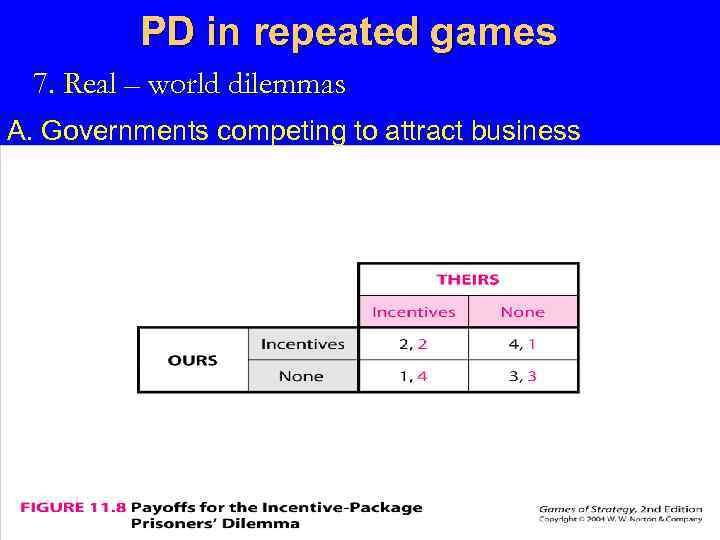 PD in repeated games 7. Real – world dilemmas A. Governments competing to attract business
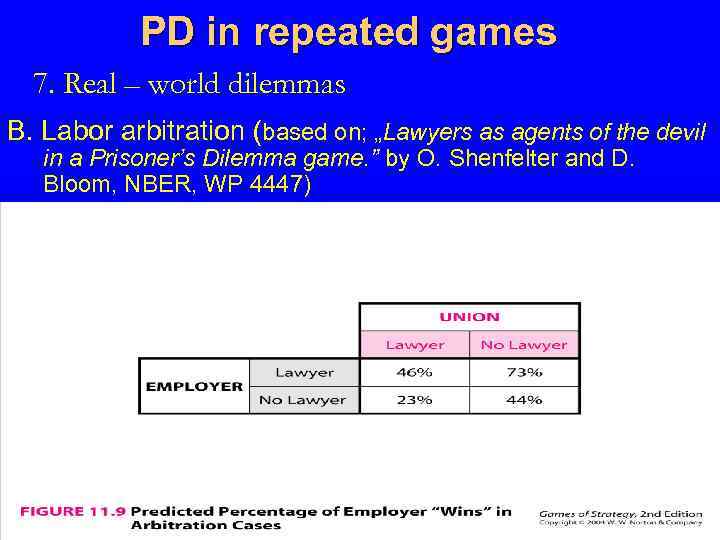 PD in repeated games 7. Real – world dilemmas B. Labor arbitration (based on; „Lawyers as agents of the devil in a Prisoner’s Dilemma game. ” by O. Shenfelter and D. Bloom, NBER, WP 4447)
 PD in repeated games 7. Real – world dilemmas D. Price matching Ø Most – favored – customer clause Ø Guarantee of the best price Ø Is it good for customers? Ø Is it good for shops?
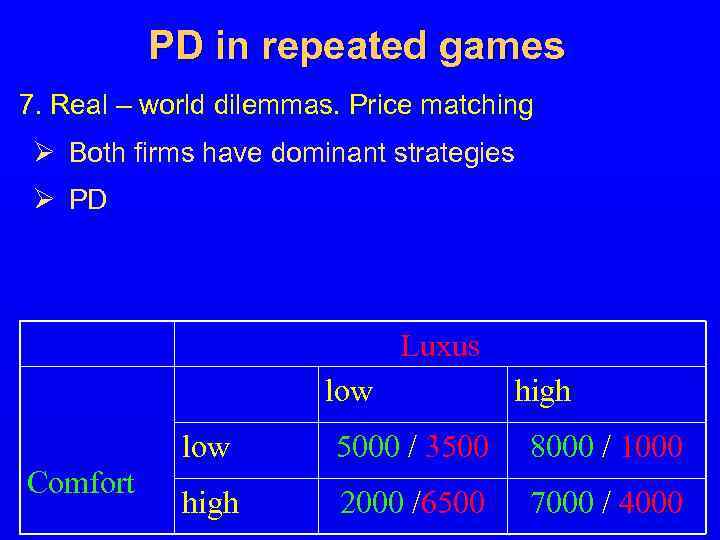 PD in repeated games 7. Real – world dilemmas. Price matching Ø Both firms have dominant strategies Ø PD Luxus low high low Comfort 5000 / 3500 8000 / 1000 high 2000 /6500 7000 / 4000
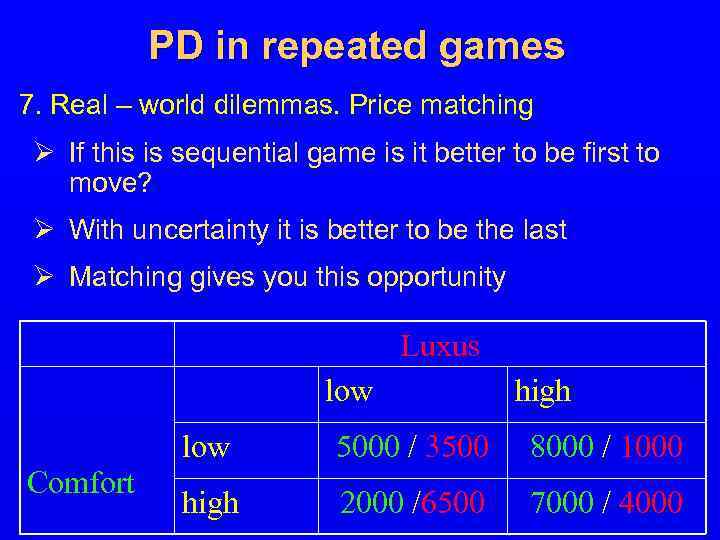 PD in repeated games 7. Real – world dilemmas. Price matching Ø If this is sequential game is it better to be first to move? Ø With uncertainty it is better to be the last Ø Matching gives you this opportunity Luxus low high low Comfort 5000 / 3500 8000 / 1000 high 2000 /6500 7000 / 4000
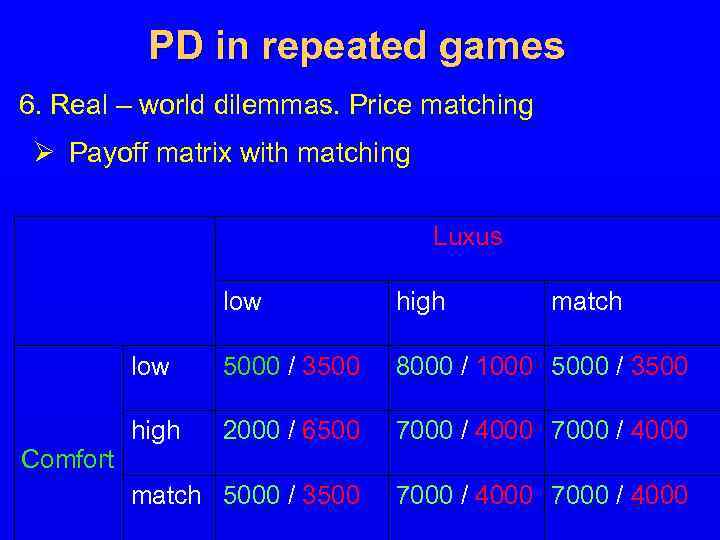 PD in repeated games 6. Real – world dilemmas. Price matching Ø Payoff matrix with matching Luxus low Comfort high match 5000 / 3500 8000 / 1000 5000 / 3500 high 2000 / 6500 7000 / 4000 match 5000 / 3500 7000 / 4000
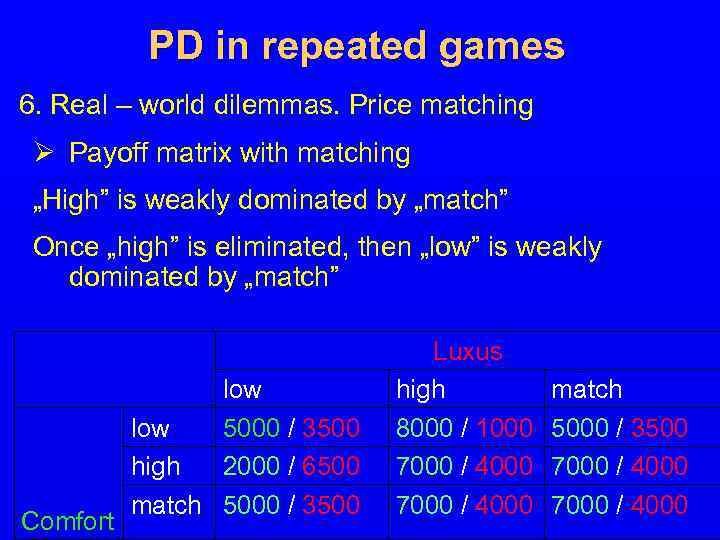 PD in repeated games 6. Real – world dilemmas. Price matching Ø Payoff matrix with matching „High” is weakly dominated by „match” Once „high” is eliminated, then „low” is weakly dominated by „match” Comfort low 5000 / 3500 high 2000 / 6500 match 5000 / 3500 Luxus high 8000 / 1000 7000 / 4000 match 5000 / 3500 7000 / 4000