 Скачать презентацию Introduction to FP 7 Vlado Bužek Budmerice December
3289956158862a82b8f1efcfb59e1d27.ppt
- Количество слайдов: 63



Introduction to FP 7 Vlado Bužek Budmerice, December 15, 2006
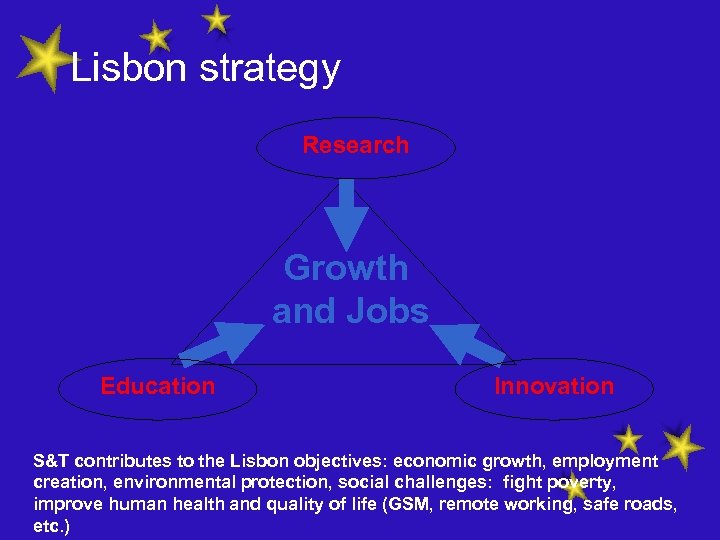
Lisbon strategy Research Growth and Jobs Education Innovation S&T contributes to the Lisbon objectives: economic growth, employment creation, environmental protection, social challenges: fight poverty, improve human health and quality of life (GSM, remote working, safe roads, etc. )
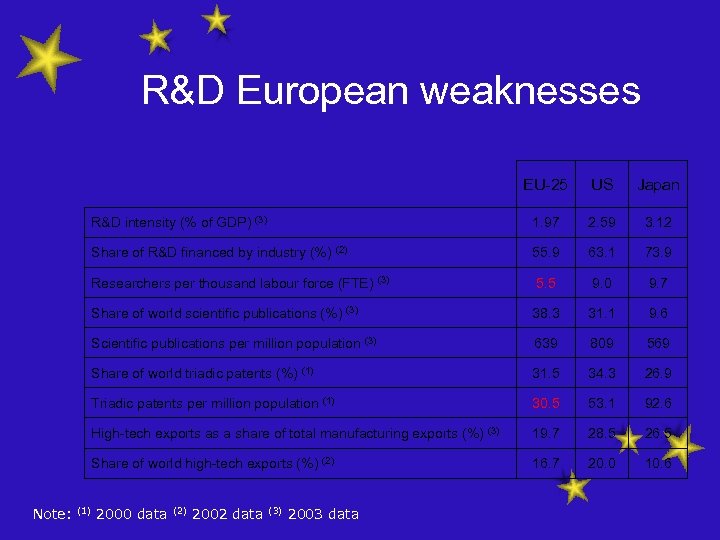
R&D European weaknesses EU-25 1. 97 2. 59 3. 12 Share of R&D financed by industry (%) (2) 55. 9 63. 1 73. 9 Researchers per thousand labour force (FTE) (3) 5. 5 9. 0 9. 7 Share of world scientific publications (%) (3) 38. 3 31. 1 9. 6 Scientific publications per million population (3) 639 809 569 Share of world triadic patents (%) (1) 31. 5 34. 3 26. 9 Triadic patents per million population (1) 30. 5 53. 1 92. 6 High-tech exports as a share of total manufacturing exports (%) (3) 19. 7 28. 5 26. 5 Share of world high-tech exports (%) (2) (1) Japan R&D intensity (% of GDP) (3) Note: US 16. 7 20. 0 10. 6 2000 data (2) 2002 data (3) 2003 data
Research at European level Pooling and leveraging resources Resources are pooled to achieve critical mass Leverage effect on private investments Interoperability and complementarity of big science Fostering human capacity and excellence in S&T Stimulate training and international mobility of researchers Improve S&T capabilities Stimulate competition in research Better integration of European R&D Create scientific base for pan-European policy challenges Encourage coordination of national policies Effective comparative research at EU-level Efficient dissemination of research results
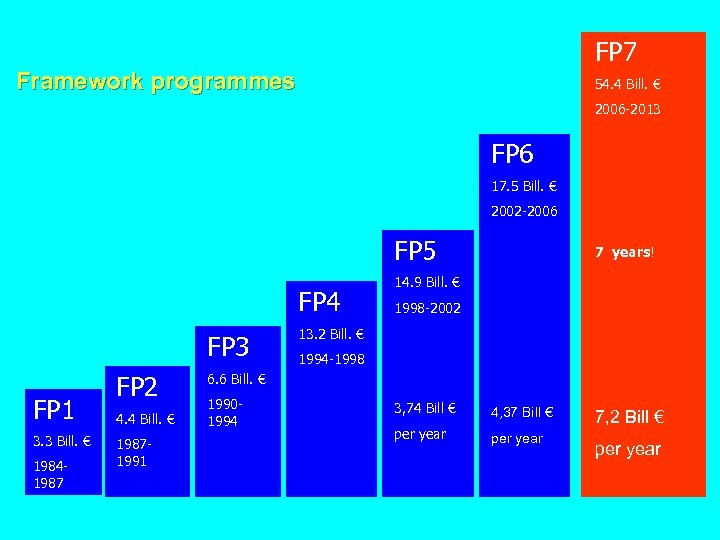
FP 7 Framework programmes 54. 4 Bill. € 2006 -2013 FP 6 17. 5 Bill. € 2002 -2006 FP 5 FP 4 FP 3 FP 1 3. 3 Bill. € 19841987 FP 2 4. 4 Bill. € 19871991 7 years! 14. 9 Bill. € 1998 -2002 13. 2 Bill. € 1994 -1998 6. 6 Bill. € 19901994 3, 74 Bill € 4, 37 Bill € per year 7, 2 Bill € per year
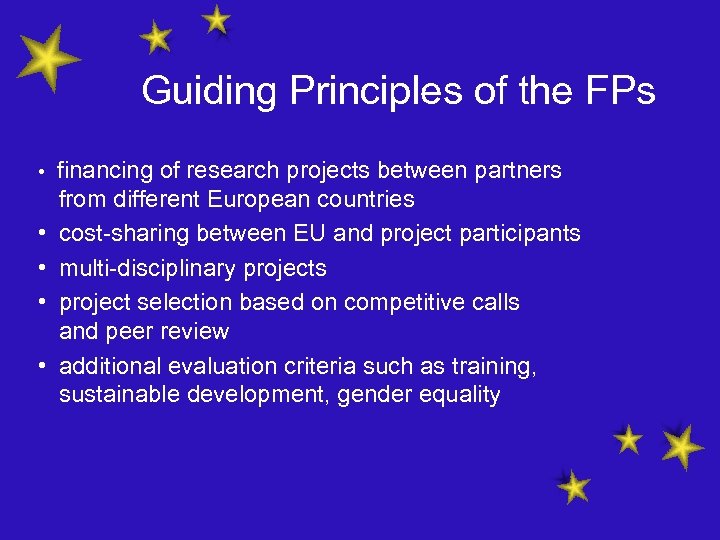
Guiding Principles of the FPs • • • financing of research projects between partners from different European countries cost-sharing between EU and project participants multi-disciplinary projects project selection based on competitive calls and peer review additional evaluation criteria such as training, sustainable development, gender equality
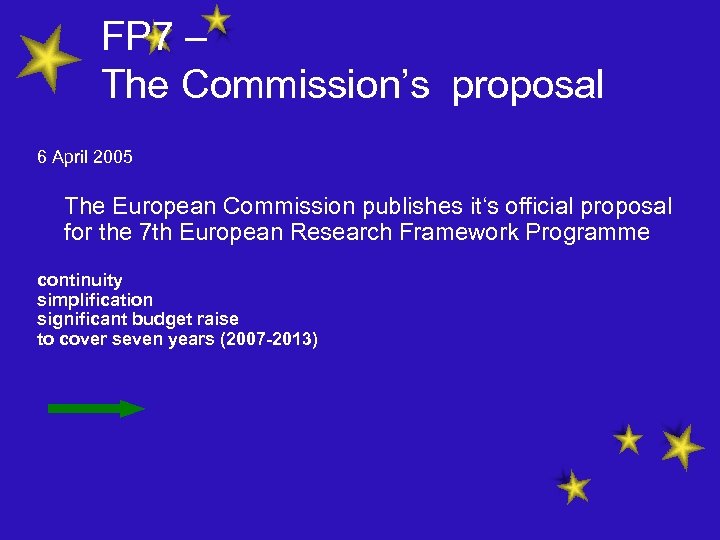
FP 7 – The Commission’s proposal 6 April 2005 The European Commission publishes it‘s official proposal for the 7 th European Research Framework Programme continuity simplification significant budget raise to cover seven years (2007 -2013)
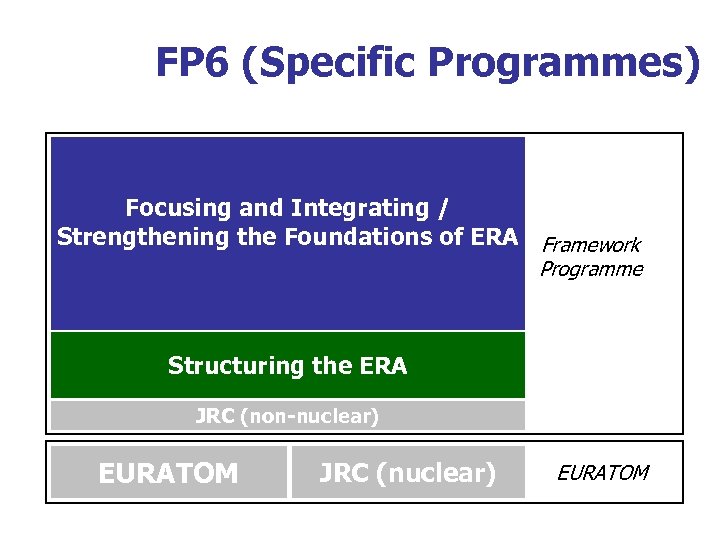
FP 6 (Specific Programmes) Focusing and Integrating / Strengthening the Foundations of ERA Framework Programme Structuring the ERA JRC (non-nuclear) EURATOM JRC (nuclear) EURATOM
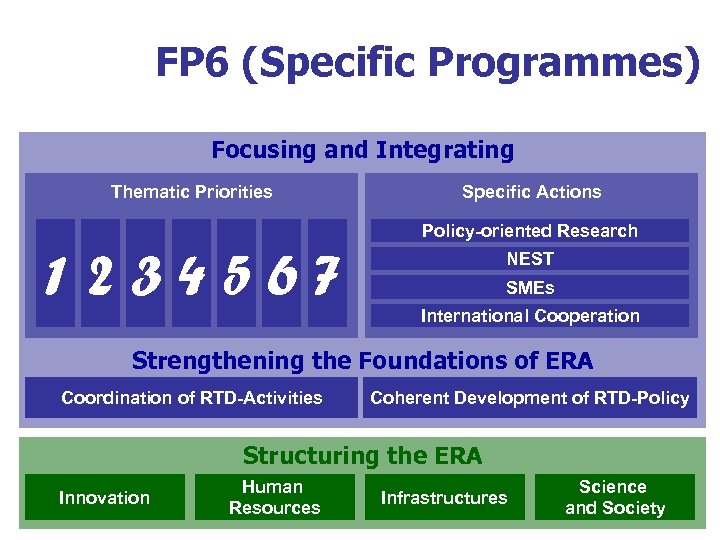
FP 6 (Specific Programmes) Focusing and Integrating Thematic Priorities Specific Actions Policy-oriented Research 1 234567 NEST SMEs International Cooperation Strengthening the Foundations of ERA Coordination of RTD-Activities Coherent Development of RTD-Policy Structuring the ERA Innovation Human Resources Infrastructures Science and Society
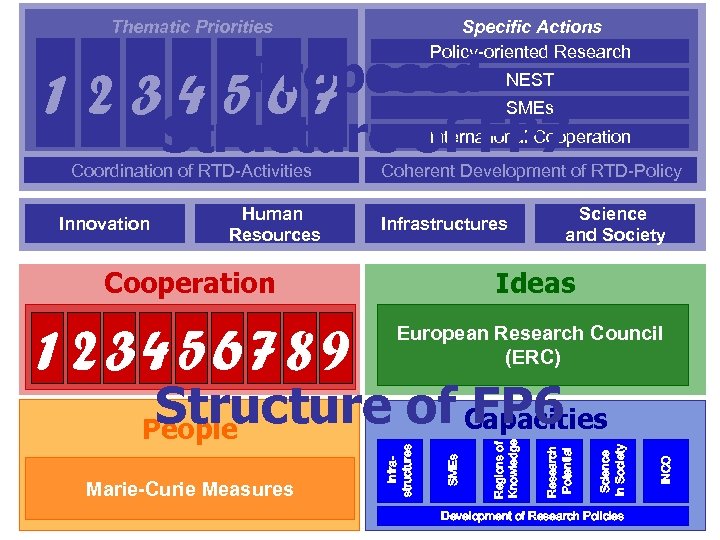
Thematic Priorities 12 Specific Actions Policy-oriented Research Proposed 34567 Structure of FP 7 NEST SMEs International Cooperation Coordination of RTD-Activities Innovation Human Resources Coherent Development of RTD-Policy Infrastructures Science and Society Cooperation Ideas 1 2 34 5 6 7 8 9 European Research Council (ERC) Development of Research Policies INCO Science in Society Research Potential Regions of Knowledge SMEs Marie-Curie Measures Infrastructures Structure of Capacities FP 6 People
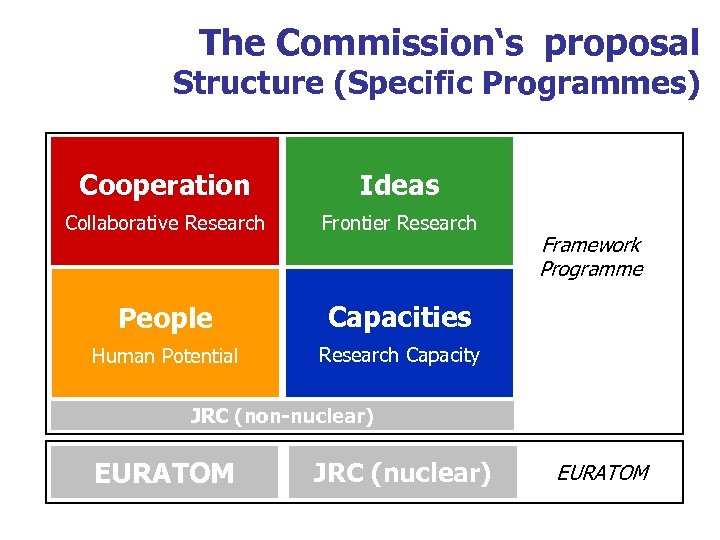
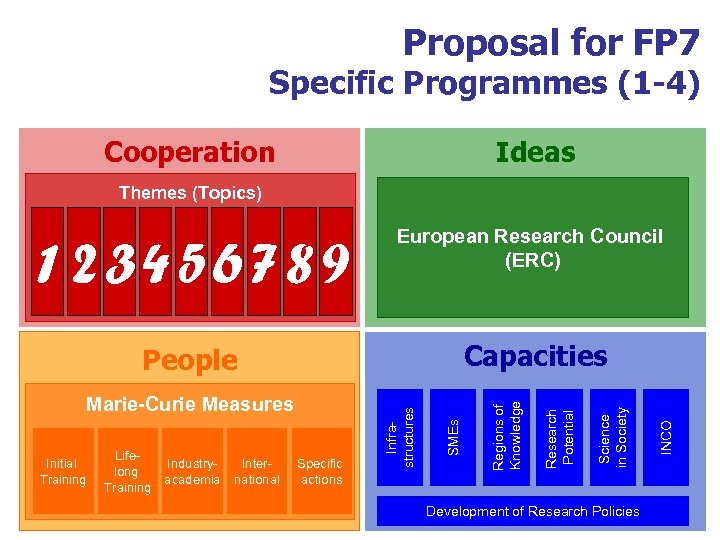
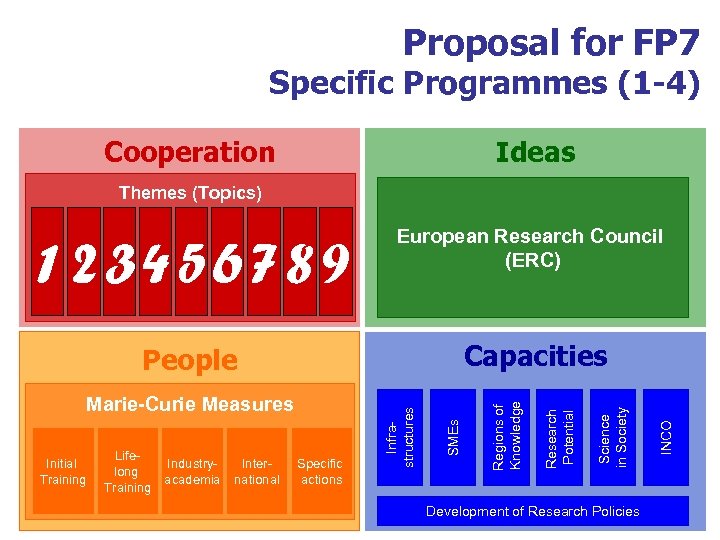
The Commission‘s proposal Structure (Specific Programmes) Cooperation Ideas Collaborative Research Frontier Research People Capacities Human Potential Research Capacity Framework Programme JRC (non-nuclear) EURATOM JRC (nuclear) EURATOM
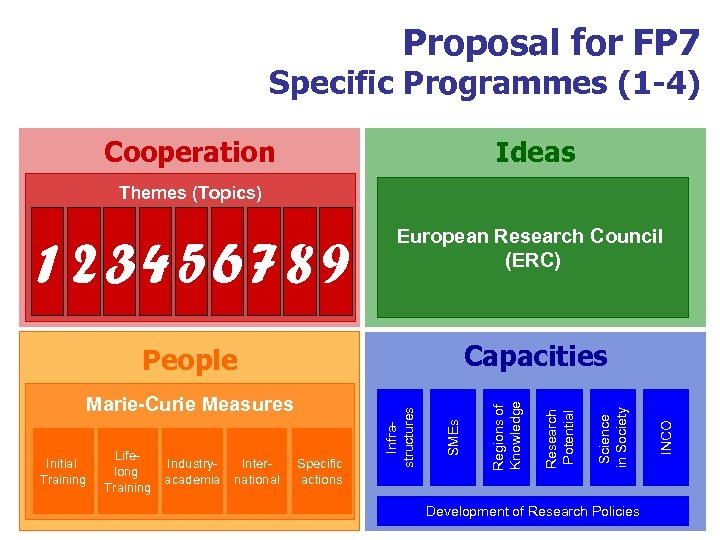
Proposal for FP 7 Specific Programmes (1 -4) Cooperation Ideas Themes (Topics) Industryacademia International Specific actions Development of Research Policies INCO Lifelong Training Science in Society Initial Training Research Potential Marie-Curie Measures Regions of Knowledge Capacities SMEs People Infrastructures 1 2 34 5 6 7 8 9 European Research Council (ERC)
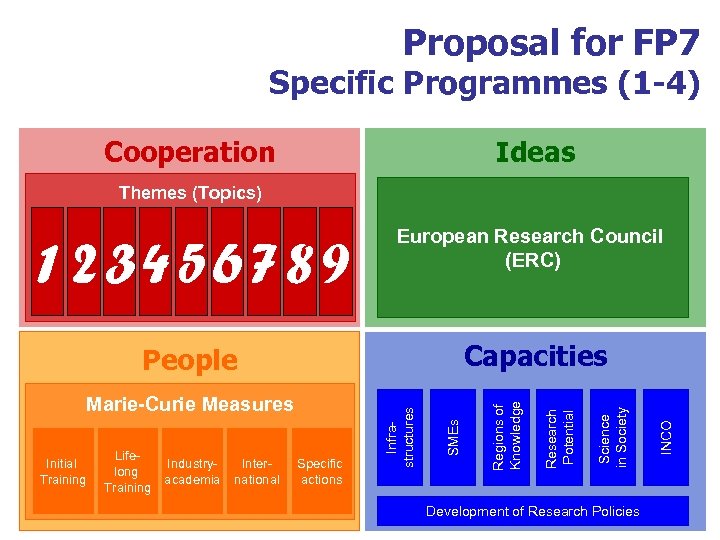
Proposal for FP 7 Specific Programmes (1 -4) Cooperation Ideas Themes (Topics) Industryacademia International Specific actions Development of Research Policies INCO Lifelong Training Science in Society Initial Training Research Potential Marie-Curie Measures Regions of Knowledge Capacities SMEs People Infrastructures 1 2 34 5 6 7 8 9 European Research Council (ERC)
Cooperation Collaborative Research • more than half the total FP 7 budget • support of cooperation between universities, industry, research centres and public authorities Goal: to gain leadership in key scientific and technology areas
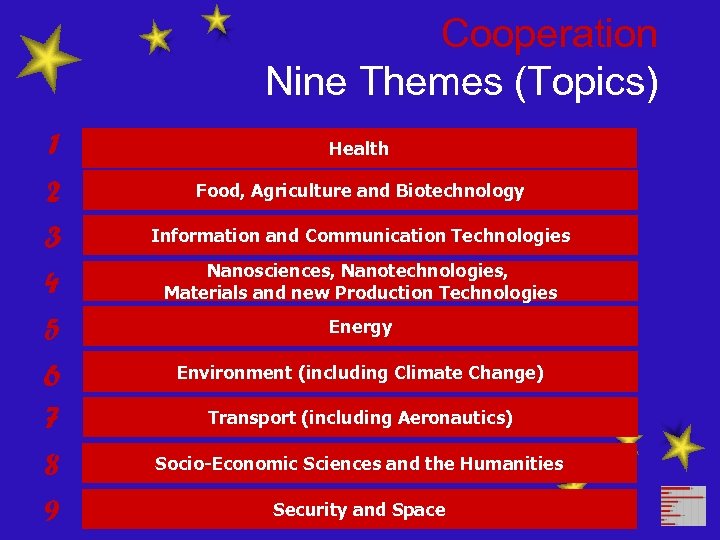
Cooperation Nine Themes (Topics) 1 2 3 4 5 6 7 8 9 Health Food, Agriculture and Biotechnology Information and Communication Technologies Nanosciences, Nanotechnologies, Materials and new Production Technologies Energy Environment (including Climate Change) Transport (including Aeronautics) Socio-Economic Sciences and the Humanities Security and Space
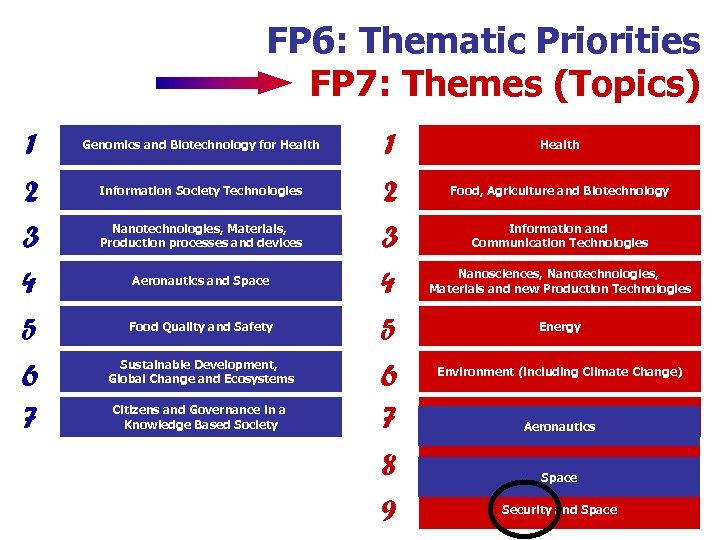
FP 6: Thematic Priorities FP 7: Themes (Topics) 1 2 3 4 5 6 7 Genomics and Biotechnology for Health Information Society Technologies Nanotechnologies, Materials, Production processes and devices Aeronautics and Space Food Quality and Safety Sustainable Development, Global Change and Ecosystems Citizens and Governance in a Knowledge Based Society 1 2 3 4 5 6 7 8 9 Health Food, Agriculture and Biotechnology Information and Communication Technologies Nanosciences, Nanotechnologies, Materials and new Production Technologies Energy Environment (including Climate Change) Transport (including Aeronautics) Aeronautics Socio-Economic Sciences and the Humanities Space Security and Space
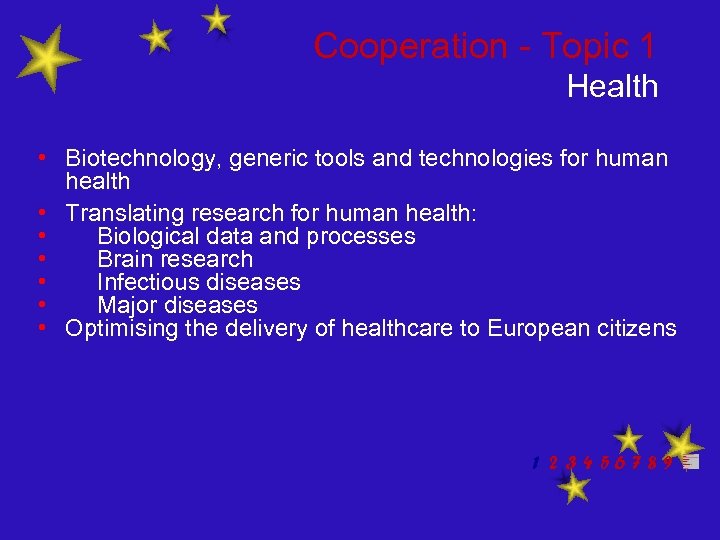
Cooperation - Topic 1 Health • Biotechnology, generic tools and technologies for human health • Translating research for human health: • Biological data and processes • Brain research • Infectious diseases • Major diseases • Optimising the delivery of healthcare to European citizens 1 2 3456789
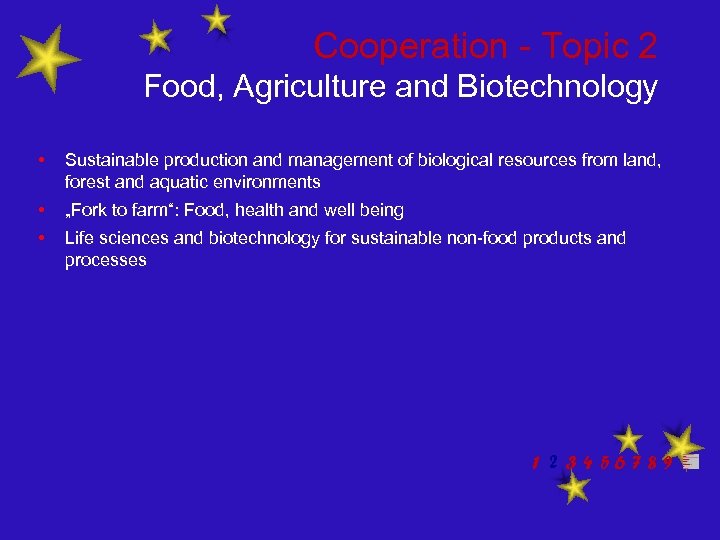
Cooperation - Topic 2 Food, Agriculture and Biotechnology • Sustainable production and management of biological resources from land, forest and aquatic environments • „Fork to farm“: Food, health and well being • Life sciences and biotechnology for sustainable non-food products and processes 1 2 3456789
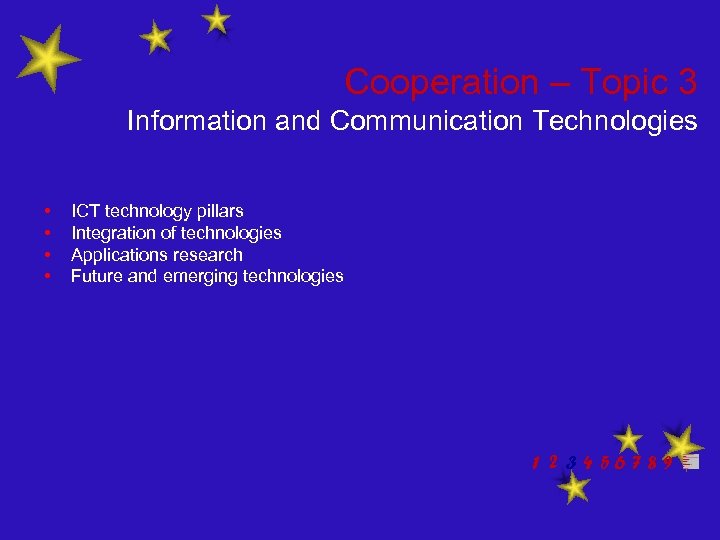
Cooperation – Topic 3 Information and Communication Technologies • • ICT technology pillars Integration of technologies Applications research Future and emerging technologies 1 2 3456789
Cooperation – Topic 4 Nanosciences, Nanotechnologies, Materials and new Production Technologies • • Nanosciences and nanotechnologies Materials New production Integration of technologies for industrial applications 1 2 3456789
Cooperation – Topic 5 Energy • • • Hydrogen and fuel cells Renewable electricity generation Renewable fuel production Renewables for heating and cooling CO 2 capture and storage technologies for zero emission power generation Clean coal technologies Smart energy networks Energy efficiency and savings Knowledge for energy policy making 1 2 3456789
Cooperation – Topic 6 Environment (incl. Climate Change) • • Climate change, pollution and risks Sustainable management of resources Environmental technologies Earth observation and assessment tools 1 2 3456789
Cooperation – Topic 7 Transport (incl. Aeronautics) • • • Aeronautics and air transport Surface transport (rail, road and waterborne) Support to the European global satellite navigation system (Galileo) 1 2 3456789
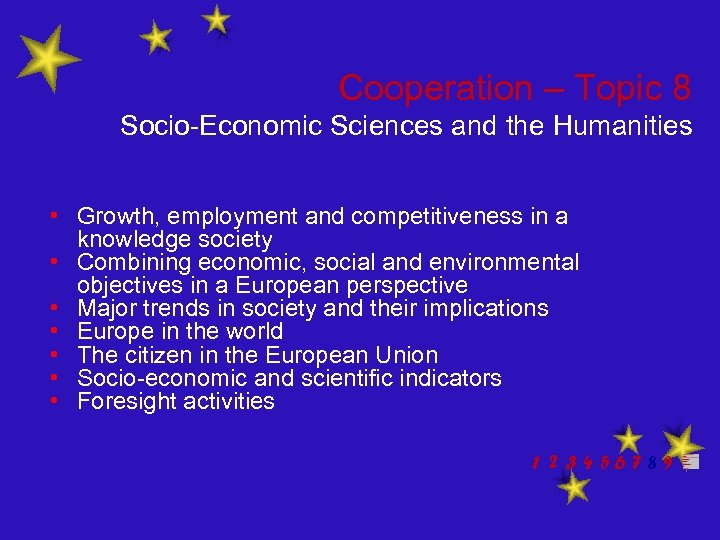
Cooperation – Topic 8 Socio-Economic Sciences and the Humanities • Growth, employment and competitiveness in a knowledge society • Combining economic, social and environmental objectives in a European perspective • Major trends in society and their implications • Europe in the world • The citizen in the European Union • Socio-economic and scientific indicators • Foresight activities 1 2 3456789
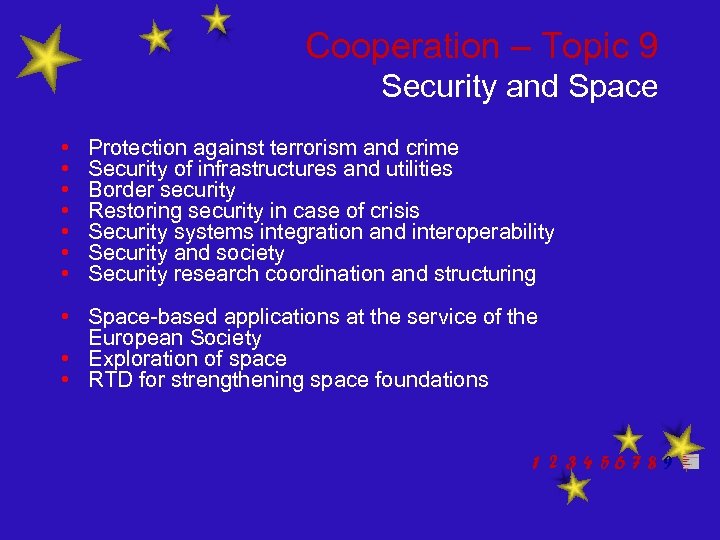
Cooperation – Topic 9 Security and Space • • Protection against terrorism and crime Security of infrastructures and utilities Border security Restoring security in case of crisis Security systems integration and interoperability Security and society Security research coordination and structuring • Space-based applications at the service of the European Society • Exploration of space • RTD for strengthening space foundations 1 2 3456789
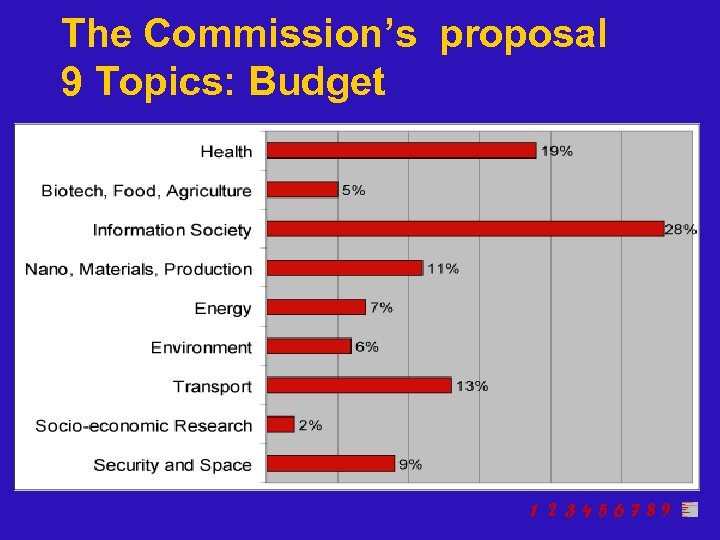
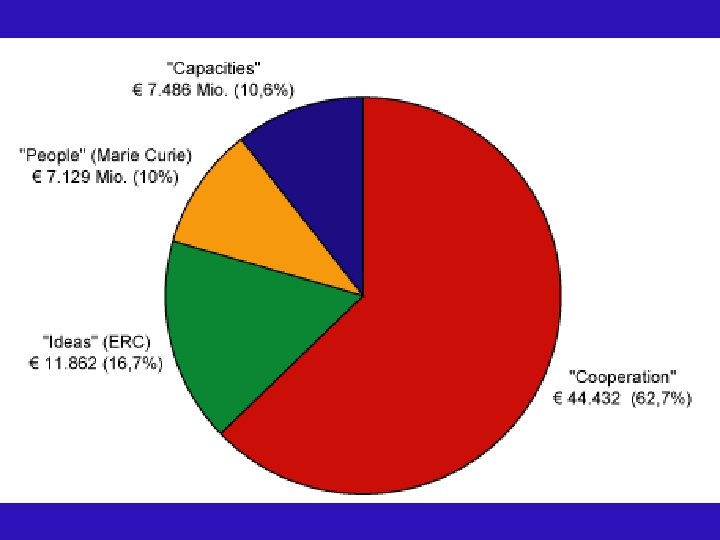
The Commission’s proposal 9 Topics: Budget 1 2 3456789
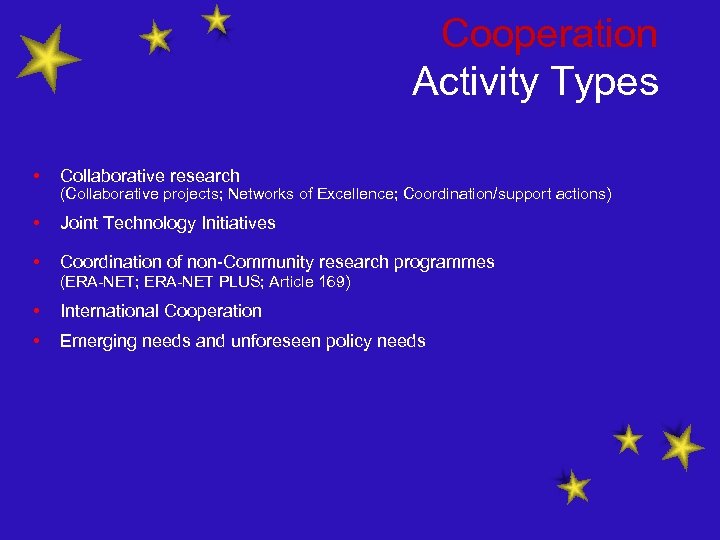
Cooperation Activity Types • Collaborative research • Joint Technology Initiatives • Coordination of non-Community research programmes (Collaborative projects; Networks of Excellence; Coordination/support actions) (ERA-NET; ERA-NET PLUS; Article 169) • International Cooperation • Emerging needs and unforeseen policy needs
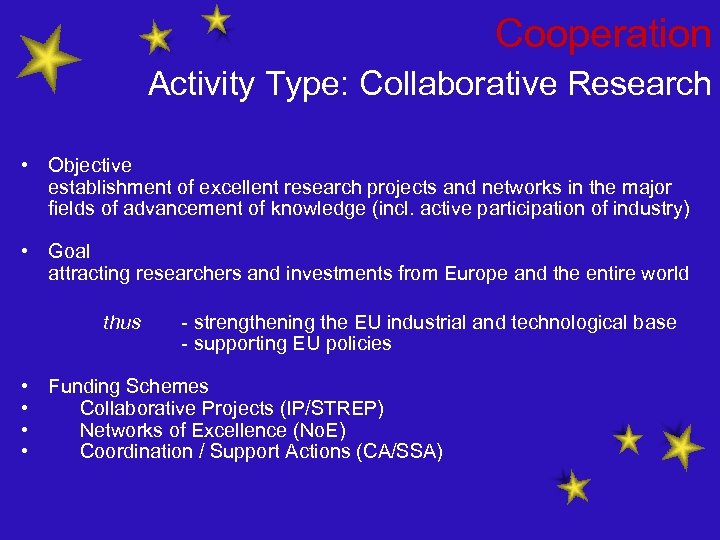
Cooperation Activity Type: Collaborative Research • Objective establishment of excellent research projects and networks in the major fields of advancement of knowledge (incl. active participation of industry) • Goal attracting researchers and investments from Europe and the entire world thus - strengthening the EU industrial and technological base - supporting EU policies • Funding Schemes • Collaborative Projects (IP/STREP) • Networks of Excellence (No. E) • Coordination / Support Actions (CA/SSA)
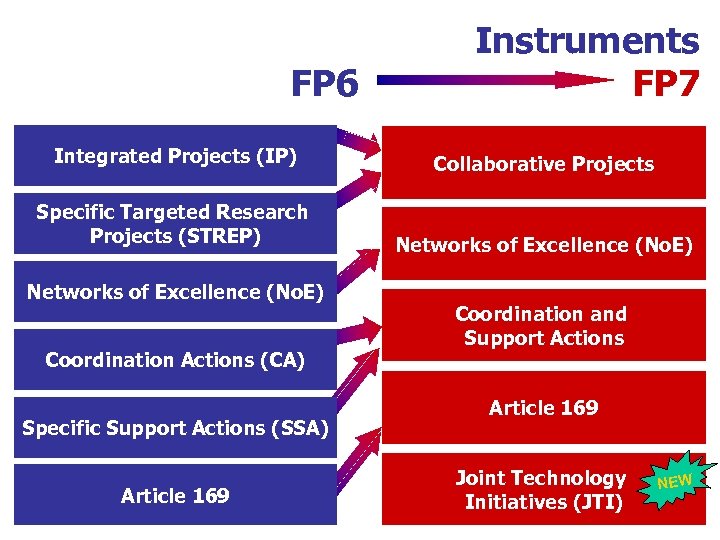
FP 6 Instruments FP 7 Integrated Projects (IP) Collaborative Projects Specific Targeted Research Projects (STREP) Networks of Excellence (No. E) Coordination Actions (CA) Specific Support Actions (SSA) Article 169 Coordination and Support Actions Article 169 Joint Technology Initiatives (JTI) NEW
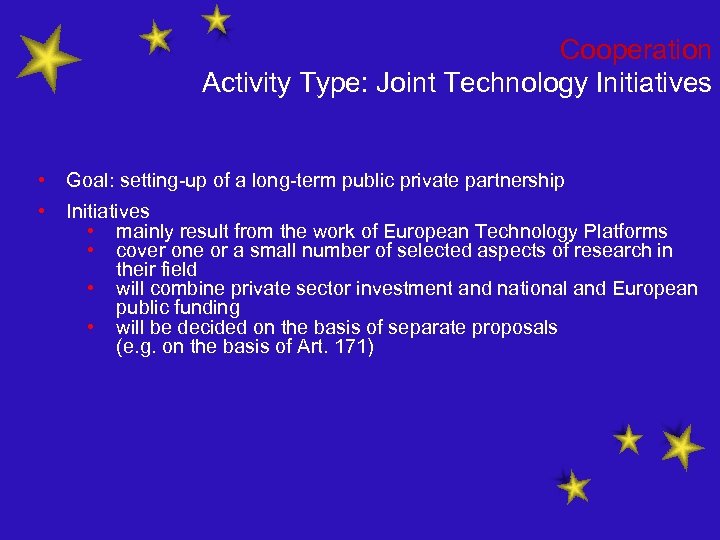
Cooperation Activity Type: Joint Technology Initiatives • Goal: setting-up of a long-term public private partnership • Initiatives • mainly result from the work of European Technology Platforms • cover one or a small number of selected aspects of research in their field • will combine private sector investment and national and European public funding • will be decided on the basis of separate proposals (e. g. on the basis of Art. 171)
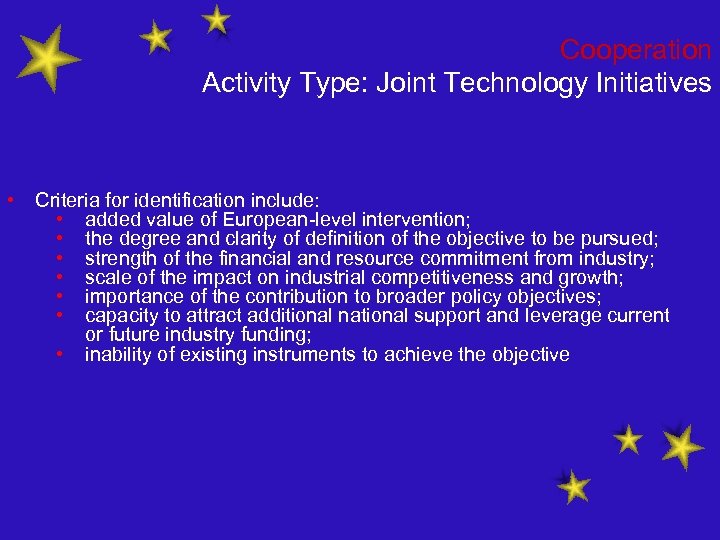
Cooperation Activity Type: Joint Technology Initiatives • Criteria for identification include: • added value of European-level intervention; • the degree and clarity of definition of the objective to be pursued; • strength of the financial and resource commitment from industry; • scale of the impact on industrial competitiveness and growth; • importance of the contribution to broader policy objectives; • capacity to attract additional national support and leverage current or future industry funding; • inability of existing instruments to achieve the objective
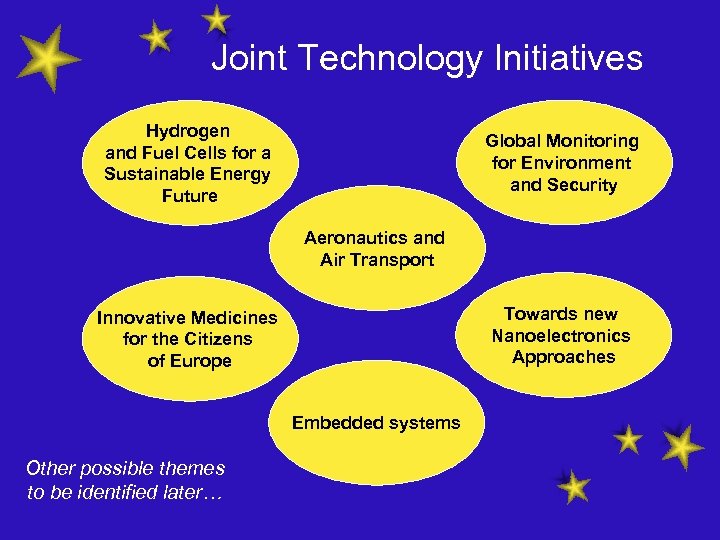
Joint Technology Initiatives Hydrogen and Fuel Cells for a Sustainable Energy Future Global Monitoring for Environment and Security Aeronautics and Air Transport Towards new Nanoelectronics Approaches Innovative Medicines for the Citizens of Europe Embedded systems Other possible themes to be identified later…
Cooperation Activity Type: Coordination of non-Community research programmes • ERA-Net Scheme: ERA-Net / ERA-Net PLUS • Providing a framework for actors implementing public research programmes to step up the coordination of their activities. This will include support for new ERA-NETs as well as for the broadening and deepening of the scope of existing ERA-NETs, e. g. by extending their partnership, as well as opening mutually their programmes; • Providing additional EU financial support to those participants that create a common fund for the purpose of joint calls for proposals between their respective national and regional programmes (“ERANET PLUS”). • • Art. 169 Participation of the Community in national research programmes jointly implemented on the basis of Article 169: European cooperation on a large scale in “variable geometry” between Member States sharing common needs and/or interests.
Cooperation Activity Type: International Cooperation International Science and Technology policy with two interdependent objectives: 1. Supporting and promoting European competitiveness through strategic research partnerships with third countries including highly industrialised and emerging economies in science and technology by engaging the best third country scientists to work in and with Europe. 2. Addressing specific problems that third countries face or that have a global character, on the basis of mutual interest and mutual benefit.
Cooperation Activity Types: “Emerging” needs and “Unforeseen policy needs” • Emerging Needs Through specific support for spontaneous research proposals aiming at identifying or further exploring, in a given field and/or at the intersection of several disciplines, new scientific and technological opportunities, in particular linked with a potential for significant breakthroughs • Unforeseen policy needs Providing the possibility to respond in a flexible way to new policy needs that arise during the course of the Framework Programme, such as unforeseen developments or events requiring a quick reaction like, the new epidemics, emerging concerns in food safety or natural disaster response.
Proposal for FP 7 Specific Programmes (1 -4) Cooperation Ideas Themes (Topics) Industryacademia International Specific actions Development of Research Policies INCO Lifelong Training Science in Society Initial Training Research Potential Marie-Curie Measures Regions of Knowledge Capacities SMEs People Infrastructures 1 2 34 5 6 7 8 9 European Research Council (ERC)
Ideas Frontier Research • Setting-up of a European Research Council (ERC) • Goal: to stimulate creativity and excellence by funding basic or 'frontier' research by individual teams competing at European level
Proposal for FP 7 Specific Programmes (1 -4) Cooperation Ideas Themes (Topics) Industryacademia International Specific actions Development of Research Policies INCO Lifelong Training Science in Society Initial Training Research Potential Marie-Curie Measures Regions of Knowledge Capacities SMEs People Infrastructures 1 2 34 5 6 7 8 9 European Research Council (ERC)
People Human Potential • Support to training, mobility and careers development through reinforced 'Marie Curie actions' • Goal: to develop and strengthen the human potential of European research
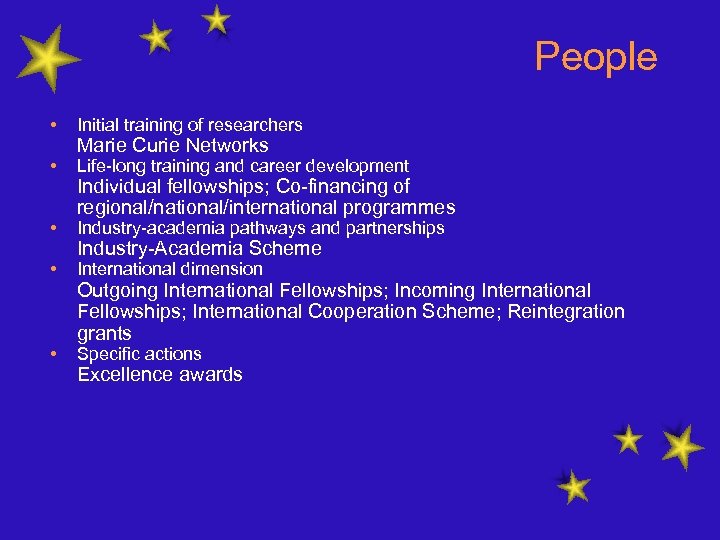
People • Initial training of researchers • Life-long training and career development • • • Marie Curie Networks Individual fellowships; Co-financing of regional/national/international programmes Industry-academia pathways and partnerships Industry-Academia Scheme International dimension Outgoing International Fellowships; Incoming International Fellowships; International Cooperation Scheme; Reintegration grants Specific actions Excellence awards
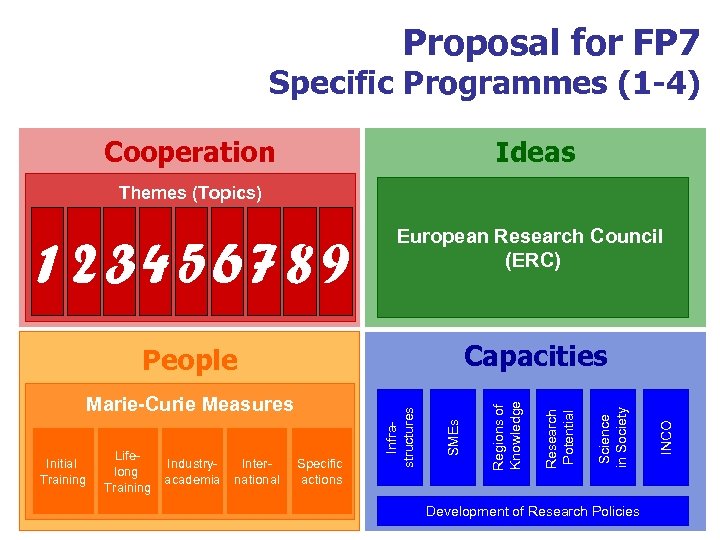
Proposal for FP 7 Specific Programmes (1 -4) Cooperation Ideas Themes (Topics) Industryacademia International Specific actions Development of Research Policies INCO Lifelong Training Science in Society Initial Training Research Potential Marie-Curie Measures Regions of Knowledge Capacities SMEs People Infrastructures 1 2 34 5 6 7 8 9 European Research Council (ERC)
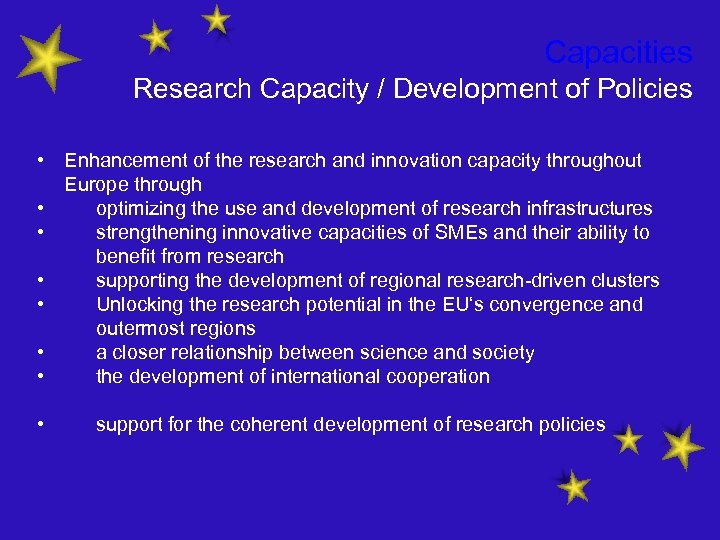
Capacities Research Capacity / Development of Policies • Enhancement of the research and innovation capacity throughout Europe through • optimizing the use and development of research infrastructures • strengthening innovative capacities of SMEs and their ability to benefit from research • supporting the development of regional research-driven clusters • Unlocking the research potential in the EU‘s convergence and outermost regions • a closer relationship between science and society • the development of international cooperation • support for the coherent development of research policies
Capacities
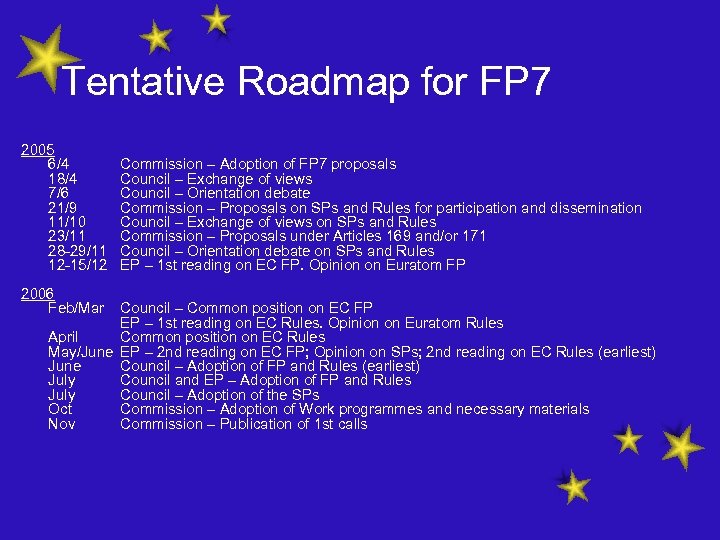
Tentative Roadmap for FP 7 2005 6/4 18/4 7/6 21/9 11/10 23/11 28 -29/11 12 -15/12 2006 Feb/Mar Commission – Adoption of FP 7 proposals Council – Exchange of views Council – Orientation debate Commission – Proposals on SPs and Rules for participation and dissemination Council – Exchange of views on SPs and Rules Commission – Proposals under Articles 169 and/or 171 Council – Orientation debate on SPs and Rules EP – 1 st reading on EC FP. Opinion on Euratom FP Council – Common position on EC FP EP – 1 st reading on EC Rules. Opinion on Euratom Rules April Common position on EC Rules May/June EP – 2 nd reading on EC FP; Opinion on SPs; 2 nd reading on EC Rules (earliest) June Council – Adoption of FP and Rules (earliest) July Council and EP – Adoption of FP and Rules July Council – Adoption of the SPs Oct Commission – Adoption of Work programmes and necessary materials Nov Commission – Publication of 1 st calls
Preparing for FP 7 - Partner Search -
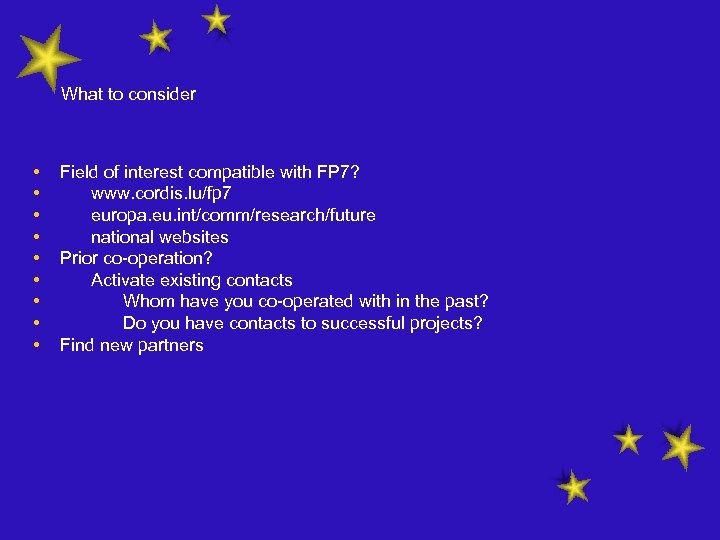
What to consider • • • Field of interest compatible with FP 7? www. cordis. lu/fp 7 europa. eu. int/comm/research/future national websites Prior co-operation? Activate existing contacts Whom have you co-operated with in the past? Do you have contacts to successful projects? Find new partners

Where to look • Expressions of Interest Database eoi. cordis. lu
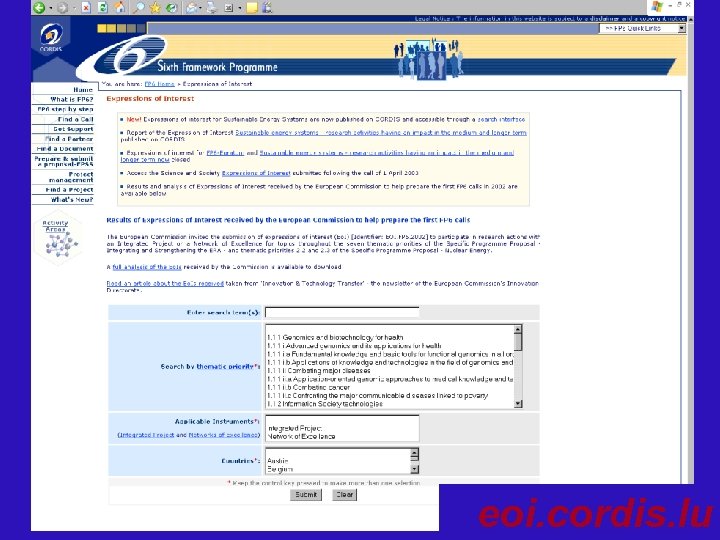
eoi. cordis. lu

Where to look • Expressions of Interest Database eoi. cordis. lu • CORDIS Partners partners-service. cordis. lu
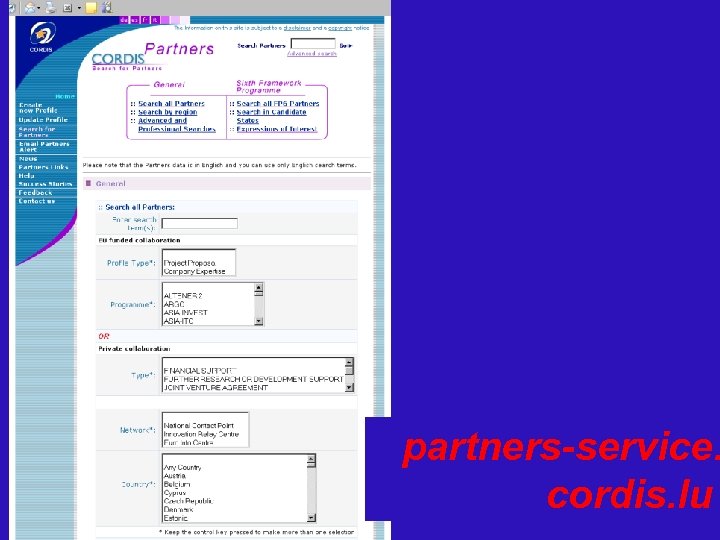
partners-service. cordis. lu
Where to look • Expressions of Interest Database eoi. cordis. lu • CORDIS Partners partners-service. cordis. lu • CORDIS Project Database: “Find a project” www. cordis. lu/fp 6/projects. htm
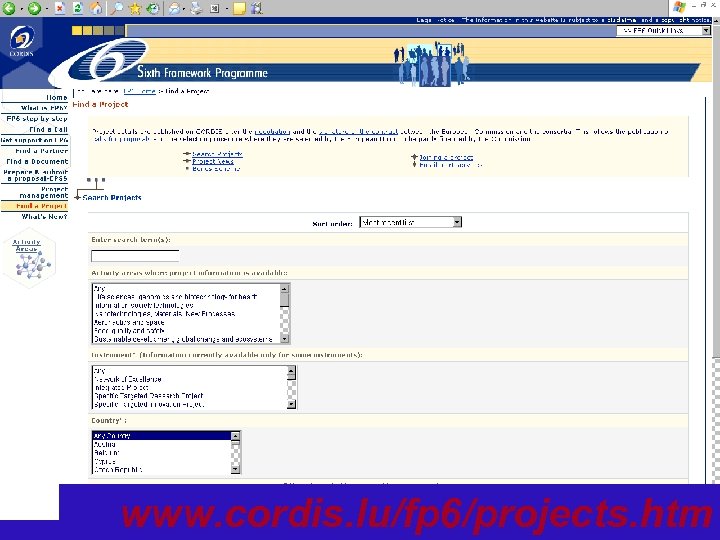
www. cordis. lu/fp 6/projects. htm
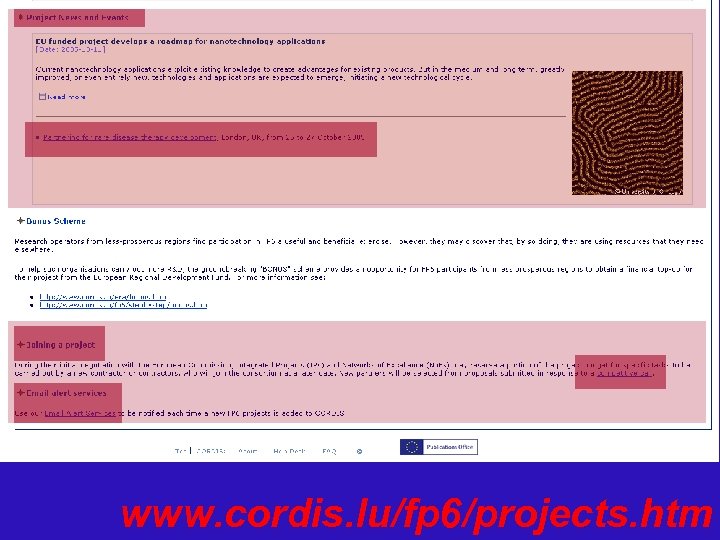
www. cordis. lu/fp 6/projects. htm
Keep yourself informed Official web sites: www. cordis. lu/fp 7 http: //europa. eu. int/comm/research/future/index_en. html Daily news: www. cordis. lu/news/ www. cordis. lu/rapidus/
Keep yourself informed Monthly magazines and e-news: CORDIS Focus http: //www. cordis. lu/focus/ R&D organisations located in Brussels www. iglortd. org EU R&D associations www. hyperion. ie/euassociations. htm Research in Europe www. research. com
Keep yourself informed Other information sources: Presentations by EU officials at different events www. cordis. lu/fp 6/ncps. htm Register for access at: www. ipr-helpdesk. org Best ways: become an evaluator participate in thematic networks, confrences etc
Expected simplification of the whole FP system • introduction of a database of legal, financial and administrative information • minimisation of administrative and financial regulations • extended use of lump sum financing • simplified rules for participation and minimisation of paper work • reduction of time between the opening of negotiations and the effective entry into force of contracts • full operational autonomy to project consortiums • simplification of reporting procedure
Expected simplification of the whole FP system • • rationalisation and simplification of information materials two stage submission procedure will be extended to all calls removal of need for complex cost reporting models simplification of framework of Community’s financial contribution and clear definition of eligible and non-eligible costs • systematic use of electronic tools for proposal submission, contract negotiations and submission of periodic and final reports
What’s new ? Main new elements compared to FP 6: • Longer duration, more flexible implementation • Annual budget doubled (EUR 5 billion ► 7. 2 billion) • Basic research (~ EUR 1. 5 billion per year) • Simplification of procedures • Logistical and administrative tasks to be transferred to external structures • Multi-financed large-scale initiatives
What’s new ? • • Frontier research – European Researc Council Technology platforms+ joint technology initiatives Financial support to new infrastructures (23 planned) Marie Curie grants (coordination of EU/national/ regional ressources) ERA-NET Plus innovation part of FP 6 will be moved to competitiveness and innovation programme new topic – security and space

Please note… … that the CORDIS-Server has changed its address to:

Thank you for your attention!
Скачать презентацию Introduction to FP 7 Vlado Bužek Budmerice December
3289956158862a82b8f1efcfb59e1d27.ppt