


 Скачать презентацию Introduction to FP 7 Grant Agreements and Financial
9807b5d655c3df7862329faa019d037c.ppt
- Количество слайдов: 95
 Introduction to FP 7: Grant Agreements and Financial Issues University of Bristol 19 May 2011 Emma Carey emma. carey@bbsrc. ac. uk http: //www. ukro. ac. uk
 Arts and Humanities Research Council Biotechnology and Biological Sciences Research Council UK Research Office Economic and Social Research Council 2 Engineering and Physical Sciences Research Council Medical Research Council Natural Environment Research Council Science and Technology Facilities Council
 UKRO’s Aim UK Research Office …promotes effective UK participation in EU-funded research, innovation and higher education programmes, and other related activities… Based in Brussels, UKRO: Provides early insight and briefing; • Disseminates EU funding opportunities; • Provides high quality guidance and training; • Exchanges information between the UK and EU
 UKRO Services include • Website: • with information on programmes, FAQs & guidance http: //www. ukro. ac. uk • Information services UK Research Office • e-mail updates (& searchable database) http: //ims. ukro. ac. uk • • Enquiry service Annual visit from your UKRO European Advisor Specialist training courses and information events Annual conference for European officers • Meeting room in Brussels • Monthly publication - British Council ‘European RTD Insight’ • National Contact Points (Marie Curie and ERC)
 FP 7 Overview, Eligible Countries, and Grant Cycle
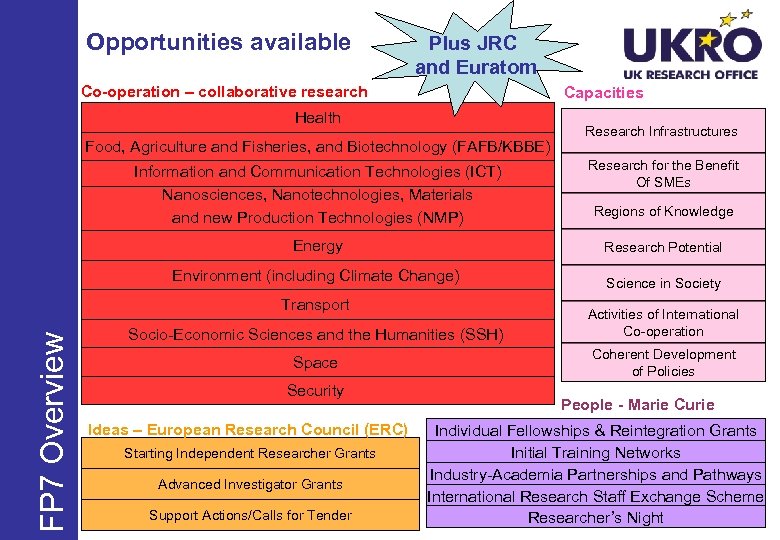 Opportunities available Plus JRC and Euratom Co-operation – collaborative research Capacities Health Food, Agriculture and Fisheries, and Biotechnology (FAFB/KBBE) Research Infrastructures Information and Communication Technologies (ICT) Nanosciences, Nanotechnologies, Materials and new Production Technologies (NMP) Research for the Benefit Of SMEs Energy Research Potential Environment (including Climate Change) Science in Society FP 7 Overview Transport Socio-Economic Sciences and the Humanities (SSH) Space Security Ideas – European Research Council (ERC) Starting Independent Researcher Grants Advanced Investigator Grants Support Actions/Calls for Tender Regions of Knowledge Activities of International Co-operation Coherent Development of Policies People - Marie Curie Individual Fellowships & Reintegration Grants Initial Training Networks Industry-Academia Partnerships and Pathways International Research Staff Exchange Scheme Researcher’s Night
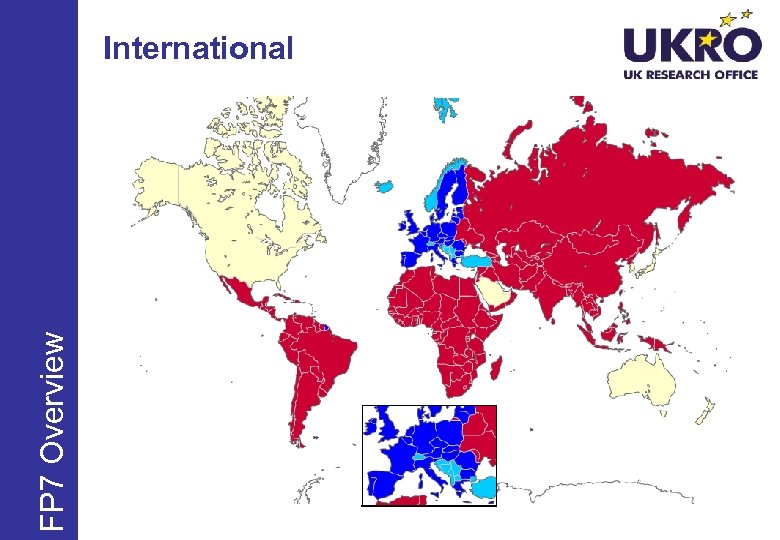
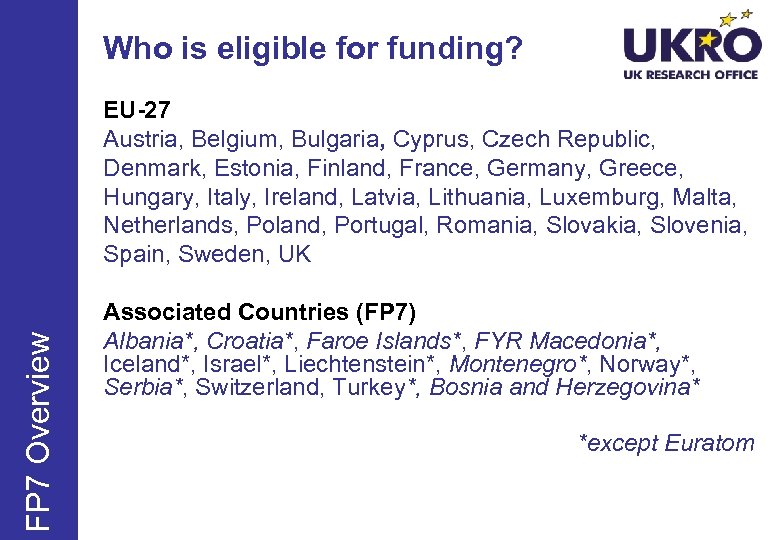 Who is eligible for funding? FP 7 Overview EU-27 Austria, Belgium, Bulgaria, Cyprus, Czech Republic, Denmark, Estonia, Finland, France, Germany, Greece, Hungary, Italy, Ireland, Latvia, Lithuania, Luxemburg, Malta, Netherlands, Poland, Portugal, Romania, Slovakia, Slovenia, Spain, Sweden, UK Associated Countries (FP 7) Albania*, Croatia*, Faroe Islands*, FYR Macedonia*, Iceland*, Israel*, Liechtenstein*, Montenegro*, Norway*, Serbia*, Switzerland, Turkey*, Bosnia and Herzegovina* *except Euratom
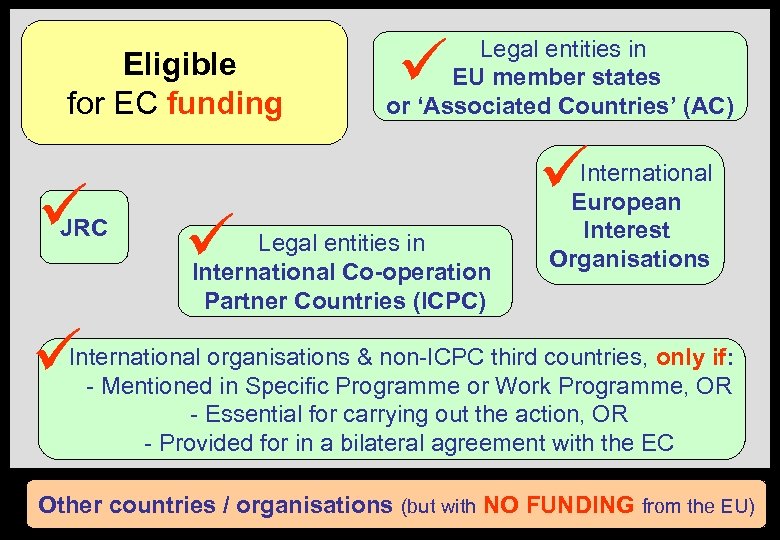 Eligible for EC funding JRC Legal entities in EU member states or ‘Associated Countries’ (AC) Legal entities in International Co-operation Partner Countries (ICPC) International European Interest Organisations International organisations & non-ICPC third countries, only if: - Mentioned in Specific Programme or Work Programme, OR - Essential for carrying out the action, OR - Provided for in a bilateral agreement with the EC Other countries / organisations (but with NO FUNDING from the EU)
 FP 7 Overview International
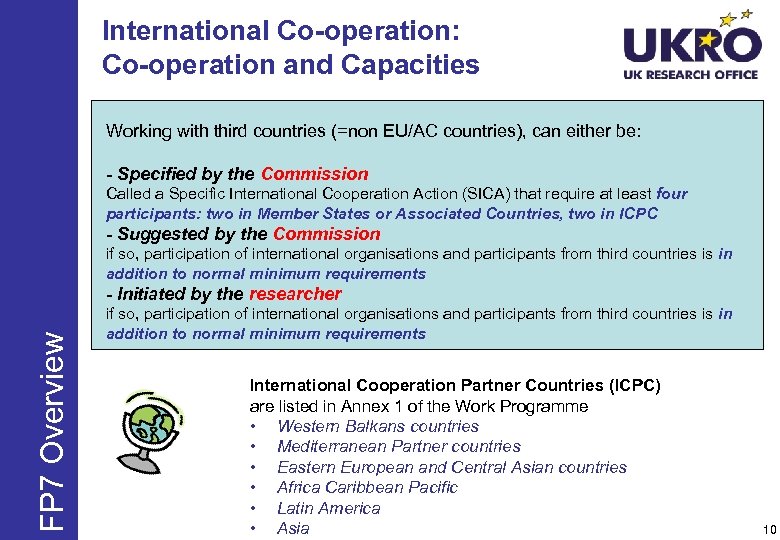 International Co-operation: Co-operation and Capacities Working with third countries (=non EU/AC countries), can either be: - Specified by the Commission Called a Specific International Cooperation Action (SICA) that require at least four participants: two in Member States or Associated Countries, two in ICPC - Suggested by the Commission if so, participation of international organisations and participants from third countries is in addition to normal minimum requirements FP 7 Overview - Initiated by the researcher if so, participation of international organisations and participants from third countries is in addition to normal minimum requirements International Cooperation Partner Countries (ICPC) are listed in Annex 1 of the Work Programme • Western Balkans countries • Mediterranean Partner countries • Eastern European and Central Asian countries • Africa Caribbean Pacific • Latin America • Asia 10
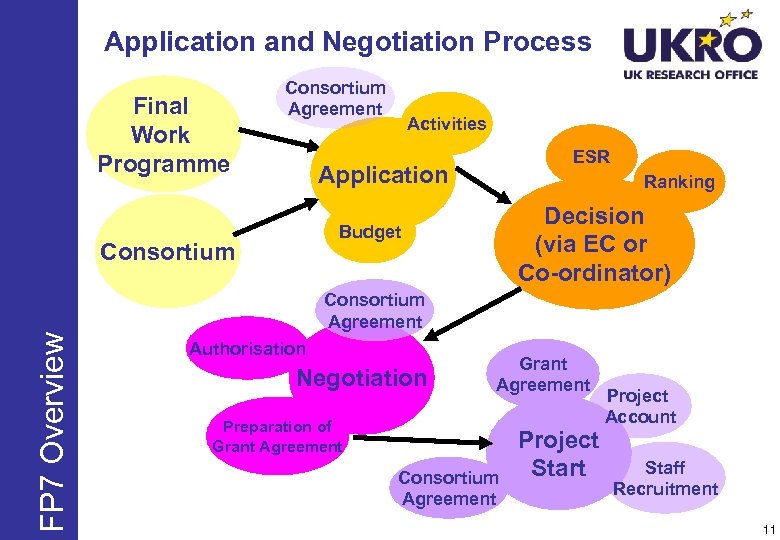 Application and Negotiation Process Final Work Programme Consortium Agreement Activities ESR Application Ranking Decision (via EC or Co-ordinator) Budget Consortium FP 7 Overview Consortium Agreement Authorisation Negotiation Grant Agreement Preparation of Grant Agreement Consortium Agreement Project Start Project Account Staff Recruitment 11
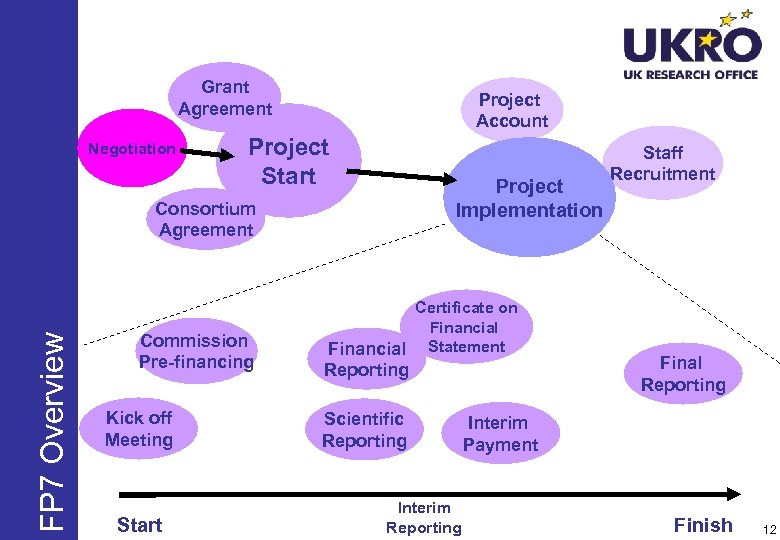 Grant Agreement Negotiation Project Account Project Start Project Implementation FP 7 Overview Consortium Agreement Commission Pre-financing Kick off Meeting Start Certificate on Financial Statement Reporting Scientific Reporting Interim Reporting Staff Recruitment Final Reporting Interim Payment Finish 12
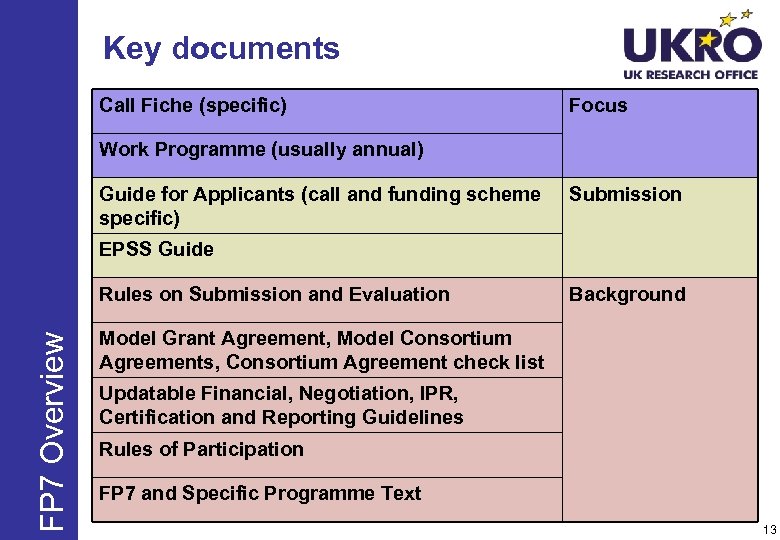 Key documents Call Fiche (specific) Focus Work Programme (usually annual) Guide for Applicants (call and funding scheme specific) Submission EPSS Guide FP 7 Overview Rules on Submission and Evaluation Background Model Grant Agreement, Model Consortium Agreements, Consortium Agreement check list Updatable Financial, Negotiation, IPR, Certification and Reporting Guidelines Rules of Participation FP 7 and Specific Programme Text 13
 Introduction to FP 7 Finances
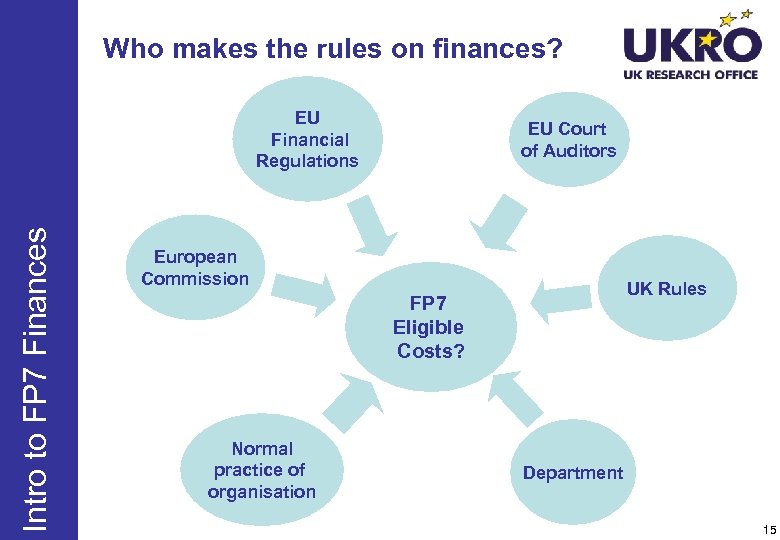 Who makes the rules on finances? Intro to FP 7 Finances EU Financial Regulations EU Court of Auditors European Commission UK Rules FP 7 Eligible Costs? Normal practice of organisation Department 15
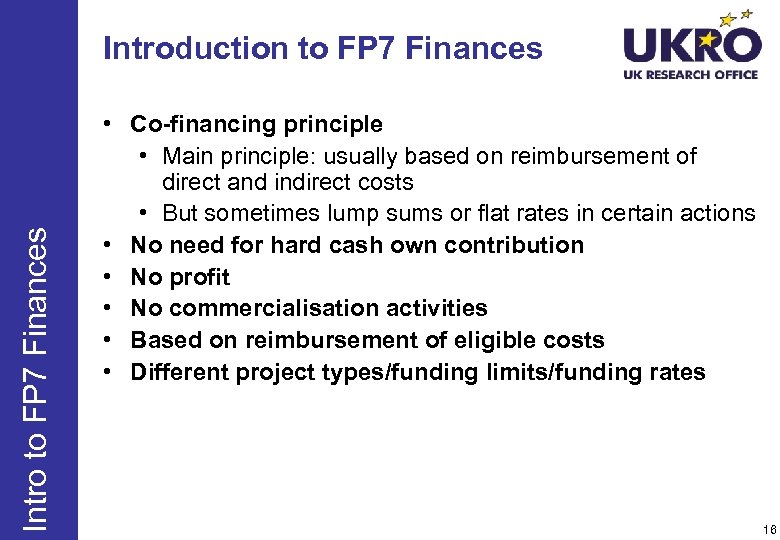 Intro to FP 7 Finances Introduction to FP 7 Finances • Co-financing principle • Main principle: usually based on reimbursement of direct and indirect costs • But sometimes lump sums or flat rates in certain actions • No need for hard cash own contribution • No profit • No commercialisation activities • Based on reimbursement of eligible costs • Different project types/funding limits/funding rates 16
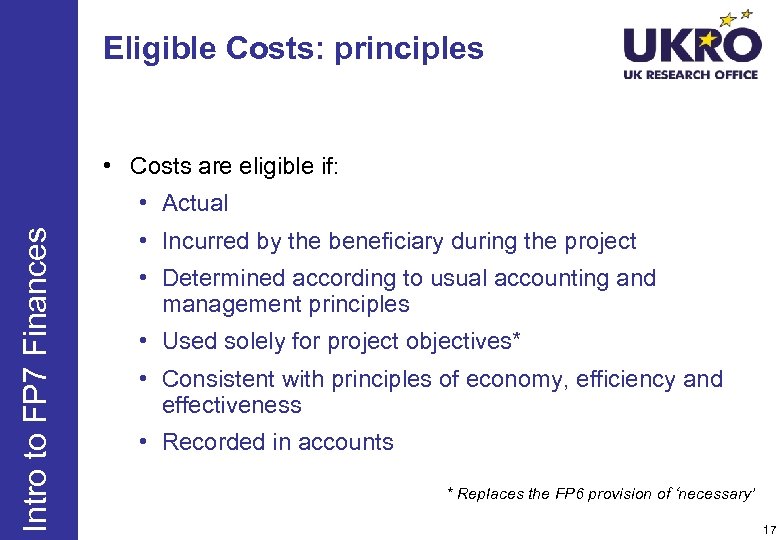 Eligible Costs: principles • Costs are eligible if: Intro to FP 7 Finances • Actual • Incurred by the beneficiary during the project • Determined according to usual accounting and management principles • Used solely for project objectives* • Consistent with principles of economy, efficiency and effectiveness • Recorded in accounts * Replaces the FP 6 provision of ‘necessary’ 17
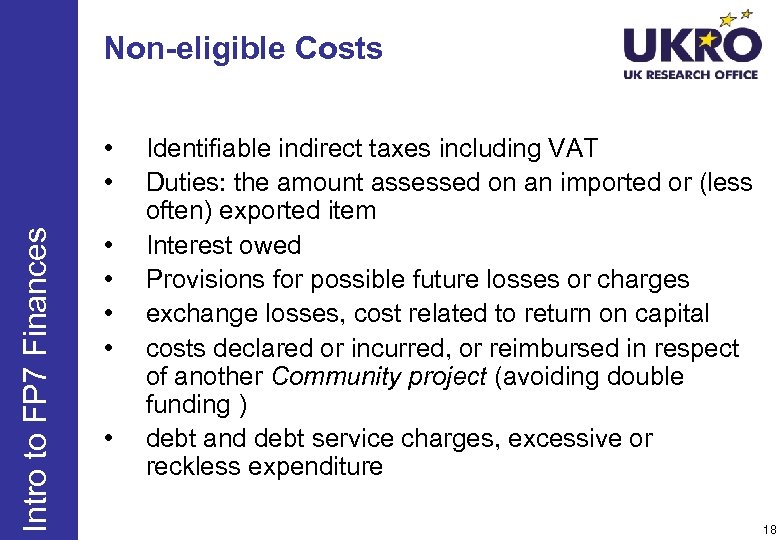 Non-eligible Costs Intro to FP 7 Finances • • Identifiable indirect taxes including VAT Duties: the amount assessed on an imported or (less often) exported item Interest owed Provisions for possible future losses or charges exchange losses, cost related to return on capital costs declared or incurred, or reimbursed in respect of another Community project (avoiding double funding ) debt and debt service charges, excessive or reckless expenditure 18
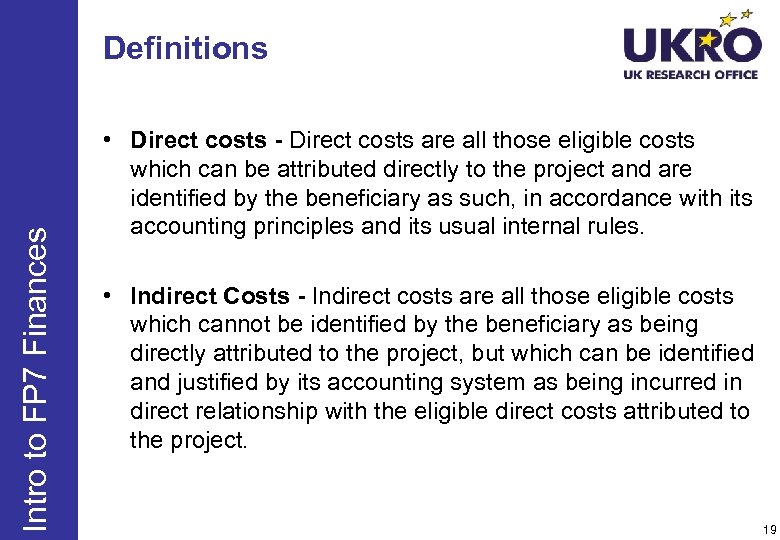 Intro to FP 7 Finances Definitions • Direct costs - Direct costs are all those eligible costs which can be attributed directly to the project and are identified by the beneficiary as such, in accordance with its accounting principles and its usual internal rules. • Indirect Costs - Indirect costs are all those eligible costs which cannot be identified by the beneficiary as being directly attributed to the project, but which can be identified and justified by its accounting system as being incurred in direct relationship with the eligible direct costs attributed to the project. 19
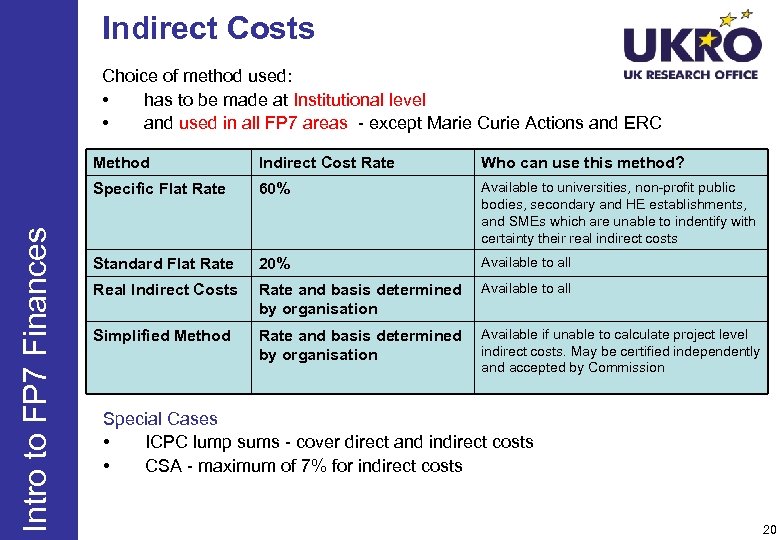 Indirect Costs Choice of method used: • has to be made at Institutional level • and used in all FP 7 areas - except Marie Curie Actions and ERC Indirect Cost Rate Who can use this method? Specific Flat Rate Intro to FP 7 Finances Method 60% Available to universities, non-profit public bodies, secondary and HE establishments, and SMEs which are unable to indentify with certainty their real indirect costs Standard Flat Rate 20% Available to all Real Indirect Costs Rate and basis determined by organisation Available to all Simplified Method Rate and basis determined by organisation Available if unable to calculate project level indirect costs. May be certified independently and accepted by Commission Special Cases • ICPC lump sums - cover direct and indirect costs • CSA - maximum of 7% for indirect costs 20
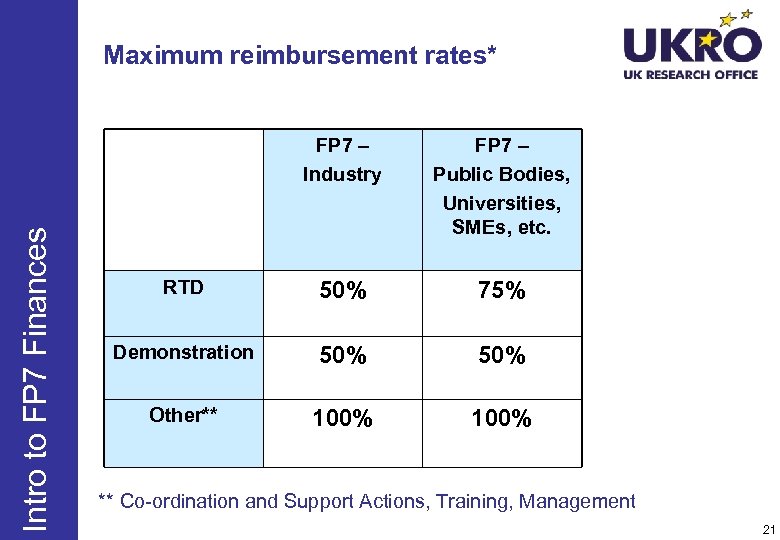 Maximum reimbursement rates* Intro to FP 7 Finances FP 7 – Industry FP 7 – Public Bodies, Universities, SMEs, etc. RTD 50% 75% Demonstration 50% Other** 100% ** Co-ordination and Support Actions, Training, Management 21
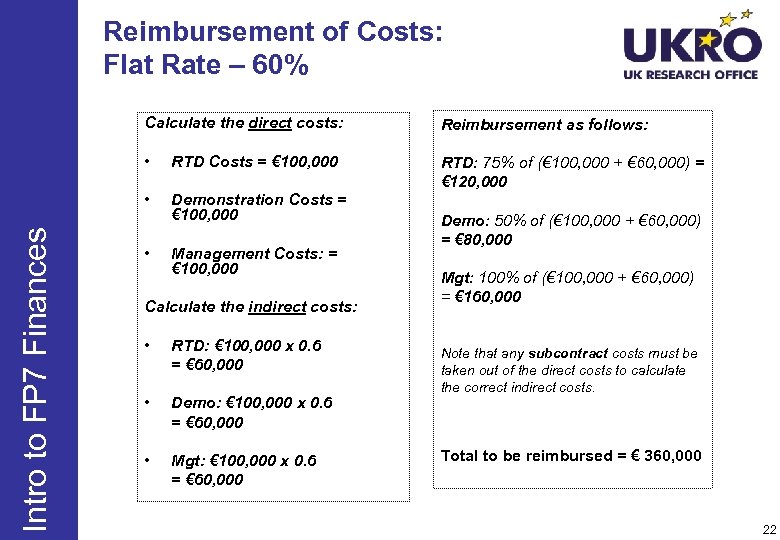 Reimbursement of Costs: Flat Rate – 60% Reimbursement as follows: • RTD Costs = € 100, 000 • Intro to FP 7 Finances Calculate the direct costs: Demonstration Costs = € 100, 000 RTD: 75% of (€ 100, 000 + € 60, 000) = € 120, 000 • Management Costs: = € 100, 000 Calculate the indirect costs: • RTD: € 100, 000 x 0. 6 = € 60, 000 • Demo: € 100, 000 x 0. 6 = € 60, 000 • Mgt: € 100, 000 x 0. 6 = € 60, 000 Demo: 50% of (€ 100, 000 + € 60, 000) = € 80, 000 Mgt: 100% of (€ 100, 000 + € 60, 000) = € 160, 000 Note that any subcontract costs must be taken out of the direct costs to calculate the correct indirect costs. Total to be reimbursed = € 360, 000 22
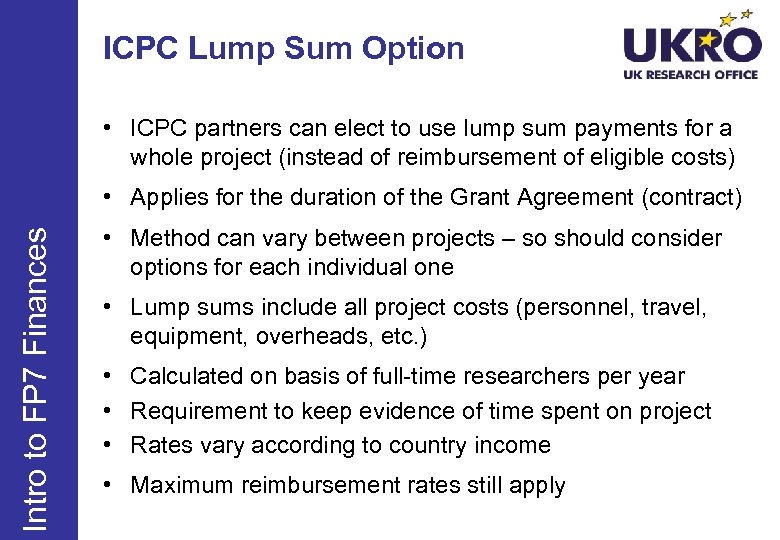 ICPC Lump Sum Option • ICPC partners can elect to use lump sum payments for a whole project (instead of reimbursement of eligible costs) Intro to FP 7 Finances • Applies for the duration of the Grant Agreement (contract) • Method can vary between projects – so should consider options for each individual one • Lump sums include all project costs (personnel, travel, equipment, overheads, etc. ) • Calculated on basis of full-time researchers per year • Requirement to keep evidence of time spent on project • Rates vary according to country income • Maximum reimbursement rates still apply
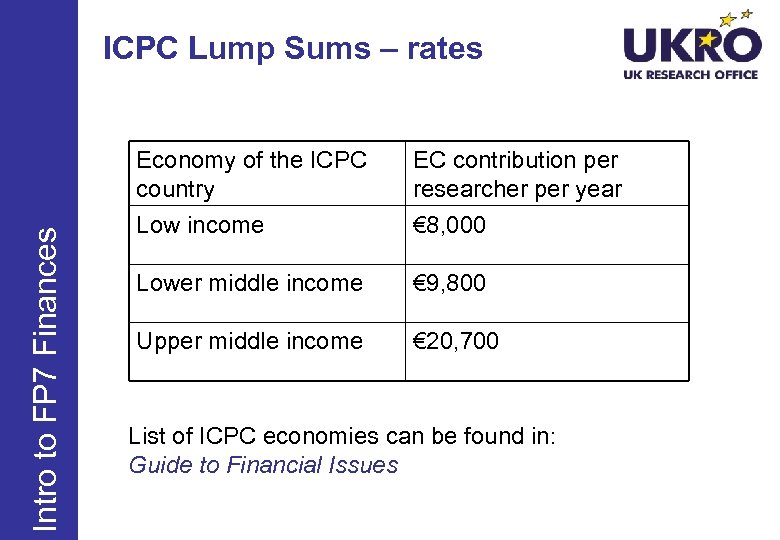 ICPC Lump Sums – rates Intro to FP 7 Finances Economy of the ICPC country EC contribution per researcher per year Low income € 8, 000 Lower middle income € 9, 800 Upper middle income € 20, 700 List of ICPC economies can be found in: Guide to Financial Issues
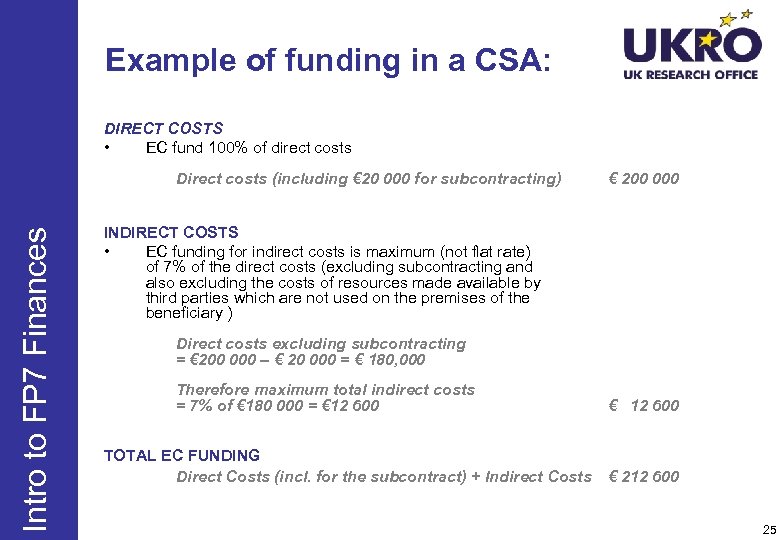 Example of funding in a CSA: DIRECT COSTS • EC fund 100% of direct costs Intro to FP 7 Finances Direct costs (including € 20 000 for subcontracting) € 200 000 INDIRECT COSTS • EC funding for indirect costs is maximum (not flat rate) of 7% of the direct costs (excluding subcontracting and also excluding the costs of resources made available by third parties which are not used on the premises of the beneficiary ) Direct costs excluding subcontracting = € 200 000 – € 20 000 = € 180, 000 Therefore maximum total indirect costs = 7% of € 180 000 = € 12 600 TOTAL EC FUNDING Direct Costs (incl. for the subcontract) + Indirect Costs € 212 600 25
 Participant Portal
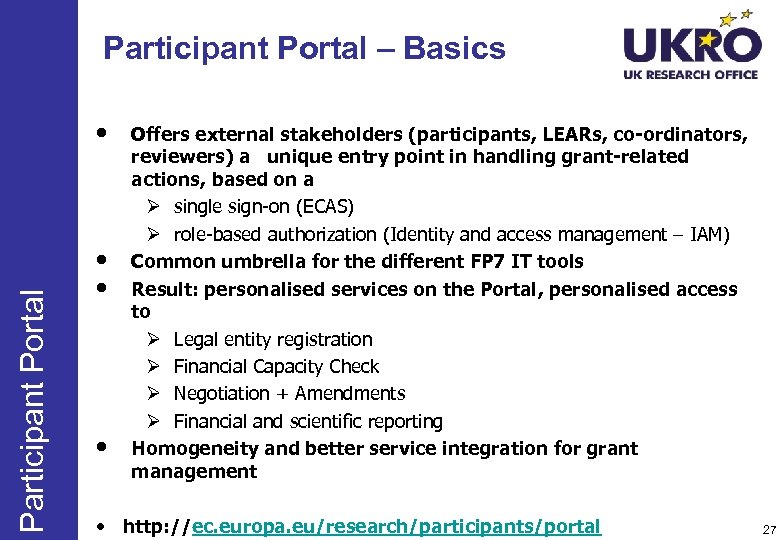 Participant Portal – Basics Participant Portal • • Offers external stakeholders (participants, LEARs, co-ordinators, reviewers) a unique entry point in handling grant-related actions, based on a Ø single sign-on (ECAS) Ø role-based authorization (Identity and access management – IAM) Common umbrella for the different FP 7 IT tools Result: personalised services on the Portal, personalised access to Ø Legal entity registration Ø Financial Capacity Check Ø Negotiation + Amendments Ø Financial and scientific reporting Homogeneity and better service integration for grant management • http: //ec. europa. eu/research/participants/portal 27
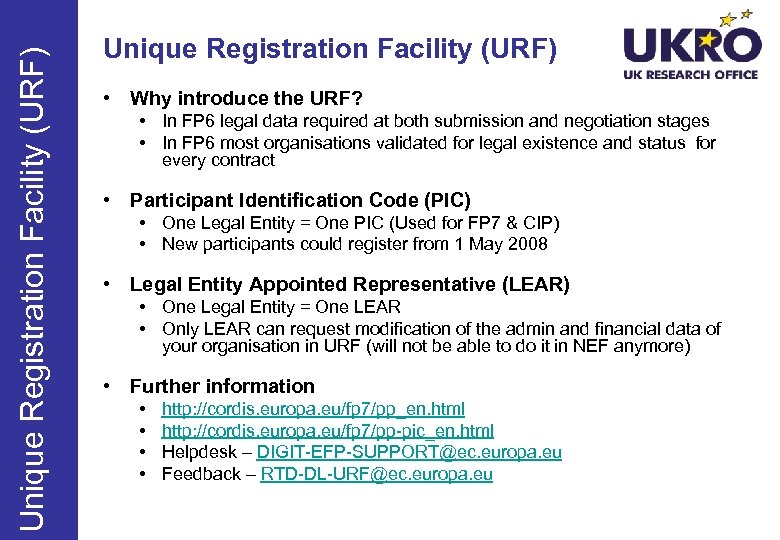 Unique Registration Facility (URF) • Why introduce the URF? • In FP 6 legal data required at both submission and negotiation stages • In FP 6 most organisations validated for legal existence and status for every contract • Participant Identification Code (PIC) • One Legal Entity = One PIC (Used for FP 7 & CIP) • New participants could register from 1 May 2008 • Legal Entity Appointed Representative (LEAR) • One Legal Entity = One LEAR • Only LEAR can request modification of the admin and financial data of your organisation in URF (will not be able to do it in NEF anymore) • Further information • • http: //cordis. europa. eu/fp 7/pp_en. html http: //cordis. europa. eu/fp 7/pp-pic_en. html Helpdesk – DIGIT-EFP-SUPPORT@ec. europa. eu Feedback – RTD-DL-URF@ec. europa. eu
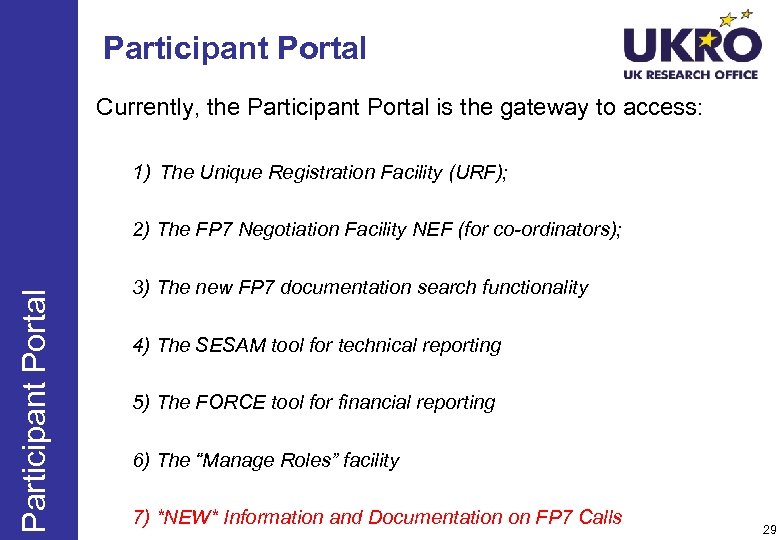 Participant Portal Currently, the Participant Portal is the gateway to access: 1) The Unique Registration Facility (URF); Participant Portal 2) The FP 7 Negotiation Facility NEF (for co-ordinators); 3) The new FP 7 documentation search functionality 4) The SESAM tool for technical reporting 5) The FORCE tool for financial reporting 6) The “Manage Roles” facility 7) *NEW* Information and Documentation on FP 7 Calls 29
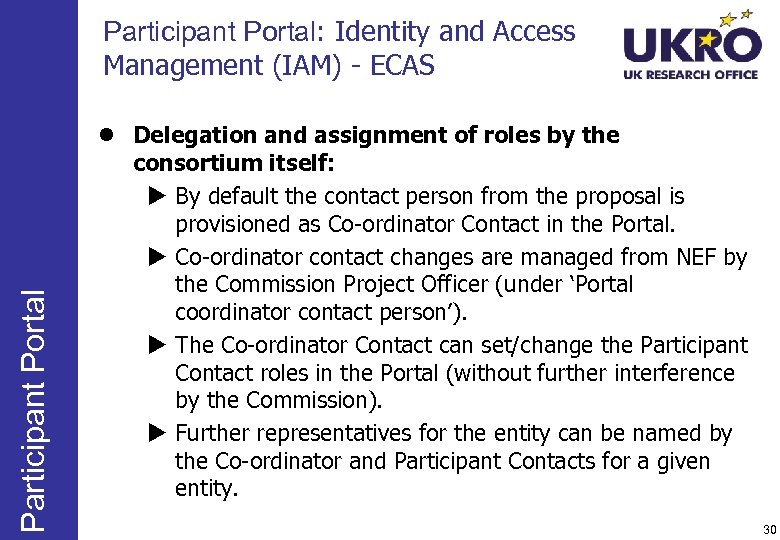 Participant Portal: Identity and Access Management (IAM) - ECAS Participant Portal ● Delegation and assignment of roles by the consortium itself: u By default the contact person from the proposal is provisioned as Co-ordinator Contact in the Portal. u Co-ordinator contact changes are managed from NEF by the Commission Project Officer (under ‘Portal coordinator contact person’). u The Co-ordinator Contact can set/change the Participant Contact roles in the Portal (without further interference by the Commission). u Further representatives for the entity can be named by the Co-ordinator and Participant Contacts for a given entity. 30
 Project Stages
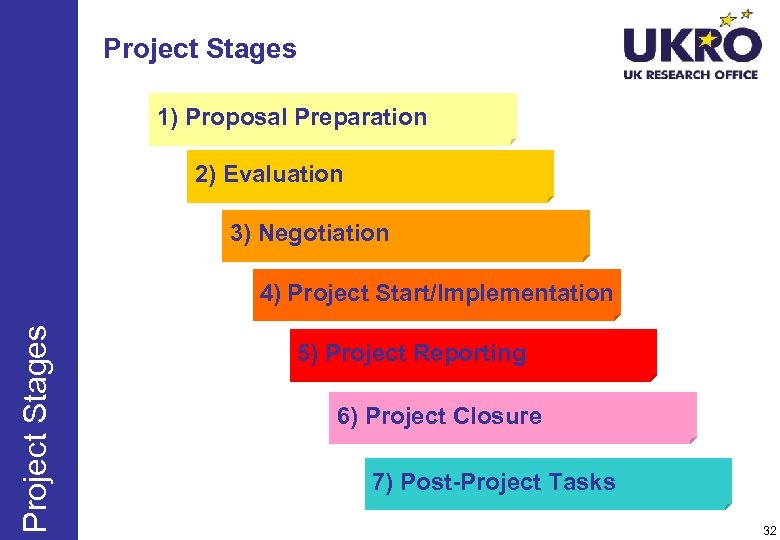 Project Stages 1) Proposal Preparation 2) Evaluation 3) Negotiation Project Stages 4) Project Start/Implementation 5) Project Reporting 6) Project Closure 7) Post-Project Tasks 32
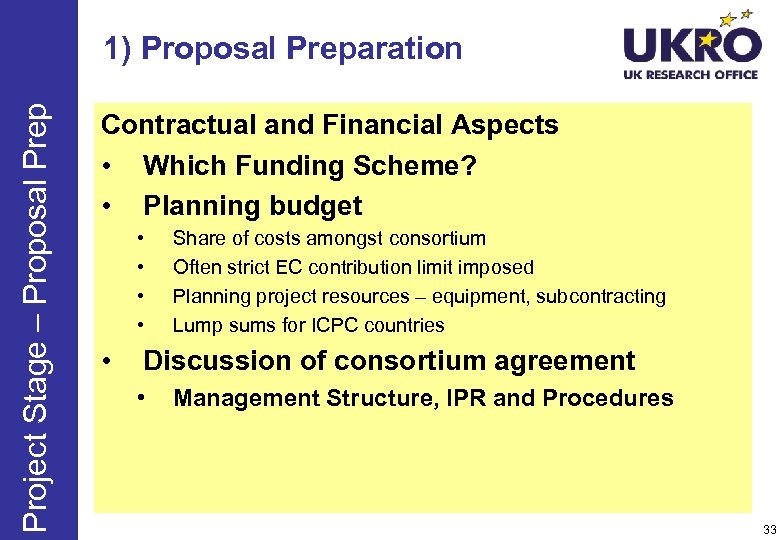 Project Stage – Proposal Prep 1) Proposal Preparation Contractual and Financial Aspects • Which Funding Scheme? • Planning budget • • • Share of costs amongst consortium Often strict EC contribution limit imposed Planning project resources – equipment, subcontracting Lump sums for ICPC countries Discussion of consortium agreement • Management Structure, IPR and Procedures 33
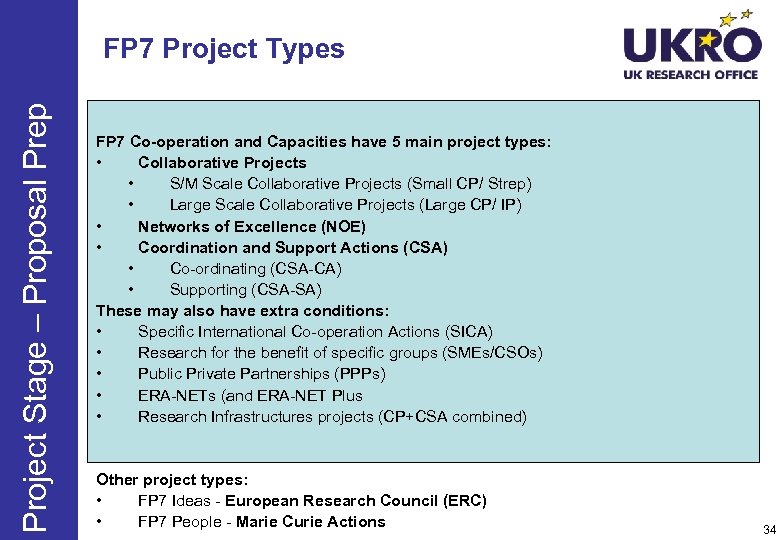 Project Stage – Proposal Prep FP 7 Project Types FP 7 Co-operation and Capacities have 5 main project types: • Collaborative Projects • S/M Scale Collaborative Projects (Small CP/ Strep) • Large Scale Collaborative Projects (Large CP/ IP) • Networks of Excellence (NOE) • Coordination and Support Actions (CSA) • Co-ordinating (CSA-CA) • Supporting (CSA-SA) These may also have extra conditions: • Specific International Co-operation Actions (SICA) • Research for the benefit of specific groups (SMEs/CSOs) • Public Private Partnerships (PPPs) • ERA-NETs (and ERA-NET Plus • Research Infrastructures projects (CP+CSA combined) Other project types: • FP 7 Ideas - European Research Council (ERC) • FP 7 People - Marie Curie Actions 34
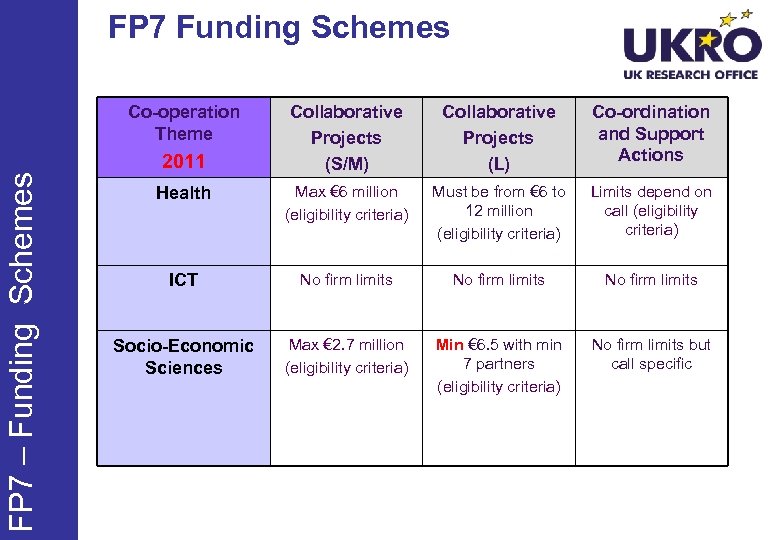 FP 7 Funding Schemes FP 7 – Funding Schemes Co-operation Theme Collaborative Projects (S/M) Collaborative Projects (L) Co-ordination and Support Actions Health Max € 6 million (eligibility criteria) Must be from € 6 to 12 million (eligibility criteria) Limits depend on call (eligibility criteria) ICT No firm limits Socio-Economic Sciences Max € 2. 7 million (eligibility criteria) Min € 6. 5 with min 7 partners (eligibility criteria) No firm limits but call specific 2011
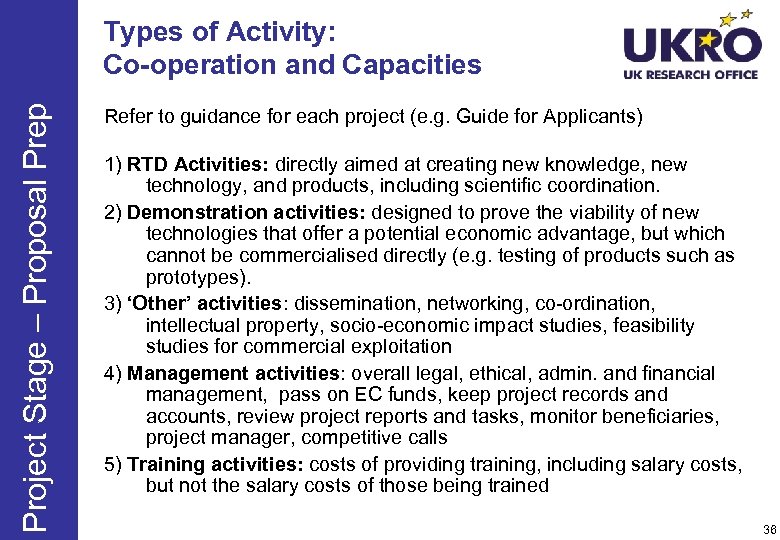 Project Stage – Proposal Prep Types of Activity: Co-operation and Capacities Refer to guidance for each project (e. g. Guide for Applicants) 1) RTD Activities: directly aimed at creating new knowledge, new technology, and products, including scientific coordination. 2) Demonstration activities: designed to prove the viability of new technologies that offer a potential economic advantage, but which cannot be commercialised directly (e. g. testing of products such as prototypes). 3) ‘Other’ activities: dissemination, networking, co-ordination, intellectual property, socio-economic impact studies, feasibility studies for commercial exploitation 4) Management activities: overall legal, ethical, admin. and financial management, pass on EC funds, keep project records and accounts, review project reports and tasks, monitor beneficiaries, project manager, competitive calls 5) Training activities: costs of providing training, including salary costs, but not the salary costs of those being trained 36
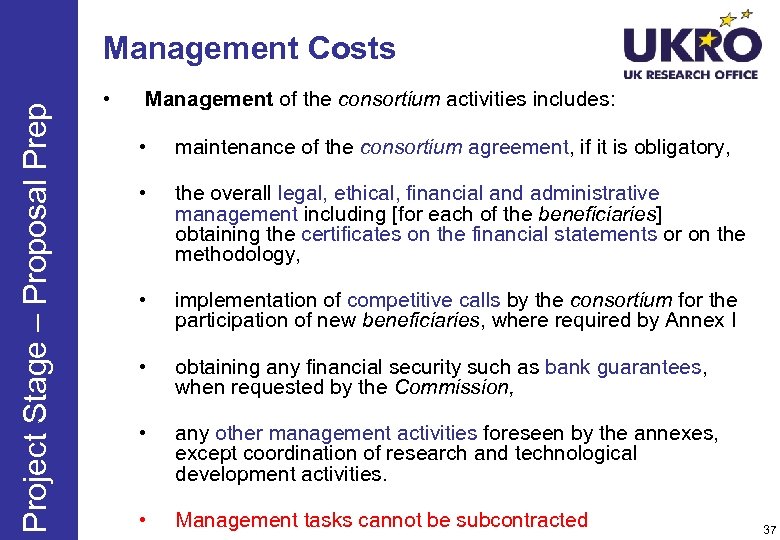 Project Stage – Proposal Prep Management Costs • Management of the consortium activities includes: • maintenance of the consortium agreement, if it is obligatory, • the overall legal, ethical, financial and administrative management including [for each of the beneficiaries] obtaining the certificates on the financial statements or on the methodology, • implementation of competitive calls by the consortium for the participation of new beneficiaries, where required by Annex I • obtaining any financial security such as bank guarantees, when requested by the Commission, • any other management activities foreseen by the annexes, except coordination of research and technological development activities. • Management tasks cannot be subcontracted 37
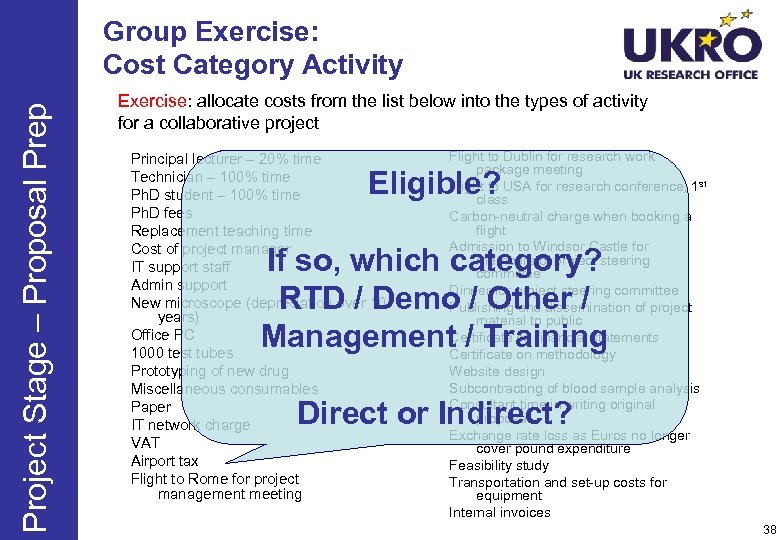 Project Stage – Proposal Prep Group Exercise: Cost Category Activity Exercise: allocate costs from the list below into the types of activity for a collaborative project Principal lecturer – 20% time Technician – 100% time Ph. D student – 100% time Ph. D fees Replacement teaching time Cost of project manager IT support staff Admin support New microscope (depreciation over 10 years) Office PC 1000 test tubes Prototyping of new drug Miscellaneous consumables Paper IT network charge VAT Airport tax Flight to Rome for project management meeting Flight to Dublin for research work package meeting Flight to USA for research conference, 1 st class Carbon-neutral charge when booking a flight Admission to Windsor Castle for members of project steering committee Dinner for project steering committee Publishing and dissemination of project material to public Certificate on financial statements Certificate on methodology Website design Subcontracting of blood sample analysis Consultant time in writing original proposal Exchange rate loss as Euros no longer cover pound expenditure Feasibility study Transportation and set-up costs for equipment Internal invoices Eligible? If so, which category? RTD / Demo / Other / Management / Training Direct or Indirect? 38
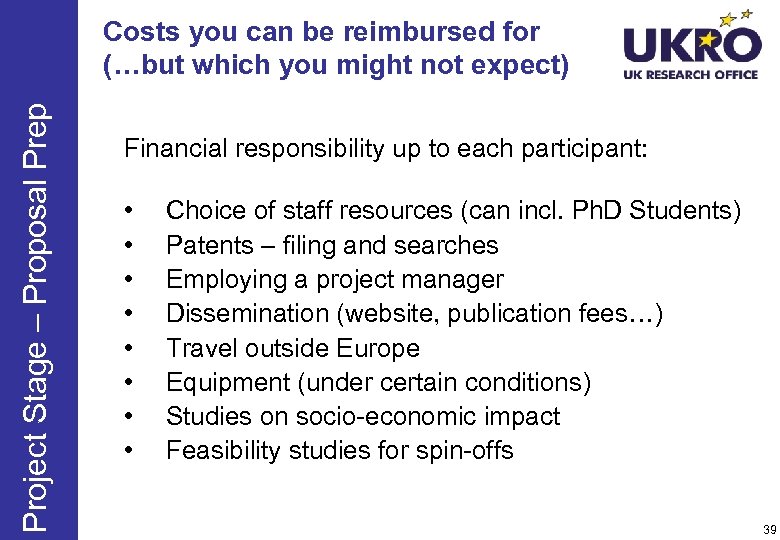 Project Stage – Proposal Prep Costs you can be reimbursed for (…but which you might not expect) Financial responsibility up to each participant: • • Choice of staff resources (can incl. Ph. D Students) Patents – filing and searches Employing a project manager Dissemination (website, publication fees…) Travel outside Europe Equipment (under certain conditions) Studies on socio-economic impact Feasibility studies for spin-offs 39
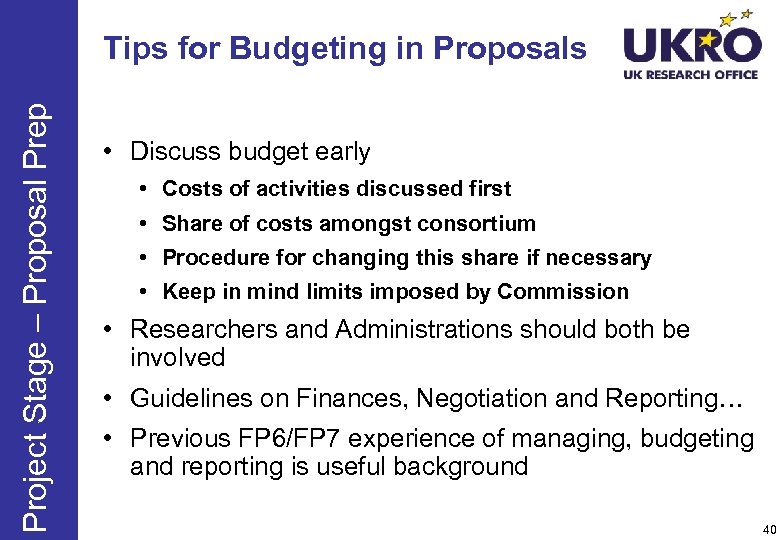 Project Stage – Proposal Prep Tips for Budgeting in Proposals • Discuss budget early • Costs of activities discussed first • Share of costs amongst consortium • Procedure for changing this share if necessary • Keep in mind limits imposed by Commission • Researchers and Administrations should both be involved • Guidelines on Finances, Negotiation and Reporting… • Previous FP 6/FP 7 experience of managing, budgeting and reporting is useful background 40
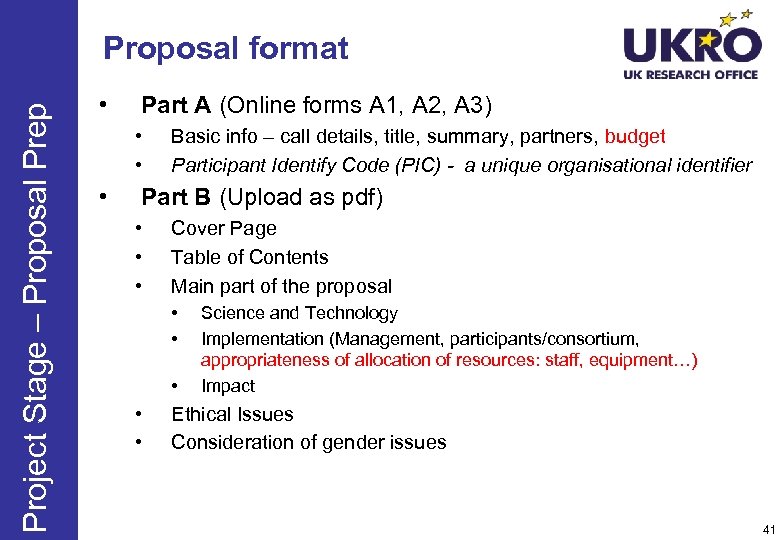 Project Stage – Proposal Prep Proposal format • Part A (Online forms A 1, A 2, A 3) • • • Basic info – call details, title, summary, partners, budget Participant Identify Code (PIC) - a unique organisational identifier Part B (Upload as pdf) • • • Cover Page Table of Contents Main part of the proposal • • • Science and Technology Implementation (Management, participants/consortium, appropriateness of allocation of resources: staff, equipment…) Impact Ethical Issues Consideration of gender issues 41
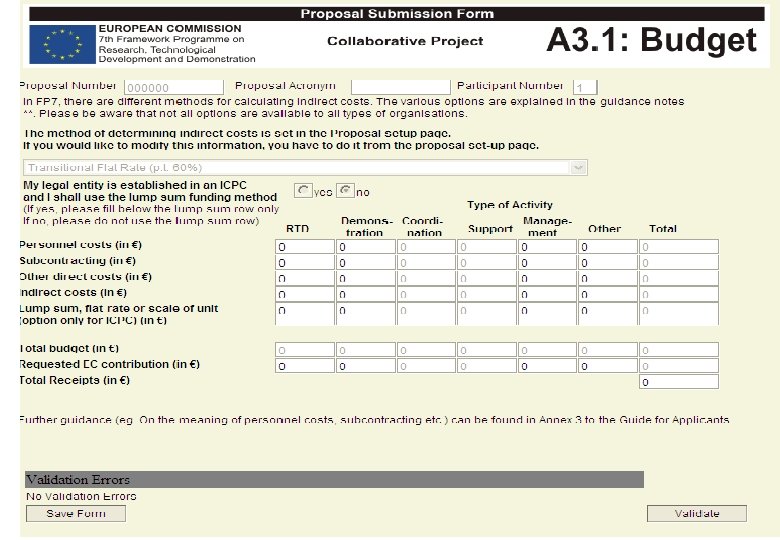 Establishing Projects EPSS A 3 Forms – Collaborative Project
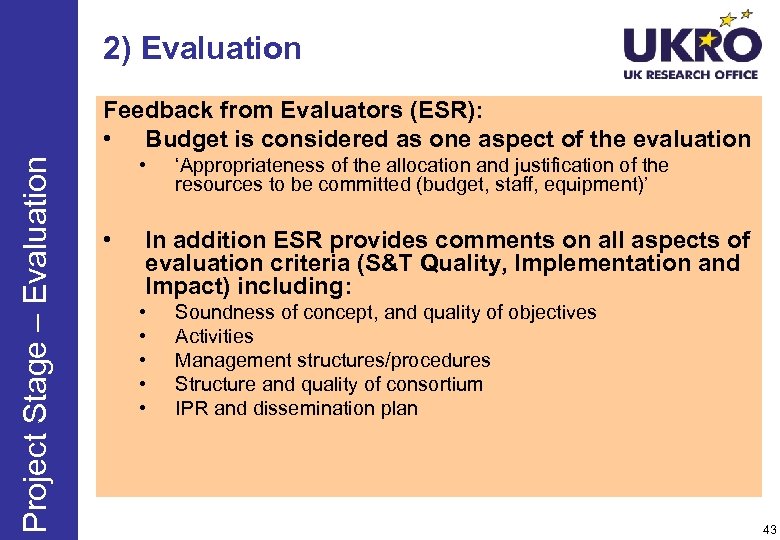 2) Evaluation Project Stage – Evaluation Feedback from Evaluators (ESR): • Budget is considered as one aspect of the evaluation • • ‘Appropriateness of the allocation and justification of the resources to be committed (budget, staff, equipment)’ In addition ESR provides comments on all aspects of evaluation criteria (S&T Quality, Implementation and Impact) including: • • • Soundness of concept, and quality of objectives Activities Management structures/procedures Structure and quality of consortium IPR and dissemination plan 43
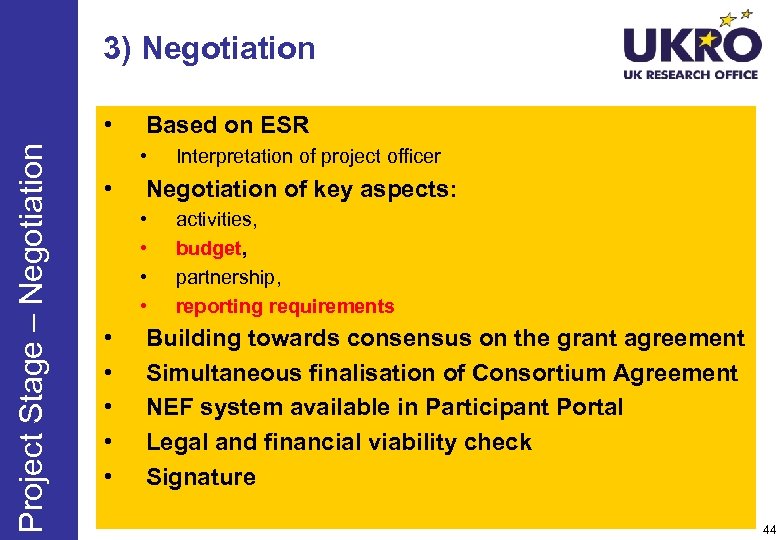 3) Negotiation Project Stage – Negotiation • Based on ESR • • Negotiation of key aspects: • • • Interpretation of project officer activities, budget, partnership, reporting requirements Building towards consensus on the grant agreement Simultaneous finalisation of Consortium Agreement NEF system available in Participant Portal Legal and financial viability check Signature 44
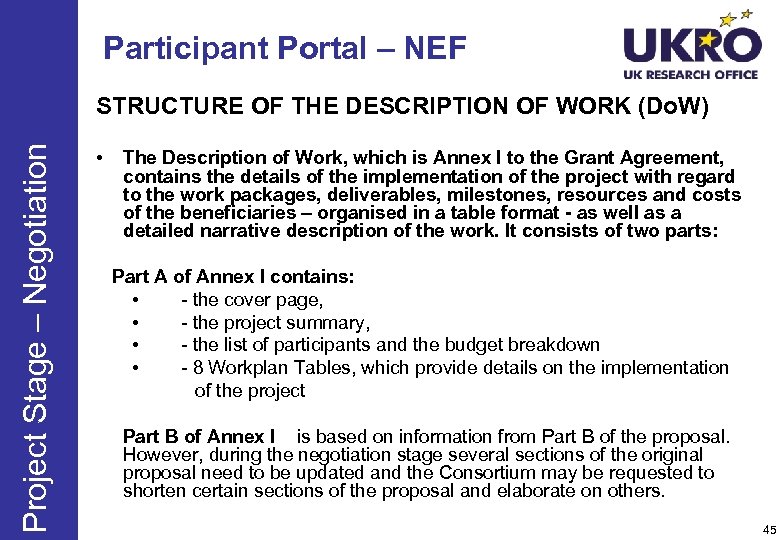 Participant Portal – NEF Project Stage – Negotiation STRUCTURE OF THE DESCRIPTION OF WORK (Do. W) • The Description of Work, which is Annex I to the Grant Agreement, contains the details of the implementation of the project with regard to the work packages, deliverables, milestones, resources and costs of the beneficiaries – organised in a table format - as well as a detailed narrative description of the work. It consists of two parts: Part A of Annex I contains: • - the cover page, • - the project summary, • - the list of participants and the budget breakdown • - 8 Workplan Tables, which provide details on the implementation of the project Part B of Annex I is based on information from Part B of the proposal. However, during the negotiation stage several sections of the original proposal need to be updated and the Consortium may be requested to shorten certain sections of the proposal and elaborate on others. 45
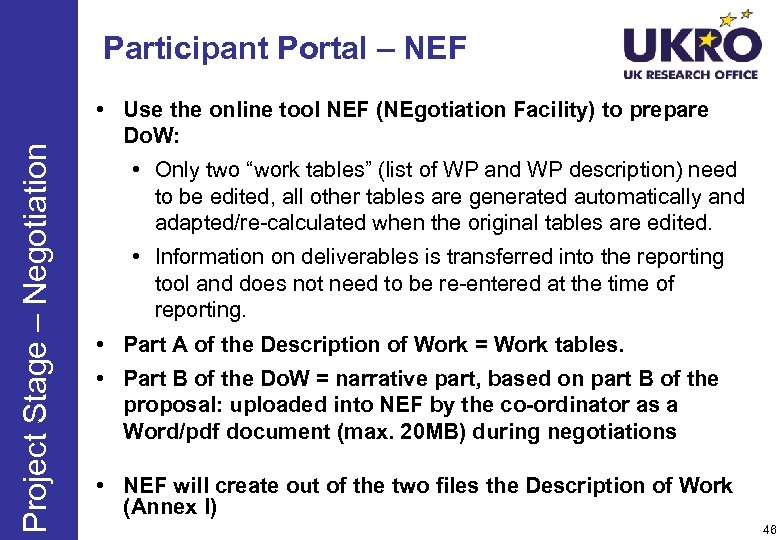 Project Stage – Negotiation Participant Portal – NEF • Use the online tool NEF (NEgotiation Facility) to prepare Do. W: • Only two “work tables” (list of WP and WP description) need to be edited, all other tables are generated automatically and adapted/re-calculated when the original tables are edited. • Information on deliverables is transferred into the reporting tool and does not need to be re-entered at the time of reporting. • Part A of the Description of Work = Work tables. • Part B of the Do. W = narrative part, based on part B of the proposal: uploaded into NEF by the co-ordinator as a Word/pdf document (max. 20 MB) during negotiations • NEF will create out of the two files the Description of Work (Annex I) 46
 Project Stage – Negotiation The negotiation process (1) The following forms need to be submitted to the EC Project Officer: 1) First drafts of Annex I to the Grant Agreement 2) Grant Agreement Preparation Forms (GPFs) via the NEF tool 3) Supporting documents that verify legal existence and status of beneficiaries (if you have no PIC) 4) Financial documents for financial viability checking (request is more than € 500, 000, done only once for each institution throughout FP 7) 47
 The negotiation process (2) Project Stage – Negotiation • EC Project Officer will indicate changes or improvements to the submitted forms • Consortium responds and negotiates with EC Project Officer until agreement is reached • Meetings between Consortium and EC may be required • Process should be concluded before deadline for completion of negotiations 48
 Important points to remember Project Stage – Negotiation • An invitation to start negotiation does not, under any circumstance, guarantee the funding of a project or the offer of a grant agreement. • The funding of the proposal may depend on the Consortium’s acceptance of changes requested by the Commission services in the Negotiation Mandate. • The maximum amount of funding for a project is fixed in the negotiation mandate. • EC can terminate negotiations or request a change in consortium if it doubts the financial and human resources available to carry out the proposed work. • If negotiations are not completed within the given time limit, the EC may terminate negotiations. • • • Further information: FP 7 Negotiation Guidance notes NEF User’s Guide for Co-ordinators and Participants 49
 Project Stakeholders
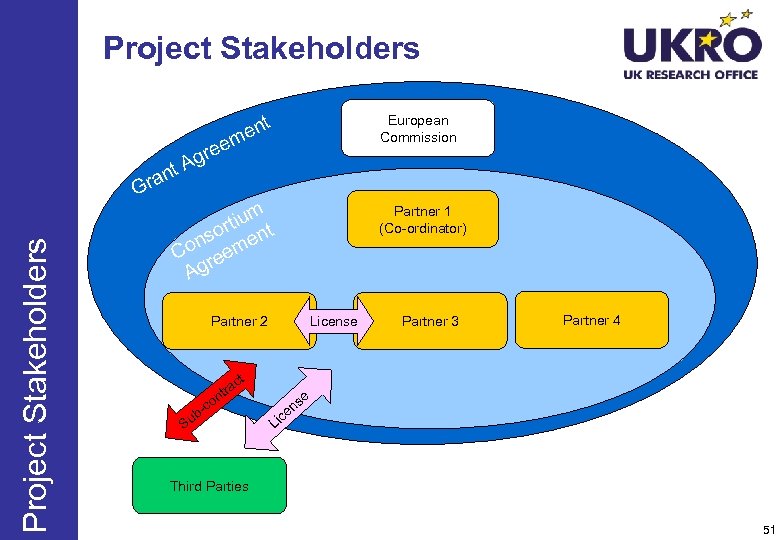 Project Stakeholders t European Commission n me ree Ag Project Stakeholders t ran G tium t r nso men Co ree Ag Partner 1 (Co-ordinator) Partner 2 Su on -c b t ra License ct Li s en Partner 3 Partner 4 e c Third Parties 51
 Project Officer Project Stakeholders • • • Appointed to a project at start of grant agreement negotiation stage Essentially the EC’s representative Responsible for project negotiations towards final grant agreement and start Responsible for monitoring, interim reporting, and processing of finances Responsible for signing off project Productive, open, regular contact with project officer is vital, via the co-ordinator 52
 Co-ordinator • • Project Stakeholders • • • Essentially, one beneficiary who has extra responsibility (but not necessarily extra rights) Must pass on pre-financing (as agreed by beneficiaries in consortium agreement) Responsible for reporting to the Commission (finances, payments, task progress…) Must pass on information regarding performance obligations of project to beneficiaries These co-ordination tasks cannot be subcontracted, nor carried out by other beneficiaries Must report on interest gained from EC pre-financing in their account Management activities are not merely co-ordination tasks Good contact and honesty with co-ordinator is also very important 53
 Participants/Beneficiaries • • Project Stakeholders • • • Organisations signed up to the Grant Agreement Each beneficiary has consortium and individual responsibilities Beneficiaries should normally have the capacity to do the project (as they signed up to it) Must be seen to be working together Responsible for managing own performance and finances – including declaring receipts Responsible for performance of any subcontractors they are attached to Researchers involved in projects must make own arrangements/fit in with policy requirements to work together with other project stakeholders at their own organisation 54
 Project Stakeholders Third Parties • Organisations which are not signed up to the grant agreement • Make some contribution to the project • Must be identified in project negotiations, or raised with Project Officer subsequently • Subcontractors are one type of third party 55
 Subcontractors • Project Stakeholders • • • Type of 3 rd Party, not a beneficiary, but does specialised work on behalf of a beneficiary Subcontractor charges price for the work, and paid 100% Not directly supervised, but beneficiary takes responsibility, and owns IP generated Beneficiary pays subcontractor either using EC contribution or own funds Not for core parts of project, management or research Not for subcontracting research between participants Must be identified in Annex I, and ‘best bid’ accepted 56
 FP 7 Grant Agreements
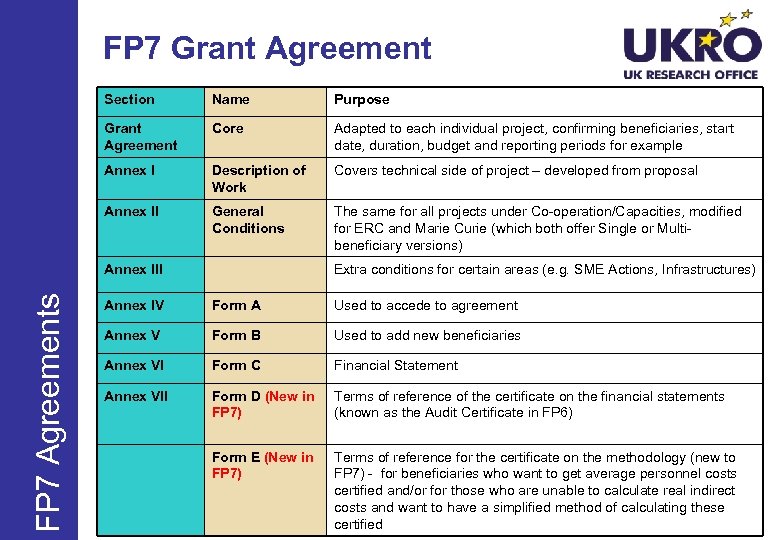 FP 7 Grant Agreement Name Purpose Grant Agreement Core Adapted to each individual project, confirming beneficiaries, start date, duration, budget and reporting periods for example Annex I Description of Work Covers technical side of project – developed from proposal Annex II FP 7 Agreements Section General Conditions The same for all projects under Co-operation/Capacities, modified for ERC and Marie Curie (which both offer Single or Multibeneficiary versions) Annex III Extra conditions for certain areas (e. g. SME Actions, Infrastructures) Annex IV Form A Used to accede to agreement Annex V Form B Used to add new beneficiaries Annex VI Form C Financial Statement Annex VII Form D (New in FP 7) Terms of reference of the certificate on the financial statements (known as the Audit Certificate in FP 6) Form E (New in FP 7) Terms of reference for the certificate on the methodology (new to FP 7) - for beneficiaries who want to get average personnel costs certified and/or for those who are unable to calculate real indirect costs and want to have a simplified method of calculating these certified
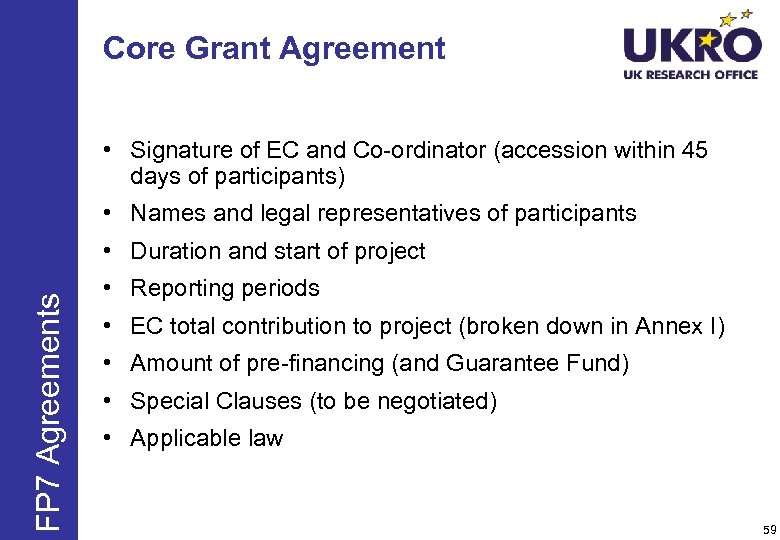 Core Grant Agreement • Signature of EC and Co-ordinator (accession within 45 days of participants) • Names and legal representatives of participants FP 7 Agreements • Duration and start of project • Reporting periods • EC total contribution to project (broken down in Annex I) • Amount of pre-financing (and Guarantee Fund) • Special Clauses (to be negotiated) • Applicable law 59
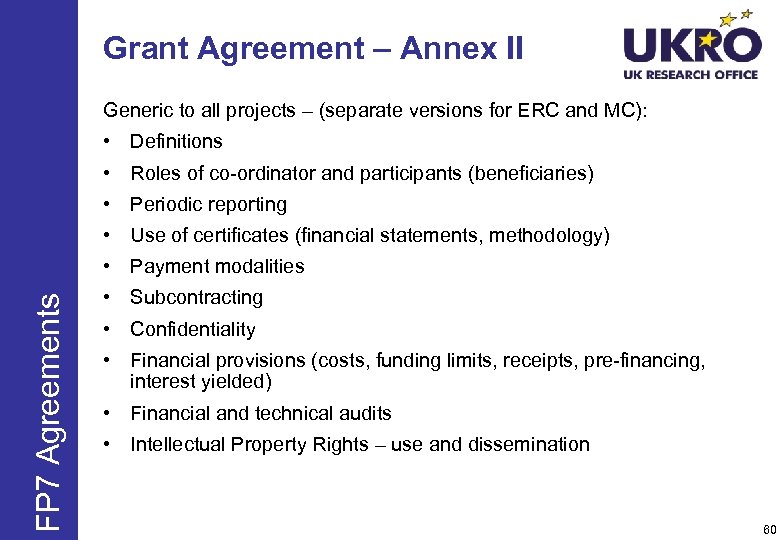 Grant Agreement – Annex II Generic to all projects – (separate versions for ERC and MC): • Definitions • Roles of co-ordinator and participants (beneficiaries) • Periodic reporting FP 7 Agreements • Use of certificates (financial statements, methodology) • Payment modalities • Subcontracting • Confidentiality • Financial provisions (costs, funding limits, receipts, pre-financing, interest yielded) • Financial and technical audits • Intellectual Property Rights – use and dissemination 60
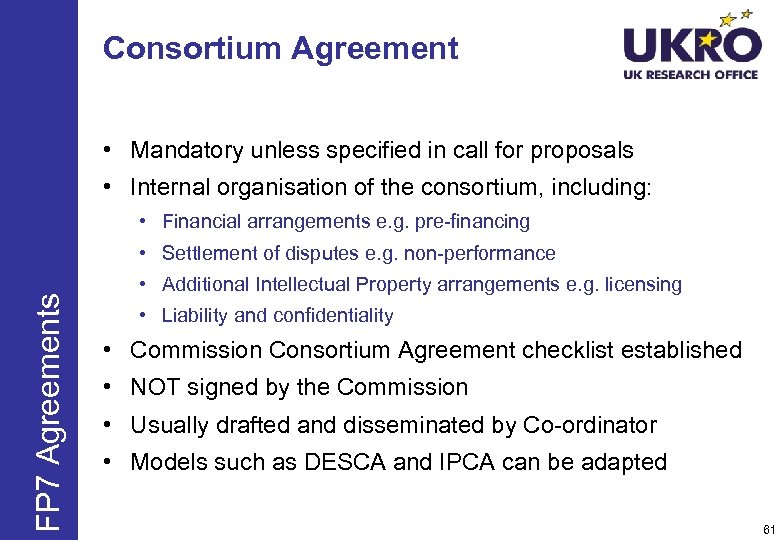 Consortium Agreement • Mandatory unless specified in call for proposals • Internal organisation of the consortium, including: • Financial arrangements e. g. pre-financing FP 7 Agreements • Settlement of disputes e. g. non-performance • Additional Intellectual Property arrangements e. g. licensing • Liability and confidentiality • Commission Consortium Agreement checklist established • NOT signed by the Commission • Usually drafted and disseminated by Co-ordinator • Models such as DESCA and IPCA can be adapted 61
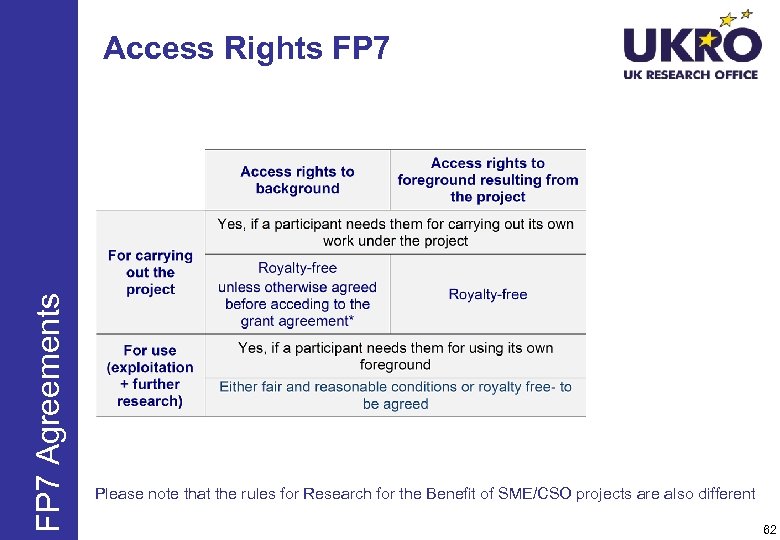 FP 7 Agreements Access Rights FP 7 Please note that the rules for Research for the Benefit of SME/CSO projects are also different 62
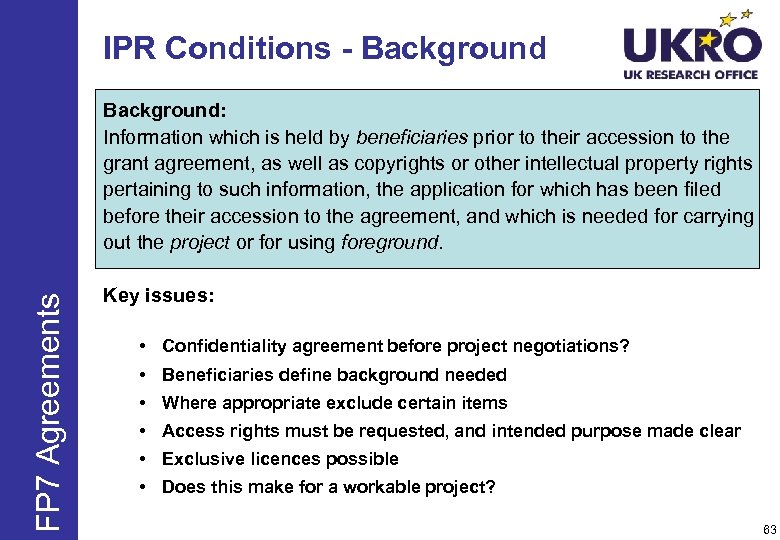 IPR Conditions - Background FP 7 Agreements Background: Information which is held by beneficiaries prior to their accession to the grant agreement, as well as copyrights or other intellectual property rights pertaining to such information, the application for which has been filed before their accession to the agreement, and which is needed for carrying out the project or for using foreground. Key issues: • Confidentiality agreement before project negotiations? • Beneficiaries define background needed • Where appropriate exclude certain items • Access rights must be requested, and intended purpose made clear • Exclusive licences possible • Does this make for a workable project? 63
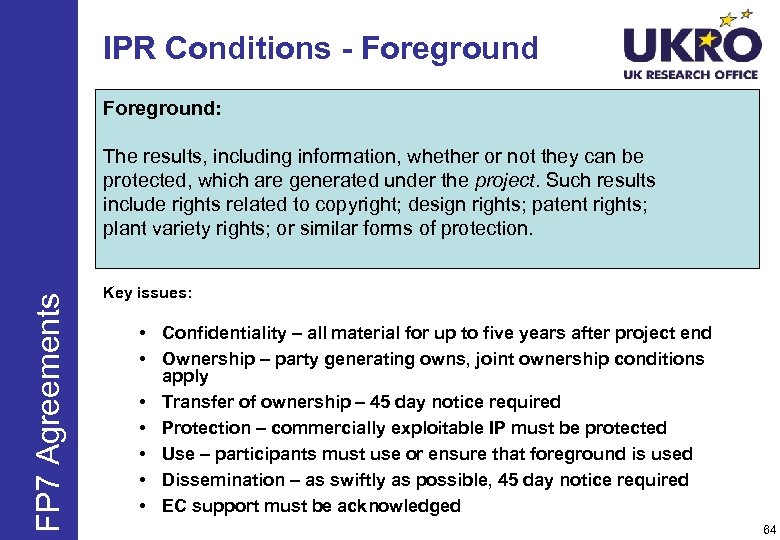 IPR Conditions - Foreground: FP 7 Agreements The results, including information, whether or not they can be protected, which are generated under the project. Such results include rights related to copyright; design rights; patent rights; plant variety rights; or similar forms of protection. Key issues: • Confidentiality – all material for up to five years after project end • Ownership – party generating owns, joint ownership conditions apply • Transfer of ownership – 45 day notice required • Protection – commercially exploitable IP must be protected • Use – participants must use or ensure that foreground is used • Dissemination – as swiftly as possible, 45 day notice required • EC support must be acknowledged 64
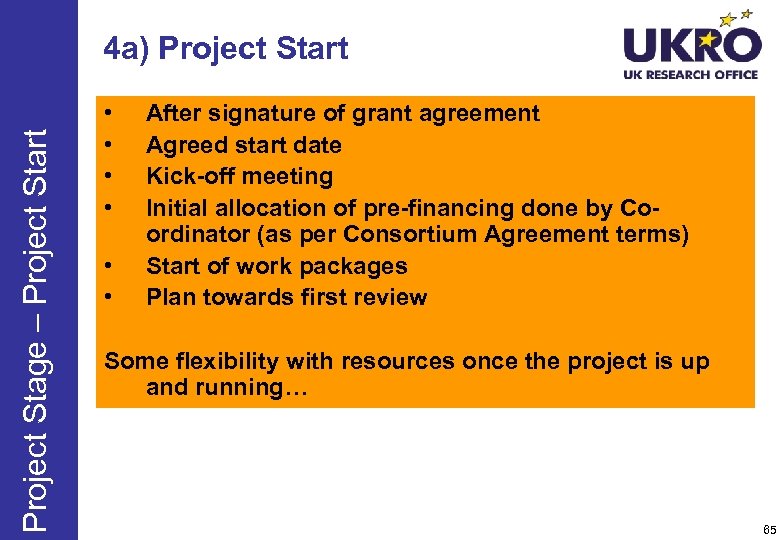 Project Stage – Project Start 4 a) Project Start • • • After signature of grant agreement Agreed start date Kick-off meeting Initial allocation of pre-financing done by Coordinator (as per Consortium Agreement terms) Start of work packages Plan towards first review Some flexibility with resources once the project is up and running… 65
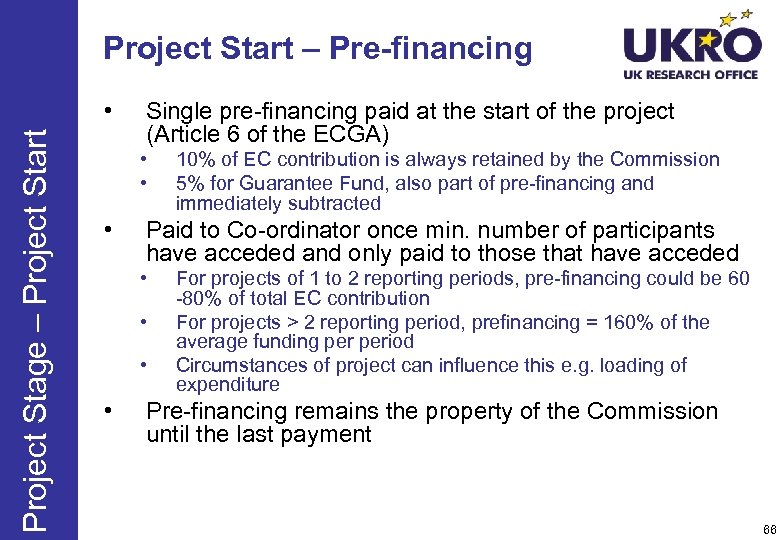 Project Start – Pre-financing Project Stage – Project Start • Single pre-financing paid at the start of the project (Article 6 of the ECGA) • • • Paid to Co-ordinator once min. number of participants have acceded and only paid to those that have acceded • • 10% of EC contribution is always retained by the Commission 5% for Guarantee Fund, also part of pre-financing and immediately subtracted For projects of 1 to 2 reporting periods, pre-financing could be 60 -80% of total EC contribution For projects > 2 reporting period, prefinancing = 160% of the average funding period Circumstances of project can influence this e. g. loading of expenditure Pre-financing remains the property of the Commission until the last payment 66
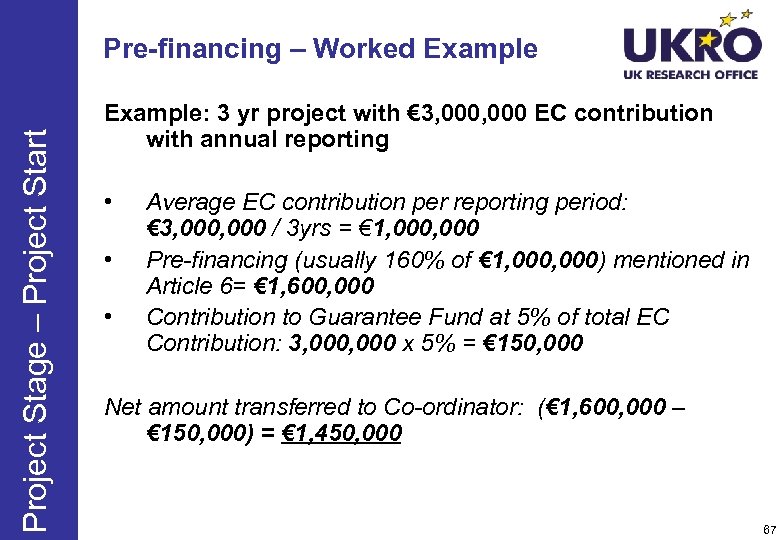 Project Stage – Project Start Pre-financing – Worked Example: 3 yr project with € 3, 000 EC contribution with annual reporting • • • Average EC contribution per reporting period: € 3, 000 / 3 yrs = € 1, 000 Pre-financing (usually 160% of € 1, 000) mentioned in Article 6= € 1, 600, 000 Contribution to Guarantee Fund at 5% of total EC Contribution: 3, 000 x 5% = € 150, 000 Net amount transferred to Co-ordinator: (€ 1, 600, 000 – € 150, 000) = € 1, 450, 000 67
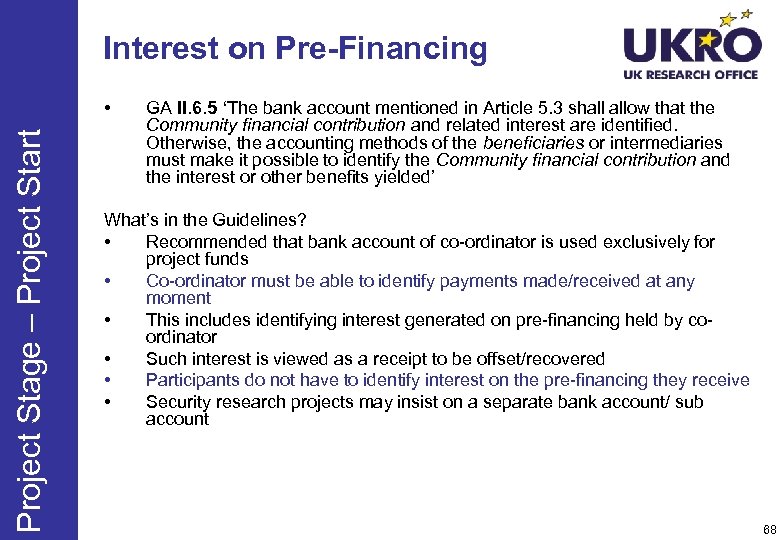 Interest on Pre-Financing Project Stage – Project Start • GA II. 6. 5 ‘The bank account mentioned in Article 5. 3 shall allow that the Community financial contribution and related interest are identified. Otherwise, the accounting methods of the beneficiaries or intermediaries must make it possible to identify the Community financial contribution and the interest or other benefits yielded’ What’s in the Guidelines? • Recommended that bank account of co-ordinator is used exclusively for project funds • Co-ordinator must be able to identify payments made/received at any moment • This includes identifying interest generated on pre-financing held by coordinator • Such interest is viewed as a receipt to be offset/recovered • Participants do not have to identify interest on the pre-financing they receive • Security research projects may insist on a separate bank account/ sub account 68
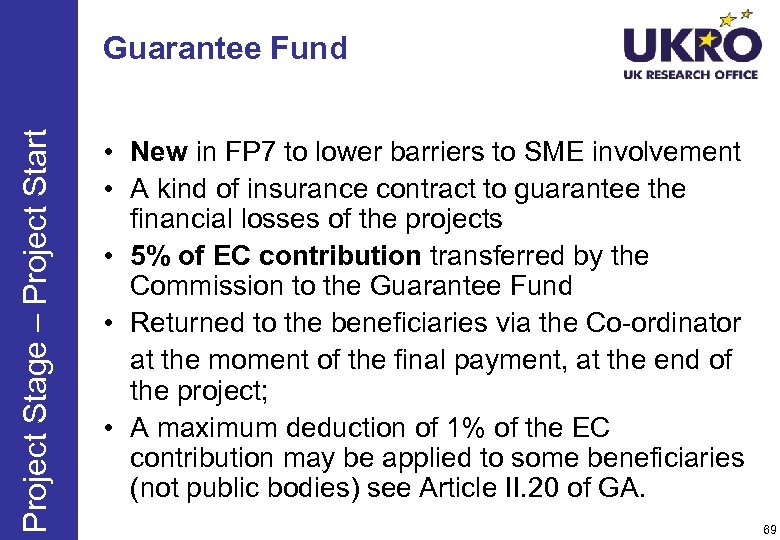 Project Stage – Project Start Guarantee Fund • New in FP 7 to lower barriers to SME involvement • A kind of insurance contract to guarantee the financial losses of the projects • 5% of EC contribution transferred by the Commission to the Guarantee Fund • Returned to the beneficiaries via the Co-ordinator at the moment of the final payment, at the end of the project; • A maximum deduction of 1% of the EC contribution may be applied to some beneficiaries (not public bodies) see Article II. 20 of GA. 69
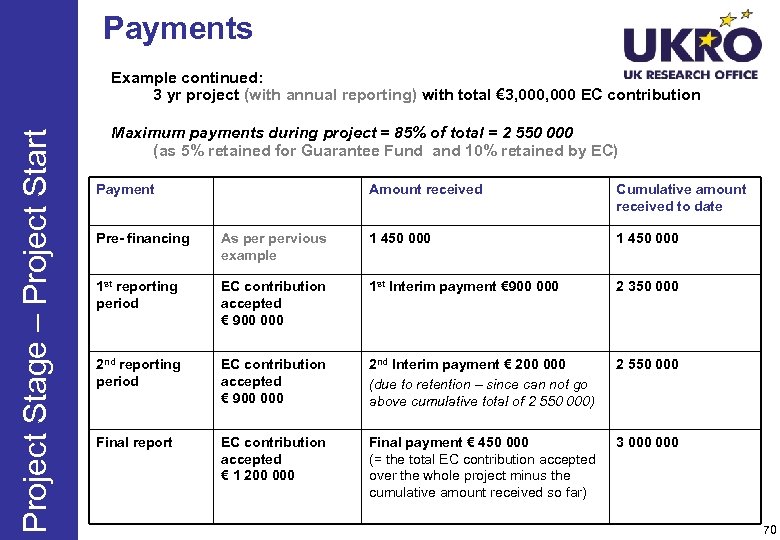 Payments Project Stage – Project Start Example continued: 3 yr project (with annual reporting) with total € 3, 000 EC contribution Maximum payments during project = 85% of total = 2 550 000 (as 5% retained for Guarantee Fund and 10% retained by EC) Payment Amount received Cumulative amount received to date Pre- financing As pervious example 1 450 000 1 st reporting period EC contribution accepted € 900 000 1 st Interim payment € 900 000 2 350 000 2 nd reporting period EC contribution accepted € 900 000 2 nd Interim payment € 200 000 (due to retention – since can not go above cumulative total of 2 550 000) 2 550 000 Final report EC contribution accepted € 1 200 000 Final payment € 450 000 (= the total EC contribution accepted over the whole project minus the cumulative amount received so far) 3 000 70
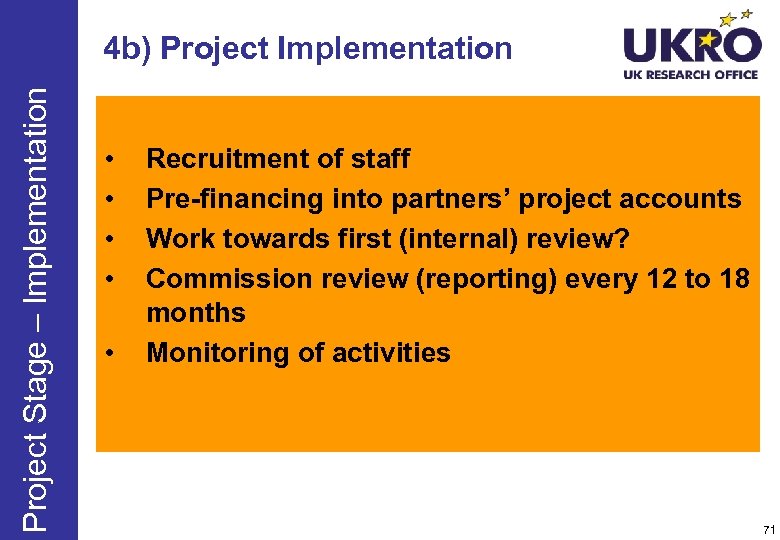 Project Stage – Implementation 4 b) Project Implementation • • • Recruitment of staff Pre-financing into partners’ project accounts Work towards first (internal) review? Commission review (reporting) every 12 to 18 months Monitoring of activities 71
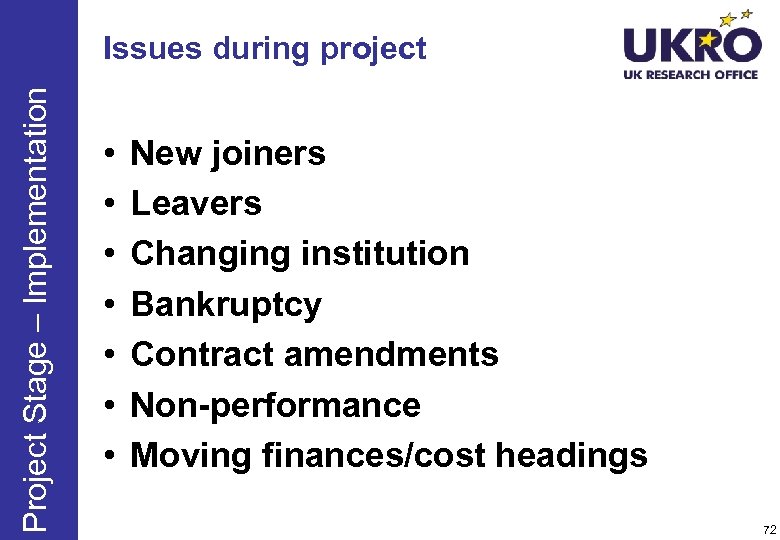 Project Stage – Implementation Issues during project • • New joiners Leavers Changing institution Bankruptcy Contract amendments Non-performance Moving finances/cost headings 72
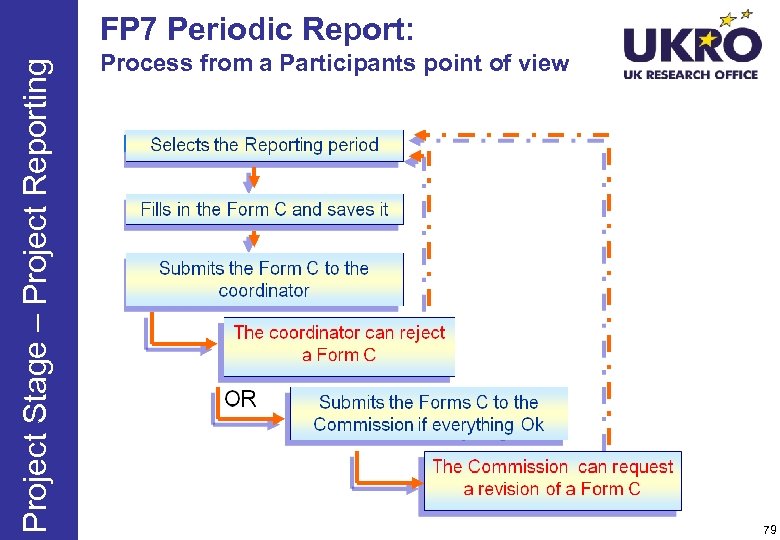
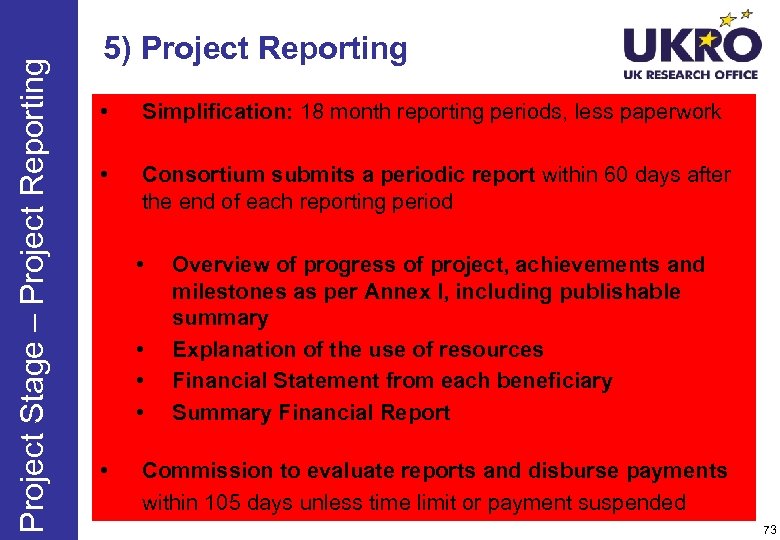 Project Stage – Project Reporting 5) Project Reporting • Simplification: 18 month reporting periods, less paperwork • Consortium submits a periodic report within 60 days after the end of each reporting period • • • Overview of progress of project, achievements and milestones as per Annex I, including publishable summary Explanation of the use of resources Financial Statement from each beneficiary Summary Financial Report Commission to evaluate reports and disburse payments within 105 days unless time limit or payment suspended 73
 Project Stage – Project Reporting Scientific Reporting • Online tool for preparation and submission of periodic and final scientific FP 7 reports, project technical reviews by external experts (SESAM) • Deployed under the Participant Portal • Use has become mandatory from 1 March 2010 • Quick guides available at: http: //webgate. ec. europa. eu/sesam 74
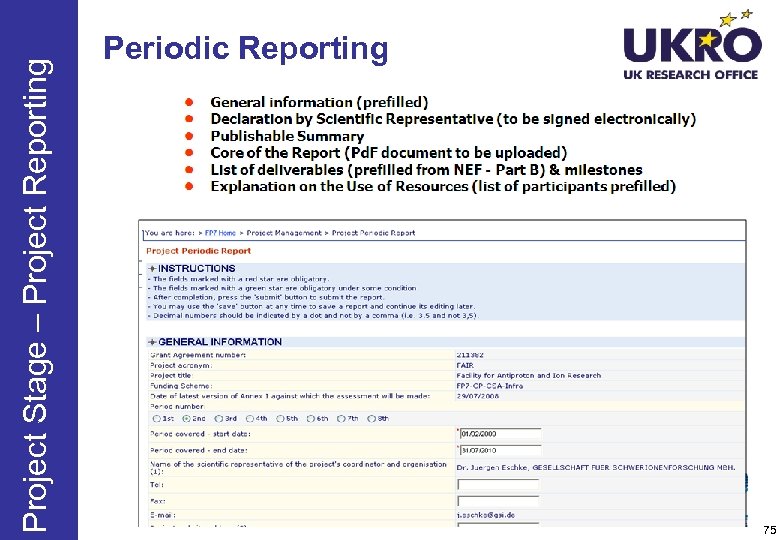 Project Stage – Project Reporting Periodic Reporting 75
 Project Stage – Project Reporting Cost Claims – Form C • Form C – models available per funding scheme • Report by partner • Per activity type (e. g. RTD, Demo, Mgt, Other) • Show total and max EC contribution • Show receipts • Third party completes attached form (only under Clause 10) 76
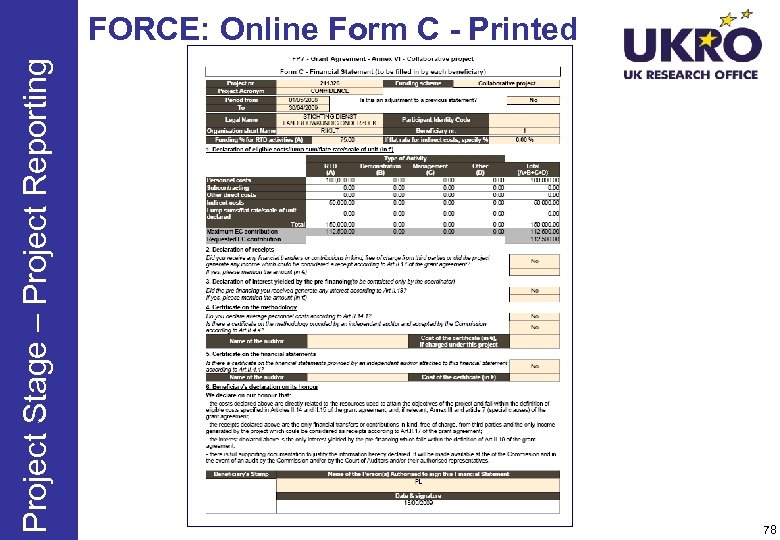
 Project Stage – Project Reporting FORCE: Online Form C • DG Research use FORCE – web-based tool to edit, save, print and submit FP 6 and FP 7 FORM C: • Prepare FORM C online for each project and each partner • Print Form C • Submit electronically Form C • Signed paper version to be sent afterwards • Correction of Form C in case of errors/refusal of EC • Access via ‘Participant Portal’ 77
 Project Stage – Project Reporting FORCE: Online Form C - Printed 78
 Project Stage – Project Reporting FP 7 Periodic Report: Process from a Participants point of view 79
 Project Stage – Project Reporting Costs for CSA Co-ordination and Support Actions • Indirect costs are ‘up to 7%’ of direct costs (minus subcontracting) • How to report costs: • Flat-rate (60%) • No RTD costs here, so the default is the 20% flat-rate – enter 20% (minus subcontracting) and can claim back 7% in EC contribution row • Indirect costs are not audited or certified due to being a ‘flat-rate’ • Actual Indirect Costs (simplified or real) • Declare actual indirect costs in form and claim total up to 7% back in EC contribution row • Indirect costs are auditable and included in certificate on financial statements (if required) 80
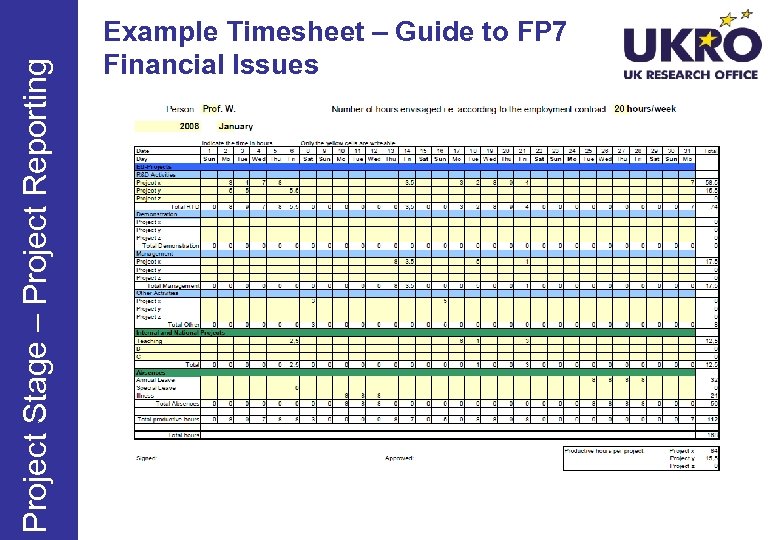
 Project Stage – Project Reporting EC Guidance for Time-sheets (or equivalent) • Can only claim for hours worked • Kept by ALL staff working on the project • Full name of beneficiary as indicated in the GA; • • • full name of the employee directly contributing to RTD project; title of RTD project as indicated in the GA; project account number should be indicated; time period concerned (for instance on daily, weekly, monthly basis) according to the beneficiary's normal practice; amount of hours claimed on the RTD project. All hours claimed must be able to be verified in a reliable manner; full name and a signature of a supervisor (person in charge of the project). • The complete time recording system should enable reconciliation of total hours in cases where personnel work on several projects during the same period • Can also be useful for equipment – if it is within normal practice
 Project Stage – Project Reporting Example Timesheet – Guide to FP 7 Financial Issues
 Project Stage – Project Reporting Certificates on Financial Statements • • Provides independent opinion on the claims made by the Form C Either external auditor or if public body can be done by ‘competent public officer’ Annex VII Form D – provides terms of reference for auditors and procedures to be performed by auditor Looks at Personnel Costs, Subcontracting, Other Direct costs (equipment, consumables, travel), indirect costs (possible methods? ), use of exchange rates, receipts and interest on prefinancing (Co-ordinator only) 83
 Project Stage – Project Reporting Certificates on Financial Statements • • • Required for each period when a beneficiary is claiming more than € 375, 000 (cumulatively) Not required otherwise, even at end of project Exception of two year projects – not required if over € 375, 000 in first year, only at end Eligible cost as ‘management activity’ (100%) Suggest meeting with auditors for FP 7 projects early to discuss requirements and costs 84
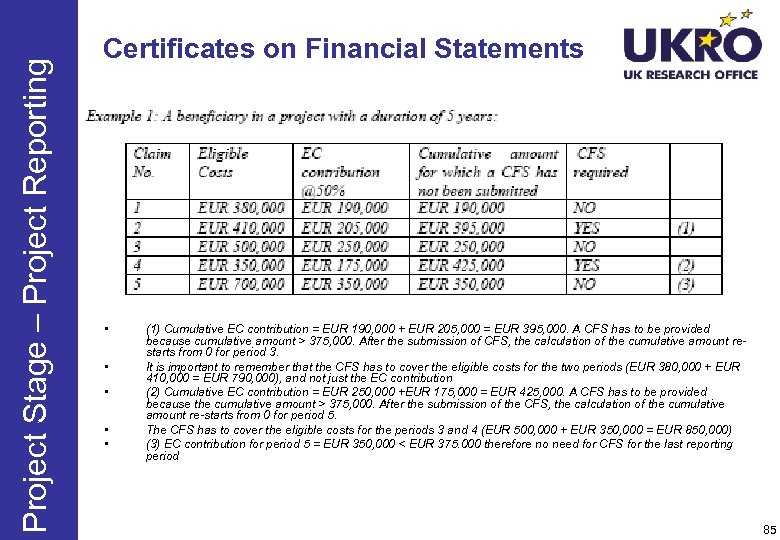 Project Stage – Project Reporting Certificates on Financial Statements • • • (1) Cumulative EC contribution = EUR 190, 000 + EUR 205, 000 = EUR 395, 000. A CFS has to be provided because cumulative amount > 375, 000. After the submission of CFS, the calculation of the cumulative amount restarts from 0 for period 3. It is important to remember that the CFS has to cover the eligible costs for the two periods (EUR 380, 000 + EUR 410, 000 = EUR 790, 000), and not just the EC contribution (2) Cumulative EC contribution = EUR 250, 000 +EUR 175, 000 = EUR 425, 000. A CFS has to be provided because the cumulative amount > 375, 000. After the submission of the CFS, the calculation of the cumulative amount re-starts from 0 for period 5. The CFS has to cover the eligible costs for the periods 3 and 4 (EUR 500, 000 + EUR 350, 000 = EUR 850, 000) (3) EC contribution for period 5 = EUR 350, 000 < EUR 375. 000 therefore no need for CFS for the last reporting period 85
 Project Stage – Project Reporting Exchange Rates and Reporting FP 7 Model Grant Agreement Annex II: Costs shall be reported in EUR. Beneficiaries with accounts in currencies other than EUR shall report in EUR on the basis of the exchange rate that would have applied either: - on the date that the actual costs were incurred or - on the basis of the rate applicable on the first day of the month following the end of the reporting period. Hints and tips • Follow your institutional accounting practices; • When budgeting, set conservative exchange rate to avoid overspend; • Establish mechanisms in consortium agreement to deal with underspend (e. g. transfer funds to other project partners); • Inform project officer when dealing with over/underspend. 86
 Project Stage - Reporting Grant Agreement Amendments • Modification to GA = Amendment • Amendment Guide for FP 7 • Examples: – Adding beneficiaries – Change co-ordinator – Partial transfer rights and obligations – Project title, acronym, duration of project – Modification of reporting periods – Change of bank details – Add/remove special clause – Modification of annex 1 • Model letters – all requests in writing • ‘Entry into Force’ • Don’t need amendment for budget transfers
 Project Stage – Project Closure 6) Project Closure • Final report within 60 days after the end of the project • • Periodic report Final publishable summary of results, conclusions and socio-economic impact as well as plan for use and dissemination of foreground Report covering wider societal implications of the project Final Payment • • • Co-ordinator to distribute final payment Report to EC on the distribution of the payment to the consortium Submitted 30 days after the final payment 88
 Project Stage – Post-Project Tasks 7) Post-Project Tasks • • Distribution of final payment Consortium agreement still active? Commission audit Technical audit Remember! • ‘The beneficiaries shall keep the originals or, in exceptional cases, duly authenticated copies – including electronic copies - of all documents relating to the grant agreement for up to five years from the end of the project. These shall be made available to the Commission where requested during any audit under the grant agreement. ’ 89
 Project Stage – Post-Project Tasks Financial Audits and Controls • • • Commission audit (or by appointed representatives) Can look at finance, systems in place and accounting and management aspects Requires originals/duly authenticated copies (incl electronic) of data upon request (including third party) Commission sends provisional report to beneficiary Respond to Commission report within one month Final report issued by Commission within two months of the deadline for comments 90
 Project Stage – Post-Project Tasks Technical Audits • • By Commission or appointed S&T experts Scientific, technological aspects and others relating to the effective execution of the project An assessment of fulfilment of project work plan, relevance of work, resources used, management procedures, beneficiaries contributions, impact, ethics audit Commission send provisional report to beneficiary Respond to review within one month Commission to inform co-ordinator of decision Guidance notes and template on “Project Technical Reviews in FP 7 Involving Independent Reviewer(s)” 91
 Further information and links
 FP 7 – Further information Sources of Information UKRO Website: http: //www. ukro. ac. uk UKRO FP 7 Grant Agreements and Finances page: http: //www. ukro. ac. uk/subscriber_services/fp 7/legal_financial Includes Key Reference Documents: • Rules of Participation • Grant Agreements • Consortium Agreements UKRO information services: http: //ims. ukro. ac. uk Use advanced search function on the UKRO Information Services! 93
 FP 7 – Further information Important links to the Participant Portal: http: //ec. europa. eu/research/participants/portal Login to access the Participant Portal services: http: //ec. europa. eu/research/participants/portal/appmana ger/participants/portal/login/ Creation of an ECAS account to log into the Participant Portal: https: //webgate. ec. europa. eu/aida/selfreg Technical helpdesk of the Participant Portal: DIGIT-EFP 7 -SUPPORT@ec. europa. eu 94
 Further Information FP 7 – Further information • EPSS Helpdesk • E-mail: support@epss-fp 7. org • Tel: +32 2 233 3760 • IPR helpdesk Website • http: //www. iprhelpdesk. eu/home • European Commission FP 7 Ethics Website • http: //cordis. europa. eu/fp 7/ethics_en 95