


 Скачать презентацию Introduction to EXPRe S — SURFnet and JIVE
f3d12fe40f165554fcbee835ae57b652.ppt
- Количество слайдов: 19
 Introduction to EXPRe. S - SURFnet and JIVE Giga. Port seminar for astronomers T. Charles Yun Program Manager EXPRe. S Project, JIVE
 Presentation Overview • Introduction to VLBI • Introduction to EXPRe. S • Segue into the detailed astronomy and research of EXPRe. S 2006 November 02 Tuesday SURFnet/JIVE- Gigaport Astronomy Seminar 2
 Giga. Port and SURFnet 6 • Without the efforts of SURFnet, e-VLBI would not be possible in the Netherlands or in Europe • Connectivity between • Amsterdam and Dwingeloo • Dwingeloo and Groningen • Leadership • Dedicated light paths as the foundation for SURFnet 6 • SURFnet continues to be a leader in the network world 2006 November 02 Tuesday SURFnet/JIVE- Gigaport Astronomy Seminar 3
 Introduction to VLBI A one slide VLBI primer • A radio telescope looks at an object in the sky and collects data to create an “image” of the source • Multiple telescopes can view the same object. The distance between the telescopes is the baseline. The baseline can be compared to building a single telescope with the diameter of this distance (sort of). • Correlation is the process by which data from multiple telescopes is collected and processed to create a more accurate image. The correlator a super computer (interferometry) • The resolution of the image increases with the data collection rate. Higher data rates are better; higher resolution is better. 2006 November 02 Tuesday SURFnet/JIVE- Gigaport Astronomy Seminar 4
 Introduction to VLBI Once upon a time. . . • Telescopes collected data on tapes. Tapes were heavy and bulky. Someone had to stand next to the recorders and change tapes. The boxes had to be boxed and labeled. They were then sent via postal mail to the correlator facility. Once all the tapes arrived from all the locations, you could begin data analysis. Sometimes tapes were lost/damaged. Sometimes data was not recorded properly onto the tapes. It was not unusual for the time between experiment to the beginning of correlation to be multiple weeks. • Hard drive arrays improved the situation. . . but only temporarily. • Today, you can transport the data over the network: e-VLBI - electronic VLBI 2006 November 02 Tuesday SURFnet/JIVE- Gigaport Astronomy Seminar 5
 Introduction to VLBI Why transport data over the network? • Using the network to transport data improves science • Eliminate the need to move physical objects • Real time analysis • Ability to identify minor problems in data collection • Hybrid observations • Responsiveness to transient events • Automated observation (hands-off observing) • Once the data is on the network, there is flexibility to investigate different options (move the correlator, multiple correlators, etc. ) 2006 November 02 Tuesday SURFnet/JIVE- Gigaport Astronomy Seminar 6
 Introduction to VLBI Optical networks, Radio astronomy • Advanced optical networks provide radio astronomy a solution to the data transport problem. • Networks can address VLBI’s inherently geographically distributed nature • Assumption: SURFnet will have shown Dutch, European and international network maps • Network data rates are improving and provide a flexibility not available with physical media • VLBI also happens to be loss tolerant, which is a useful characteristic when dealing with high-speed networks • Layer 2 networking introduces a level of control that allows VLBI to pursue different ways of moving data, thus different ways of obtainin the data for correlations 2006 November 02 Tuesday SURFnet/JIVE- Gigaport Astronomy Seminar 7
 Introduction to EXPRe. S What is EXPRe. S? • EXPRe. S = Express Production Real-time e-VLBI Service The overall objective of EXPRe. S is to create a productionlevel, real-time, “electronic” VLBI (e-VLBI) service, in which the radio telescopes are reliably connected to the central supercomputer at JIVE in the Netherlands, via a high -speed optical-fibre communication network. . . - or Make e-VLBI routine, reliable and realistic for astronomers 2006 November 02 Tuesday SURFnet/JIVE- Gigaport Astronomy Seminar 8
 Introduction to EXPRe. S Details • EXPRe. S is made possible by the European Commission (DGINFSO), Sixth Framework Programme, Contract #026642 • Project Details • Three year, started March 2006 • International collaboration • Funded at 3. 9 million EUR by the • Means: high-speed communication networks operating in real-time and connecting some of the largest and most sensitive radio telescopes on the planet 2006 November 02 Tuesday SURFnet/JIVE- Gigaport Astronomy Seminar 9
 Introduction to EXPRe. S Partners • • • • • Joint Institute for VLBI in Europe (coordinator), the Netherlands AARNET Pty Ltd. , Australia ASTRON, the Netherlands Centro Nacional de Informacion Geografica, Spain Chalmers Tekniska Hoegskola Aktiebolag, Sweden Commonwealth Scientific and Industrial Research Organization (CSIRO), Australia Cornell University, USA Delivery of Advanced Network Technology to Europe Ltd. (DANTE), UK Instituto Nazionale di Astrofisica, Italy Instytut Chemii Bioorganicznej PAN, Poland Max Planck Gesellschaft zur Foerderung der Wissenschaften e. V. , Germany National Research Foundation, South Africa Shanghai Astronomical Observatory, Chinese Academy of Sciences, China SURFNet b. v. , The Netherlands Teknillinen Korkeakoulu, Finland The University of Manchester, UK Universidad de Concepcion, Chile Uniwersytet Mikolaja Kopernika, Poland Ventspils Augstskola, Latvia 2006 November 02 Tuesday SURFnet/JIVE- Gigaport Astronomy Seminar 10
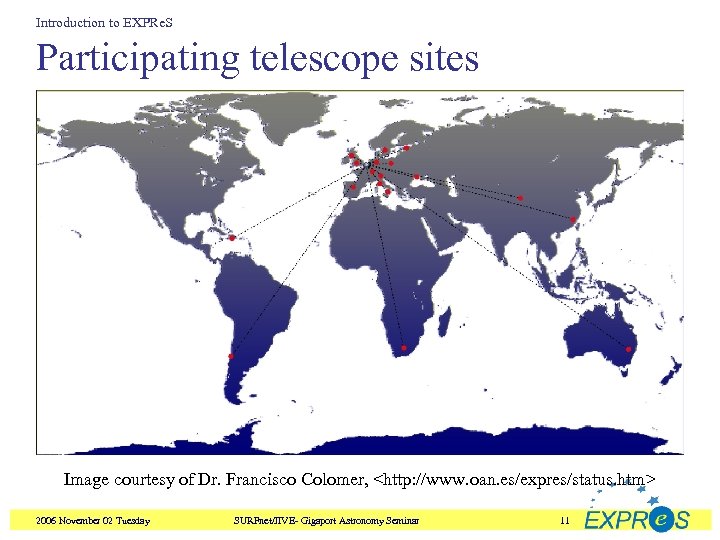 Introduction to EXPRe. S Participating telescope sites Image courtesy of Dr. Francisco Colomer,
 . . . a quick aside. . . “Heavy Users” • In her introduction, Sandra mentioned “heavy users” of the network. • Used to be code for physicists at CERN • Only moving files between two locations • HEP community can be unfairly summarized as FTP • One source, multiple destinations • They are not yet running • e-VLBI is real-time data transport from multiple locations to the correlator (think: supercomputer), with the ability to capture data at rates that will saturate the backbone of any network We are doing things today We want more tomorrow 2006 November 02 Tuesday SURFnet/JIVE- Gigaport Astronomy Seminar 12
 Introduction to EXPRe. S Activities in EXPRe. S • Networking Activities • NA 1: Management of I 3 • NA 2: EVN-NREN Forum • NA 3: e-VLBI Science Forum • NA 4: e-VLBI Outreach, Dissemination & Communications • Specific Service Activities • SA 1: Production e-VLBI Service • SA 2: Network Provision for a Global e-VLBI Array • Joint Research Activities • JRA 1: Future Arrays of Broadband Radio Telescopes on Internet Computing 2006 November 02 Tuesday SURFnet/JIVE- Gigaport Astronomy Seminar 13
 Segue to Astronomy The Real work • Today you will hear about from two activities in the EXPRe. S Project • JRA 1 “FABRIC” • SA 1 Production Services • Each of these activities address different aspects of the effort to take advantage of advanced network technologies in support of e -VLBI 2006 November 02 Tuesday SURFnet/JIVE- Gigaport Astronomy Seminar 14
 Conclusion Questions/Answers • Contact information T. Charles Yun Project Manager EXPRe. S (JIVE) tcyun at jive dot nl • Additional Information http: //expres-eu. org/ http: //www. jive. nl/ • [note: only one “s”] EXPRe. S is made possible through the support of the European Commission (DG-INFSO), Sixth Framework Programme, Contract #026642 2006 November 02 Tuesday SURFnet/JIVE- Gigaport Astronomy Seminar 15
 Extra Interesting Bits Do we really need networks? • Fully loaded carrying capacity of a 747 cargo carrying Blu-Ray DVDs • 37 Tbps • However • Latency: buy 1, 488, 800 DVDs (€€), burn each (2 years @ 1 second burn/DVD), hand label (lots of Sharpie pens), box DVDs, transport to airport, load, fly (€€€) time, unload (€), sort boxes, read each DVD. . . • Pack Loss: rare, but fairly devastating when you lose “one packet” • Every transport is unique, no re-use of media. Source: http: //dltj. org/2006/07/internet 2 -hopi-network http: //walt. lishost. org/? p=344 2006 November 02 Tuesday SURFnet/JIVE- Gigaport Astronomy Seminar 16
 Conclusion How much data does e-VLBI create? • 19 Telescope sites • 1 Gbps data rates • Correlator is currently located in Dwingeloo • fiber cross-section is into the correlator is non-trivial • e-VLBI science runs can last for arbitrarily long periods of time, but 3 weeks runs are not unusual • 19 sites x 1 day x 512 Mbps = 19 sites x 86400 seconds x 512 Mbps = 840, 499, 200 Mbits = ~105 Tera. Bytes per day 2006 November 02 Tuesday SURFnet/JIVE- Gigaport Astronomy Seminar 17
 General Notes and Information Networking activities • NA 1: Management of I 3 • Provides resources to effectively manage the EXPRe. S I 3 project. The objective is to efficiently manage EXPRES and monitor the overall progress of the project goals, in particular the realisation of a production-level e-VLBI infrastructure. Responsible for the overall financial management of the project and the generation of annual and final reports via input from the chairs of the NA, SA and JRAs. • NA 2: EVN-NREN Forum • Partially supports a forum in which representatives of the networking and radio astronomy technical community will meet and interact with each other, including day-to-day communication via the on-line EVN-NREN email forum. The objective is to ensure that both communities are effectively engaged and that together they agree and move forward on the solutions, objectives and development priorities within EXPRe. S. • NA 3: e-VLBI Science Forum • Partially support the activities of the e-VLBI Science Advisory Group (e. VSAG). The objectives of this activity will be to ensure that e-VLBI end-users are well informed and organised about EXPRe. S developments and can provide critical review of the project’s evolution. This group will also help promote & develop the full potential of the e-VLBI technique as an astronomical application. • NA 4: e-VLBI Outreach, Dissemination & Communications • Partially supports outreach and communication aspects of the EXPRe. S I 3. Objectives include: creation of the EXPRe. S web-site (addressing public outreach, project management and end-user communication requirements), general promotion of EXPRe. S to the broad scientific and networking communities via a programme of PR activities. 2006 November 02 Tuesday SURFnet/JIVE- Gigaport Astronomy Seminar 18
 General Notes and Information Specific Service & Research Activities • SA 1: Production e-VLBI Service • A programme of integration and development that will provide astronomers (and other end-users) with a production level e -VLBI infrastructure service, capable of servicing and robustly processing e-VLBI data streams of up to 16 Gbps (net) at the EVN data processor at JIVE. The objectives will be to realise a distributed scientific instrument with unique capabilities - an e-VLBI infrastructure operating in real-time - a service that will be expandable to include input from up to 16 telescopes located across the planet (including individual telescopes of the UK e-MERLIN array). • SA 2: Network Provision for a Global e-VLBI Array • A programme of network communication provision that will permit radio telescopes across Europe and the rest of the world to obtain last mile connections to high-speed communication networks that can be connected to national research networks and international communication networks, in particular GÉANT. • JRA 1: Future Arrays of Broadband Radio Telescopes on Internet Computing • A research project that looks towards the future hardware and software requirements that will enable the development of an e-VLBI facility in which data flows of ~ 10 -30 Gbps per telescope can be reliably sustained and processed. The main objectives are to design and prototype an e-VLBI data acquisition platform (based on COTS hardware), investigate transport mechanisms and identify protocols that are optimal for e-VLBI, develop a software correlator (e-VLBI data processor) that can run on standard workstations and take advantage of distributed Grid computing resources. 2006 November 02 Tuesday SURFnet/JIVE- Gigaport Astronomy Seminar 19