


 Скачать презентацию Introduction to Experimental Techniques in Optics Motivation Optics
098cc50787f8a61e70f86bb2f074b105.ppt
- Количество слайдов: 16
 Introduction to Experimental Techniques in Optics Motivation: Optics is becoming increasingly important in many application areas such as communication/computing and chemical/biological diagnostics. For most of these applications, the basic hardware and experimental techniques are similar. Overview: This course will provide a hands-on introduction to these techniques. Lab skills are the main focus. Lectures will supplement. Specific details: • Start from scratch -- Build opto-electronic servo systems – laser intensity stabilization – wavelength filter -- active control • Break complex tasks into a series of simpler ones
 Sample of material covered Experimental techniques and capabilities • Optics & mechanics – Optics handling – Mount assembly – Machining skills ? ? – Cannot always buy what is needed • Optoelectronics – Electronics skills – soldering, prototype boards – Circuit design – servos ? ? – High sensitivity of optics often requires control – Interfaces – detectors, transducers • Lab proficiency demonstrations • Lab book – important in real world – Neatness not critical – will not count against – Completeness important
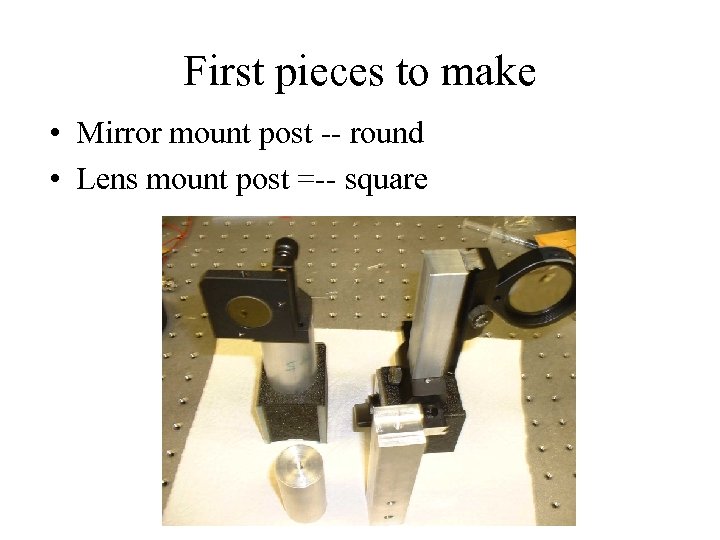 First pieces to make • Mirror mount post -- round • Lens mount post =-- square
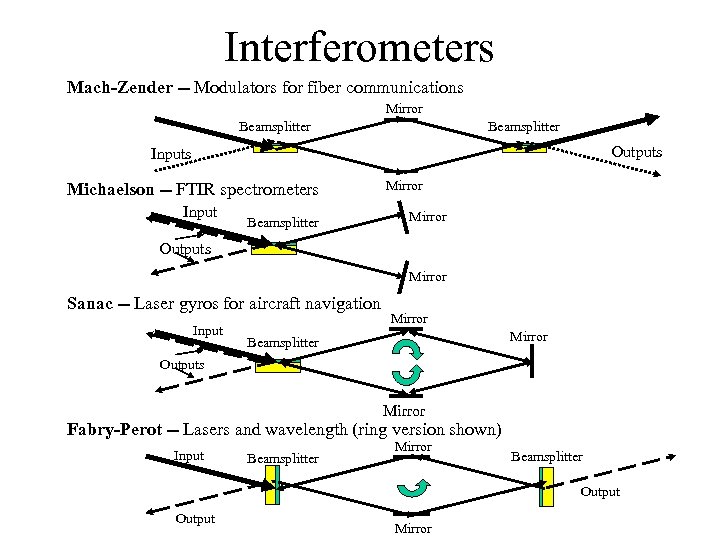 Interferometers Mach-Zender -- Modulators for fiber communications Mirror Beamsplitter Outputs Inputs Michaelson -- FTIR spectrometers Input Beamsplitter Mirror Outputs Mirror Sanac -- Laser gyros for aircraft navigation Input Mirror Beamsplitter Outputs Mirror Fabry-Perot -- Lasers and wavelength (ring version shown) Input Beamsplitter Mirror Beamsplitter Output Mirror
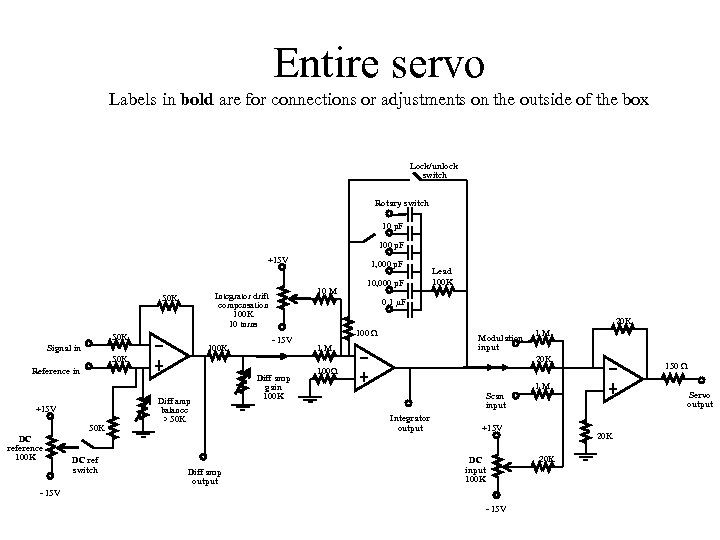 Entire servo Labels in bold are for connections or adjustments on the outside of the box Lock/unlock switch Rotary switch 10 p. F 100 p. F +15 V 10 M Integrator drift compensation 100 K 10 turns 50 K Signal in 100 K 1, 000 p. F 10, 000 p. F Lead 100 K 0. 1 m. F 20 K - 15 V 100 W Modulation input 1 M 50 K 20 K Reference in +15 V 50 K DC reference 100 K DC ref switch 1 M Diff amp balance > 50 K Diff amp output Diff amp gain 100 K 150 W 100 W Scan input Integrator output 1 M +15 V DC input 100 K - 15 V Servo output 20 K
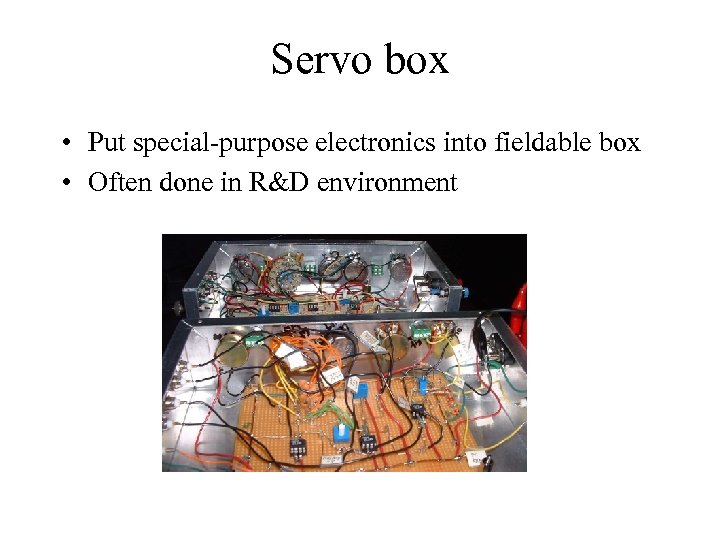 Servo box • Put special-purpose electronics into fieldable box • Often done in R&D environment
 Lab proficiency demos • Assemble mounts from “spare” parts – basic machine shop skills – optics cleaning techniques • Basic electronics – soldering techniques – construct and balance differential amplifier – construct and null integrator • Construct interferometers – construct 4 types of interferometers – white light interferometer • Construct and align opto-electronic system – photodiodes, PZTs, HV drivers • Stabilize laser intensity using simple servo – acousto-optic shifters, VCOs • Lock optical spectrum analyzer (Fabry-Perot) to laser – lock-in amplifiers and ac servos, etc. • Construct servo box – design and packaging of special-purpose electronics
 Lab books • Some are smart enough to make anything work on the first try • The rest of us have to be organized Lab book is key to organization • Complex experiments: – 1 day to take data – 1 day to analyze and update lab book What goes in a lab book -- everything you need to reproduce results • Crude diagrams of experiment, circuit schematics, etc • Pin-outs and data sheets for opto-electronic components • Raw data -– ex: as read off voltmeter or scope – copy of data traces (chart recorder trace, scope photo, computer image file) • Processed data -- after computer fits, smoothing, etc • Equations and relevant theory • Narrative in your own words -- what was done, why, and what were results Real world -- lab books can settle patent disputes, etc
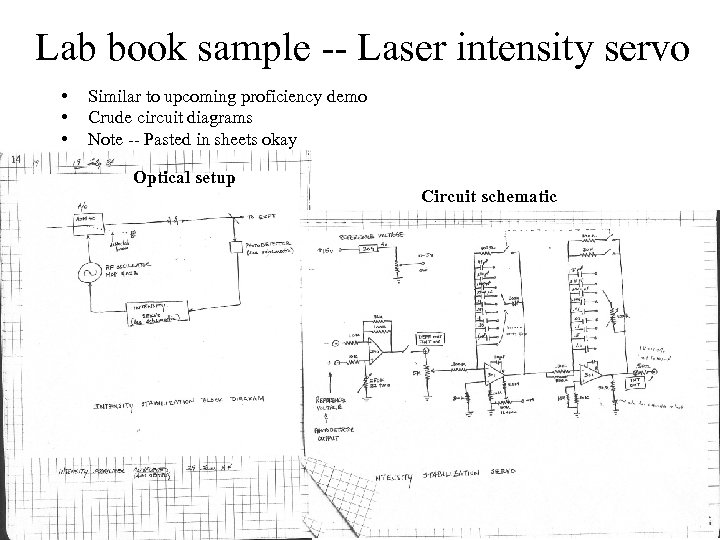 Lab book sample -- Laser intensity servo • • • Similar to upcoming proficiency demo Crude circuit diagrams Note -- Pasted in sheets okay Optical setup Circuit schematic
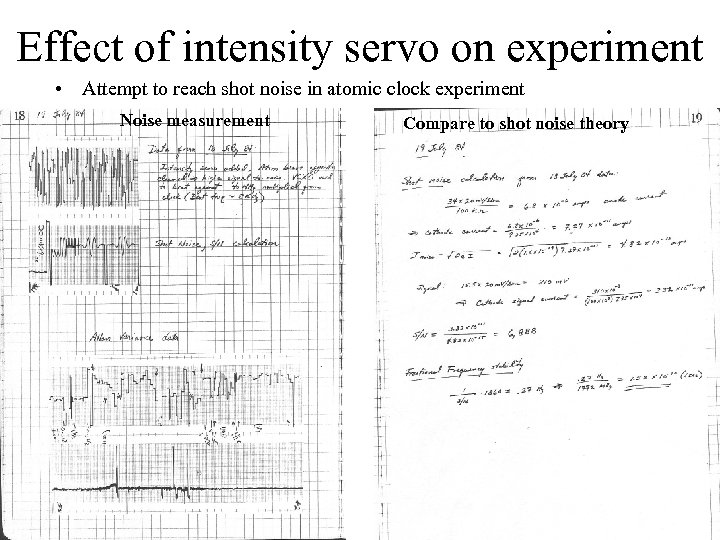 Effect of intensity servo on experiment • Attempt to reach shot noise in atomic clock experiment Noise measurement Compare to shot noise theory
 Lecture topics • • • Basic experimental techniques including keeping a laboratory book and handling of optical components Optical mechanics and component mounting techniques Passive optical components such as mirrors, lenses, and polarizers Lasers – properties and operation Coherence and interference effects Basic electronics including op amps Optical detectors and data collection Active optical elements such as acousto-optics Servos and transducers Laser intensity stabilization Lock-in amplifiers and ac servo techniques Technical presentation skills
 Possible supplemental topics • • • Spectroscopy, FTIR Liquid crystal displays, optical memories & correlators Microscopy, confocal and fluorescence Photon counting and correlation Fiber optic techniques
 Prerequisites & references Prerequisites: None • Include both beginning and advanced students • Disadvantage – Advanced students bored? , Beginning students overwhelmed? Solution • Advanced students: Move at own pace -- proficiency exams • Beginning students: Extended lecture time or special lectures – questions and answers
 References: Optics by Eugene Hecht, Addison Wesley Pub. Co. • In print more than 20 years • Reads like series of complete lectures • Frees up more class time for lab work Supplemental handouts/ web addresses • Example: Manufacturer’s application notes – http: //www. newport. com/store/default. asp? lone=Optics<wo=Technical+ Reference&lang=1 – http: //www. cvilaser. com/Catalog. asp? filename=/bil-productindex 1221. asp – http: //www. mellesgriot. com/resourcelibrary/technicalnotes/default. asp – http: //www. newfocus. com/support_freelit. cfm
 Grading will be “bottom-line” oriented – Prepare to succeed in future job • Did you learn the material or not. • Tests: 20% – Written – scheduled, based on lecture material • Final exam: 20% – Optional – Can use test average as final exam grade • Laboratory proficiency exams: 20% – Demonstrations of experimental proficiency – when ready • Laboratory notebooks: 20% – Completeness first. – Neatness only in summaries. Nothing deducted for messiness elsewhere. – Will also be allowed during quizzes and proficiency demos • Presentations: 20% – Present after completing core proficiency demons – Fellow students will also rate – Contributes to your grade – Presentations can have “dry runs” – not count toward grade
 Course meeting times Lectures: MW 10: 20 -- 11: 10 am Lab: F 10: 20 am -- 1: 10 pm, supplemental times ? Problem: Limited space and equipment Solution: Split into two groups Homework: Everyone will have lab access Lab books: Will supply