Скачать презентацию Introduction to Elie Wiesel s Night The Holocaust and
b8d19c1ee54e58a46321e6b612cac419.ppt
- Количество слайдов: 52
 Introduction to Elie Wiesel’s Night The Holocaust and other Background Information
 The Holocaust: Terms to Know n Holocaust: n burnt offering; a sacrifice consumed by fire n Genocide: n The systematic annihilation of a whole people or nation n Antisemitism: n Prejudice against or hatred of all Jews n Ghetto: n a confined area of a city in which members of a minority group are compelled to live because of social, legal, or economic pressure.
 The Holocaust: Terms to Know n SS: abbreviation for Schutzstaffel n (protection squads). A paramilitary formation of the Nazi party initially created to serve as bodyguard to Hitler and other Nazi leaders. n Kapo n Prisoner forces in charge of other prisoners n Had extra food and privileges
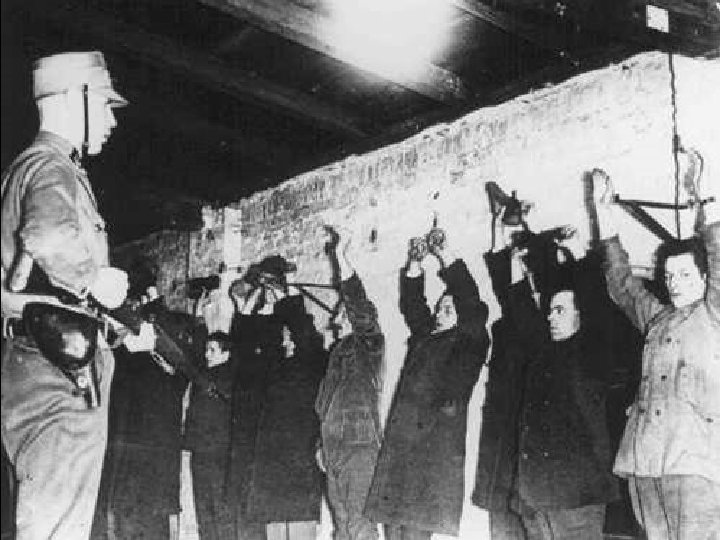
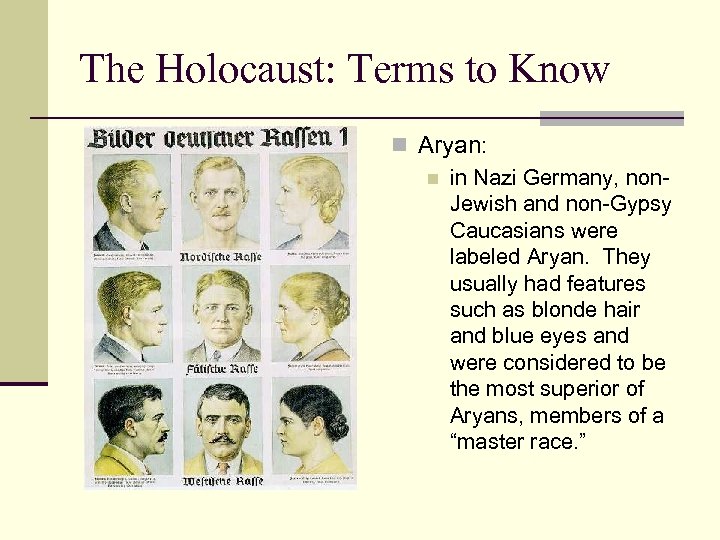 The Holocaust: Terms to Know n Aryan: n in Nazi Germany, non. Jewish and non-Gypsy Caucasians were labeled Aryan. They usually had features such as blonde hair and blue eyes and were considered to be the most superior of Aryans, members of a “master race. ”
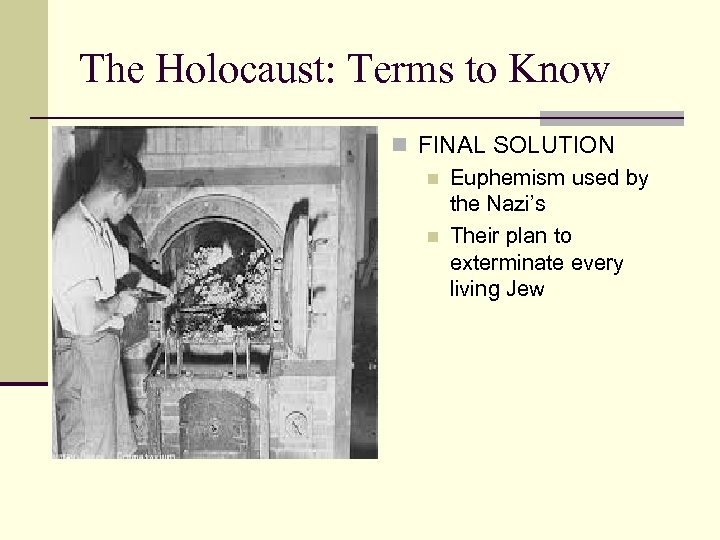 The Holocaust: Terms to Know n FINAL SOLUTION n Euphemism used by the Nazi’s n Their plan to exterminate every living Jew
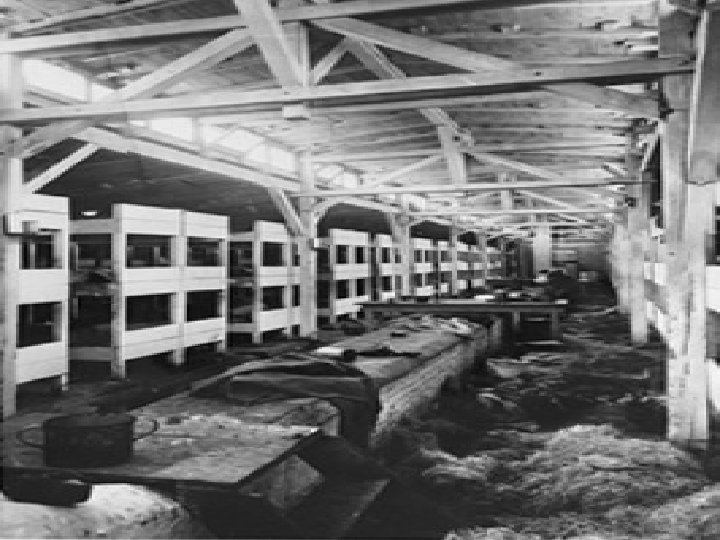
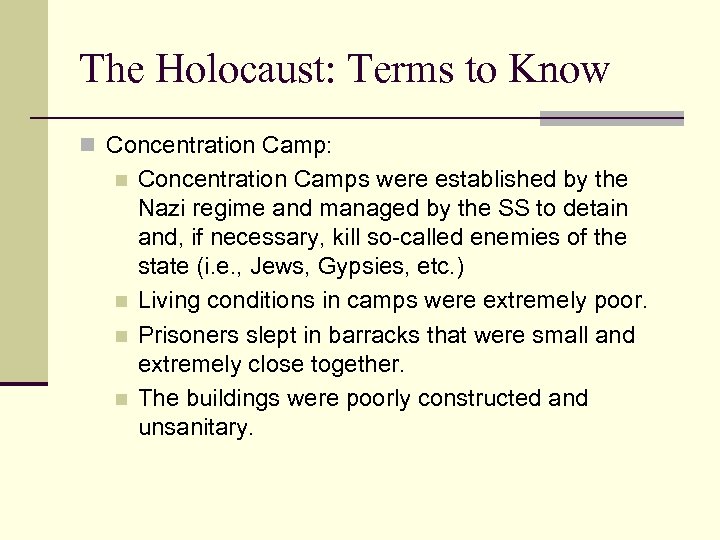 The Holocaust: Terms to Know n Concentration Camp: n n Concentration Camps were established by the Nazi regime and managed by the SS to detain and, if necessary, kill so-called enemies of the state (i. e. , Jews, Gypsies, etc. ) Living conditions in camps were extremely poor. Prisoners slept in barracks that were small and extremely close together. The buildings were poorly constructed and unsanitary.
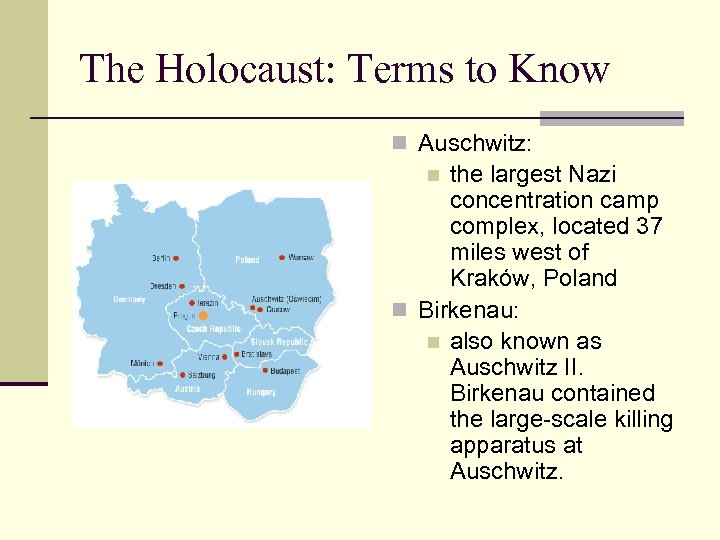 The Holocaust: Terms to Know n Auschwitz: the largest Nazi concentration camp complex, located 37 miles west of Kraków, Poland n Birkenau: n also known as Auschwitz II. Birkenau contained the large-scale killing apparatus at Auschwitz. n
 Jewish Terms n Judaism: n the monotheistic religion (belief in one god) of the Jews, having its ethical, ceremonial, and legal foundation in the precepts of the Old Testament and in the teachings and commentaries of the rabbis as found chiefly in the Talmud n Talmud: n the most significant collection of Jewish oral tradition
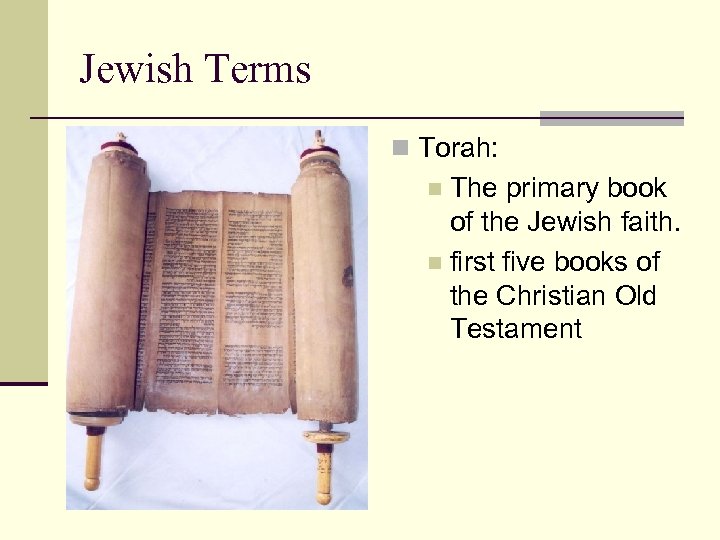 Jewish Terms n Torah: The primary book of the Jewish faith. n first five books of the Christian Old Testament n
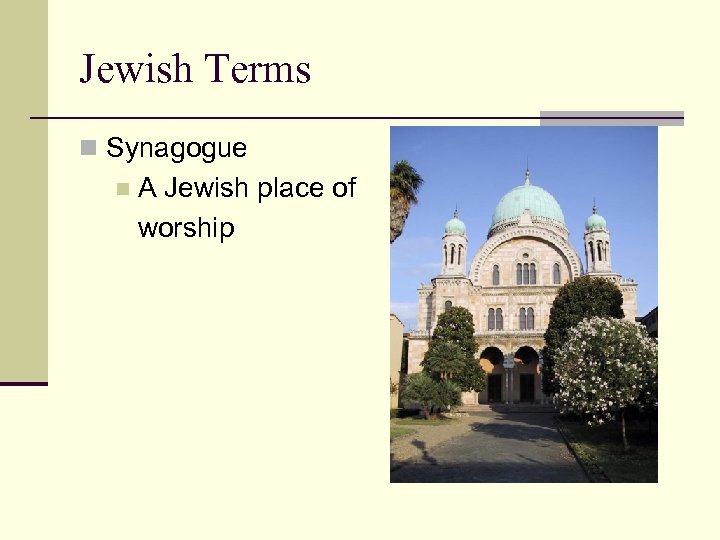 Jewish Terms n Synagogue n A Jewish place of worship
 Jewish Terms n Cabbala (Kaballah) n the religious mystical system (collection of writings) n claiming an insight into divine nature n Kaddish n A prayer recited in the daily synagogue services and by mourners after the death of a close relative.
 Jewish Terms n Yom Kippur n The Holiest Day n People are judged by God n Rosh Hashanah n Jewish New Year n Passover n 8 day festival commemorating the feeing of the Jews from Egypt
 Timeline of Holocaust Events: 1933 n Adolf Hitler's Nazi Party gains control of the German government. n Nazi: The National Socialist Workers’ Party n The Nazis decree a 3 day boycott of Jewish businesses.
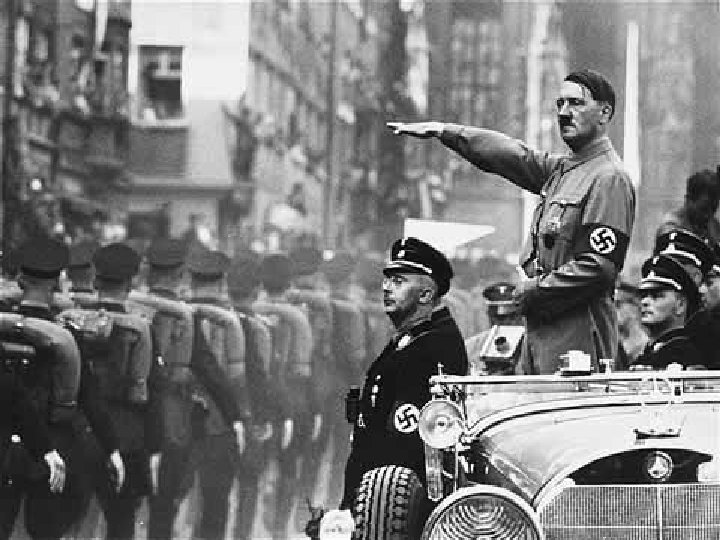
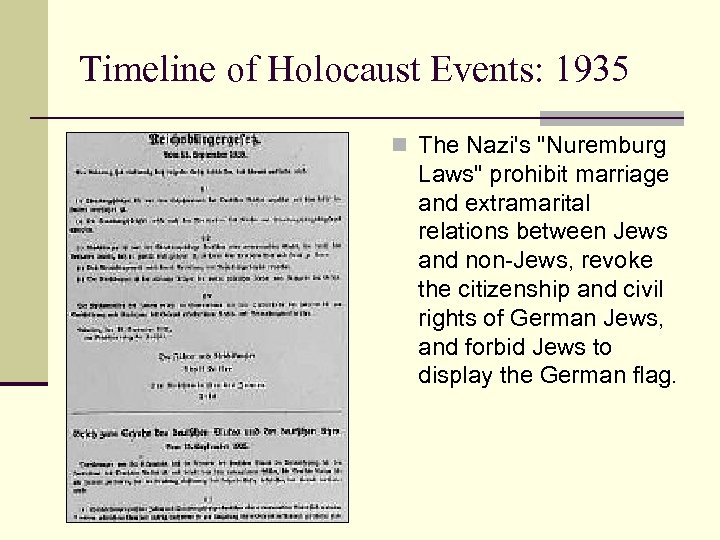 Timeline of Holocaust Events: 1935 n The Nazi's "Nuremburg Laws" prohibit marriage and extramarital relations between Jews and non-Jews, revoke the citizenship and civil rights of German Jews, and forbid Jews to display the German flag.
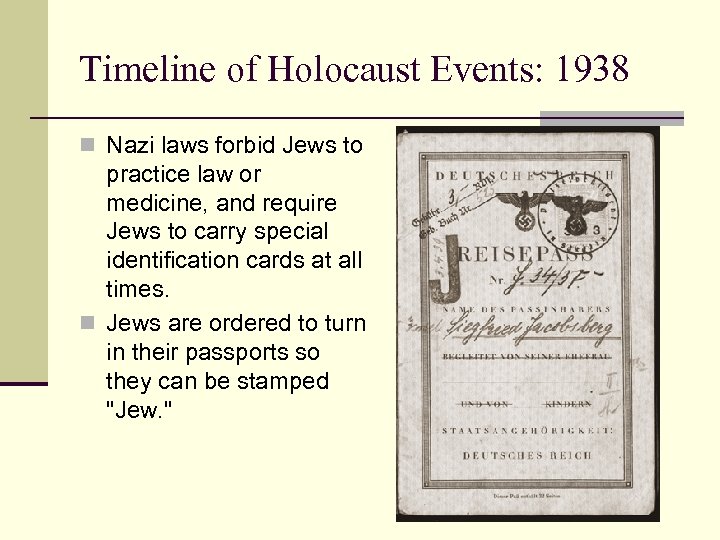 Timeline of Holocaust Events: 1938 n Nazi laws forbid Jews to practice law or medicine, and require Jews to carry special identification cards at all times. n Jews are ordered to turn in their passports so they can be stamped "Jew. "
 Timeline of Holocaust Events: 1938 n Nazi laws require Jews to report their financial assets and property. n The Nazi government assumes control of all Jewish religious institutions.
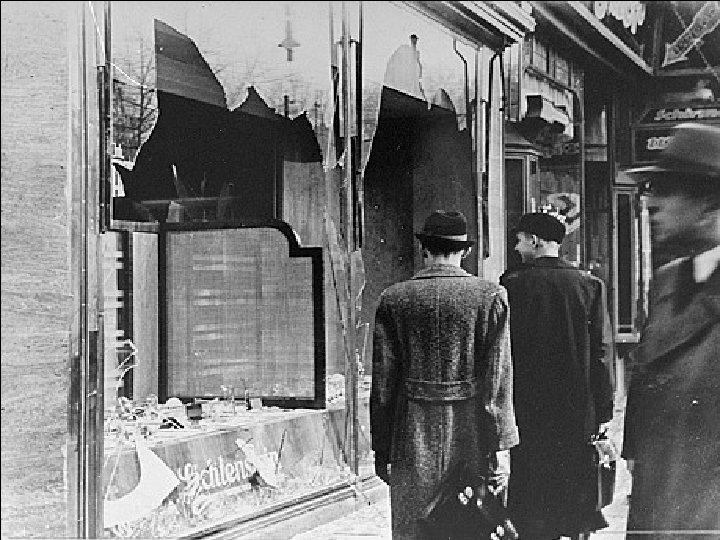
 Timeline of Holocaust Events: 1938 n Kristallnacht n ("The Night of Broken Glass, " November 9): a government-sanctioned night of anti-Jewish riots, during which synagogues are burned, Jewish homes looted, Jewish businesses destroyed, and thousands of Jews beaten, tortured, arrested, or killed.
 Timeline of Holocaust Events: 1938 n Nazi police arrest approximately 30, 000 Jewish men n n for deportation to concentration camps. Deportation: the removal of people from their areas of residency for purposes of resettlement elsewhere. Nazi laws ban Jewish newspapers and journals, expel Jewish children from German schools, and bar Jews from theaters, museums, and other public gathering places. The Nazi government closes all Jewish businesses and prohibits further Jewish business activity. The government imposes a tax on Jews to pay for Kristallnacht property damage.
 Timeline of Holocaust Events: 1939 n The Nazi Gestapo assumes control of all Jewish affairs. n Gestapo: The German State Police n The Nazis establish detailed procedures for confiscating Jewish property. n Nazi Invasion of Poland (September 1): Nazi Einsatzgruppen (mobile killing squads) follow the advancing German army and execute thousands of Poles, whom the Nazis regard as "subhuman. " Thousands more are shipped to Germany as slave laborers or relocated within Poland to provide open space for German settlement.
 Timeline of Holocaust Events: 1939 n Nazi forces round up approximately 3 million Polish Jews and confine them in urban ghettos. n Polish Jews are required to wear the Star of David. n In Germany, the Nazis initiate a euthanasia program to kill institutionalized and handicapped patients who are deemed incurable.
 Timeline of Holocaust Events: 1940 n Nazi Conquest of Europe: Anti-Jewish policies are imposed in Nazi-occupied Denmark, Norway, Holland, Belgium, Luxembourg, France, and in other European countries under Nazi domination.
 Timeline of Holocaust Events: 1941 n Nazi Invasion of the Soviet Union (June 22): Einsatzgruppen following the advancing army exterminate Jews, Gypsies, communists, and other "undesirables"; more than one million people are massacred. n Extermination camps with gas chambers for mass executions are constructed in Poland at Auschwitz-Birkenau, Chelmno, Belzec, Sobibor, Majdanek, and Treblinka.
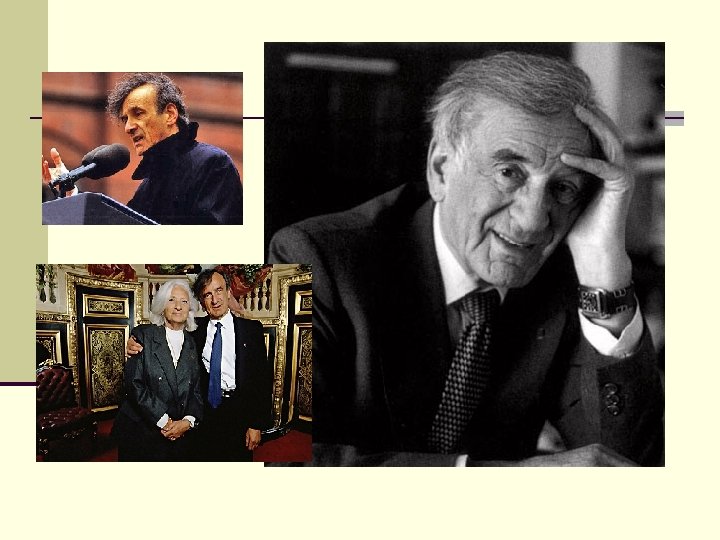
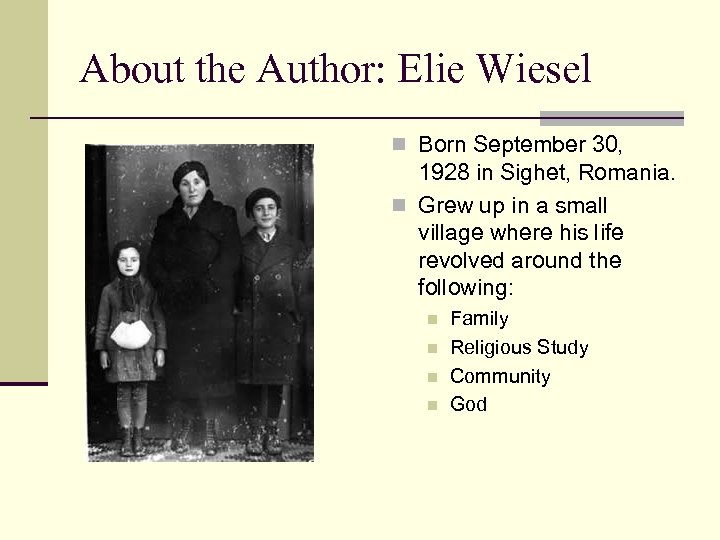 About the Author: Elie Wiesel n Born September 30, 1928 in Sighet, Romania. n Grew up in a small village where his life revolved around the following: n n Family Religious Study Community God
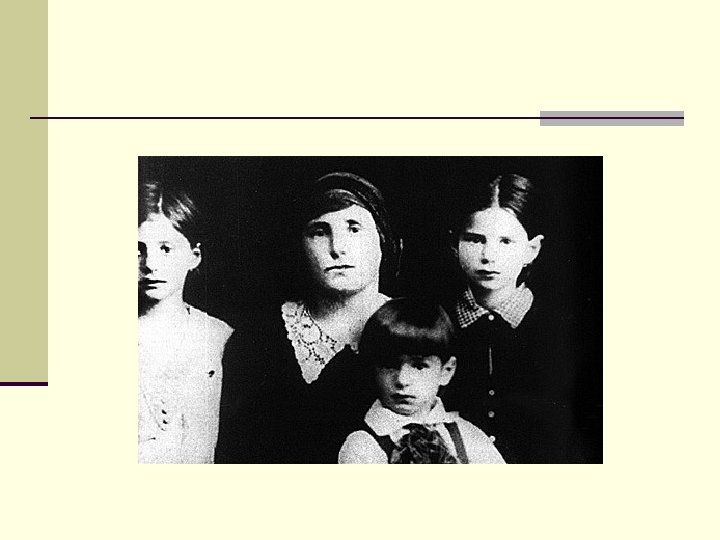
 About the Author n In 1944, when Elie was 15, he was deported to Auschwitz. n When they arrived at the camp, he and his father were warned to lie about their ages. Elie said he was 18 and his father said he was 40 instead of 50. n n They were sent to be slave laborers. His mother and youngest sister were sent to the gas chambers.
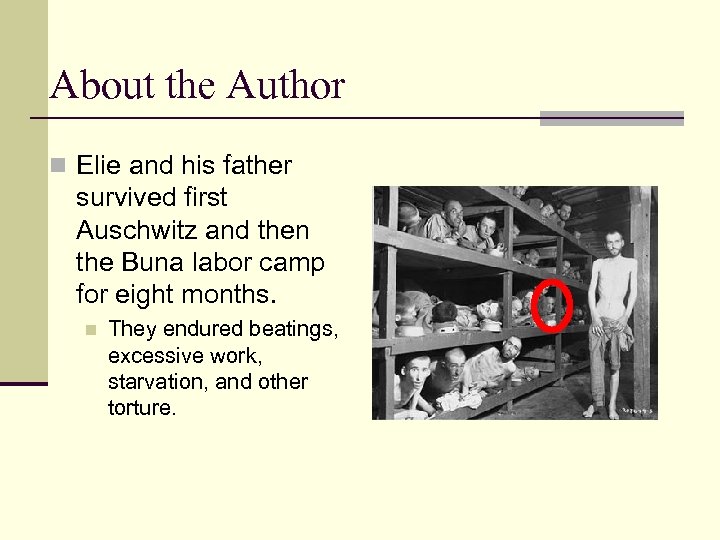 About the Author n Elie and his father survived first Auschwitz and then the Buna labor camp for eight months. n They endured beatings, excessive work, starvation, and other torture.
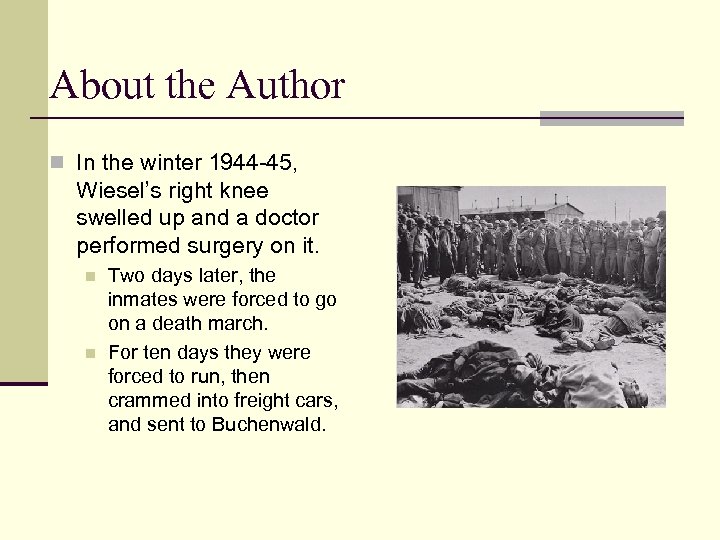 About the Author n In the winter 1944 -45, Wiesel’s right knee swelled up and a doctor performed surgery on it. n n Two days later, the inmates were forced to go on a death march. For ten days they were forced to run, then crammed into freight cars, and sent to Buchenwald.
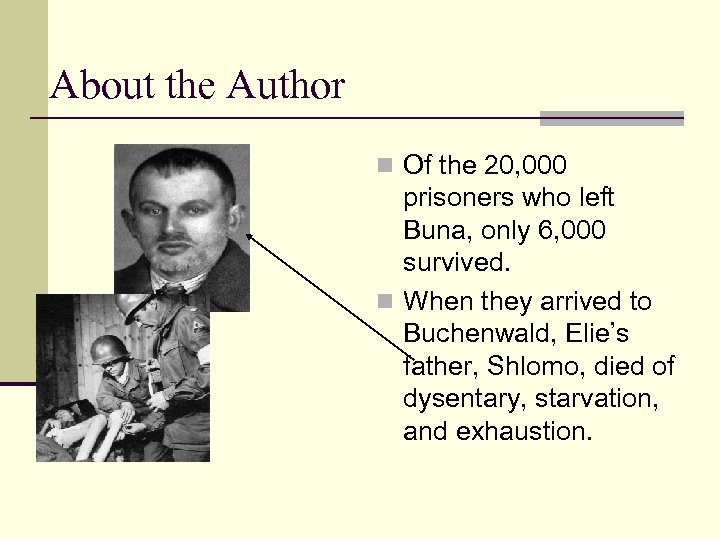 About the Author n Of the 20, 000 prisoners who left Buna, only 6, 000 survived. n When they arrived to Buchenwald, Elie’s father, Shlomo, died of dysentary, starvation, and exhaustion.
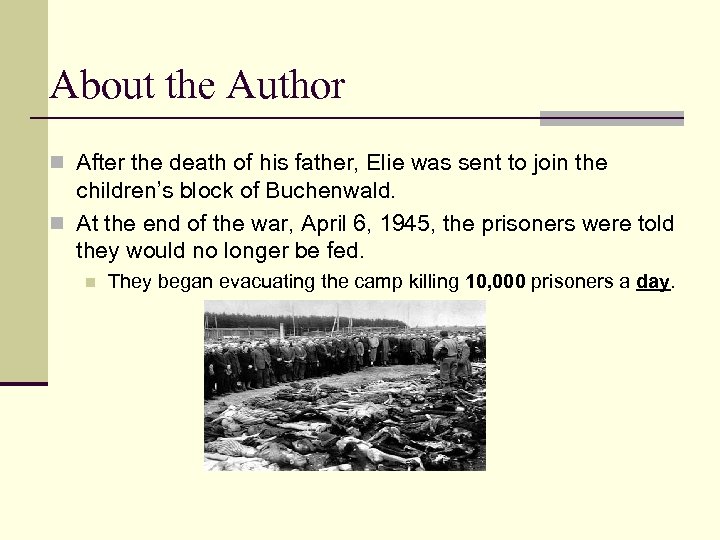 About the Author n After the death of his father, Elie was sent to join the children’s block of Buchenwald. n At the end of the war, April 6, 1945, the prisoners were told they would no longer be fed. n They began evacuating the camp killing 10, 000 prisoners a day.
 About the Author n After he was freed from the camp on April 11, Wiesel became sick with intestinal problems. n After several days in the hospital, Wiesel wrote an outline for a book describing the Holocaust. n He wasn’t ready to publicize his experience, but promised he would in ten years.
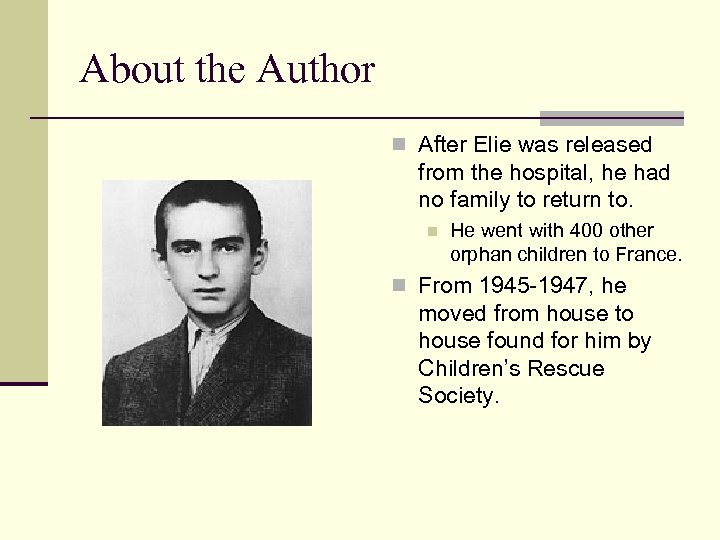 About the Author n After Elie was released from the hospital, he had no family to return to. n He went with 400 other orphan children to France. n From 1945 -1947, he moved from house to house found for him by Children’s Rescue Society.
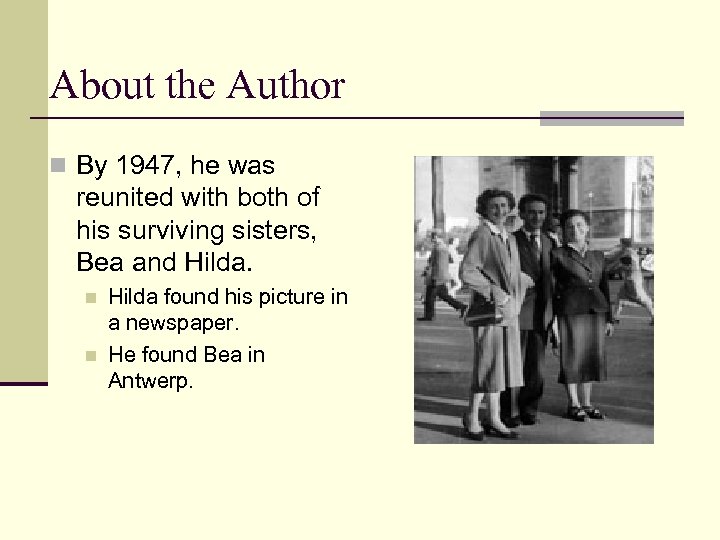 About the Author n By 1947, he was reunited with both of his surviving sisters, Bea and Hilda. n n Hilda found his picture in a newspaper. He found Bea in Antwerp.
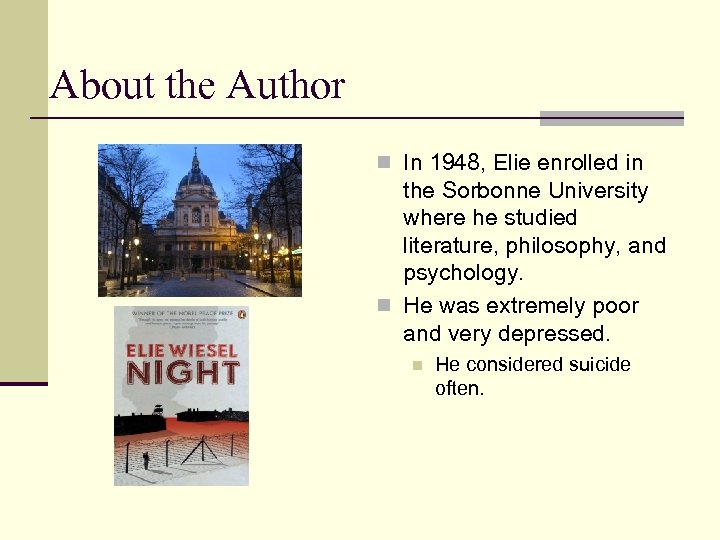 About the Author n In 1948, Elie enrolled in the Sorbonne University where he studied literature, philosophy, and psychology. n He was extremely poor and very depressed. n He considered suicide often.
 About the Author n Over time, he became involved with the Irgun, a Jewish militant organization in Palestine, and translated materials from Hebrew to Yiddish for the Irgun’s newspaper. n He began working as a reporter, and in 1949, he traveled to Israel as a correspondent for the French newspaper, L’Arche. n In Israel, he found a job as a Paris correspondent for the Israeli newspaper Yediot Achronot. n n He traveled the world in the 1950’s. He also became involved in the argument whether Israel should accept reparations payments from West Germany.
 Turning Point n Weisel’s turning point came when he interviewed the Catholic writer, Fancois Mauriac. n During the interview, everything was centered around Jesus and Wiesel ended up saying the following; n "…ten years ago, not very far from here, I knew Jewish children every one of whom suffered a thousand times more, six million times more, than Christ on the cross. And we don’t speak about them. " n Wiesel ran out of the room, but Mauriac followed and advised Weisel to write down his experience.
 The Novel n Elie spent a year working on the 862 page manuscript he called And the World Was Silent. n n He gave it to his publisher who returned it as a 258 page book called Night. The book was published first in France in 1958 and then in the U. S. in 1960. n n The book is autobiographical and told of his experiences during the Holocaust. It also is his personal account of his loss of religious faith.
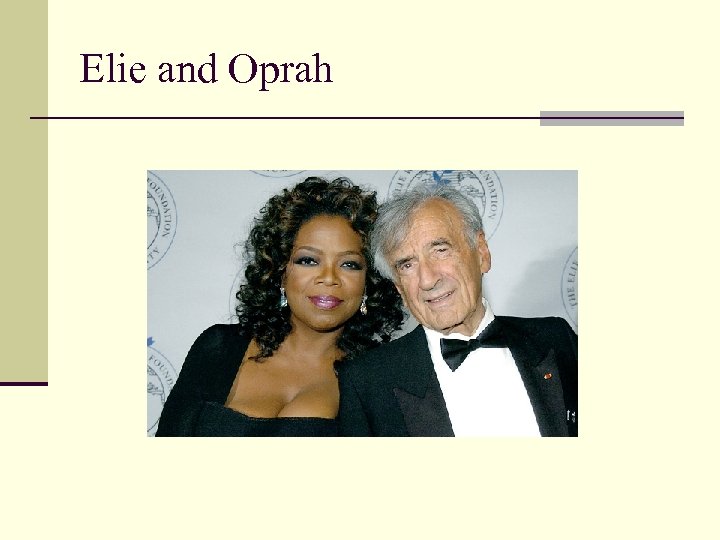 Elie and Oprah
 Losing Faith n In 1955, Wiesel moved to New York as foreign correspondent for Yediot Ahronot. n It was around this time that he decided to stop attending synagogue, except on the High Holidays, as a protest against what he concluded was divine injustice.
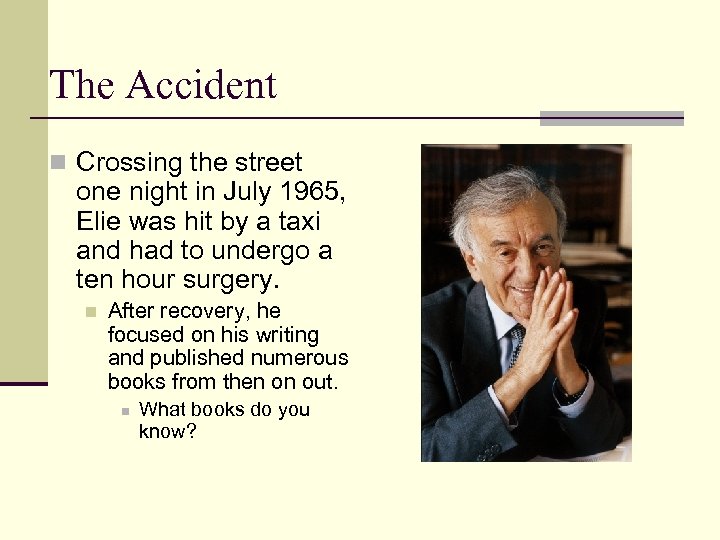 The Accident n Crossing the street one night in July 1965, Elie was hit by a taxi and had to undergo a ten hour surgery. n After recovery, he focused on his writing and published numerous books from then on out. n What books do you know?
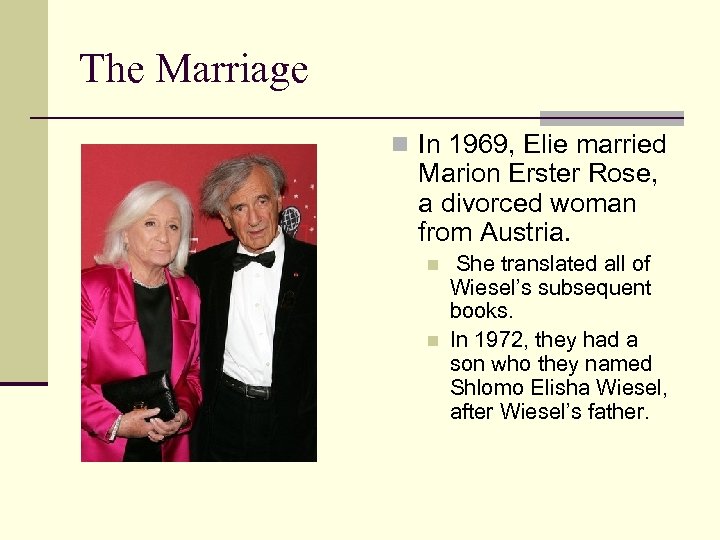 The Marriage n In 1969, Elie married Marion Erster Rose, a divorced woman from Austria. n n She translated all of Wiesel’s subsequent books. In 1972, they had a son who they named Shlomo Elisha Wiesel, after Wiesel’s father.
 Dedication n Wiesel was outspoken about the suffering of all people, not only Jews. n n n In the 1970 s, he protested against South African apartheid. In 1980, he delivered food to starving Cambodians In 1986, he received the Nobel Peace Prize as “a messenger to mankind, ” and “a human being dedicated to humanity. ” n He explained his actions by saying the whole world knew what was happening in the concentration camps, but did nothing. “That is why I swore never to be silent whenever and wherever human beings endure suffering and humiliation. ”
 Accomplishments n From 1972 to 1978, Wiesel was a Distinguished Professor of Judaic Studies at the City University of New York. n 1978, he became a Professor of Humanities at Boston University. n In 1978, President Jimmy Carter asked him to head the U. S. Holocaust Memorial Council, which he did for six years. n In 1985, Wiesel was awarded the Congressional Gold Medal of Achievement.
 Accomplishments n In 1988, he established his own humanitarian foundation, the Elie Wiesel Foundation for Humanity, to explore the problems of hatred and ethnic conflicts. n In the early 1990 s, he lobbied the U. S. government on behalf of victims of ethnic cleansing in Bosnia. n Wiesel has received numerous awards and approximately 75 honorary doctorates.
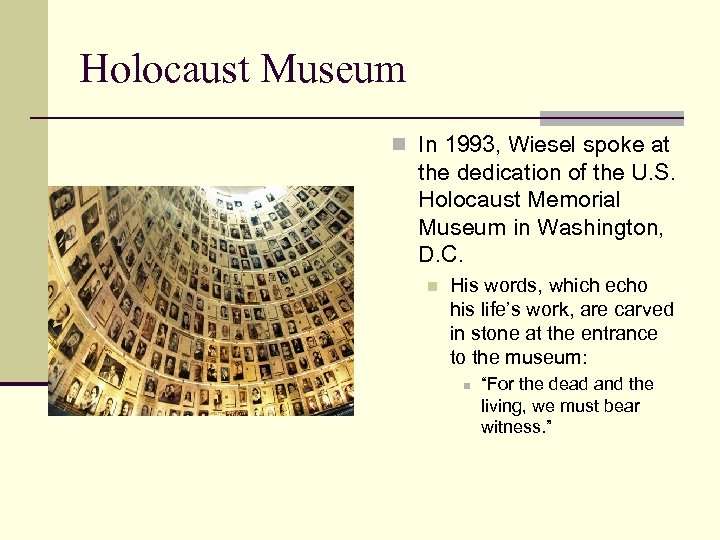 Holocaust Museum n In 1993, Wiesel spoke at the dedication of the U. S. Holocaust Memorial Museum in Washington, D. C. n His words, which echo his life’s work, are carved in stone at the entrance to the museum: n “For the dead and the living, we must bear witness. ”
 Quotes to Remember n A destruction, an annihilation that only man can provoke, only man can prevent. n Hope is like peace. It is not a gift from God. It is a gift only we can give one another. n I decided to devote my life to telling the story because I felt that having survived I owe something to the dead. and anyone who does not remember betrays them again. n I swore never to be silent whenever and wherever human beings endure suffering and humiliation. We must always take sides. Neutrality helps the oppressor, never the victim. Silence encourages the tormentor, never the tormented.
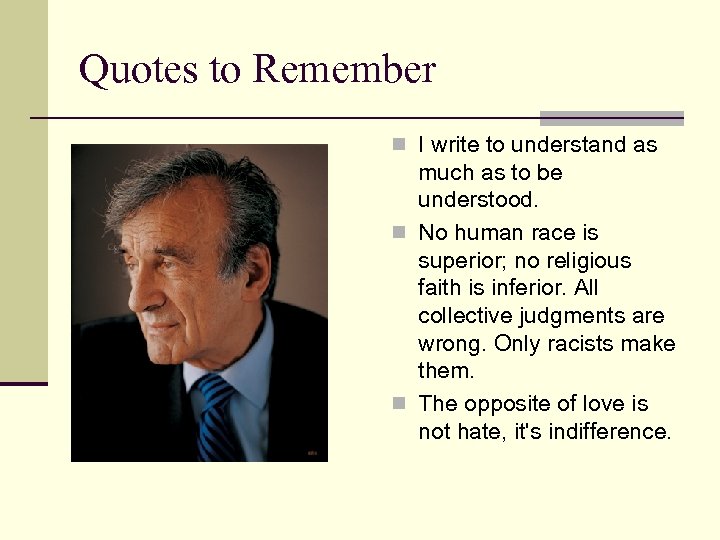 Quotes to Remember n I write to understand as much as to be understood. n No human race is superior; no religious faith is inferior. All collective judgments are wrong. Only racists make them. n The opposite of love is not hate, it's indifference.