 Скачать презентацию Introduction to Disarmament Demobilization and Reintegration DDR Weapons
139a96a1a40748989ff0412fd2d0fc4b.ppt
- Количество слайдов: 25



Introduction to Disarmament, Demobilization and Reintegration (DDR) Weapons Collection FO 07 Slide 1
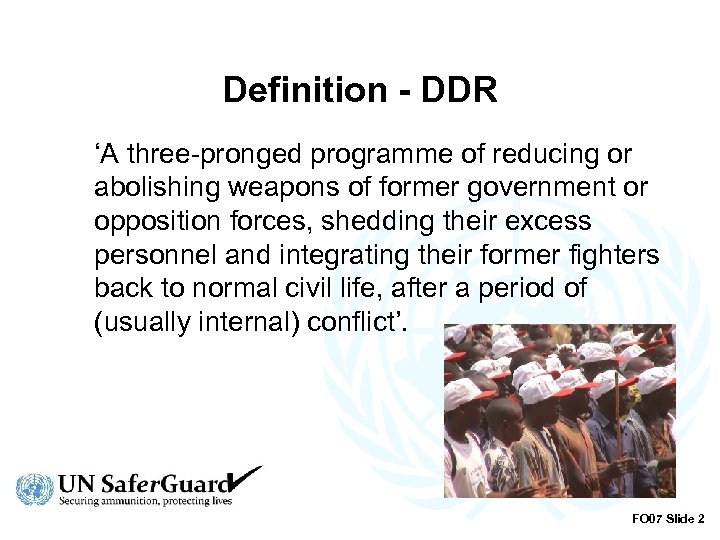
Definition - DDR ‘A three-pronged programme of reducing or abolishing weapons of former government or opposition forces, shedding their excess personnel and integrating their former fighters back to normal civil life, after a period of (usually internal) conflict’. FO 07 Slide 2
Definition – SALW Control ‘Those activities, which, together, aim to reduce the social, economic and environmental impact of uncontrolled SALW proliferation and possession’. FO 07 Slide 3
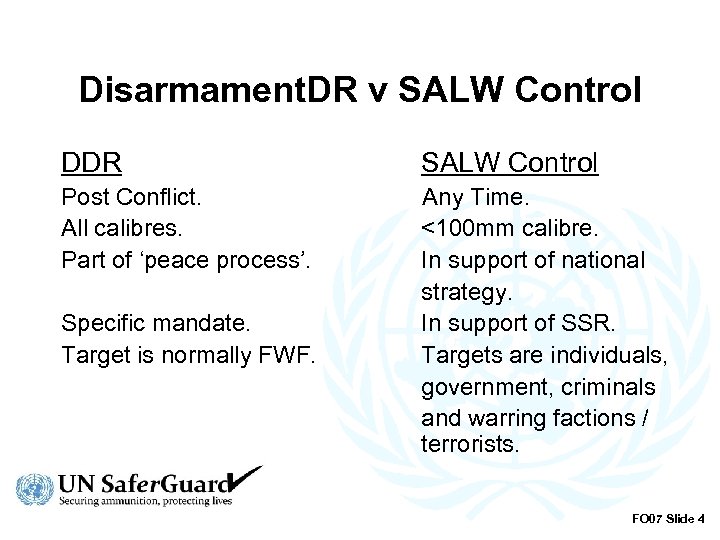
Disarmament. DR v SALW Control DDR SALW Control Post Conflict. All calibres. Part of ‘peace process’. Any Time. <100 mm calibre. In support of national strategy. In support of SSR. Targets are individuals, government, criminals and warring factions / terrorists. Specific mandate. Target is normally FWF. FO 07 Slide 4
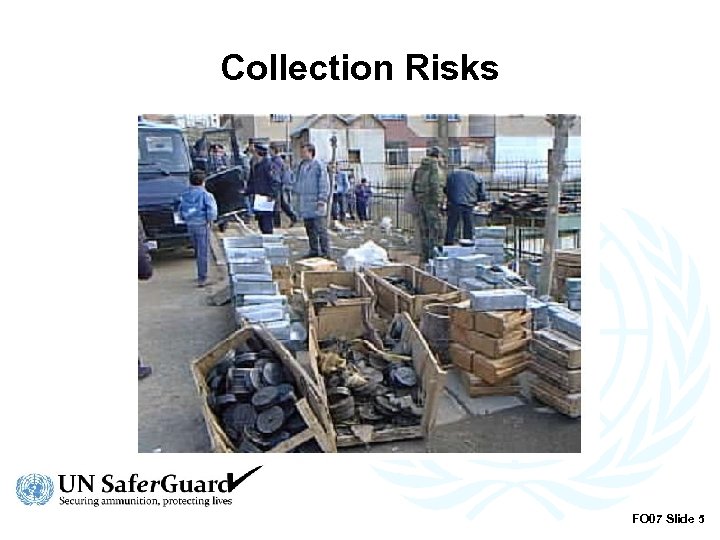
Collection Risks FO 07 Slide 5
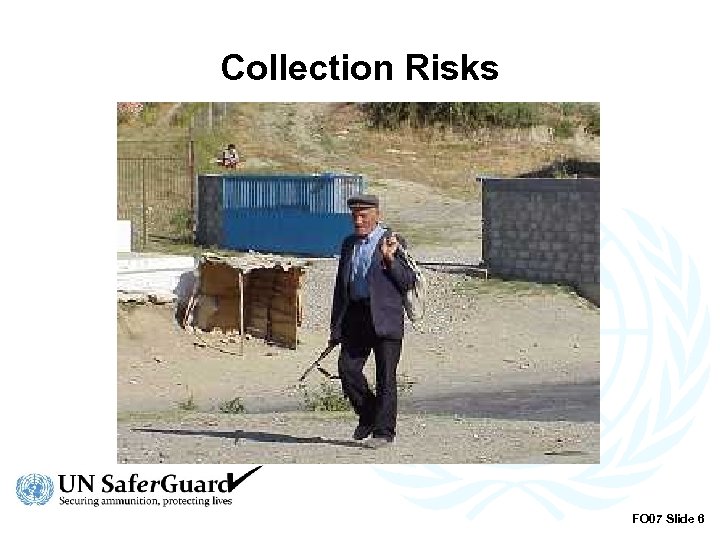
Collection Risks FO 07 Slide 6
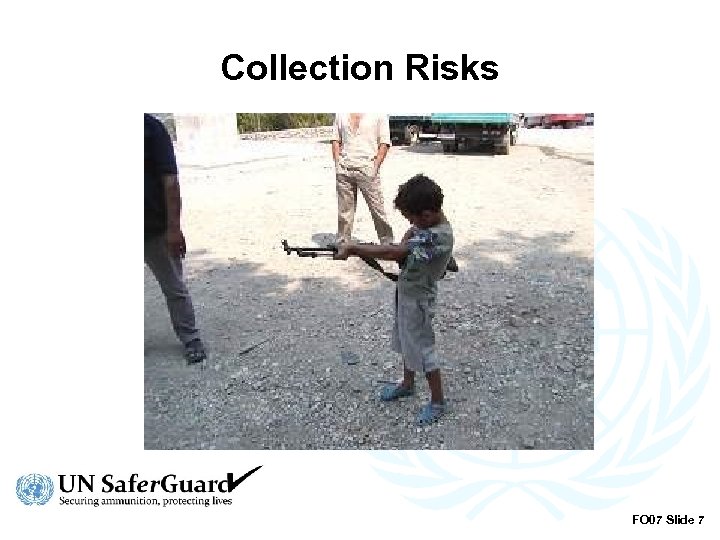
Collection Risks FO 07 Slide 7
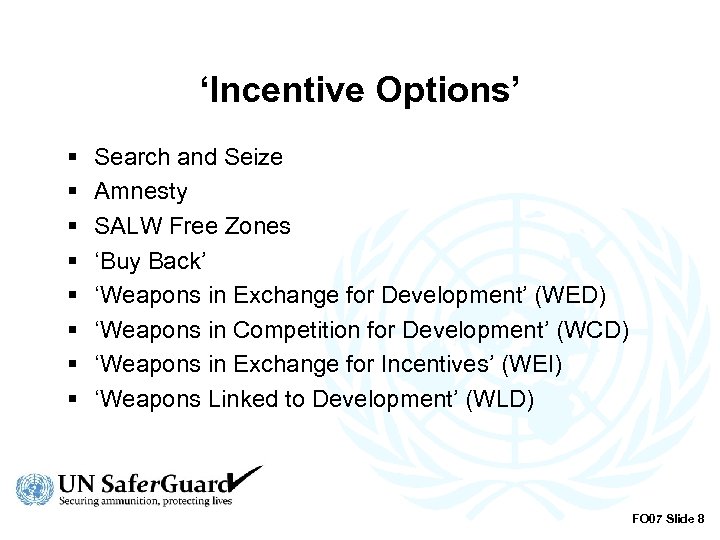
‘Incentive Options’ § § § § Search and Seize Amnesty SALW Free Zones ‘Buy Back’ ‘Weapons in Exchange for Development’ (WED) ‘Weapons in Competition for Development’ (WCD) ‘Weapons in Exchange for Incentives’ (WEI) ‘Weapons Linked to Development’ (WLD) FO 07 Slide 8
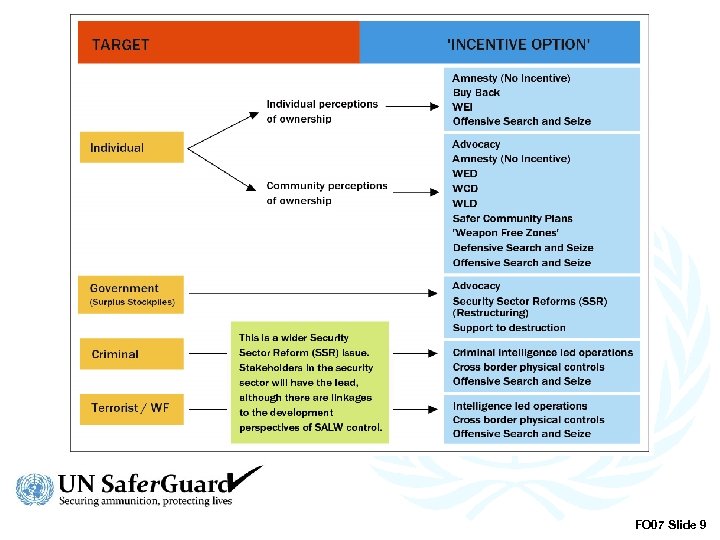
FO 07 Slide 9
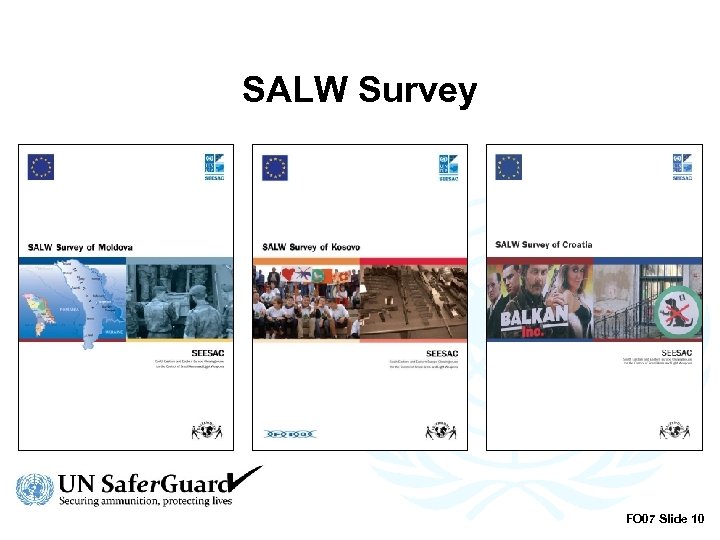
SALW Survey FO 07 Slide 10
Why SALW Survey ? § SALW Survey takes account of ALL stakeholders views. § To obtain and share knowledge. § To maintain permanent records. § Necessary for project planning and efficient operational management. § Necessary to support any SALW Awareness campaign. FO 07 Slide 11
Why SALW Survey ? § Required for the development of Performance Indicators (PI) for project or operational evaluation. § SALW Survey is a distinct operational task. FO 07 Slide 12
The Aim of SALW Survey To determine the nature and extent of SALW proliferation and impact within a region, nation or community in order to provide accurate data and information for a safe, effective and efficient intervention by an appropriate organisation. FO 07 Slide 13
Components of SALW Survey § § SALW Distribution Assessment (SADA) SALW Impact Survey (SAIS) SALW Perception Survey (SAPS) SALW Capacity Survey (SACS) FO 07 Slide 14
Risk assessment § To ensure the safest possible working environment. § To identify ‘tolerable risk’. § To identify ‘protective measures’. § To identify ‘residual risk’. FO 07 Slide 15
There is no absolute safety! Safety is achieved by reducing risk to tolerable levels. Tolerable risk is determined by the search for an optimal balance between the ideal of absolute safety and the demands to be met by the process, and factors such as benefit to the user, suitability for purpose, cost effectiveness, and conventions of the society concerned. It follows that there is a need to review continually the tolerable level, in particular when developments, both in technology and in knowledge, can lead to economically feasible improvements to attain the minimum risk compatible with the use of the process. (ISO) FO 07 Slide 16
Achieving tolerable risk § The selection of equipment with inherently safe design; § The development of work practices that contribute to risk reduction; § Risk education as part of a SALW awareness campaign; § Sound and effective training; § Sound management and supervision; and § Appropriate personal protective equipment. FO 07 Slide 17
Explosive risk § Evaluate risk from returned ammunition, explosives and UXO. § Ensure adequate explosion danger areas. § Take appropriate technical advice. (Experts!) FO 07 Slide 18
Collection phases § Pre-operational activities • • SALW survey Capacity assessment Training Logistic planning § Weapons Registration / SALW Accounting FO 07 Slide 19
Collection phases § Pre-operational activities • • SALW survey Capacity assessment Training Logistic planning § Weapons Registration / SALW Accounting § Recce Weapons Collection Points (WCP) FO 07 Slide 20
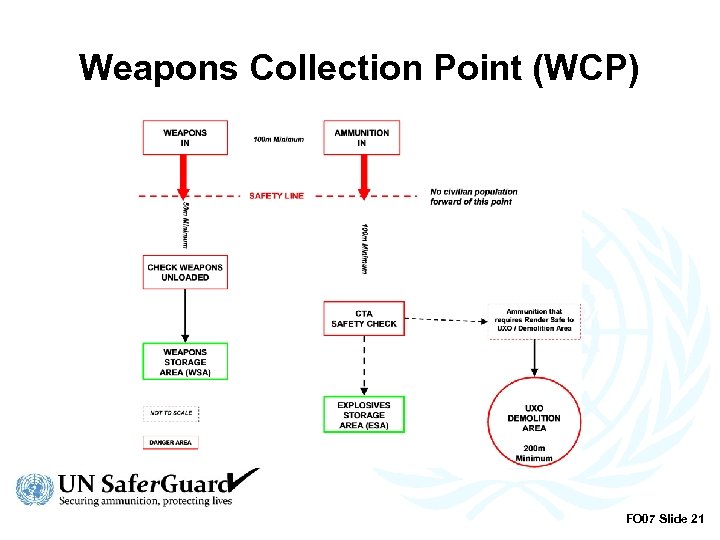
Weapons Collection Point (WCP) FO 07 Slide 21
Collection phases § Pre-operational activities • • § § SALW survey Capacity assessment Training Logistic planning Weapons Registration / SALW Accounting Recce Weapons Collection Points (WCP) Integrate with SALW Awareness Explosive Safety activities FO 07 Slide 22
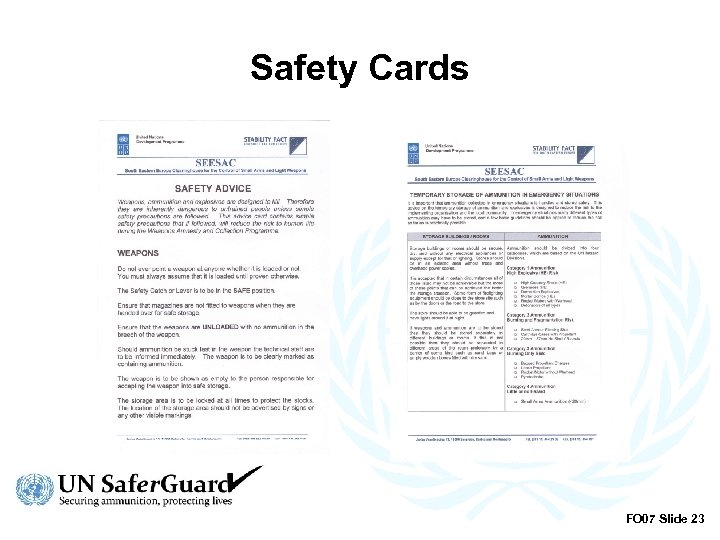
Safety Cards FO 07 Slide 23
Comment § Security presence at WCP must be inobtrusive; maintain a balance. § Don’t assume that police and army are safe when handling weapons. § Transparency and safety are the keys to technical success; although cannot guarantee voluntary surrender. § Monitoring is an essential component for maintaining standards and improving public confidence. FO 07 Slide 24
Questions FO 07 Slide 25
Скачать презентацию Introduction to Disarmament Demobilization and Reintegration DDR Weapons
139a96a1a40748989ff0412fd2d0fc4b.ppt