


 Скачать презентацию Introduction to Digital Rights Management DRM Multimedia Security
405394ab9582f0f287c1bae3df84fa30.ppt
- Количество слайдов: 97
 Introduction to Digital Rights Management (DRM) Multimedia Security
 Outline • Digital rights management: an overview • Digital watermarking – Basics and models – Trends and challenges • • • Cryptography in DRM Digital rights languages Important DRM standards Legislative concerns about DRM researches in CML 2
 Digital Rights Management: An Overview
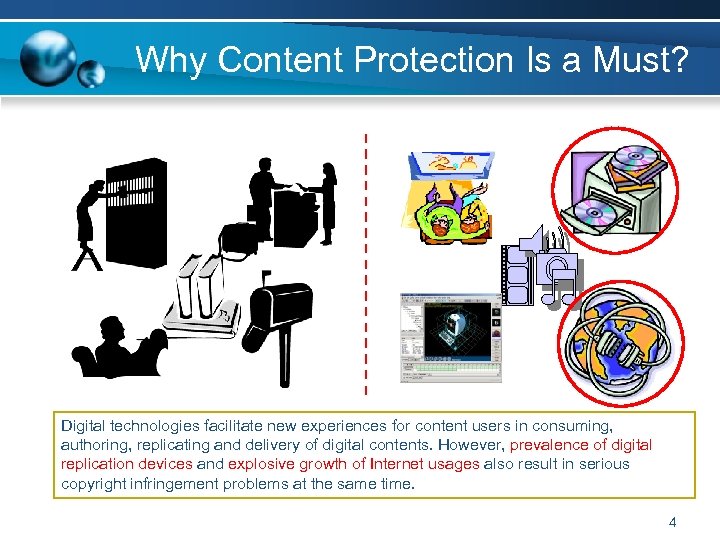 Why Content Protection Is a Must? Digital technologies facilitate new experiences for content users in consuming, authoring, replicating and delivery of digital contents. However, prevalence of digital replication devices and explosive growth of Internet usages also result in serious copyright infringement problems at the same time. 4
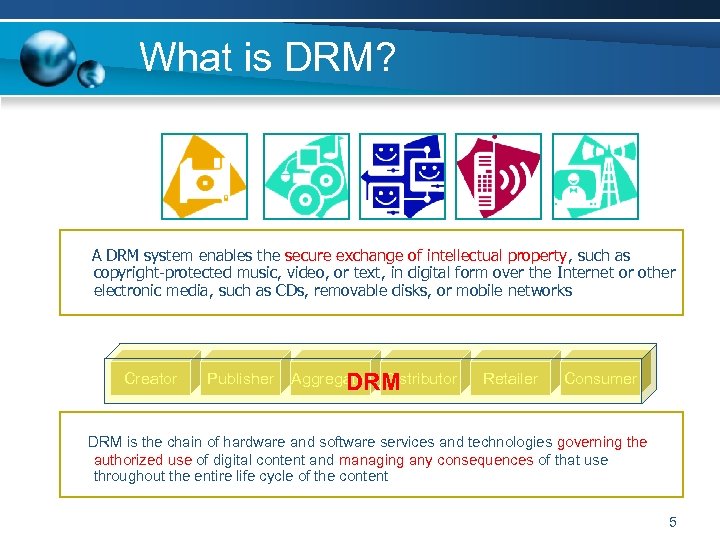 What is DRM? A DRM system enables the secure exchange of intellectual property, such as copyright-protected music, video, or text, in digital form over the Internet or other electronic media, such as CDs, removable disks, or mobile networks Creator Publisher Aggregator Distributor DRM Retailer Consumer DRM is the chain of hardware and software services and technologies governing the authorized use of digital content and managing any consequences of that use throughout the entire life cycle of the content 5
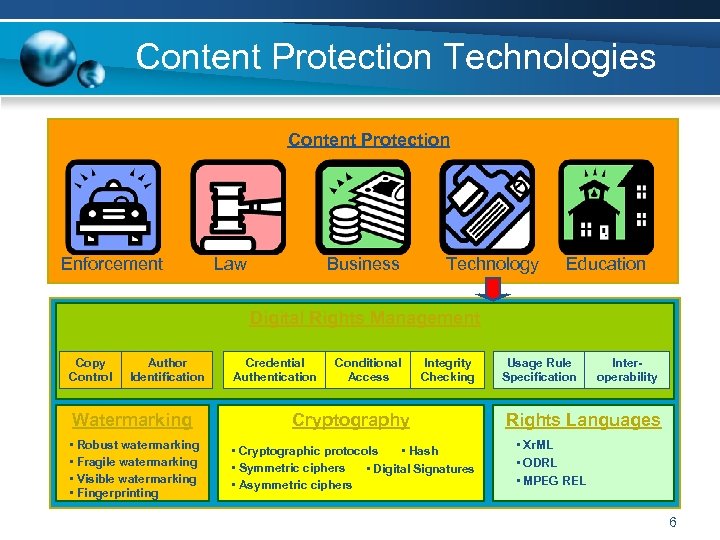 Content Protection Technologies Content Protection Enforcement Law Business Technology Education Digital Rights Management Copy Control Author Identification Credential Authentication Conditional Access Integrity Checking Watermarking Cryptography • Robust watermarking • Fragile watermarking • Visible watermarking • Fingerprinting • Cryptographic protocols • Hash • Symmetric ciphers • Digital Signatures • Asymmetric ciphers Usage Rule Specification Interoperability Rights Languages • Xr. ML • ODRL • MPEG REL 6
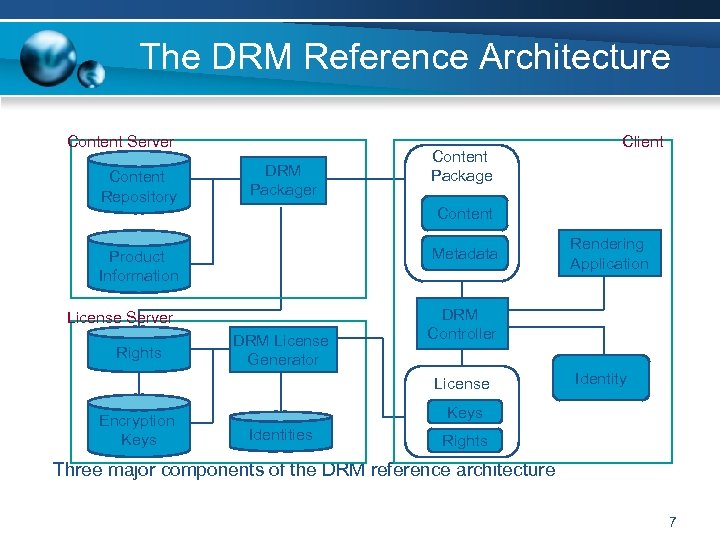 The DRM Reference Architecture Content Server Content Repository DRM Packager Content Metadata Product Information License Server Rights Content Package DRM License Generator Rendering Application DRM Controller License Encryption Keys Client Identity Keys Identities Rights Three major components of the DRM reference architecture 7
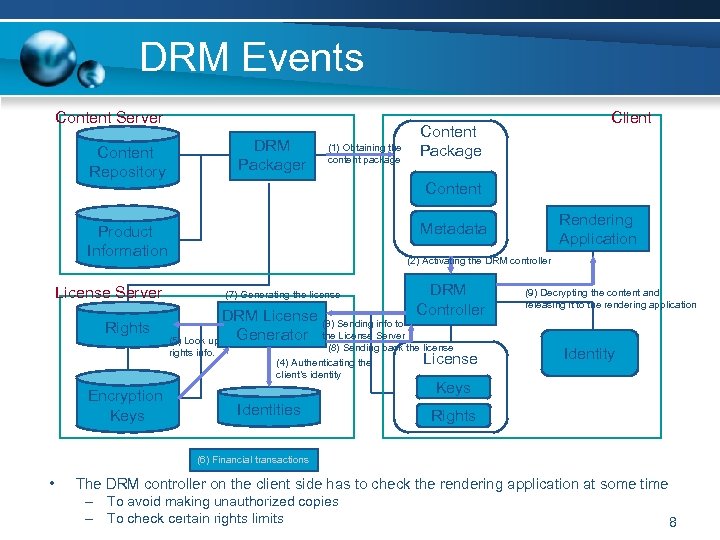 DRM Events Content Server DRM Packager Content Repository (1) Obtaining the content package Rendering Application Metadata (2) Activating the DRM controller License Server (7) Generating the license DRM License (3) Sending info to Generator the License Server (5) Look up rights info. Encryption Keys Content Package Content Product Information Rights Client DRM Controller (8) Sending back the license (4) Authenticating the client’s identity License (9) Decrypting the content and releasing it to the rendering application Identity Keys Identities Rights (6) Financial transactions • The DRM controller on the client side has to check the rendering application at some time – To avoid making unauthorized copies – To check certain rights limits 8
 Digital Watermarking Technologies
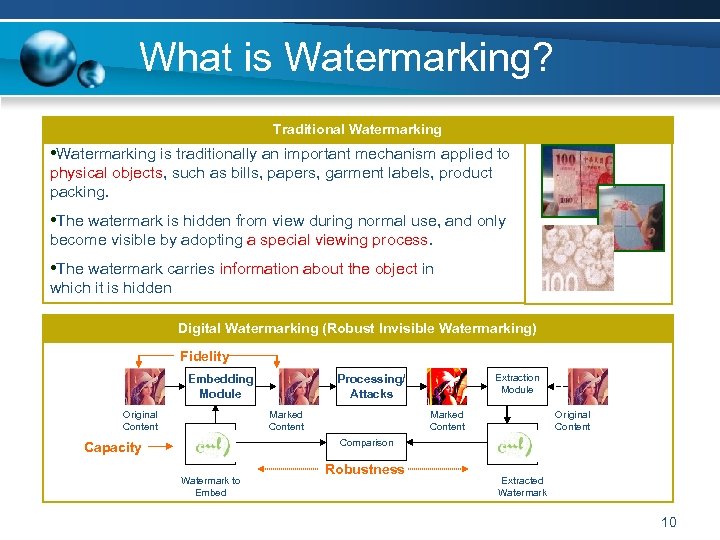 What is Watermarking? Traditional Watermarking • Watermarking is traditionally an important mechanism applied to physical objects, such as bills, papers, garment labels, product packing. • The watermark is hidden from view during normal use, and only become visible by adopting a special viewing process. • The watermark carries information about the object in which it is hidden Digital Watermarking (Robust Invisible Watermarking) Fidelity Embedding Module Marked Content Original Content Extraction Module Processing/ Attacks Marked Content Original Content Comparison Capacity Watermark to Embed Robustness Extracted Watermark 10
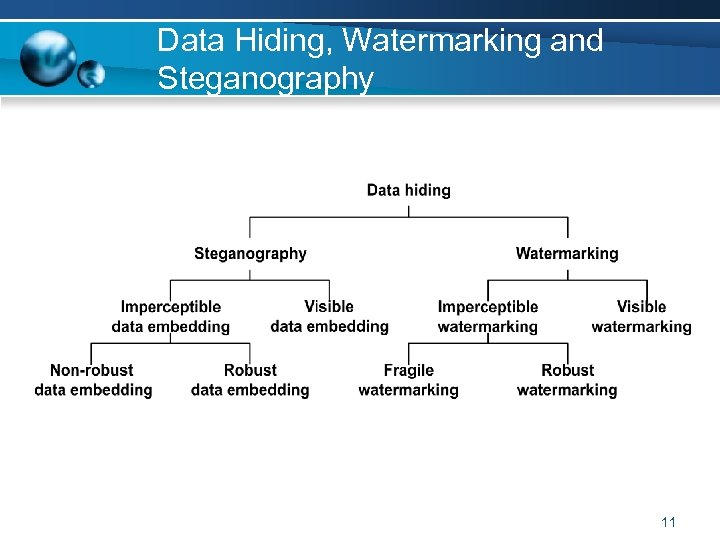 Data Hiding, Watermarking and Steganography 11
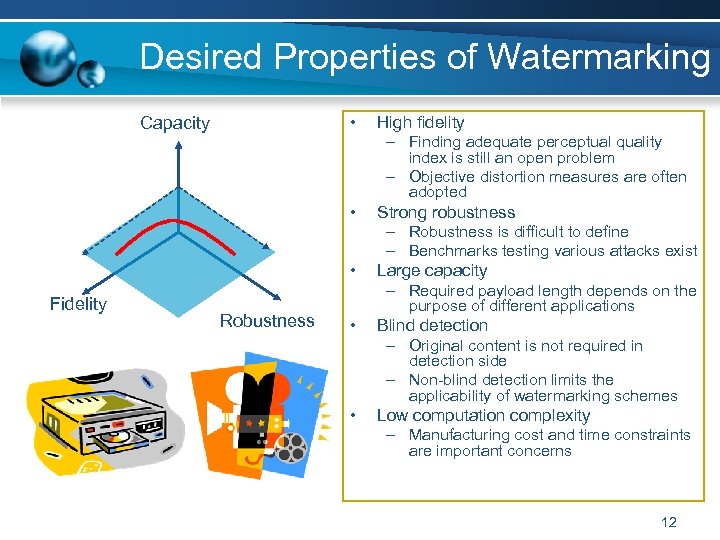 Desired Properties of Watermarking • Capacity High fidelity – Finding adequate perceptual quality index is still an open problem – Objective distortion measures are often adopted • • Fidelity Robustness Strong robustness – Robustness is difficult to define – Benchmarks testing various attacks exist Large capacity – Required payload length depends on the purpose of different applications • Blind detection – Original content is not required in detection side – Non-blind detection limits the applicability of watermarking schemes • Low computation complexity – Manufacturing cost and time constraints are important concerns 12
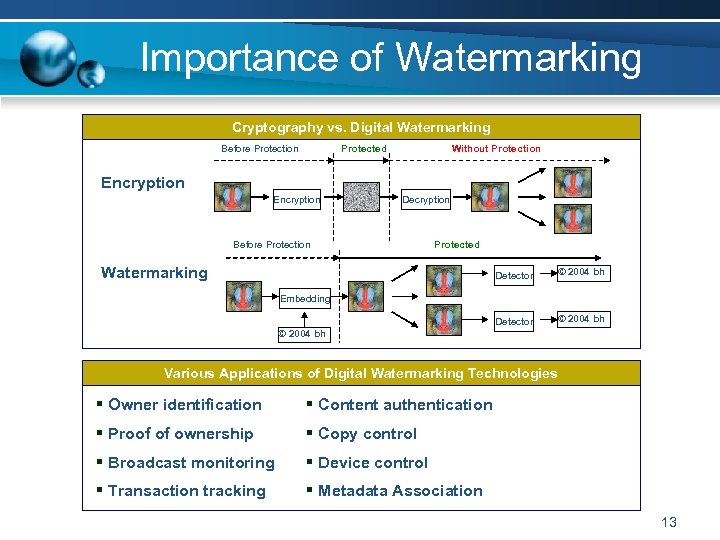 Importance of Watermarking Cryptography vs. Digital Watermarking Before Protection Protected Without Protection Encryption : Decryption Before Protection Protected Watermarking Detector Embedding © 2004 bh : © 2004 bh Various Applications of Digital Watermarking Technologies § Owner identification § Content authentication § Proof of ownership § Copy control § Broadcast monitoring § Device control § Transaction tracking § Metadata Association 13
 Owner Identification (I) • Under the U. S. law, although the copyright notice is not required in every distributed copy to protect the rights of copyright holders, the award to the copyright holders whose work is misused will be significantly limited without a copyright notice found on the distributed materials. • Traditional textual copyright notices – “Copyright date owner” – “© date owner” – “Copr. date owner” 14
 Owner Identification (II) • Disadvantages for textual copyright notices – Easily removed from a document when it is copied • E. g. the Lena Sjooblom picture (see the next slide) – Copyright notices printed on the physical medium are not copied along with the digital content • E. g. the Music CD – Occupying a portion of the image and aesthetically reducing the value of artworks • Since watermarks are imperceptible and inseparable from the work, they are obviously superior to textual copyright notices. 15
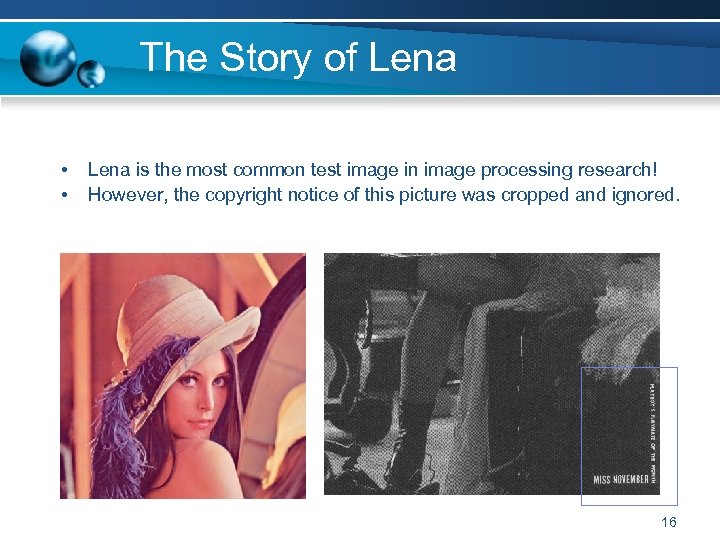 The Story of Lena • • Lena is the most common test image in image processing research! However, the copyright notice of this picture was cropped and ignored. 16
 Proof of Ownership • Textual copyright notices cannot be used to solve the copyright dispute since they can be easily forged • Registering every work to a central repository is too costly! – http: //www. loc. gov/copyright – $30 per document • Watermarking can be of use! 17
 Broadcast Monitoring (I) • TV or radio advertisements should be monitored to prevent airtime overbooking! – In 1997, a scandal broke out in Japan. Advertisers are paying for thousands of commercials that were never aired! • Broadcast monitoring – By human watchers – Passive monitoring – Active monitoring 18
 Broadcast Monitoring (II) • Passive monitoring – Use computers to monitor received signal and compares with a database of known contents – Disadvantages • Comparing is not trivial • Signal degraded due to broadcasting • Management and maintenance of the database is quite expensive 19
 Broadcast Monitoring (III) • Active monitoring – Simpler to implement – Identification information can be directly decoded reliably – E. g. • close captions on VBI or file headers – Watermarking is an obvious alternative method of hiding identification information • Existing within the content • Completely compatible with the equipments 20
 Transaction Tracking • Watermarks recording the recipient in each legal sale or distribution of the work. • If the work is misused (leaked to the press or illegally distributed), the owner could find out who is the traitor. • Visible watermarking is often adopted in this application, but Invisible watermark is even better 21
 The Defunct Di. VX DVD Player • The DIVX Corporation sold a enhanced DVD player that implements a pay-per-view model. • Each player will place a unique watermark in the video disk it played. • Once the video disk is recorded and sold, the adversary can be tracked! 22
 Copy Control (I) • Encryption is the first and strongest line of defense against illegal copy – Overcome an encryption mechanism • Decrypt a copy without a valid key – Theoretically infeasible for a well designed system • Obtain a valid key – Reverse-engineering hardware or software – E. g. the De. CSS program against the CSS protecting DVD • Legally obtain a key and pirate the decrypted content – The central weakness of cryptographic protection! – The content must be decrypted before it is used, but all protection is lost once decrypted! 23
 Copy Control (II) • Watermarking in copy control – Combining every content recorder with a watermark detector – When a copy-prohibit watermark is detected, the recording device will refuse to copy – The system has been envisioned by CPTWG and SDMI to protect DVD and audio 24
 Copy Control (III) • Problems of adopting watermarking module in recording devices – Increasing cost – Reducing the value of devices • Solution – Include the requirement for a watermark detector in the patent license of CSS instead of enforcing by law 25
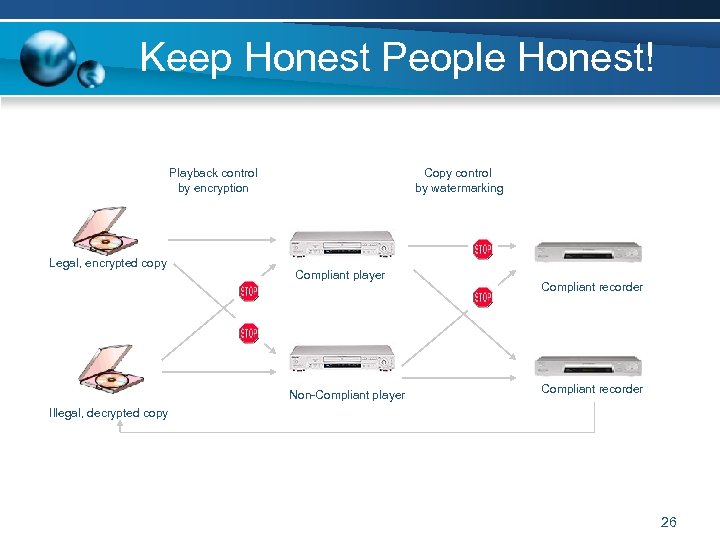 Keep Honest People Honest! Playback control by encryption Legal, encrypted copy Copy control by watermarking Compliant player Non-Compliant player Compliant recorder Illegal, decrypted copy 26
 Device Control • Copy control belongs to a broader category device control • Other applications of device control – Automatically turning on/off functions related to special contents • E. g Including watermark to skip advertisements – Action toys interactive with the TV program – Digimarc’s Media. Bridge 27
 Properties of Watermarking • Correct detection result – Embedding effectiveness – False-alarm rate • Fidelity (perceptual similarity) • Resisting distortions – Robustness – Security • Data payload (capacity) • Blind/informed watermarking • Cost 28
 Effectiveness • Effectiveness of a watermarking system – The probability of detection after embedding – A 100% effectiveness is desirable, but it is often not the case due to other conflict requirements, such as perceptual similarity • E. g. watermarking system for a stock photo house 29
 False-alarm Rate • Detection of watermark in a work that do not actually contain one – The number of false positives occur in a given number of runs of watermark detector • The false alarm rate of the watermarking system used in DVD recorder should be lower than 1/1012 – E. g. a false alarm occurred in a world-series baseball game 30
 Fidelity (Perceptual Similarity) • The fidelity of the watermarking system – The perceptual similarity between the original and the watermarked version of the cover work – It is the similarity at the point at which the watermarked content is provided to the customer that counts • E. g. NTSC video or AM radio has different perceptual similarity requirements from the HDTV or DVD video and audio 31
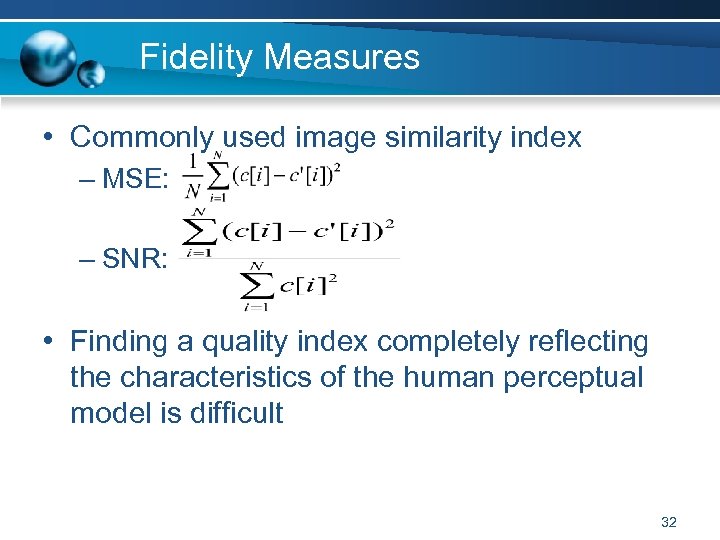 Fidelity Measures • Commonly used image similarity index – MSE: – SNR: • Finding a quality index completely reflecting the characteristics of the human perceptual model is difficult 32
 Robustness (I) • The ability to detect the watermark after common signal processing operations – Common images distortions • spatial filtering, lossy compression, printing/scanning, geometric distortions – Common video distortions • Changes in frame rate, recording to tape… – Common audio distortions • temporal filtering, recording on audio tape… 33
 Robustness (II) • Not all watermarking applications require robustness to all possible signal processing operations. • There is a special class of watermarking techniques where robustness is undesirable – The fragile watermarking 34
 Security • The ability to resist hostile attacks – Unauthorized removal • Eliminating attacks • Masking attacks • Collusion attacks – Unauthorized embedding • Embed forgery watermarks into works that should not contain watermarks • E. g. fragile watermarks for Authentication – Unauthorized detection 35
 Data Capacity • The number of bits a watermarking scheme encodes within a unit of time or within a work. • Different applications require different data capacities, e. g. – 4 -8 bits for a 5 -minutes video of copy control – Longer messages for broadcast monitoring 36
 Blind/Informed Detection • Informed watermarking schemes – The detector requires access to the unwatermarked original • E. g. transaction tracking, • Blind watermarking schemes – Detectors do not require any information related to the original • E. g. DVD copy control module • E. g. An automatic image IPR checking robot 37
 Multiple Watermarks • In certain cases, more than one watermarks are needed. – E. g. American copyright grants the right of TV viewers to make a single copy of broadcast programs for time-shift watch. But further copies is not allowed. • Adding two watermarks instead of alternating the original watermark to avoid the risk caused by easily changing watermarks 38
 Cost • The costs in deploying watermark embedders and detectors depends on the scenario and the business model. – Real-time constraint • Broadcast monitoring v. s. proof of copyright – Embedder/detector constraint • Copy protection v. s. transaction tracking (DIV-X) 39
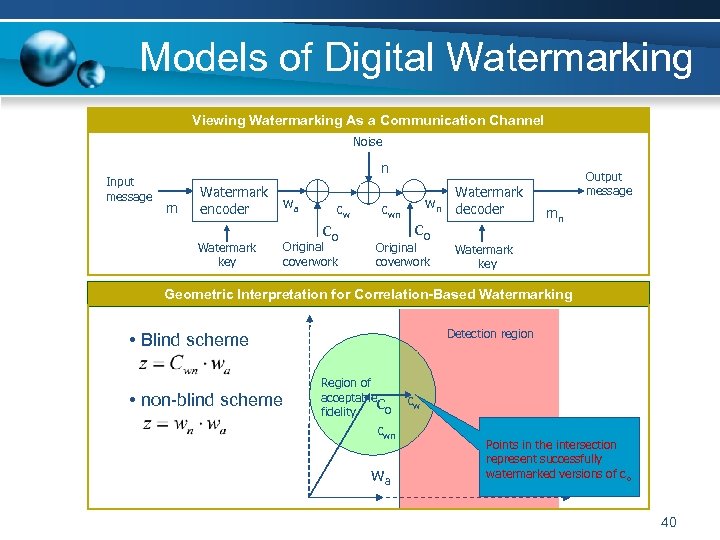 Models of Digital Watermarking Viewing Watermarking As a Communication Channel Noise Input message n m Watermark encoder Watermark key wa cw co Original coverwork cwn wn co Original coverwork Watermark decoder Output message mn Watermark key Geometric Interpretation for Correlation-Based Watermarking Detection region • Blind scheme • non-blind scheme Region of acceptable co fidelity cwn wa cw Points in the intersection represent successfully watermarked versions of c o 40
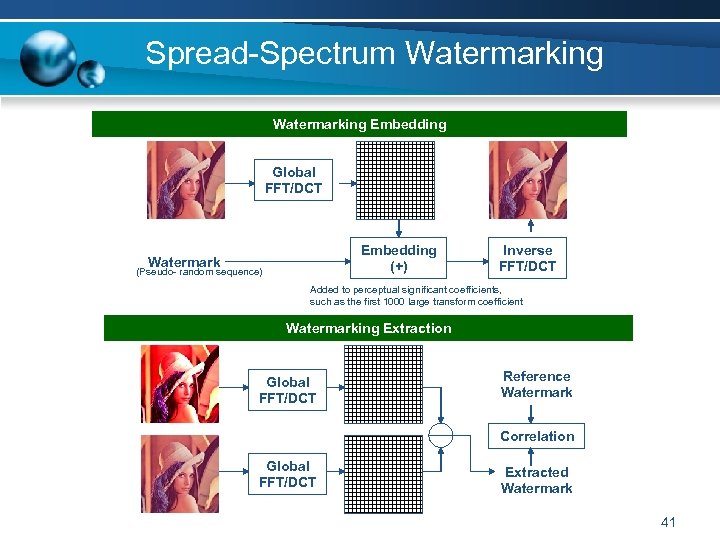 Spread-Spectrum Watermarking Embedding Global FFT/DCT Embedding (+) Watermark (Pseudo- random sequence) Inverse FFT/DCT Added to perceptual significant coefficients, such as the first 1000 large transform coefficient Watermarking Extraction Global FFT/DCT Reference Watermark Correlation Global FFT/DCT Extracted Watermark 41
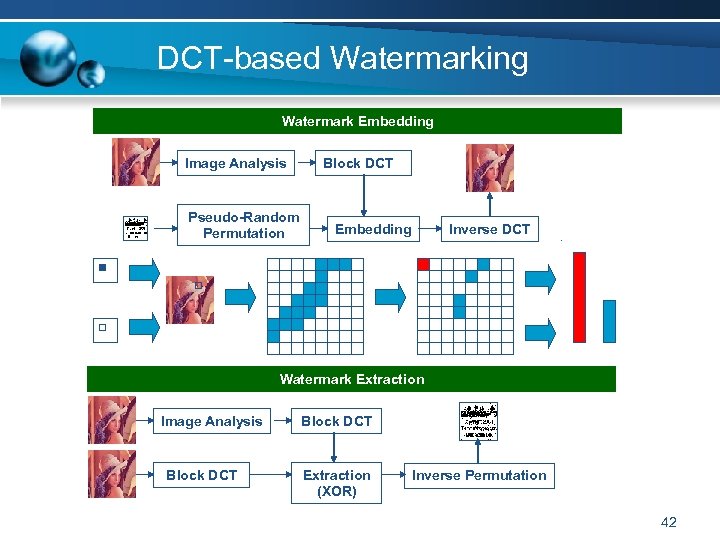 DCT-based Watermarking Watermark Embedding Image Analysis Pseudo-Random Permutation Block DCT Embedding Inverse DCT Watermark Extraction Image Analysis Block DCT Extraction (XOR) Inverse Permutation 42
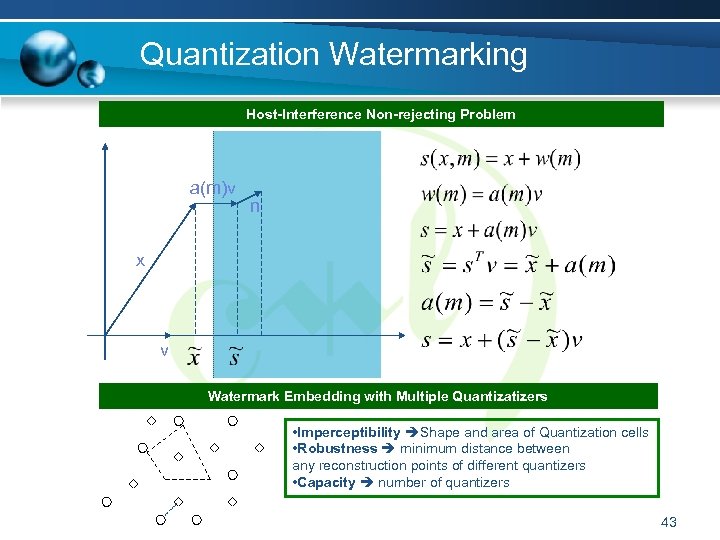 Quantization Watermarking Host-Interference Non-rejecting Problem a(m)v n x v Watermark Embedding with Multiple Quantizatizers • Imperceptibility Shape and area of Quantization cells • Robustness minimum distance between any reconstruction points of different quantizers • Capacity number of quantizers 43
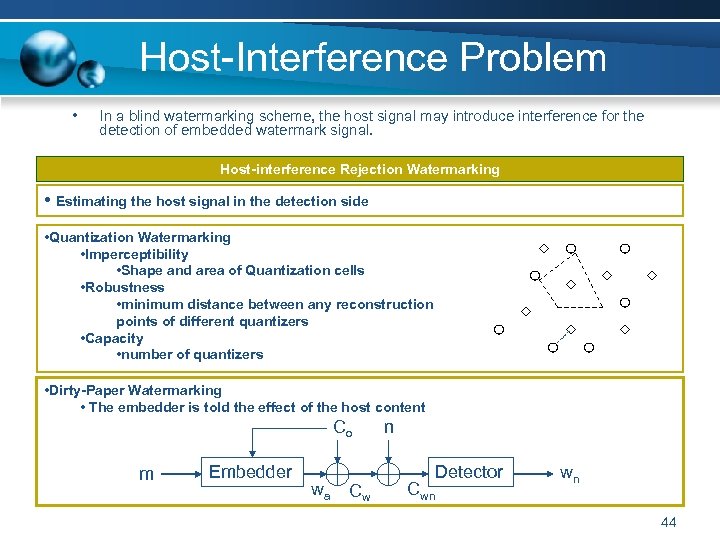 Host-Interference Problem • In a blind watermarking scheme, the host signal may introduce interference for the detection of embedded watermark signal. Host-interference Rejection Watermarking • Estimating the host signal in the detection side • Quantization Watermarking • Imperceptibility • Shape and area of Quantization cells • Robustness • minimum distance between any reconstruction points of different quantizers • Capacity • number of quantizers • Dirty-Paper Watermarking • The embedder is told the effect of the host content Co m Embedder wa Cw n Cwn Detector wn 44
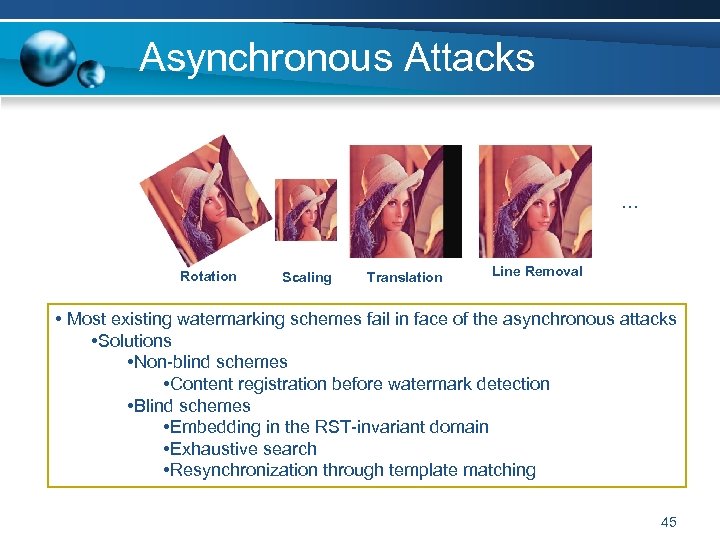 Asynchronous Attacks … Rotation Scaling Translation Line Removal • Most existing watermarking schemes fail in face of the asynchronous attacks • Solutions • Non-blind schemes • Content registration before watermark detection • Blind schemes • Embedding in the RST-invariant domain • Exhaustive search • Resynchronization through template matching 45
 Watermarking Benchmarks • Stirmark – http: //www. petitcolas. net/fabien/watermarking/ stirmark/ • Checkmark – http: //watermarking. unige. ch/Checkmark/inde x. html • Optimark – http: //poseidon. csd. auth. gr/optimark/ 46
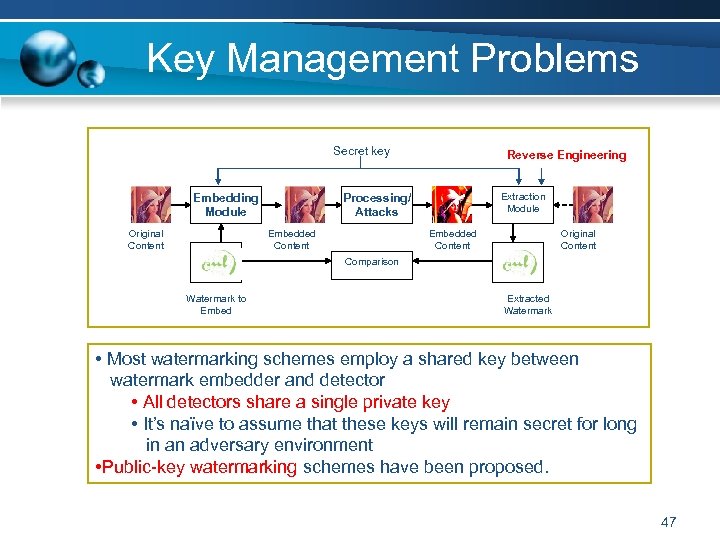 Key Management Problems Secret key Embedding Module Extraction Module Processing/ Attacks Embedded Content Original Content Reverse Engineering Embedded Content Original Content Comparison Watermark to Embed Extracted Watermark • Most watermarking schemes employ a shared key between watermark embedder and detector • All detectors share a single private key • It’s naïve to assume that these keys will remain secret for long in an adversary environment • Public-key watermarking schemes have been proposed. 47
 Lossless Data Hiding • Lossless watermarking is also named as reversible watermarking or invertible watermarking • In certain applications, it is desired to reverse the marked media back to the original cover media after the hidden data is retrieved. • Proposed approach • Reversible visible watermarking • Losslessly compressing bit-planes to leave space for data embedding • Modulo-addition based scheme • Integer Wavelet Transform based scheme • Difference expansion based scheme • Achieving high capacity while maintaining the fidelity constraint 48
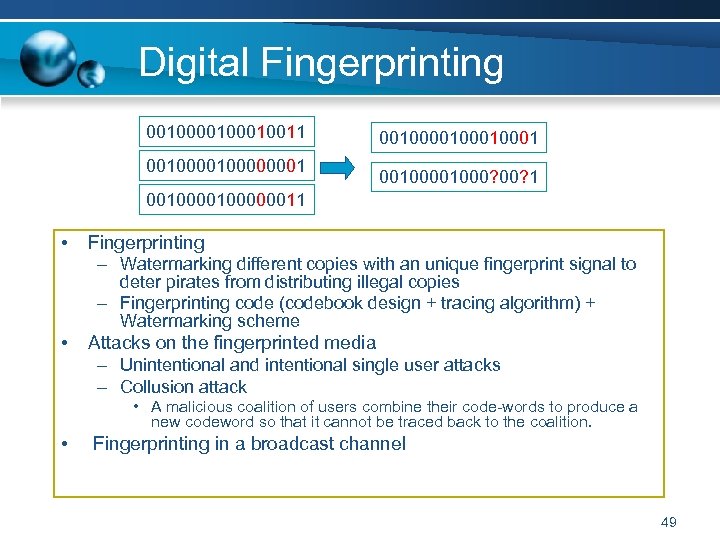 Digital Fingerprinting 00100010011 00100000001 00100010001 001000? 00? 1 00100000011 • Fingerprinting – Watermarking different copies with an unique fingerprint signal to deter pirates from distributing illegal copies – Fingerprinting code (codebook design + tracing algorithm) + Watermarking scheme • Attacks on the fingerprinted media – Unintentional and intentional single user attacks – Collusion attack • A malicious coalition of users combine their code-words to produce a new codeword so that it cannot be traced back to the coalition. • Fingerprinting in a broadcast channel 49
 Cryptography in DRM
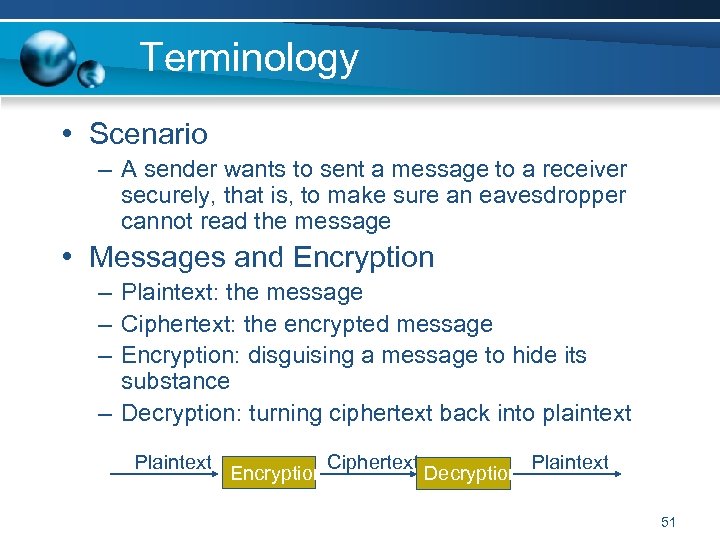 Terminology • Scenario – A sender wants to sent a message to a receiver securely, that is, to make sure an eavesdropper cannot read the message • Messages and Encryption – Plaintext: the message – Ciphertext: the encrypted message – Encryption: disguising a message to hide its substance – Decryption: turning ciphertext back into plaintext Plaintext Encryption Ciphertext Decryption Plaintext 51
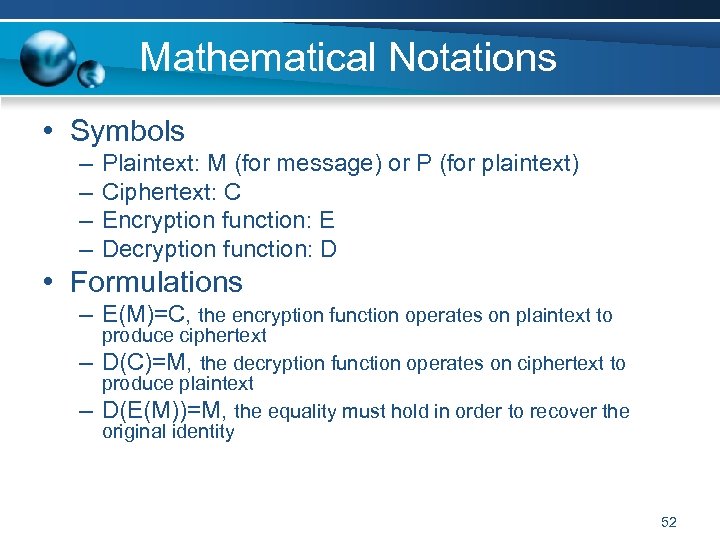 Mathematical Notations • Symbols – – Plaintext: M (for message) or P (for plaintext) Ciphertext: C Encryption function: E Decryption function: D • Formulations – E(M)=C, the encryption function operates on plaintext to – – produce ciphertext D(C)=M, the decryption function operates on ciphertext to produce plaintext D(E(M))=M, the equality must hold in order to recover the original identity 52
 Goals of Cryptography • Confidentiality • Authentication – Receiver must be able to ascertain the message’s origin • Integrity – Receiver shall be able to verify that the message is not modified in transit • Non-repudiation – Sender should not be able to falsely deny later that he sent a message 53
 Restricted Algorithms • Basics of Restricted Algorithms – The security of an algorithm is based on keeping the way that algorithm works a secret – Of historical interests only, inadequate in today’s applications • Frequent changes of algorithm due to user-leaving • Difficult to test the security of adopted algorithms – Widely used in low-security applications 54
 Keys and Algorithms • Modern cryptography solves the problems of restricted algorithms with key (or keys), usually denoted by K • The key may be any one of a large number of values • The range of possible values of the key is called the keyspace • All of the security in these algorithms is based in the keys; none is based in the details of the algorithm 55
 Cryptosystem • A cryptosystem is composed of – An algorithm – All possible plaintexts – All possible ciphertexts – All keys 56
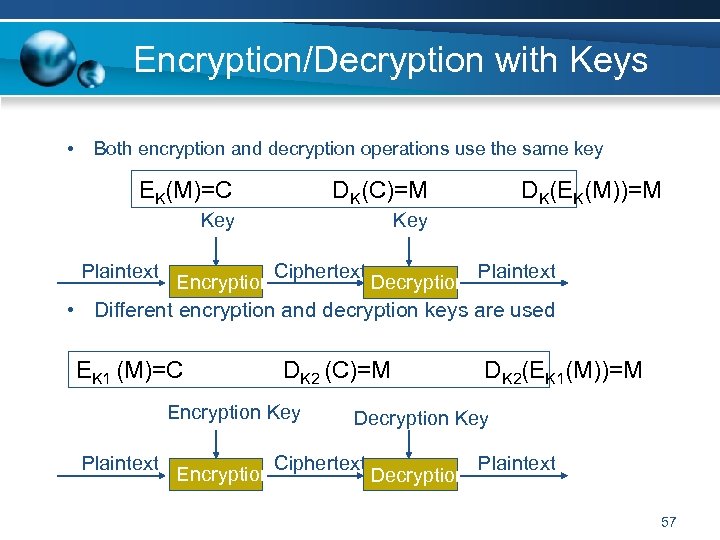 Encryption/Decryption with Keys • Both encryption and decryption operations use the same key EK(M)=C DK(C)=M Key Plaintext Encryption Ciphertext Decryption DK(EK(M))=M Plaintext • Different encryption and decryption keys are used EK 1 (M)=C DK 2 (C)=M Encryption Key Plaintext Encryption DK 2(EK 1(M))=M Decryption Key Ciphertext Decryption Plaintext 57
 Symmetric Algorithms • Symmetric Algorithms (Conventional Algorithms) – Algorithms where the encryption key can be calculated from the decryption key and vice versa • In most symmetric algorithms, the encryption key and the decryption key are the same – Categories • Stream algorithms • Block algorithms 58
 Asymmetric Algorithms • Asymmetric Algorithms (Public-key Algorithms) – The key used for encryption is different from the key used for decryption – The decryption key cannot be calculated from the encryption key – The encryption key can be made public (public key) – The decryption key (private key) 59
 Cryptanalysis • Overview of cryptanalysis – The science of recovering the plaintext of a message without access to the key – Successful cryptanalysis may recover • The plaintext • The key • Weakness in a cryptosystem that eventually lead to the results above 60
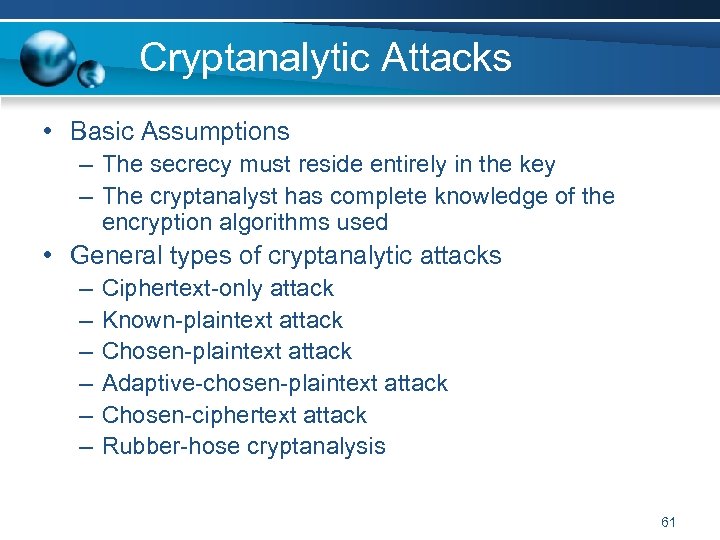 Cryptanalytic Attacks • Basic Assumptions – The secrecy must reside entirely in the key – The cryptanalyst has complete knowledge of the encryption algorithms used • General types of cryptanalytic attacks – – – Ciphertext-only attack Known-plaintext attack Chosen-plaintext attack Adaptive-chosen-plaintext attack Chosen-ciphertext attack Rubber-hose cryptanalysis 61
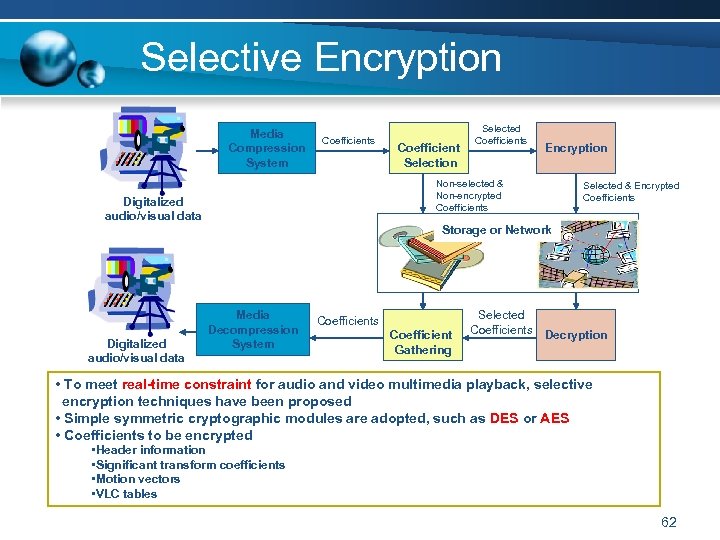 Selective Encryption Media Compression System Coefficients Coefficient Selection Selected Coefficients Encryption Non-selected & Non-encrypted Coefficients Digitalized audio/visual data Selected & Encrypted Coefficients Storage or Network Digitalized audio/visual data Media Decompression System Coefficients Coefficient Gathering Selected Coefficients Decryption • To meet real-time constraint for audio and video multimedia playback, selective encryption techniques have been proposed • Simple symmetric cryptographic modules are adopted, such as DES or AES • Coefficients to be encrypted • Header information • Significant transform coefficients • Motion vectors • VLC tables 62
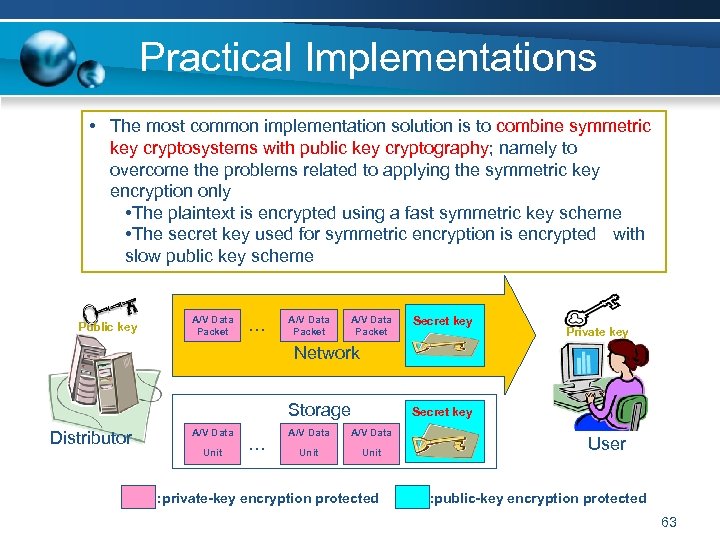 Practical Implementations • The most common implementation solution is to combine symmetric key cryptosystems with public key cryptography; namely to overcome the problems related to applying the symmetric key encryption only • The plaintext is encrypted using a fast symmetric key scheme • The secret key used for symmetric encryption is encrypted with slow public key scheme Public key A/V Data Packet … A/V Data Packet Secret key Private key Network Storage Distributor A/V Data Unit … Secret key A/V Data Unit : private-key encryption protected User : public-key encryption protected 63
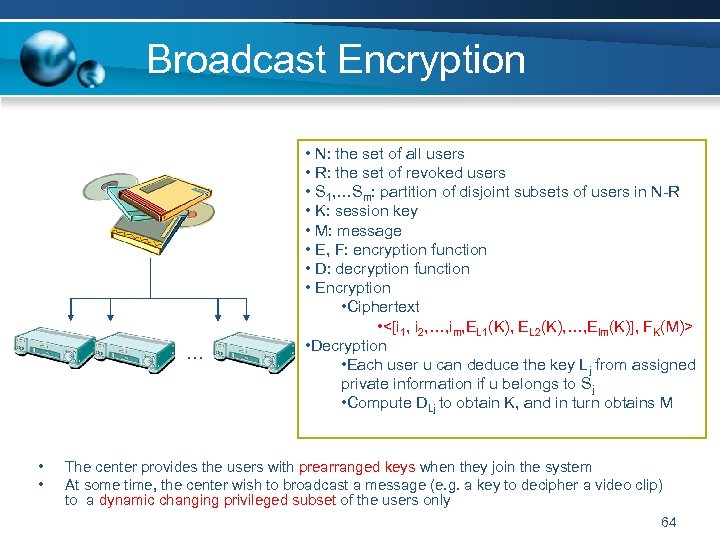 Broadcast Encryption … … • • • N: the set of all users • R: the set of revoked users • S 1, …Sm: partition of disjoint subsets of users in N-R • K: session key • M: message • E, F: encryption function • D: decryption function • Encryption • Ciphertext • <[i 1, i 2, …, im, EL 1(K), EL 2(K), …, Elm(K)], FK(M)> • Decryption • Each user u can deduce the key Lj from assigned private information if u belongs to Sj • Compute DLj to obtain K, and in turn obtains M The center provides the users with prearranged keys when they join the system At some time, the center wish to broadcast a message (e. g. a key to decipher a video clip) to a dynamic changing privileged subset of the users only 64
 Digital Rights Language
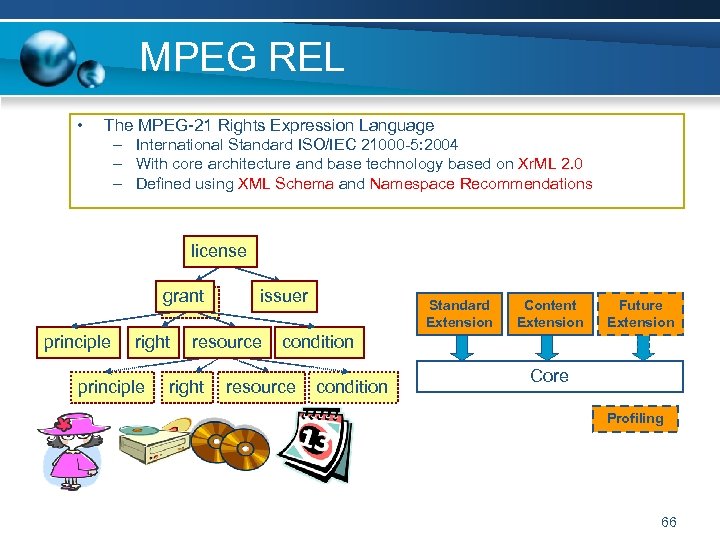 MPEG REL • The MPEG-21 Rights Expression Language – International Standard ISO/IEC 21000 -5: 2004 – With core architecture and base technology based on Xr. ML 2. 0 – Defined using XML Schema and Namespace Recommendations license grant principle right principle issuer resource right Standard Extension Content Extension Future Extension condition resource condition Core Profiling 66
 Important DRM-related Standards
 MPEG-21 • In 2002 June, MPEG (ISO/IEC JTC 1 SC 29 WG 11) started working on the definition of enabling normative technology for the multimedia applications of the 21 st century: MPEG-21 “Multimedia Framework” – To enable transparent and augmented use of multimedia resources across a wide range of networks and devices – To support transparent and highly automated transactions, especially taking in account • Digital rights management (DRM) requirements • Multimedia access and delivery using heterogeneous networks and terminals 68
 Digital Rights Management • The desire to achieve interoperability may be in violation with the requirement to protect the value of the content and the rights of the rights holders – DRM systems can go against the very goal of interoperability if they use non-standardized protection mechanism – To realize an open multimedia infrastructure, more interoperability in DRM systems are crucial • IPMP in MPEG series – MPEG-4 describes a set of standard interfaces to proprietary intellectual property management and protection (IPMP) systems – IPMP is at the very core of the MPEG-21 specifications 69
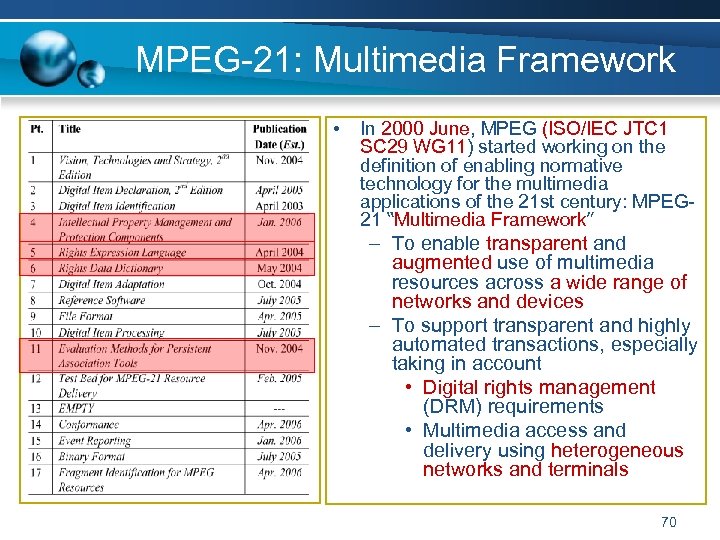 MPEG-21: Multimedia Framework • In 2000 June, MPEG (ISO/IEC JTC 1 SC 29 WG 11) started working on the definition of enabling normative technology for the multimedia applications of the 21 st century: MPEG 21 “Multimedia Framework” – To enable transparent and augmented use of multimedia resources across a wide range of networks and devices – To support transparent and highly automated transactions, especially taking in account • Digital rights management (DRM) requirements • Multimedia access and delivery using heterogeneous networks and terminals 70
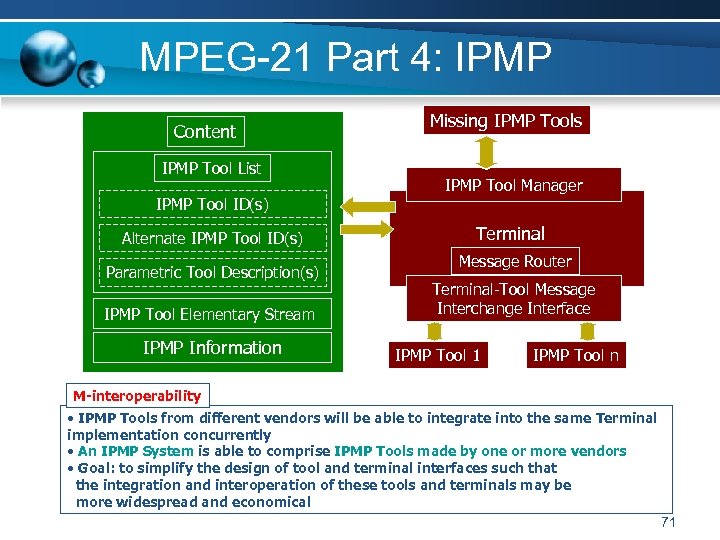 MPEG-21 Part 4: IPMP Content IPMP Tool List Missing IPMP Tools IPMP Tool Manager IPMP Tool ID(s) Alternate IPMP Tool ID(s) Parametric Tool Description(s) IPMP Tool Elementary Stream IPMP Information Terminal Message Router Terminal-Tool Message Interchange Interface IPMP Tool 1 IPMP Tool n M-interoperability • IPMP Tools from different vendors will be able to integrate into the same Terminal C-interoperability implementation concurrently • An IPMP System is able of MPEG in general • The major focus to comprise IPMP Tools made by one or more vendors • Goal: • Asimplify the designapproach terminal interfaces such that to consumer centric of tool and the integration and interoperation of these tools and terminals may be • Content protected by one IPMP vendor will play on any given Terminal more widespread and economical 71
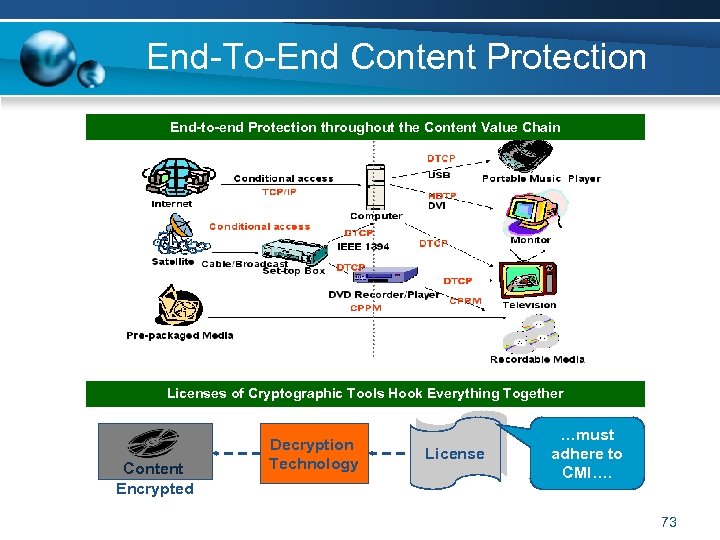
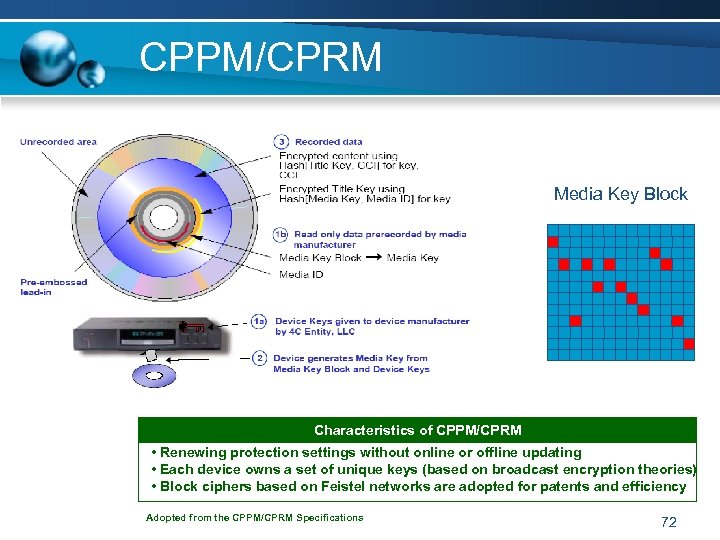 CPPM/CPRM Media Key Block Characteristics of CPPM/CPRM • Renewing protection settings without online or offline updating • Each device owns a set of unique keys (based on broadcast encryption theories) • Block ciphers based on Feistel networks are adopted for patents and efficiency Adopted from the CPPM/CPRM Specifications 72
 End-To-End Content Protection End-to-end Protection throughout the Content Value Chain Licenses of Cryptographic Tools Hook Everything Together Content Encrypted Decryption Technology License …must adhere to CMI…. 73
 DRM-related Legislative Issues Adopted from Digital Rights Management Business and Technology Chapter 3: Help from the government: Law and Technology
 Laws and DRM Definition of the term “Rights” “an interest or title in an object of property; a just and legal claim to hold, use, and enjoy it or convey it or donate it ” - Black’s Law Dictionary • Laws are what provide us all with DRM business opportunities. • The rights that content providers seek to manage in DRM are creations of the law, and no such right is inherent or self-evident. 75
 Intellectual Properties • Four basic types of intellectual properties – Patents – Trademarks – Trade secrets – Copyrights • Central to DRM 76
 Patents • Patents protect novel and unique inventions or processes. – After you patent your invention, nobody can use it without your permission, and you have essentially unlimited monopoly for a period of years – The details of your invention will be disclosed to the world – After the patent time expires, anyone can freely use your invention 77
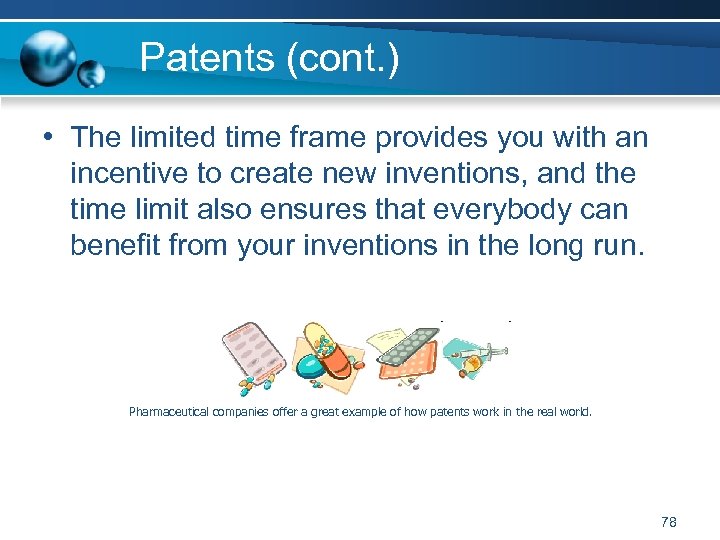 Patents (cont. ) • The limited time frame provides you with an incentive to create new inventions, and the time limit also ensures that everybody can benefit from your inventions in the long run. Pharmaceutical companies offer a great example of how patents work in the real world. 78
 Patents and DRM • Patents are not generally the object of DRM systems and applications. • However, patent rights do play an important role in the creation of DRM systems and applications Patent Pool: technology companies pool their various patents and agree to reasonable licenses Vision of MPEG-21: a multimedia framework to enable the transparent and augmented use of multimedia resources across a wide range of networks and devices used by different communities 79
 Trademarks • Trademarks protects logos, trade names, and symbols used to identify a company’s products or services, which could be sounds and smells in addition to graphical symbols. • The strength of a trademark lies in the answer to the question ”What association does the trademark generate in a consumer’s mind? ” • The licensing of trademarks is more close to rights sales, and is less suited to the application of DRM technology. 80
 Trade Secrets • Trade secrets may consist of any formula, pattern, device of compilation of information which is used in one’s business and which gives a person an opportunity t obtain an advantage over competitors who do not know or use it…. ” • Trade secrets usually occurs within companies that are not primarily content providers, but they manifest themselves in digital information. – Thus DRM vendors have begun to build systems that control access to documents and emails. 81
 Copyrights • Copyrights are central to DRM – What you heard about stolen music and streaming video are all related with infringement of somebody’s copyright • A copyrighted work must be – An original work of ownership • One who copies another’s original works does not own copyrights, but authors of independent and identical works do – Fixed in a tangible medium of expression – Able to be reproduced or otherwise communicated • Silly examples: books inscribed on the Jupiter or on a electron 82
 Copyrights and DRM • The essence of DRM involves these questions – Whose copyrights are being abused? – Whose copyrights may be abused? – How can we prevent that? – How can we facilitate the use of such copyrights so that the owner gets paid and the users get access? 83
 Balance of Interests “…The primary objective in conferring the copyright monopoly lies in the general benefit derived by the public from the labors of authors and their agents. It is said that reward to the author or artist serves to induce release to the public of the products of his creative genius…” - Sony Corporation v. Universal City Studio, 464 US 416, 428 • The primary intent of copyright is to increase and not to impede the harvest of knowledge • Those seeking to profit from DRM systems should keep in mind that their enrichment is not the primary consideration of the law. 84
 Benefits of Copyright Law • For a certain number of years , copyright holder has the exclusive right to – Reproduce the work – Modify the work by creating new work based on the old work – Distribute the work – Perform the work publicly – Display the work publicly 85
 Registering Copyrights • • Copyright arises upon creation, and registration is not required to a copyright to be considered valid. Why bother to register copyrights? – To recover monetary damages in any action that you bring against an infringer for your copyright, registration is necessary • • The registration system is now inadequate for automatic electronic registrations and needs an overhaul DRM systems shall take copyright identification and registration into consideration The Copyright Office: http: //www. loc. gov/copyright/ 86
 Types of Copyrighted Works n Literal Works • Including book, manuscript, online work, pamphlet, poetry, report, test, automated database, computer program, or other text n Visual Arts works • Pictorial, graphic, or sculptural work, including 2 -dimensional and 3 dimensional work of fine, graphic, and applied art. Also, register architectural work • Performing Arts Works • Musical work, dramatic work, script, pantomime, choreography, motion picture, or other audiovisual work • Sound Recording • Register your recording of music, drama, or a lecture • Serials and Periodicals • Register your recording of music, drama, or a lecture • Mask Works • This protection relates to integrated circuits on a semiconductor chip 87
 Fair Use • Fair use is one of the limitations on the exclusive rights of copyright – The fair use of a copyrighted work is not a infringement of copyright – It is a defense to an allegation of copyright infringement – Example • Small-amount usage for educational purpose – Not belonging to fair use • Substantial usage, commercial purpose, measurable market effect… 88
 Fair Use Factors • • The purpose and character of the use The nature of the copyrighted work The amount of the taking The effect of the market value of the copyrighted work Fair use can be regarded as one of the examples that copyright seeks to preserve the balance between the copyright owner and work users. 89
 Fair Use in DRM? • Can fair use survive DRM systems? – Positive opinion • As long as the rights specification language is detailed enough, all possible uses of content can be listed and thus fair use can provided – Negative opinion • Fair use can only be judged case by case, and cannot be objectively defined in advance • Consumers can easily throw away their fair-use rights by agreeing end user license agreement 90
 First Sale Doctrine • The First Sale Doctrine said that one can apply his first sale rights to the specific copy he bought • The First Sale Doctrine with respect to record and computer software rentals is limited by the US congress 91
 First Sale Doctrine in DRM? • Most electrical media are now supplied under license, instead of being sold. – Consumers can easily give up their first sale doctrine rights by agreeing to certain contract. – Example: • Can you sell or license a legal copy of Microsoft Windows XP to others? – Rights protected by copyright laws are supplanted by a commercial agreement DRM systems protect the freedom to contract, but disrupt the balance that copyright laws want to strike 92
 Characteristics of Licenses and Purchasing • EULA (End-User License Agreement) • Copyright protection technology – Transferability • Format migration – Continuing access • Decomposition of works 93
 Important Legislation • • The Uniform Information Transactions Act The Digital Millennium Copyright Act The Electronic Signature Act The European Copyright Directive 94
 The Uniform Information Transactions Act (UCITA) • The sale of tangible goods is generally governed by a set of laws in the U. S. known as Uniform Commercial Code (UCC) – Whether UCC governs software is not clear • UCITA is a contract law that will provide a clear body of law for software and information license transactions. • Arguments between licensors and licensees are still unsolved UCITA Online: www. ucitaonline. com 95
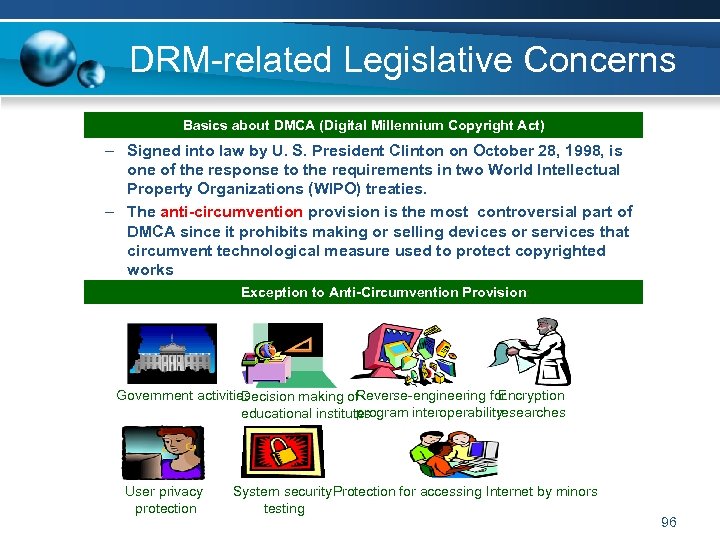 DRM-related Legislative Concerns Basics about DMCA (Digital Millennium Copyright Act) – Signed into law by U. S. President Clinton on October 28, 1998, is one of the response to the requirements in two World Intellectual Property Organizations (WIPO) treaties. – The anti-circumvention provision is the most controversial part of DMCA since it prohibits making or selling devices or services that circumvent technological measure used to protect copyrighted works –Exception to Anti-Circumvention Provision: Government activities Reverse-engineering for Encryption Decision making of program interoperability researches educational institutes User privacy protection System security Protection for accessing Internet by minors testing 96
 The Electronic Signatures Act • President Clinton signed into law the Electronic Signature Act in June 2000. • Parties can sign checks and apply for loans without a signature on paper. – Contracts are legally effective in electronic form • An important building block for DRM systems 97