 Скачать презентацию INTRODUCTION TO DERIVATIVES MARKETS INVESTMENTS BACKGROUND SPRING 2006
49fde82ba147d66c8805d683387c07fb.ppt
- Количество слайдов: 91



INTRODUCTION TO DERIVATIVES MARKETS (INVESTMENTS BACKGROUND) SPRING 2006 1
REAL VS. FINANCIAL ASSETS A. REAL ASSETS u Plant and Equipment=Physical Capital u Growth Opportunities: e. g. R&D, Patents, New Ventures u Human Capital=Expertise, Labor Services u Contribute Directly to the Productive Capacity of the Economy (i. e. to GNP Growth) 2
REAL VS. FINANCIAL ASSETS B. FINANCIAL ASSETS u Stocks, Bonds, Hybrid Securities u Are Claims to the After-Tax Earnings Streams Generated by Real Assets u Provide an Incentive to Invest in Real Assets by Providing Liquidity u Establishes a Pricing (Valuation) Mechanism for Real Assets u Thereby Contribute Indirectly to the Productive Capacity of the Economy 3
CLIENTS OF THE FINANCIAL SYSTEM u THE HOUSEHOLD SECTOR (INDIVIDUALS) The financial assets households desire to hold depend on their tax status, investment horizons, need for liquidity, cash-flow needs, and risk preferences. u THE BUSINESS SECTOR (CORPORATIONS) Raises money by debt and equity issues in primary capital markets. The business sector raises money efficiently by using investment bankers and by keeping securities simple. THE GOVERNMENT SECTOR (STATE, FEDERAL, AND MUNICIPAL AGENCIES ) Can only borrow through debt issues and taxation, but regulates the financial sector. u 4
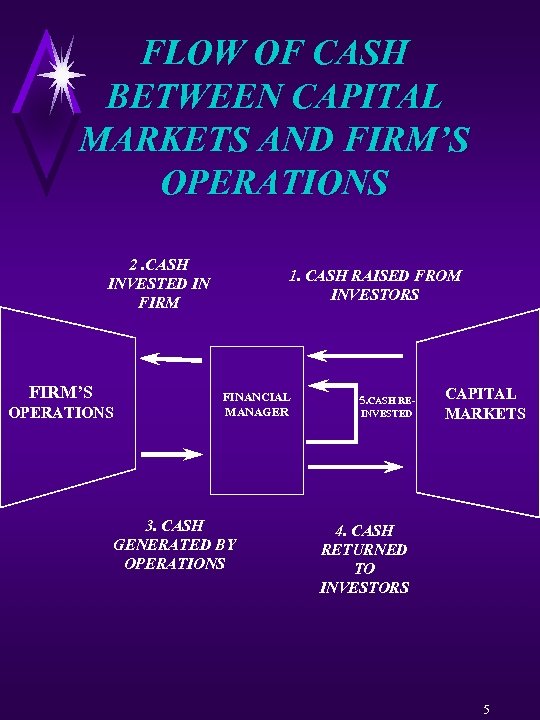
FLOW OF CASH BETWEEN CAPITAL MARKETS AND FIRM’S OPERATIONS 2. CASH INVESTED IN FIRM’S OPERATIONS 1. CASH RAISED FROM INVESTORS FINANCIAL MANAGER 3. CASH GENERATED BY OPERATIONS 5. CASH REINVESTED CAPITAL MARKETS 4. CASH RETURNED TO INVESTORS 5
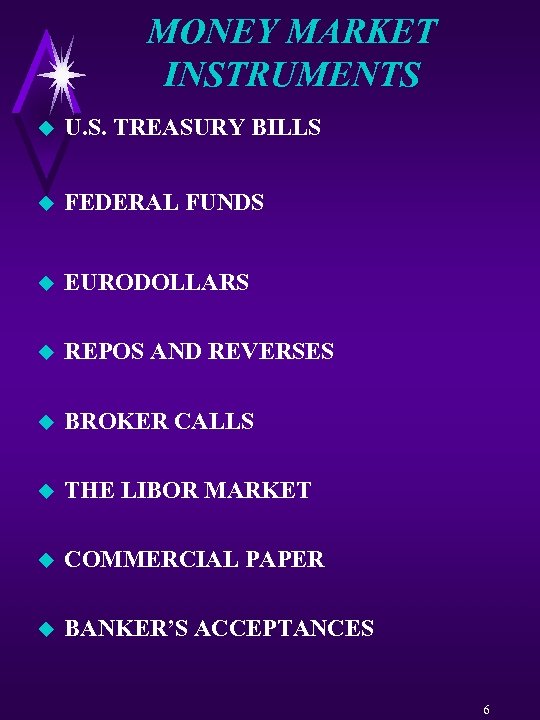
MONEY MARKET INSTRUMENTS u U. S. TREASURY BILLS u FEDERAL FUNDS u EURODOLLARS u REPOS AND REVERSES u BROKER CALLS u THE LIBOR MARKET u COMMERCIAL PAPER u BANKER’S ACCEPTANCES 6
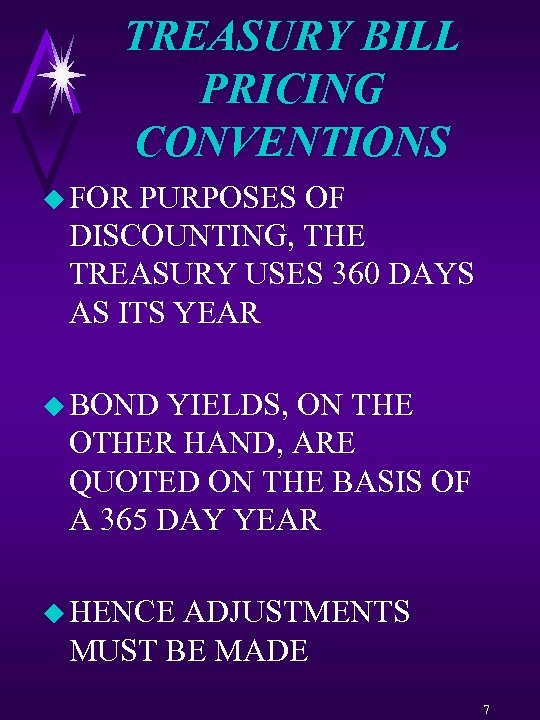
TREASURY BILL PRICING CONVENTIONS u FOR PURPOSES OF DISCOUNTING, THE TREASURY USES 360 DAYS AS ITS YEAR u BOND YIELDS, ON THE OTHER HAND, ARE QUOTED ON THE BASIS OF A 365 DAY YEAR u HENCE ADJUSTMENTS MUST BE MADE 7
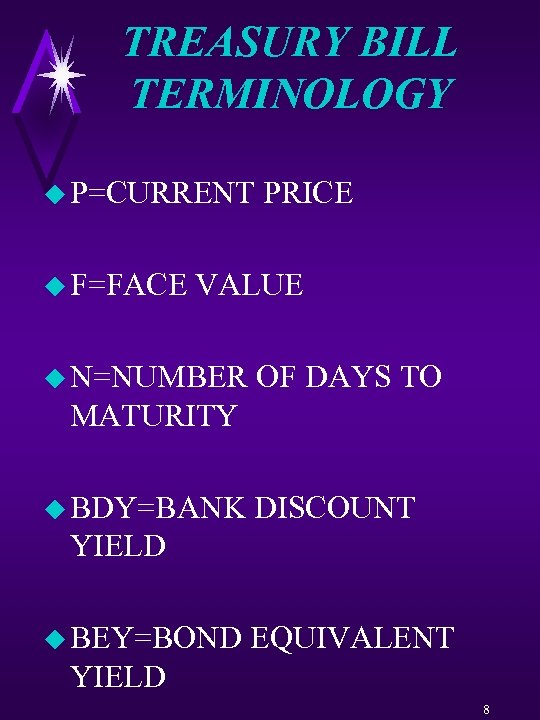
TREASURY BILL TERMINOLOGY u P=CURRENT u F=FACE PRICE VALUE u N=NUMBER OF DAYS TO MATURITY u BDY=BANK DISCOUNT YIELD u BEY=BOND EQUIVALENT YIELD 8
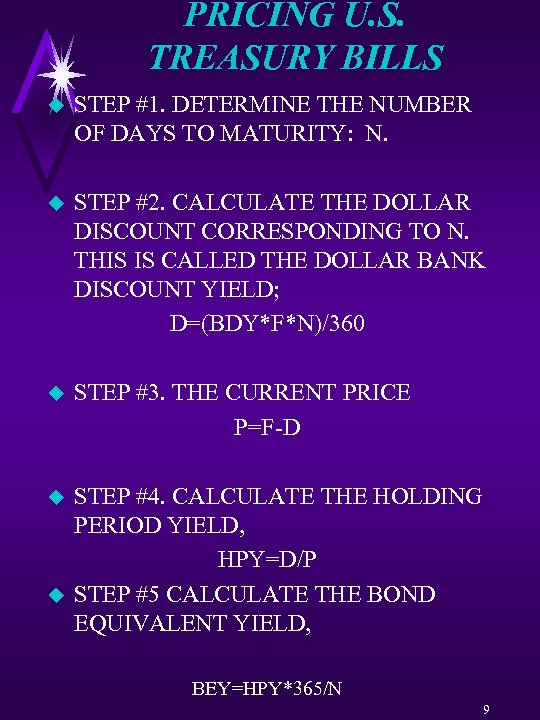
PRICING U. S. TREASURY BILLS u STEP #1. DETERMINE THE NUMBER OF DAYS TO MATURITY: N. u STEP #2. CALCULATE THE DOLLAR DISCOUNT CORRESPONDING TO N. THIS IS CALLED THE DOLLAR BANK DISCOUNT YIELD; D=(BDY*F*N)/360 u STEP #3. THE CURRENT PRICE P=F-D u STEP #4. CALCULATE THE HOLDING PERIOD YIELD, HPY=D/P STEP #5 CALCULATE THE BOND EQUIVALENT YIELD, u BEY=HPY*365/N 9
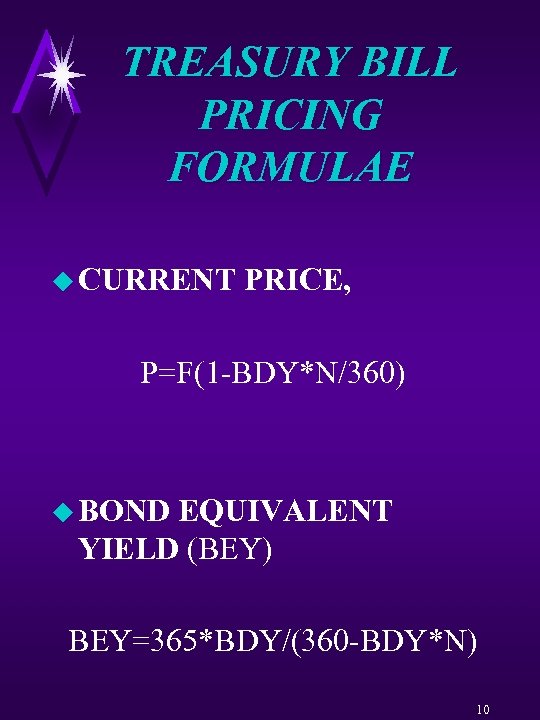
TREASURY BILL PRICING FORMULAE u CURRENT PRICE, P=F(1 -BDY*N/360) u BOND EQUIVALENT YIELD (BEY) BEY=365*BDY/(360 -BDY*N) 10

U. S. TREASURY BILLS ‘PRICE’ QUOTE (SOURCE: www. bloomberg. com) 11
MONEY RATES (SOURCE: WSJ 01/06/03) See BKM Text p. 32 Figure 2. 1 12
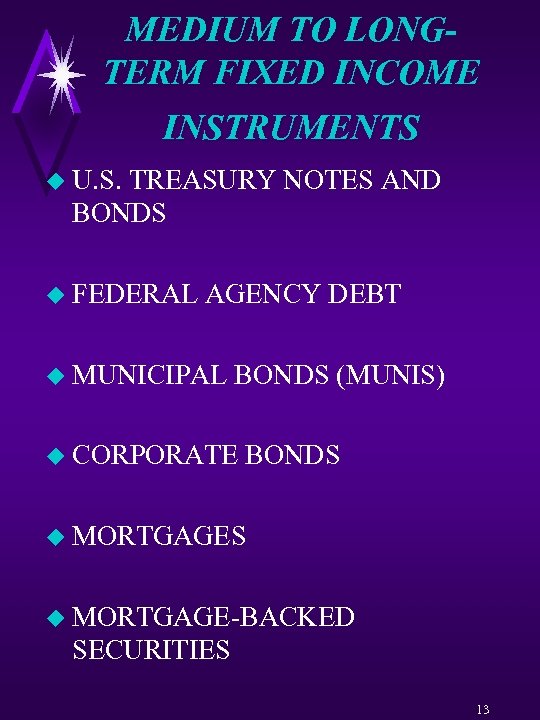
MEDIUM TO LONGTERM FIXED INCOME INSTRUMENTS u U. S. TREASURY NOTES AND BONDS u FEDERAL AGENCY DEBT u MUNICIPAL BONDS (MUNIS) u CORPORATE BONDS u MORTGAGE-BACKED SECURITIES 13
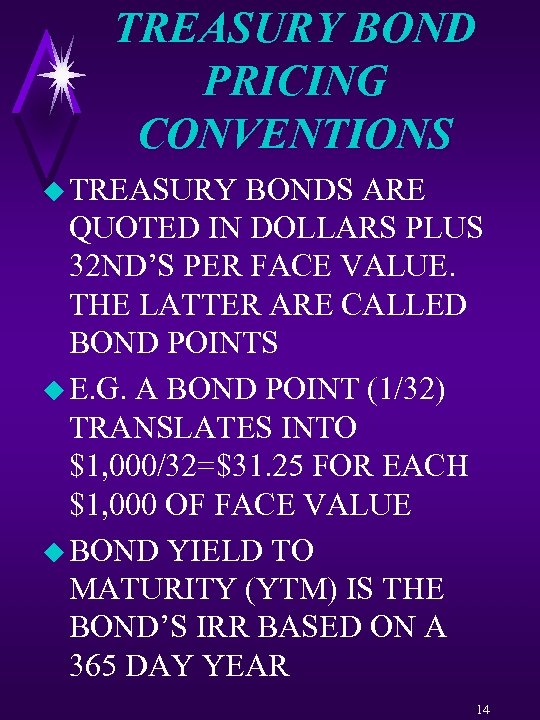
TREASURY BOND PRICING CONVENTIONS u TREASURY BONDS ARE QUOTED IN DOLLARS PLUS 32 ND’S PER FACE VALUE. THE LATTER ARE CALLED BOND POINTS u E. G. A BOND POINT (1/32) TRANSLATES INTO $1, 000/32=$31. 25 FOR EACH $1, 000 OF FACE VALUE u BOND YIELD TO MATURITY (YTM) IS THE BOND’S IRR BASED ON A 365 DAY YEAR 14
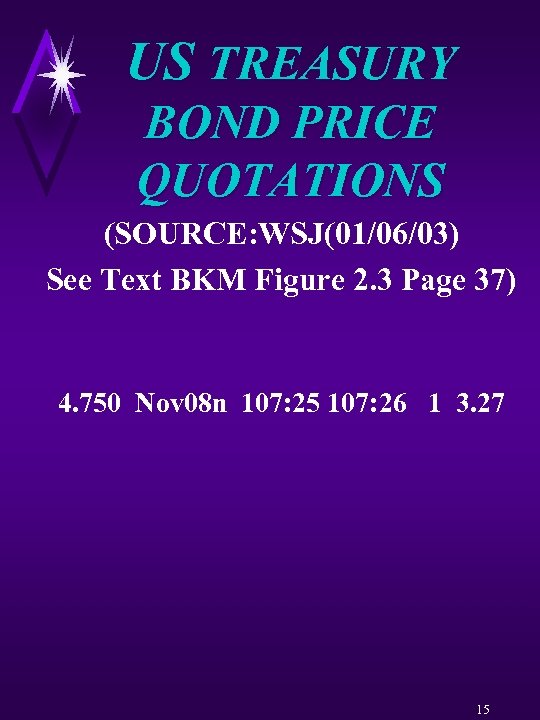
US TREASURY BOND PRICE QUOTATIONS (SOURCE: WSJ(01/06/03) See Text BKM Figure 2. 3 Page 37) 4. 750 Nov 08 n 107: 25 107: 26 1 3. 27 15
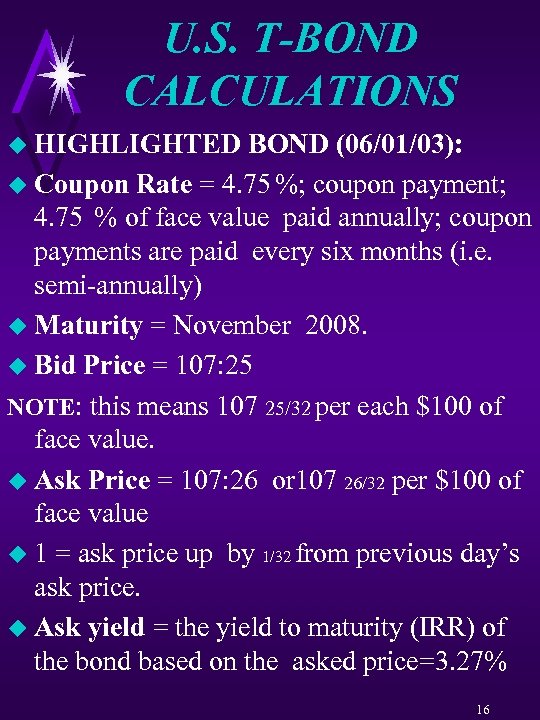
U. S. T-BOND CALCULATIONS u HIGHLIGHTED BOND (06/01/03): u Coupon Rate = 4. 75 %; coupon payment; 4. 75 % of face value paid annually; coupon payments are paid every six months (i. e. semi-annually) u Maturity = November 2008. u Bid Price = 107: 25 NOTE: this means 107 25/32 per each $100 of face value. u Ask Price = 107: 26 or 107 26/32 per $100 of face value u 1 = ask price up by 1/32 from previous day’s ask price. u Ask yield = the yield to maturity (IRR) of the bond based on the asked price=3. 27% 16
CORPORATE BOND QUOTATIONS See text BKM Figure 2. 7, page 42 17
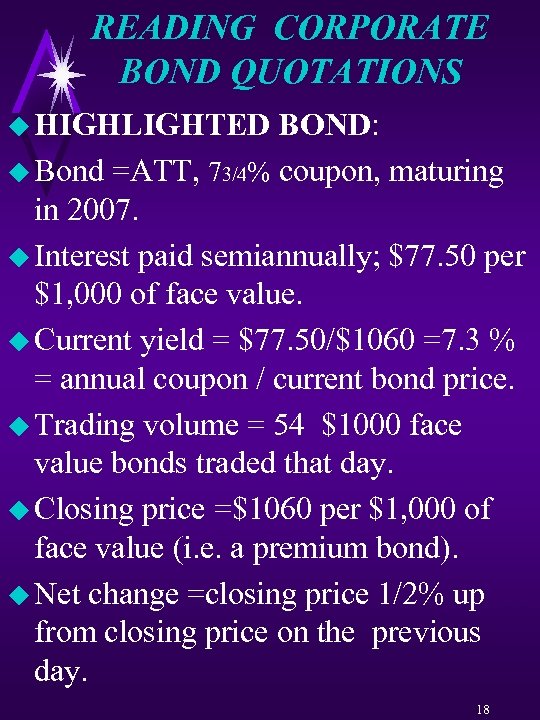
READING CORPORATE BOND QUOTATIONS u HIGHLIGHTED BOND: u Bond =ATT, 73/4% coupon, maturing in 2007. u Interest paid semiannually; $77. 50 per $1, 000 of face value. u Current yield = $77. 50/$1060 =7. 3 % = annual coupon / current bond price. u Trading volume = 54 $1000 face value bonds traded that day. u Closing price =$1060 per $1, 000 of face value (i. e. a premium bond). u Net change =closing price 1/2% up from closing price on the previous day. 18
READING STOCK MARKET QUOTATIONS (SOURCE WSJ (09/08/97) See text BKM Figure 2. 9, page 46 19
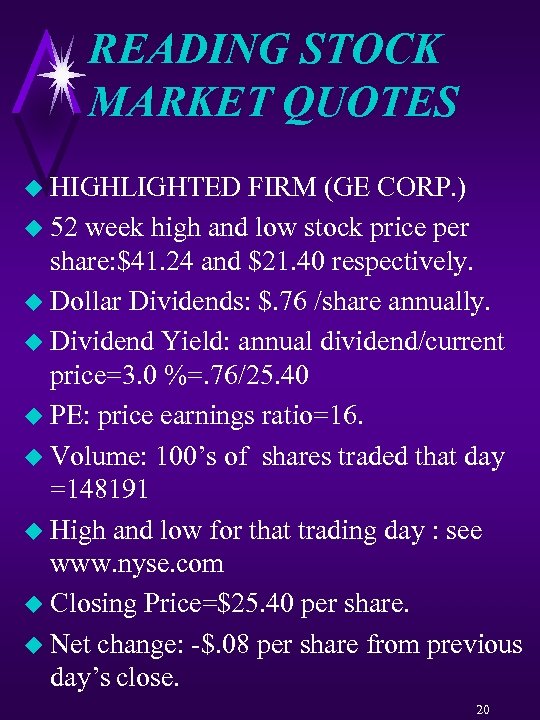
READING STOCK MARKET QUOTES u HIGHLIGHTED FIRM (GE CORP. ) u 52 week high and low stock price per share: $41. 24 and $21. 40 respectively. u Dollar Dividends: $. 76 /share annually. u Dividend Yield: annual dividend/current price=3. 0 %=. 76/25. 40 u PE: price earnings ratio=16. u Volume: 100’s of shares traded that day =148191 u High and low for that trading day : see www. nyse. com u Closing Price=$25. 40 per share. u Net change: -$. 08 per share from previous day’s close. 20
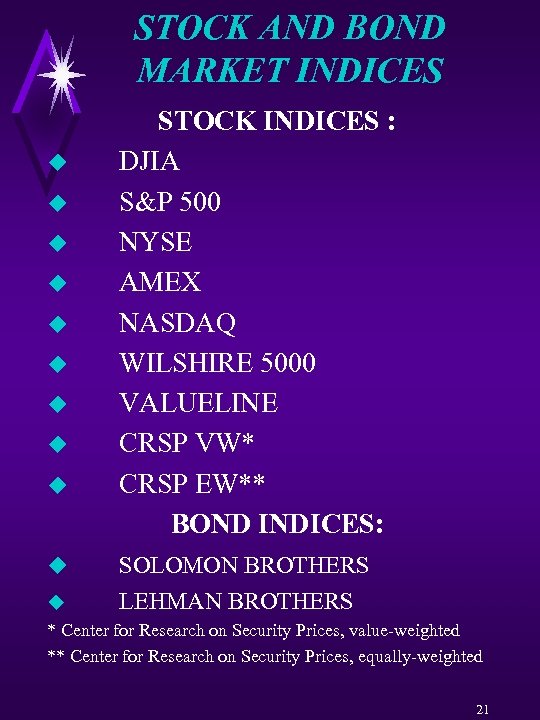
STOCK AND BOND MARKET INDICES u u u u u STOCK INDICES : DJIA S&P 500 NYSE AMEX NASDAQ WILSHIRE 5000 VALUELINE CRSP VW* CRSP EW** BOND INDICES: SOLOMON BROTHERS LEHMAN BROTHERS u * Center for Research on Security Prices, value-weighted ** Center for Research on Security Prices, equally-weighted 21
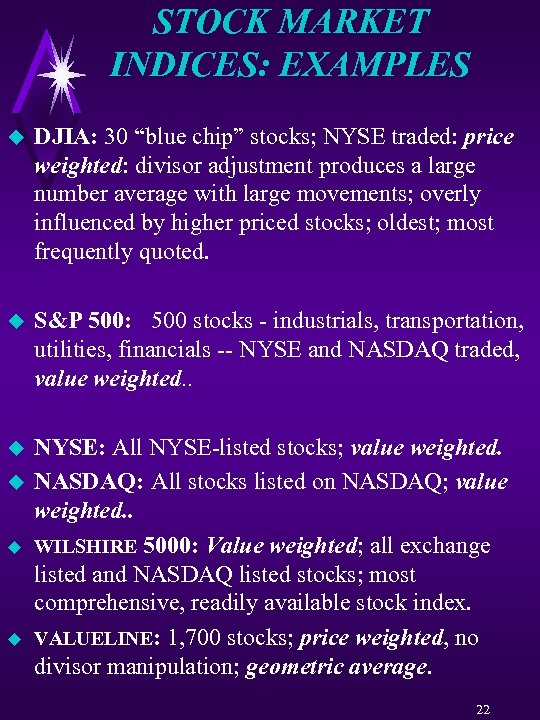
STOCK MARKET INDICES: EXAMPLES u DJIA: 30 “blue chip” stocks; NYSE traded: price weighted: divisor adjustment produces a large number average with large movements; overly influenced by higher priced stocks; oldest; most frequently quoted. u S&P 500: 500 stocks - industrials, transportation, utilities, financials -- NYSE and NASDAQ traded, value weighted. . u NYSE: All NYSE-listed stocks; value weighted. NASDAQ: All stocks listed on NASDAQ; value weighted. . WILSHIRE 5000: Value weighted; all exchange listed and NASDAQ listed stocks; most comprehensive, readily available stock index. VALUELINE: 1, 700 stocks; price weighted, no divisor manipulation; geometric average. u u u 22
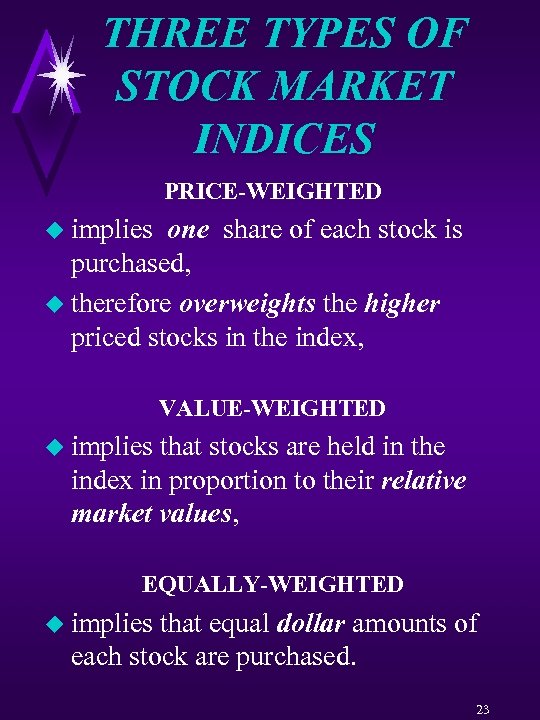
THREE TYPES OF STOCK MARKET INDICES PRICE-WEIGHTED u implies one share of each stock is purchased, u therefore overweights the higher priced stocks in the index, VALUE-WEIGHTED u implies that stocks are held in the index in proportion to their relative market values, EQUALLY-WEIGHTED u implies that equal dollar amounts of each stock are purchased. 23
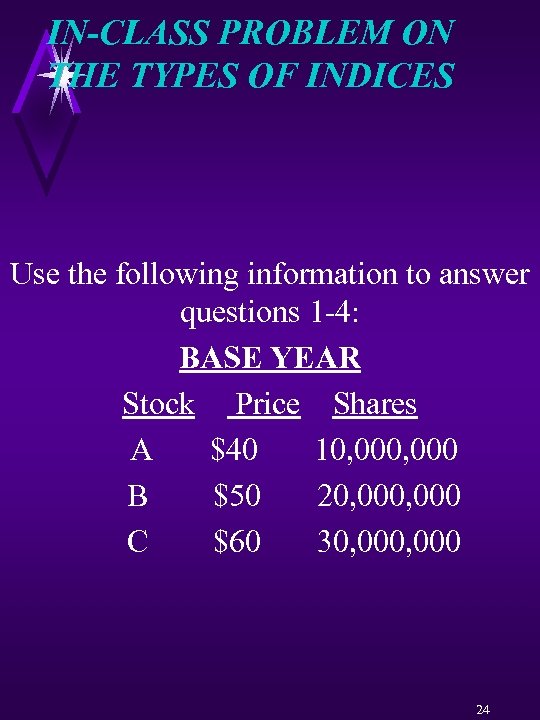
IN-CLASS PROBLEM ON THE TYPES OF INDICES Use the following information to answer questions 1 -4: BASE YEAR Stock Price Shares A $40 10, 000 B $50 20, 000 C $60 30, 000 24
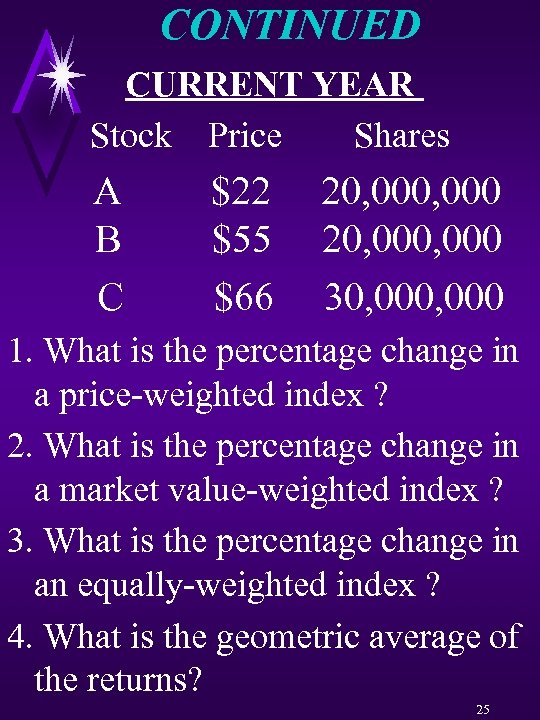
CONTINUED CURRENT YEAR Stock Price Shares A B C $22 $55 $66 20, 000, 000 30, 000 1. What is the percentage change in a price-weighted index ? 2. What is the percentage change in a market value-weighted index ? 3. What is the percentage change in an equally-weighted index ? 4. What is the geometric average of the returns? 25
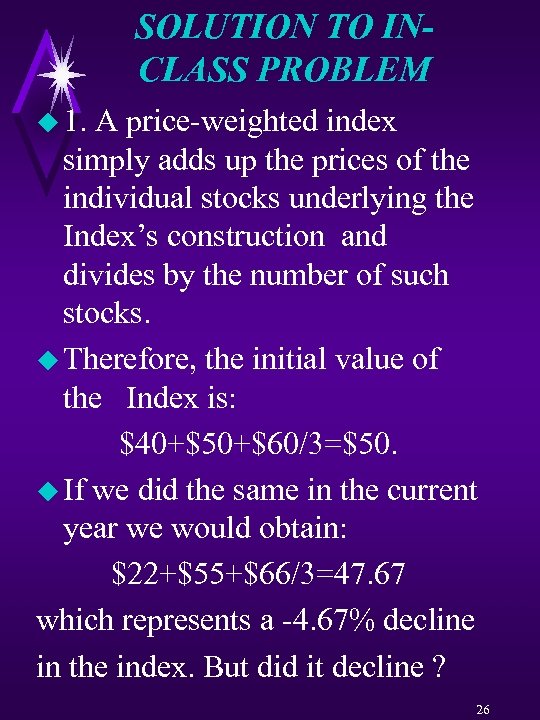
SOLUTION TO INCLASS PROBLEM u 1. A price-weighted index simply adds up the prices of the individual stocks underlying the Index’s construction and divides by the number of such stocks. u Therefore, the initial value of the Index is: $40+$50+$60/3=$50. u If we did the same in the current year we would obtain: $22+$55+$66/3=47. 67 which represents a -4. 67% decline in the index. But did it decline ? 26
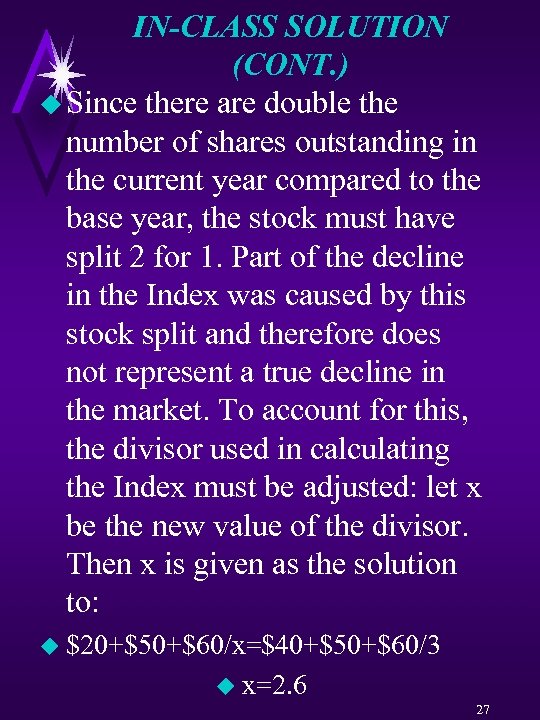
IN-CLASS SOLUTION (CONT. ) u Since there are double the number of shares outstanding in the current year compared to the base year, the stock must have split 2 for 1. Part of the decline in the Index was caused by this stock split and therefore does not represent a true decline in the market. To account for this, the divisor used in calculating the Index must be adjusted: let x be the new value of the divisor. Then x is given as the solution to: u $20+$50+$60/x=$40+$50+$60/3 u x=2. 6 27
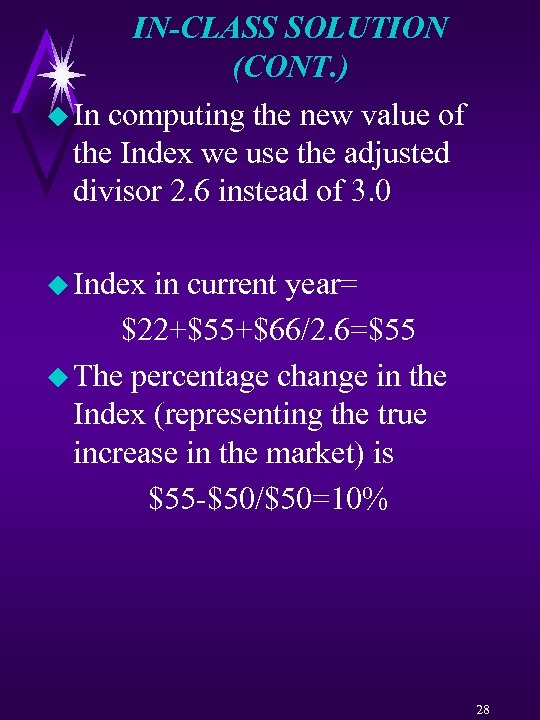
IN-CLASS SOLUTION (CONT. ) u In computing the new value of the Index we use the adjusted divisor 2. 6 instead of 3. 0 u Index in current year= $22+$55+$66/2. 6=$55 u The percentage change in the Index (representing the true increase in the market) is $55 -$50/$50=10% 28
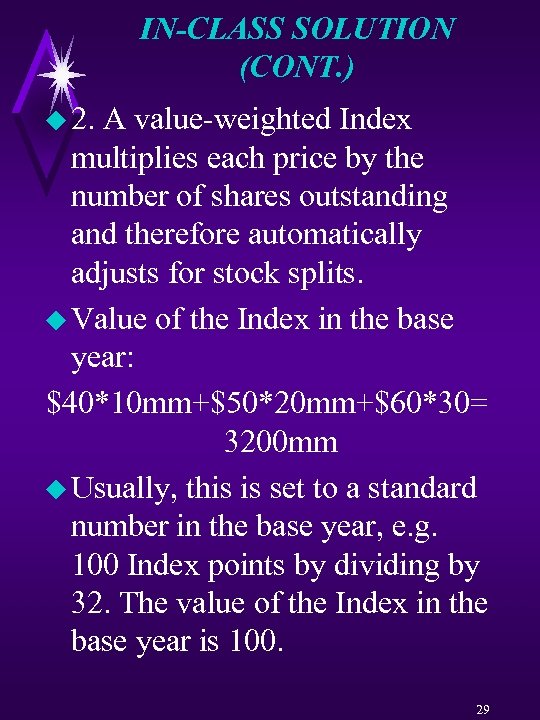
IN-CLASS SOLUTION (CONT. ) u 2. A value-weighted Index multiplies each price by the number of shares outstanding and therefore automatically adjusts for stock splits. u Value of the Index in the base year: $40*10 mm+$50*20 mm+$60*30= 3200 mm u Usually, this is set to a standard number in the base year, e. g. 100 Index points by dividing by 32. The value of the Index in the base year is 100. 29
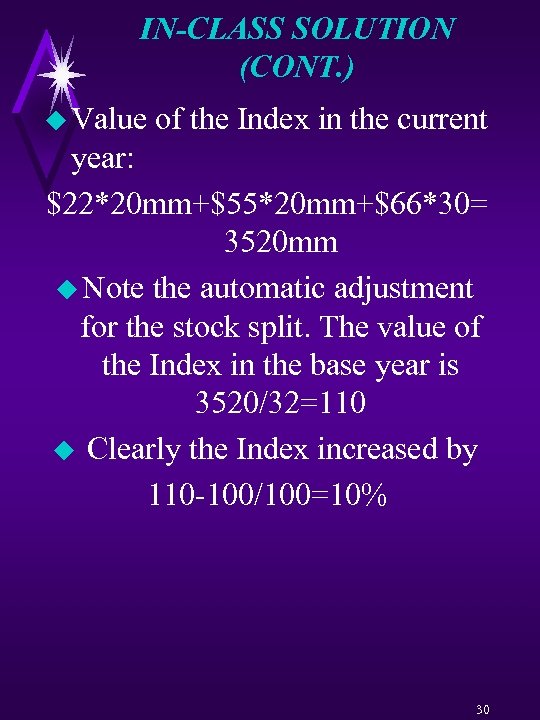
IN-CLASS SOLUTION (CONT. ) u Value of the Index in the current year: $22*20 mm+$55*20 mm+$66*30= 3520 mm u Note the automatic adjustment for the stock split. The value of the Index in the base year is 3520/32=110 u Clearly the Index increased by 110 -100/100=10% 30
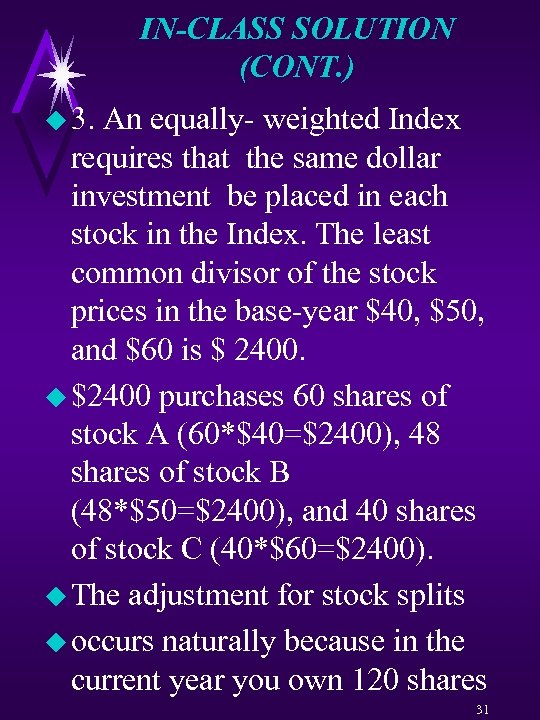
IN-CLASS SOLUTION (CONT. ) u 3. An equally- weighted Index requires that the same dollar investment be placed in each stock in the Index. The least common divisor of the stock prices in the base-year $40, $50, and $60 is $ 2400. u $2400 purchases 60 shares of stock A (60*$40=$2400), 48 shares of stock B (48*$50=$2400), and 40 shares of stock C (40*$60=$2400). u The adjustment for stock splits u occurs naturally because in the current year you own 120 shares 31
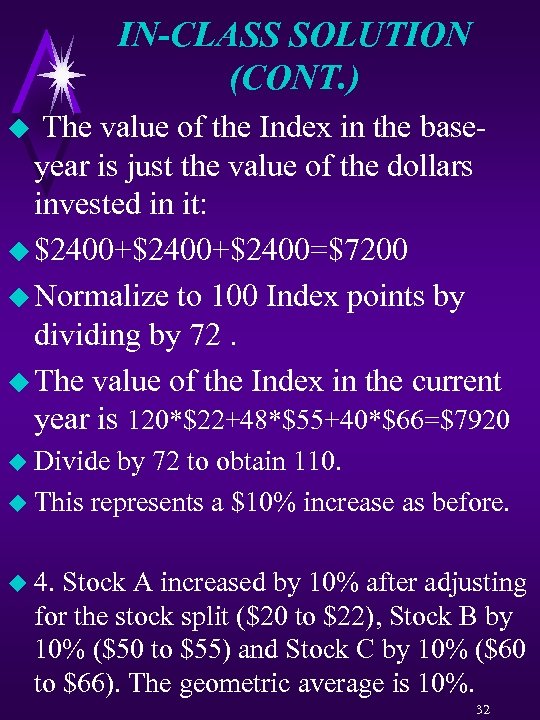
IN-CLASS SOLUTION (CONT. ) The value of the Index in the baseyear is just the value of the dollars invested in it: u $2400+$2400=$7200 u Normalize to 100 Index points by dividing by 72. u The value of the Index in the current year is 120*$22+48*$55+40*$66=$7920 u u Divide by 72 to obtain 110. u This represents a $10% increase as before. u 4. Stock A increased by 10% after adjusting for the stock split ($20 to $22), Stock B by 10% ($50 to $55) and Stock C by 10% ($60 to $66). The geometric average is 10%. 32
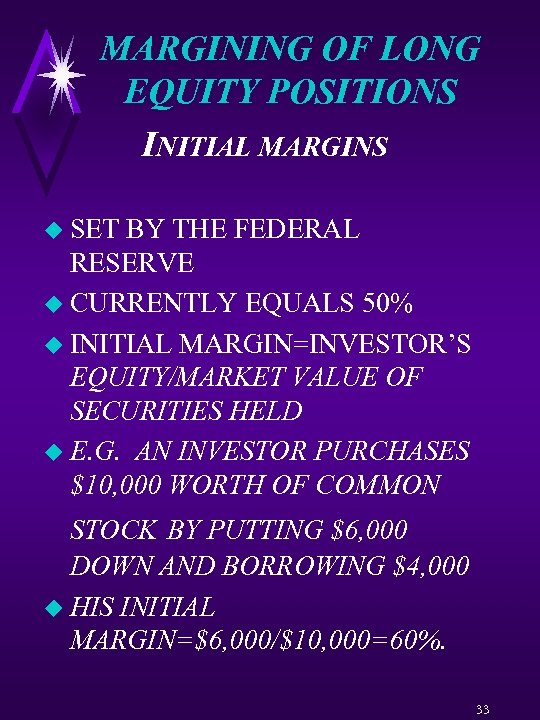
MARGINING OF LONG EQUITY POSITIONS INITIAL MARGINS u SET BY THE FEDERAL RESERVE u CURRENTLY EQUALS 50% u INITIAL MARGIN=INVESTOR’S EQUITY/MARKET VALUE OF SECURITIES HELD u E. G. AN INVESTOR PURCHASES $10, 000 WORTH OF COMMON STOCK BY PUTTING $6, 000 DOWN AND BORROWING $4, 000 u HIS INITIAL MARGIN=$6, 000/$10, 000=60%. 33
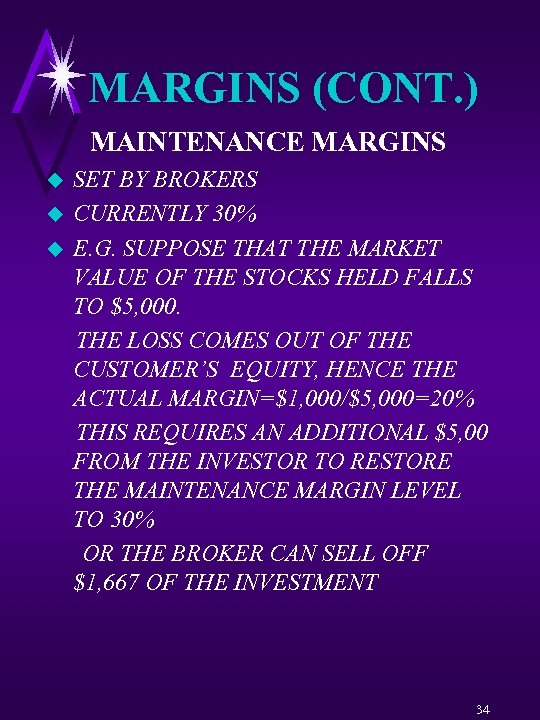
MARGINS (CONT. ) MAINTENANCE MARGINS u u u SET BY BROKERS CURRENTLY 30% E. G. SUPPOSE THAT THE MARKET VALUE OF THE STOCKS HELD FALLS TO $5, 000. THE LOSS COMES OUT OF THE CUSTOMER’S EQUITY, HENCE THE ACTUAL MARGIN=$1, 000/$5, 000=20% THIS REQUIRES AN ADDITIONAL $5, 00 FROM THE INVESTOR TO RESTORE THE MAINTENANCE MARGIN LEVEL TO 30% OR THE BROKER CAN SELL OFF $1, 667 OF THE INVESTMENT 34
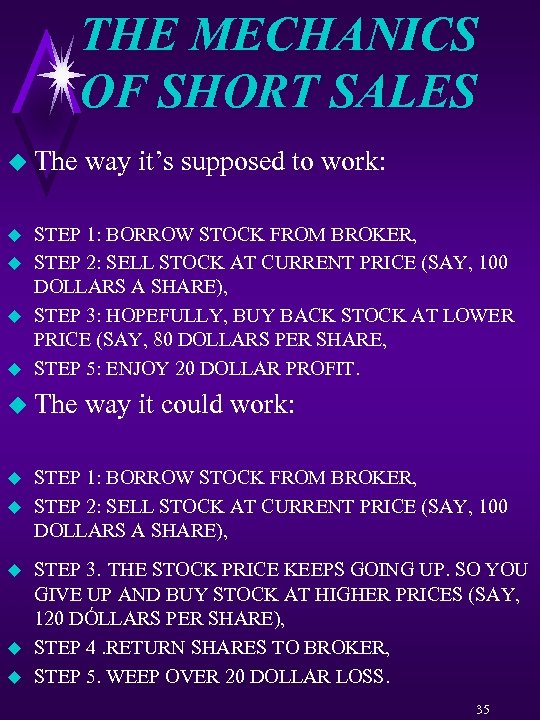
THE MECHANICS OF SHORT SALES u The u u STEP 1: BORROW STOCK FROM BROKER, STEP 2: SELL STOCK AT CURRENT PRICE (SAY, 100 DOLLARS A SHARE), STEP 3: HOPEFULLY, BUY BACK STOCK AT LOWER PRICE (SAY, 80 DOLLARS PER SHARE, STEP 5: ENJOY 20 DOLLAR PROFIT. u The u u u way it’s supposed to work: way it could work: STEP 1: BORROW STOCK FROM BROKER, STEP 2: SELL STOCK AT CURRENT PRICE (SAY, 100 DOLLARS A SHARE), STEP 3. THE STOCK PRICE KEEPS GOING UP. SO YOU GIVE UP AND BUY STOCK AT HIGHER PRICES (SAY, 120 DÓLLARS PER SHARE), STEP 4. RETURN SHARES TO BROKER, STEP 5. WEEP OVER 20 DOLLAR LOSS. 35
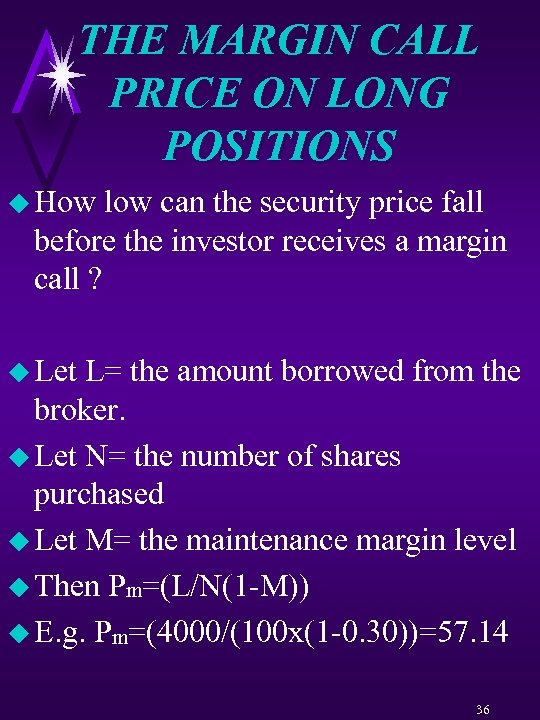
THE MARGIN CALL PRICE ON LONG POSITIONS u How low can the security price fall before the investor receives a margin call ? u Let L= the amount borrowed from the broker. u Let N= the number of shares purchased u Let M= the maintenance margin level u Then Pm=(L/N(1 -M)) u E. g. Pm=(4000/(100 x(1 -0. 30))=57. 14 36
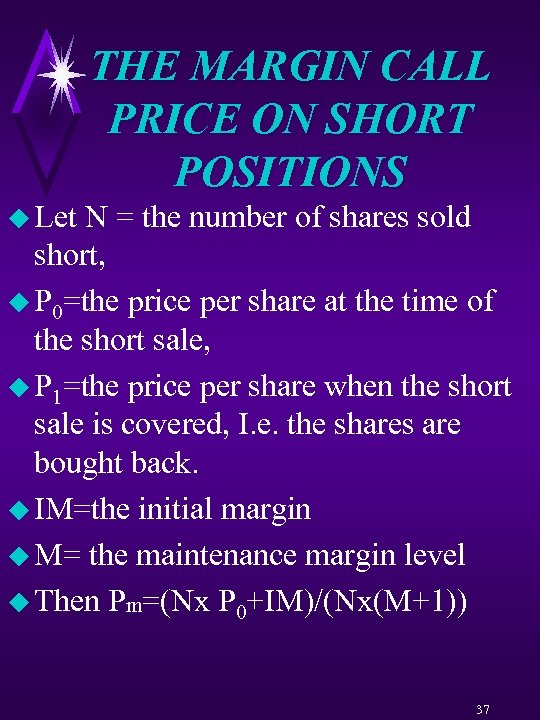
THE MARGIN CALL PRICE ON SHORT POSITIONS u Let N = the number of shares sold short, u P 0=the price per share at the time of the short sale, u P 1=the price per share when the short sale is covered, I. e. the shares are bought back. u IM=the initial margin u M= the maintenance margin level u Then Pm=(Nx P 0+IM)/(Nx(M+1)) 37
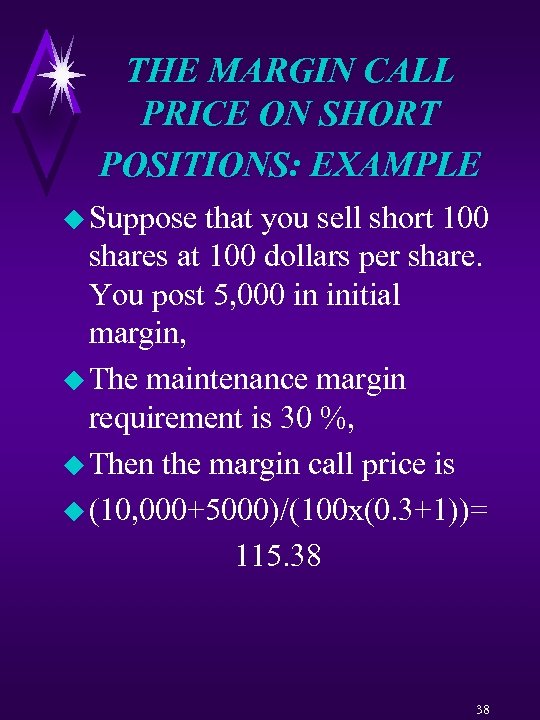
THE MARGIN CALL PRICE ON SHORT POSITIONS: EXAMPLE u Suppose that you sell short 100 shares at 100 dollars per share. You post 5, 000 in initial margin, u The maintenance margin requirement is 30 %, u Then the margin call price is u (10, 000+5000)/(100 x(0. 3+1))= 115. 38 38
DEFINING INVESTMENTS: A GENERAL DEFINITION We need a definition of ‘investment’ sufficiently general to encompass investments in real assets and investment in financial assets. Further, it should apply to explaining the connection between the two. The following definition serves: u THE SACRIFICE OF (CERTAIN) PRESENT CONSUMPTION FOR FUTURE (GENERALLY UNCERTAIN) CONSUMPTION 39
THE PROBLEM SOLVED BY INVESTMENTS u. Re-allocating consumption claims (certain and uncertain) across time and under conditions of uncertainty 40
ONE MAIN REASON FOR INVESTING u IN ORDER TO REALLOCATE CONSUMPTION CLAIMS IN THE PRESENT AND IN THE FUTURE FROM GIVEN PATTERNS INTO PREFERRED PATTERNS. u THE PRICING MECHANISM GIVES THE RATES AT WHICH THIS IS POSSIBLE IN THE MARKET THROUGH A VARIETY OF FINANCIAL VEHICLES. 41
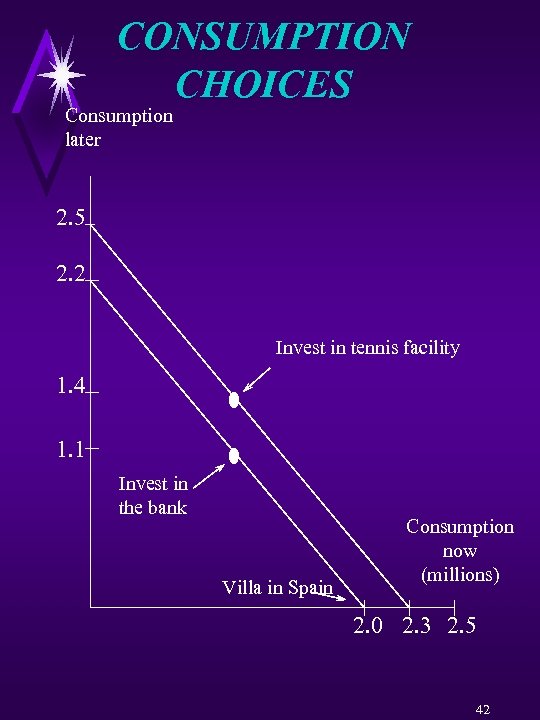
CONSUMPTION CHOICES Consumption later 2. 5 2. 2 Invest in tennis facility 1. 4 1. 1 Invest in the bank Villa in Spain Consumption now (millions) 2. 0 2. 3 2. 5 42
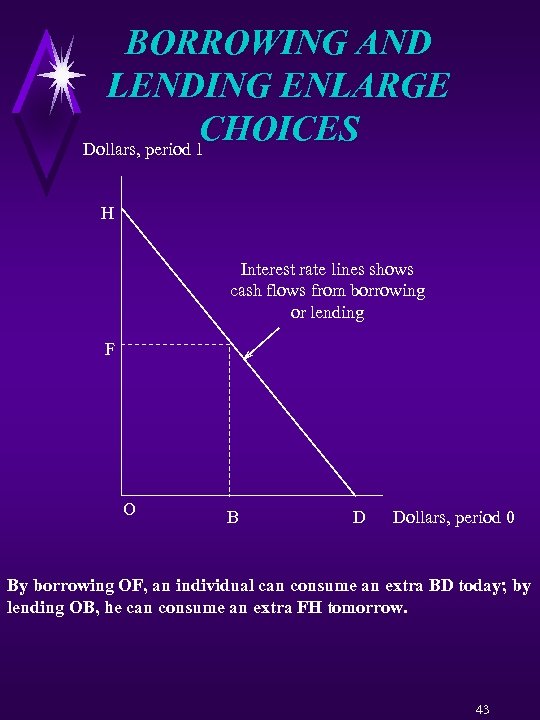
BORROWING AND LENDING ENLARGE CHOICES Dollars, period 1 H Interest rate lines shows cash flows from borrowing or lending F O B D Dollars, period 0 By borrowing OF, an individual can consume an extra BD today; by lending OB, he can consume an extra FH tomorrow. 43
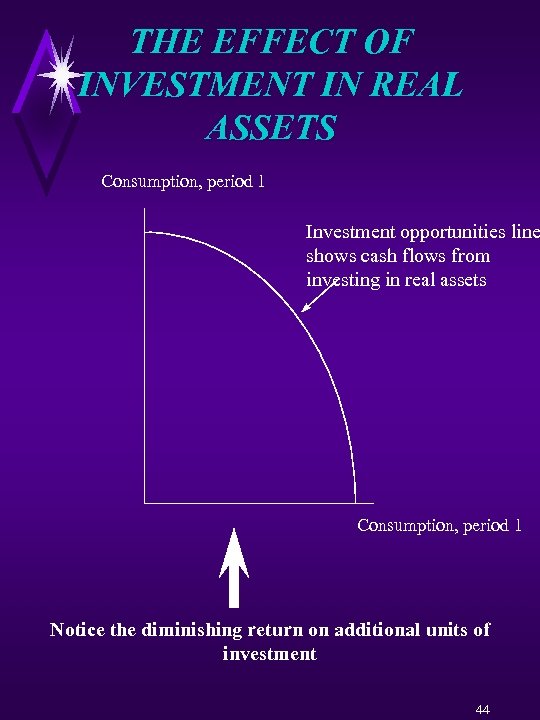
THE EFFECT OF INVESTMENT IN REAL ASSETS Consumption, period 1 Investment opportunities line shows cash flows from investing in real assets Consumption, period 1 Notice the diminishing return on additional units of investment 44
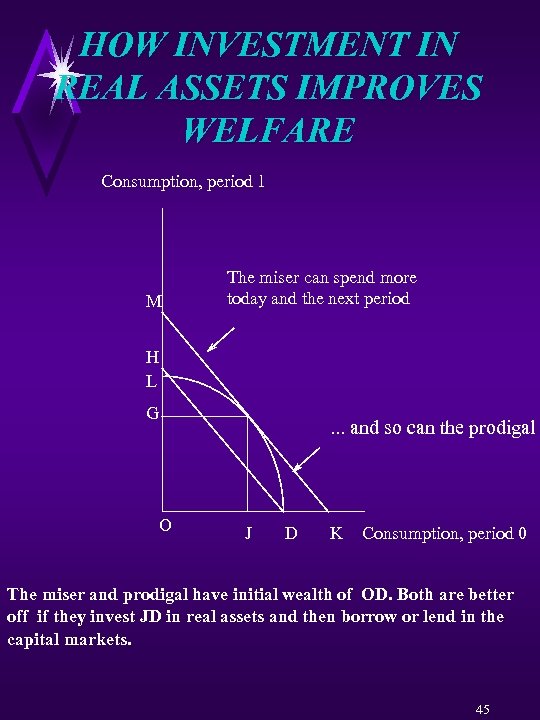
HOW INVESTMENT IN REAL ASSETS IMPROVES WELFARE Consumption, period 1 M The miser can spend more today and the next period H L G . . . and so can the prodigal O J D K Consumption, period 0 The miser and prodigal have initial wealth of OD. Both are better off if they invest JD in real assets and then borrow or lend in the capital markets. 45
KEY QUESTIONS ADDRESSED BY INVESTMENT ANALYSIS u 1. WHAT TYPES OF RE- ALLOCATIONS ARE AVAILABLE IN THE MARKETS FOR FIXED INCOME, EQUITIES, HYBRIDS, ETC. ? u 2. WHAT ARE THE RISK/EXPECTED RETURN CHARACTERISTICS OF THESE MECHANISMS (OPPORTTUNITY COSTS) ? u 3. HOW CAN THESE INVESTMENT VEHICLES BE RISK-MANAGED ? u E. G. THROUGH PORTFOLIO DIVERSIFICATION, AND THE CORRECT USES OF DERIVATIVES. 46
DEFINING VIABLE INVESTMENT PROGRAMS u 1. THE SET OF AVAILABLE ‘RISKFREE’ INVESTMENT ALTERNATIVES. u 2. THE SET OF AVAILABLE RISKY INVESTMENT ALTERNATIVES. u 3. SUBJECTIVE PREFERENCES FOR THE RISK/EXPECTED RETURN TRADEOFFS EMBODIED IN FINANCIAL INSTRUMENTS AS INVESTMENT VEHICLES. 47
OBJECTIVES OF INVESTMENT ANALYSIS u 1. MAP OUT THE RISK/RETURN CHARACTERISTICS OF ALTERNATIVE INVESTMENT STRATEGIES. u 2. SIFT OUT WHAT CAN ACTUALLY BE DONE BY PORTFOLIO MANAGERS FOR THEIR CLIENTS FROM WHAT CAN’T BE DONE SO AS TO SATISFY THEIR SUBJECTIVE RISK/RETURN PREFERENCES. 48
TYPES OF INVESTMENT STRATEGIES u 1. MARKET TIMING. u 2. STATIC PORTFOLIO DIVERSIFICATION. u 3. DYNAMIC PORTFOLIO DIVERSIFICATION. u 4. ASSET ALLOCATION. 49
BASIC ASSET ALLOCATION STRATEGIES u ALLOCATING FUNDS BETWEEN CASH EQUIVALENTS, BONDS, AND EQUITIES. u E. G. CAPITAL ALLOCATION LINE STRATEGIES--HOW MUCH IN THE BANK =, HOW MUCH IN A SINGLE RISKY ASSET MUTUAL FUND 50
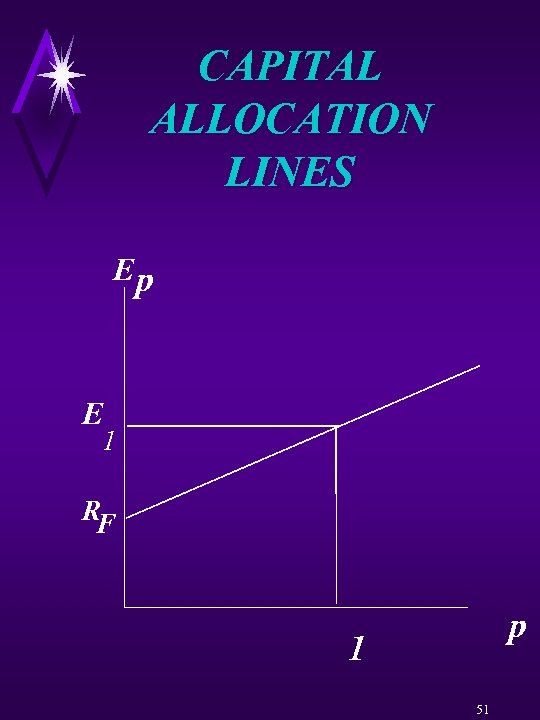
CAPITAL ALLOCATION LINES Ep E 1 RF p 1 51
![THE EQUATION OF THE CAL u. E(RP )= RF+[(E 1 -RF ) / 1]x](https://present5.com/presentation/49fde82ba147d66c8805d683387c07fb/image-52.jpg "THE EQUATION OF THE CAL u. E(RP )= RF+[(E 1 -RF ) / 1]x")
THE EQUATION OF THE CAL u. E(RP )= RF+[(E 1 -RF ) / 1]x p u. WHERE E(RP ) IS THE EXPECTED RATE OF RETURN OF THE PORTFOLIO. u. AND p IS THE STANDARD DEVIATION OF THE RATE OF RETURN OF THE PORTFOLIO. 52
CAPITAL ALLOCATION LINES (REWARD TO RISK RATIO) u THE SLOPE OF THE CAPITAL ALLOCATION LINE IS THE (EXCESS) REWARD TO RISK RATIO= (E 1 -RF ) / 1 THAT (E 1 -RF ) IS THE EXCESS EXPECTED RETURN OFFERED BY SECURITY OR PORTFOLIO 1 ABOVE THAT OFFERED BY CASH EQUIVALENTS REPRESENTED BY THE SURE RATE OF RETURN, u NOTE u 1 IS A MEASURE OF ‘RISK’ 53
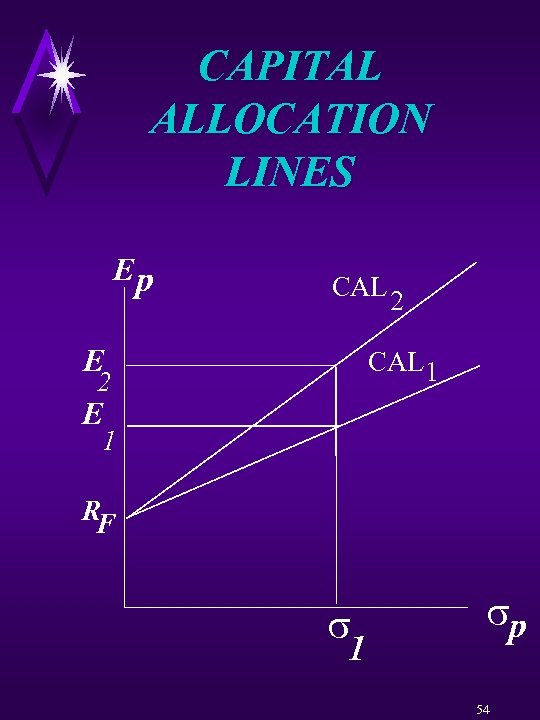
CAPITAL ALLOCATION LINES Ep CAL 2 E CAL 1 2 E 1 RF 1 p 54
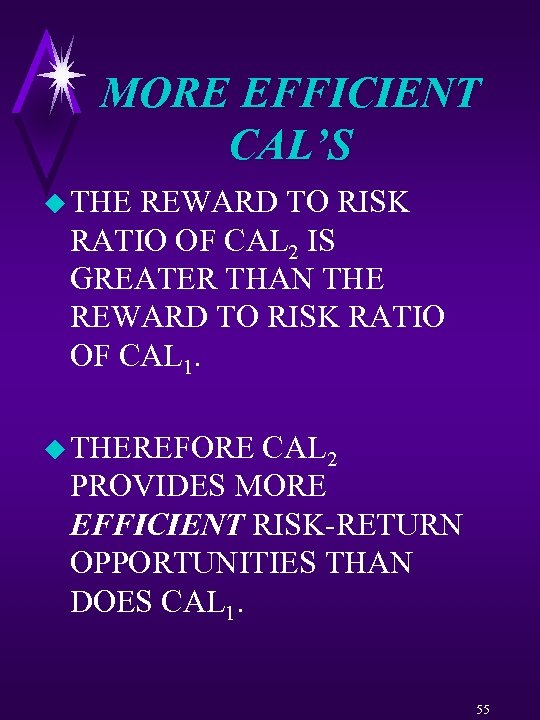
MORE EFFICIENT CAL’S u THE REWARD TO RISK RATIO OF CAL 2 IS GREATER THAN THE REWARD TO RISK RATIO OF CAL 1. u THEREFORE CAL 2 PROVIDES MORE EFFICIENT RISK-RETURN OPPORTUNITIES THAN DOES CAL 1. 55
ROLE OF THE PORTFOLIO MANAGER u OFFER MORE AND MORE EFFICIENT CAPITAL ALLOCATION LINES TO INVESTORS RATHER THAN: u ATTEMPTING TO SATISFY THEIR SUBJECTIVE RISK/RETURN PREFERENCES DIRECTLY. 56
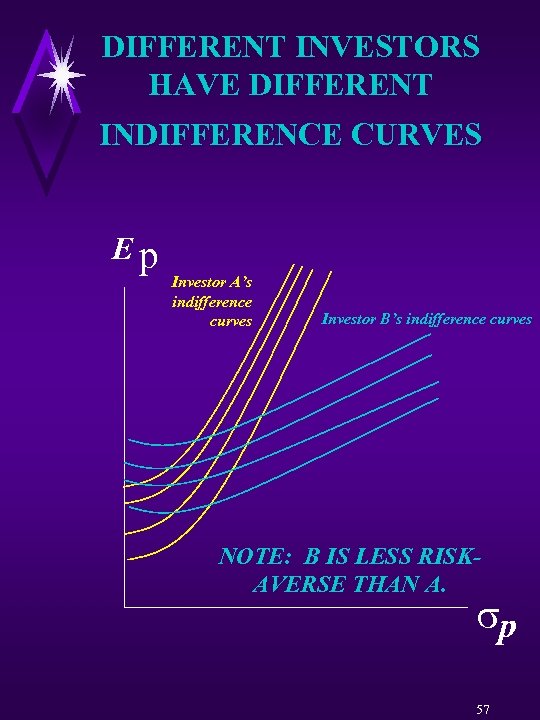
DIFFERENT INVESTORS HAVE DIFFERENT INDIFFERENCE CURVES Ep Investor A’s indifference curves Investor B’s indifference curves NOTE: B IS LESS RISKAVERSE THAN A. p 57
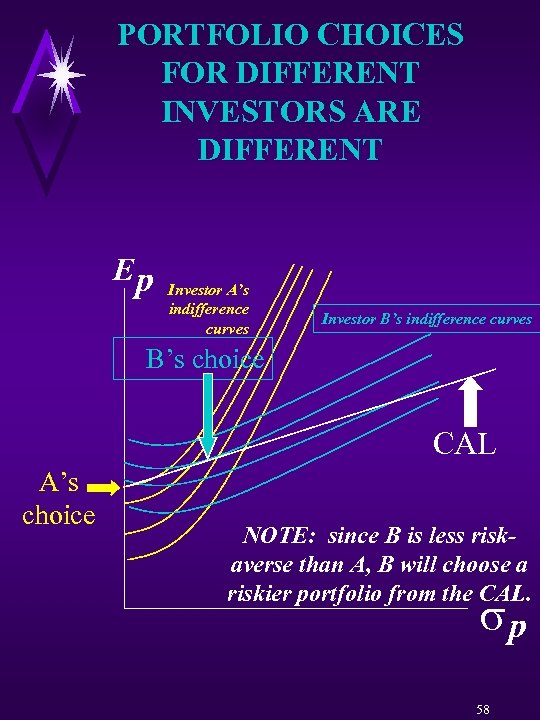
PORTFOLIO CHOICES FOR DIFFERENT INVESTORS ARE DIFFERENT Ep Investor A’s indifference curves Investor B’s indifference curves B’s choice CAL A’s choice NOTE: since B is less riskaverse than A, B will choose a riskier portfolio from the CAL. p 58
PORTFOLIO ANALYSIS u 1. What is a portfolio ? u 2. Calculating two parameters of paramount importance to risk -averse investors: u (a) Expected rate of return of a portfolio: E(RP ). u (b) Standard deviation of the rate of return of a portfolio: P. 59
PORTFOLIO ANALYSIS (CONT. ) u Suppose that there are N securities traded in the market. u A portfolio is an asset allocation scheme for distributing your capital among the available securities traded in the market. u In order to define a portfolio, you need to have : u 1. A list of the securities that you want to include in the portfolio. u An asset allocation scheme defined by a set of portfolio weights: x 1, x 2, x 3, ……. , x. N. 60
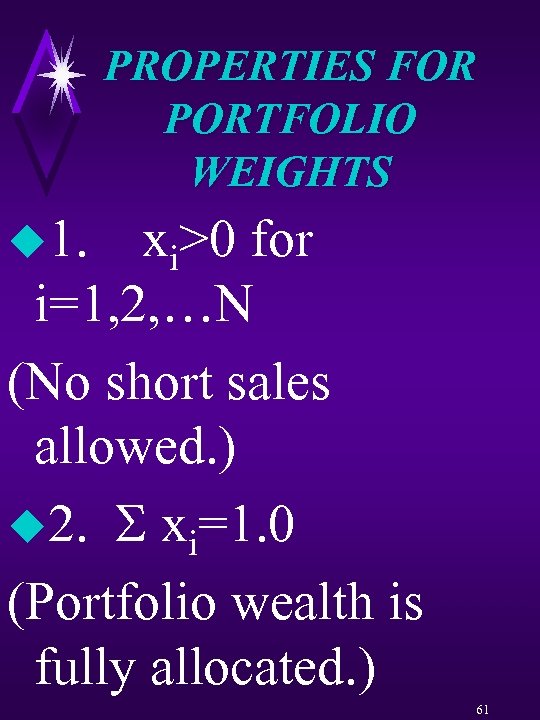
PROPERTIES FOR PORTFOLIO WEIGHTS u 1. xi>0 for i=1, 2, …N (No short sales allowed. ) u 2. xi=1. 0 (Portfolio wealth is fully allocated. ) 61
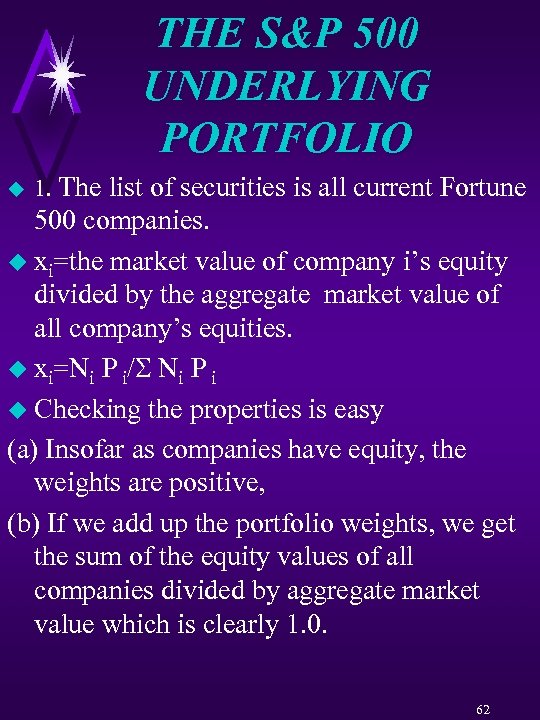
THE S&P 500 UNDERLYING PORTFOLIO u 1. The list of securities is all current Fortune 500 companies. u xi=the market value of company i’s equity divided by the aggregate market value of all company’s equities. u xi=Ni P i/ Ni P i u Checking the properties is easy (a) Insofar as companies have equity, the weights are positive, (b) If we add up the portfolio weights, we get the sum of the equity values of all companies divided by aggregate market value which is clearly 1. 0. 62

NUMERICAL EXAMPLE OF WHAT A PORTFOLIO DOES 63
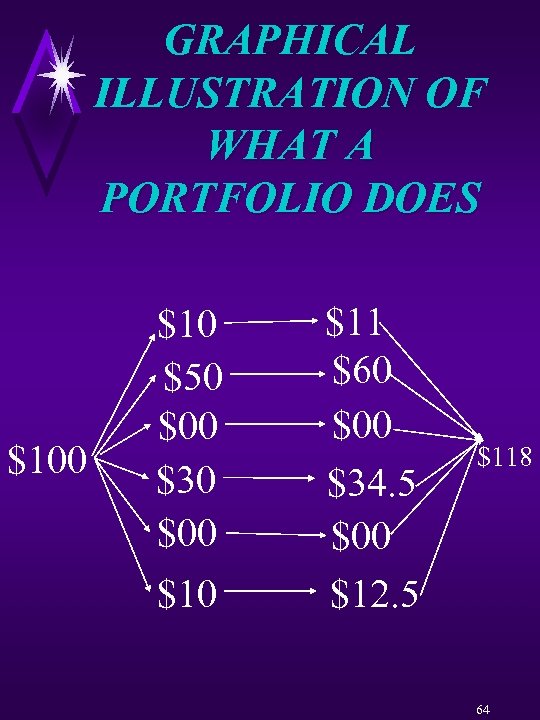
GRAPHICAL ILLUSTRATION OF WHAT A PORTFOLIO DOES $100 $10 $50 $00 $30 $00 $11 $60 $00 $34. 5 $00 $12. 5 $118 64
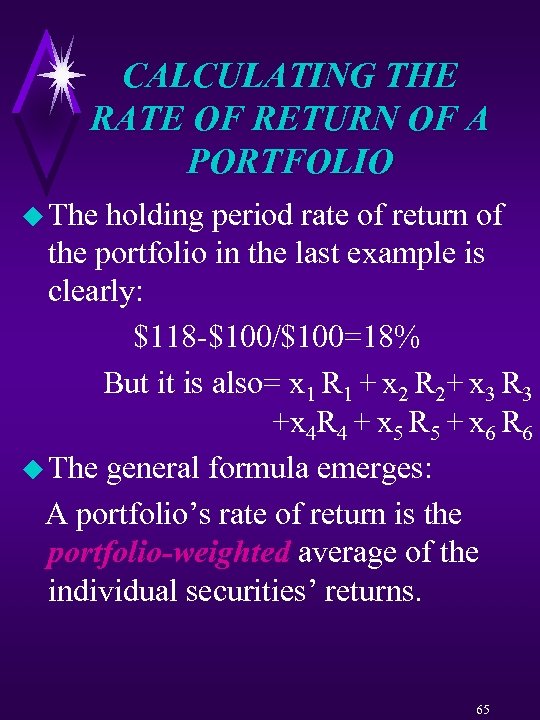
CALCULATING THE RATE OF RETURN OF A PORTFOLIO u The holding period rate of return of the portfolio in the last example is clearly: $118 -$100/$100=18% But it is also= x 1 R 1 + x 2 R 2+ x 3 R 3 +x 4 R 4 + x 5 R 5 + x 6 R 6 u The general formula emerges: A portfolio’s rate of return is the portfolio-weighted average of the individual securities’ returns. 65
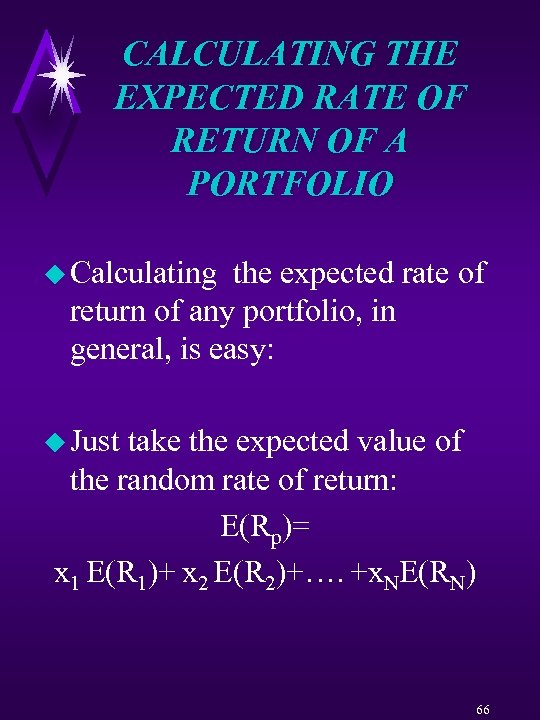
CALCULATING THE EXPECTED RATE OF RETURN OF A PORTFOLIO u Calculating the expected rate of return of any portfolio, in general, is easy: u Just take the expected value of the random rate of return: E(Rp)= x 1 E(R 1)+ x 2 E(R 2)+…. +x. NE(RN) 66
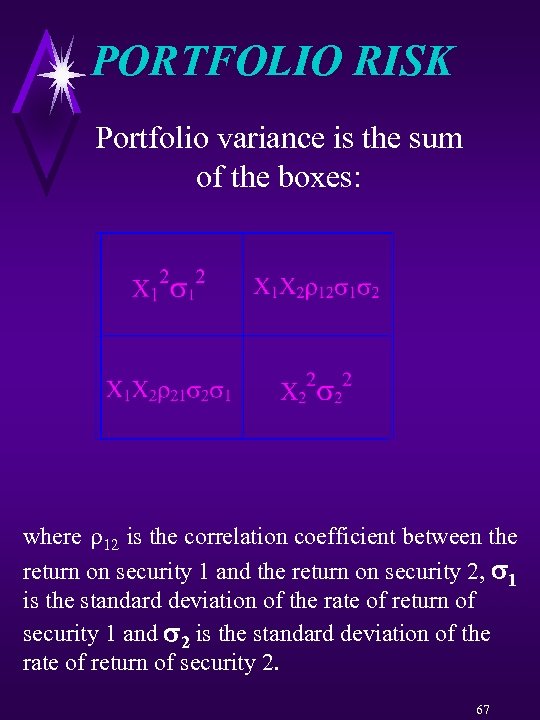
PORTFOLIO RISK Portfolio variance is the sum of the boxes: where 12 is the correlation coefficient between the return on security 1 and the return on security 2, 1 is the standard deviation of the rate of return of security 1 and 2 is the standard deviation of the rate of return of security 2. 67
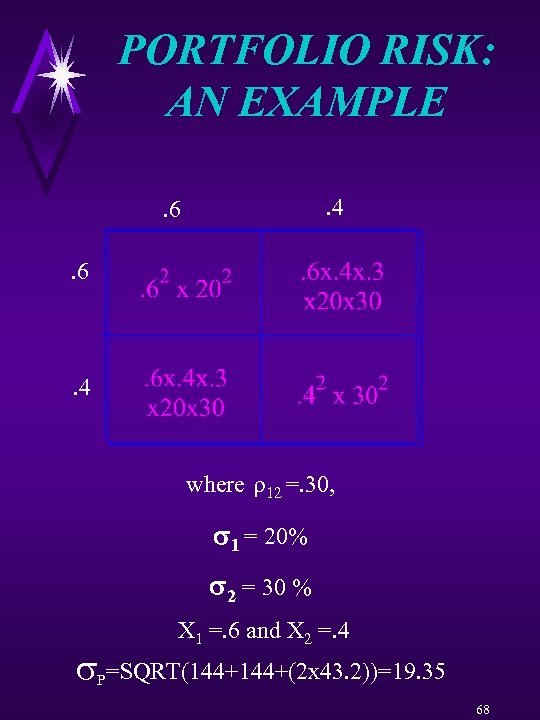
PORTFOLIO RISK: AN EXAMPLE. 4 . 6. 6 . 4 where 12 =. 30, 1 = 20% 2 = 30 % X 1 =. 6 and X 2 =. 4 P=SQRT(144+(2 x 43. 2))=19. 35 68
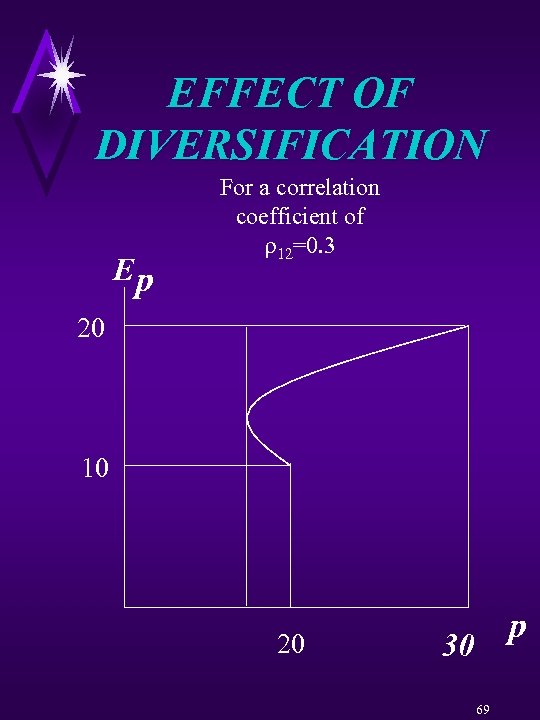
EFFECT OF DIVERSIFICATION Ep For a correlation coefficient of 12=0. 3 20 10 20 p 30 69

THE DIVERSIFICATION EFFECT IN AN EXTREME CASE 70
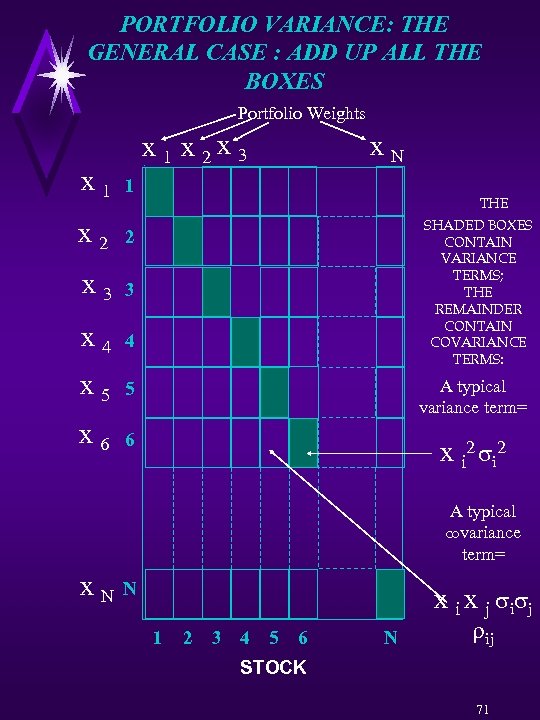
PORTFOLIO VARIANCE: THE GENERAL CASE : ADD UP ALL THE BOXES Portfolio Weights x 1 x 2 x 3 x. N x 1 1 x 2 2 x 3 3 x 4 4 x 5 5 A typical variance term= x 6 6 x i 2 THE SHADED BOXES CONTAIN VARIANCE TERMS; THE REMAINDER CONTAIN COVARIANCE TERMS: A typical COvariance term= x. NN x i x j i j 1 2 3 4 5 6 N ij STOCK 71
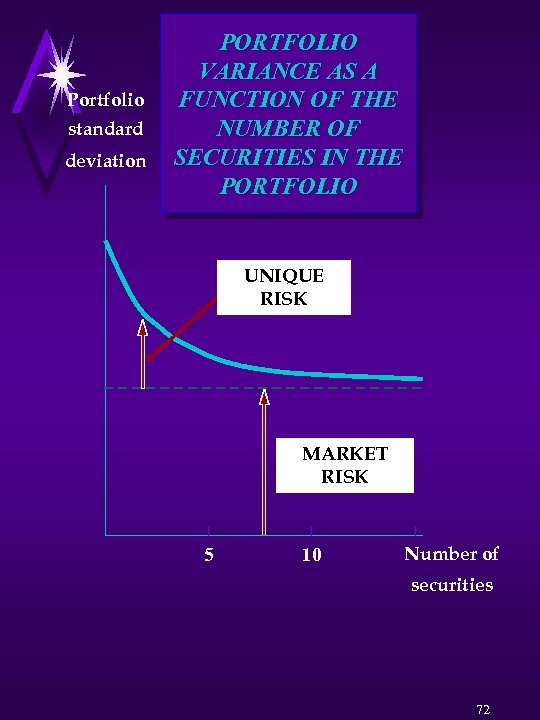
Portfolio standard deviation PORTFOLIO VARIANCE AS A FUNCTION OF THE NUMBER OF SECURITIES IN THE PORTFOLIO UNIQUE RISK MARKET RISK 5 10 Number of securities 72
u. The FOUNDATIONS OF PORTFOLIO ANALYSIS efficient frontier of risky assets: u. Identify the efficient riskexpected return combinations from among the simply feasible ones, u. Choosing the optimal risky asset portfolio from the efficient frontier: u. Find the optimal portfolio that supports the highest CAL. 73
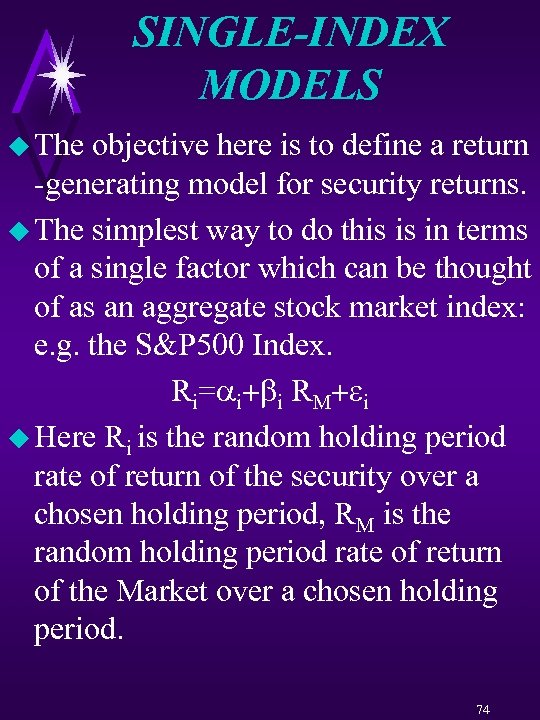
SINGLE-INDEX MODELS u The objective here is to define a return -generating model for security returns. u The simplest way to do this is in terms of a single factor which can be thought of as an aggregate stock market index: e. g. the S&P 500 Index. Ri=ai+bi RM+ei u Here Ri is the random holding period rate of return of the security over a chosen holding period, RM is the random holding period rate of return of the Market over a chosen holding period. 74
SINGLE-INDEX MODELS (CONT. ) u ai is the actual rate of return that the security can earn on its own, i. e. independently of the Market, bi is the beta of the security’s rate of return, i. e. a measure of its comovement with the market as a percentage of the total volatility of the market, u ei is a pure noise term, I. e. a random variable that is independent of the Market’s rate of return. u 75
SINGLE-INDEX MODELS (CONT. ) KEY PROPERTIES OF ei: u a. E(ei)=0 (zero mean, I. e no systematic bias in any direction) u b. Cov(ei, RM )=0 (noise is not a fundamental economic factor, it is not correlated with any such factor). 76
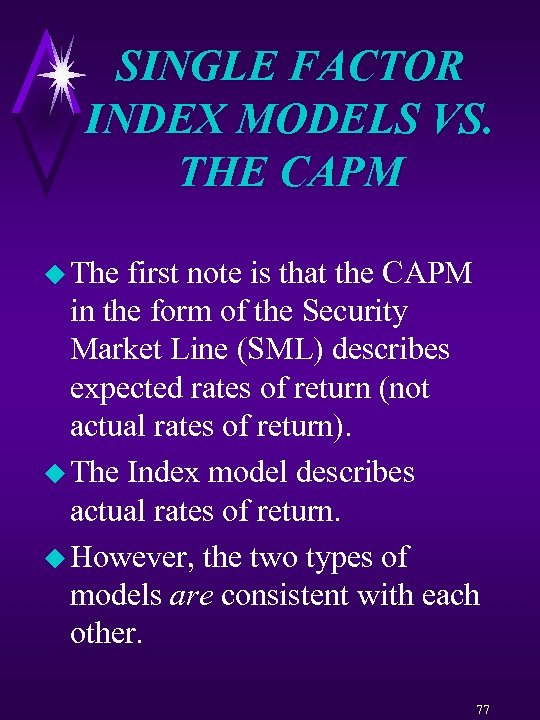
SINGLE FACTOR INDEX MODELS VS. THE CAPM u The first note is that the CAPM in the form of the Security Market Line (SML) describes expected rates of return (not actual rates of return). u The Index model describes actual rates of return. u However, the two types of models are consistent with each other. 77
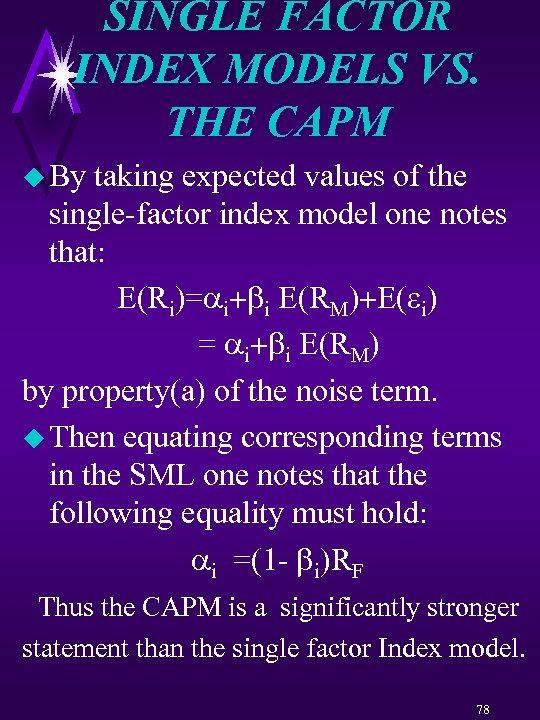
SINGLE FACTOR INDEX MODELS VS. THE CAPM u By taking expected values of the single-factor index model one notes that: E(Ri)=ai+bi E(RM)+E(ei) = ai+bi E(RM) by property(a) of the noise term. u Then equating corresponding terms in the SML one notes that the following equality must hold: ai =(1 - bi)RF Thus the CAPM is a significantly stronger statement than the single factor Index model. 78
PORTFOLIO CHOICES OF DIFFERENT INVESTORS u. The optimal final portfolio and the Separation Property: u. Mix the optimal risky portfolio with cash equivalents to get the final portfolio for the given investor. 79
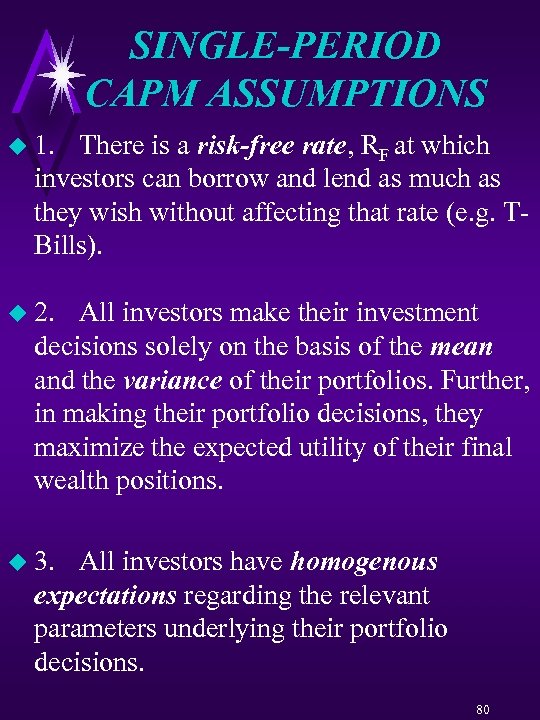
SINGLE-PERIOD CAPM ASSUMPTIONS u 1. There is a risk-free rate, RF at which investors can borrow and lend as much as they wish without affecting that rate (e. g. TBills). u 2. All investors make their investment decisions solely on the basis of the mean and the variance of their portfolios. Further, in making their portfolio decisions, they maximize the expected utility of their final wealth positions. u 3. All investors have homogenous expectations regarding the relevant parameters underlying their portfolio decisions. 80
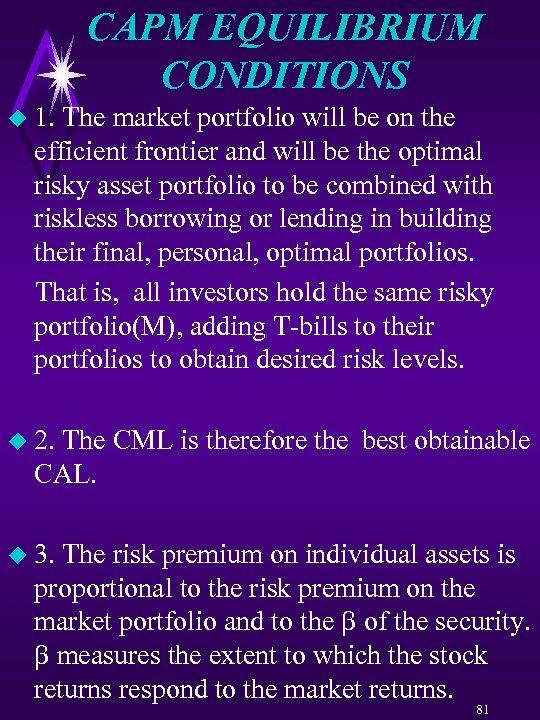
CAPM EQUILIBRIUM CONDITIONS u 1. The market portfolio will be on the efficient frontier and will be the optimal risky asset portfolio to be combined with riskless borrowing or lending in building their final, personal, optimal portfolios. That is, all investors hold the same risky portfolio(M), adding T-bills to their portfolios to obtain desired risk levels. u 2. The CML is therefore the best obtainable CAL. u 3. The risk premium on individual assets is proportional to the risk premium on the market portfolio and to the b of the security. b measures the extent to which the stock returns respond to the market returns. 81
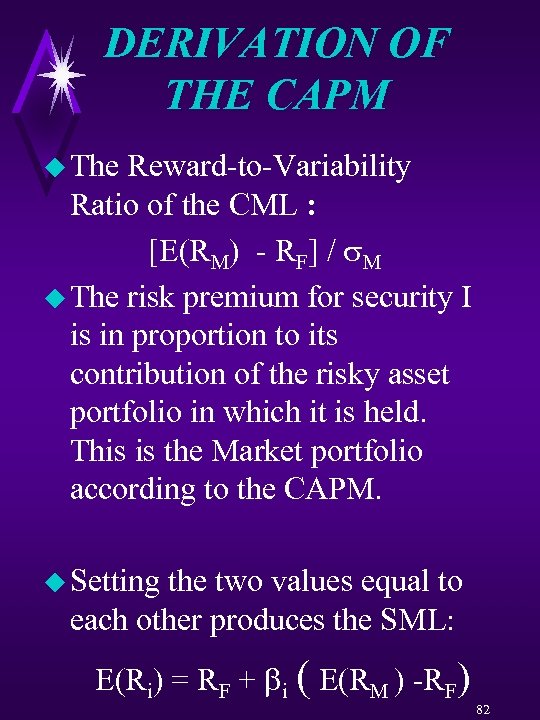
DERIVATION OF THE CAPM u The Reward-to-Variability Ratio of the CML : [E(RM) - RF] / M u The risk premium for security I is in proportion to its contribution of the risky asset portfolio in which it is held. This is the Market portfolio according to the CAPM. u Setting the two values equal to each other produces the SML: E(Ri) = RF + bi ( E(RM ) -RF) 82
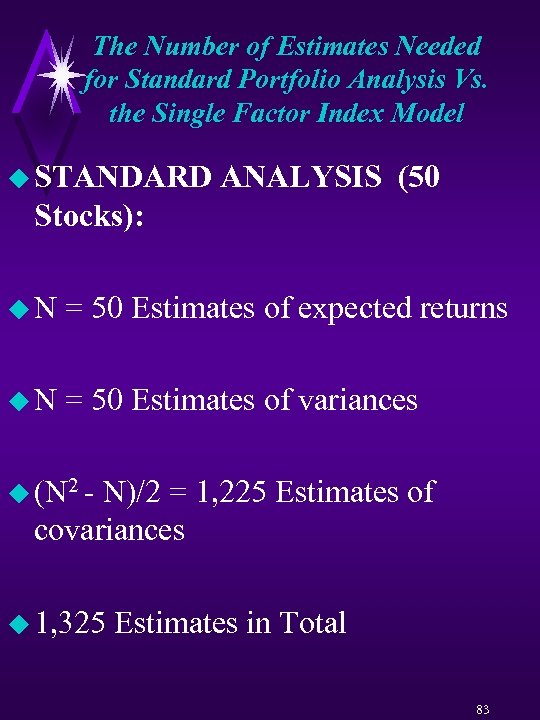
The Number of Estimates Needed for Standard Portfolio Analysis Vs. the Single Factor Index Model u STANDARD ANALYSIS (50 Stocks): u. N = 50 Estimates of expected returns u. N = 50 Estimates of variances u (N 2 - N)/2 = 1, 225 Estimates of covariances u 1, 325 Estimates in Total 83
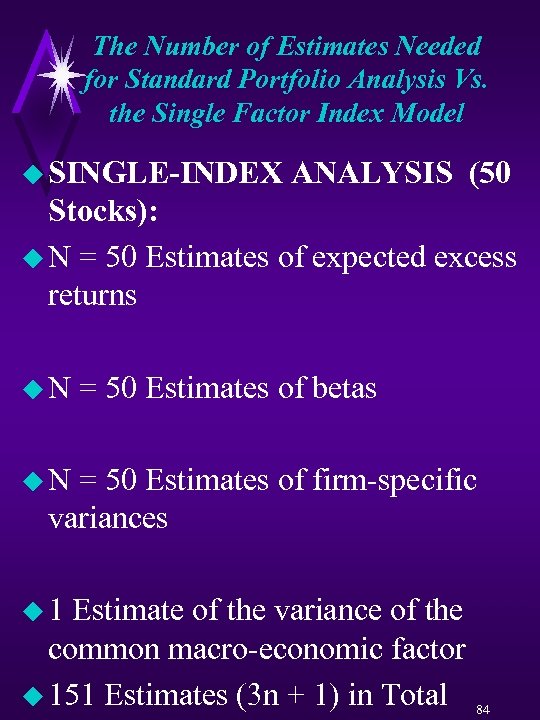
The Number of Estimates Needed for Standard Portfolio Analysis Vs. the Single Factor Index Model u SINGLE-INDEX ANALYSIS (50 Stocks): u N = 50 Estimates of expected excess returns u. N = 50 Estimates of betas u. N = 50 Estimates of firm-specific variances u 1 Estimate of the variance of the common macro-economic factor u 151 Estimates (3 n + 1) in Total 84
THE CAPM VS. THE APT u 1. The CAPM assumes an unobservable “market” portfolio, u 2. The APT is based on the assumption of no arbitrage profits in well-diversified portfolios, u 3. However, the APT admits the possibility of arbitrage profits on a “few” individual securities, u 4. The APT provides no guidance for identification of the various market factors and appropriate risk premiums for these factors 85
PERFORMANCE ATTRIBUTION PROCEDURES u First, decide on the proportions of equity, fixed income, and money market funds in the portfolio. u Secondly, decide on the proportions of particular industries (sectors) within each market. u Third, decide on the particular securities in an industry to be included in the portfolio. u Use a benchmark or “bogey” portfolio as the standard of a passive strategy. 86
PERFORMANCE ATTRIBUTION PROCEDURES (CONT. ) u For allocation comparisons, compare the bogey portfolio returns to the returns on your portfolio which has different allocations. u Subtract the allocation differential returns from the total return differential to get the security return difference. 87
PERFORMANCE ATTRIBUTION PROCEDURES (CONT. ) u Compare your equity performance to the S&P 500 Index. u Compare your fixed income performance to the Shearson. Lehman Index. u Compare sector weights in your portfolio to the sector weights in the S&P 500 Index. 88
![RISK-ADJUSTED MEASURES OF PORTFOLIO PERFORMANCE u SHARPE MEASURE =[E(RP) - RF] / P u](https://present5.com/presentation/49fde82ba147d66c8805d683387c07fb/image-89.jpg "RISK-ADJUSTED MEASURES OF PORTFOLIO PERFORMANCE u SHARPE MEASURE =[E(RP) - RF] / P u")
RISK-ADJUSTED MEASURES OF PORTFOLIO PERFORMANCE u SHARPE MEASURE =[E(RP) - RF] / P u TREYNOR MEASURE =[E(RP) - RF] / b. P u JENSEN MEASURE = a. P =E(RP) -[RF + bi ( E(RM ) -RF)] u APPRAISAL RATIO =a. P/ (e. P) 89

INVESTOR Cl. ASSIFICATIONS u INDIVIDUAL INVESTORS u PERSONAL TRUSTS u MUTUAL FUNDS u PENSION FUNDS u ENDOWMENT FUNDS u LIFE INSURANCE COMPANIES u NONLIFE INSURANCE COMPANIES u BANKS 90
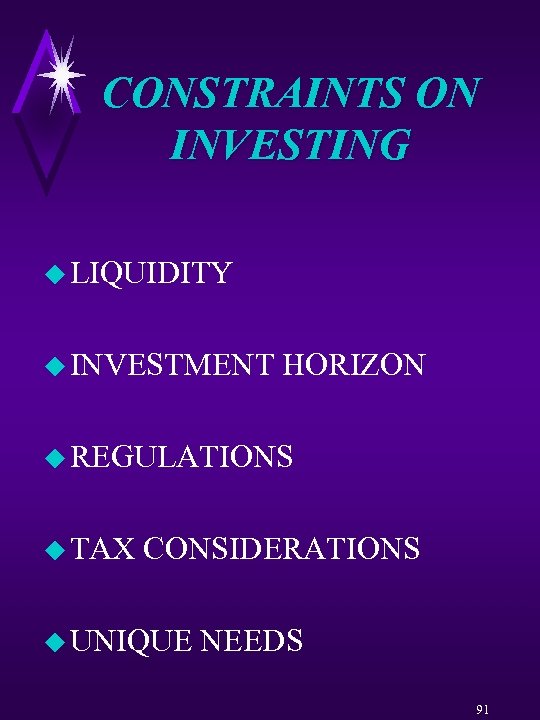
CONSTRAINTS ON INVESTING u LIQUIDITY u INVESTMENT HORIZON u REGULATIONS u TAX CONSIDERATIONS u UNIQUE NEEDS 91
Скачать презентацию INTRODUCTION TO DERIVATIVES MARKETS INVESTMENTS BACKGROUND SPRING 2006
49fde82ba147d66c8805d683387c07fb.ppt