


 Скачать презентацию Introduction to Decision Support Systems Principles of Decision
6e9096f98440f3339883ac61141dac89.ppt
- Количество слайдов: 45
 Introduction to Decision Support Systems Principles of Decision Support Systems Abe Feinberg California State University, Northridge 1
 Managers and Managerial Work v Managing within an Organization v Definition: A System of Resources Structured by Power Centers to Achieve some Objectives within an Environment v Orientation: Public <---> Private v Size of the Organization v Durability of the Organization 2
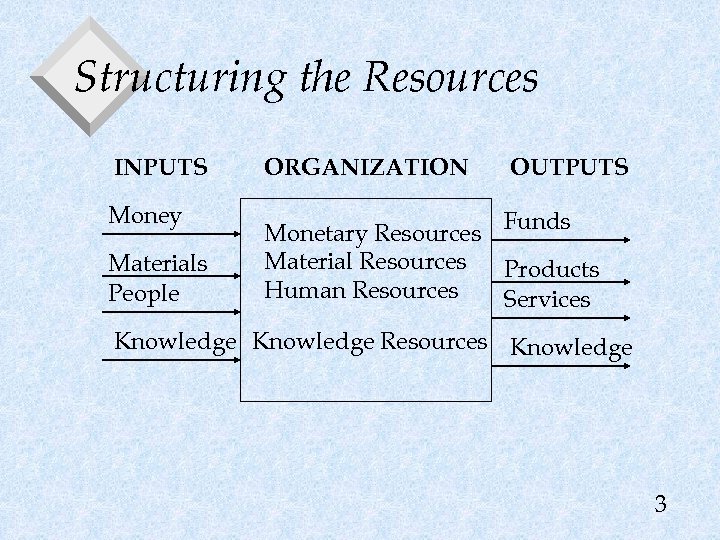 Structuring the Resources INPUTS ORGANIZATION Money Monetary Resources Funds Material Resources Products Human Resources Services Materials People OUTPUTS Knowledge Resources Knowledge 3
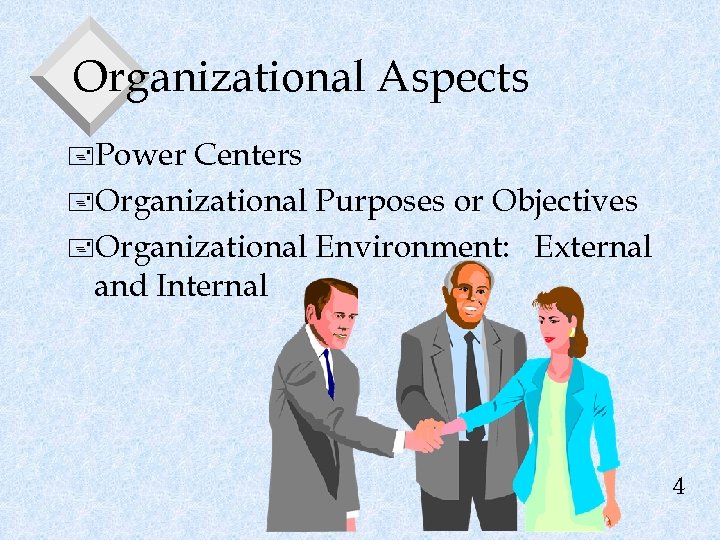 Organizational Aspects +Power Centers +Organizational Purposes or Objectives +Organizational Environment: External and Internal 4
 Managerial Functions v Planning v Organizing v Commanding v Coordinating v Controlling 5
 Mangerial Roles v Informational v Interpersonal Entrepreneur; Disturbance Handler; Resource Allocator; and Negotiator v Decisional: 6
 Types of Knowledge v Descriptive: Information or Data – Examples: Demand for Service, Inventories, Personnel Records v Procedural: How to do something or steps to follow to do something or an Algorithm 7
 Decisions v What is Decision Making? v Choosing among Alternatives? v Generating Alternatives? v Selecting a Course of Actions? v Handling Risk? v All of the Above!! 8
 Decision Context v Organizational Setting: Planning vs. Control v Emergent vs. Established Situation v Timing of Decisions v Organizational Design: Centralized vs. Decentralized v Decision Type: Strategic or Tactical 9
 Decision Structuredness v Programmed v Structured v Semi-Structured v Unstructured v The Degree of Structuredness Can Change over Time v Negotiated vs. Unilateral Decisions 10
 Contributions of DSS’s v Answering What-If Questions v Assessing Potential Outcomes v Aiding Negotiations v Providing Consistent Decisions v Evaluating and Limiting Risk 11
 Some DSS examples v Forecasting Demand for Service v Staffing v Resource Allocation v Project Management v Vehicle Routing v Waste Disposal 11 A
 DECISION MAKING AND COMPUTERIZED SUPPORT v Management Support Systems (MSS) Computerized technologies v Objectives – Support managerial work – Support decision making 12
 Management Support Systems An Overview Emerging and Advanced Computer Technologies for Supporting Managerial Problem Solution v v v Changing Organizational Structure Enabling Business Transformation Changing Management Methods 14
 Managers and Decision Making: Why Computerized Support? v Competition v Speed v The MANAGERS are always responsible for decision making 15
 Factors Affecting Decision Making v Technology / Information / Computers v Structural Complexity / Competition v International Markets / Political Stability / Consumerism v Changes, Fluctuations 16
 Managers and Computerized Support v Information Technology: vital to the business v Support technologies extensively implemented 17
 Computer Applications Evolving from Transaction Processing Systems (TPS) and MIS to Proactive Applications (DSS) New modern management tools in v v v Data access Online analytical processing (OLAP) Internet / Intranet / Web for decision support 18
 Need for Computerized Decision Support and the Supporting Technologies v v v v Speedy computations Overcome cognitive limits in processing and storage Cognitive limits may restrict an individual’s problem-solving capability Cost reduction Technical support Quality support Competitive edge 19
 Decision Support Technologies v v v v v Management Support Systems (MSS) Decision Support Systems (DSS) Group Support Systems (GSS) Enterprise (Executive) Information Systems (EIS) Enterprise Resource Planning (ERP) and Supply -Chain Management (SCM) Knowledge Management Systems Expert Systems (ES) Artificial Neural Networks (ANN) Hybrid Support Systems Intelligent DSS 19
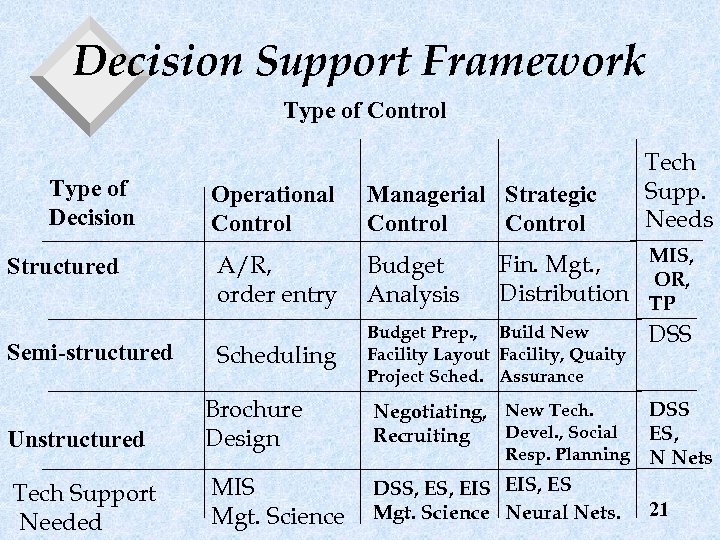 Decision Support Framework Type of Control Type of Decision Structured Semi-structured Operational Control Managerial Strategic Control A/R, order entry Budget Analysis Scheduling Budget Prep. , Build New Facility Layout Facility, Quaity Project Sched. Assurance Unstructured Brochure Design Tech Support Needed MIS Mgt. Science Tech Supp. Needs MIS, Fin. Mgt. , OR, Distribution TP DSS ES, Resp. Planning N Nets DSS, EIS EIS, ES Mgt. Science Neural Nets. 21 Negotiating, New Tech. Devel. , Social Recruiting
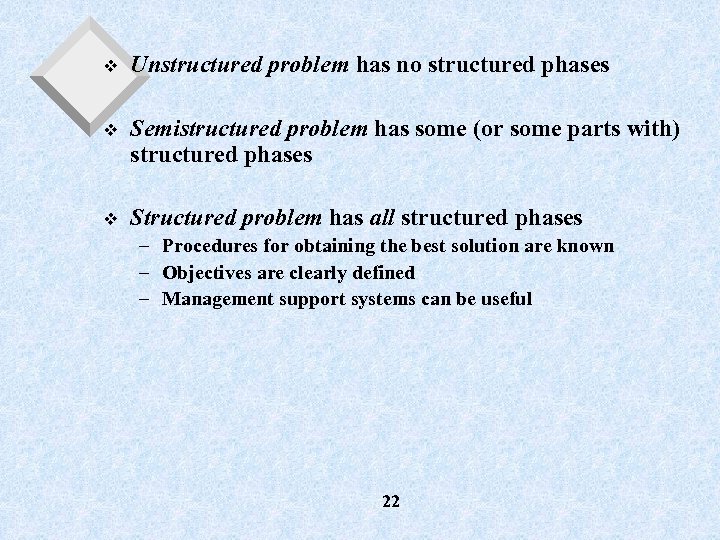 v Unstructured problem has no structured phases v Semistructured problem has some (or some parts with) structured phases v Structured problem has all structured phases – Procedures for obtaining the best solution are known – Objectives are clearly defined – Management support systems can be useful 22
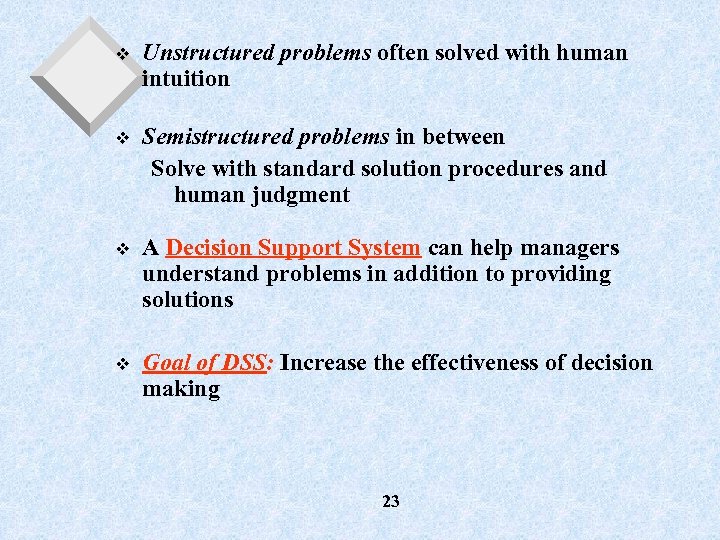 v Unstructured problems often solved with human intuition v Semistructured problems in between Solve with standard solution procedures and human judgment v A Decision Support System can help managers understand problems in addition to providing solutions v Goal of DSS: Increase the effectiveness of decision making 23
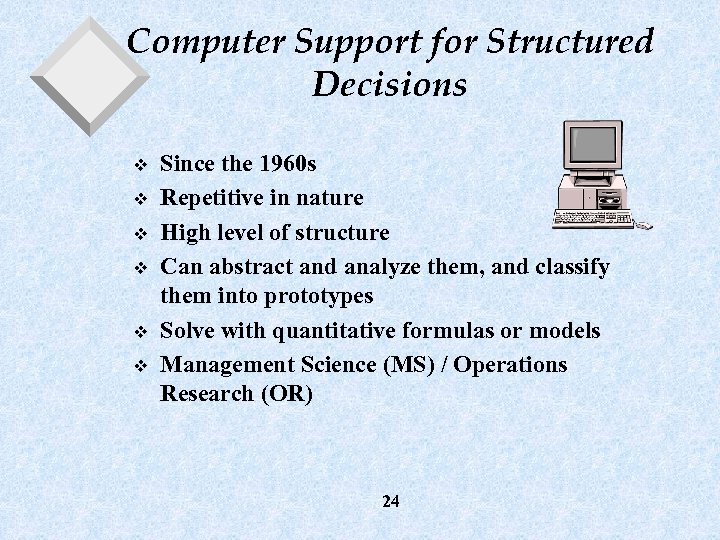 Computer Support for Structured Decisions v v v Since the 1960 s Repetitive in nature High level of structure Can abstract and analyze them, and classify them into prototypes Solve with quantitative formulas or models Management Science (MS) / Operations Research (OR) 24
 Management Science Scientific approach to automate managerial decision making 1. Define problem 2. Classify problem 3. Construct mathematical model 4. Find and evaluate potential solutions 5. Choose and recommend a solution Modeling: Transforming the real-world problem into an appropriate prototype structure 25
 Decision Support Systems Concept v DSS are interactive computer-based systems, which help decision makers utilize data and models to solve unstructured problems v Decision support systems couple the intellectual resources of individuals with the capabilities of the computer to improve the quality of decisions. It is a computer-based support system for management decision makers who deal with semi-structured problems Content-free expression v There is no universally accepted definition of DSS Umbrella term vs. narrow definition (specific technology) v 26
 Major DSS Characteristics DSS Example for Mineral Exploration v v v Initial risk analysis (management science) Model scrutiny using experience, judgment, and intuition Initial model mathematically correct, but incomplete DSS provided very quick analysis DSS: flexible and responsive. Allows managerial intuition and judgment 27
 Why Use DSS? Perceived benefits – – – decision quality improved communication cost reduction increased productivity time savings improved customer and employee satisfaction 28
 Major Reasons v v v v Unstable economy Difficulty in tracking numerous business objectives Increased competition Electronic commerce Existing systems did not support decision making IS Department is too busy Special analysis Need accurate information Organizational winner New or timely information needed Mandated by management Cost reductions End-user computing 29
 Group Support Systems (GSS) v v Decisions often made by groups Supports groupwork, anytime, anyplace Also called v v v Groupware Electronic meeting systems Collaborative computing 30
 Executive Information (Support) Systems (EIS, ESS) v v v v Organizational view Information needs of executives / managers Customized user seductive interface Timely and effective tracking and control Drill down Filter, compress, and track critical data / information Identify problems / opportunities 31
 EIS v Mid-1980 s - large corporations v Now global v Affordable to smaller companies v Serves managers as enterprise-wide systems 32
 Expert Systems (ES) v v Experts solve complex problems Experts have specific knowledge and experience Expert systems mimic human experts ES performance comparable to or better than experts in a specialized and usually narrow problem area 33
 Intelligent Agents v Help automate various tasks v Increase productivity and quality v Learn how you work 34
 Artificial Neural Systems v Artificial Neural Networks (ANN): v Mathematical models of the human brain v ANN learn patterns in data v ANN can work with partial, incomplete, or inexact information 35
 Knowledge Management Systems (KMS) v Capture and reuse knowledge at the organizational level v Knowledge repository for storage v Organizational impacts can be dramatic 36
 ERP and SCM v Enterprise Resource Planning (Management) v Supply Chain Management including Customer Resource Management (CRM) v Enterprise-level cost cutters 37
 Cutting Edge Intelligent Systems v Genetic Algorithms Work in an evolutionary fashion v Fuzzy Logic Continuous logic (NOT just True / False) v Intelligent Agents In search engines, e-mail, electronic commerce 38
 Hybrid Support Systems v v v Combines MSS technologies Use strengths of each Goal: successful solution of the managerial problem v Tools support each other v Tools can add intelligence to traditional MSS 39
 Computerized Decision Aids Evolution and Attributes v Computerized procedures development aids decision making – – Early: Calculations Intermediate: Find, organize and display information Current: Decision relevant computations, displays and interactions Starting: Complex fuzzy decision support, collaborative decision making and machine learning 40
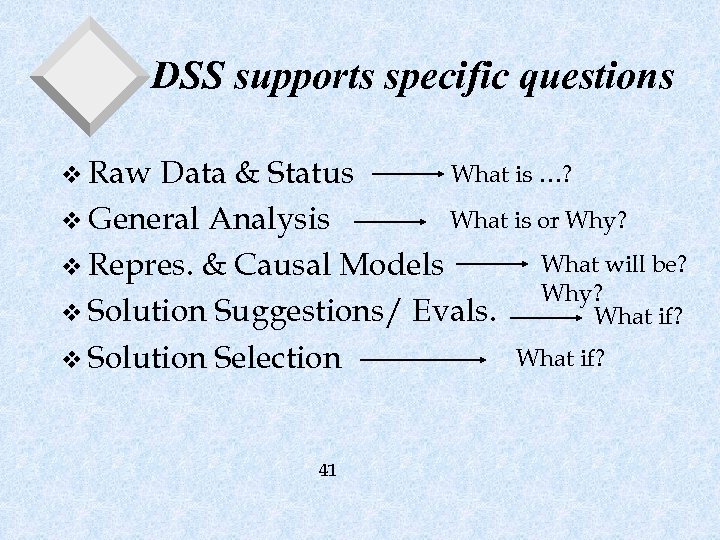 DSS supports specific questions v Raw What is …? Data & Status What is or Why? v General Analysis What will be? v Repres. & Causal Models Why? v Solution Suggestions/ Evals. What if? v Solution Selection 41
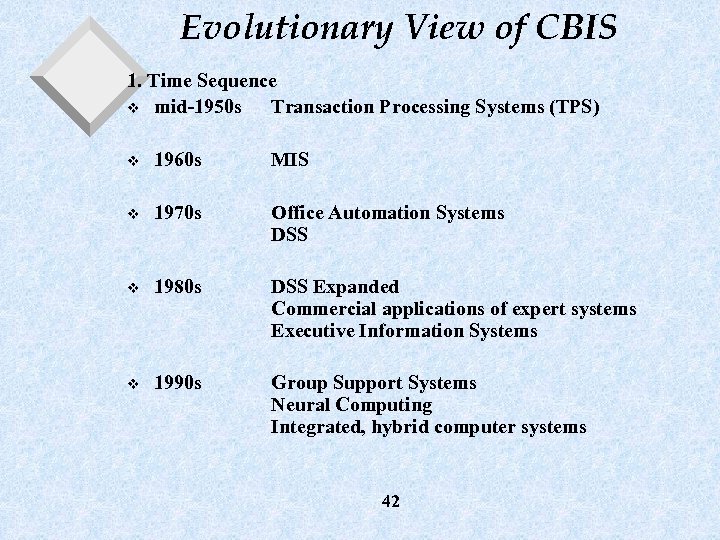 Evolutionary View of CBIS 1. Time Sequence v mid-1950 s Transaction Processing Systems (TPS) v 1960 s MIS v 1970 s Office Automation Systems DSS v 1980 s DSS Expanded Commercial applications of expert systems Executive Information Systems v 1990 s Group Support Systems Neural Computing Integrated, hybrid computer systems 42
 2. Computer evolved over time 3. Systemic linkages in how each system processes data into information Relationship among these and other technologies 43
 Relationship Among Technologies v v v Each technology unique Technologies interrelated Each supports some aspects of managerial decision making Ever expanding role of information technology improving management Interrelationship and coordination evolving 44
 Summary v DSS has many definitions v Complexity of managerial decision making is increasing v Computer support for managerial decision making v Several MSS technologies including hybrids 45