 Скачать презентацию Introduction to Debt Markets Bonds vs Stocks In
fc09dabb8ae8fdf683ebb7f61e2350f7.ppt
- Количество слайдов: 33



Introduction to Debt Markets Bonds vs. Stocks In the Rearview Mirror Debt Classes Sources of Risks
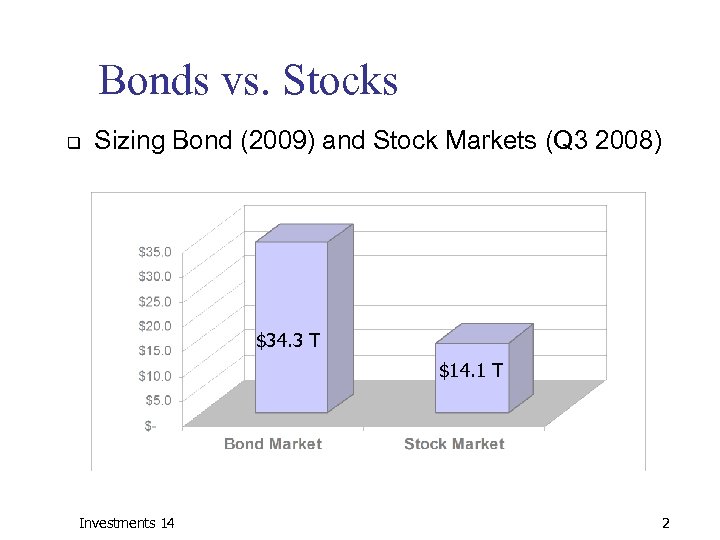
Bonds vs. Stocks q Sizing Bond (2009) and Stock Markets (Q 3 2008) $34. 3 T $14. 1 T Investments 14 2
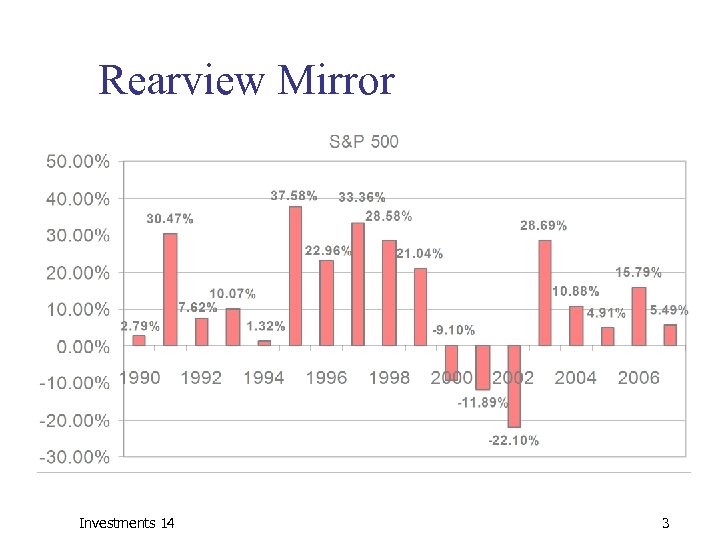
Rearview Mirror Investments 14 3
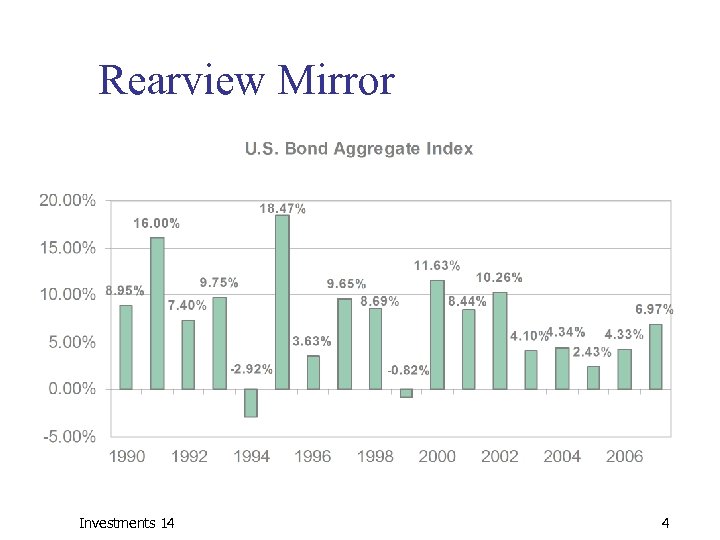
Rearview Mirror Investments 14 4
Source of Risks q Interest Rate Risk (Market Risk) Ø Ø Ø q Inflation Risk Ø Ø q The major factor affecting bond prices The price of bond changes in the opposite direction of interest change All bonds are exposed Inflation reduces purchasing power Yield changes to reflect the expected inflation Reinvestment Risk Ø No guarantees that coupon payments could be reinvested at the same rate Investments 14 5
Source of Risks q Credit Risk Ø Ø Ø q Liquidity Risk Ø Ø q Inability of issuer to pay coupon and/or principal Corporate, Emerging market and high-yield bonds Credit linked debt securities, credit derivatives Inability to unload position without substantial loss Municipal, Corporate, and Emerging market bond FX Risk Ø The risk of exchange rate fluctuation in reducing the return on a foreign bond Investments 14 6
Why Bonds? q Bonds form an important asset class Ø Sources of risk and return in bonds q q When liabilities are fixed in nominal terms, investing in suitably chosen bond portfolios may lead to lower risk Ø q Interest rate risk Reinvestment risk Default risk May not be necessary to consider all asset classes and use mean variance optimization methods Bond mispricing may arbitrage opportunities for an active portfolio manager Investments 14 7
Issuers of Bonds q U. S. Treasury Ø q Municipalities Ø q Tax-Exempt Bonds Corporations Ø q Notes and Bonds Corporate Bonds, Preferred Stock International Governments and Corporations Ø Innovative Bonds • • Indexed Bonds Floaters and Reverse Floaters Investments 14 8
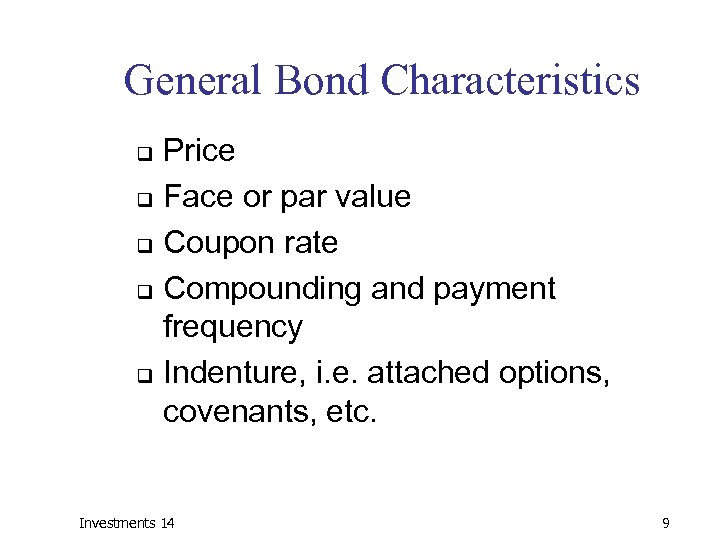
General Bond Characteristics Price q Face or par value q Coupon rate q Compounding and payment frequency q Indenture, i. e. attached options, covenants, etc. q Investments 14 9
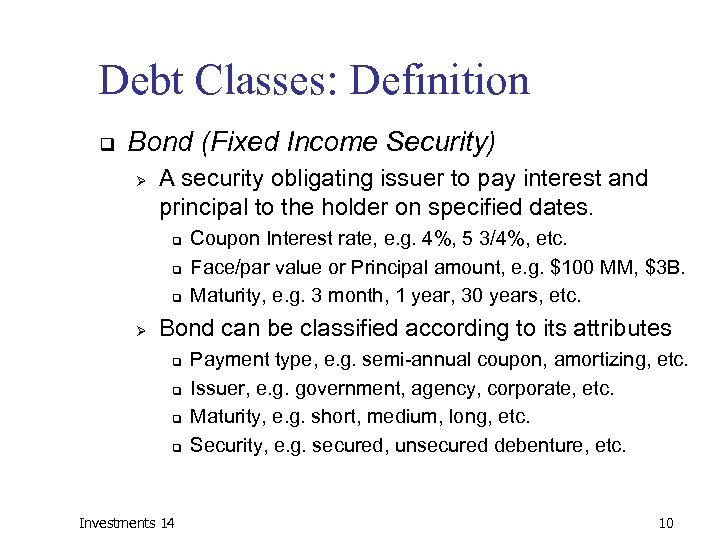
Debt Classes: Definition q Bond (Fixed Income Security) Ø A security obligating issuer to pay interest and principal to the holder on specified dates. q q q Ø Coupon Interest rate, e. g. 4%, 5 3/4%, etc. Face/par value or Principal amount, e. g. $100 MM, $3 B. Maturity, e. g. 3 month, 1 year, 30 years, etc. Bond can be classified according to its attributes q q Investments 14 Payment type, e. g. semi-annual coupon, amortizing, etc. Issuer, e. g. government, agency, corporate, etc. Maturity, e. g. short, medium, long, etc. Security, e. g. secured, unsecured debenture, etc. 10
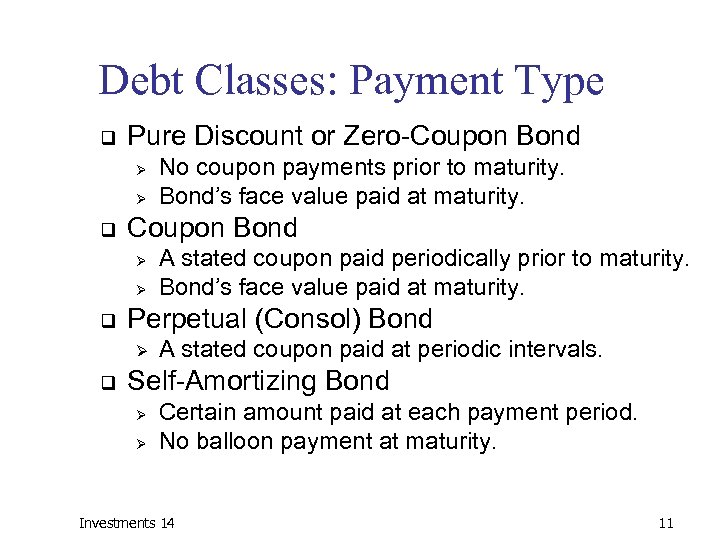
Debt Classes: Payment Type q Pure Discount or Zero-Coupon Bond Ø Ø q A stated coupon paid periodically prior to maturity. Bond’s face value paid at maturity. Perpetual (Consol) Bond Ø q No coupon payments prior to maturity. Bond’s face value paid at maturity. A stated coupon paid at periodic intervals. Self-Amortizing Bond Ø Ø Certain amount paid at each payment period. No balloon payment at maturity. Investments 14 11
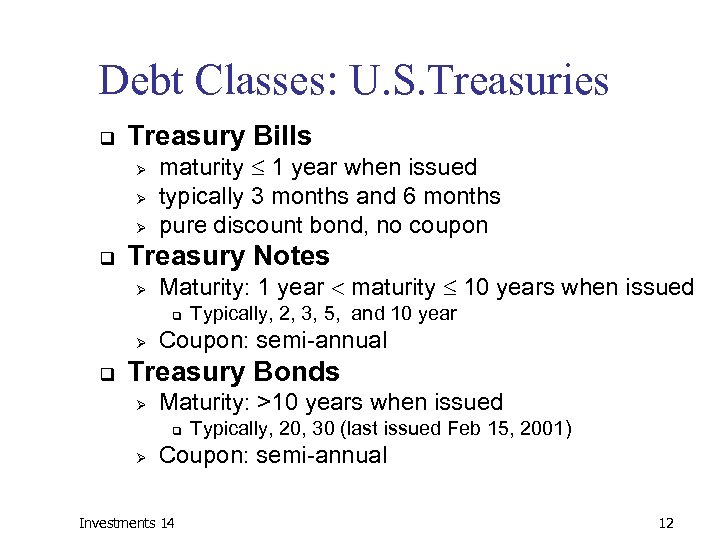
Debt Classes: U. S. Treasuries q Treasury Bills Ø Ø Ø q maturity 1 year when issued typically 3 months and 6 months pure discount bond, no coupon Treasury Notes Ø Maturity: 1 year maturity 10 years when issued q Ø q Typically, 2, 3, 5, and 10 year Coupon: semi-annual Treasury Bonds Ø Maturity: >10 years when issued q Ø Typically, 20, 30 (last issued Feb 15, 2001) Coupon: semi-annual Investments 14 12
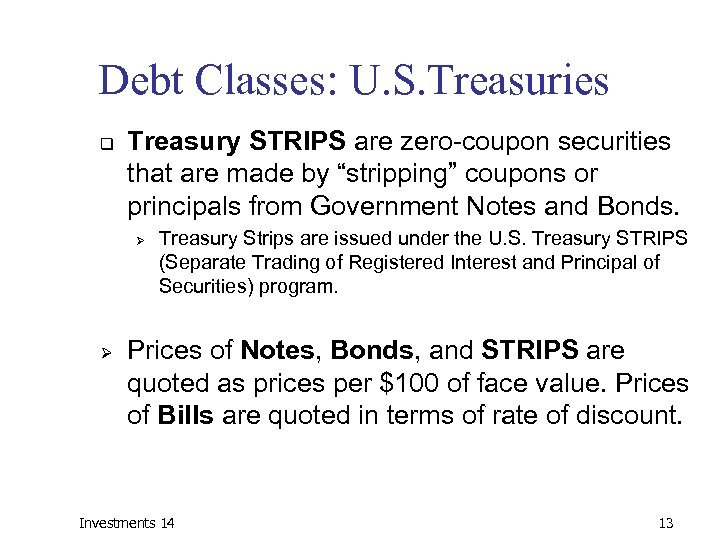
Debt Classes: U. S. Treasuries q Treasury STRIPS are zero-coupon securities that are made by “stripping” coupons or principals from Government Notes and Bonds. Ø Ø Treasury Strips are issued under the U. S. Treasury STRIPS (Separate Trading of Registered Interest and Principal of Securities) program. Prices of Notes, Bonds, and STRIPS are quoted as prices per $100 of face value. Prices of Bills are quoted in terms of rate of discount. Investments 14 13
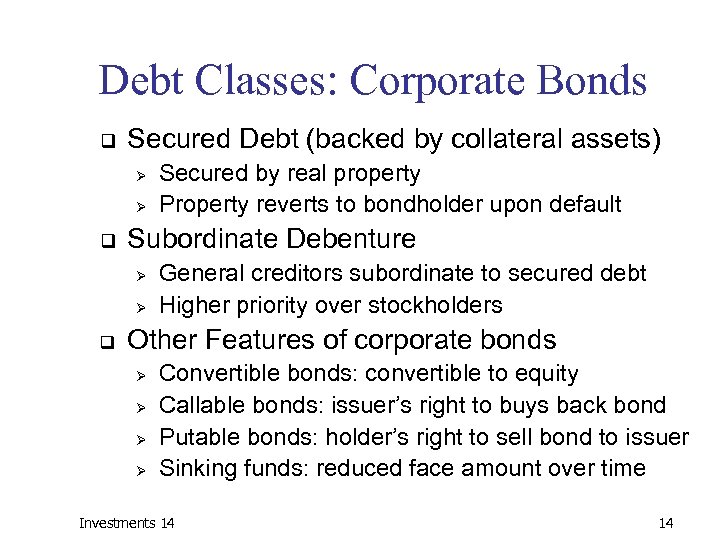
Debt Classes: Corporate Bonds q Secured Debt (backed by collateral assets) Ø Ø q Subordinate Debenture Ø Ø q Secured by real property Property reverts to bondholder upon default General creditors subordinate to secured debt Higher priority over stockholders Other Features of corporate bonds Ø Ø Convertible bonds: convertible to equity Callable bonds: issuer’s right to buys back bond Putable bonds: holder’s right to sell bond to issuer Sinking funds: reduced face amount over time Investments 14 14
Corporate Bonds – Default Risk q q One of the biggest differences between Corporate Bonds and U. S. Treasury Bonds is the default risk on corporate bonds Corporate bonds are rated on the basis of their default risk by a few rating companies Investments 14 15
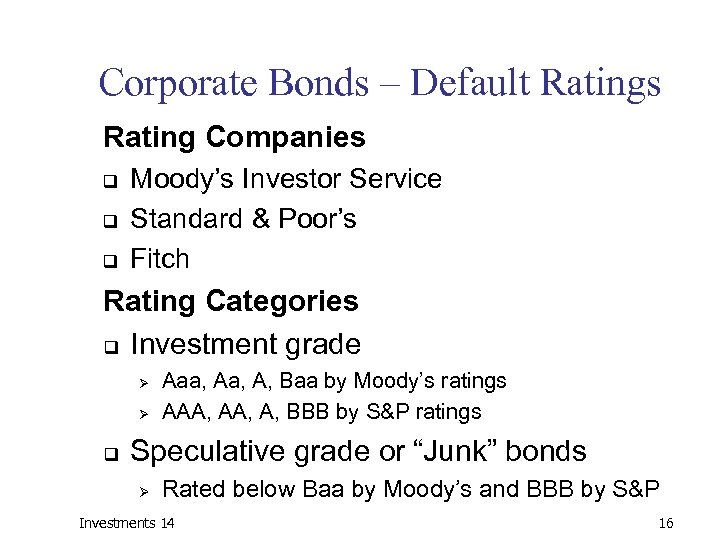
Corporate Bonds – Default Ratings Rating Companies q q q Moody’s Investor Service Standard & Poor’s Fitch Rating Categories q Investment grade Ø Ø q Aaa, A, Baa by Moody’s ratings AAA, A, BBB by S&P ratings Speculative grade or “Junk” bonds Ø Rated below Baa by Moody’s and BBB by S&P Investments 14 16
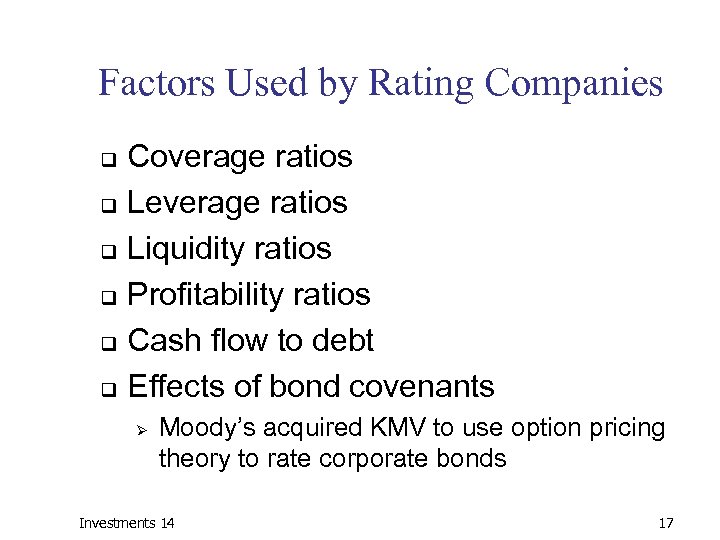
Factors Used by Rating Companies Coverage ratios q Leverage ratios q Liquidity ratios q Profitability ratios q Cash flow to debt q Effects of bond covenants q Ø Moody’s acquired KMV to use option pricing theory to rate corporate bonds Investments 14 17
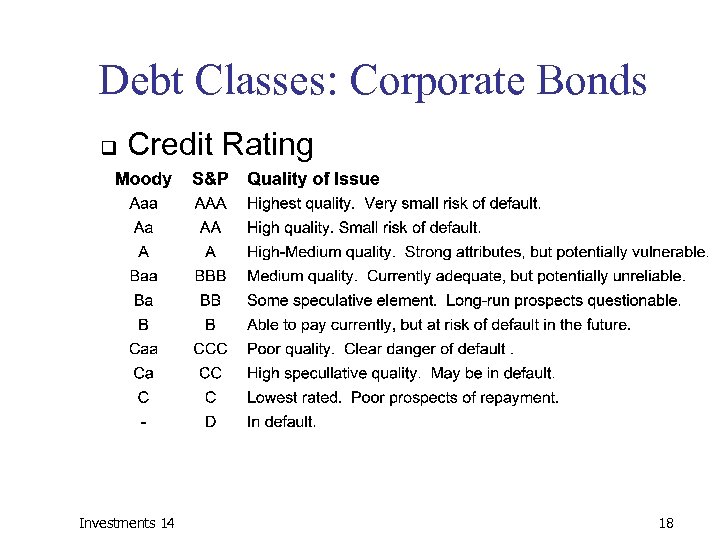
Debt Classes: Corporate Bonds q Credit Rating Investments 14 18
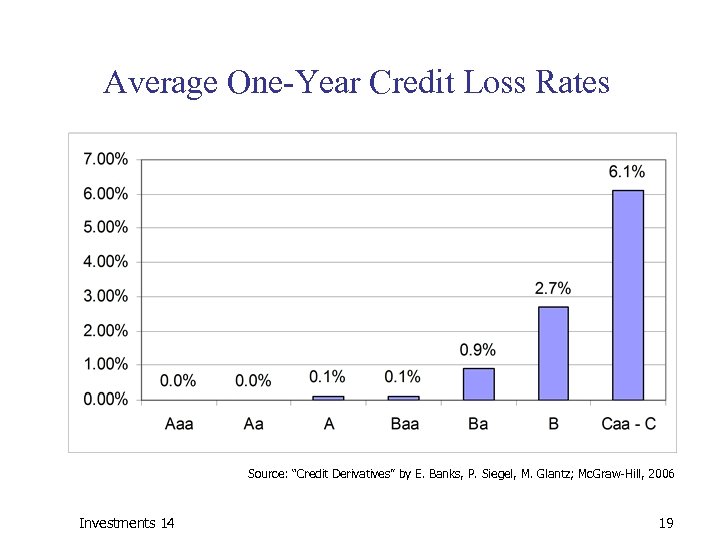
Average One-Year Credit Loss Rates Source: “Credit Derivatives” by E. Banks, P. Siegel, M. Glantz; Mc. Graw-Hill, 2006 Investments 14 19
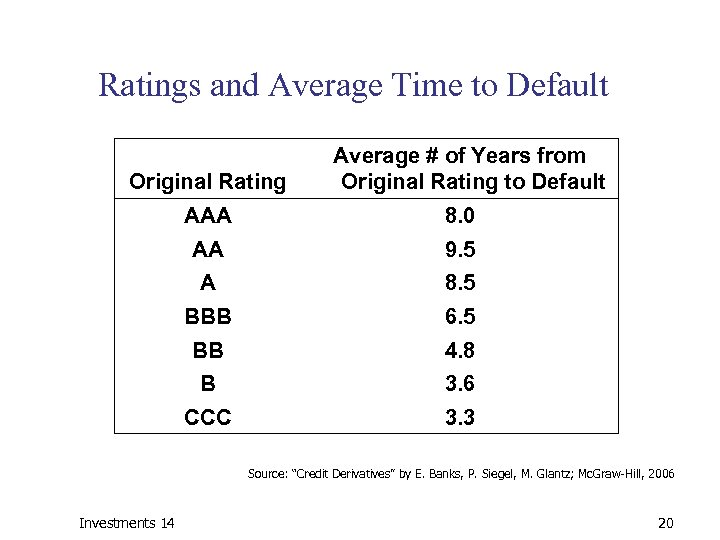
Ratings and Average Time to Default Original Rating Average # of Years from Original Rating to Default AAA 8. 0 AA 9. 5 A 8. 5 BBB 6. 5 BB 4. 8 B 3. 6 CCC 3. 3 Source: “Credit Derivatives” by E. Banks, P. Siegel, M. Glantz; Mc. Graw-Hill, 2006 Investments 14 20
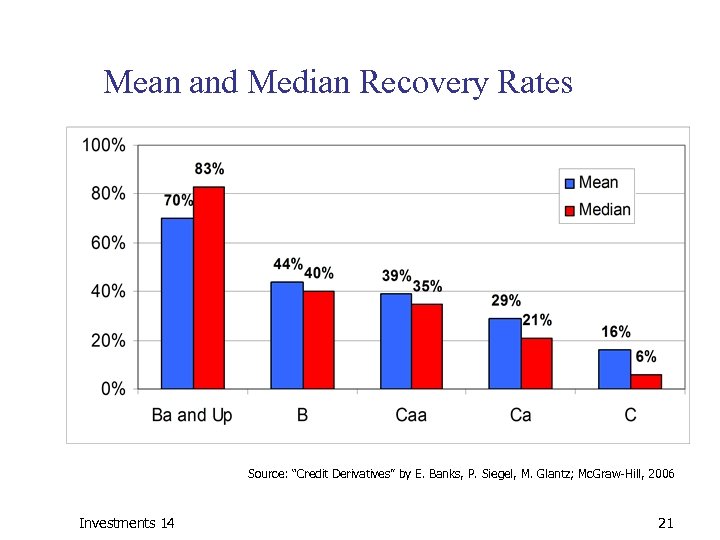
Mean and Median Recovery Rates Source: “Credit Derivatives” by E. Banks, P. Siegel, M. Glantz; Mc. Graw-Hill, 2006 Investments 14 21
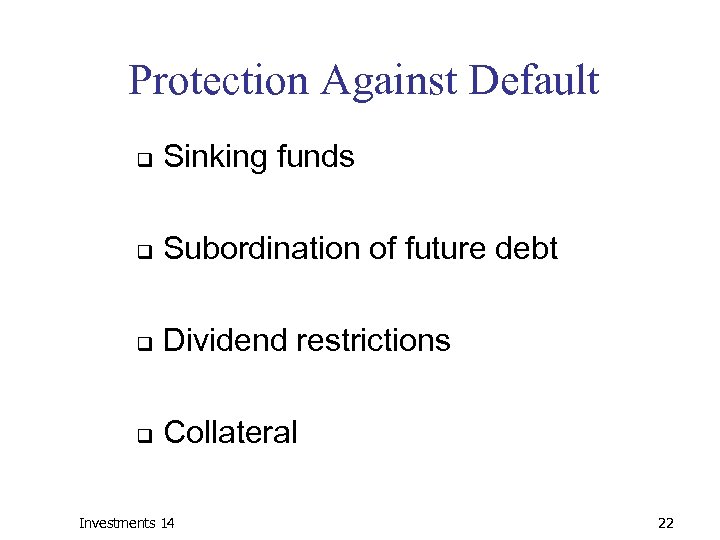
Protection Against Default q Sinking funds q Subordination of future debt q Dividend restrictions q Collateral Investments 14 22
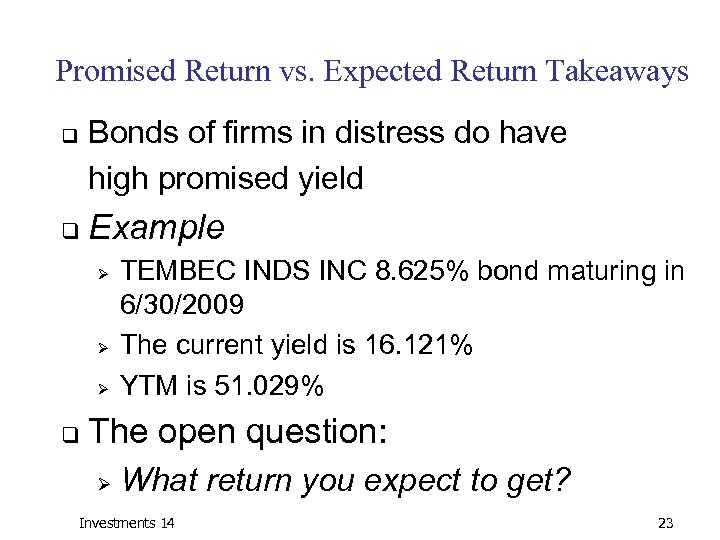
Promised Return vs. Expected Return Takeaways Bonds of firms in distress do have high promised yield q q Example Ø Ø Ø q TEMBEC INDS INC 8. 625% bond maturing in 6/30/2009 The current yield is 16. 121% YTM is 51. 029% The open question: Ø What return you expect to get? Investments 14 23
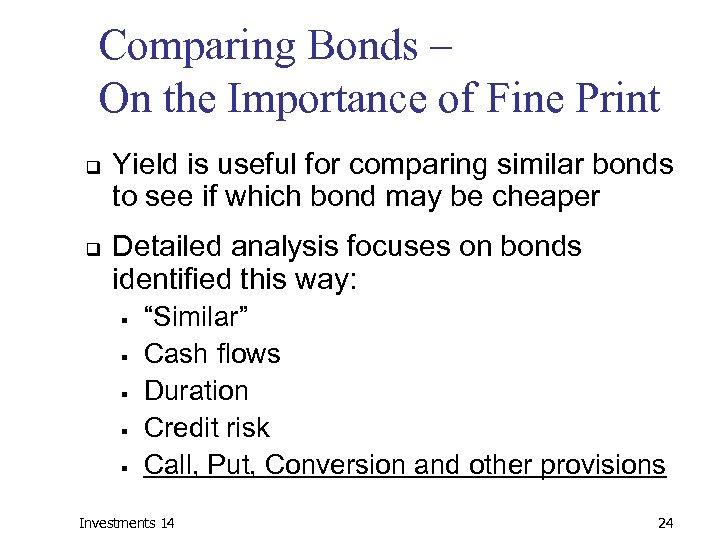
Comparing Bonds – On the Importance of Fine Print q q Yield is useful for comparing similar bonds to see if which bond may be cheaper Detailed analysis focuses on bonds identified this way: § § § “Similar” Cash flows Duration Credit risk Call, Put, Conversion and other provisions Investments 14 24
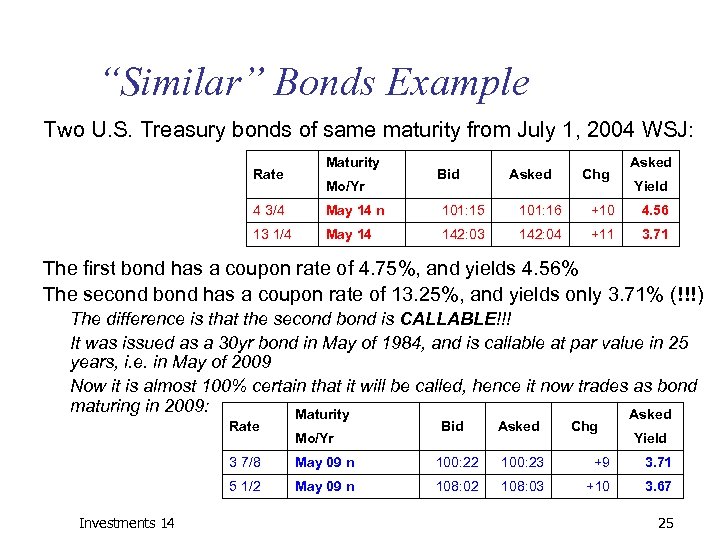
“Similar” Bonds Example Two U. S. Treasury bonds of same maturity from July 1, 2004 WSJ: Maturity Rate Mo/Yr Bid Asked Chg Asked Yield 4 3/4 May 14 n 101: 15 101: 16 +10 4. 56 13 1/4 May 14 142: 03 142: 04 +11 3. 71 The first bond has a coupon rate of 4. 75%, and yields 4. 56% The second bond has a coupon rate of 13. 25%, and yields only 3. 71% (!!!) The difference is that the second bond is CALLABLE!!! It was issued as a 30 yr bond in May of 1984, and is callable at par value in 25 years, i. e. in May of 2009 Now it is almost 100% certain that it will be called, hence it now trades as bond maturing in 2009: Maturity Asked Rate Mo/Yr Bid Asked Chg Yield 3 7/8 100: 22 100: 23 +9 3. 71 5 1/2 Investments 14 May 09 n 108: 02 108: 03 +10 3. 67 25
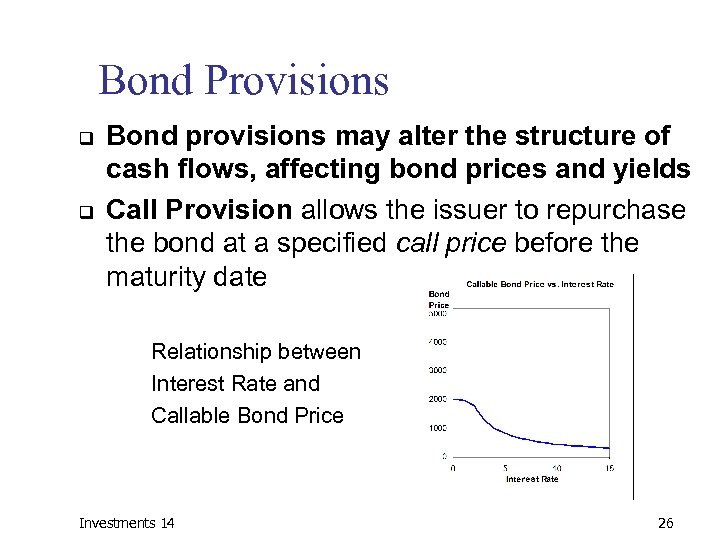
Bond Provisions q q Bond provisions may alter the structure of cash flows, affecting bond prices and yields Call Provision allows the issuer to repurchase the bond at a specified call price before the maturity date Relationship between Interest Rate and Callable Bond Price Investments 14 26
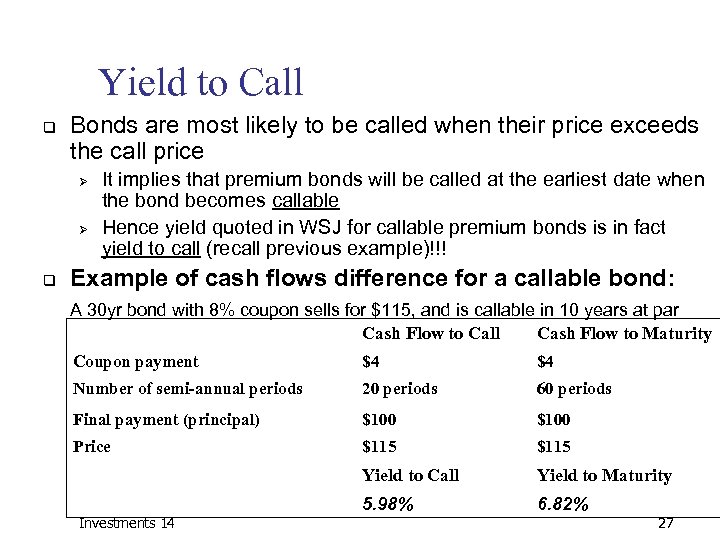
Yield to Call q Bonds are most likely to be called when their price exceeds the call price Ø Ø q It implies that premium bonds will be called at the earliest date when the bond becomes callable Hence yield quoted in WSJ for callable premium bonds is in fact yield to call (recall previous example)!!! Example of cash flows difference for a callable bond: A 30 yr bond with 8% coupon sells for $115, and is callable in 10 years at par Cash Flow to Call Cash Flow to Maturity Coupon payment $4 $4 Number of semi-annual periods 20 periods 60 periods Final payment (principal) $100 Price $115 Yield to Call Yield to Maturity 5. 98% 6. 82% Investments 14 27
Bond Provisions Continued q q q Put Provision allows a bondholder to reclaim a principal, or to extend bond’s life Convertible Provision allows a bondholder to exchange a bond for common stock Ø Typically are callable as well Secured Bonds have specific collaterals for bonds Sinking Funds guarantee gradual repurchase of corporate bonds by the issuer Floating Rate Bonds have interest payments tied to some measure of current market rates Investments 14 28
Debt Classes: Municipal Bonds q Municipal Bonds Ø Ø Ø Maturity varies from one month to 40 years Exempt from federal taxes and state taxes (for residents of issuing state) Generally two types: q Revenue bonds Ø Ø q General Obligation bonds Ø Ø Ø backed by the revenue of a particular project e. g. water bond backed by the tax revenue of local government e. g. school bond Riskier than U. S. Government bonds Investments 14 29
Debt Classes: Non-US Issues q Investment Grade Bond outside US Ø Ø Ø q Bonds issued by foreign companies and nations Greater than $7 trillion by 2001 e. g. , U. K. Gilts, Japan’s JGBs, Germany’s Bunds, French’s OATs, etc. Emerging Market Bond Ø Ø Bonds issued by governments and companies of emerging economies $1. 2 trillion by 1995 Denomination in local currency or US$ Some issues have principal and a few coupon backed by US government (Brady bond) Investments 14 30
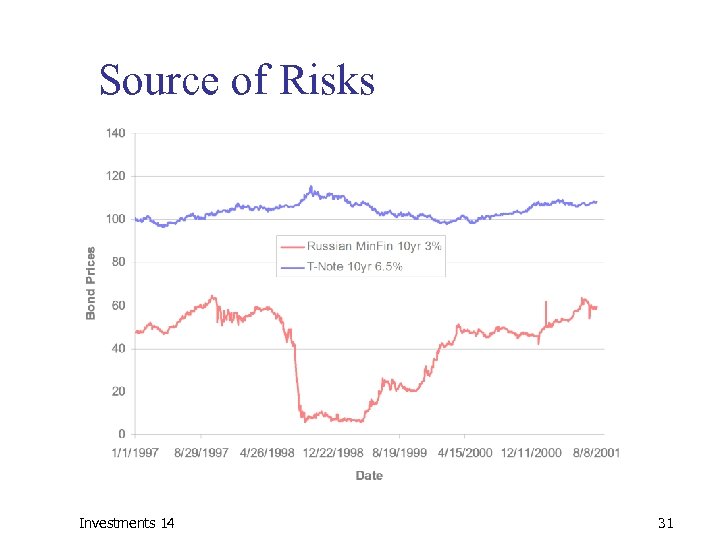
Source of Risks Investments 14 31
Bond Resources www. bondmarkets. com q www. investinginbonds. com q bonds. yahoo. com q PIMCO q Lehman Brothers Bond Indices q Bloomberg Bond Rates q Live Market Analysis on Bonds and Related Topics q Investments 14 32
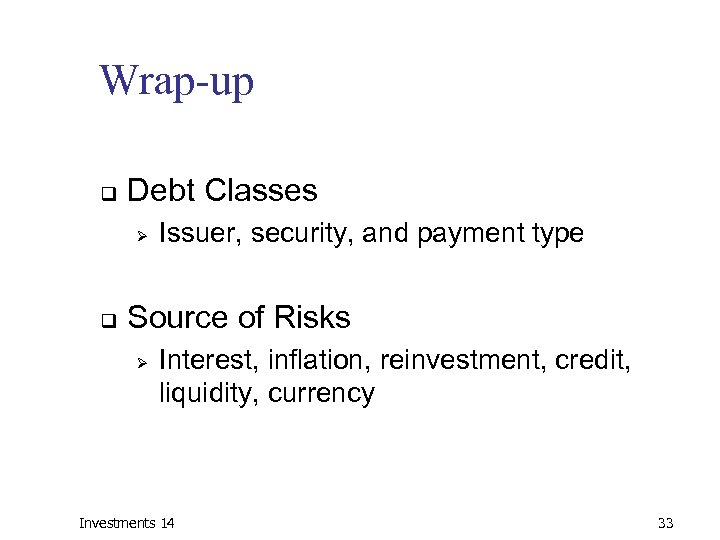
Wrap-up q Debt Classes Ø q Issuer, security, and payment type Source of Risks Ø Interest, inflation, reinvestment, credit, liquidity, currency Investments 14 33
Скачать презентацию Introduction to Debt Markets Bonds vs Stocks In
fc09dabb8ae8fdf683ebb7f61e2350f7.ppt