 Скачать презентацию Introduction to Data Mining Supercomputing 2002 Peter Bajcsy
61e038ffc80232898bdf21ac72bf60e2.ppt
- Количество слайдов: 78



Introduction to Data Mining Supercomputing 2002 Peter Bajcsy, Ph. D. Research Scientist Adjunct Assistant Professor, CS Department, UIUC Automated Learning Group National Center for Supercomputing Applications University of Illinois pbajcsy@ncsa. uiuc. edu
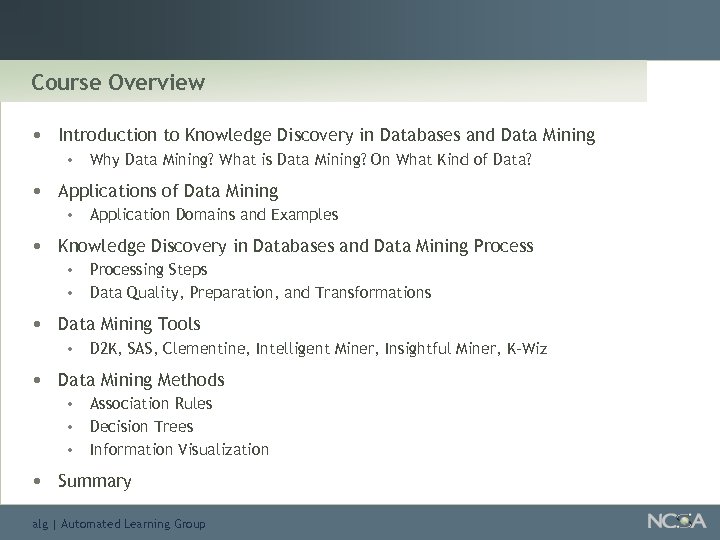
Course Overview • Introduction to Knowledge Discovery in Databases and Data Mining • • Applications of Data Mining • • • D 2 K, SAS, Clementine, Intelligent Miner, Insightful Miner, K-Wiz Data Mining Methods • • Processing Steps Data Quality, Preparation, and Transformations Data Mining Tools • • Application Domains and Examples Knowledge Discovery in Databases and Data Mining Process • • Why Data Mining? What is Data Mining? On What Kind of Data? Association Rules Decision Trees Information Visualization Summary alg | Automated Learning Group
Acknowledgement • Contributions: • Michael Welge, Loretta Auvil, Lisa Gatzke, Automated Learning Group, National Center for Supercomputing Applications (NCSA), University of Illinois at Urbana-Champaign • Jiawei Han, Computer Science, University of Illinois at Urbana-Champaign alg | Automated Learning Group
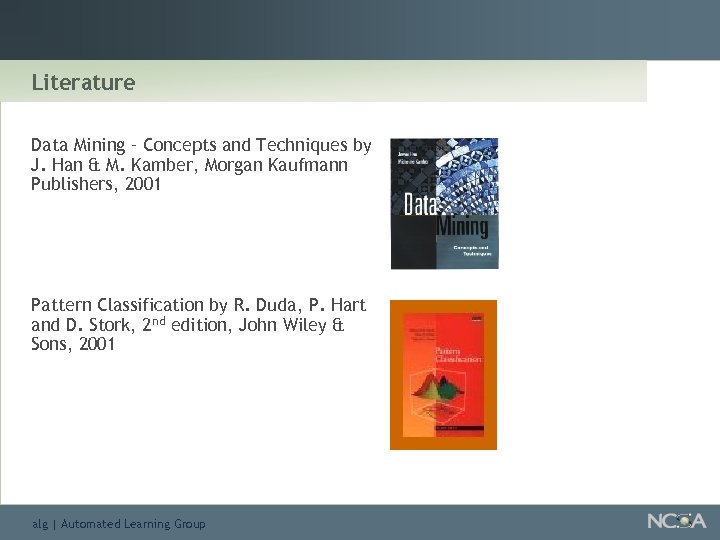
Literature Data Mining – Concepts and Techniques by J. Han & M. Kamber, Morgan Kaufmann Publishers, 2001 Pattern Classification by R. Duda, P. Hart and D. Stork, 2 nd edition, John Wiley & Sons, 2001 alg | Automated Learning Group
Introduction to Knowledge Discovery in Databases and Data Mining alg | Automated Learning Group
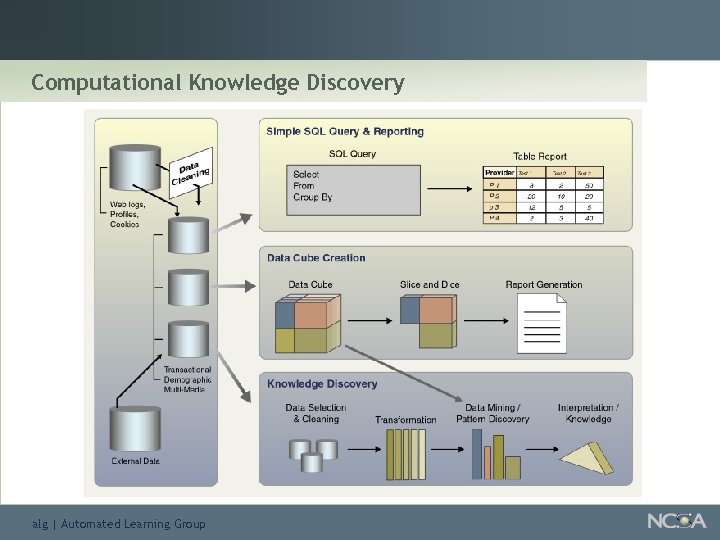
Computational Knowledge Discovery alg | Automated Learning Group
Terminology • Data Mining A step in the knowledge discovery process consisting of particular algorithms (methods) that under some acceptable objective, produces a particular enumeration of patterns (models) over the data. • Knowledge Discovery Process The process of using data mining methods (algorithms) to extract (identify) what is deemed knowledge according to the specifications of measures and thresholds, using a database along with any necessary preprocessing or transformations. alg | Automated Learning Group
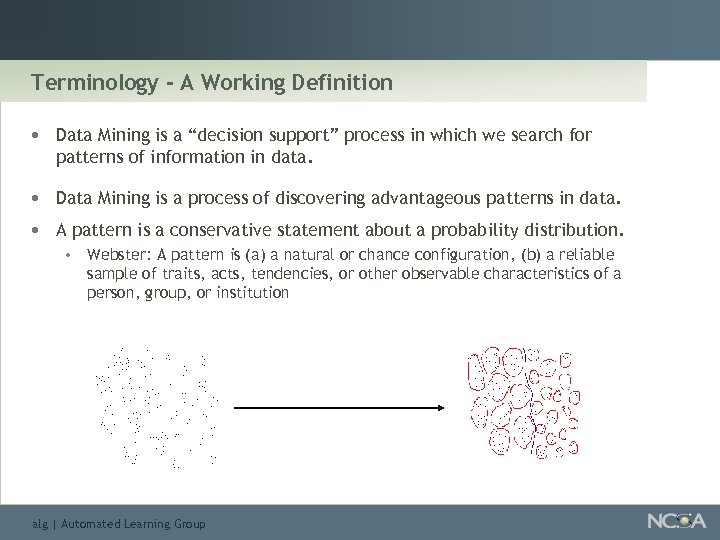
Terminology - A Working Definition • Data Mining is a “decision support” process in which we search for patterns of information in data. • • Data Mining is a process of discovering advantageous patterns in data. A pattern is a conservative statement about a probability distribution. • Webster: A pattern is (a) a natural or chance configuration, (b) a reliable sample of traits, acts, tendencies, or other observable characteristics of a person, group, or institution alg | Automated Learning Group
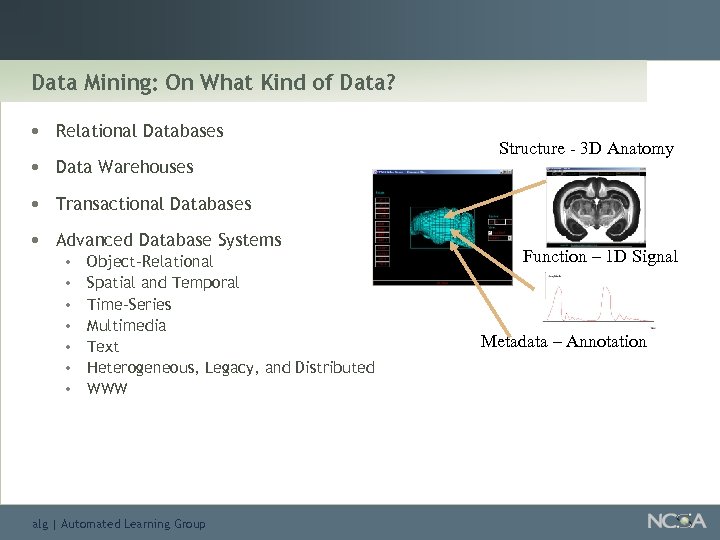
Data Mining: On What Kind of Data? • Relational Databases • Data Warehouses • Transactional Databases • Advanced Database Systems • • Object-Relational Spatial and Temporal Time-Series Multimedia Text Heterogeneous, Legacy, and Distributed WWW alg | Automated Learning Group Structure - 3 D Anatomy Function – 1 D Signal Metadata – Annotation
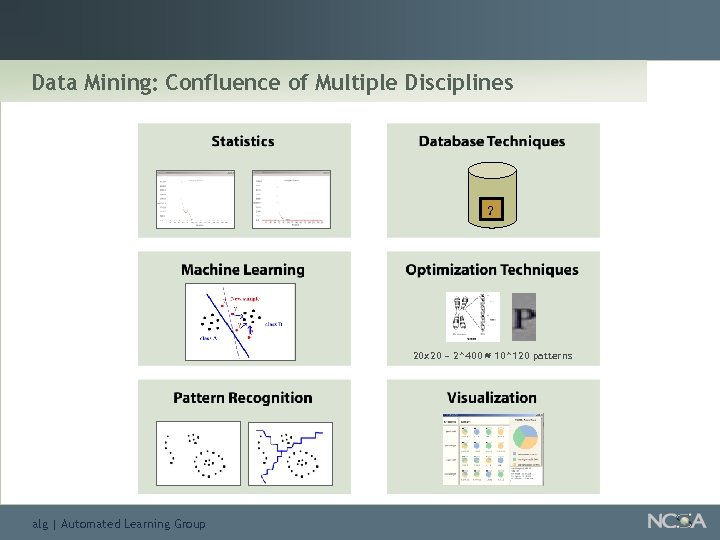
Data Mining: Confluence of Multiple Disciplines ? 20 x 20 ~ 2^400 10^120 patterns alg | Automated Learning Group
Why Do We Need Data Mining ? • Data volumes are too large for classical analysis approaches: • • Large number of records (108 – 1012 bytes) High dimensional data ( 102 – 104 attributes) How do you explore millions of records, tens or hundreds of fields, and find patterns? alg | Automated Learning Group
Why Do We Need Data Mining ? • Leverage organization’s data assets • Only a small portion (typically - 5%-10%) of the collected data is ever analyzed • Data that may never be analyzed continues to be collected, at a great expense, out of fear that something which may prove important in the future is missing. • Growth rates of data precludes traditional “manually intensive” approach alg | Automated Learning Group
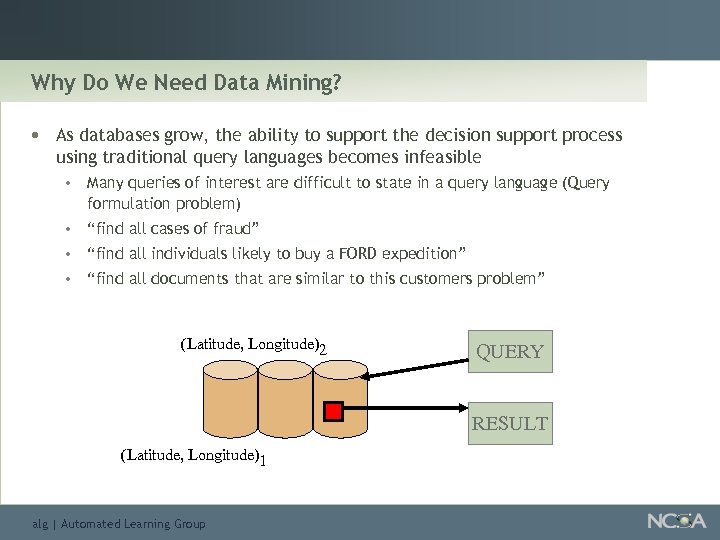
Why Do We Need Data Mining? • As databases grow, the ability to support the decision support process using traditional query languages becomes infeasible • Many queries of interest are difficult to state in a query language (Query formulation problem) • “find all cases of fraud” • “find all individuals likely to buy a FORD expedition” • “find all documents that are similar to this customers problem” (Latitude, Longitude)2 QUERY RESULT (Latitude, Longitude)1 alg | Automated Learning Group
What is It? Knowledge Discovery in Databases is the non-trivial process of identifying valid, novel, potentially useful, and ultimately understandable patterns in data. • The understandable patterns are used to: • • Make predictions or classifications about new data Explain existing data Summarize the contents of a large database to support decision making Graphical data visualization to aid humans in discovering deeper patterns alg | Automated Learning Group
Applications of Data Mining alg | Automated Learning Group
Data Mining Applications • • • Market analysis • Text mining (news group, email, documents) and Web mining • Stream data mining • DNA and bio-data analysis Risk analysis and management Fraud detection and detection of unusual patterns (outliers) alg | Automated Learning Group
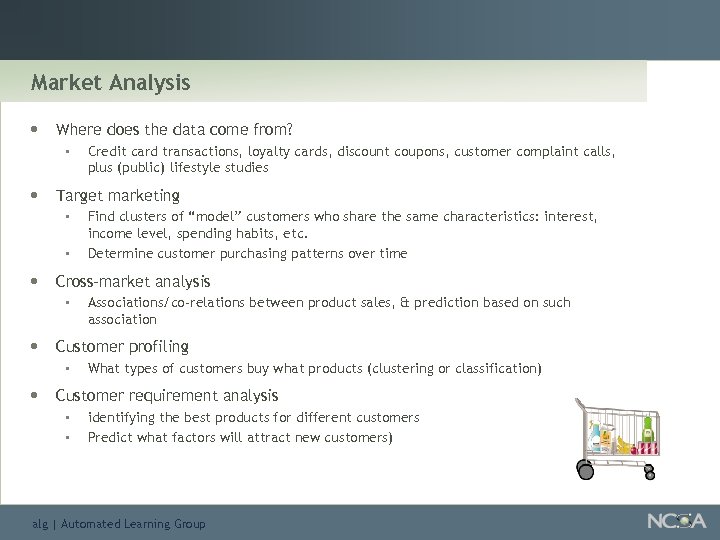
Market Analysis • Where does the data come from? • • Target marketing • • • Associations/co-relations between product sales, & prediction based on such association Customer profiling • • Find clusters of “model” customers who share the same characteristics: interest, income level, spending habits, etc. Determine customer purchasing patterns over time Cross-market analysis • • Credit card transactions, loyalty cards, discount coupons, customer complaint calls, plus (public) lifestyle studies What types of customers buy what products (clustering or classification) Customer requirement analysis • • identifying the best products for different customers Predict what factors will attract new customers) alg | Automated Learning Group
Corporate Analysis & Risk Management • Finance planning and asset evaluation • • Resource planning • • cash flow analysis and prediction contingent claim analysis to evaluate assets cross-sectional and time series analysis (financial-ratio, trend analysis, etc. ) summarize and compare the resources and spending Competition • • • monitor competitors and market directions group customers into classes and a class-based pricing procedure set pricing strategy in a highly competitive market alg | Automated Learning Group
Fraud Detection & Mining Unusual Patterns • • Approaches: Clustering & model construction for frauds, outlier analysis Applications: Health care, retail, credit card service, telecomm. • • • Auto insurance: ring of collisions Money laundering: suspicious monetary transactions Medical insurance – Professional patients, ring of doctors, and ring of references – Unnecessary or correlated screening tests Telecommunications: phone-call fraud – Phone call model: destination of the call, duration, time of day or week. Analyze patterns that deviate from an expected norm Retail industry – Analysts estimate that 38% of retail shrink is due to dishonest employees Anti-terrorism alg | Automated Learning Group
Data Mining and Business Intelligence alg | Automated Learning Group
Knowledge Discovery in Databases Process alg | Automated Learning Group
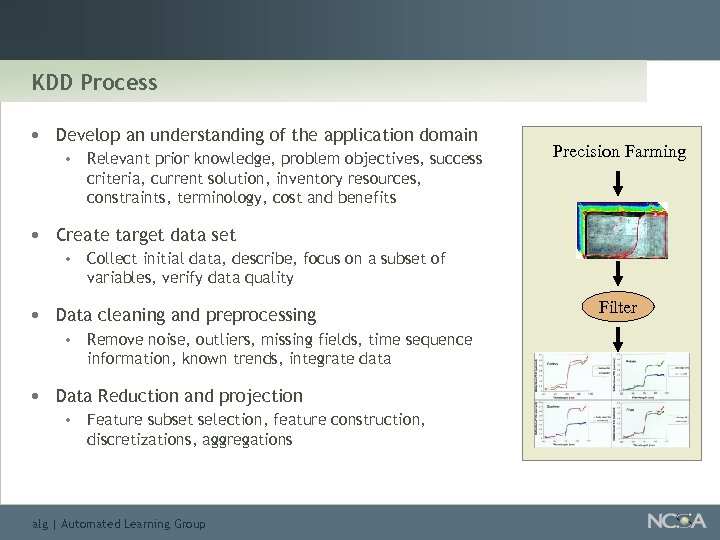
KDD Process • Develop an understanding of the application domain • • Collect initial data, describe, focus on a subset of variables, verify data quality Data cleaning and preprocessing • • Precision Farming Create target data set • • Relevant prior knowledge, problem objectives, success criteria, current solution, inventory resources, constraints, terminology, cost and benefits Remove noise, outliers, missing fields, time sequence information, known trends, integrate data Data Reduction and projection • Feature subset selection, feature construction, discretizations, aggregations alg | Automated Learning Group Filter
KDD Process • Selection of data mining task • • • Classification, segmentation, deviation detection, link analysis Select data mining approach Data mining to extract patterns or models Interpretation and evaluation of patterns/models Consolidating discovered knowledge alg | Automated Learning Group
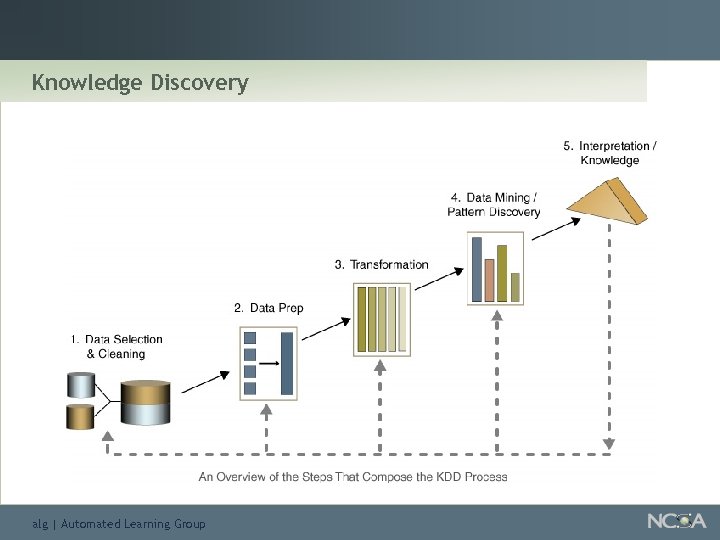
Knowledge Discovery alg | Automated Learning Group
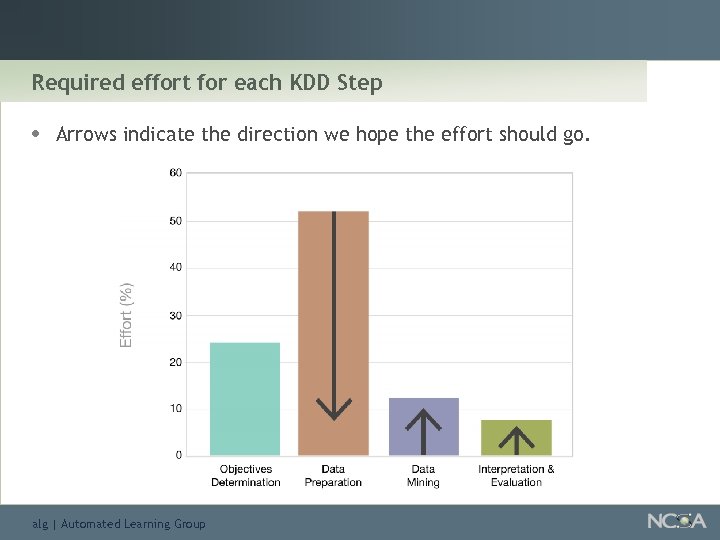
Required effort for each KDD Step • Arrows indicate the direction we hope the effort should go. alg | Automated Learning Group
Data Mining Tools alg | Automated Learning Group
Commercial and Research Tools Data To Knowledge http: //www. ncsa. uiuc. edu/Divisions/DMV/ALG/d 2 k/ SAS http: //www. sas. com/ Clementine http: //www. spss. com/spssbi/clementine/ Intelligent Miner http: //www-3. ibm. com/software/data/iminer/ Insightful Miner http: //www. insightful. com/products/product. asp? PID=26 K-Wiz http: //www. thinkanalytics. com/products/factsheets/Kwiz_product_brief. htm alg | Automated Learning Group
Software Engineering in Data Mining Conceptual Software Hierarchy • • • Operating System (Windows, Mac OS, UNIX, Linux) Programming Language (Java) Modules = Sequences of Programming Language Commands Itineraries = Linked Modules Streamlines = Linked Itineraries Software for Users with Various Levels of Programming Skills Collaborating Users alg | Automated Learning Group
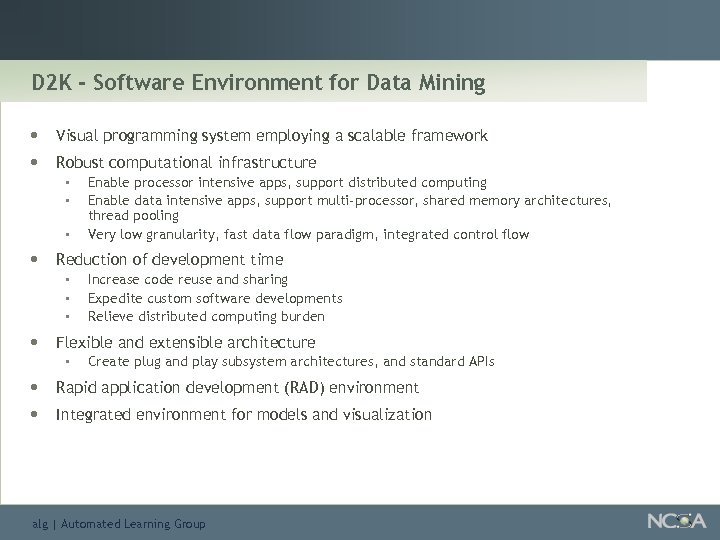
D 2 K - Software Environment for Data Mining • • Visual programming system employing a scalable framework Robust computational infrastructure • • Reduction of development time • • Increase code reuse and sharing Expedite custom software developments Relieve distributed computing burden Flexible and extensible architecture • • • Enable processor intensive apps, support distributed computing Enable data intensive apps, support multi-processor, shared memory architectures, thread pooling Very low granularity, fast data flow paradigm, integrated control flow Create plug and play subsystem architectures, and standard APIs Rapid application development (RAD) environment Integrated environment for models and visualization alg | Automated Learning Group
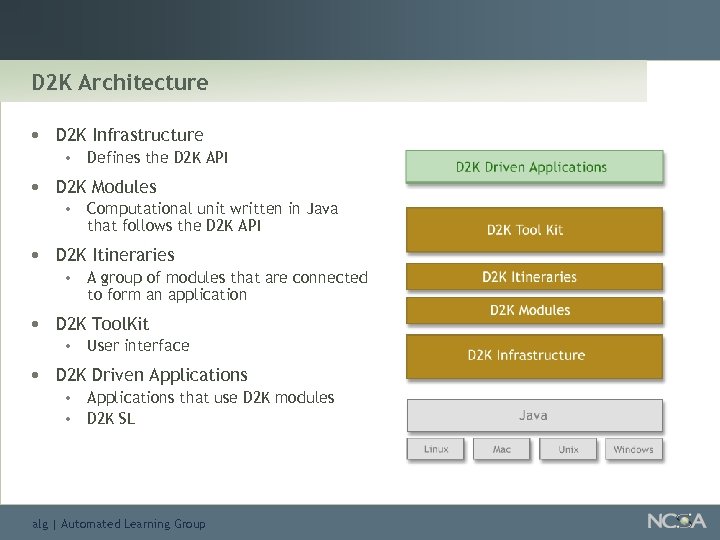
D 2 K Architecture • D 2 K Infrastructure • • D 2 K Modules • • A group of modules that are connected to form an application D 2 K Tool. Kit • • Computational unit written in Java that follows the D 2 K API D 2 K Itineraries • • Defines the D 2 K API User interface D 2 K Driven Applications • • Applications that use D 2 K modules D 2 K SL alg | Automated Learning Group
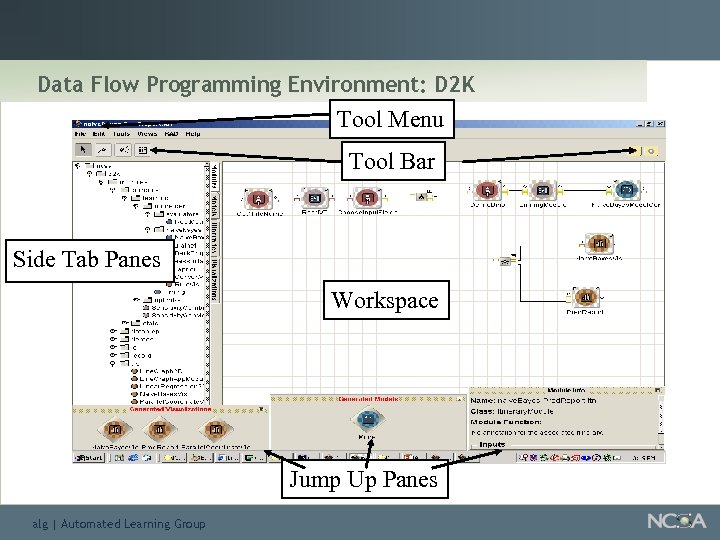
Data Flow Programming Environment: D 2 K Tool Menu Tool Bar Side Tab Panes Workspace Jump Up Panes alg | Automated Learning Group
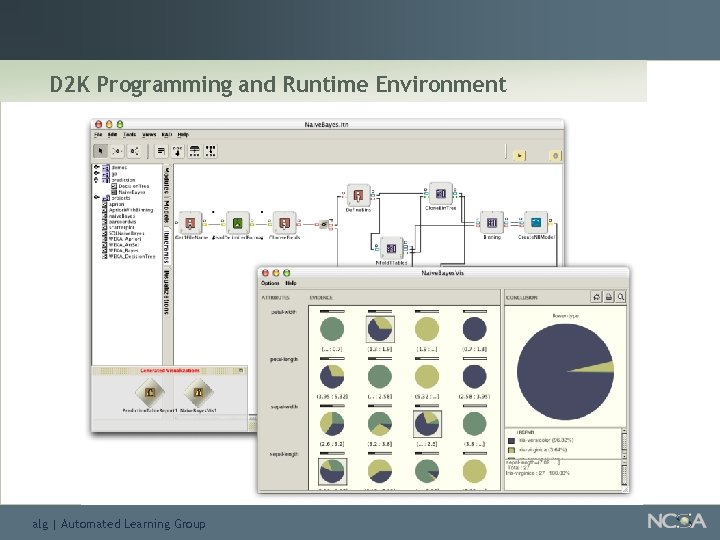
D 2 K Programming and Runtime Environment alg | Automated Learning Group
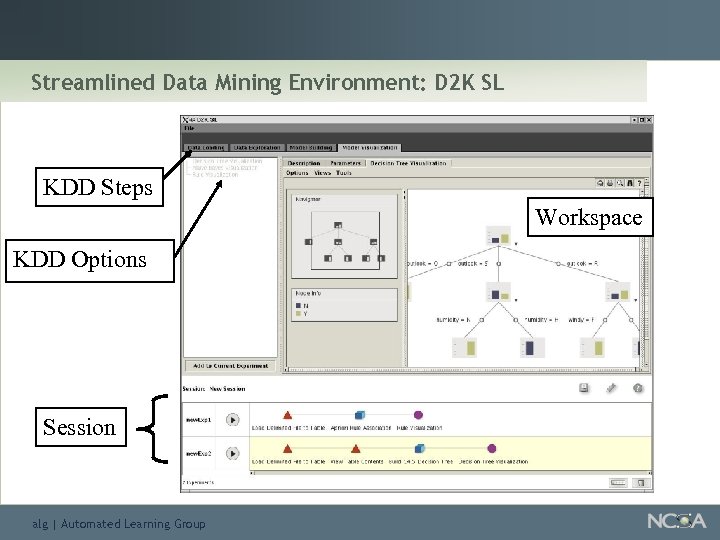
Streamlined Data Mining Environment: D 2 K SL KDD Steps Workspace KDD Options Session alg | Automated Learning Group
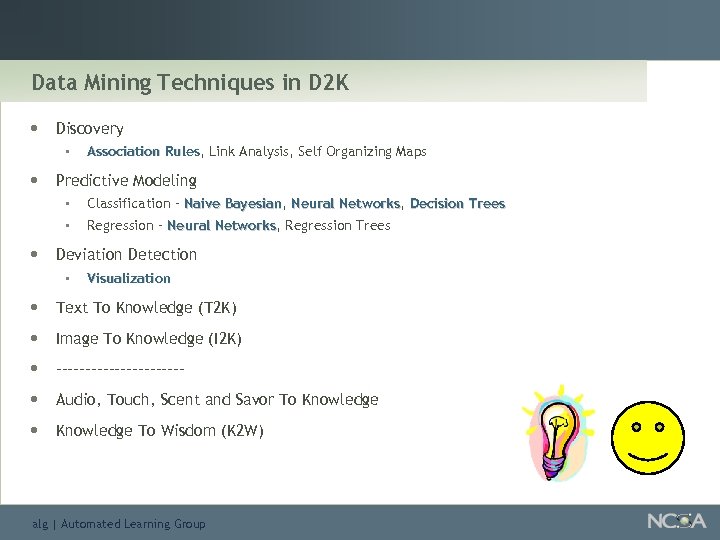
Data Mining Techniques in D 2 K • Discovery • • Association Rules, Link Analysis, Self Organizing Maps Rules Predictive Modeling • • • Classification – Naive Bayesian, Neural Networks, Decision Trees Bayesian Networks Regression – Neural Networks, Regression Trees Networks Deviation Detection • • • Visualization Text To Knowledge (T 2 K) Image To Knowledge (I 2 K) -----------Audio, Touch, Scent and Savor To Knowledge To Wisdom (K 2 W) alg | Automated Learning Group
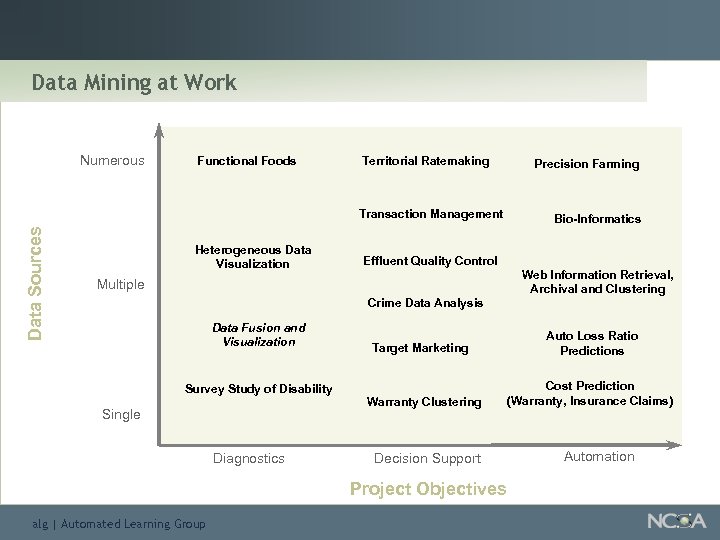
Data Mining at Work Numerous Functional Foods Territorial Ratemaking Data Sources Transaction Management Heterogeneous Data Visualization Crime Data Analysis Survey Study of Disability Single Diagnostics Target Marketing Warranty Clustering Decision Support Project Objectives alg | Automated Learning Group Bio-Informatics Effluent Quality Control Multiple Data Fusion and Visualization Precision Farming Web Information Retrieval, Archival and Clustering Auto Loss Ratio Predictions Cost Prediction (Warranty, Insurance Claims) Automation
Examples of Data Mining Methods alg | Automated Learning Group
Three Primary Data Mining Paradigms • Discovery • • Predictive Modeling • • Example: Association Rules Classification Example: Decision Trees Deviation Detection • Visualization alg | Automated Learning Group
Association Rules and Market Basket Analysis alg | Automated Learning Group
What is Market Basket Analysis? • Customer Analysis • • Market Basket Analysis uses the information about what a customer purchases to give us insight into who they are and why they make certain purchases. Product Analysis • Market basket Analysis gives us insight into the merchandise by telling us which products tend to be purchased together and which are most amenable to purchase. alg | Automated Learning Group
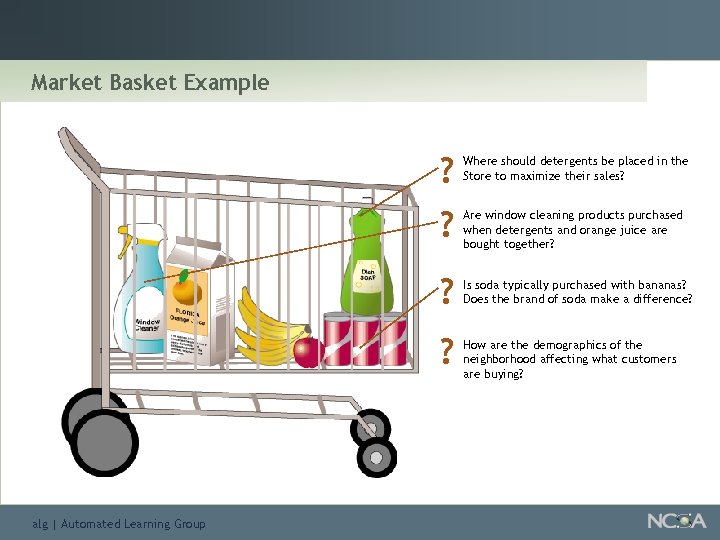
Market Basket Example ? ? alg | Automated Learning Group Where should detergents be placed in the Store to maximize their sales? Are window cleaning products purchased when detergents and orange juice are bought together? Is soda typically purchased with bananas? Does the brand of soda make a difference? How are the demographics of the neighborhood affecting what customers are buying?
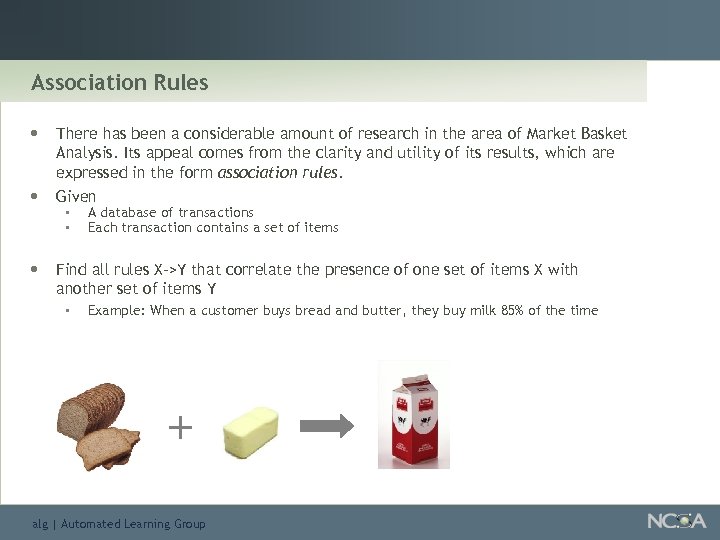
Association Rules • There has been a considerable amount of research in the area of Market Basket Analysis. Its appeal comes from the clarity and utility of its results, which are expressed in the form association rules. • Given • Find all rules X->Y that correlate the presence of one set of items X with another set of items Y • • • A database of transactions Each transaction contains a set of items Example: When a customer buys bread and butter, they buy milk 85% of the time + alg | Automated Learning Group
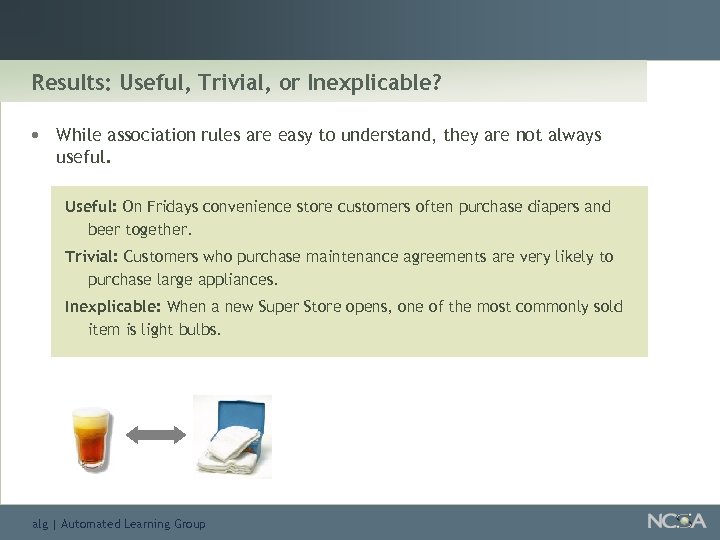
Results: Useful, Trivial, or Inexplicable? • While association rules are easy to understand, they are not always useful. Useful: On Fridays convenience store customers often purchase diapers and beer together. Trivial: Customers who purchase maintenance agreements are very likely to purchase large appliances. Inexplicable: When a new Super Store opens, one of the most commonly sold item is light bulbs. alg | Automated Learning Group
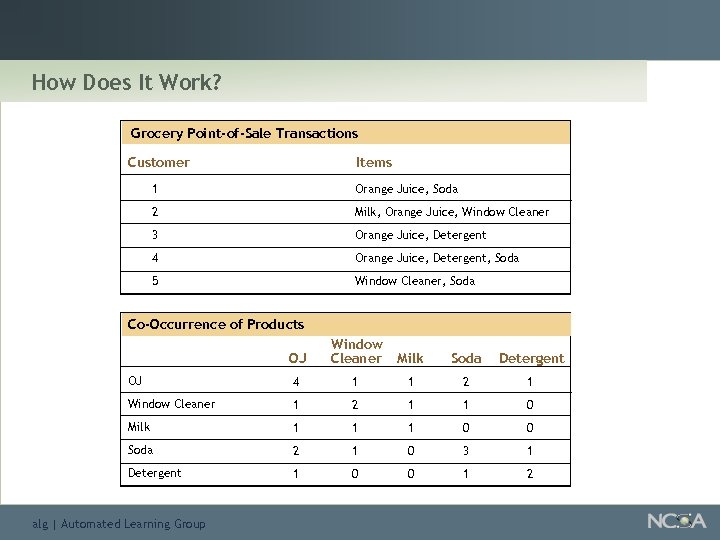
How Does It Work? Grocery Point-of-Sale Transactions Customer Items 1 Orange Juice, Soda juice, 2 Milk, Orange Juice, Window Cleaner 3 Orange Juice, Detergent 4 Orange Juice, detergent, soda juice, Detergent, Soda 5 Window Cleaner, soda cleaner, Soda Co-Occurrence of Products OJ Window Cleaner Milk Soda Detergent OJ 4 1 1 2 1 Window Cleaner 1 2 1 1 0 Milk 1 1 1 0 0 Soda 2 1 0 3 1 Detergent 1 0 0 1 2 alg | Automated Learning Group
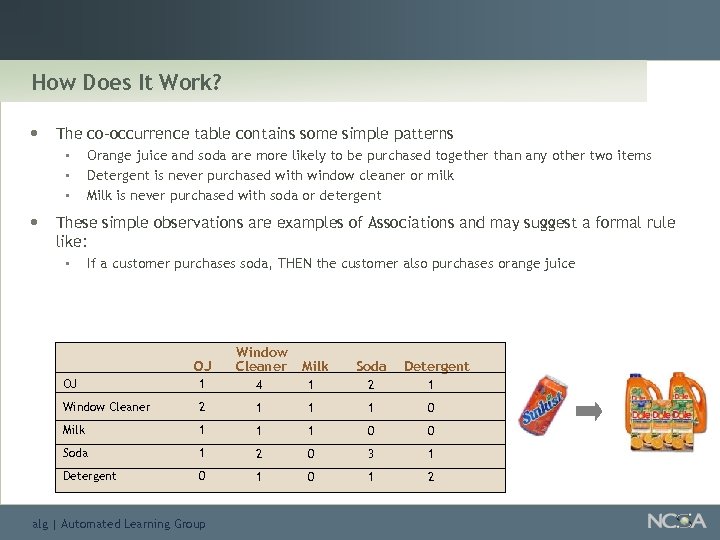
How Does It Work? • The co-occurrence table contains some simple patterns • • Orange juice and soda are more likely to be purchased together than any other two items Detergent is never purchased with window cleaner or milk Milk is never purchased with soda or detergent These simple observations are examples of Associations and may suggest a formal rule like: • If a customer purchases soda, THEN the customer also purchases orange juice OJ Window Cleaner OJ 1 4 1 2 1 Window Cleaner 2 1 1 1 0 Milk 1 1 1 0 0 Soda 1 2 0 3 1 Detergent 0 1 2 alg | Automated Learning Group Milk Soda Detergent
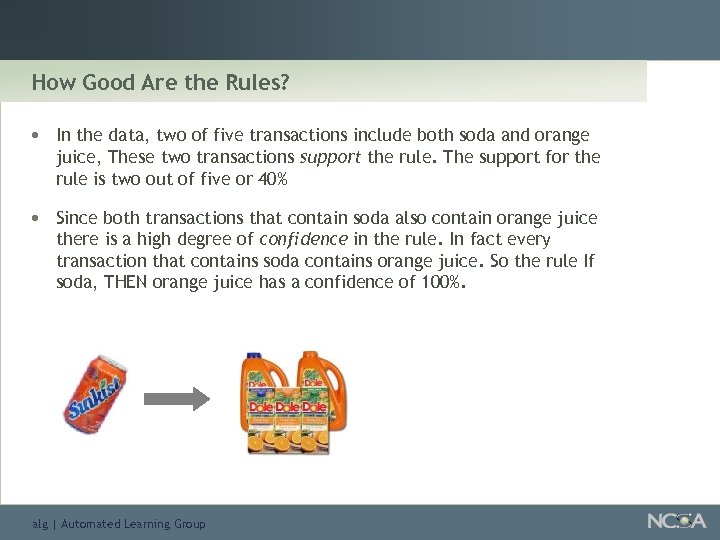
How Good Are the Rules? • In the data, two of five transactions include both soda and orange juice, These two transactions support the rule. The support for the rule is two out of five or 40% • Since both transactions that contain soda also contain orange juice there is a high degree of confidence in the rule. In fact every transaction that contains soda contains orange juice. So the rule If soda, THEN orange juice has a confidence of 100%. alg | Automated Learning Group
Confidence and Support - How Good Are the Rules • A rule must have some minimum user-specified confidence • • 1 & 2 -> 3 has a 90% confidence if when a customer bought 1 and 2, in 90% of the cases, the customer also bought 3. A rule must have some minimum user-specified support • 1 & 2 -> 3 should hold in some minimum percentage of transactions to have value. alg | Automated Learning Group
Association Examples • Find all rules that have “Diet Coke” as a result. These rules may help plan what the store should do to boost the sales of Diet Coke. • Find all rules that have “Yogurt” in the condition. These rules may help determine what products may be impacted if the store discontinues selling “Yogurt”. • Find all rules that have “Brats” in the condition and “mustard” in the result. These rules may help in determining the additional items that have to be sold together to make it highly likely that mustard will also be sold. • Find the best k rules that have “Yogurt” in the result. alg | Automated Learning Group
The Basic Process • Choosing the right set of items • • Taxonomies Generation of rules • • • If condition Then result Negation Overcoming the practical limits imposed by thousand or tens of thousands of products • Minimum Support Pruning alg | Automated Learning Group
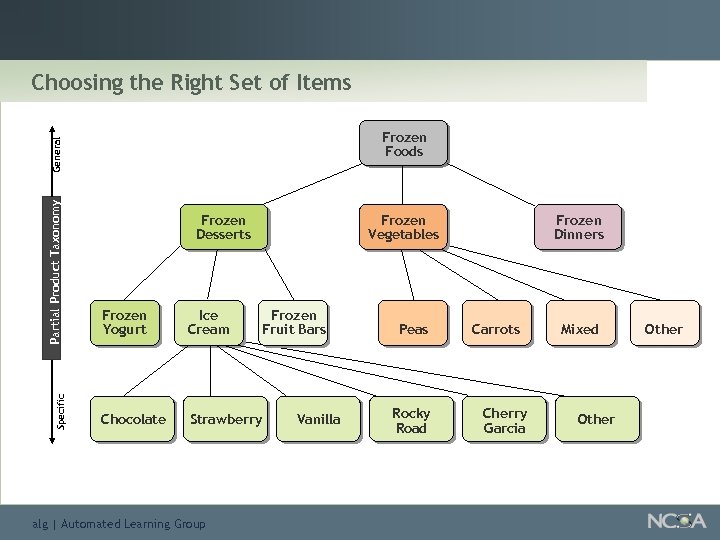
Choosing the Right Set of Items Specific Partial Product Taxonomy General Frozen Foods Frozen Desserts Frozen Vegetables Frozen Yogurt Ice Cream Chocolate Strawberry alg | Automated Learning Group Frozen Fruit Bars Vanilla Peas Rocky Road Frozen Dinners Carrots Cherry Garcia Mixed Other
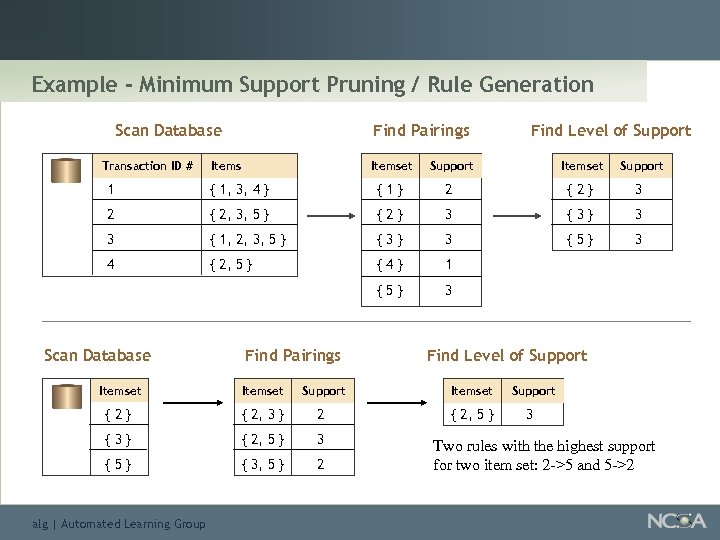
Example - Minimum Support Pruning / Rule Generation Scan Database Transaction ID # Find Pairings Items Find Level of Support Itemset Support 1 { 1, 3, 4 } {1} 2 {2} 3 2 { 2, 3, 5 } {2} 3 {3} 3 3 { 1, 2, 3, 5 } {3} 3 {5} 3 4 { 2, 5 } {4} 1 {5} 3 Scan Database Find Pairings Find Level of Support Itemset {2} { 2, 3 } 2 { 2, 5 } {3} { 2, 5 } 3 {5} { 3, 5 } 2 alg | Automated Learning Group Support 3 Two rules with the highest support for two item set: 2 ->5 and 5 ->2
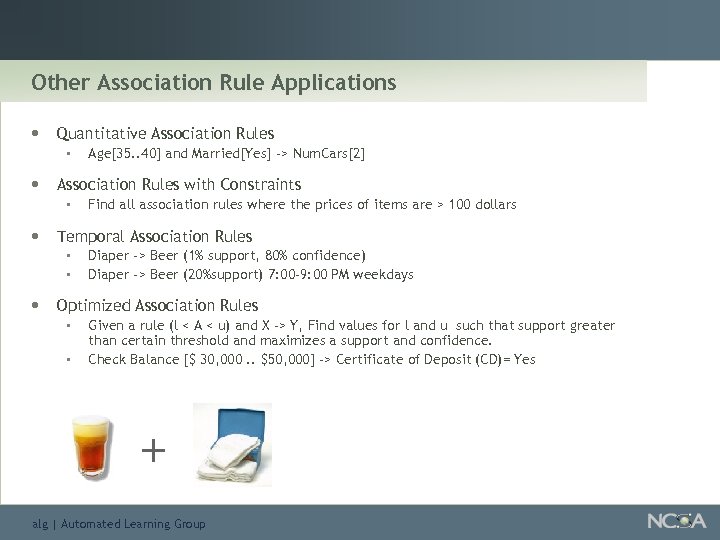
Other Association Rule Applications • Quantitative Association Rules • • Association Rules with Constraints • • Find all association rules where the prices of items are > 100 dollars Temporal Association Rules • • • Age[35. . 40] and Married[Yes] -> Num. Cars[2] Diaper -> Beer (1% support, 80% confidence) Diaper -> Beer (20%support) 7: 00 -9: 00 PM weekdays Optimized Association Rules • • Given a rule (l < A < u) and X -> Y, Find values for l and u such that support greater than certain threshold and maximizes a support and confidence. Check Balance [$ 30, 000. . $50, 000] -> Certificate of Deposit (CD)= Yes + alg | Automated Learning Group
Strengths of Market Basket Analysis • • It produces easy to understand results It supports undirected data mining It works on variable length data Rules are relatively easy to compute alg | Automated Learning Group
Weaknesses of Market Basket Analysis • • It an exponentially growth algorithm It is difficult to determine the optimal number of items It discounts rare items It is limited on the support that it provides attributes alg | Automated Learning Group
Decision Tree Learning alg | Automated Learning Group
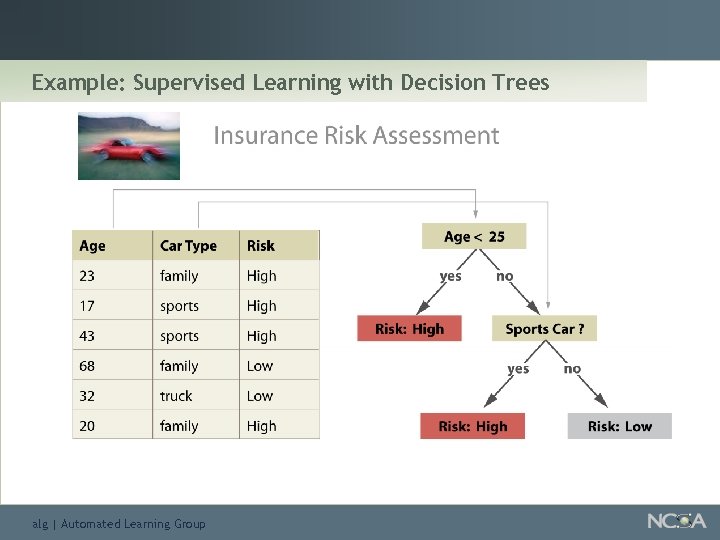
Example: Supervised Learning with Decision Trees alg | Automated Learning Group
Decision Tree Learning • Start with data at the root node • Select an attribute and form a logical test on attribute • Branch on each outcome of test, move subset of example satisfying that out come to corresponding child node • Recurse on each child node • Termination rule specifies when to declare a node is a leaf node Note: this is a one-step look ahead, non-backtracking search through the space of all decision trees Critical Steps • • Formulation of good logical tests Selection measure for attributes alg | Automated Learning Group
Decision Trees • Classifiers • • Internal Nodes: Tests for Attribute Values • • • Typical: equality test (e. g. , “Wind = ? ”) Inequality, other tests possible Branches: Attribute Values • • Instances (unlabeled examples): represented as attribute (“feature”) vectors One-to-one correspondence (e. g. , “Wind = Strong”, “Wind = Light”) Leaves: Assigned Classifications (Class Labels) alg | Automated Learning Group
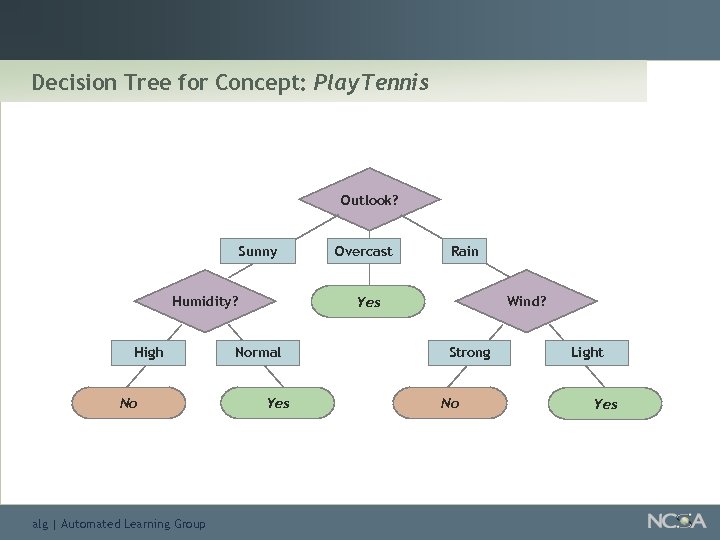
Decision Tree for Concept: Play. Tennis Outlook? Sunny Humidity? High No alg | Automated Learning Group Overcast Rain Wind? Yes Normal Yes Strong No Light Yes
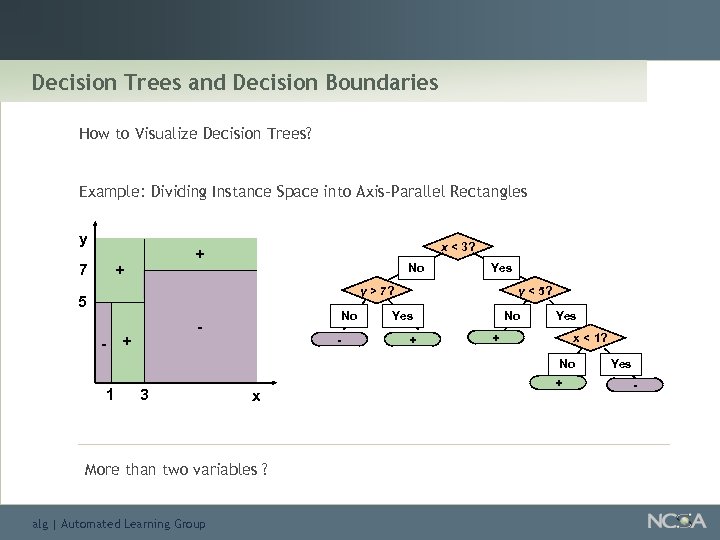
Decision Trees and Decision Boundaries How to Visualize Decision Trees? Example: Dividing Instance Space into Axis-Parallel Rectangles y 7 x < 3? + + No Yes y > 7? 5 + - No - - y < 5? Yes + No Yes + x < 1? No 1 3 x More than two variables ? alg | Automated Learning Group + Yes -
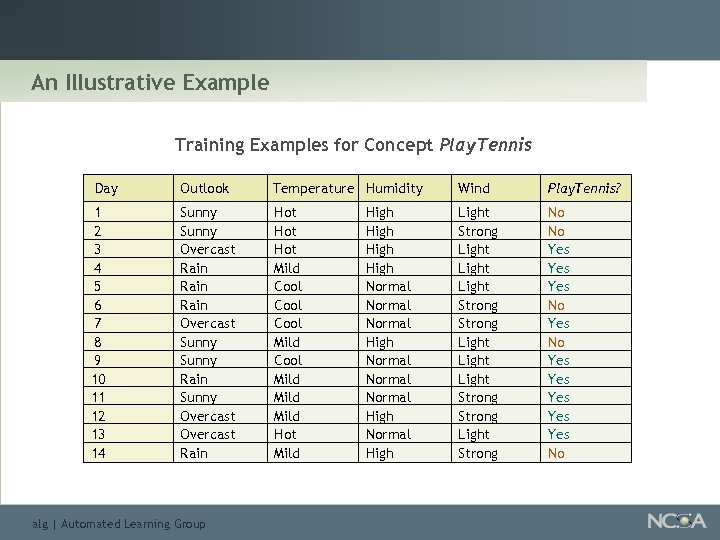
An Illustrative Example Training Examples for Concept Play. Tennis Day Outlook Temperature Humidity Wind Play. Tennis? 1 2 3 4 5 6 7 8 9 10 11 12 13 14 Sunny Overcast Rain Overcast Sunny Rain Sunny Overcast Rain Hot Hot Mild Cool Mild Hot Mild Light Strong Light Light Strong Light Strong No No Yes Yes Yes No alg | Automated Learning Group High Normal Normal High
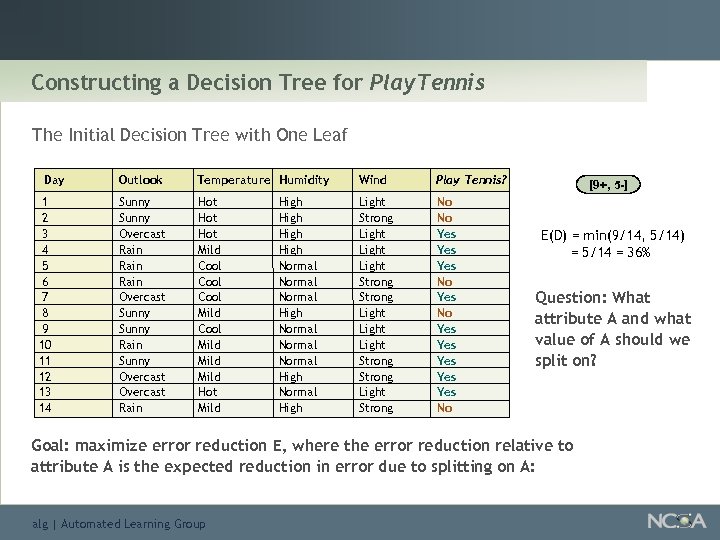
Constructing a Decision Tree for Play. Tennis The Initial Decision Tree with One Leaf Day 1 2 3 4 5 6 7 8 9 10 11 12 13 14 Outlook Temperature Humidity Wind Play Tennis? Sunny Overcast Rain Overcast Sunny Rain Sunny Overcast Rain Hot Hot Mild Cool Mild Hot Mild Light Strong Light Light Strong Light Strong No No Yes Yes Yes No High Normal Normal High [9+, 5 -] E(D) = min(9/14, 5/14) = 5/14 = 36% Question: What attribute A and what value of A should we split on? Goal: maximize error reduction E, where the error reduction relative to attribute A is the expected reduction in error due to splitting on A: alg | Automated Learning Group
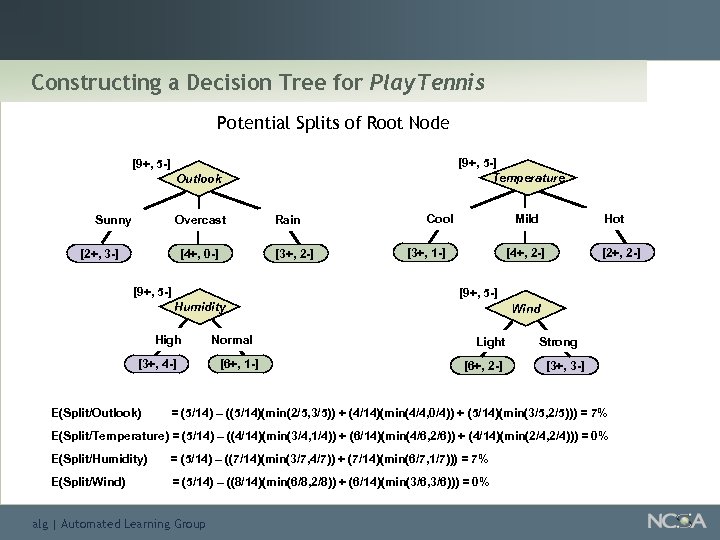
Constructing a Decision Tree for Play. Tennis Potential Splits of Root Node [9+, 5 -] Temperature [9+, 5 -] Outlook Sunny Overcast [4+, 0 -] [2+, 3 -] Rain [3+, 2 -] [9+, 5 -] Cool Mild [4+, 2 -] [3+, 1 -] [2+, 2 -] [9+, 5 -] Humidity High [3+, 4 -] E(Split/Outlook) Hot Normal [6+, 1 -] Wind Light [6+, 2 -] Strong [3+, 3 -] = (5/14) – ((5/14)(min(2/5, 3/5)) + (4/14)(min(4/4, 0/4)) + (5/14)(min(3/5, 2/5))) = 7% E(Split/Temperature) = (5/14) – ((4/14)(min(3/4, 1/4)) + (6/14)(min(4/6, 2/6)) + (4/14)(min(2/4, 2/4))) = 0% E(Split/Humidity) = (5/14) – ((7/14)(min(3/7, 4/7)) + (7/14)(min(6/7, 1/7))) = 7% E(Split/Wind) = (5/14) – ((8/14)(min(6/8, 2/8)) + (6/14)(min(3/6, 3/6))) = 0% alg | Automated Learning Group
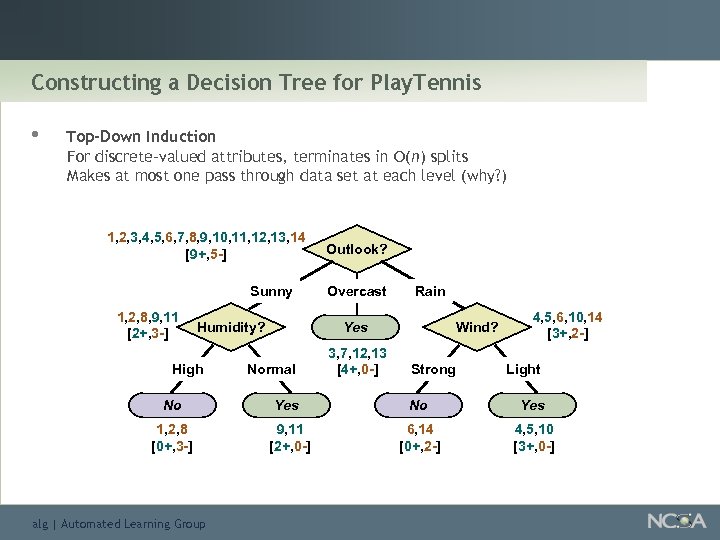
Constructing a Decision Tree for Play. Tennis • Top-Down Induction For discrete-valued attributes, terminates in (n) splits Makes at most one pass through data set at each level (why? ) 1, 2, 3, 4, 5, 6, 7, 8, 9, 10, 11, 12, 13, 14 [9+, 5 -] Sunny 1, 2, 8, 9, 11 [2+, 3 -] Humidity? High Outlook? Overcast Rain Wind? Yes Normal 3, 7, 12, 13 [4+, 0 -] Strong 4, 5, 6, 10, 14 [3+, 2 -] Light No Yes 1, 2, 8 [0+, 3 -] 9, 11 [2+, 0 -] 6, 14 [0+, 2 -] 4, 5, 10 [3+, 0 -] alg | Automated Learning Group
Strengths Of Decision Trees • Decision trees are able to generate understandable results • Decision trees perform classification without requiring much computation • Decisions trees can handle both continuous and categorical variables • Decision trees provide a clear indication of which attributes are most important for prediction or classification alg | Automated Learning Group
Weakness Of Decision Trees • Error-prone with too many classes • Quick partitioning of data results in fast deterioration in attribute selection quality • Trouble with non-rectangular regions alg | Automated Learning Group
Visualization alg | Automated Learning Group
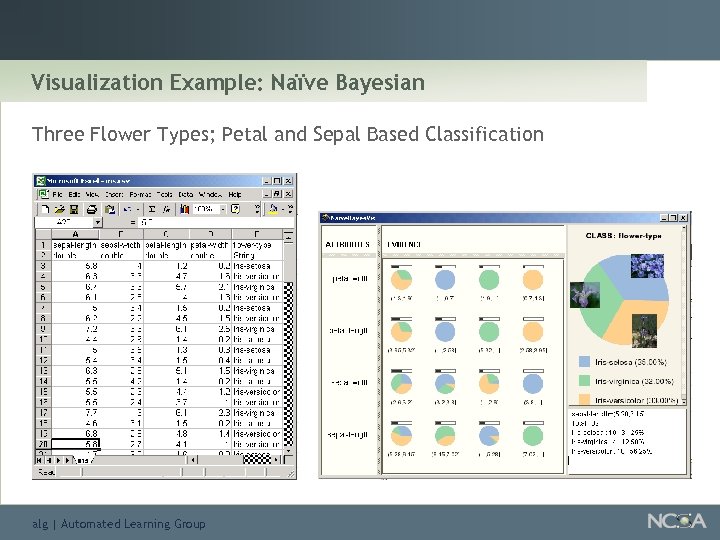
Visualization Example: Naïve Bayesian Three Flower Types; Petal and Sepal Based Classification alg | Automated Learning Group
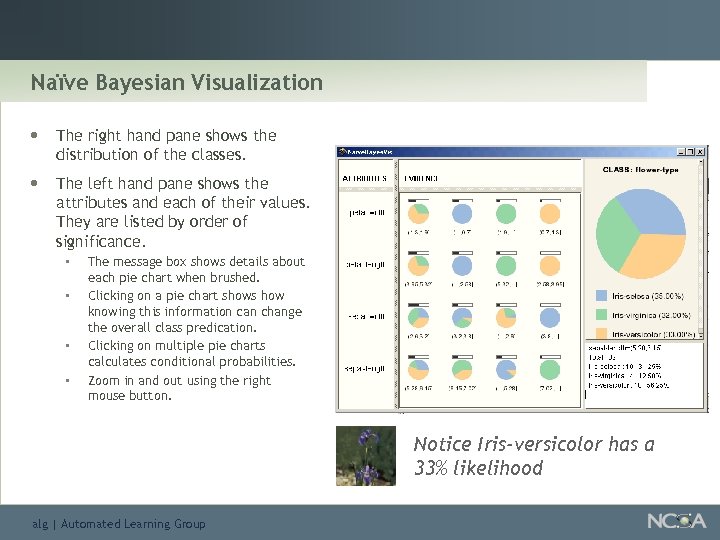
Naïve Bayesian Visualization • The right hand pane shows the distribution of the classes. • The left hand pane shows the attributes and each of their values. They are listed by order of significance. • • The message box shows details about each pie chart when brushed. Clicking on a pie chart shows how knowing this information can change the overall class predication. Clicking on multiple pie charts calculates conditional probabilities. Zoom in and out using the right mouse button. Notice Iris-versicolor has a 33% likelihood alg | Automated Learning Group
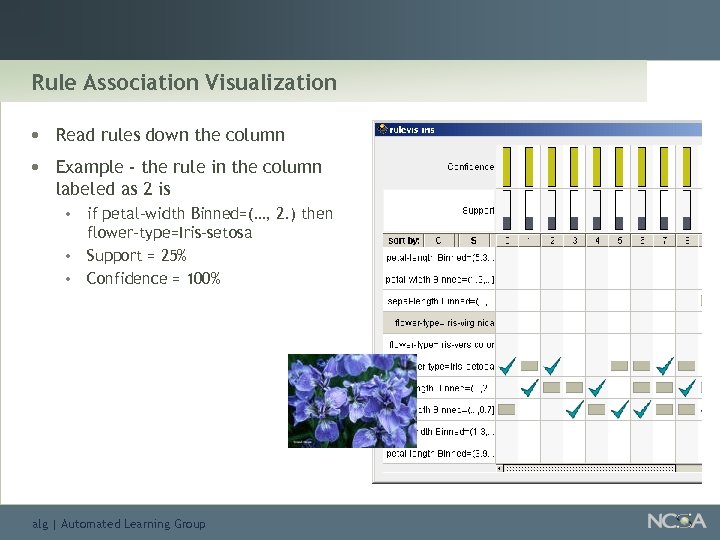
Rule Association Visualization • • Read rules down the column Example - the rule in the column labeled as 2 is • • • if petal-width Binned=(…, 2. ) then flower-type=Iris-setosa Support = 25% Confidence = 100% alg | Automated Learning Group
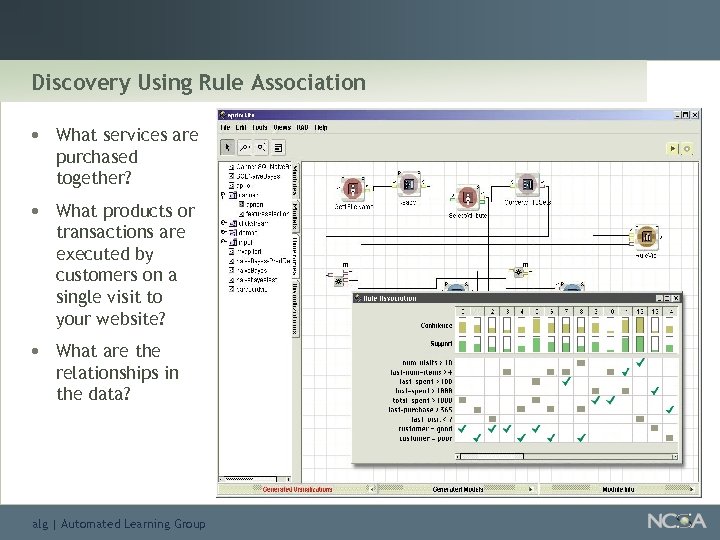
Discovery Using Rule Association • What services are purchased together? • What products or transactions are executed by customers on a single visit to your website? • What are the relationships in the data? alg | Automated Learning Group
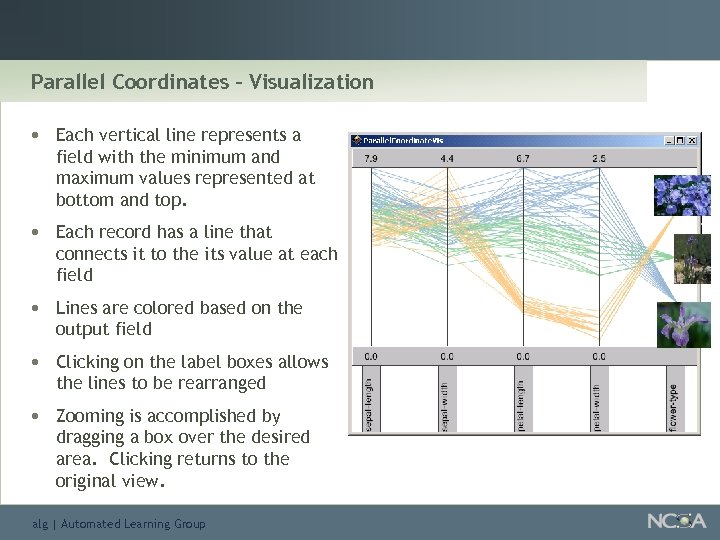
Parallel Coordinates - Visualization • Each vertical line represents a field with the minimum and maximum values represented at bottom and top. • Each record has a line that connects it to the its value at each field • Lines are colored based on the output field • Clicking on the label boxes allows the lines to be rearranged • Zooming is accomplished by dragging a box over the desired area. Clicking returns to the original view. alg | Automated Learning Group
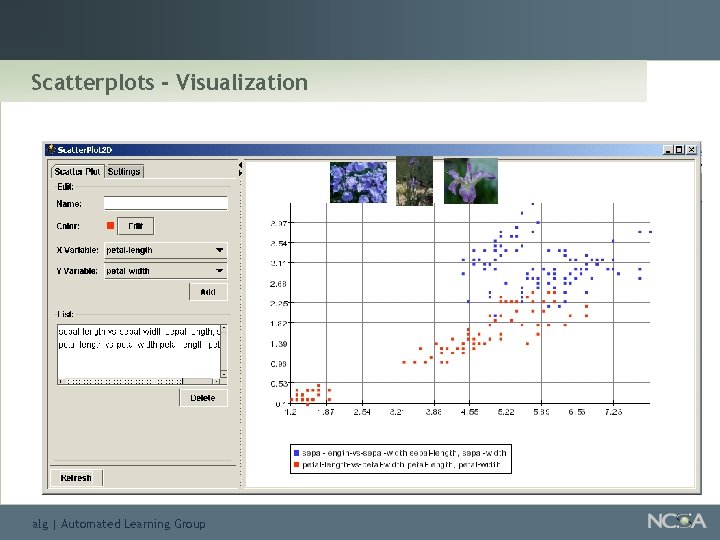
Scatterplots - Visualization alg | Automated Learning Group
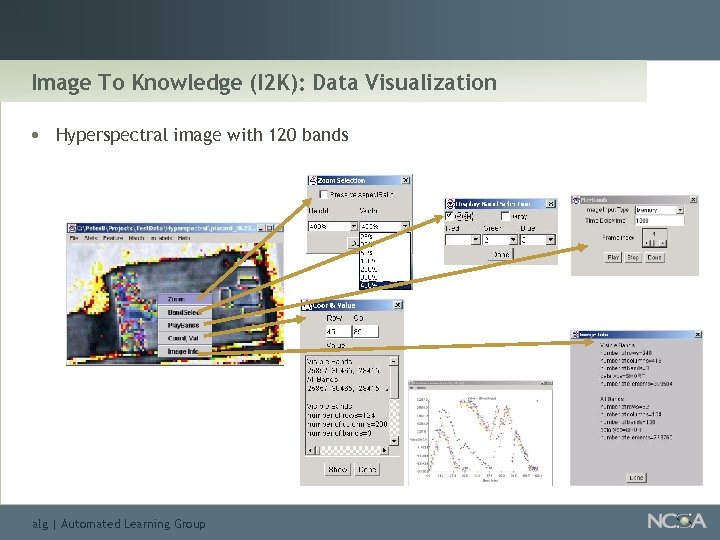
Image To Knowledge (I 2 K): Data Visualization • Hyperspectral image with 120 bands alg | Automated Learning Group
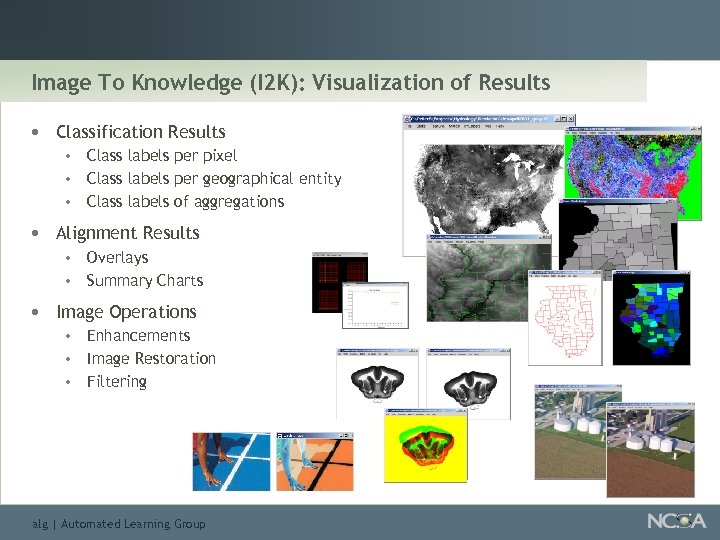
Image To Knowledge (I 2 K): Visualization of Results • Classification Results • • Alignment Results • • • Class labels per pixel Class labels per geographical entity Class labels of aggregations Overlays Summary Charts Image Operations • • • Enhancements Image Restoration Filtering alg | Automated Learning Group
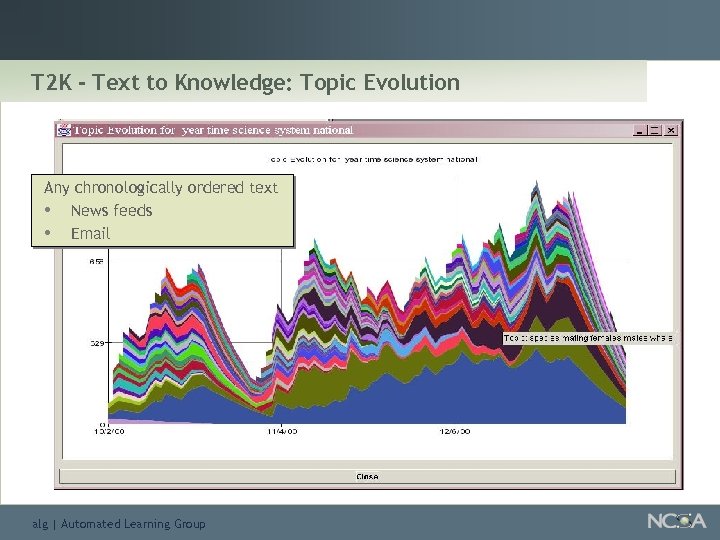
T 2 K - Text to Knowledge: Topic Evolution Any chronologically ordered text • News feeds • Email alg | Automated Learning Group
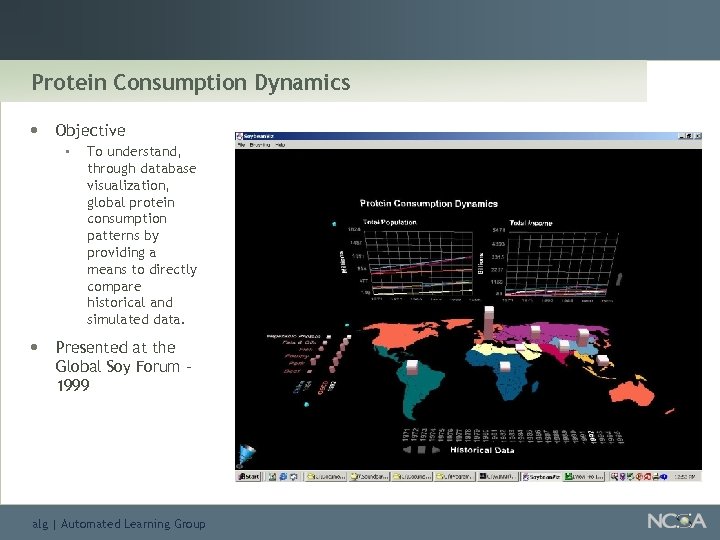
Protein Consumption Dynamics • Objective • • To understand, through database visualization, global protein consumption patterns by providing a means to directly compare historical and simulated data. Presented at the Global Soy Forum 1999 alg | Automated Learning Group
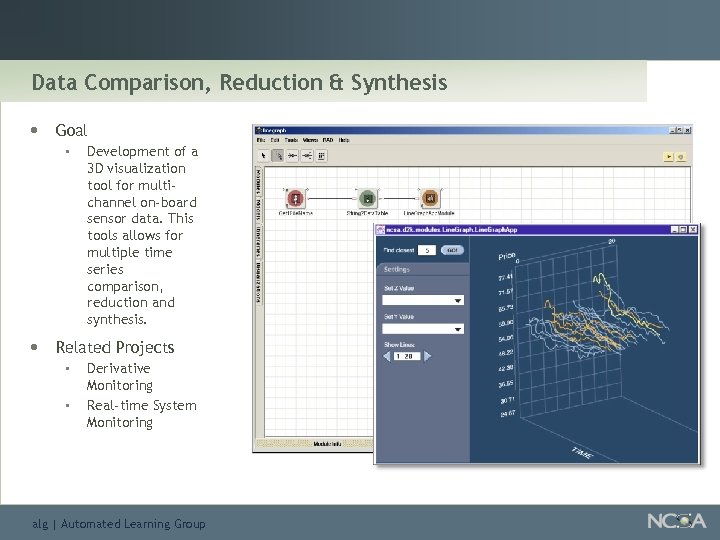
Data Comparison, Reduction & Synthesis • Goal • • Development of a 3 D visualization tool for multichannel on-board sensor data. This tools allows for multiple time series comparison, reduction and synthesis. Related Projects • • Derivative Monitoring Real-time System Monitoring alg | Automated Learning Group
Summary • • • Curious? Puzzled? • • • Become Familiar with Data Mining Terminology Found Application? Domain Specific Questions? Learn ! Introduction to Data Mining Look For Tools Apply Data Mining Techniques to Problems Ask For Help alg | Automated Learning Group
Скачать презентацию Introduction to Data Mining Supercomputing 2002 Peter Bajcsy
61e038ffc80232898bdf21ac72bf60e2.ppt