


 Скачать презентацию Introduction to Data Management for Ocean Science Research
a7eabff59f660115b7aa6ff644751ffb.ppt
- Количество слайдов: 22
 Introduction to Data Management for Ocean Science Research Cyndy Chandler Biological and Chemical Oceanography Data Management Office 12 November 2009 Ocean Acidification Short Course Woods Hole, MA USA Biological and Chemical Oceanography Data Management Office slide 1 of 22
 Discussion Topics Part 1 of 2: Introduction Why data management matters New funding agency requirements New research paradigms New expectations for data access Part 2: data management specifics C. Chandler ~ Biological and Chemical Oceanography Data Management Office slide 2 of 22
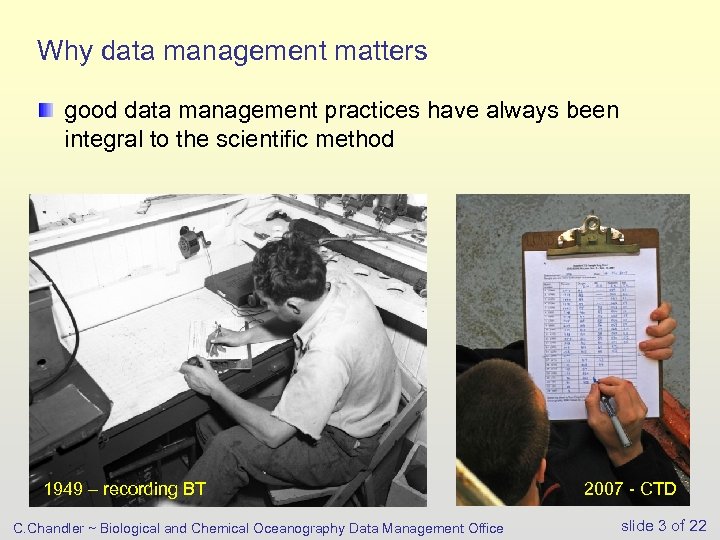 Why data management matters good data management practices have always been integral to the scientific method 1949 – recording BT C. Chandler ~ Biological and Chemical Oceanography Data Management Office 2007 - CTD slide 3 of 22
 Why data management matters It’s important to science careful and deliberate record keeping results reported and made publicly available enabling reproducibility of results from the pre-course survey 57% of students reported having ‘minimal experience’ with “Metadata production and data archiving” C. Chandler ~ Biological and Chemical Oceanography Data Management Office slide 4 of 22
 Some definitions … what do I mean by … Data Management end-to-end data management proposal to preservation having a plan from the beginning to ensure that data and metadata are recorded accurately, are preserved securely (backups) and will be made accessible to others and ‘dataset’ ? a logical grouping of related measurements (often from the sampling device or sensor) C. Chandler ~ Biological and Chemical Oceanography Data Management Office slide 5 of 22
 Metadata metadata ~ “about the data” information required to interpret the data Metadata records capture the information required to answer the who, what, where, why, how and when questions that are asked about a data set. It is important to know who collected, analyzed and contributed the data and where, when and how those data were acquired and subsequently analyzed and processed. C. Chandler ~ Biological and Chemical Oceanography Data Management Office slide 6 of 22
 Changes and Challenges data sets used to be smaller and were often published on paper (in a journal article or a data report, and they fit in Table 1) data were published as a tangible thing as data acquisition becomes automated, rate of acquisition and volume increases but metadata acquisition (data documentation) is not being automated at the same rate C. Chandler ~ Biological and Chemical Oceanography Data Management Office slide 7 of 22
 What else has changed? shift from ‘local’ to ‘global’ Ø research themes Ø collaborative teams of researchers are trending toward being more distributed ~~ thematically and geographically technological advances are enabling these changes cultural changes lag behind technological changes Ø no direct relationship between career advancement and publication of data C. Chandler ~ Biological and Chemical Oceanography Data Management Office slide 8 of 22
 Why data management matters Cultural Changes – a work in progress: goal: scientific data should be freely accessible to all achievement of that goal relies on agreement that: anyone using the data must properly acknowledge the data originators (proper citation of all source data used) C. Chandler ~ Biological and Chemical Oceanography Data Management Office slide 9 of 22
 Publication of Data Cultural issues … Ø little incentive for researchers to publish their data Ø exacerbated by the perception that the data are the ‘property’ of the originating investigator, and might be ‘stolen’ Conventional wisdom is still that ‘publish or perish’ applies predominantly to journal publications, not data publication. In the US, funding agency program managers are beginning to effect change in this area. NSF, NASA and NOAA all require publication of data generated by federally funded research. C. Chandler ~ Biological and Chemical Oceanography Data Management Office slide 10 of 22
 New funding agency requirements Division of Ocean Sciences Data and Sample Policy. National Science Foundation. NSF 04 -004 http: //www. nsf. gov/pubs/2004/nsf 04004. pdf General Data Policy Principal Investigators are required to submit all environmental data collected to the designated National Data Centers as soon as possible, but no later than two (2) years after the data are collected. Inventories (metadata) of all marine environmental data collected should be submitted to the designated National Data Centers within sixty (60) days after the observational period/cruise. C. Chandler ~ Biological and Chemical Oceanography Data Management Office slide 11 of 22
 New funding agency requirements Proposal Requirements The NSF Grant Proposal Guide requires that proposal Project Descriptions outline plans for preservation, documentation, and sharing of data, samples, physical collections, curriculum materials and other related research and education products. Plans for the handling of data and other products will be considered in the review process. Reporting Requirements Annual reports, required for all projects, should address progress on data and research product sharing. The Division of Ocean Sciences requires that final reports document compliance or explain why it did not occur. C. Chandler ~ Biological and Chemical Oceanography Data Management Office slide 12 of 22
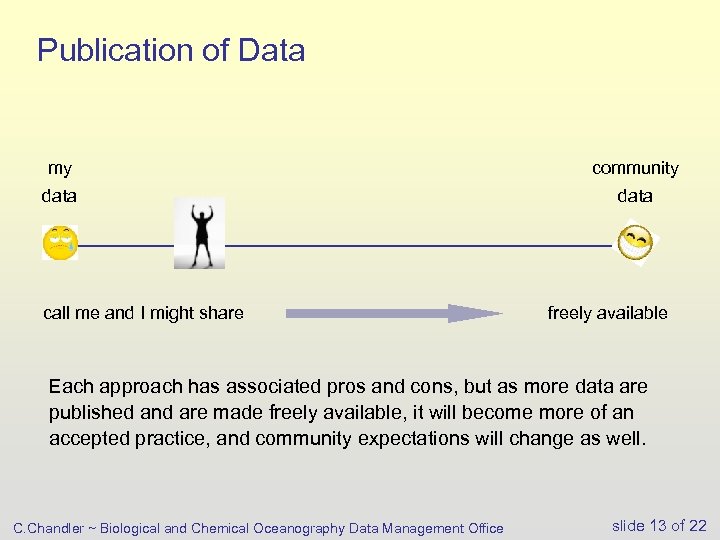 Publication of Data my community data call me and I might share freely available Each approach has associated pros and cons, but as more data are published and are made freely available, it will become more of an accepted practice, and community expectations will change as well. C. Chandler ~ Biological and Chemical Oceanography Data Management Office slide 13 of 22
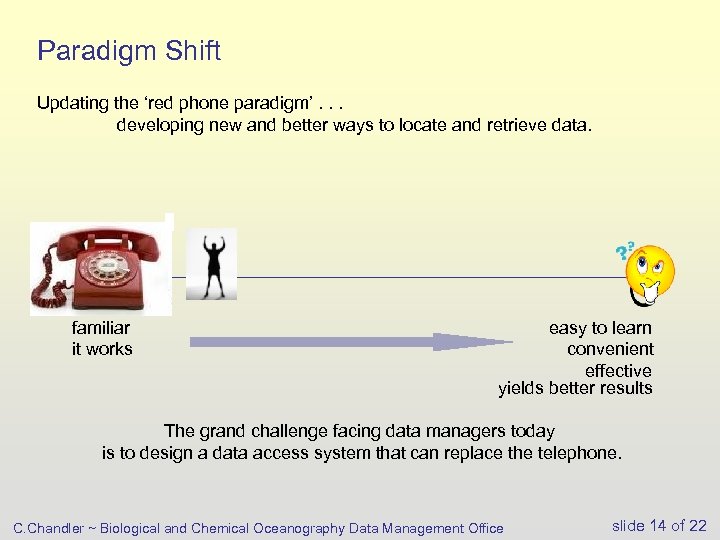 Paradigm Shift Updating the ‘red phone paradigm’. . . developing new and better ways to locate and retrieve data. familiar it works easy to learn convenient effective yields better results The grand challenge facing data managers today is to design a data access system that can replace the telephone. C. Chandler ~ Biological and Chemical Oceanography Data Management Office slide 14 of 22
 New research paradigms. . . science themes are trending toward Ø interdisciplinary Ø basin-wide studies involving coupling of complex models Ø atmospheric and hydrologic Ø end-to-end food web . . . require access to data from many disciplines C. Chandler ~ Biological and Chemical Oceanography Data Management Office slide 15 of 22
 New expectations for data access complex research themes (ocean biogeochemistry, ocean acidification research) require access to data collected by other researchers access to research designed to enable science-based decision support for legislative policies Ø Ø social science economics history broad range of disciplines C. Chandler ~ Biological and Chemical Oceanography Data Management Office slide 16 of 22
 What does ‘access to data’ mean? ability to locate data of interest determine ‘fitness for purpose’ accurately use the data “Scientists are confronted with significant data management problems due to the large volume and high complexity of scientific data. In particular, the latter makes data integration a significant technical challenge. ” (A. K. Sinha, Geoinformatics, 2006) C. Chandler ~ Biological and Chemical Oceanography Data Management Office slide 17 of 22
 New expectations for data access New tools based on emerging technologies are being developed to address the challenge of integration of distributed heterogeneous data informatics semantic mediation registered ontologies C. Chandler ~ Biological and Chemical Oceanography Data Management Office slide 18 of 22
 New expectations for data access all of the new technologies assume that data resources will be accompanied by machine-readable metadata while we wait for the new informatics tools, and semantic escience resources to come online … … ocean science data accompanied by human readable metadata are of great value C. Chandler ~ Biological and Chemical Oceanography Data Management Office slide 19 of 22
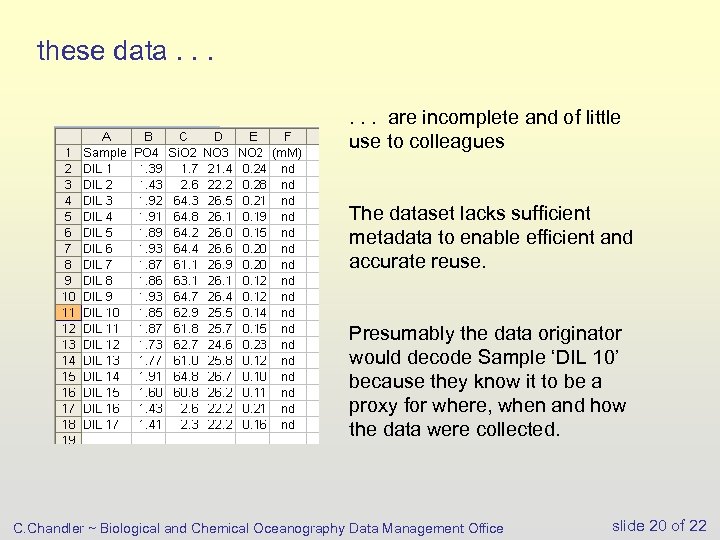 these data. . . are incomplete and of little use to colleagues The dataset lacks sufficient metadata to enable efficient and accurate reuse. Presumably the data originator would decode Sample ‘DIL 10’ because they know it to be a proxy for where, when and how the data were collected. C. Chandler ~ Biological and Chemical Oceanography Data Management Office slide 20 of 22
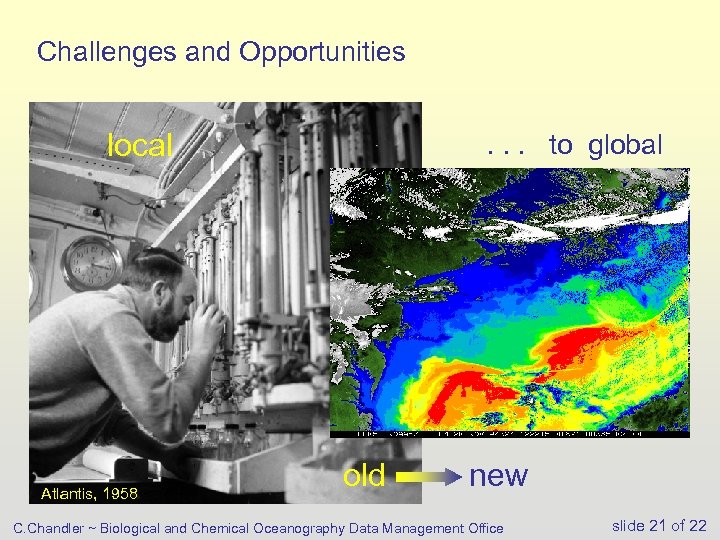 Challenges and Opportunities local Atlantis, 1958 . . . to global old new C. Chandler ~ Biological and Chemical Oceanography Data Management Office slide 21 of 22
 “ You can’t play with the data without the metadata. Well, you can, but it’s much less fun. “ (Peter Wiebe, WHOI, 2009) end of part 1 Biological and Chemical Oceanography Data Management Office slide 22 of 22