


 Скачать презентацию Introduction to Curriculum Leadership and Management Series for
2eca4f8b1b4c9cf10fccdc06cd4c8772.ppt
- Количество слайдов: 43
 Introduction to Curriculum Leadership and Management Series for New Primary School Curriculum Leaders (2010/11) Key Emphases and Strategies in Planning the English Language Education KLA 14 October 2010 English Language Education Section Curriculum Development Institute Education Bureau
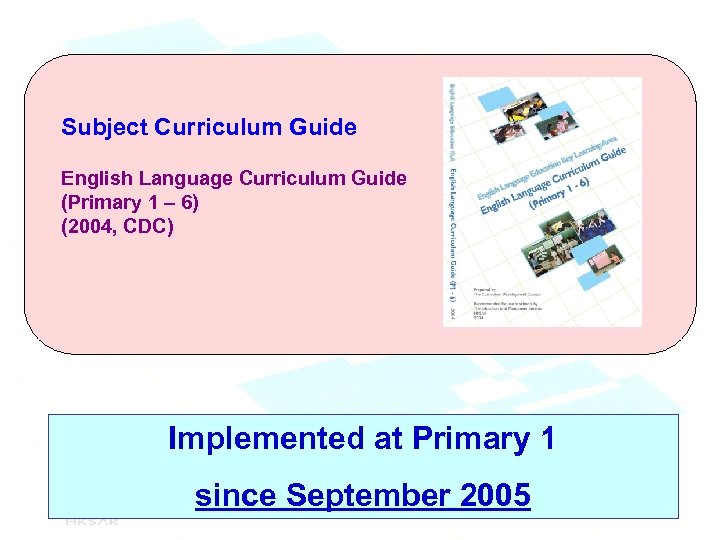 Subject Curriculum Guide English Language Curriculum Guide (Primary 1 – 6) (2004, CDC) Implemented at Primary 1 since September 2005
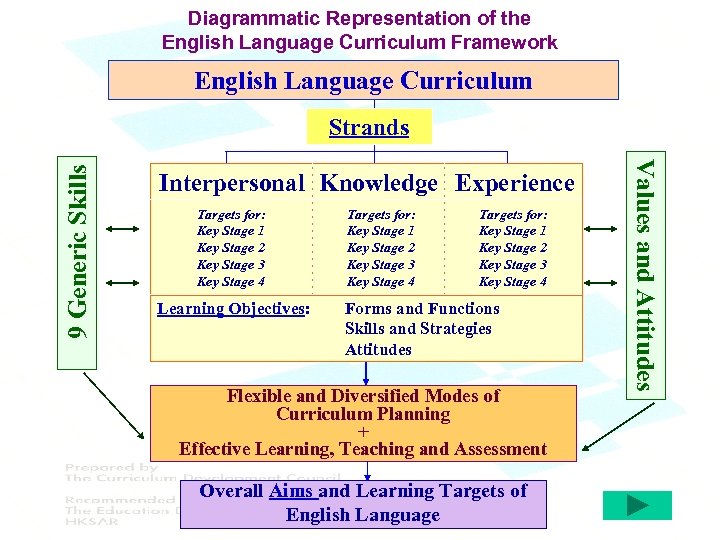 Diagrammatic Representation of the English Language Curriculum Framework English Language Curriculum Interpersonal Knowledge Experience Targets for: Key Stage 1 Key Stage 2 Key Stage 3 Key Stage 4 Learning Objectives: Targets for: Key Stage 1 Key Stage 2 Key Stage 3 Key Stage 4 Forms and Functions Skills and Strategies Attitudes Flexible and Diversified Modes of Curriculum Planning + Effective Learning, Teaching and Assessment Overall Aims and Learning Targets of English Language Values and Attitudes 9 Generic Skills Strands
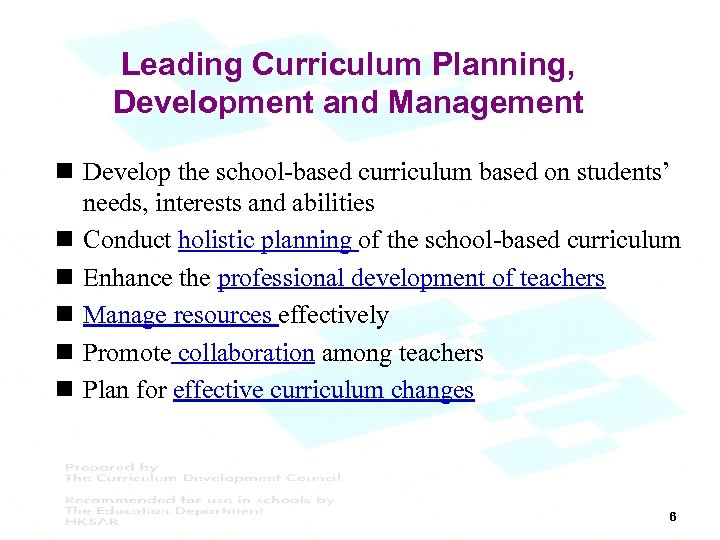 Leading Curriculum Planning, Development and Management n Develop the school-based curriculum based on students’ needs, interests and abilities n Conduct holistic planning of the school-based curriculum n Enhance the professional development of teachers n Manage resources effectively n Promote collaboration among teachers n Plan for effective curriculum changes 6
 Conducting Holistic Planning • Needs analysis - Refer to different sources of data (e. g. TSA data, internal assessment data, ESR and SSE findings) - Conduct a critical review of the current situation • Action planning • Evaluation 7
 Action Planning • Draw upon the needs analysis to identify the development focuses • Set clear and specific objectives • Decide on appropriate measures • Ensure vertical and horizontal coordination • Set a clear and practical schedule for implementation 8
 Enhancing Professional Development of Teachers n Encourage and organise teachers to attend professional development programmes n Encourage sharing of knowledge, ideas, experiences and good practices Ø Ø Ø Collaborative lesson preparation Co-teaching Peer coaching Peer lesson observation Teacher reflection Regular sharing sessions 10
 Managing Resources to Enhance Effective Learning and Teaching English Enhancement Grant Scheme for Primary Schools (EDBCM 162/2009) n Facilitating the planning, development and implementation of the school-based English Language curriculum, with learning, teaching and assessment as an integral part n Enhancing English teachers’ professional development n Creating a rich English language learning environment 11
 Promoting Collaboration among Teachers n n n Collaborative lesson preparation Collaborate with the teacher-librarian to promote a reading culture Promote collaboration across different KLAs (e. g. cross-curricular tasks/projects) 12
 Planning for Effective Curriculum Changes n n n Review and evaluate the curriculum implementation strategies based on evidence of student learning Sustain good practices Explore innovative / effective teaching methods 13
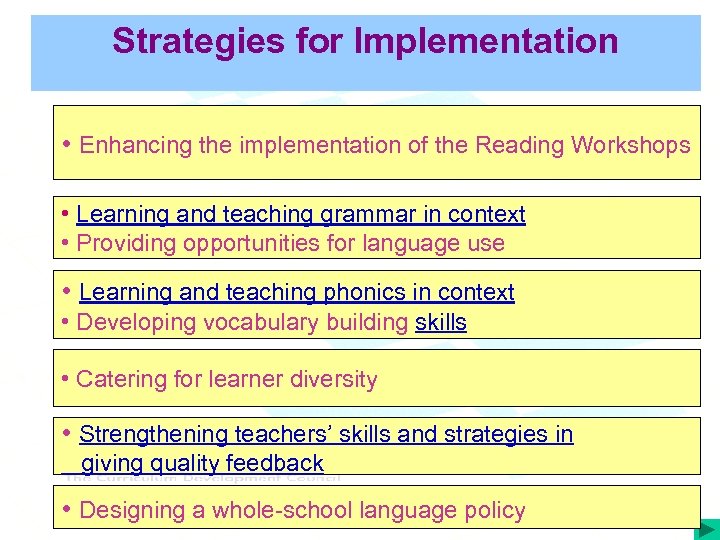 Key Strategiesof the English Language Emphases for Implementation Curriculum Guide (Primary 1 - 6) • Strengthening ‘learning to read’ • Enhancing the implementation of the Reading Workshops • Promoting a ‘reading to learn’ culture • Learningtask-based approach in learning, teaching and • Using a and teaching grammar in context • Providing opportunities for language use assessment • Learning and teaching phonics in context • Promoting learner independence • Developing vocabulary building skills • Catering for learner diversity • Strengthening teachers’for learningstrategies in Promoting assessment skills and giving quality feedback • Creating a a whole-schoolenvironment • Designing language-rich language policy
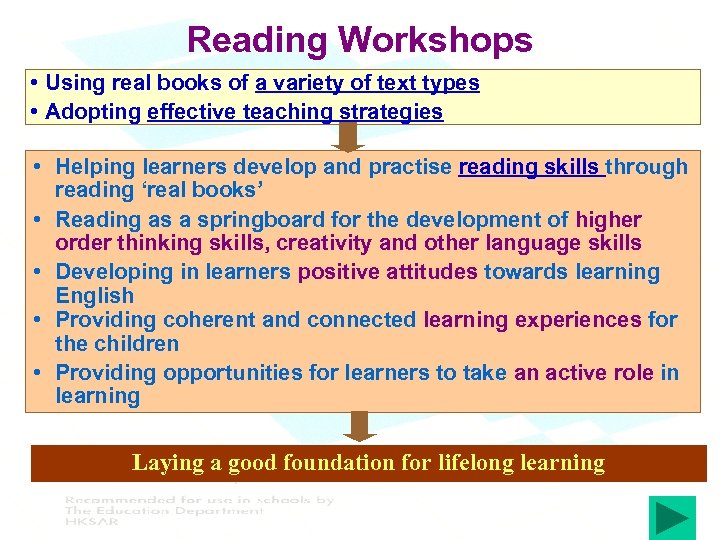 Reading Workshops • Using real books of a variety of text types • Adopting effective teaching strategies • Helping learners develop and practise reading skills through reading ‘real books’ • Reading as a springboard for the development of higher order thinking skills, creativity and other language skills • Developing in learners positive attitudes towards learning English • Providing coherent and connected learning experiences for the children • Providing opportunities for learners to take an active role in learning Laying a good foundation for lifelong learning
 Text Types • Different text types (e. g. poems, diaries, rules, posters, cartoons, news reports) have their own particular textual structures, style, grammar features and vocabulary
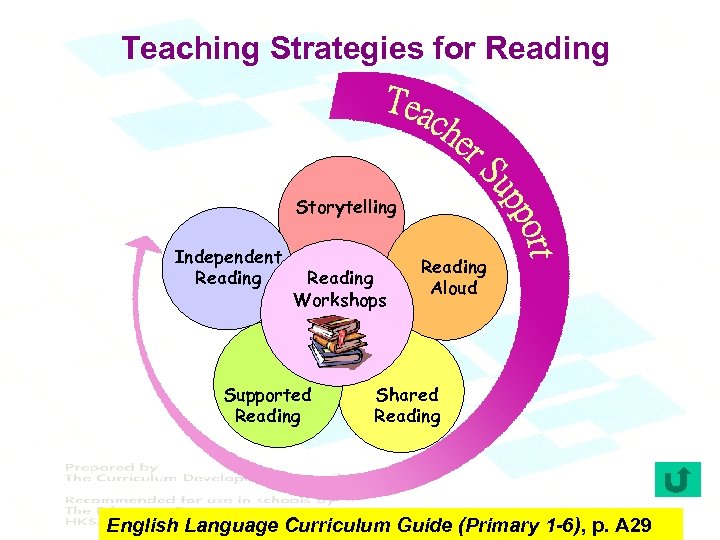 Teaching Strategies for Reading Storytelling Independent Reading Workshops Supported Reading Aloud Shared Reading English Language Curriculum Guide (Primary 1 -6), p. A 29
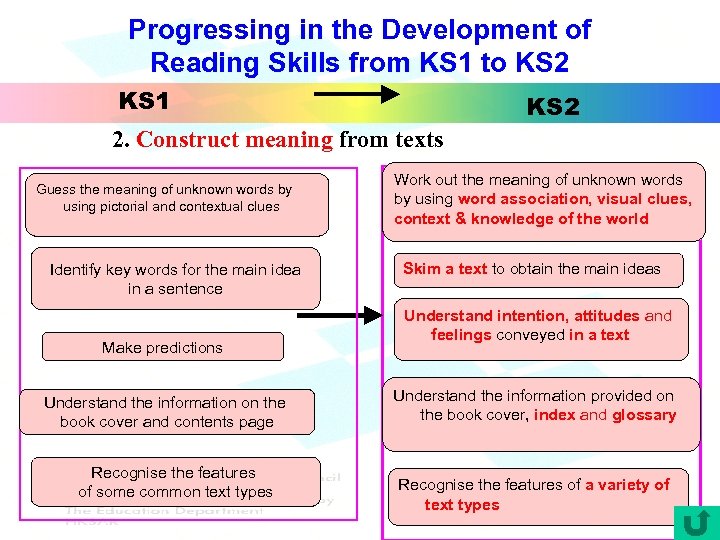 Progressing in the Development of Reading Skills from KS 1 to KS 2 KS 1 KS 2 2. Construct meaning from texts Guess the meaning of unknown words by using pictorial and contextual clues Identify key words for the main idea in a sentence Make predictions Understand the information on the book cover and contents page Recognise the features of some common text types Work out the meaning of unknown words by using word association, visual clues, context & knowledge of the world Skim a text to obtain the main ideas Understand intention, attitudes and feelings conveyed in a text Understand the information provided on the book cover, index and glossary Recognise the features of a variety of text types
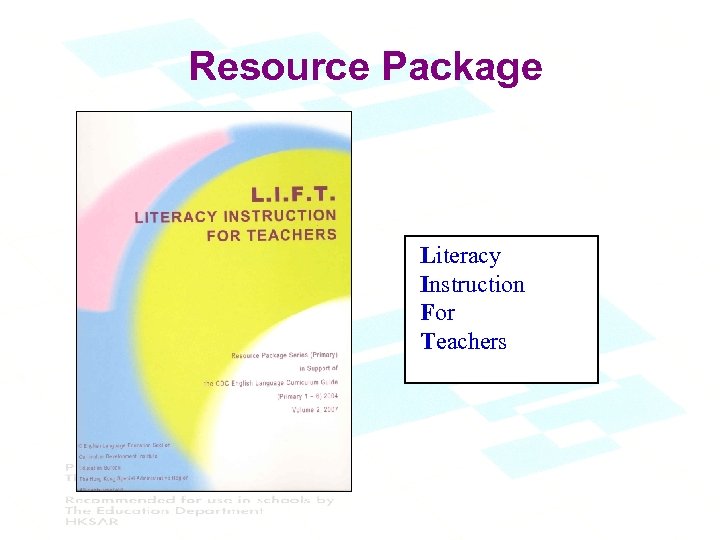 Resource Package Literacy Instruction For Teachers
 PDP 2010 -2011 Reading across the Curriculum to Enhance the Transition from KS 1 to KS 2 and from KS 2 to KS 3 (Re-run) Apr-May 2011
 PDP 2010 -2011 Learning English through Language Arts at Primary Level (Re-run) Jan 2011
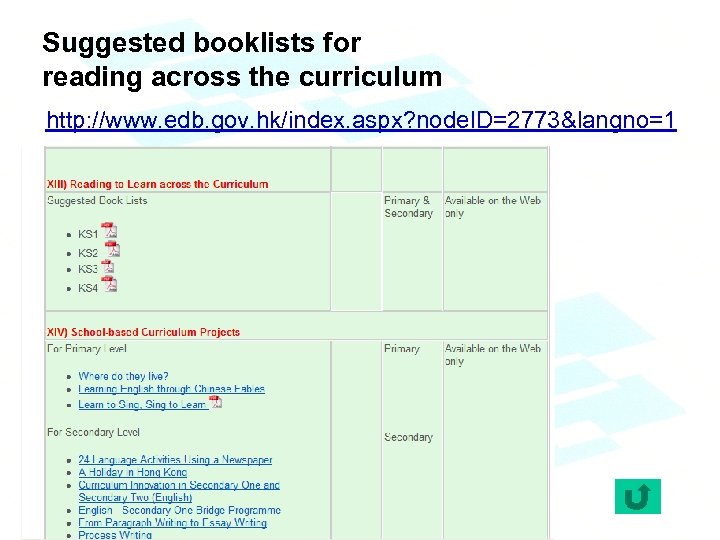 Suggested booklists for reading across the curriculum http: //www. edb. gov. hk/index. aspx? node. ID=2773&langno=1
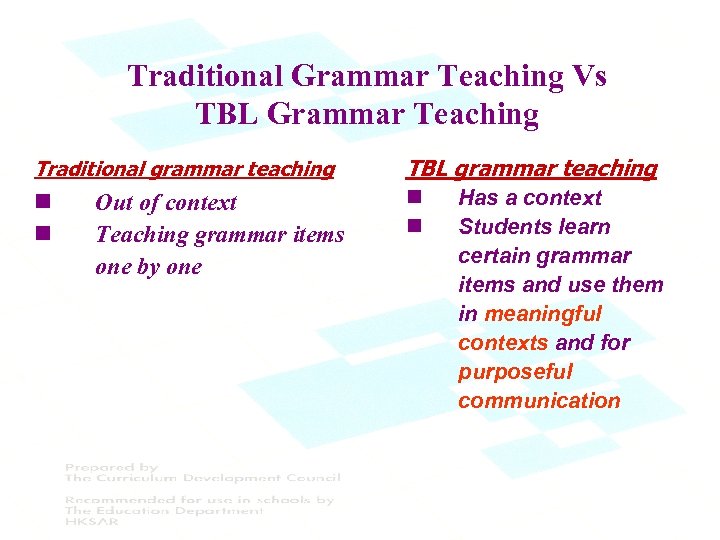 Traditional Grammar Teaching Vs TBL Grammar Teaching Traditional grammar teaching n n Out of context Teaching grammar items one by one TBL grammar teaching n Has a context n Students learn certain grammar items and use them in meaningful contexts and for purposeful communication
 Learning and Teaching Grammar in Context • Using grammar focus activities and exercises in task-based learning • Facilitating grammar learning and teaching through exposure to a variety of text types • Introducing grammar rules and terms in an explicit way at appropriate stage of learning when necessary • Giving equal emphasis to the development of fluency and accuracy English Language Curriculum Guide (Primary 1 -6), pp. 160 -164
 Developing Phonics Skills Helping learners: • develop an awareness of the letter-sound relationships through explicit teaching • build up strategies for decoding (in reading) and encoding (in spelling) words at an early stage of learning • gain confidence and competence in reading aloud and develop an interest in reading books in English • develop strategies in discriminating sounds, in listening and speaking in English, and use accurate spelling in writing English Language Curriculum Guide (Primary 1 -6), pp. 171 -174
 Learning and Teaching Phonics in Context • Incorporate phonics teaching into the school English programme instead of adopting and implementing a separate phonics programme • Teach and practise phonics in the GE Programme as well as Reading Workshops through short, interesting and purposeful activities and games (e. g. funny rhymes, phonics tic-tac-toe) English Language Curriculum Guide (Primary 1 -6), pp. 171 -174
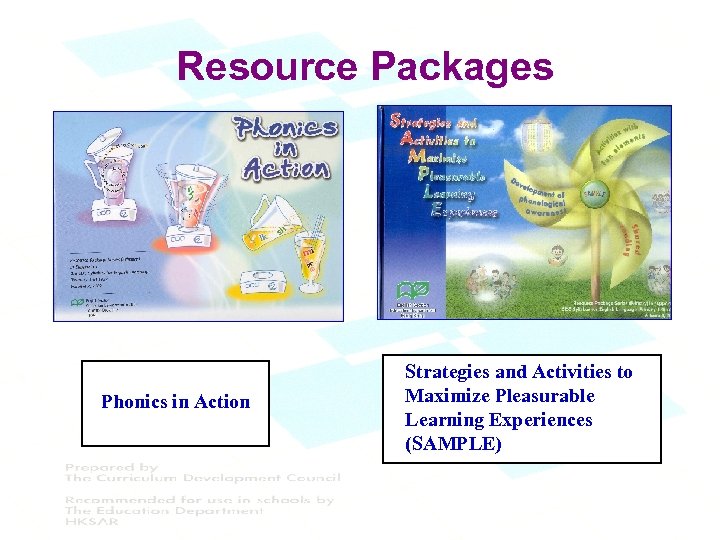 Resource Packages Phonics in Action Strategies and Activities to Maximize Pleasurable Learning Experiences (SAMPLE)
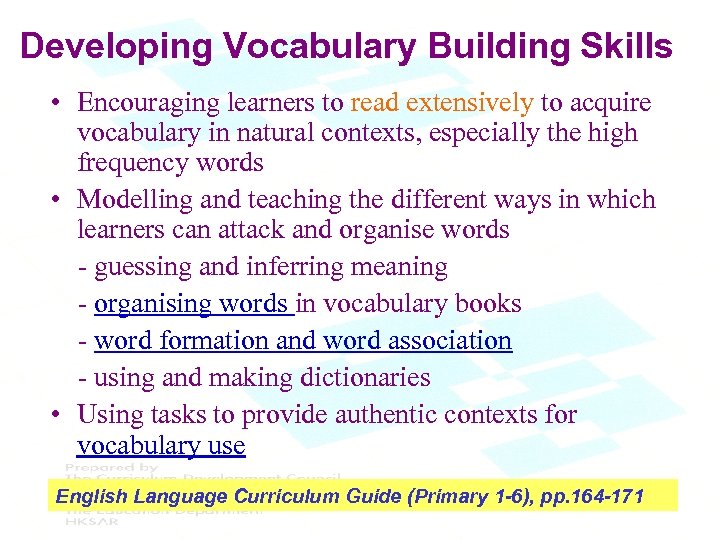 Developing Vocabulary Building Skills • Encouraging learners to read extensively to acquire vocabulary in natural contexts, especially the high frequency words • Modelling and teaching the different ways in which learners can attack and organise words - guessing and inferring meaning - organising words in vocabulary books - word formation and word association - using and making dictionaries • Using tasks to provide authentic contexts for vocabulary use English Language Curriculum Guide (Primary 1 -6), pp. 164 -171
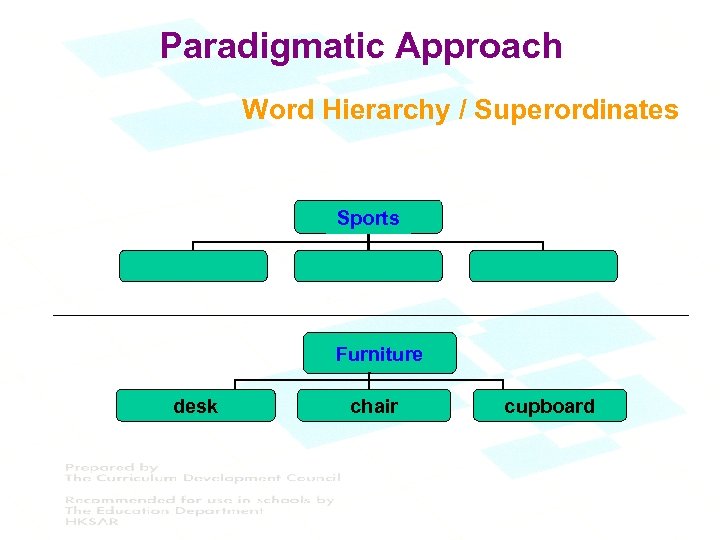 Paradigmatic Approach Word Hierarchy / Superordinates ? Sports football tennis basketball ? Furniture desk chair cupboard
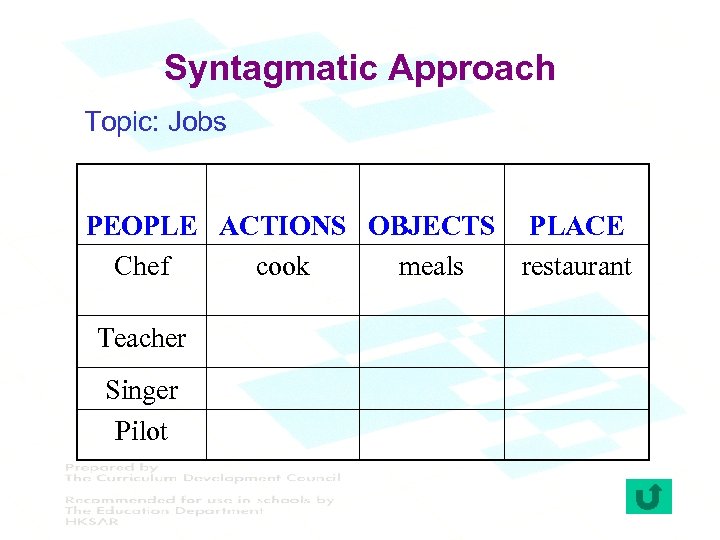 Syntagmatic Approach Topic: Jobs PEOPLE ACTIONS OBJECTS PLACE Chef cook meals restaurant Teacher Singer Pilot
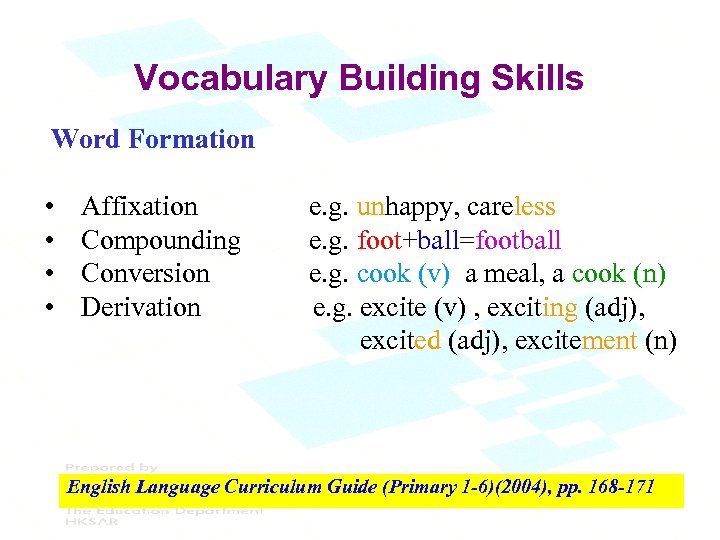 Vocabulary Building Skills Word Formation • • Affixation Compounding Conversion Derivation e. g. unhappy, careless e. g. foot+ball=football e. g. cook (v) a meal, a cook (n) e. g. excite (v) , exciting (adj), excited (adj), excitement (n) English Language Curriculum Guide (Primary 1 -6)(2004), pp. 168 -171
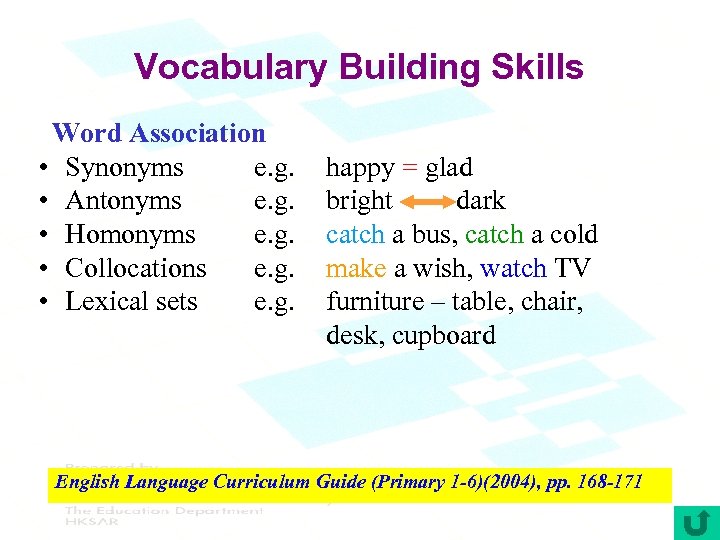 Vocabulary Building Skills Word Association • Synonyms e. g. • Antonyms e. g. • Homonyms e. g. • Collocations e. g. • Lexical sets e. g. happy = glad bright dark catch a bus, catch a cold make a wish, watch TV furniture – table, chair, desk, cupboard English Language Curriculum Guide (Primary 1 -6)(2004), pp. 168 -171
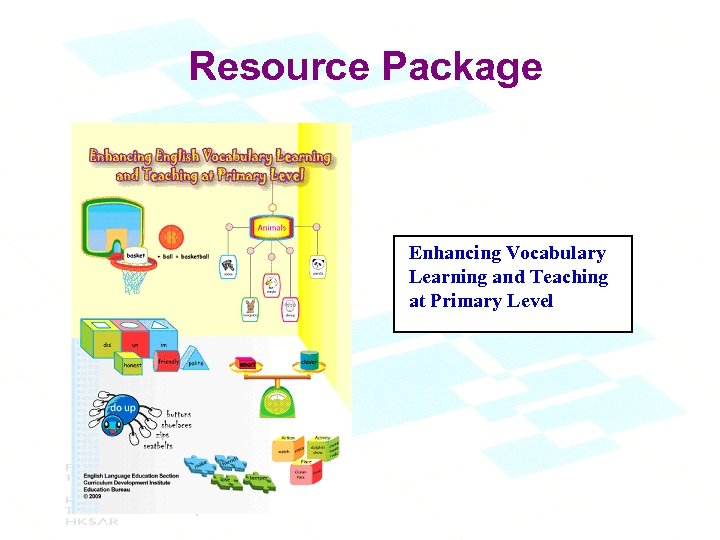 Resource Package Enhancing Vocabulary Learning and Teaching at Primary Level
 PDP 2010 -2011 Enhancing English Vocabulary Learning and Teaching at Primary Level (Re-run) Feb-Mar 2011
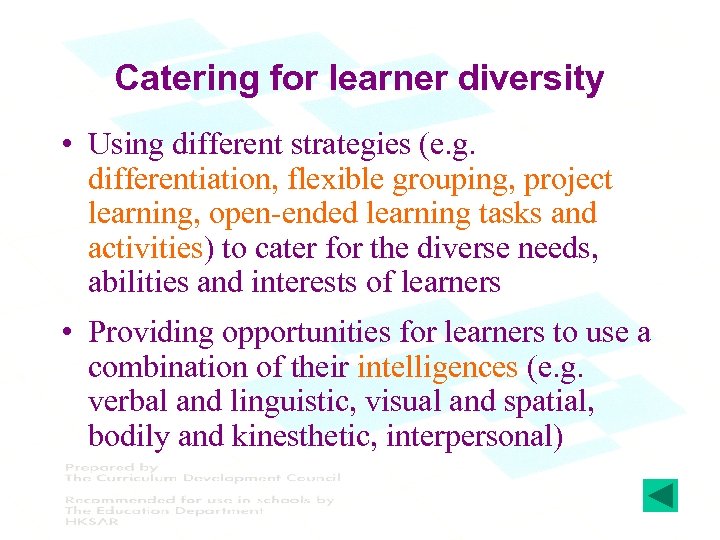 Catering for learner diversity • Using different strategies (e. g. differentiation, flexible grouping, project learning, open-ended learning tasks and activities) to cater for the diverse needs, abilities and interests of learners • Providing opportunities for learners to use a combination of their intelligences (e. g. verbal and linguistic, visual and spatial, bodily and kinesthetic, interpersonal)
 Promoting Assessment for Learning • An integral part of learning-teaching-assessment cycle • Sharing learning intentions and success criteria with learners • Using different modes of assessment • Making use of assessment data (e. g. TSA data, internal assessment data) to help review - expectation of pupils’ learning - content of learning - strategies to enhance learning • Providing quality feedback to enhance learning English Language Curriculum Guide (Primary 1 -6)(2004), pp. 191 -201
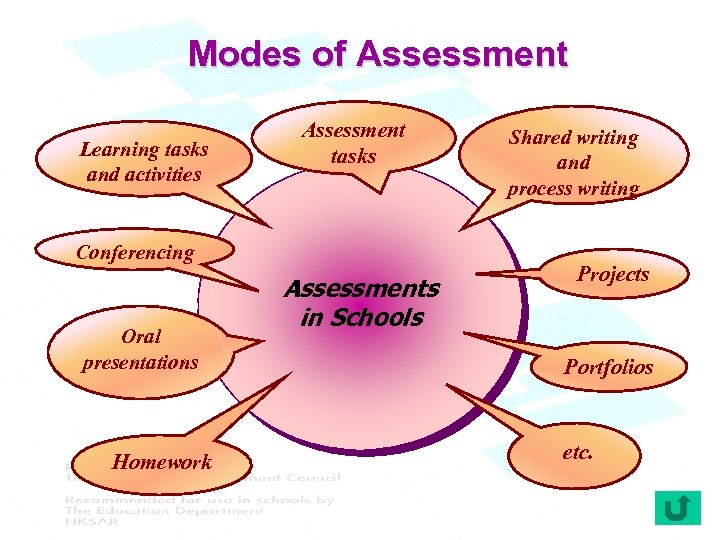 Modes of Assessment Learning tasks and activities Assessment tasks Conferencing Oral presentations Homework Assessments in Schools Shared writing and process writing Projects Portfolios etc.
 Quality Feedback • • • Positive Diagnostic Constructive Focused Timely Encourage self-correction and independence Promoting Assessment for Learning in English Language at Primary Level, pp. 84 -86
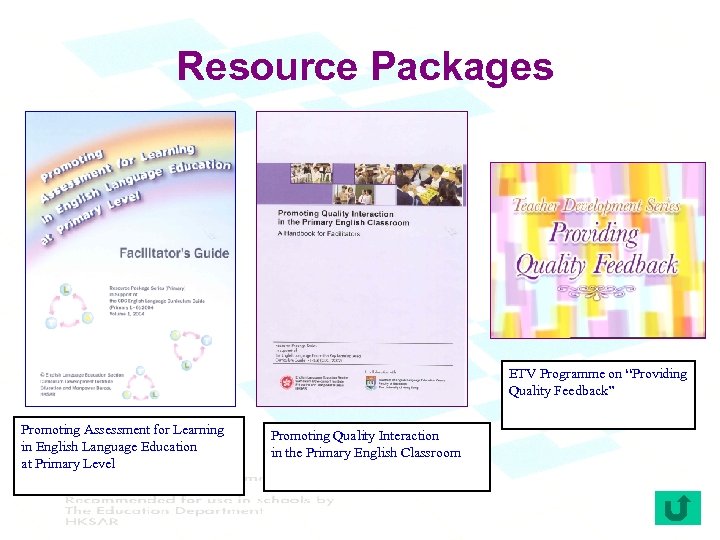 Resource Packages ETV Programme on “Providing Quality Feedback” Promoting Assessment for Learning in English Language Education at Primary Level Promoting Quality Interaction in the Primary English Classroom
 Devising a Whole-school Language Policy • Create a rich language learning environment • Widen the space of learning and teaching English • Enhance students’ motivation in learning English
 Creating a Rich Language Learning Environment • Encourage the use of English in all English lessons • Encourage students to interact with teachers and one another in English outside the classroom • Display target language items and vocabulary as well as students’ work on the learning wall in the classroom • Display print materials in English (e. g. posters, signs, notices) all around the school • Set up a well-stocked library with reading materials of a wide range of subject content and text types • Provide easy access to reading materials in different parts of the school
 Creating a Rich Language Learning Environment • Establish a lively and encouraging school and classroom atmosphere through daily routines or practices (e. g. morning reading time, reciting during assembly, show-and-tell activities, Campus TV) • Organise English learning activities (e. g. English Days, English Camps, drama performances)
 Widening the Space of Learning and Teaching English • Arouse students’ curiosity and interests in observing language use in the school campus and the real world (e. g. signs, announcements, advertisements) • Give assignments which require students to make use of the materials displayed in the school and outside school • Encourage students to watch TV programmes or listen to radio programmes in English (e. g. Sunday Smile on RTHK 3) • Encourage students to take part in English activities organised by other institutions (e. g. SCOLAR – Drama in Education, HK Speech Festival)
 Enhancing Motivation in Learning English • Foster a ‘can-do’ attitude and encourage risk taking • Incorporate interesting language arts activities (e. g. storytelling, Readers’ Theatre, songs, rhymes, drama) • Set up Reading Award Schemes • Nurture a school reading culture through role-modelling of teachers and the school head
 More Information • General – circulars, training calendar, links, etc. http: //www. edb. gov. hk • Professional development programmes for primary schools http: //www. edb. gov. hk/File. Manager/EN/Content_2396/pdp_ pri_e. doc • Quicker access to information regarding the English Language Education Key Learning Area – training opportunities, references & resources, etc. http: //www. edb. gov. hk/index. aspx? langno=1&node. ID=2402 • English Language Education Section, CDI Room 1206, 12/F. , Wu Chung House, 213 Queen’s Rd. East, Wan Chai, HK (Fax: 2834 7810) Ms Emilie Tong (Tel: 2892 6571)
 Thank you