 Скачать презентацию INTRODUCTION TO CORPORATE FINANCE Laurence Booth W
17dbd6eb3c97822982e60a20e83aae5b.ppt
- Количество слайдов: 37



INTRODUCTION TO CORPORATE FINANCE Laurence Booth • W. Sean Cleary Prepared by Ken Hartviksen

CHAPTER 1 An Introduction to Finance
Lecture Agenda • • Learning Objectives Important Terms Finance Defined Real versus Financial Assets The Financial System Financial Instruments and Markets The Global Financial Community Summary and Conclusions – Concept Review Questions CHAPTER 1 - An Introduction to Finance 3
Learning Objectives 1. What finance is and what is involved in the study of finance. 2. How financial securities can be used to provide financing for borrowers and simultaneously to provide investment opportunities for lenders. 3. How financial systems work in general. 4. The channels of intermediation and the role played by market and financial intermediaries within this system. 5. The basic types of financial instruments that are available and how they are traded. 6. The importance of the global financial system. CHAPTER 1 - An Introduction to Finance 4
Key Terms • • • • • Bourse de Montréal brokers Canadian Trading and Quotation System Inc. (CNQ) capital market securities common share corporate finance Crown corporations dealer or over-the-counter (OTC) markets debt instruments equity instruments exchanges or auction markets finance financial assets financial intermediaries fourth market intermediation investments CHAPTER 1 - An Introduction to Finance 5
Key Terms • • • • • market capitalization market intermediary marketable financial assets money market securities New York Stock Exchange (NYSE) non-marketable financial assets Ontario Securities Commission preferred shares primary markets real assets secondary markets third market Toronto Stock Exchange (TSX) TSX Group Inc. TSX Markets TSX Venture Exchange Winnipeg Commodity Exchange CHAPTER 1 - An Introduction to Finance 6
What Is Finance? • Finance is the study of how and under what terms savings (money) are allocated between lenders and borrowers. – Finance is distinct from economics in that it addresses not only how resources are allocated but also under what terms and through what channels • Financial contracts or securities occur whenever funds are transferred from issuer to buyer. CHAPTER 1 - An Introduction to Finance 7
The Study of Finance • The study of finance requires a basic understanding of: – – – Securities Corporate law Financial institutions and markets CHAPTER 1 - An Introduction to Finance 8
Real Versus Financial Assets • Real assets are tangible things owned by persons and businesses – – Residential structures and property Major appliances and automobiles Office towers, factories, mines Machinery and equipment • Financial assets are what one individual has lent to another – Consumer credit – Loans – Mortgages CHAPTER 1 - An Introduction to Finance 9
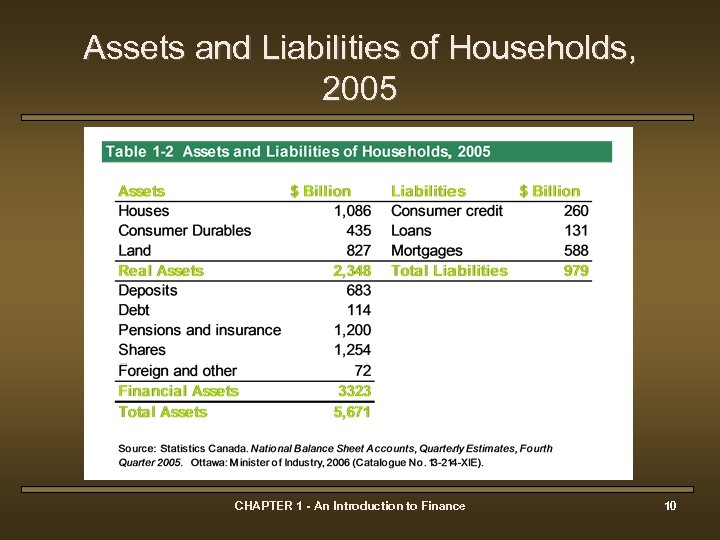
Assets and Liabilities of Households, 2005 CHAPTER 1 - An Introduction to Finance 10
The Financial System Overview • The household is the primary provider of funds to businesses and government. • Households must accumulate financial resources throughout their working life times to have enough savings (pension) to live on in their retirement years • Financial intermediaries transform the nature of the securities they issue and invest in • Banks, trust companies, credit unions, insurance firms, mutual funds • Market intermediaries simply help make markets work • Investment dealers • Brokers CHAPTER 1 - An Introduction to Finance 11
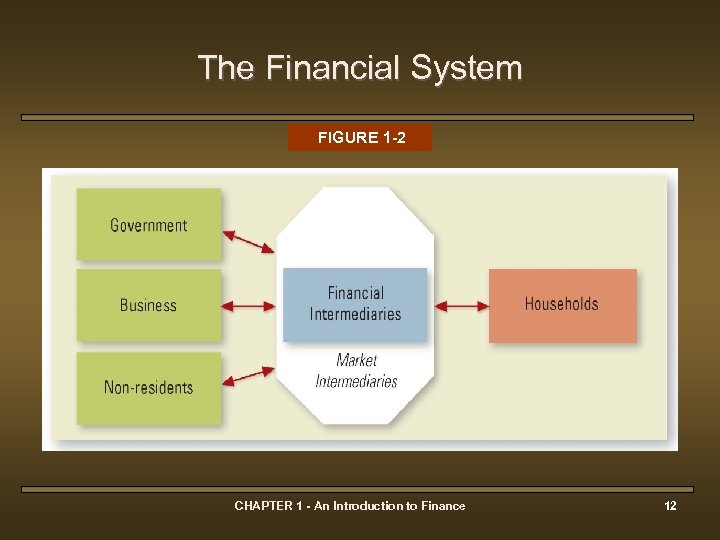
The Financial System FIGURE 1 -2 CHAPTER 1 - An Introduction to Finance 12
The Financial System Channels of Intermediation • Funds can be channeled from saver to borrower in three ways: – Direct intermediation (direct transfer from saver to borrower – a non-market transaction) – Direct intermediation (a market-based transaction usually through a market intermediary such as a broker) – Indirect claims through a financial intermediary (where the financial intermediary such as a bank offers deposit-taking services and ultimately lends those deposits out as mortgages or loans) CHAPTER 1 - An Introduction to Finance 13
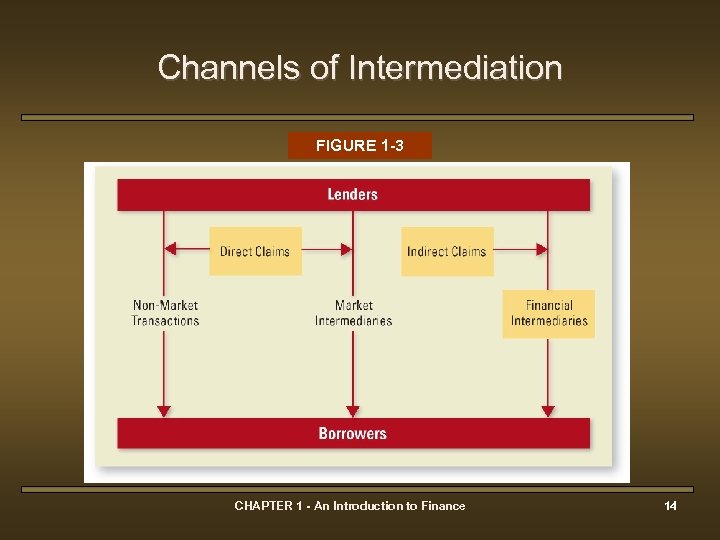
Channels of Intermediation FIGURE 1 -3 CHAPTER 1 - An Introduction to Finance 14
The Financial System Financial Intermediaries • • Banks and other deposit-taking institutions Insurance companies Pension Funds Mutual Funds CHAPTER 1 - An Introduction to Finance 15
Financial Intermediaries Canadian Chartered Banks • • Banks take deposits from numerous depositors from across Canada The deposits are ‘pooled’ in the Bank The bank takes these pooled funds and lends them out to households and businesses in the form of mortgages and loans The bank transforms the original nature of the savers (depositors) money: – Deposits are usually small in amount…face little or no risk, and depositors expect to withdraw the amount at any time – Loans and mortgages on the other hand usually have the following characteristics: • • Large sums Borrowed for long periods of time Borrowed for risky purposes. Banks can perform this transformation function because they become experts at risk assessment, financial contracting (pricing the risk) and monitoring the activities of borrowers. CHAPTER 1 - An Introduction to Finance 16
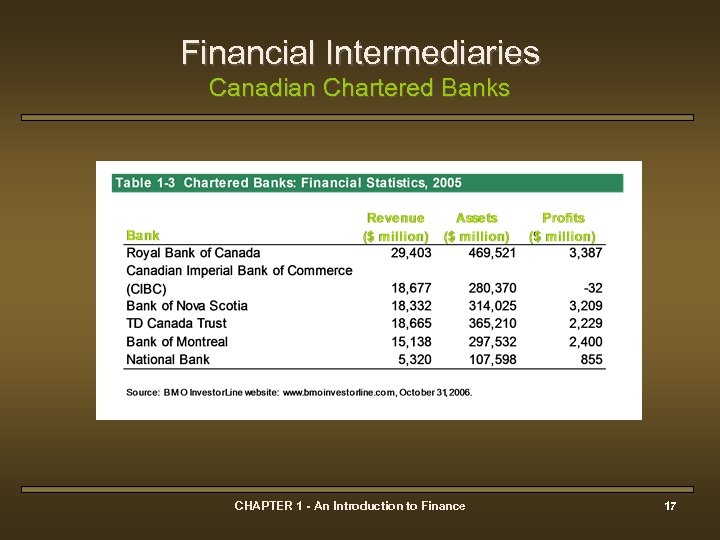
Financial Intermediaries Canadian Chartered Banks CHAPTER 1 - An Introduction to Finance 17
Financial Intermediaries Insurance Companies – Insurers sell policies and collect premiums from customers based on the pricing of those policies given the probability of a claim and the size the policy and administrative fees. – They invest the premiums so that the accumulated value in the future will grow to meet the anticipated claims of the policyholders. – In this way, unsupportable risks (such as the death of wage earner or the burning down of a business) are shared among a large number of policyholders through the insurance company. – Insurance allows households, business and government to engage in risky activities without having to bear the entire risk of loss themselves. CHAPTER 1 - An Introduction to Finance 18
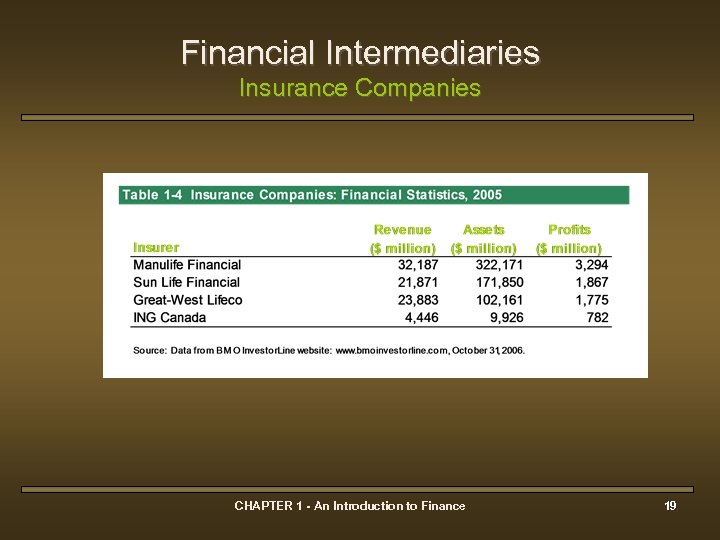
Financial Intermediaries Insurance Companies CHAPTER 1 - An Introduction to Finance 19
Financial Intermediaries Pension Plan Assets – Individuals and employers make payments over the entire working life of a person with those funds invested to grow over time. – Ultimately, the accumulated value in the pension can be used by the person in retirement. – Pension plans accumulate considerable sums of money, and their managers invest those funds with long-term investment time horizons in diversified portfolios of investments. These investments are a major source of capital, fuelling investment in research and development, capital equipment, resource exploration and ultimately contributing in a substantial way to growth in the economy. CHAPTER 1 - An Introduction to Finance 20
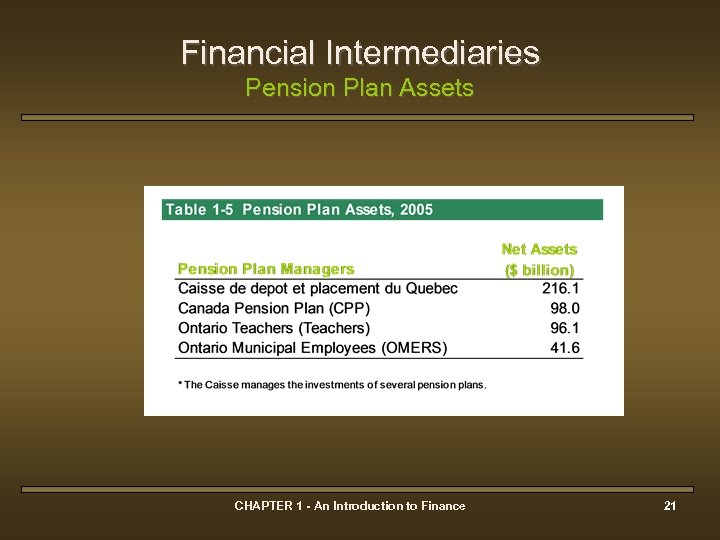
Financial Intermediaries Pension Plan Assets CHAPTER 1 - An Introduction to Finance 21
Financial Intermediaries Canadian Mutual Fund Assets • Mutual funds give small investors access to diversified, professionally-managed portfolios of securities. • Small investors often do not have the funds necessary to invest directly into market-traded stocks and bonds. • This is called denomination intermediation because the mutual fund makes investments available in smaller, more affordable amounts of money. • Canadian indirect investment in the markets through managed products such as mutual funds and segregated funds has grown exponentially. (see Figure 1 -4 on the next slide) CHAPTER 1 - An Introduction to Finance 22
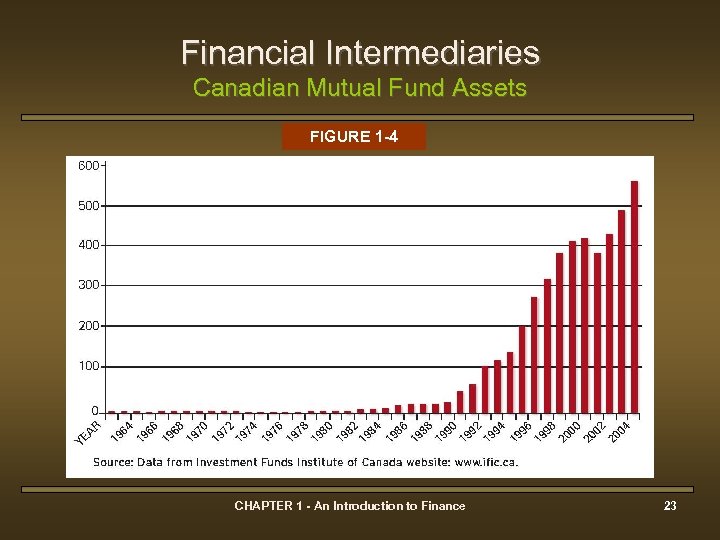
Financial Intermediaries Canadian Mutual Fund Assets FIGURE 1 -4 CHAPTER 1 - An Introduction to Finance 23
The Financial System The Major Borrowers • Public Debt – Governments • • Federal Provincial Municipal Crown Corporations • Private Debt – Households – Non-financial Corporations CHAPTER 1 - An Introduction to Finance 24
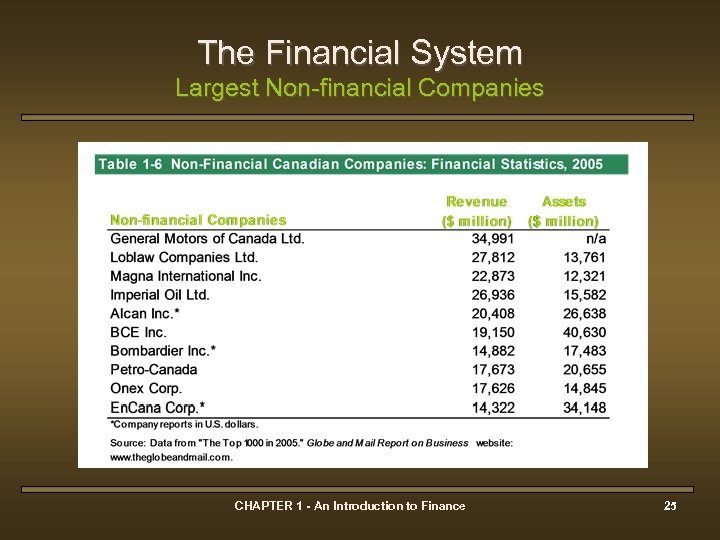
The Financial System Largest Non-financial Companies CHAPTER 1 - An Introduction to Finance 25
Financial Instruments • There are two major categories of financial securities: 1. Debt Instruments – – – Commercial paper Bankers’ acceptances Treasury bills Mortgage loans Bonds Debentures 2. Equity Instruments – – Common stock Preferred stock CHAPTER 1 - An Introduction to Finance 26
Financial Instruments Non-marketable • Characteristics of non-marketable securities – Cannot be traded between or among investors – May be redeemable (a reverse transaction between the borrower and the lender) – Examples: • • Savings accounts Term Deposits Guaranteed Investment Certificates Canada Savings Bonds CHAPTER 1 - An Introduction to Finance 27
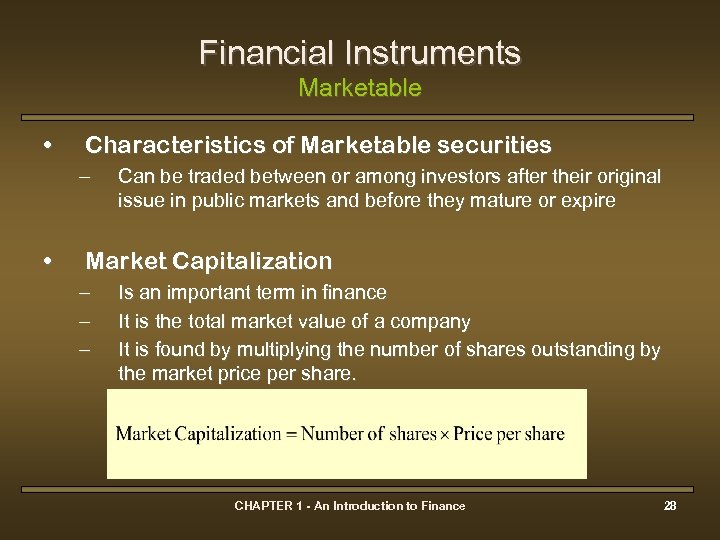
Financial Instruments Marketable • Characteristics of Marketable securities – • Can be traded between or among investors after their original issue in public markets and before they mature or expire Market Capitalization – – – Is an important term in finance It is the total market value of a company It is found by multiplying the number of shares outstanding by the market price per share. CHAPTER 1 - An Introduction to Finance 28
Financial Instruments Marketable Markets can be categorized by the time to maturity: • Money Market Securities (for short-term debt securities that are pure discount notes) – Bankers’ acceptances – Commercial Paper – Treasury Bills • Capital Market Securities (for long-term debt or equity securities with maturities greater than 1 year) – – Bonds Debentures Common Stock Preferred Stock CHAPTER 1 - An Introduction to Finance 29
Financial Markets • Primary Market – Markets that involve the issue of new securities by the borrower in return for cash from investors (Capital formation occurs) • Secondary Market – Markets that involve buyers and sellers of existing securities. Funds flow from buyer to seller. Seller becomes the new owner of the security. (No capital formation occurs) CHAPTER 1 - An Introduction to Finance 30
Financial Markets Types of Secondary Markets • Exchanges or Auction Markets • Secondary markets that involve a bidding process that takes place in specific location • For example TSX, NYSE • Dealer or Over-the-counter (OTC) Markets • Secondary markets that do not have a physical location and consist of a network of dealers who trade directly with one another. • For example the bond market CHAPTER 1 - An Introduction to Finance 31
Financial Markets Other Markets • Third Market • Trading of securities that are listed on organized exchanges in the Over-the-counter market • Fourth Market • Trading of securities directly between investors (usually between two large institutions) without the involvement of brokers or dealers. • Operates through the use of privately owned automated systems such as Instinet CHAPTER 1 - An Introduction to Finance 32
The Global Financial Community • Represents an important source of funds for borrowers • Provides investors with important alternatives as they seek to build wealth through diversified portfolios CHAPTER 1 - An Introduction to Finance 33
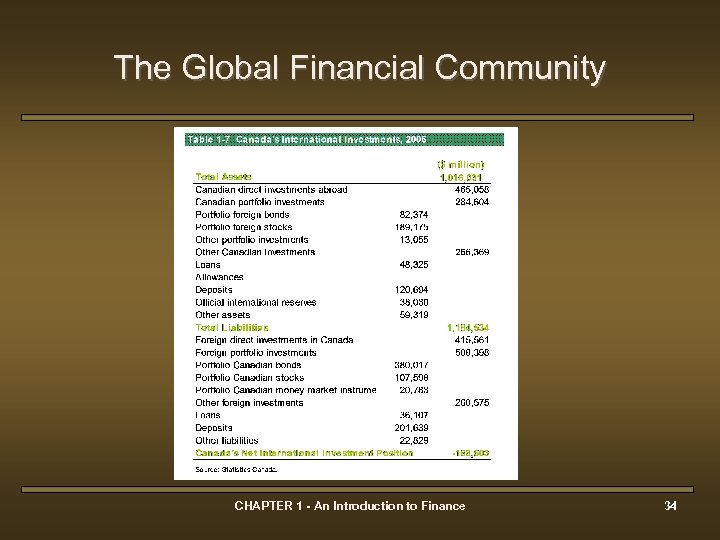
The Global Financial Community CHAPTER 1 - An Introduction to Finance 34
Summary • In this chapter you have learned about: – Financial systems in general, and the Canadian financial system in particular – Major participants in the Canadian financial system, including the different types of financial securities and financial markets CHAPTER 1 - An Introduction to Finance 35
Internet Links • BMO Investor. Line: www. bmoinvestorline. com • Investment Funds Institute of Canada: www. ific. ca • Globe and Mail Report on Business: www. theglobeandmail. com • Toronto Stock Exchange (TSX): http: //www. tsx. com/ • Canadian Trading and Quotation System Inc. : http: //www. cnq. ca/ • Ontario Securities Commission: http: //www. osc. gov. on. ca/index. jsp • Winnipeg Commodity Exchange: http: //www. wce. ca/ • New York Stock Exchange (NYSE) Euronext: http: //www. nyse. com/ CHAPTER 1 - An Introduction to Finance 36

Copyright © 2007 John Wiley & Sons Canada, Ltd. All rights reserved. Reproduction or translation of this work beyond that permitted by Access Copyright (the Canadian copyright licensing agency) is unlawful. Requests for further information should be addressed to the Permissions Department, John Wiley & Sons Canada, Ltd. The purchaser may make back-up copies for his or her own use only and not for distribution or resale. The author and the publisher assume no responsibility for errors, omissions, or damages caused by the use of these files or programs or from the use of the information contained herein. CHAPTER 1 - An Introduction to Finance 37
Скачать презентацию INTRODUCTION TO CORPORATE FINANCE Laurence Booth W
17dbd6eb3c97822982e60a20e83aae5b.ppt