


 Скачать презентацию Introduction to Computer Networks CMPE 150 Fall 2005
6b53cca8fae5a9a116c406437f4f2a77.ppt
- Количество слайдов: 30
 Introduction to Computer Networks CMPE 150 Fall 2005 Lecture 15 CMPE 150 - Introduction to Computer Networks 1
 Announcements • Midterm moved to 11. 04. – In class, closed books/notes. • Homework 3 is up. – Due on 11, 07. 05. CMPE 150 - Introduction to Computer Networks 2
 Today • MAC. CMPE 150 - Introduction to Computer Networks 3
 Example DLL Protocols CMPE 150 - Introduction to Computer Networks 4
 Example DLL Protocols • High-Level Data Link Control (HDLC). • Point-to-Point Protocol (PPP). CMPE 150 - Introduction to Computer Networks 5
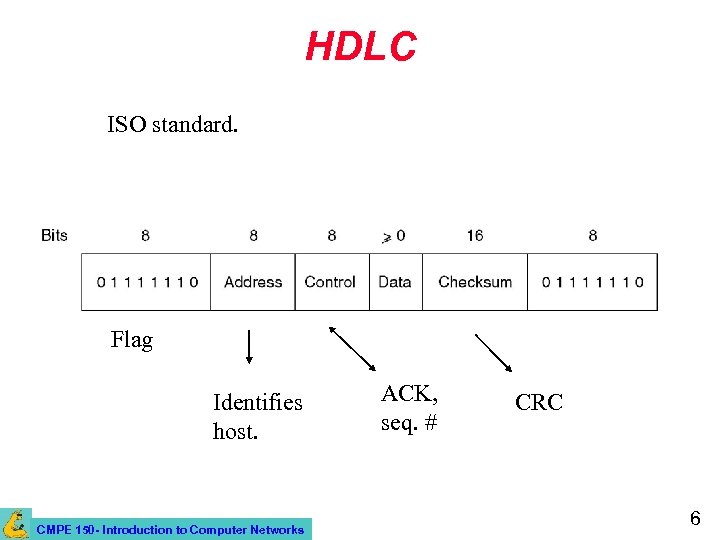 HDLC ISO standard. Flag Identifies host. CMPE 150 - Introduction to Computer Networks ACK, seq. # CRC 6
 PPP • • Internet’s DLL. Router-to-router. Home user-to-ISP. RFC 1661, etc. • PPP is a multi-protocol framing mechanism that can be used over multiple PHYs (dial-up, dedicated point-to-point connections). CMPE 150 - Introduction to Computer Networks 7
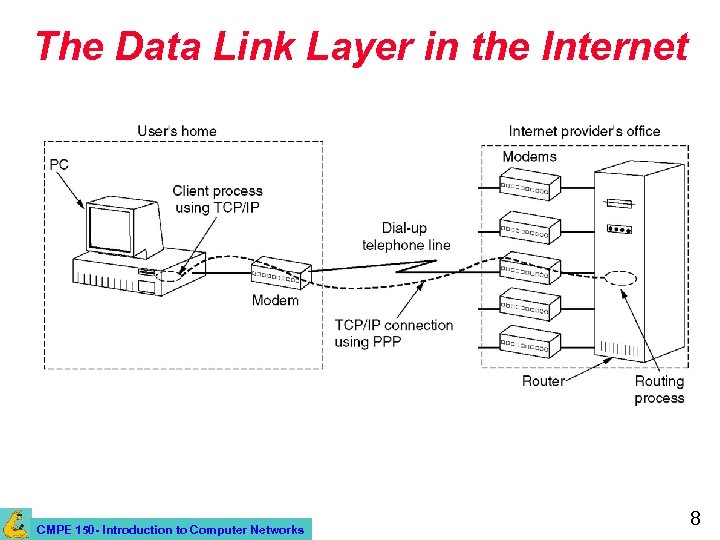 The Data Link Layer in the Internet CMPE 150 - Introduction to Computer Networks 8
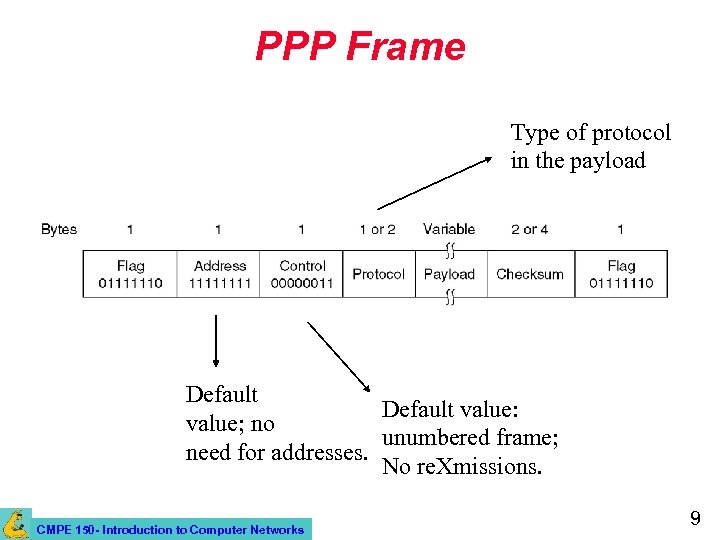 PPP Frame Type of protocol in the payload Default value: value; no unumbered frame; need for addresses. No re. Xmissions. CMPE 150 - Introduction to Computer Networks 9
 Medium Access Control • MAC. • Tanenbaum, Chapter 4. CMPE 150 - Introduction to Computer Networks 10
 Why MAC? • Point-to-point versus shared-medium networks. • Shared-medium networks use “broadcast” channels. – A. k. a. multi-access or random access channels. MAC layer protocols regulate access to medium in shared-medium networks. CMPE 150 - Introduction to Computer Networks 11
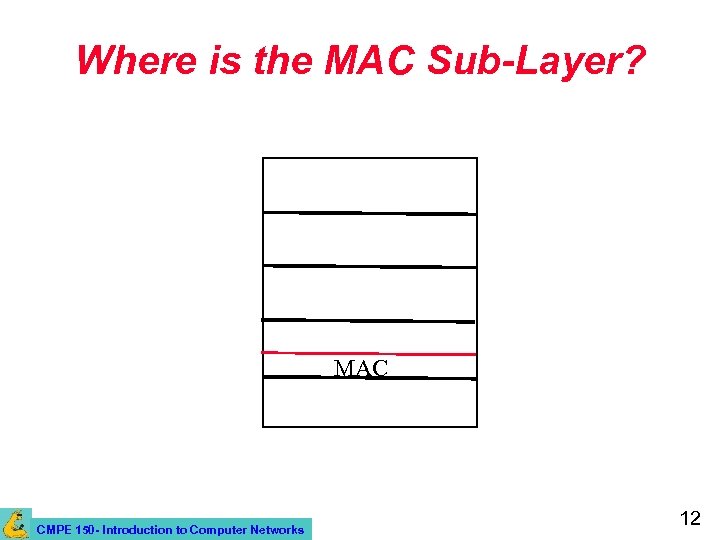 Where is the MAC Sub-Layer? MAC CMPE 150 - Introduction to Computer Networks 12
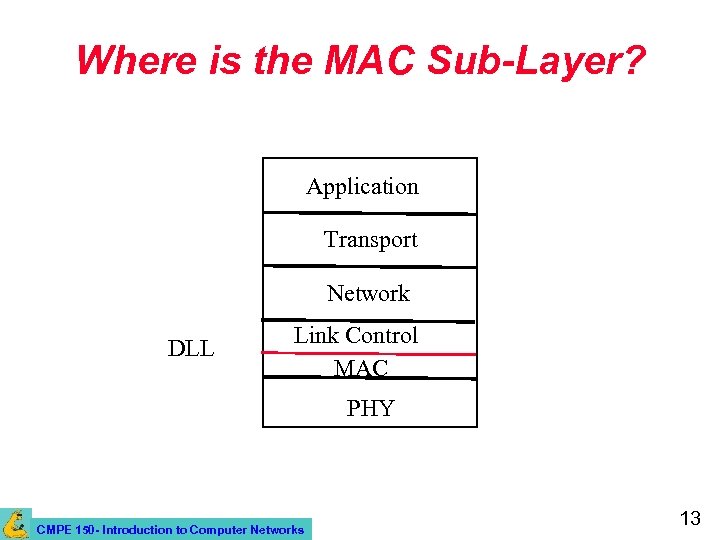 Where is the MAC Sub-Layer? Application Transport Network DLL Link Control MAC PHY CMPE 150 - Introduction to Computer Networks 13
 MAC and LANs • LANs typically use shared-medium. • Examples? • MAC layer critical! – BTW, in wireless networks also! • WANs typically use point-to-point connections. CMPE 150 - Introduction to Computer Networks 14
 Channel Allocation Problem • How to allocate single shared, broadcast channel among several stations/users. • If no arbitration, several stations/users may transmit at the same time: COLLISIONS! • A. k. a. , “floor control”. CMPE 150 - Introduction to Computer Networks 15
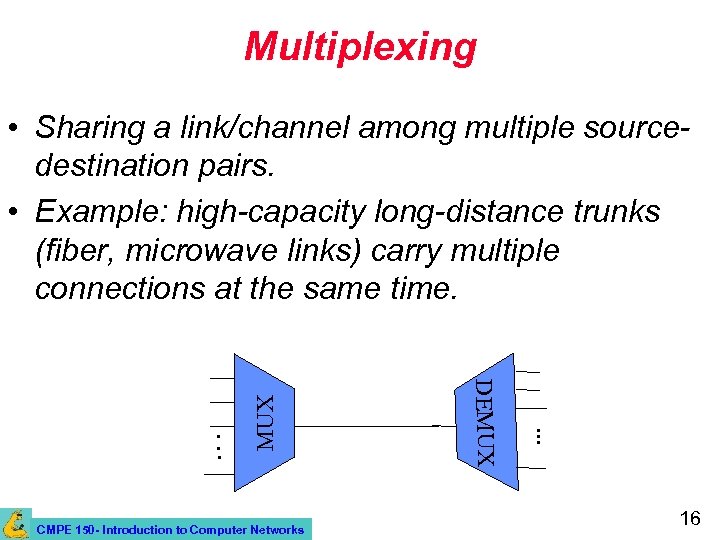 Multiplexing . . . CMPE 150 - Introduction to Computer Networks DEMUX . . . MUX • Sharing a link/channel among multiple sourcedestination pairs. • Example: high-capacity long-distance trunks (fiber, microwave links) carry multiple connections at the same time. 16
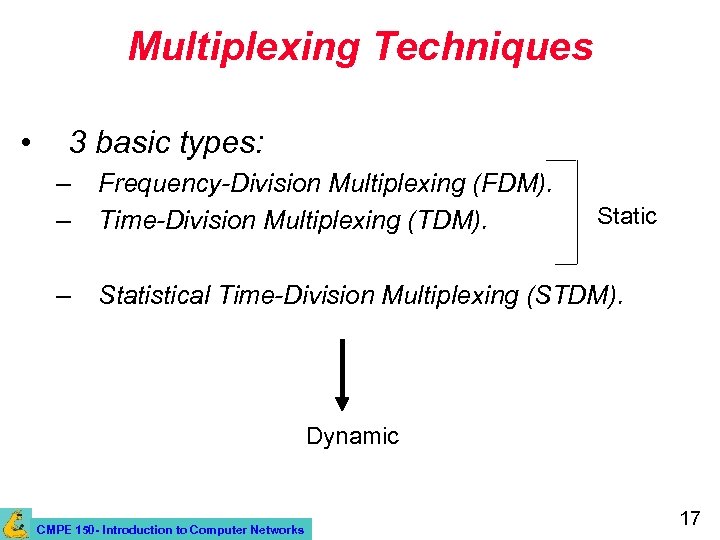 Multiplexing Techniques • 3 basic types: – – Frequency-Division Multiplexing (FDM). Time-Division Multiplexing (TDM). – Statistical Time-Division Multiplexing (STDM). Static Dynamic CMPE 150 - Introduction to Computer Networks 17
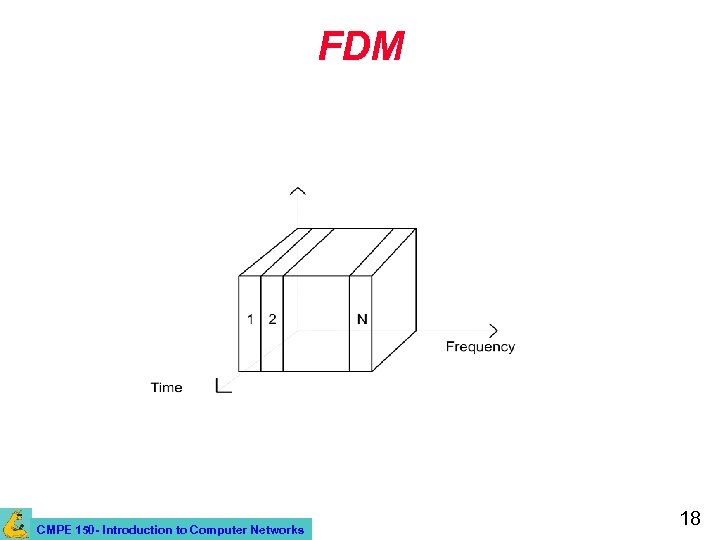 FDM CMPE 150 - Introduction to Computer Networks 18
 FDM • Simple. • But: – What if number of users is large? – What if number of users changes over time? – What if traffic is bursty? CMPE 150 - Introduction to Computer Networks 19
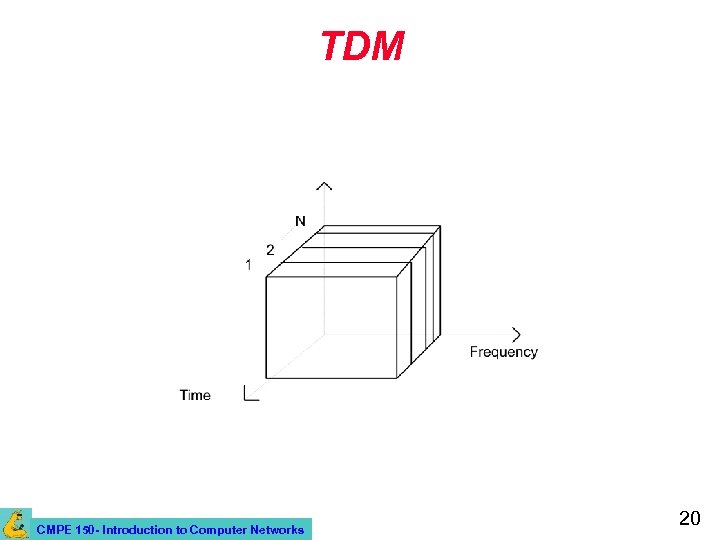 TDM CMPE 150 - Introduction to Computer Networks 20
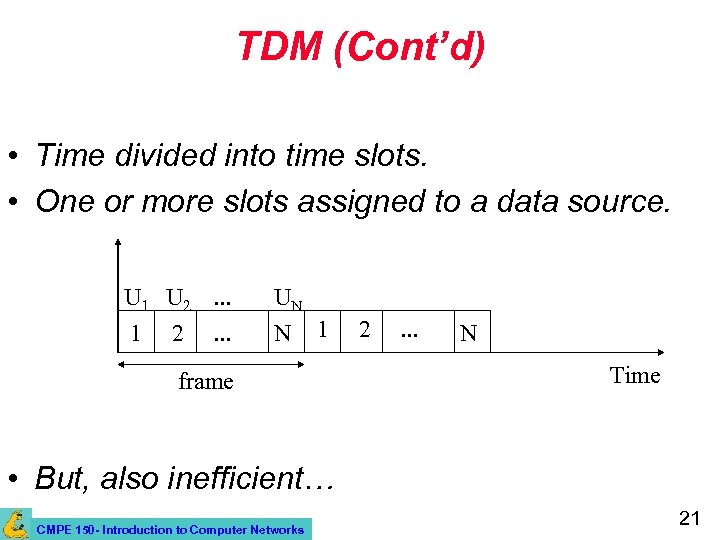 TDM (Cont’d) • Time divided into time slots. • One or more slots assigned to a data source. U 1 U 2. . . 1 2. . . UN N 1 frame 2 . . . N Time • But, also inefficient… CMPE 150 - Introduction to Computer Networks 21
 Dynamic Multiplexing • Dynamic allocation. • In particular, statistical TDM. – Dynamically allocates time slots on demand. • Increased channel utilization. • But… CMPE 150 - Introduction to Computer Networks 22
 Multiple Access Protocols • Centralized approaches: – Controller grants access to medium. – Simple, greater control: priorities, Qo. S. – But, single point of failure and performance bottleneck. • Decentralized schemes: – All stations collectively run MAC to decide when to transmit. CMPE 150 - Introduction to Computer Networks 23
 Round-Robin MAC • Each station is allowed to transmit; station may decline or transmit (bounded by some maximum transmit time). • Centralized (e. g. , polling) or distributed (e. g. , token ring) control of who is next to transmit. • When done, station relinquishes and right to transmit goes to next station. • Efficient when many stations have data to transmit over extended period (stream). CMPE 150 - Introduction to Computer Networks 24
 Scheduled-Access MAC • • Time divided into slots. Station reserves slots in the future. Multiple slots for extended transmissions. Suited to stream traffic. CMPE 150 - Introduction to Computer Networks 25
 Contention-Based MAC • • • No control. Stations try to acquire the medium. Distributed in nature. Perform well for bursty traffic. Can get very inefficient under heavy load. CMPE 150 - Introduction to Computer Networks 26
 Contention-Based MACs • ALOHA family. • CSMA family. CMPE 150 - Introduction to Computer Networks 27
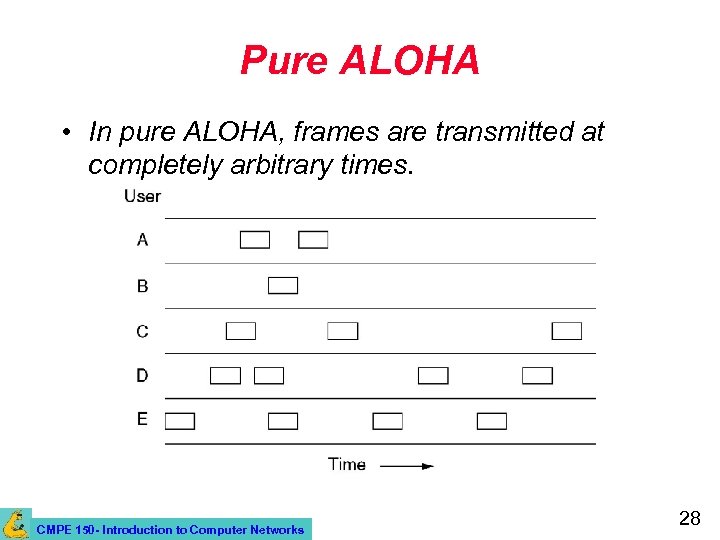 Pure ALOHA • In pure ALOHA, frames are transmitted at completely arbitrary times. CMPE 150 - Introduction to Computer Networks 28
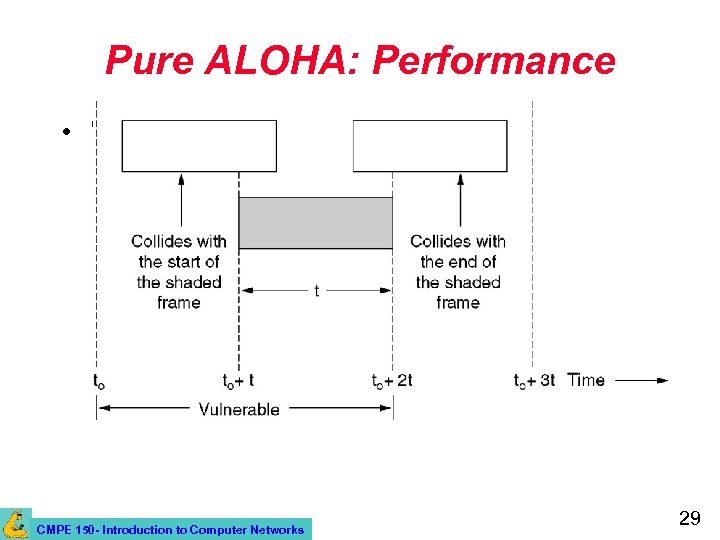 Pure ALOHA: Performance • Vulnerable period for the shaded frame. CMPE 150 - Introduction to Computer Networks 29
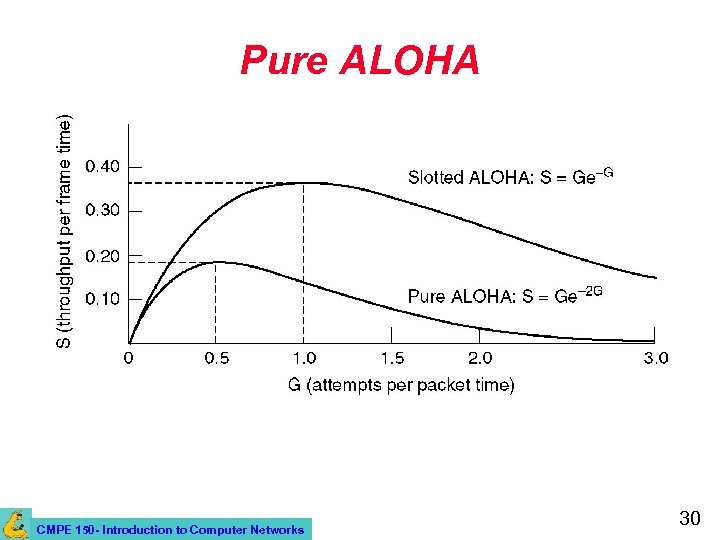 Pure ALOHA • Throughput versus offered traffic for ALOHA systems. CMPE 150 - Introduction to Computer Networks 30