


 Скачать презентацию Introduction to Computer Engineering CS ECE 252 Fall 2007
88b7af97fdb6e7e6df0d673bec5cca3c.ppt
- Количество слайдов: 15
 Introduction to Computer Engineering CS/ECE 252, Fall 2007 Prof. Mark D. Hill Computer Sciences Department University of Wisconsin – Madison
 Place On Desk • • IPod Laptop Treo Etc. • All Computers • Software/Hardware separation key
 Computers! • Engineers and scientists of all disciplines rely on computers for many aspects of their work – Not just word processing, spreadsheets, CAD, etc. – Computational methods, data mining, analysis/synthesis are fundamental to advances in many fields • Many of the advanced techniques used in today’s microprocessors were invented right here at UW • Some of the most renowned computer design researchers in the world are on our faculty • There is a near-100% likelihood that a Wisconsin graduate helped design the computer or processor that you own
 Place on Desk • • 7 MB Disk Pack 6’ Disk IPod (30 GB) (30 GB/7 MB = 4, 000 x) • Computer useful & then 10, 000 x better!
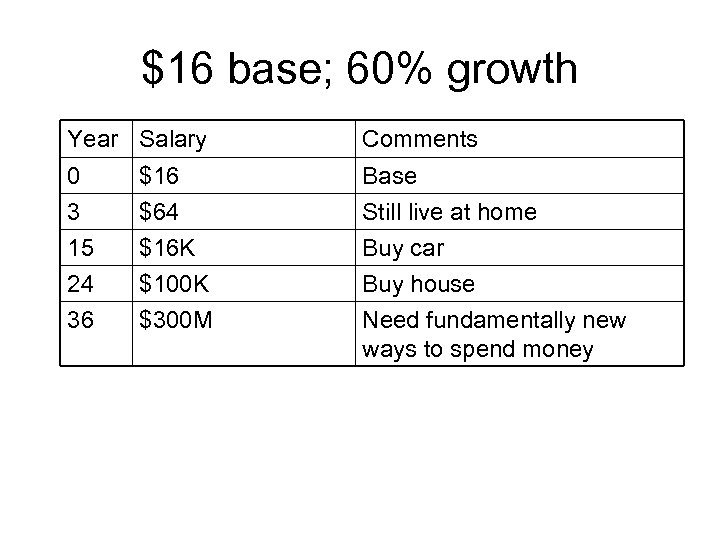 $16 base; 60% growth Year Salary Comments 0 3 15 $16 $64 $16 K Base Still live at home Buy car 24 36 $100 K $300 M Buy house Need fundamentally new ways to spend money
![Performance Growth Unmatched by any other industry ! [John Crawford, Intel] • Doubling every](https://present5.com/presentation/88b7af97fdb6e7e6df0d673bec5cca3c/image-6.jpg "Performance Growth Unmatched by any other industry ! [John Crawford, Intel] • Doubling every") Performance Growth Unmatched by any other industry ! [John Crawford, Intel] • Doubling every 18 months (1982 -1996): 800 x – Cars travel at 44, 000 mph and get 16, 000 mpg – Air travel: LA to NY in 22 seconds (MACH 800) – Wheat yield: 80, 000 bushels per acre • Doubling every 24 months (1971 -1996): 9, 000 x – Cars travel at 600, 000 mph, get 150, 000 mpg – Air travel: LA to NY in 2 seconds (MACH 9, 000) – Wheat yield: 900, 000 bushels per acre
Performance Growth Unmatched by any other industry ! [John Crawford, Intel] • Doubling every 18 months (1982 -1996): 800 x – Cars travel at 44, 000 mph and get 16, 000 mpg – Air travel: LA to NY in 22 seconds (MACH 800) – Wheat yield: 80, 000 bushels per acre • Doubling every 24 months (1971 -1996): 9, 000 x – Cars travel at 600, 000 mph, get 150, 000 mpg – Air travel: LA to NY in 2 seconds (MACH 9, 000) – Wheat yield: 900, 000 bushels per acre
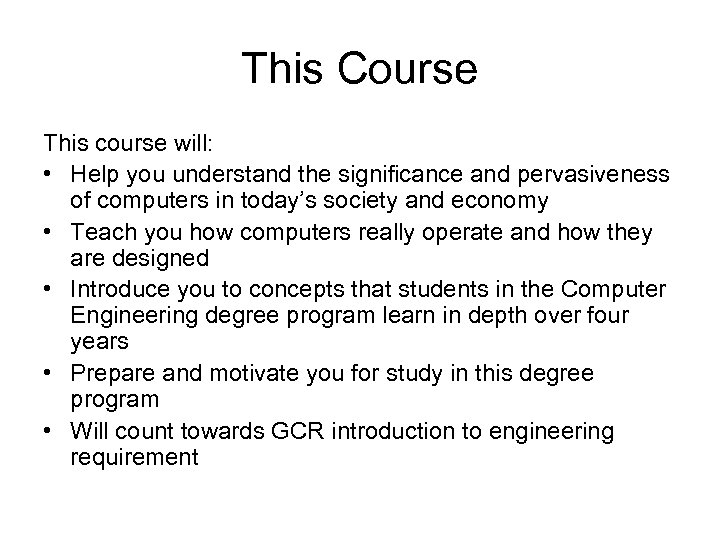 This Course This course will: • Help you understand the significance and pervasiveness of computers in today’s society and economy • Teach you how computers really operate and how they are designed • Introduce you to concepts that students in the Computer Engineering degree program learn in depth over four years • Prepare and motivate you for study in this degree program • Will count towards GCR introduction to engineering requirement
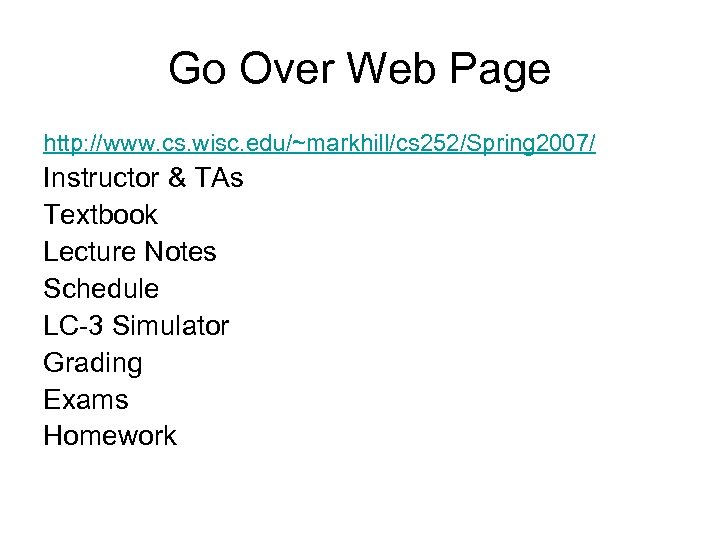 Go Over Web Page http: //www. cs. wisc. edu/~markhill/cs 252/Spring 2007/ Instructor & TAs Textbook Lecture Notes Schedule LC-3 Simulator Grading Exams Homework
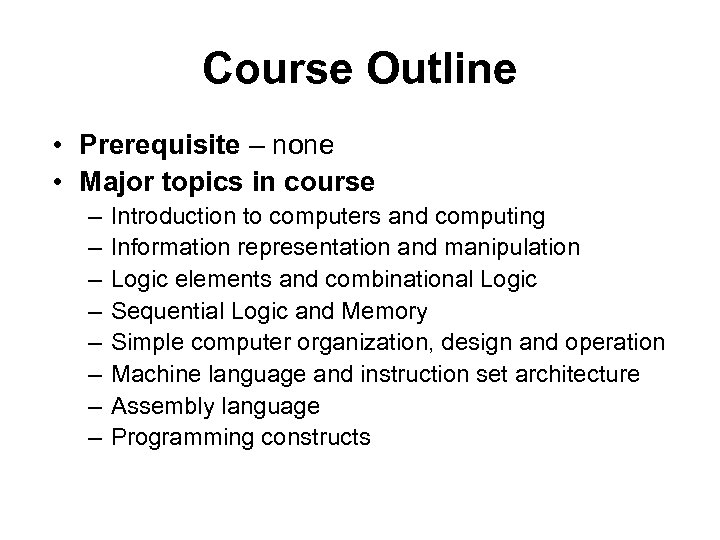 Course Outline • Prerequisite – none • Major topics in course – – – – Introduction to computers and computing Information representation and manipulation Logic elements and combinational Logic Sequential Logic and Memory Simple computer organization, design and operation Machine language and instruction set architecture Assembly language Programming constructs
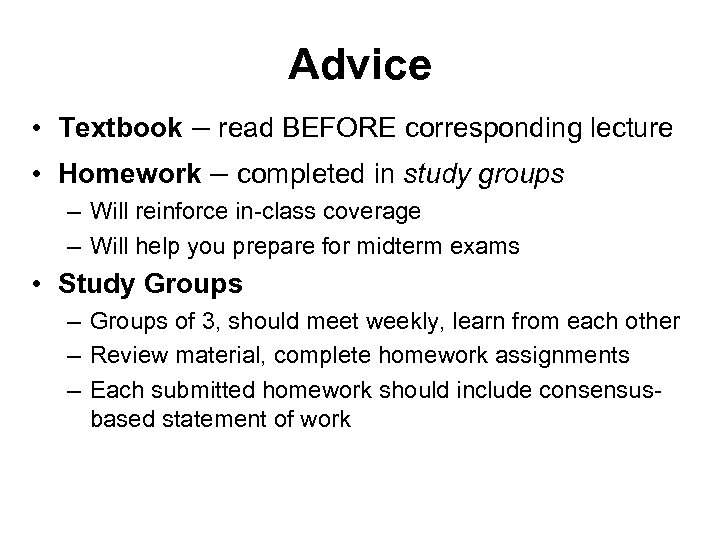 Advice • Textbook – read BEFORE corresponding lecture • Homework – completed in study groups – Will reinforce in-class coverage – Will help you prepare for midterm exams • Study Groups – Groups of 3, should meet weekly, learn from each other – Review material, complete homework assignments – Each submitted homework should include consensusbased statement of work
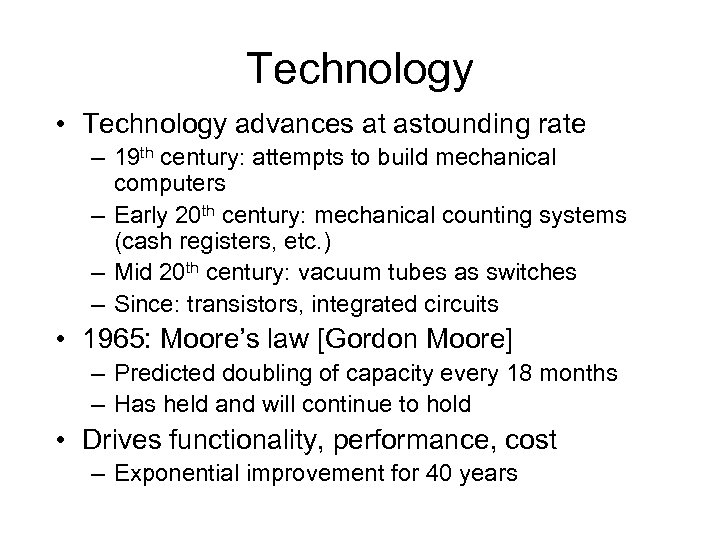 Technology • Technology advances at astounding rate – 19 th century: attempts to build mechanical computers – Early 20 th century: mechanical counting systems (cash registers, etc. ) – Mid 20 th century: vacuum tubes as switches – Since: transistors, integrated circuits • 1965: Moore’s law [Gordon Moore] – Predicted doubling of capacity every 18 months – Has held and will continue to hold • Drives functionality, performance, cost – Exponential improvement for 40 years
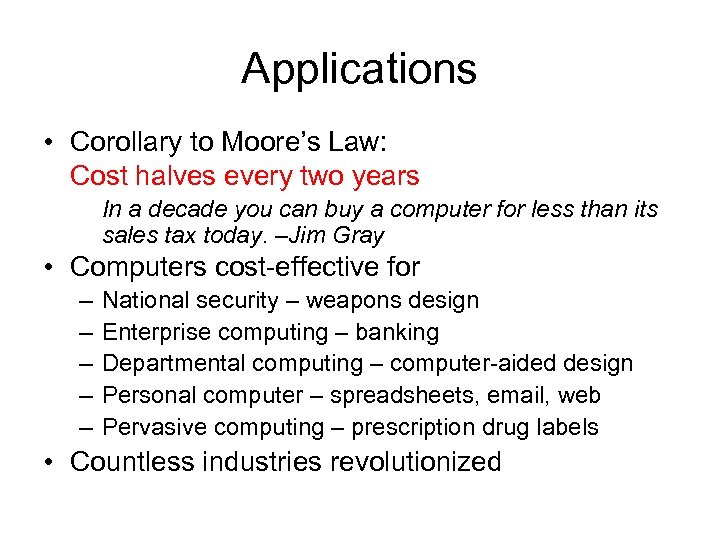 Applications • Corollary to Moore’s Law: Cost halves every two years In a decade you can buy a computer for less than its sales tax today. –Jim Gray • Computers cost-effective for – – – National security – weapons design Enterprise computing – banking Departmental computing – computer-aided design Personal computer – spreadsheets, email, web Pervasive computing – prescription drug labels • Countless industries revolutionized
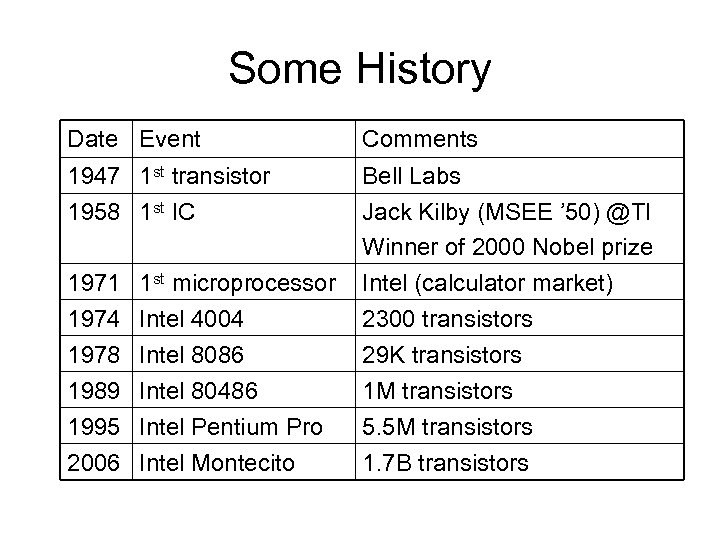 Some History Date Event Comments 1947 1 st transistor 1958 1 st IC Bell Labs Jack Kilby (MSEE ’ 50) @TI Winner of 2000 Nobel prize 1971 1974 1978 1989 1995 2006 Intel (calculator market) 2300 transistors 29 K transistors 1 M transistors 5. 5 M transistors 1. 7 B transistors 1 st microprocessor Intel 4004 Intel 8086 Intel 80486 Intel Pentium Pro Intel Montecito
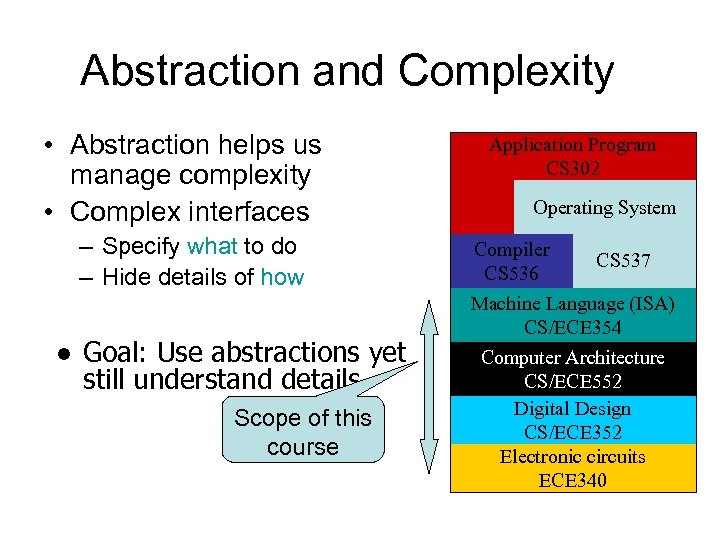 Abstraction and Complexity • Abstraction helps us manage complexity • Complex interfaces – Specify what to do – Hide details of how l Goal: Use abstractions yet still understand details Scope of this course Application Program CS 302 Operating System Compiler CS 536 CS 537 Machine Language (ISA) CS/ECE 354 Computer Architecture CS/ECE 552 Digital Design CS/ECE 352 Electronic circuits ECE 340
 Computer As a Tool • Many computers today are embedded – Fixed functionality – Appliance-like – Not really programmable by end user • Not the focus of this course! – Instead, programmable computers – Learn to think of computer as a tool • Program? – Algorithm or set of steps that computer follows – Human brains wired to work this way