 Скачать презентацию Introduction To Computer Architecture Instructor Mozafar Bag-Mohammadi Spring
4ca160b1f66acb96d91a596a59566fdb.ppt
- Количество слайдов: 32




Introduction To Computer Architecture Instructor: Mozafar Bag-Mohammadi Spring 2010 Ilam University
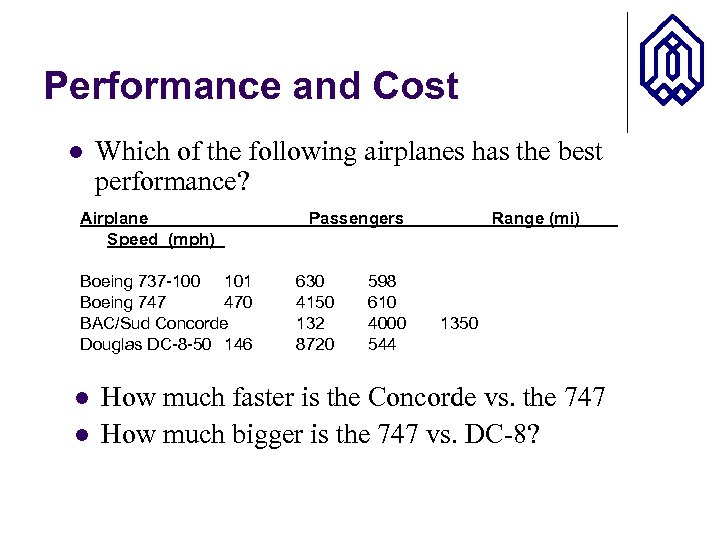
Performance and Cost l Which of the following airplanes has the best performance? Airplane Speed (mph) Boeing 737 -100 101 Boeing 747 470 BAC/Sud Concorde Douglas DC-8 -50 146 l l Passengers 630 4150 132 8720 598 610 4000 544 Range (mi) 1350 How much faster is the Concorde vs. the 747 How much bigger is the 747 vs. DC-8?
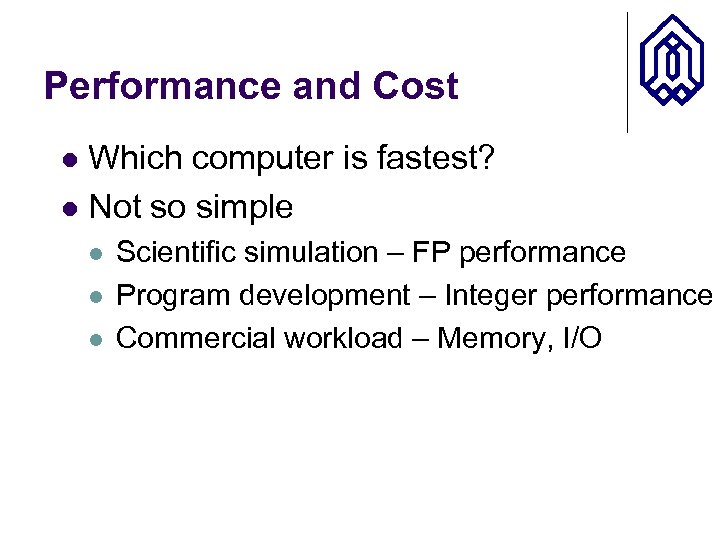
Performance and Cost Which computer is fastest? l Not so simple l l Scientific simulation – FP performance Program development – Integer performance Commercial workload – Memory, I/O
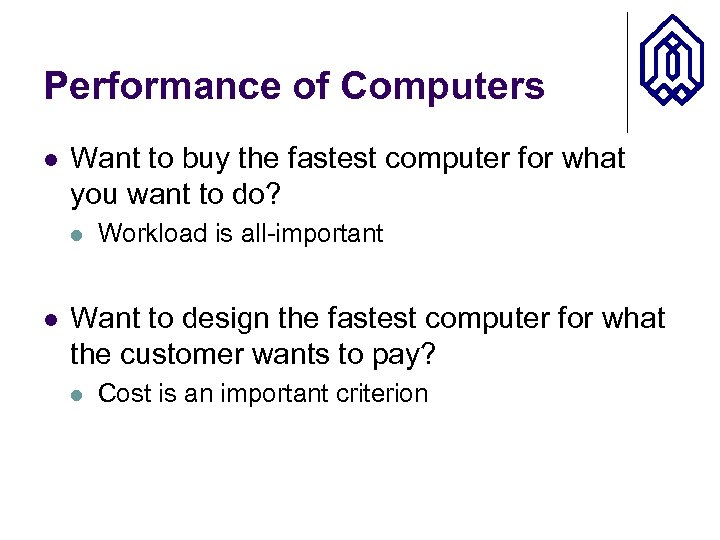
Performance of Computers l Want to buy the fastest computer for what you want to do? l l Workload is all-important Want to design the fastest computer for what the customer wants to pay? l Cost is an important criterion
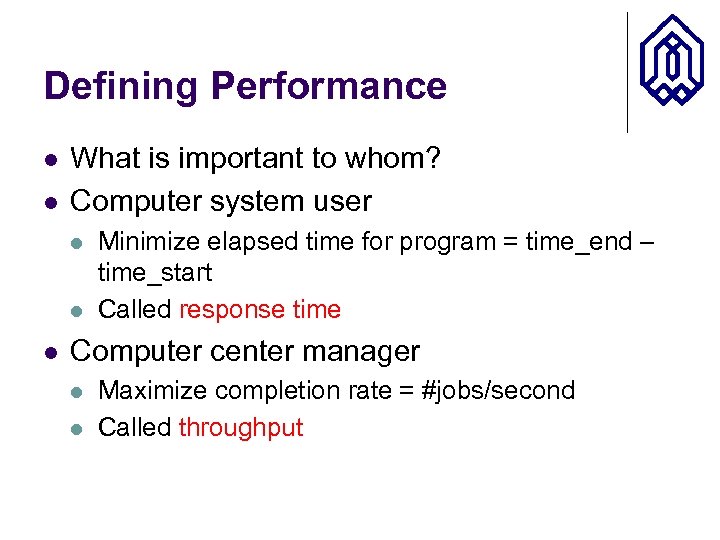
Defining Performance l l What is important to whom? Computer system user l l l Minimize elapsed time for program = time_end – time_start Called response time Computer center manager l l Maximize completion rate = #jobs/second Called throughput
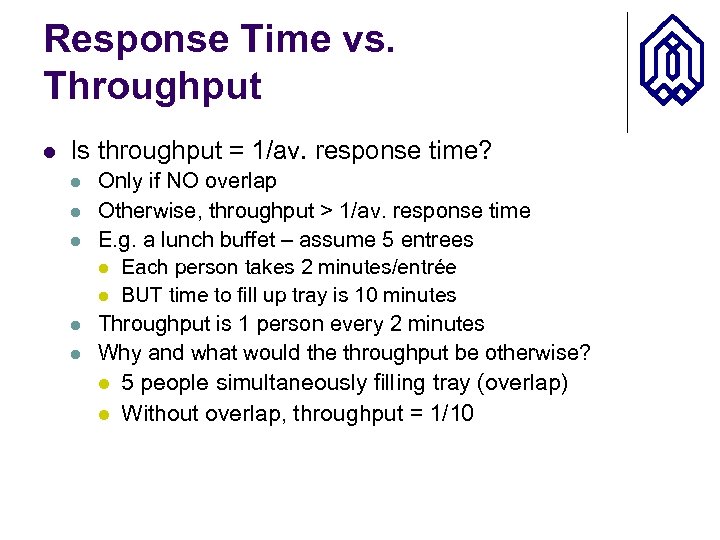
Response Time vs. Throughput l Is throughput = 1/av. response time? l l l Only if NO overlap Otherwise, throughput > 1/av. response time E. g. a lunch buffet – assume 5 entrees l Each person takes 2 minutes/entrée l BUT time to fill up tray is 10 minutes Throughput is 1 person every 2 minutes Why and what would the throughput be otherwise? l 5 people simultaneously filling tray (overlap) l Without overlap, throughput = 1/10
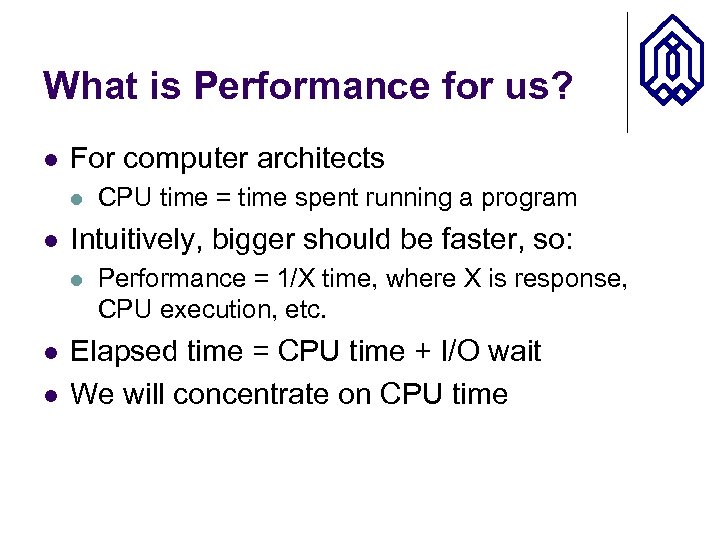
What is Performance for us? l For computer architects l l Intuitively, bigger should be faster, so: l l l CPU time = time spent running a program Performance = 1/X time, where X is response, CPU execution, etc. Elapsed time = CPU time + I/O wait We will concentrate on CPU time
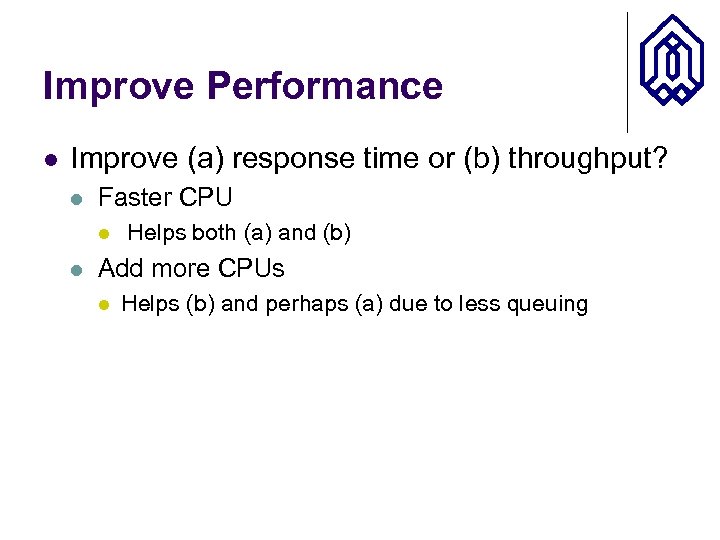
Improve Performance l Improve (a) response time or (b) throughput? l Faster CPU l l Helps both (a) and (b) Add more CPUs l Helps (b) and perhaps (a) due to less queuing
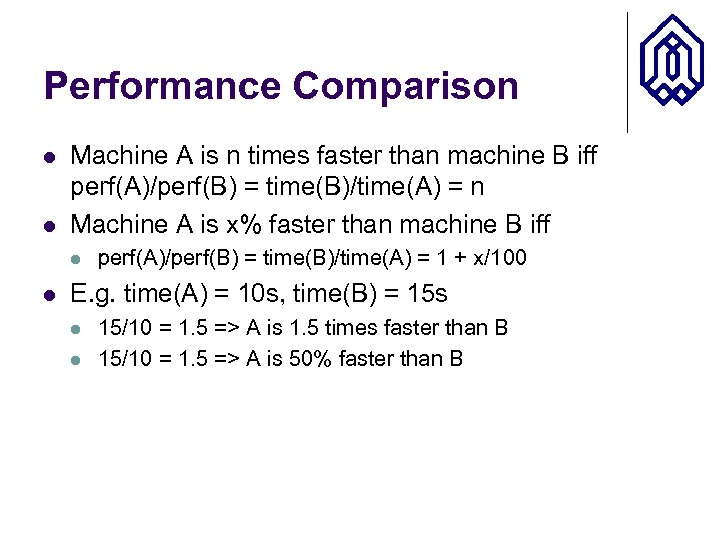
Performance Comparison l l Machine A is n times faster than machine B iff perf(A)/perf(B) = time(B)/time(A) = n Machine A is x% faster than machine B iff l l perf(A)/perf(B) = time(B)/time(A) = 1 + x/100 E. g. time(A) = 10 s, time(B) = 15 s l l 15/10 = 1. 5 => A is 1. 5 times faster than B 15/10 = 1. 5 => A is 50% faster than B
Breaking Down Performance l A program is broken into instructions l l At lower level, H/W breaks instructions into cycles l l H/W is aware of instructions, not programs Lower level state machines change state every cycle For example: l l 500 MHz P-III runs 500 M cycles/sec, 1 cycle = 2 ns 2 GHz P-4 runs 2 G cycles/sec, 1 cycle = 0. 5 ns
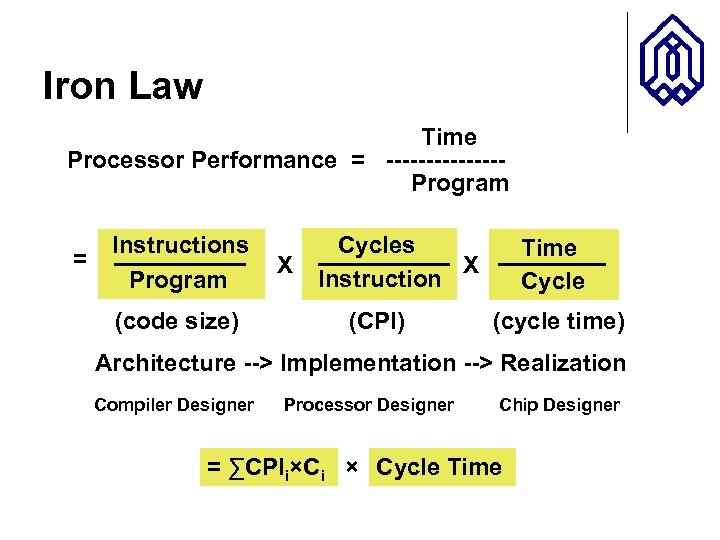
Iron Law Time Processor Performance = -------Program = Instructions Program (code size) X Cycles X Instruction (CPI) Time Cycle (cycle time) Architecture --> Implementation --> Realization Compiler Designer Processor Designer Chip Designer = ∑CPIi×Ci × Cycle Time
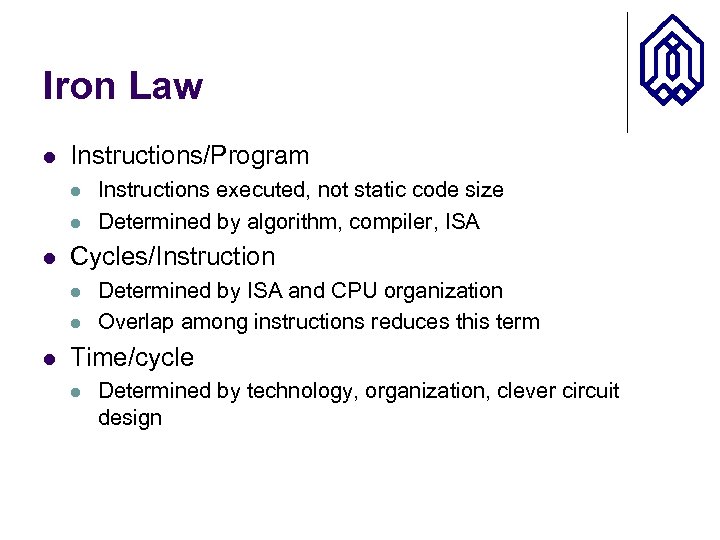
Iron Law l Instructions/Program l l l Cycles/Instruction l l l Instructions executed, not static code size Determined by algorithm, compiler, ISA Determined by ISA and CPU organization Overlap among instructions reduces this term Time/cycle l Determined by technology, organization, clever circuit design
Our Goal l l Minimize time which is the product, NOT isolated terms Common error to miss terms while devising optimizations l l l E. g. ISA change to decrease instruction count BUT leads to CPU organization which makes clock slower Bottom line: terms are inter-related
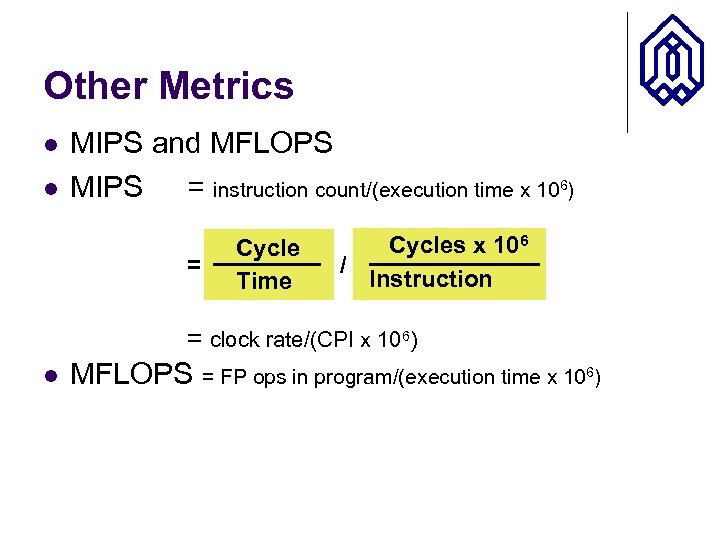
Other Metrics l l MIPS and MFLOPS MIPS = instruction count/(execution time x 106) = Cycle Time Cycles x 106 / Instruction = clock rate/(CPI x 106) l MFLOPS = FP ops in program/(execution time x 106)
Problems with MIPS l l Ignore program Usually used to quote peak performance l l Ideal conditions => guarantee not to exceed! When is MIPS ok? l l l Same compiler, same ISA E. g. same binary running on Pentium-III, IV Why? Instr/program is constant and can be ignored
Rules l l l Use ONLY Time Beware when reading, especially is details are omitted Beware of Peak l “Guaranteed not to exceed”
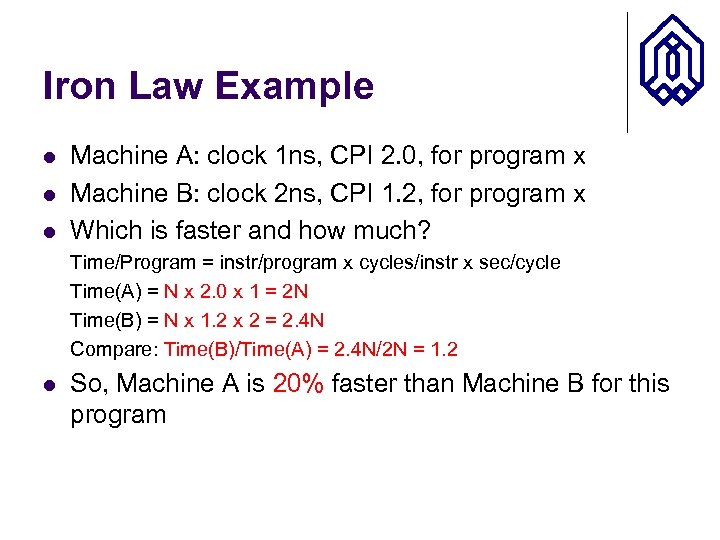
Iron Law Example l l l Machine A: clock 1 ns, CPI 2. 0, for program x Machine B: clock 2 ns, CPI 1. 2, for program x Which is faster and how much? Time/Program = instr/program x cycles/instr x sec/cycle Time(A) = N x 2. 0 x 1 = 2 N Time(B) = N x 1. 2 x 2 = 2. 4 N Compare: Time(B)/Time(A) = 2. 4 N/2 N = 1. 2 l So, Machine A is 20% faster than Machine B for this program
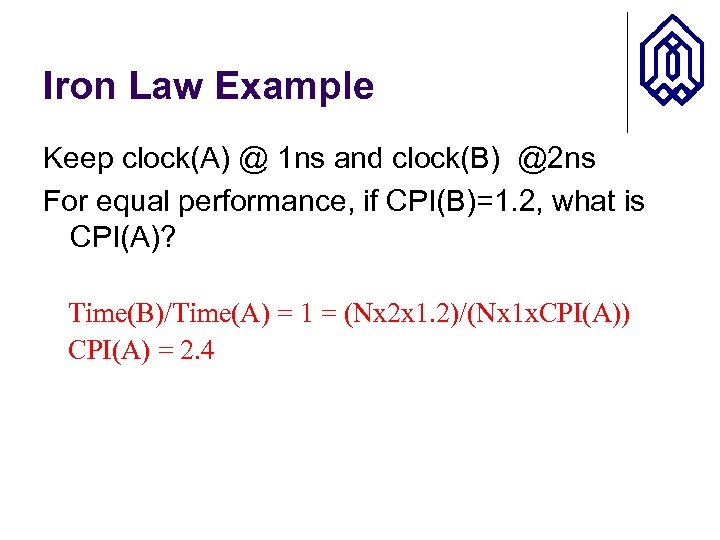
Iron Law Example Keep clock(A) @ 1 ns and clock(B) @2 ns For equal performance, if CPI(B)=1. 2, what is CPI(A)? Time(B)/Time(A) = 1 = (Nx 2 x 1. 2)/(Nx 1 x. CPI(A)) CPI(A) = 2. 4
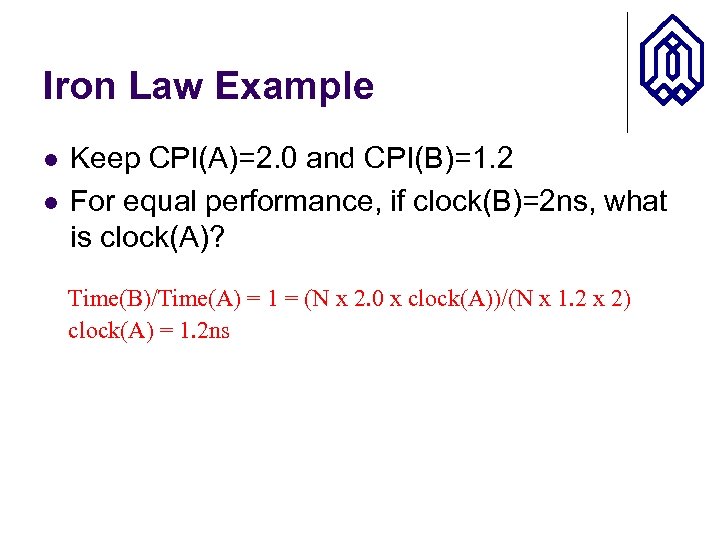
Iron Law Example l l Keep CPI(A)=2. 0 and CPI(B)=1. 2 For equal performance, if clock(B)=2 ns, what is clock(A)? Time(B)/Time(A) = 1 = (N x 2. 0 x clock(A))/(N x 1. 2 x 2) clock(A) = 1. 2 ns
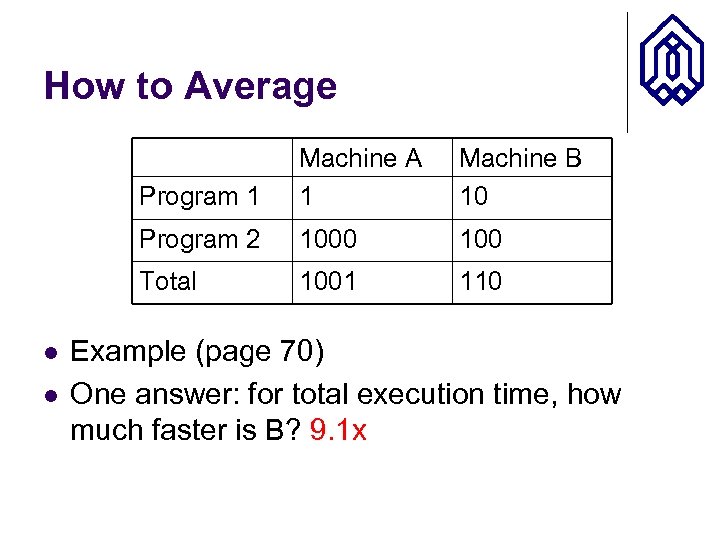
How to Average Program 1 1000 100 Total l Machine B 10 Program 2 l Machine A 1 1001 110 Example (page 70) One answer: for total execution time, how much faster is B? 9. 1 x
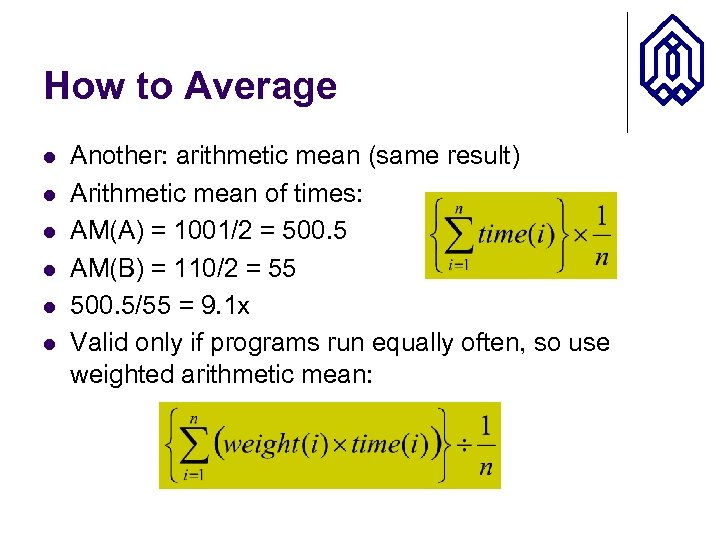
How to Average l l l Another: arithmetic mean (same result) Arithmetic mean of times: AM(A) = 1001/2 = 500. 5 AM(B) = 110/2 = 55 500. 5/55 = 9. 1 x Valid only if programs run equally often, so use weighted arithmetic mean:
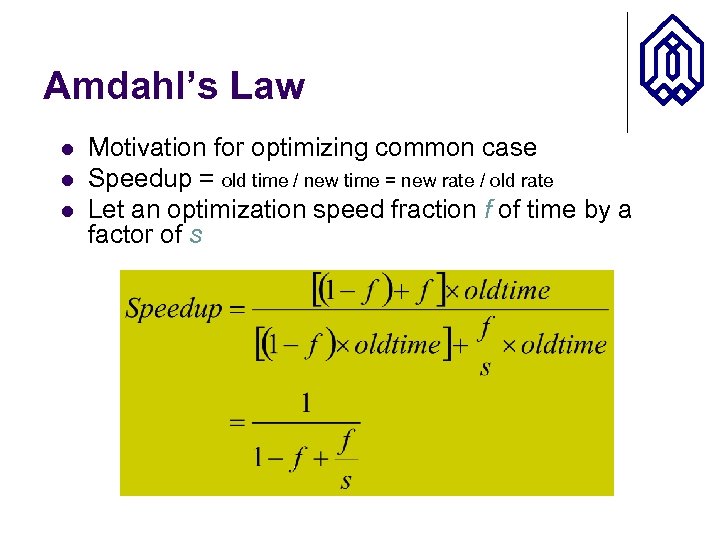
Amdahl’s Law l l l Motivation for optimizing common case Speedup = old time / new time = new rate / old rate Let an optimization speed fraction f of time by a factor of s
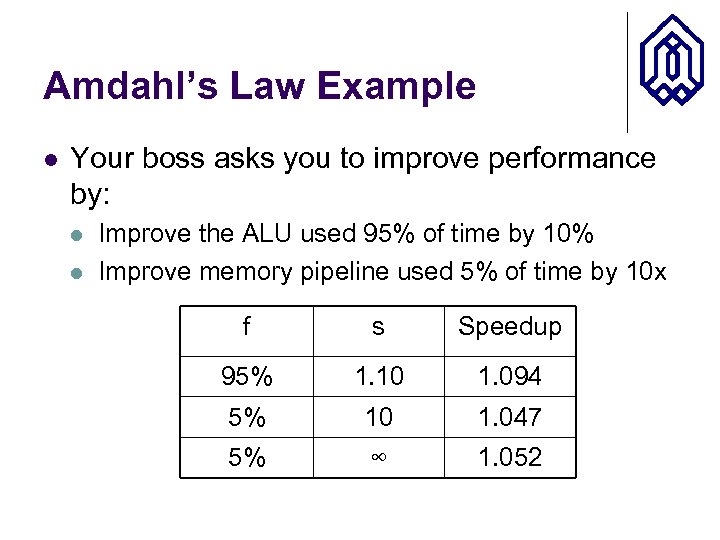
Amdahl’s Law Example l Your boss asks you to improve performance by: l l Improve the ALU used 95% of time by 10% Improve memory pipeline used 5% of time by 10 x f s Speedup 95% 1. 10 1. 094 5% 10 1. 047 5% ∞ 1. 052
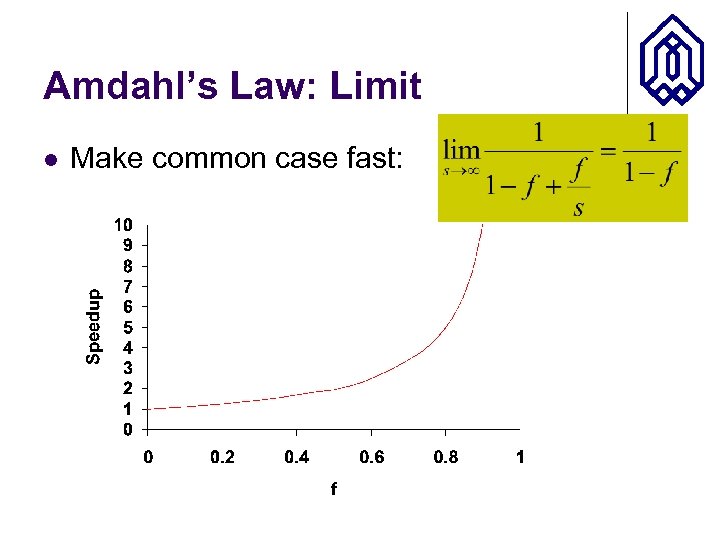
Amdahl’s Law: Limit l Make common case fast:
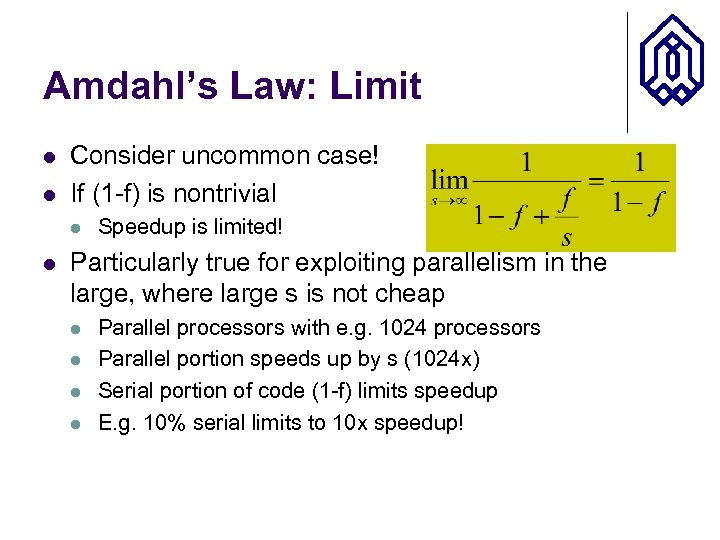
Amdahl’s Law: Limit l l Consider uncommon case! If (1 -f) is nontrivial l l Speedup is limited! Particularly true for exploiting parallelism in the large, where large s is not cheap l l Parallel processors with e. g. 1024 processors Parallel portion speeds up by s (1024 x) Serial portion of code (1 -f) limits speedup E. g. 10% serial limits to 10 x speedup!
Which Programs l l Execution time of what program? Best case – your always run the same set of programs l l Port them and time the whole workload In reality, use benchmarks l l Programs chosen to measure performance Predict performance of actual workload Saves effort and money Representative? Honest? Benchmarketing…
Benchmarks: SPEC 2000 l System Performance Evaluation Cooperative l l l Formed in 80 s to combat benchmarketing SPEC 89, SPEC 92, SPEC 95, now SPEC 2000 12 integer and 14 floating-point programs l l Sun Ultra-5 300 MHz reference machine has score of 100 Report GM of ratios to reference machine
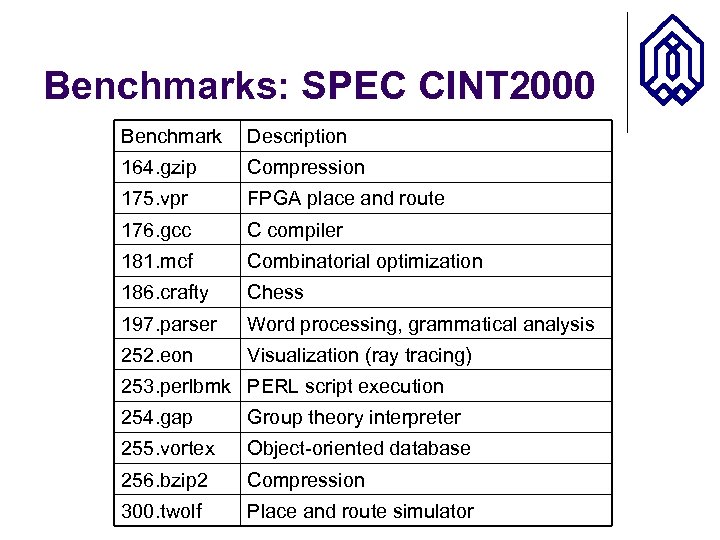
Benchmarks: SPEC CINT 2000 Benchmark Description 164. gzip Compression 175. vpr FPGA place and route 176. gcc C compiler 181. mcf Combinatorial optimization 186. crafty Chess 197. parser Word processing, grammatical analysis 252. eon Visualization (ray tracing) 253. perlbmk PERL script execution 254. gap Group theory interpreter 255. vortex Object-oriented database 256. bzip 2 Compression 300. twolf Place and route simulator
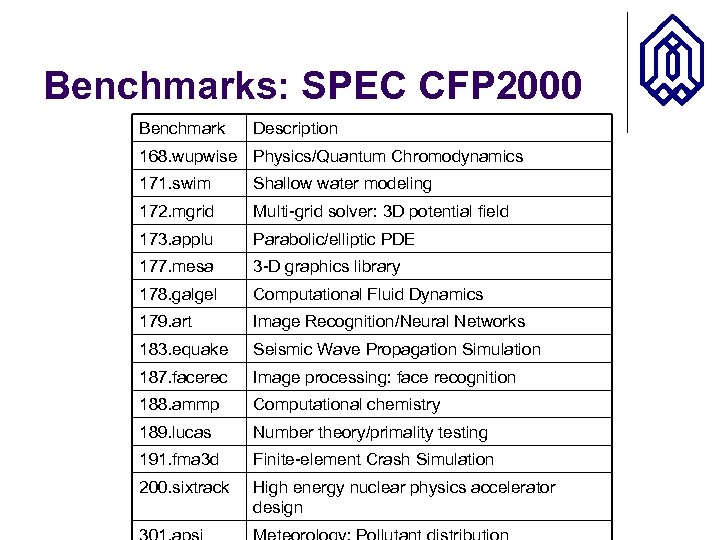
Benchmarks: SPEC CFP 2000 Benchmark Description 168. wupwise Physics/Quantum Chromodynamics 171. swim Shallow water modeling 172. mgrid Multi-grid solver: 3 D potential field 173. applu Parabolic/elliptic PDE 177. mesa 3 -D graphics library 178. galgel Computational Fluid Dynamics 179. art Image Recognition/Neural Networks 183. equake Seismic Wave Propagation Simulation 187. facerec Image processing: face recognition 188. ammp Computational chemistry 189. lucas Number theory/primality testing 191. fma 3 d Finite-element Crash Simulation 200. sixtrack High energy nuclear physics accelerator design
Benchmark Pitfalls l Benchmark not representative l l Your workload is I/O bound, SPEC is useless Benchmark is too old l l Benchmarks age poorly; benchmarketing pressure causes vendors to optimize compiler/hardware/software to benchmarks Need to be periodically refreshed
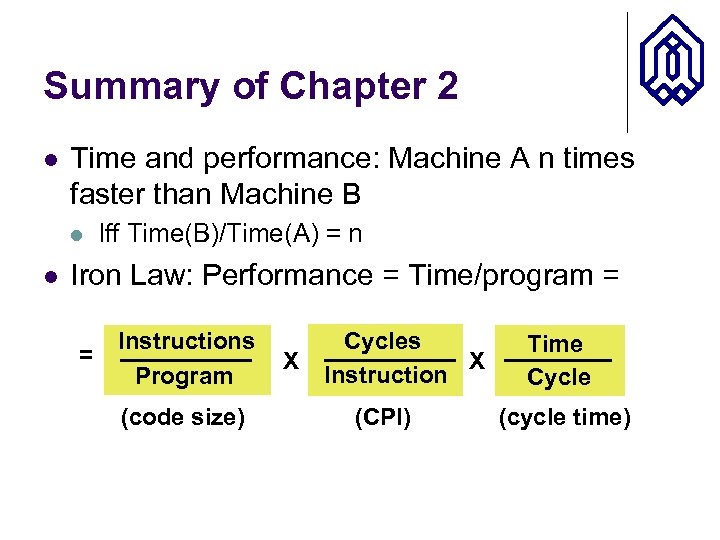
Summary of Chapter 2 l Time and performance: Machine A n times faster than Machine B l l Iff Time(B)/Time(A) = n Iron Law: Performance = Time/program = = Instructions Program (code size) X Cycles X Instruction (CPI) Time Cycle (cycle time)
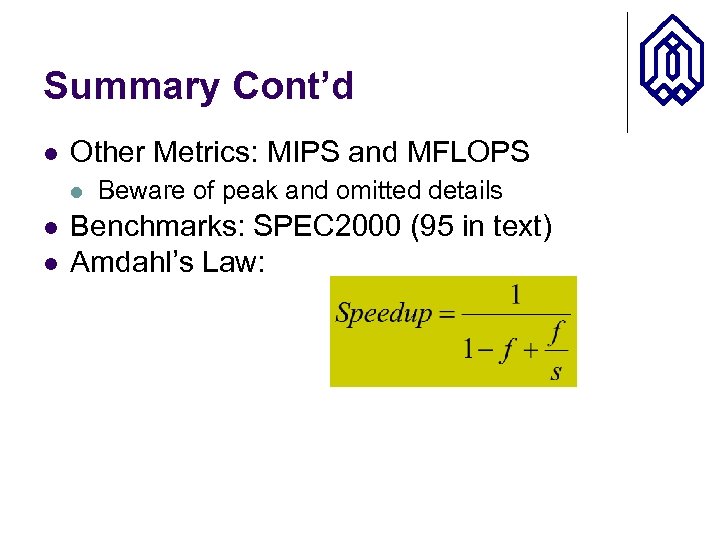
Summary Cont’d l Other Metrics: MIPS and MFLOPS l l l Beware of peak and omitted details Benchmarks: SPEC 2000 (95 in text) Amdahl’s Law:
Скачать презентацию Introduction To Computer Architecture Instructor Mozafar Bag-Mohammadi Spring
4ca160b1f66acb96d91a596a59566fdb.ppt