


 Скачать презентацию Introduction to Compilation Xiaoyin Wang CS 5363 Spring
0d48f5ddbe7a5c300aabcbf1410263c7.ppt
- Количество слайдов: 49
 Introduction to Compilation Xiaoyin Wang CS 5363 Spring 2017 1
 Course Instructor Ø Name: Dr. Xiaoyin Wang (Sean) Ø Office: NPB 3. 208 Ø Email: xiaoyin. wang@utsa. edu 2 2
 Introduce yourselves! 3 UTSA CS 5103 3
 Course Meetings, Web Pages, etc. Ø Meetings: TR 7: 30 -8: 45 pm NPB 1. 202 Ø Office Hours: Wednesday 3: 30 -5 pm, Thursday 1: 30 -3 pm Ø Website http: //xywang. 100871. net/CS 5363. htm 4 4
 Course Textbooks Ø Reference Book – Keith Cooper and Linda Torczon’s ”Engineering a Compiler, 2 nd ed. ” (2011) 5 5
 Course Topics Ø Formal Languages and Automaton Ø Lexical Analysis Ø Parsing Ø Code Generation Ø Compiler Optimization Ø Functional Languages 6 6
 Grading Scheme Ø Mid-Term Exam: 20% * 2 Ø Assignments: 10% * 2 Ø Projects: 30% ØDevelop a compiler for a simple language Ø Course participation: 10% 7 7
 More on the Course Project Ø The project consists a number of phases Ø Lexical Analysis (5 points) Ø Parser (10 points) Ø Code Generation (10 points) Ø Optimization (+5 points) Ø Documentation (5 points) 8 8
 Now, let’s go to the real lecture … 9 9
 Overview and History (1) Ø Cause – Software for early computers was written in assembly language – The benefits of reusing software on different CPUs started to become significantly greater than the cost of writing a compiler Ø The first real compiler – FORTRAN compilers of the late 1950 s – 18 person-years to build 10 10
 Overview and History (2) Ø Compiler technology – is more broadly applicable and has been employed in rather unexpected areas. ü Text-formatting languages like nroff and troff; preprocessor packages like eqn, tbl, pic üSilicon compiler for the creation of VLSI circuits ü Command languages of OS ü Query languages of Database systems 11 11
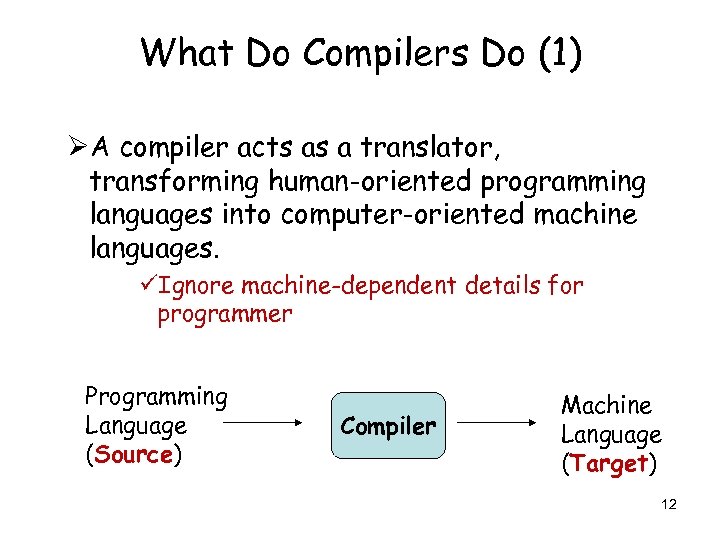 What Do Compilers Do (1) ØA compiler acts as a translator, transforming human-oriented programming languages into computer-oriented machine languages. üIgnore machine-dependent details for programmer Programming Language (Source) Compiler Machine Language (Target) 12
 What Do Compilers Do (2) ØCompilers may generate three types of code: – Pure Machine Code • Machine instruction set without assuming the existence of any operating system or library. • Mostly being OS or embedded applications. – Augmented Machine Code • Code with OS routines and runtime support routines. 13
 What Do Compilers Do (2) ØCompilers may generate three types of code: – Virtual Machine Code • Virtual instructions, can be run on any architecture with a virtual machine interpreter or a just-in-time compiler • Ex. Java 14
 What Do Compilers Do (3) ØAnother way that compilers differ from one another is in the format of the target machine code they generate: – Assembly or other source format – Re-locatable binary • Relative address • A linkage step is required – Absolute binary • Absolute address • Can be executed directly 15 15
 Interpreters & Compilers Ø Interpreter – A program that reads a source program and produces the results of executing that program Ø Compiler – A program that translates a program from one language (the source) to another (the target) 16
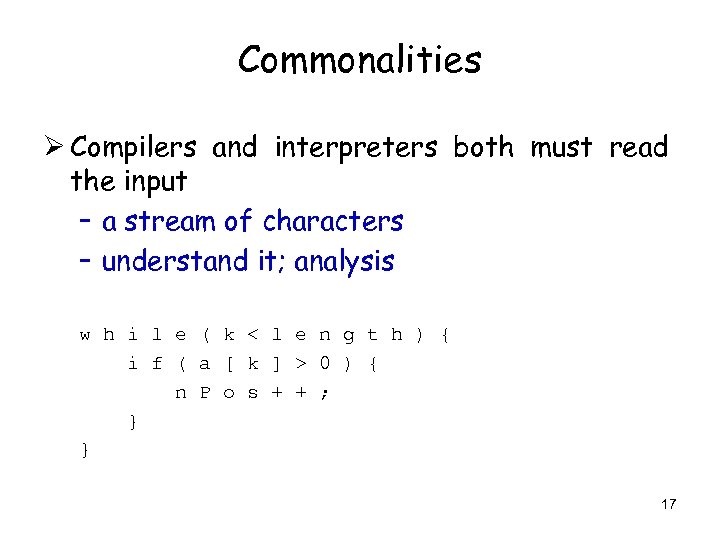 Commonalities Ø Compilers and interpreters both must read the input – a stream of characters – understand it; analysis w h i l e ( k < l e n g t h ) { i f ( a [ k ] > 0 ) { n P o s + + ; } } 17
 Interpreter • Interpreter – Execution engine – Program execution interleaved with analysis running = true; while (running) { analyze next statement; execute that statement; } – May involve repeated analysis of some statements (loops, functions) 18
 Compiler Ø Read analyze entire program Ø Translate to semantically equivalent program in another language – Presumably easier to execute or more efficient – Should “improve” the program in some fashion Ø Offline process – Tradeoff: compile time overhead (preprocessing step) vs execution performance 19
 Typical Implementations Ø Compilers – FORTRAN, C, C++, Java, COBOL, etc. – Strong need for optimization, etc. Ø Interpreters – PERL, Python, awk, sed, sh, csh, postscript printer, Java VM – Effective if interpreter overhead is low relative to execution cost of language statements 20
 Hybrid approaches Ø Well-known example: Java – Compile Java source to byte codes – Java Virtual Machine language (. class files) – Execution ü Interpret byte codes directly, or ü Compile some or all byte codes to native code – (particularly for execution hot spots) – Just-In-Time compiler (JIT) Ø Variation: VS. NET – Compilers generate MSIL – All IL compiled to native code before execution 21
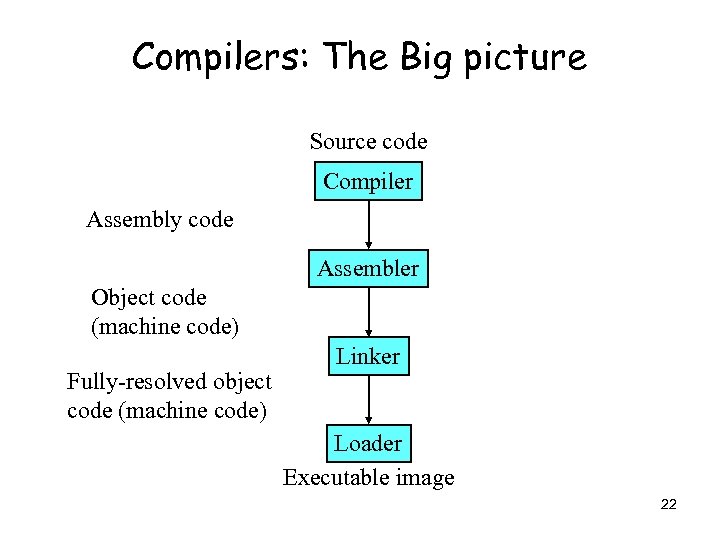 Compilers: The Big picture Source code Compiler Assembly code Assembler Object code (machine code) Fully-resolved object code (machine code) Linker Loader Executable image 22
 Idea: Translate in Steps Ø Series of program representations Ø Intermediate representations optimized for program manipulations of various kinds (checking, optimization) Ø Become more machine-specific, less languagespecific as translation proceeds 23
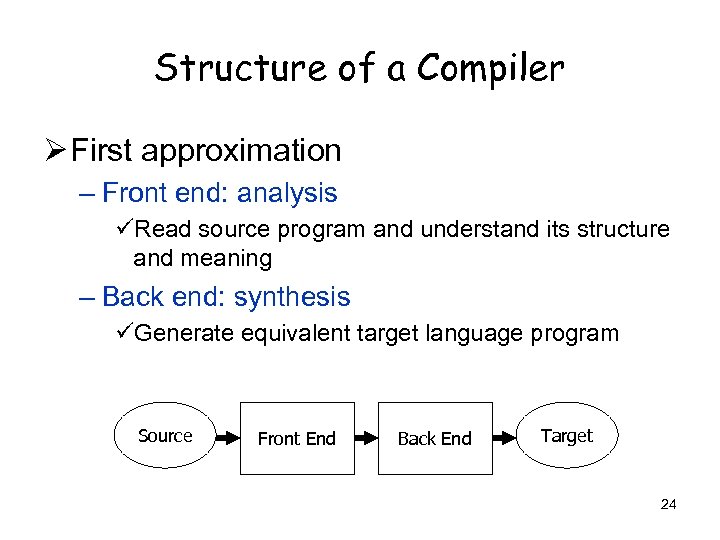 Structure of a Compiler Ø First approximation – Front end: analysis üRead source program and understand its structure and meaning – Back end: synthesis üGenerate equivalent target language program Source Front End Back End Target 24
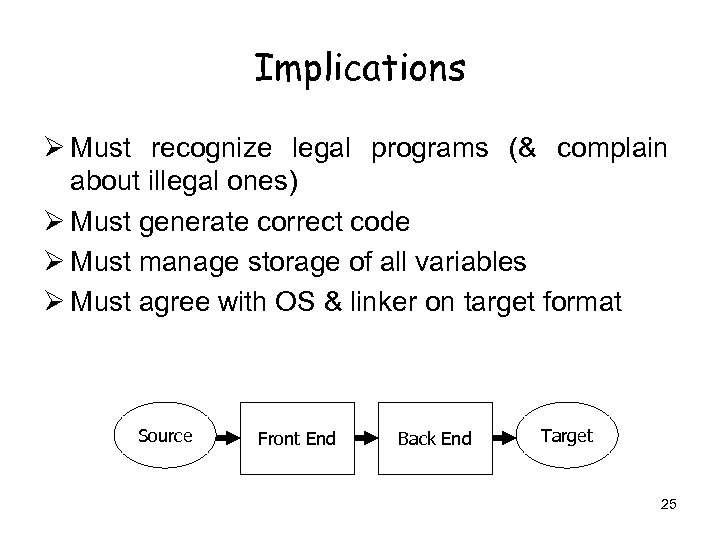 Implications Ø Must recognize legal programs (& complain about illegal ones) Ø Must generate correct code Ø Must manage storage of all variables Ø Must agree with OS & linker on target format Source Front End Back End Target 25
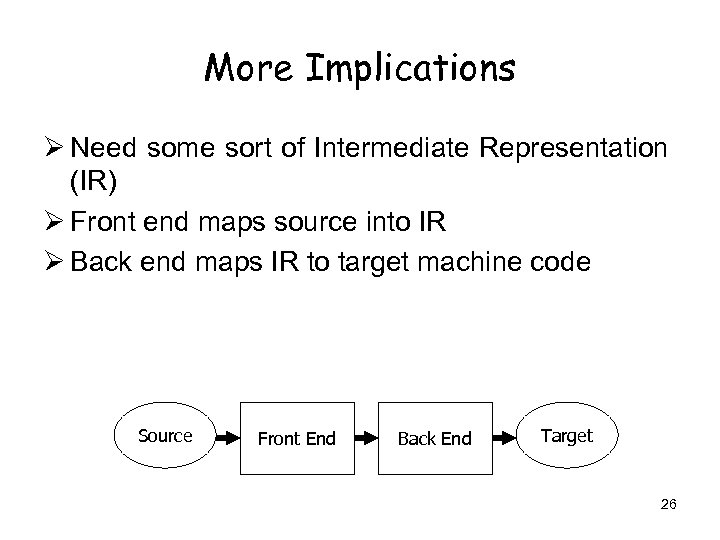 More Implications Ø Need some sort of Intermediate Representation (IR) Ø Front end maps source into IR Ø Back end maps IR to target machine code Source Front End Back End Target 26
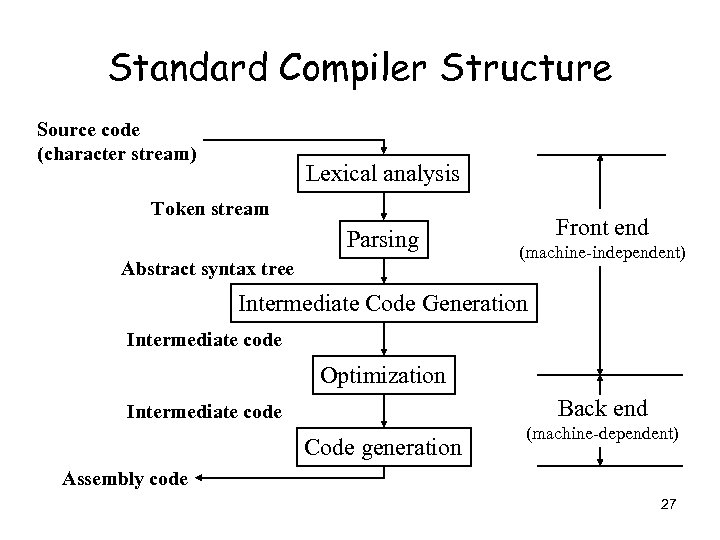 Standard Compiler Structure Source code (character stream) Lexical analysis Token stream Parsing Abstract syntax tree Front end (machine-independent) Intermediate Code Generation Intermediate code Optimization Back end Intermediate code Code generation (machine-dependent) Assembly code 27
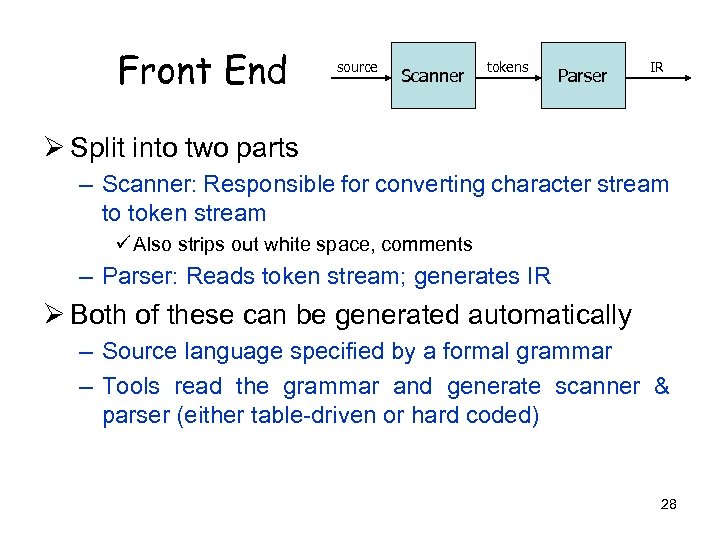 Front End source Scanner tokens Parser IR Ø Split into two parts – Scanner: Responsible for converting character stream to token stream ü Also strips out white space, comments – Parser: Reads token stream; generates IR Ø Both of these can be generated automatically – Source language specified by a formal grammar – Tools read the grammar and generate scanner & parser (either table-driven or hard coded) 28
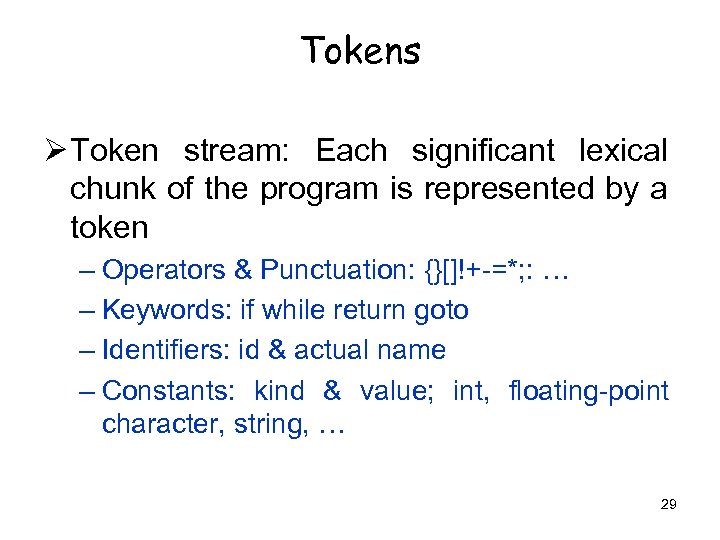 Tokens Ø Token stream: Each significant lexical chunk of the program is represented by a token – Operators & Punctuation: {}[]!+-=*; : … – Keywords: if while return goto – Identifiers: id & actual name – Constants: kind & value; int, floating-point character, string, … 29
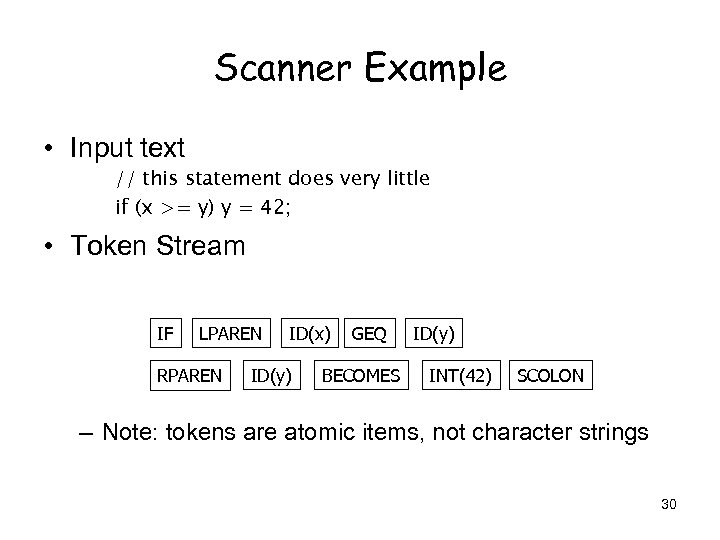 Scanner Example • Input text // this statement does very little if (x >= y) y = 42; • Token Stream IF LPAREN RPAREN ID(x) ID(y) GEQ BECOMES ID(y) INT(42) SCOLON – Note: tokens are atomic items, not character strings 30
 Parser Output (IR) Ø Many different forms – (Engineering tradeoffs) Ø Common output from a parser is an abstract syntax tree – Essential meaning of the program without the syntactic noise 31
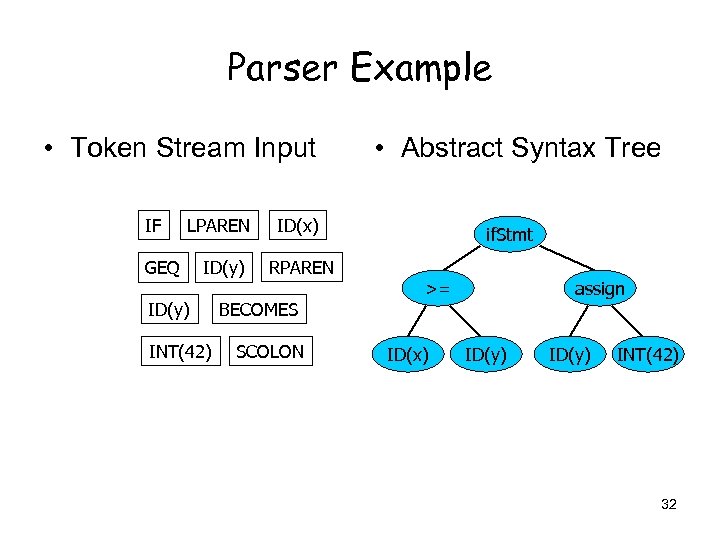 Parser Example • Token Stream Input IF LPAREN ID(x) ID(y) RPAREN • Abstract Syntax Tree GEQ ID(y) INT(42) BECOMES SCOLON if. Stmt >= ID(x) assign ID(y) INT(42) 32
 Static Semantic Analysis Ø During or (more common) after parsing – Type checking – Check for language requirements like “declare before use”, type compatibility – Preliminary resource allocation – Collect other information needed by back end analysis and code generation 33
 Back End Ø Responsibilities – Translate IR into target machine code – Should produce fast, compact code – Should use machine resources effectively üRegisters üInstructions üMemory hierarchy 34
 Back End Structure Ø Typically split into two major parts with sub phases – “Optimization” – code improvements üMay well translate parser IR into another IR – Code generation üInstruction selection & scheduling üRegister allocation 35
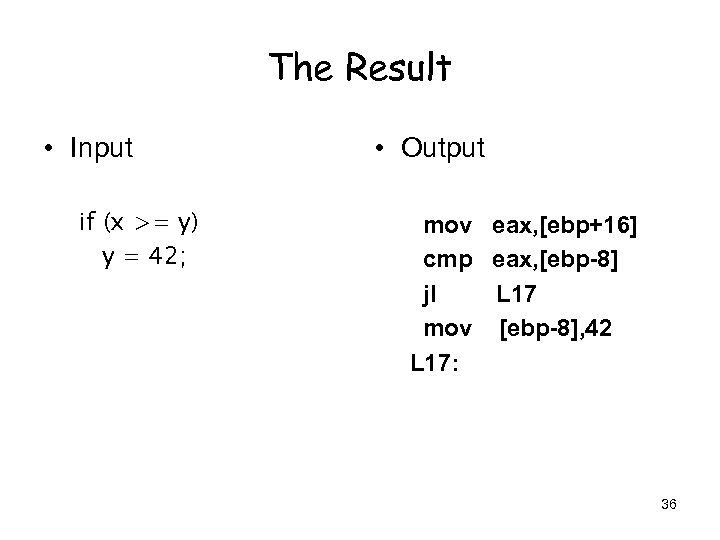 The Result • Input if (x >= y) y = 42; • Output mov eax, [ebp+16] cmp eax, [ebp-8] jl L 17 mov [ebp-8], 42 L 17: 36
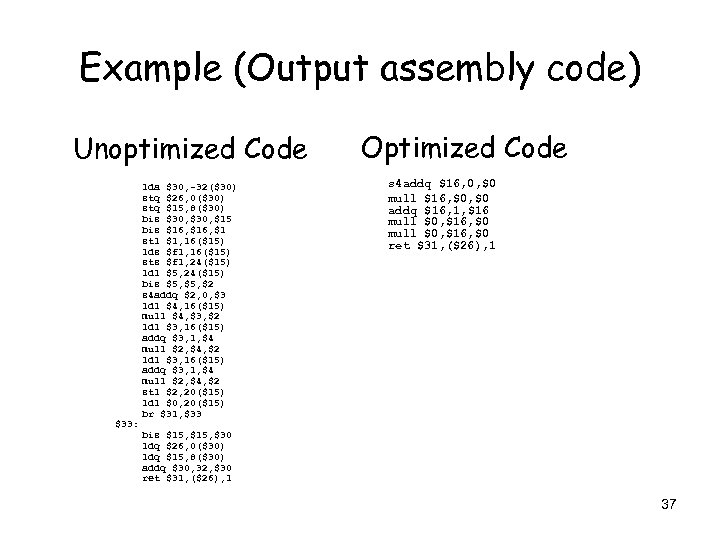 Example (Output assembly code) Unoptimized Code $33: lda $30, -32($30) stq $26, 0($30) stq $15, 8($30) bis $30, $15 bis $16, $1 stl $1, 16($15) lds $f 1, 16($15) sts $f 1, 24($15) ldl $5, 24($15) bis $5, $2 s 4 addq $2, 0, $3 ldl $4, 16($15) mull $4, $3, $2 ldl $3, 16($15) addq $3, 1, $4 mull $2, $4, $2 stl $2, 20($15) ldl $0, 20($15) br $31, $33 Optimized Code s 4 addq $16, 0, $0 mull $16, $0 addq $16, 1, $16 mull $0, $16, $0 ret $31, ($26), 1 bis $15, $30 ldq $26, 0($30) ldq $15, 8($30) addq $30, 32, $30 ret $31, ($26), 1 37
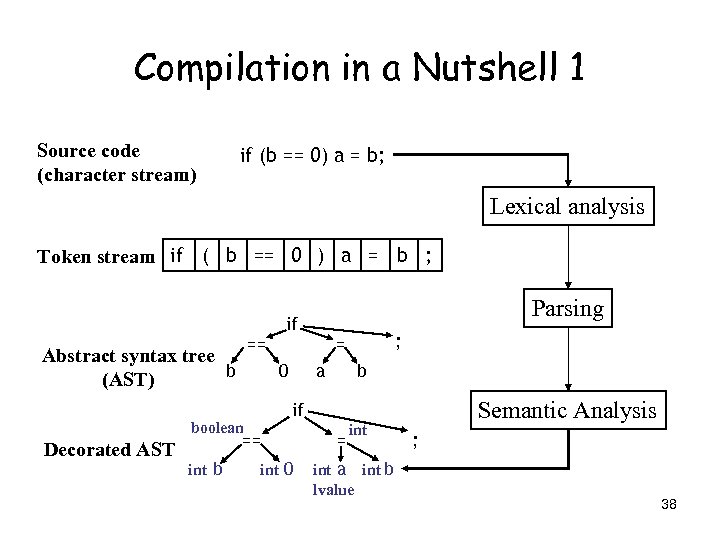 Compilation in a Nutshell 1 Source code (character stream) if (b == 0) a = b; Lexical analysis Token stream if ( b == 0 ) a = b ; == Abstract syntax tree b (AST) 0 boolean Decorated AST ; = a b Semantic Analysis if == int b Parsing if int 0 = int a int b lvalue ; 38
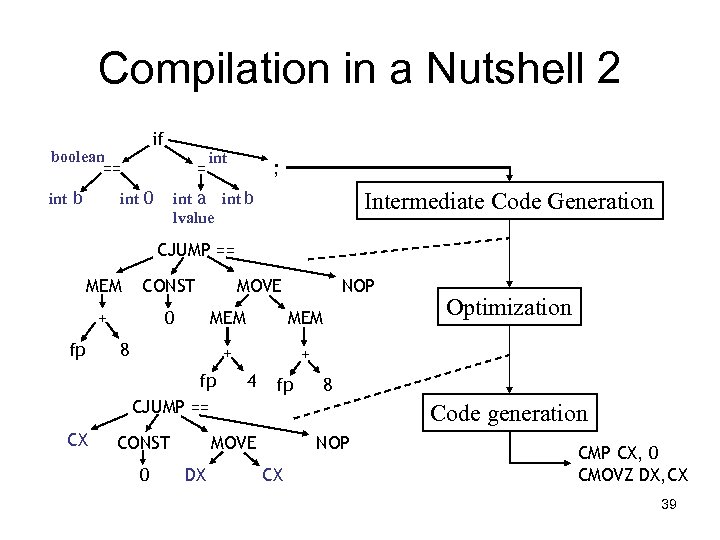 Compilation in a Nutshell 2 if boolean == int b = int 0 int ; int a int b lvalue Intermediate Code Generation CJUMP == MEM CONST + 0 fp MOVE MEM + CONST 0 4 fp 8 Code generation MOVE DX Optimization + 8 fp CJUMP == CX NOP CX CMP CX, 0 CMOVZ DX, CX 39
 Compiler Design and Programming Language Design ØAn interesting aspect is how programming language design and compiler design influence one another. ØProgramming languages that are easy to compile have many advantages 40 40
 Compiler Design and Programming Language Design(2) ØLanguages such as Snobol and APL are usually considered non-compilable ØWhat attributes must be found in a programming language to allow compilation? – Can the scope and binding of each identifier reference be determined before execution begins? – Can the type of object be determined before execution begins? – Can existing program text be changed or added to during execution? 41 41
 Computer Architecture and Compiler Design ØCompilers should exploit the hardwarespecific feature and computing capability to optimize code. ØThe problems encountered in modern computing platforms: – Instruction sets for some popular architectures are highly non-uniform. 42 42
 Computer Architecture and Compiler Design – High-level programming language operations are not always easy to support. üEx. exceptions, threads, dynamic heap access … – Exploiting architectural features such as cache, distributed processors and memory – Effective use of a large number of processors 43 43
 Compiler Design Considerations ØDebugging Compilers – Designed to aid in the development and debugging of programs. ØOptimizing Compilers – Designed to produce efficient target code ØRe-targetable Compilers – A compiler whose target architecture can be changed without its machine-independent components having to be rewritten. 44 44
 Why Study Compilers? (1) Ø Compiler techniques are everywhere – Parsing (little languages, interpreters) – Database engines – AI: domain-specific languages – Text processing üTex/La. Tex -> dvi -> Postscript -> pdf – Hardware: VHDL; model-checking tools – Mathematics (Mathematica, Matlab) 45
 Why Study Compilers? (2) Ø Fascinating blend of theory and engineering – Direct applications of theory to practice • Parsing, scanning, static analysis – Some very difficult problems (NP-hard or worse) • Resource allocation, “optimization”, etc. • Need to come up with good-enough solutions 46
 Why Study Compilers? (3) Ø Ideas from many parts of CSE – AI: Greedy algorithms, heuristic search – Algorithms: graph algorithms, dynamic programming, approximation algorithms – Theory: Grammars DFAs and PDAs, pattern matching, fixed-point algorithms – Systems: Allocation & naming, synchronization, locality – Architecture: pipelines & hierarchy management, instruction set use 47
 Class Summary Ø Compilers: Introduction – Why Compilers? – Input and Output – Structure of Compilers – Compiler Design – Welcome Test to determine the content of background sections üNo influence to grade 48
 Next Class Ø Foundation of Compilers – Formal Languages – Grammars – Automatons 49