


 Скачать презентацию Introduction to Communications Media Ch 7 Radio
8129d4dccac2847cf7501be75af2d7ca.ppt
- Количество слайдов: 19
 + Introduction to Communications Media Ch 7 Radio
 + Birth of Commercial Radio n After WWI, RCA (Radio Corporation of America) formed n n Radio was originally thought of simply as “wireless telegraphy” David Sarnoff saw its potential as a “radio music box” Early radio stations were often built by department stores (paved the way for mixed entertainment/advertising format we’re familiar with today) In early 1900 s, department stores were usually “early adopters” and where people often first experienced new technologies such as electric lights
 + Commercialization of Radio n Early stations originally did without advertising n As broadcasting became more expensive, station owners needed to generate revenue n Early ideas included asking listeners to donate money, others wanted a tax on radio tubes, AT&T eventually decided to sell time on one of its stations to anyone who wanted to broadcast a message
 + Networks n By developed as a cost savings idea linking together, stations could save money on producing programming n Networked stations also could reach a wider audience and charge more for advertising n 1926 -- NBC was the first broadcasting network (turned into two RCA’s original stations and then AT&T’s stations when the phone company got out of the radio business)
 + Networks (cont) n CBS n By started up the next year 1937 NBC had 111 affiliates and CBS 105 n Advertisers were spending more than $27 million a year on advertising n Increased revenue meant networks could hire “name” talent n Top programs developed a national audience
 + Government Regulation n In the 1920 s, so many new stations were going on the air that interference became a problem n Congress passed the Radio Act of 1927 creating the FRC (Federal Radio Commission) n The FRC issued licenses, defined the AM frequency band, standardized station channel designations and abolished portable radio stations
 + Shaping the Industry n By the end of the 1920 s, radio’s framework was in place n Commercially supported n Federally regulated n Network dominated
 + The Great Depression n Advertising stayed high, so the radio industry suffered little hardship n FCC (Federal Communications Commission) developed via the Communications Act of 1934 (consolidated regulatory functions of several government agencies
 + The Depression Years n 1930 s FM (frequency modulated radio) introduced n Programming changed to reflect the need for hope and diversion (action/adventure, soap operas)
 + Post World War II n Development of FM suffered as it competed with Television n FCC gave TV frequency spectrum FM had been using and moved FM to 88 to 108 Mhz band making many FM radios obsolete n Emergence of television challenges radio’s primacy in mass entertainment n While TV didn’t reduce radio advertising revenues it did lead to a decline in the number of radio affiliates
 + Payola n More airplay a song gets, the better it sells n Record promoters began paying DJs to air certain records more frequently (this practice is eventually outlawed) n Promoters find new, legal ways of paying to promote airplay (“legal payola”)
 + Growth and Stabilization n From 1955 to 1990 number of stations grew from 3, 343 to more than 7, 000 n Top 40 format becomes popular n Favorite of young people (who happen to have a lot of disposable income) n FM gains popularity in part because of its better sound quality n Number of FM stations triples from 1960 to 70 and many AM stations switch to News/Talk format
 + Consolidation and Specialization n Telecommunications Act of 1996 allows companies to own more stations and more stations in the same market n This change allows for a major industry realignment n Giant radio conglomerates form as big companies buy up stations n Radio programming becomes more specialized
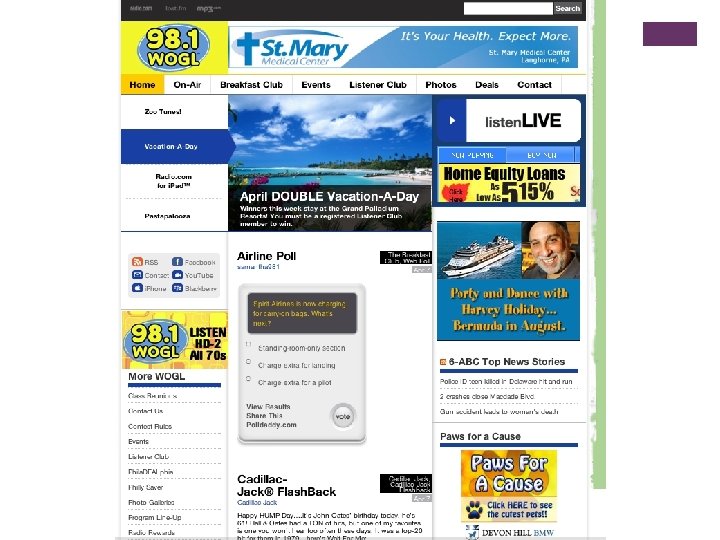
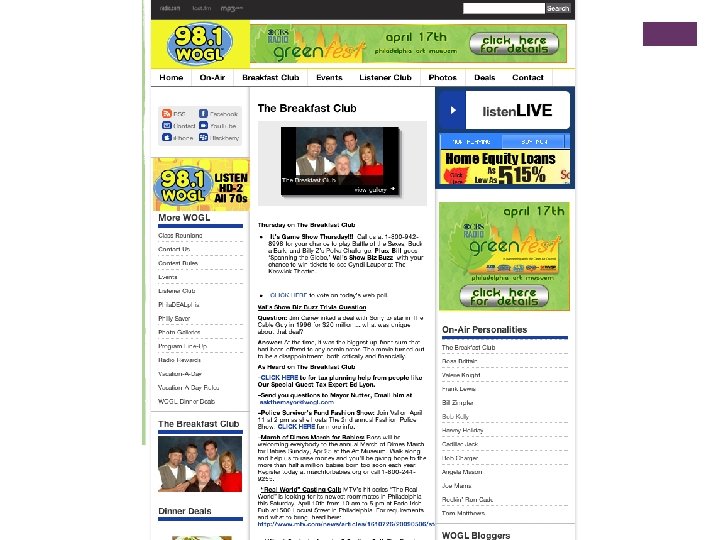
 + Radio in the Digital Age n Radio stations use their web sites to: n Stream audio n Help listeners become more familiar with station on-air personalities n Publish schedules, and movie and album reviews n Sell ads to generate additional revenue

 + High Definition (HD) Radio n Improved signal quality n Stations can broadcast multiple programs at once (one on analog signal, one on digital signal) n HD radio is free (need an HD receiver) unlike satellite radio n As of 2007 about 1, 200 radio stations were broadcasting an HD signal with more going digital every month
 + Problems Facing HD Radio n Receivers are expensive n HD radio only results in better quality, not new capabilities n HD radio has not broken new ground n Only a small percentage of listeners have HD receivers n HD radio uses more power than analog draining batteries much faster