 Скачать презентацию Introduction to Commercial Building Energy Efficiency through EPA s
b1340991a231cf2313a456c4f8bb75aa.ppt
- Количество слайдов: 57



Introduction to Commercial Building Energy Efficiency through EPA’s ENERGY STAR® Program Week 3: Market Transformation and the Role of the ENERGY STAR Program
Outline • Class Objectives • Market Transformation and the Role of the ENERGY STAR Program – Program purpose – ENERGY STAR brand influence on consumer and organization decisions – The impact of the ENERGY STAR Pledge – Increasing ENERGY STAR program effectiveness 1
Class Objectives Upon completion of this unit, you will be able to: • Describe the purpose of the ENERGY STAR program • Explain how the ENERGY STAR brand has influenced consumer and organization decisions • Explain how the ENERGY STAR Buildings program uses a whole building approach to help organizations track their energy use and improve energy performance. • Explain how local governments are creating campaigns to save energy in privately owned buildings and connecting this to stimulus dollars they receive from DOE Grants. • Discuss how the ENERGY STAR program could increase its effectiveness 2

Program Purpose
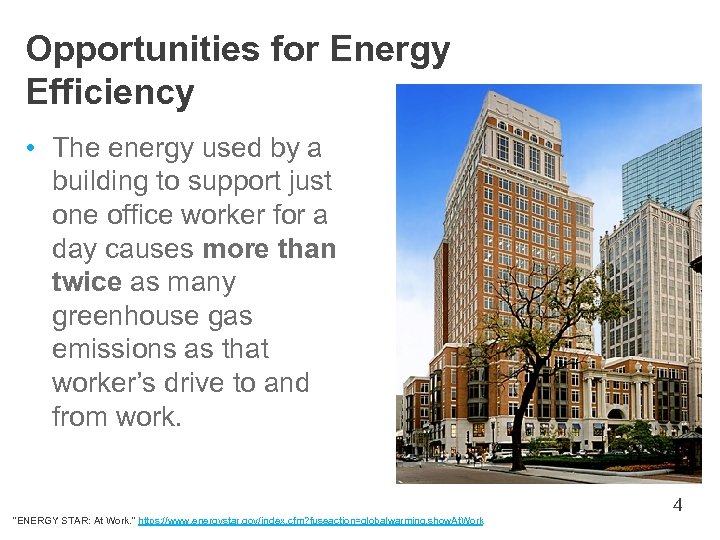
Opportunities for Energy Efficiency • The energy used by a building to support just one office worker for a day causes more than twice as many greenhouse gas emissions as that worker’s drive to and from work. 4 “ENERGY STAR: At Work. ” https: //www. energystar. gov/index. cfm? fuseaction=globalwarming. show. At. Work
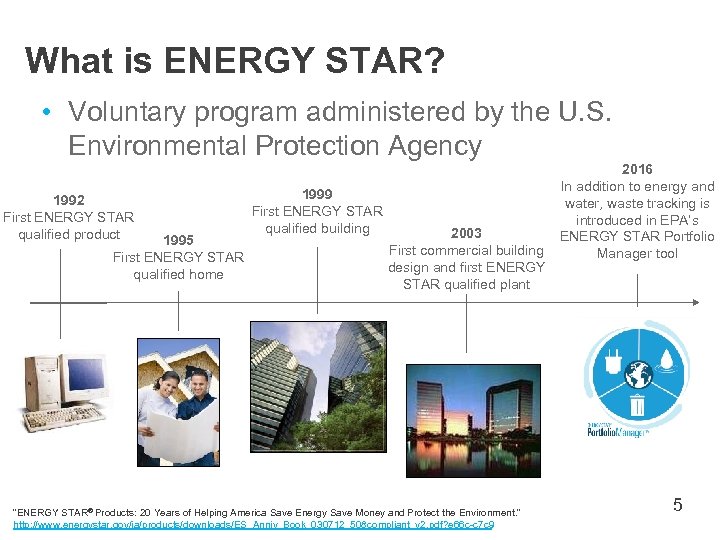
What is ENERGY STAR? • Voluntary program administered by the U. S. Environmental Protection Agency 2016 In addition to energy and 1999 1992 water, waste tracking is First ENERGY STAR introduced in EPA’s qualified building 2003 qualified product ENERGY STAR Portfolio 1995 First commercial building Manager tool First ENERGY STAR design and first ENERGY qualified home STAR qualified plant “ENERGY STAR® Products: 20 Years of Helping America Save Energy Save Money and Protect the Environment. ” http: //www. energystar. gov/ia/products/downloads/ES_Anniv_Book_030712_508 compliant_v 2. pdf? e 66 c-c 7 c 9 5
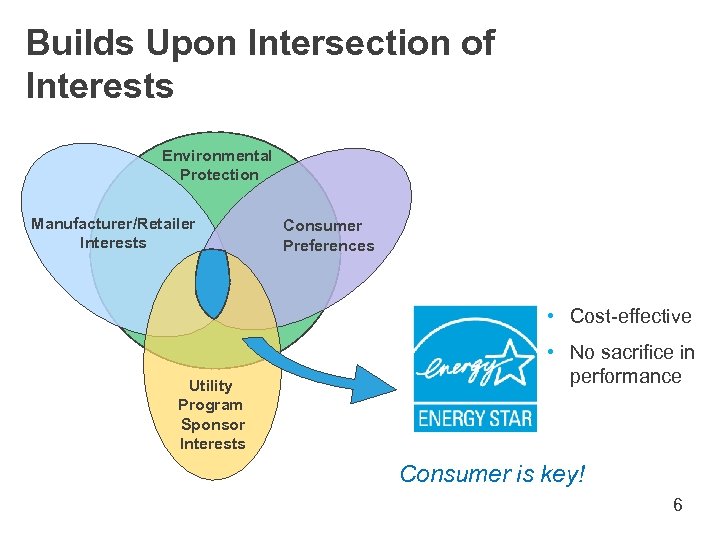
Builds Upon Intersection of Interests Environmental Protection Manufacturer/Retailer Interests Consumer Preferences • Cost-effective Utility Program Sponsor Interests • No sacrifice in performance Consumer is key! 6
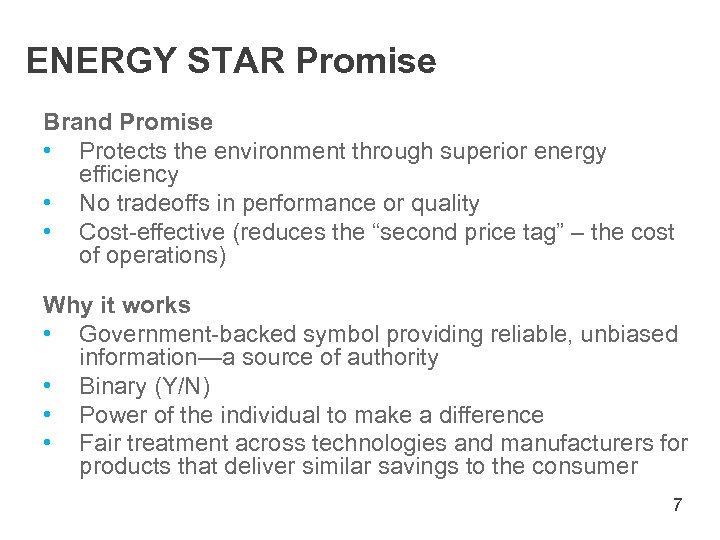
ENERGY STAR Promise Brand Promise • Protects the environment through superior energy efficiency • No tradeoffs in performance or quality • Cost-effective (reduces the “second price tag” – the cost of operations) Why it works • Government-backed symbol providing reliable, unbiased information—a source of authority • Binary (Y/N) • Power of the individual to make a difference • Fair treatment across technologies and manufacturers for products that deliver similar savings to the consumer 7
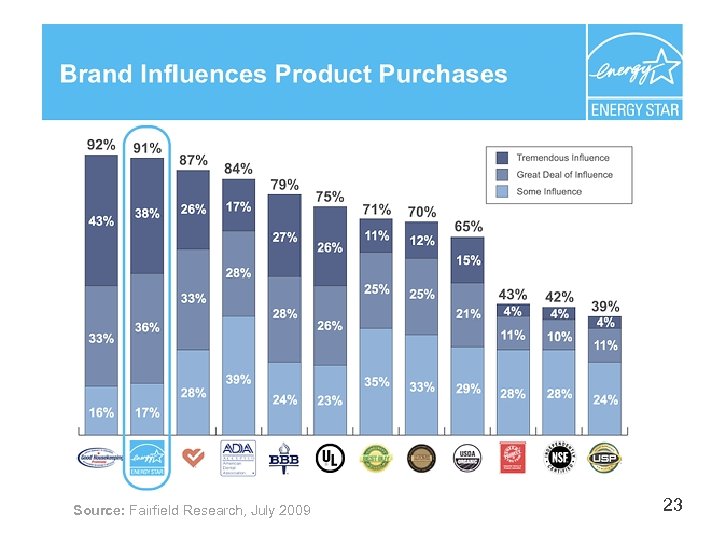
Growing Awareness and Interest in ENERGY STAR Awareness & influence continue to grow! U. S. households recognize, understand, and are influenced by the ENERGY STAR label. • As of 2015, 88% of households recognized the ENERGY STAR, and 52% of those households that purchased an ENERGY STAR product were “very much” influenced by the label. “National Awareness of ENERGY STAR® for 2015. ” https: //www. energystar. gov/index. cfm? fuseaction=publications. showpublications 8
ENERGY STAR Strategies Residential Certified Products as of 2015 • 70+ product categories • 50, 000+ certified products Commercial & Industrial Corporate Energy Management • 15– 30% more efficient • Benchmarking, goals, upgrades – Management & systems – not widgets • Indicates whole-building excellence – Technical assistance Home Improvement Services Certified Products • Beyond products • Ducts / home sealing • Whole home retrofits • For plug-load, not system components • Certified New Homes Industrial Small Business Initiative International partnerships: Canada, EU, Japan, etc. “ENERGY STAR Overview of 2015 Achievements. ” https: //www. energystar. gov/sites/default/files/asset/document/ES_Overview. Achievements_040816 -508. pdf 9
ENERGY STAR: At Home Certified Products as of 2015 • 70+ product categories including lighting, appliances, electronics, etc. • 50, 000+ certified products Certified New Homes as of 2015 • More than 1. 6 million certified homes Home Improvement • Tools to assess energy efficiency of existing homes • Improve with proper sealing and insulating; efficient heating and cooling • Whole-home approach “ENERGY STAR Overview of 2015 Achievements. ” https: //www. energystar. gov/sites/default/files/asset/document/ES_Overview. Achievements_040816 -508. pdf 10
ENERGY STAR: In Your Community Certified Buildings and Industrial Facilities • The places where we work, shop, play and learn: – Auto assembly, cement manufacturing, corn refining, and petroleum refining facilities – Schools, hotels, hospitals, supermarkets, offices, retail stores, banks, dormitories, medical offices, courthouses, warehouses, multifamily properties • More than 27, 000 buildings have earned the ENERGY STAR for energy efficiency through 2015 • ENERGY STAR labeled buildings consistently use, on average, 35 percent less energy than their peers and emit 35 percent less carbon dioxide. • 130 Designed to Earn the ENERGY STAR (pre-construction) commercial projects went on to earn the ENERGY STAR as existing buildings through 2015 “ENERGY STAR Overview of 2015 Achievements. ” https: //www. energystar. gov/sites/default/files/asset/document/ES_Overview. Achievements_040816 -508. pdfand “Celebrating A Decade Of ENERGY STAR Buildings. ” https: //www. energystar. gov/ia/business/downloads/Decade_of_Energy_Star. pdf 11
ENERGY STAR: In Your Community (continued) Corporate Energy Management • Company-wide approach – – – Strategic goal setting and planning Benchmarking Operational changes Upgrades & improvement Employee involvement • (management & systems vs. widgets & technology) • Tools to assess & improve energy efficiency of commercial buildings and industrial facilities – National Energy Performance Rating Scale (1– 100 scale) – Energy tracking tool (Portfolio Manager) – Plant Energy Performance Indicators (EPIs) “ENERGY STAR Overview of 2015 Achievements. ” https: //www. energystar. gov/sites/default/files/asset/document/ES_Overview. Achievements_040816 -508. pdf 12
Success: ENERGY STAR Accomplishments • In 2015, Americans, with the help of ENERGY STAR: – Prevented 300 million metric tons of GHG emissions— equivalent to the emissions from 63 million vehicles – Achieved more than 85% household recognition • Since 1992: – Saved $430 billion on utility bills – 16, 000+ ENERGY STAR partners – 5. 5 billion+ qualified products sold – Over 1. 6 million ENERGY STAR qualified homes – Hundreds of thousands of buildings benchmarked “ENERGY STAR Overview of 2015 Achievements. ” https: //www. energystar. gov/sites/default/files/asset/document/ES_Overview. Achievements_040816 -508. pdf 13

ENERGY STAR Brand Influence
ENERGY STAR: Brand Promise and Key Principles The Promise • Protects the Environment through superior energy efficiency • No Tradeoffs in performance or quality • Cost-Effective low-cost energy efficiency improvements The Principles • Source of Authority government-backed symbol providing valuable, unbiased information • Power of the Individual “Building a Powerful and Enduring Brand: The Past, Present, and Future of the ENERGY STAR® Brand. ” https: //www. energystar. gov/ia/partners/downloads/ENERGY_STARBnd. Manf 508. pdf? 452 b-6164 to make a difference 15
Strategy: EDUCATE and Goal: ACTIVATE • Raise awareness to help Americans save energy and fight global warming Audiences: • Consumers & Employees (create demand) • Corporate Level Executives (drive strategy and progress) • Energy & Facility Managers (direct and implement) Desired Results: • Increased consumer/employee awareness of energy saving actions they can take where they work, shop, play, and learn • Increased consumer/employee demand for energy efficiency where they work, shop, play, and learn • Increased awareness of your organization’s efforts, in partnership with ENERGY STAR, to save energy and fight global warming Ultimate Result: Decrease greenhouse gas emissions “Building a Powerful and Enduring Brand: The Past, Present, and Future of the ENERGY STAR® Brand. ” https: //www. energystar. gov/ia/partners/downloads/ENERGY_STARBnd. Manf 508. pdf? 452 b-6164 16
Reaching Consumers—Speaking to the Head AND the Heart • Protecting the environment creates a long-term connection for action, which helps to motivate change. • The Head: Energy efficiency is a rational decision—saves energy and money. • The Heart: Energy efficiency is supported by an emotional connection – helps protects the environment and guards it for future generations. “Building a Powerful and Enduring Brand: The Past, Present, and Future of the ENERGY STAR® Brand. ” https: //www. energystar. gov/ia/partners/downloads/ENERGY_STARBnd. Manf 508. pdf? 452 b-6164 17
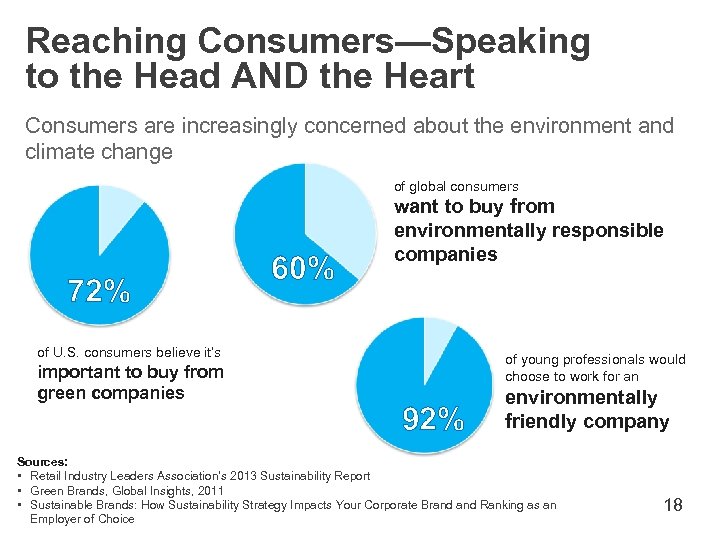
Reaching Consumers—Speaking to the Head AND the Heart Consumers are increasingly concerned about the environment and climate change of global consumers 72% 60% want to buy from environmentally responsible companies of U. S. consumers believe it’s important to buy from green companies of young professionals would choose to work for an 92% environmentally friendly company Sources: • Retail Industry Leaders Association’s 2013 Sustainability Report • Green Brands, Global Insights, 2011 • Sustainable Brands: How Sustainability Strategy Impacts Your Corporate Brand Ranking as an Employer of Choice 18
Change Consumer Behavior • Not just changing preferences—changing behavior • Educate consumer – Second price tag (life-cycle costs) – Environmental choice – Credible source – Tools/ advice/ unbiased information – Information at transaction points • Link to measurement/performance – Measured performance incents behavior change • Link to quality services 19
Clear Process for Setting/ Revising ENERGY STAR Specifications • Criteria weighed when developing or revising ENERGY STAR product specifications: – Significant energy (GHG) savings will be realized on a national basis – Product energy consumption and performance can be measured and verified with testing – Product performance will be maintained or enhanced – Purchasers of the product will recover any cost difference within a reasonable time period – Specifications do not unjustly favor any one technology – Labeling will effectively differentiate products to purchasers • Strive for top 25% of product models (not sales) but key criteria can trump that goal • Use a well-documented, transparent process 20
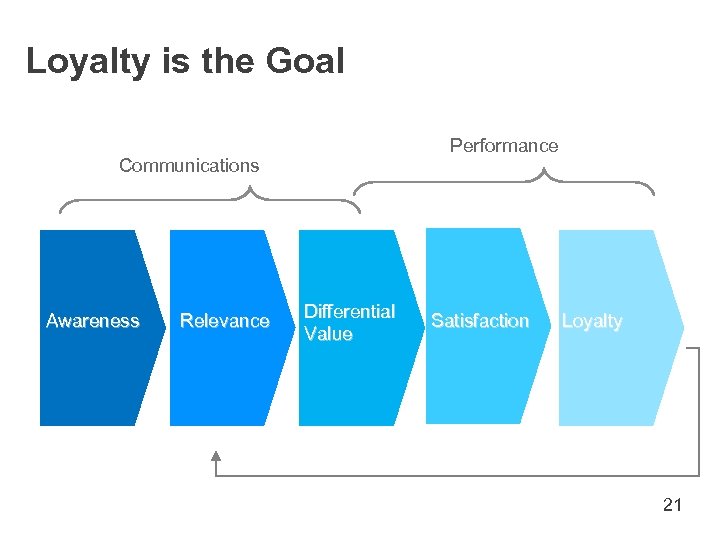
Loyalty is the Goal Performance Communications Awareness Relevance Differential Value Satisfaction Loyalty 21
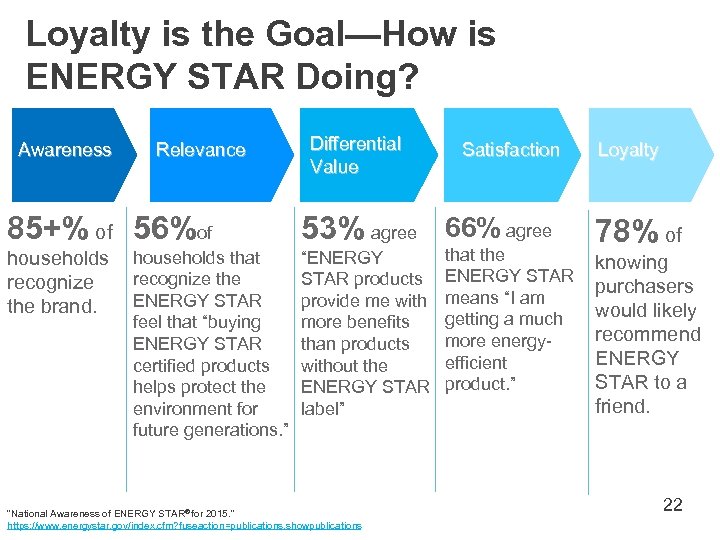
Loyalty is the Goal—How is ENERGY STAR Doing? Awareness Relevance Differential Value Satisfaction 85+% of 56%of 53% agree 66% agree households that recognize the recognize ENERGY STAR the brand. “ENERGY STAR products provide me with more benefits than products without the ENERGY STAR label” feel that “buying ENERGY STAR certified products helps protect the environment for future generations. ” “National Awareness of ENERGY STAR® for 2015. ” https: //www. energystar. gov/index. cfm? fuseaction=publications. showpublications that the ENERGY STAR means “I am getting a much more energyefficient product. ” Loyalty 78% of knowing purchasers would likely recommend ENERGY STAR to a friend. 22
Source: Fairfield Research, July 2009 23
Energy Efficiency Competitions
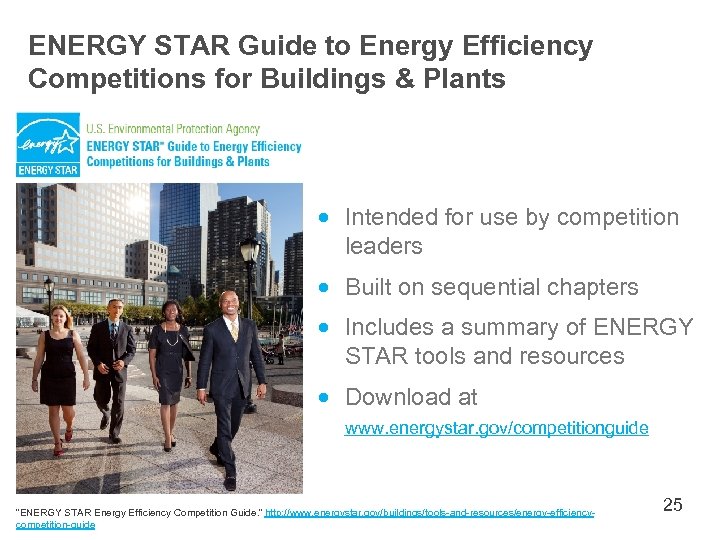
ENERGY STAR Guide to Energy Efficiency Competitions for Buildings & Plants · Intended for use by competition leaders · Built on sequential chapters · Includes a summary of ENERGY STAR tools and resources · Download at www. energystar. gov/competitionguide “ENERGY STAR Energy Efficiency Competition Guide. ” http: //www. energystar. gov/buildings/tools-and-resources/energy-efficiencycompetition-guide 25
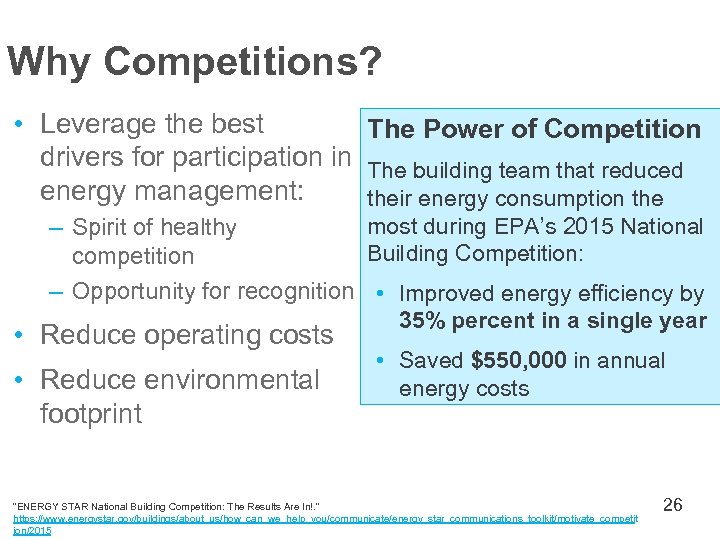
Why Competitions? • Leverage the best The Power of Competition drivers for participation in The building team that reduced energy management: their energy consumption the most during EPA’s 2015 National – Spirit of healthy Building Competition: competition – Opportunity for recognition • Improved energy efficiency by • Reduce operating costs • Reduce environmental footprint 35% percent in a single year • Saved $550, 000 in annual energy costs “ENERGY STAR National Building Competition: The Results Are In!. ” https: //www. energystar. gov/buildings/about_us/how_can_we_help_you/communicate/energy_star_communications_toolkit/motivate_competit ion/2015 26
Michigan Battle of the Buildings • Managed by USGBC – West Michigan Chapter and USGBC – Detroit Regional Chapter, in partnership with Consumers Energy, and DTE Energy • An energy management contest open to all Michigan commercial and industrial buildings (non-profits, multifamily, education, retail, campus, owners and tenants) • Awards based on greatest energy use reduction as benchmarked in Portfolio Manager for several categories, such as: • Entertainment, Education, Office, Medical, Public Buildings, Senior Living 27 “Michigan Battle of the Buildings. ” http: //www. michiganbattleofthebuildings. org/
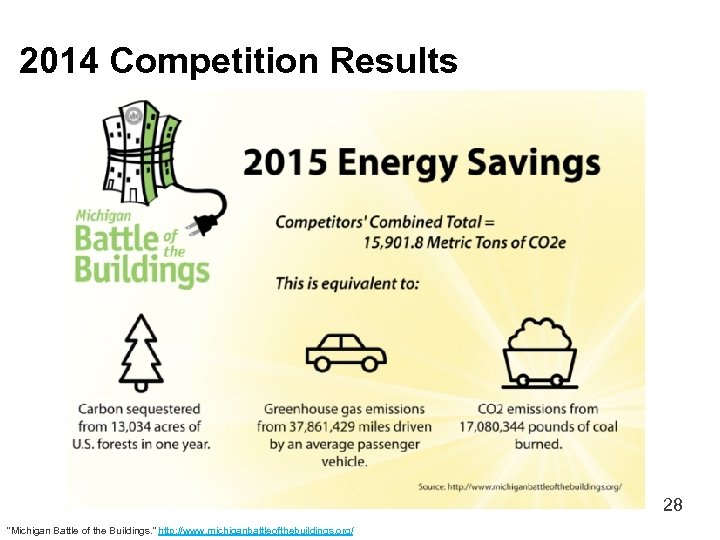
2014 Competition Results 28 “Michigan Battle of the Buildings. ” http: //www. michiganbattleofthebuildings. org/
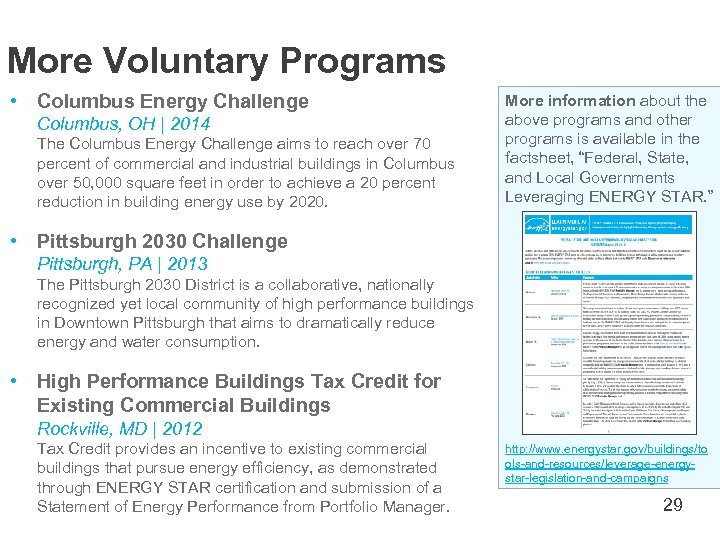
More Voluntary Programs • Columbus Energy Challenge Columbus, OH | 2014 The Columbus Energy Challenge aims to reach over 70 percent of commercial and industrial buildings in Columbus over 50, 000 square feet in order to achieve a 20 percent reduction in building energy use by 2020. More information about the above programs and other programs is available in the factsheet, “Federal, State, and Local Governments Leveraging ENERGY STAR. ” • Pittsburgh 2030 Challenge Pittsburgh, PA | 2013 The Pittsburgh 2030 District is a collaborative, nationally recognized yet local community of high performance buildings in Downtown Pittsburgh that aims to dramatically reduce energy and water consumption. • High Performance Buildings Tax Credit for Existing Commercial Buildings Rockville, MD | 2012 Tax Credit provides an incentive to existing commercial buildings that pursue energy efficiency, as demonstrated through ENERGY STAR certification and submission of a Statement of Energy Performance from Portfolio Manager. http: //www. energystar. gov/buildings/to ols-and-resources/leverage-energystar-legislation-and-campaigns 29
Who’s Improving Performance with ENERGY STAR? • Commercial Real Estate: CB Richard Ellis, Hines, Jones Lang La. Salle, USAA Realty, Transwestern) • Retail: JCPenney, Kohl’s, Target, Verizon Wireless, Food Lion, Stop & Shop • Hospitality: Marriott, Best Western, Wyndham • Healthcare: Sunrise Assisted Living, Providence Health, Inova Health System, NY Presbyterian • State and Local Government: California, New York City, Washington, DC, Louisville, Arlington County (VA) • K-12 Schools: New York City Schools, San Diego Schools, more than 75 Wisconsin school districts • Higher Education: University of New Hampshire, City University of New York, University of Michigan 30
Benchmarking — The First Step to Energy Savings in Buildings Benchmarking through ENERGY STAR allows a building owner/manager to: • Compare one building against a national sample of similar buildings • Compare all buildings of a similar type to each other • Set priorities for use of limited staff time and/or investment capital 31
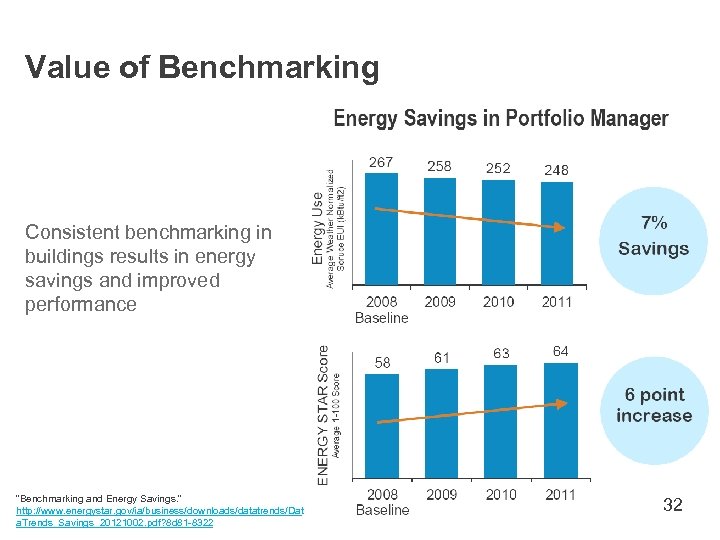
Value of Benchmarking Consistent benchmarking in buildings results in energy savings and improved performance “Benchmarking and Energy Savings. ” http: //www. energystar. gov/ia/business/downloads/datatrends/Dat a. Trends_Savings_20121002. pdf? 8 d 81 -8322 32
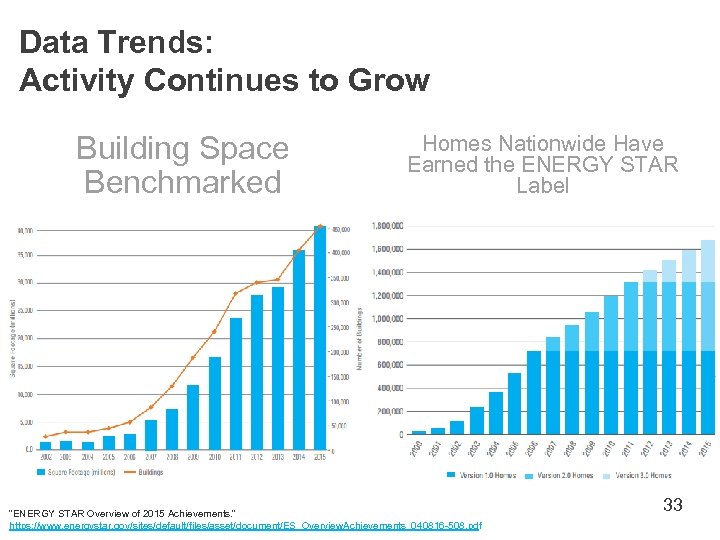
Data Trends: Activity Continues to Grow Building Space Benchmarked Homes Nationwide Have Earned the ENERGY STAR Label “ENERGY STAR Overview of 2015 Achievements. ” https: //www. energystar. gov/sites/default/files/asset/document/ES_Overview. Achievements_040816 -508. pdf 33
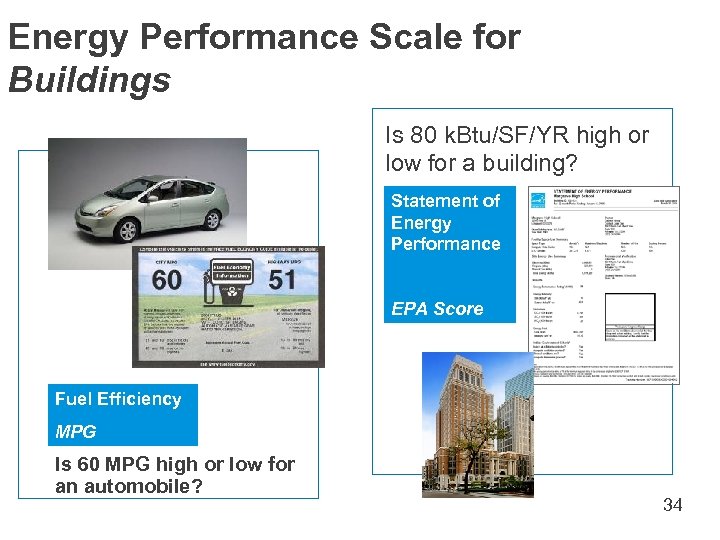
Energy Performance Scale for Buildings Is 80 k. Btu/SF/YR high or low for a building? Statement of Energy Performance EPA Score Fuel Efficiency MPG Is 60 MPG high or low for an automobile? 34
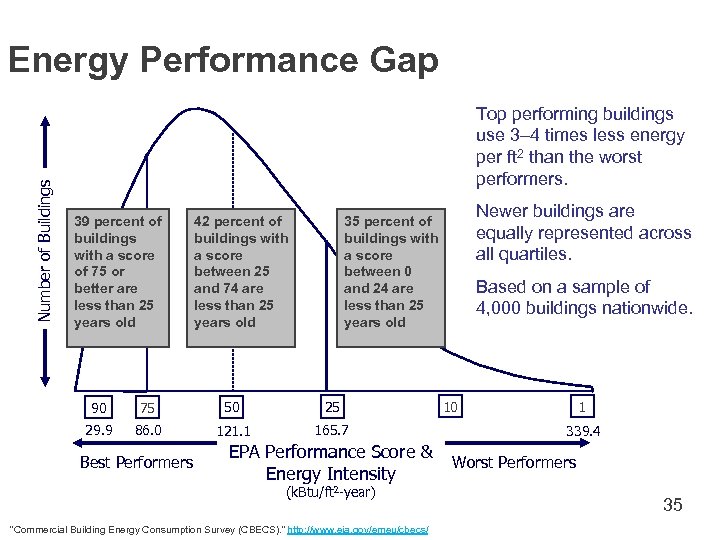
Number of Buildings Energy Performance Gap Top performing buildings use 3– 4 times less energy per ft 2 than the worst performers. 39 percent of buildings with a score of 75 or better are less than 25 years old 42 percent of buildings with a score between 25 and 74 are less than 25 years old 90 75 50 25 29. 9 86. 0 121. 1 165. 7 Best Performers Newer buildings are equally represented across all quartiles. 35 percent of buildings with a score between 0 and 24 are less than 25 years old EPA Performance Score & Energy Intensity (k. Btu/ft 2 -year) “Commercial Building Energy Consumption Survey (CBECS). ” http: //www. eia. gov/emeu/cbecs/ Based on a sample of 4, 000 buildings nationwide. 10 1 339. 4 Worst Performers 35
Technology ≠ Performance • 60 percent of building fan systems are oversized by an average of 60 percent – EPA fan study • Chillers oversized 50 percent to 200 percent – Lawrence Berkeley National Laboratory • Improper installation and poor maintenance NEXT: What can Portfolio Manager help us do? 36 “ENERGY STAR Building Upgrade Manual. ” http: //www. energystar. gov/ia/business/EPA_BUM_CH 8_Air. Dist. Systems. pdf
ENERGY STAR Portfolio Manager EPA’s no-cost energy, water, and waste measurement and tracking tool available at www. energystar. gov/benchmark • Assess the whole building energy use of existing buildings (weather normalized EUI) • Receive an energy performance score (1– 100 score) or comparison to national average • Track changes in energy and water use over time in single buildings, groups of buildings, or entire portfolios • Track CO 2 reductions and cost savings related to energy • Track 29 types of waste and materials • Consistency, transparency, and accountability 37
ENERGY STAR Portfolio Manager Upgrade New Features • Custom reporting and graphing features • Reports generate and download in real time • Over 1, 000 metrics available for download • Enhanced water use tracking (change from baseline per SF, %, total) • Updates to emissions and conversion factors • New and revised building import templates • Updated system for software providers to automatically push and pull data from Portfolio Manager • Waste and materials tracking 38
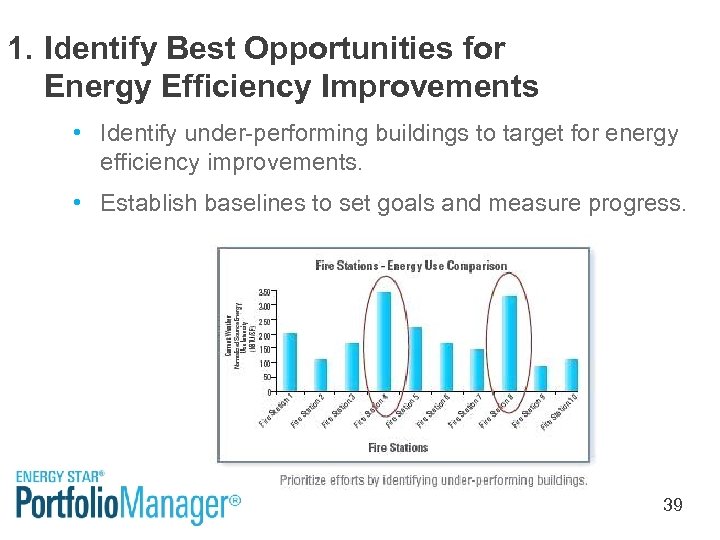
1. Identify Best Opportunities for Energy Efficiency Improvements • Identify under-performing buildings to target for energy efficiency improvements. • Establish baselines to set goals and measure progress. 39
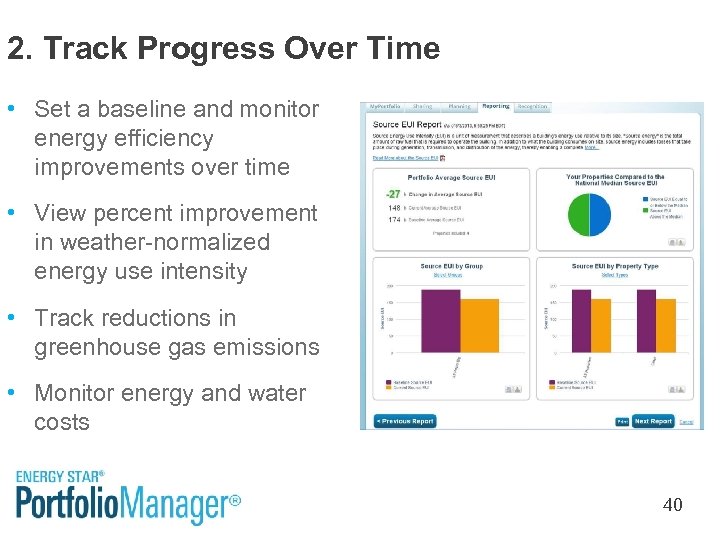
2. Track Progress Over Time • Set a baseline and monitor energy efficiency improvements over time • View percent improvement in weather-normalized energy use intensity • Track reductions in greenhouse gas emissions • Monitor energy and water costs 40
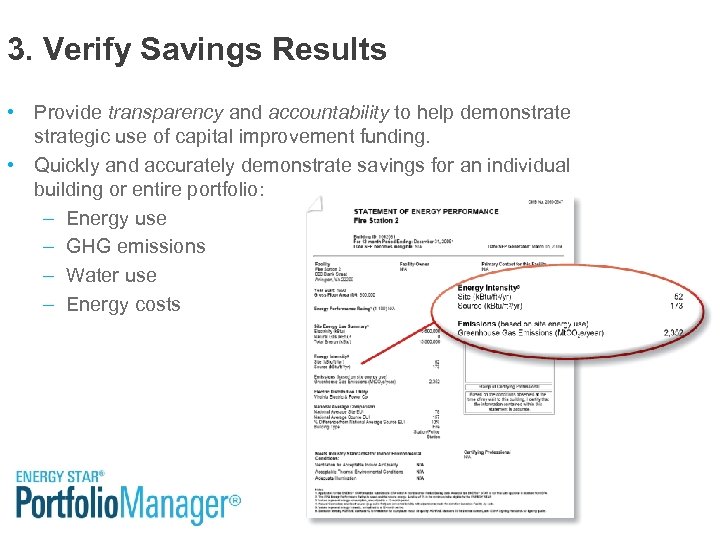
3. Verify Savings Results • Provide transparency and accountability to help demonstrategic use of capital improvement funding. • Quickly and accurately demonstrate savings for an individual building or entire portfolio: – Energy use – GHG emissions – Water use – Energy costs 41
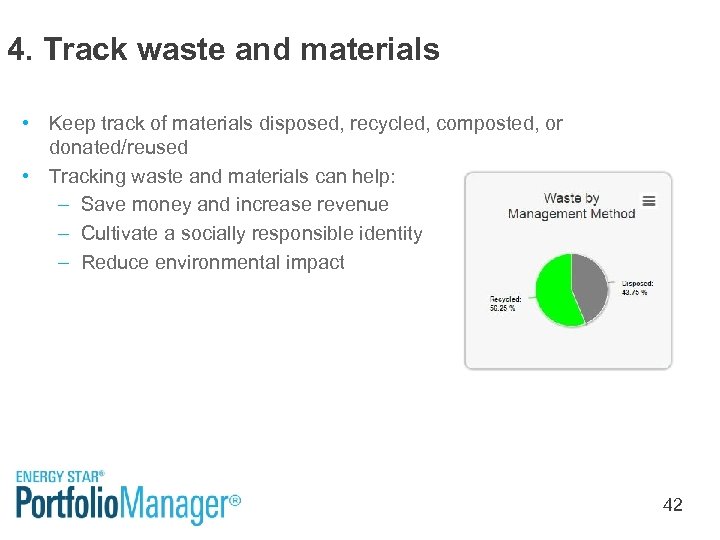
4. Track waste and materials • Keep track of materials disposed, recycled, composted, or donated/reused • Tracking waste and materials can help: – Save money and increase revenue – Cultivate a socially responsible identity – Reduce environmental impact 42
Custom Reporting • Demonstrate savings for an individual building or entire portfolio: – – – Whole building energy performance Improvements over a baseline GHG emissions Water use Energy costs Diversion rate • Create custom reports and collect benchmarking results from multiple PM users. – Create custom reports by choosing from key energy, environmental, and cost performance indicators – Download data in Excel, CSV, PDF, and XML formats – Streamlines the process of data collection when evaluating programmatic savings 43
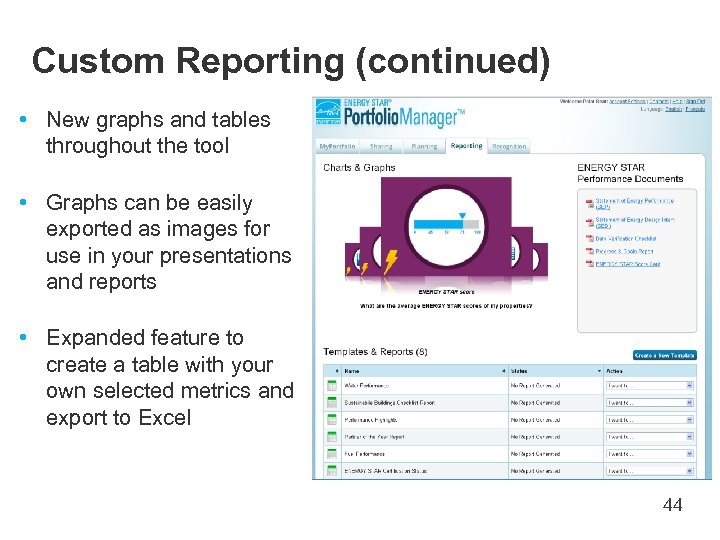
Custom Reporting (continued) • New graphs and tables throughout the tool • Graphs can be easily exported as images for use in your presentations and reports • Expanded feature to create a table with your own selected metrics and export to Excel 44
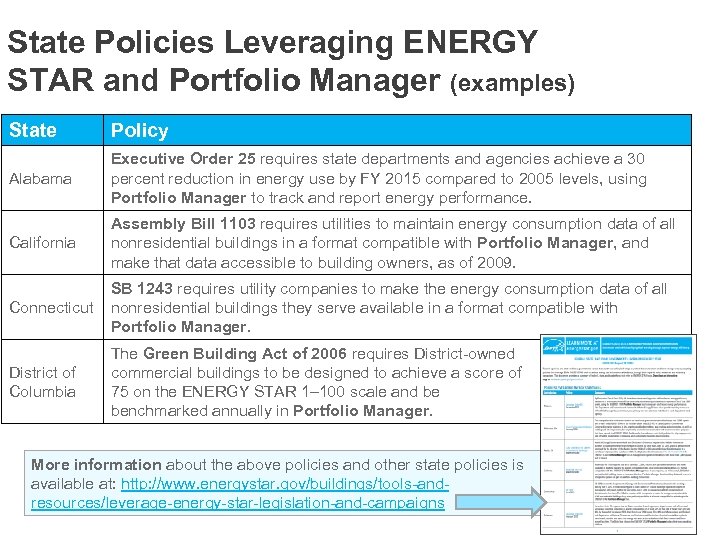
State Policies Leveraging ENERGY STAR and Portfolio Manager (examples) State Policy Alabama Executive Order 25 requires state departments and agencies achieve a 30 percent reduction in energy use by FY 2015 compared to 2005 levels, using Portfolio Manager to track and report energy performance. California Assembly Bill 1103 requires utilities to maintain energy consumption data of all nonresidential buildings in a format compatible with Portfolio Manager, and make that data accessible to building owners, as of 2009. Connecticut SB 1243 requires utility companies to make the energy consumption data of all nonresidential buildings they serve available in a format compatible with Portfolio Manager. District of Columbia The Green Building Act of 2006 requires District-owned commercial buildings to be designed to achieve a score of 75 on the ENERGY STAR 1– 100 scale and be benchmarked annually in Portfolio Manager. More information about the above policies and other state policies is available at: http: //www. energystar. gov/buildings/tools-andresources/leverage-energy-star-legislation-and-campaigns 45
Increasing Program Effectiveness
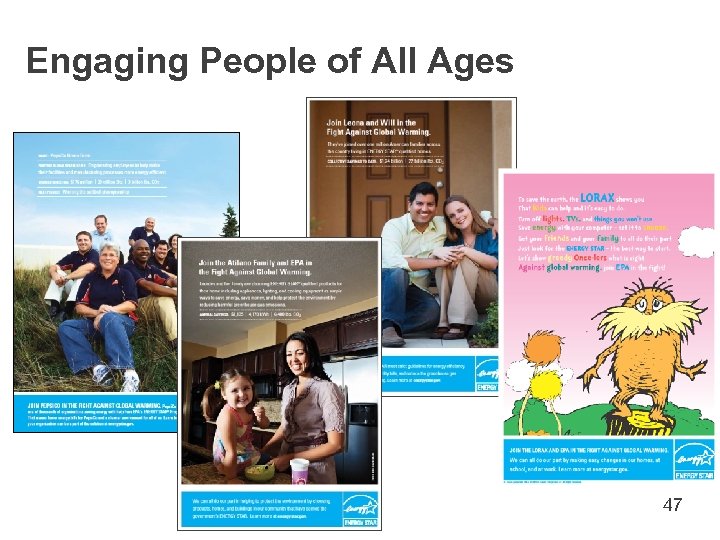
Engaging People of All Ages 47
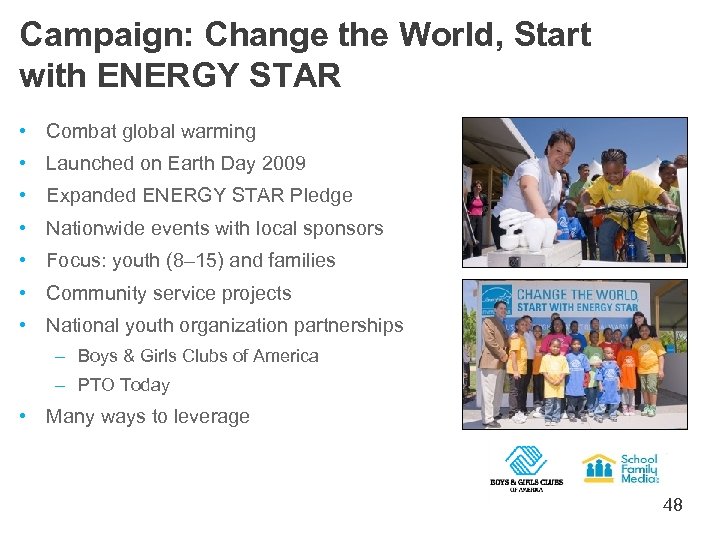
Campaign: Change the World, Start with ENERGY STAR • Combat global warming • Launched on Earth Day 2009 • Expanded ENERGY STAR Pledge • Nationwide events with local sponsors • Focus: youth (8– 15) and families • Community service projects • National youth organization partnerships – Boys & Girls Clubs of America – PTO Today • Many ways to leverage 48
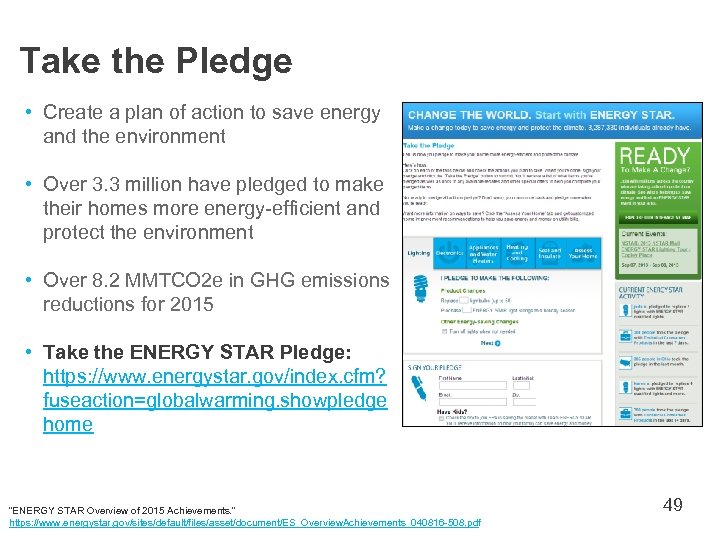
Take the Pledge • Create a plan of action to save energy and the environment • Over 3. 3 million have pledged to make their homes more energy-efficient and protect the environment • Over 8. 2 MMTCO 2 e in GHG emissions reductions for 2015 • Take the ENERGY STAR Pledge: https: //www. energystar. gov/index. cfm? fuseaction=globalwarming. showpledge home “ENERGY STAR Overview of 2015 Achievements. ” https: //www. energystar. gov/sites/default/files/asset/document/ES_Overview. Achievements_040816 -508. pdf 49
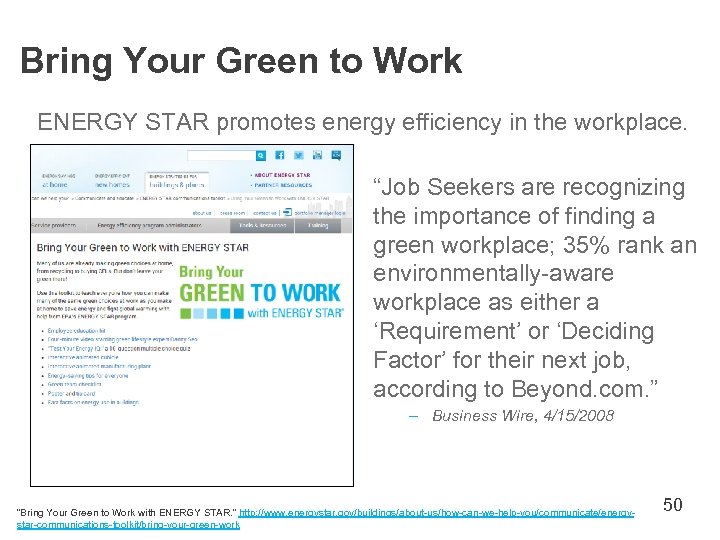
Bring Your Green to Work ENERGY STAR promotes energy efficiency in the workplace. “Job Seekers are recognizing the importance of finding a green workplace; 35% rank an environmentally-aware workplace as either a ‘Requirement’ or ‘Deciding Factor’ for their next job, according to Beyond. com. ” – Business Wire, 4/15/2008 “Bring Your Green to Work with ENERGY STAR. ” http: //www. energystar. gov/buildings/about-us/how-can-we-help-you/communicate/energystar-communications-toolkit/bring-your-green-work 50
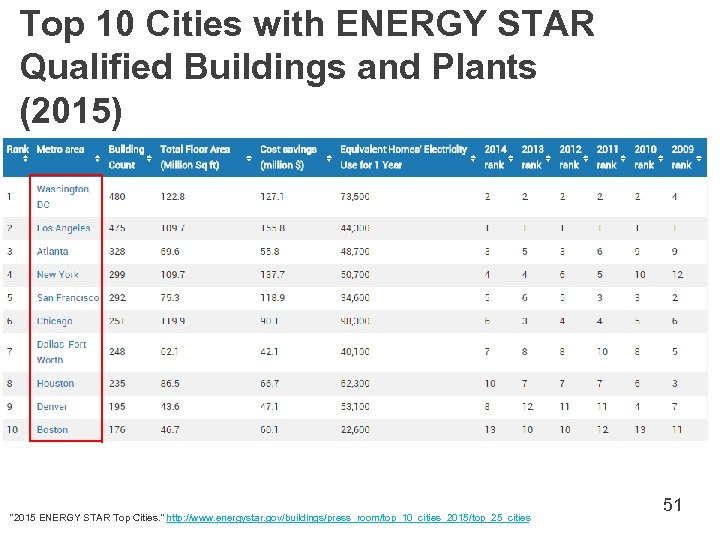
Top 10 Cities with ENERGY STAR Qualified Buildings and Plants (2015) “ 2015 ENERGY STAR Top Cities. ” http: //www. energystar. gov/buildings/press_room/top_10_cities_2015/top_25_cities 51

Review
Review Questions • Describe the purpose of the ENERGY STAR program. • Explain how the ENERGY STAR brand has influenced consumer decisions. • How can ENERGY STAR awareness among consumers help increase energy efficiency in the commercial marketplace? • How does the ENERGY STAR program help homeowners move beyond individual product purchasing decisions? What is Home Performance with ENERGY STAR? 53
Review Questions (continued) • Why does EPA use a “whole building” approach and evaluate total building energy use in the commercial market rather than focusing on equipment efficiency? • Explain the benefits of local and state energy benchmarking and disclosure requirements that utilize Portfolio Manager. 54
Up Next: Week 4 • ENERGY STAR for Commercial Buildings— Benchmarking Buildings and Prioritizing Improvements within a Portfolio of Buildings – Benchmark the energy use of a building using monthly energy bill and other required building data – Analyze and explain the benchmarking results to others in the class (and possibly the building owner/manager) using data from Portfolio Manager – Generate a Statement of Energy Performance and a Building Checklist from Portfolio Manager for a building and review the data to confirm its accuracy – Explain how to identify priority projects with a portfolio of buildings 55
Week 4 Readings • ENERGY STAR Guidelines for Energy Management http: //www. energystar. gov/index. cfm? c=gu idelines. guidelines_index • Benchmarking Starter Kit https: //www. energystar. gov/buildings/facilityowners-and-managers/existing-buildings/useportfolio-manager/get-started-benchmarking 56
Скачать презентацию Introduction to Commercial Building Energy Efficiency through EPA s
b1340991a231cf2313a456c4f8bb75aa.ppt